
SELLING EOPA IDENTIFY TYPES OF CUSTOMER PERSONALITIES Argumentative

- Slides: 21
SELLING -EOPA
IDENTIFY TYPES OF CUSTOMER PERSONALITIES • . Argumentative customers: Customers who seem to disagree, question, or look for errors in almost everything and everybody • 2. Complaining customers: Customers who believe everything is going wrong for them and everybody is either taking advantage of them or not really trying to help • 3. Difficult customers: Customers with problems that interfere with their ability to communicate satisfactorily or to function in a normal or pleasant manner • 4. Disagreeable customers: Customers who are unpleasant and hard to help • 5. Dishonest customers: Customers who intentionally attempt to avoid paying part or all of the price for a product • 6. Domineering/Superior customers: Overly confident customers who feel they know more and are better than the average person • 7. Impatient customers: Customers who feel they must be helped immediately, regardless of the circumstances
IDENTIFY TYPES OF CUSTOMER PERSONALITIES • 8. Indecisive customers: Customers who frequently have great difficulty in making a choice or a buying decision • 9. Insulting customers: Customers who intentionally make unpleasant remarks or use foul language • 10. Irritable/Moody customers: Customers who may be pleasant one day and touchy or unpredictable the next • 11. Leave-me-alone customers: Customers who prefer or pretend to prefer to be left alone to find what they want • 12. Slow/Methodical customers: Customers who require a lot of time to make a purchase because of indecisiveness • 13. Suspicious customers: Customers who doubt or question everything and may want facts and proof before being convinced something is true
EXPLAIN SALES TECHINQUES WHICH BUILD CUSTOMER LOYALITY. • 1. Set up ways to communicate with your customers-Frequent communication with your customers keeps you fresh in their minds and lets you pass along important information. • 2. Provide extra perks for your most loyal customers-One of the best—and perhaps one of the cheapest—ways to reward customer loyalty is to give extra perks to your most dependable customers. • 3. Consider different payment plans-There are some businesses out there that are very seasonal and run into cash flow issues during certain times of the year. • 4. Provide great customer service
BUILD CUSTOMER LOYALTY • 5. Don’t rely too much on technology-Even in our technologically advanced society filled with text messages and emails, we still want the ability to interact with other human beings. • 6. Offer a head start-If you want to start a customer loyalty program like coffee shops use, whereby customers buy a certain number of drinks to earn a free one, consider giving them a head start. • 7. Don’t forget to smile-This is another item that seems obvious, but it’s important enough to keep being reminded of. • 8. Give customers a reason to be loyal-Many people believe that Apple has some of the most loyal fans out there. Customers go to great lengths to prove just how much they love the company, with bumper stickers, tattoos, and vehement arguments in favor of all the products.
PROSPECT LIST • Why develop a Database? • Ensures easy storage, editing and retrieval of potential customer information • Helps in documenting prospect status, interests and other special events/actions • Better segmentation • Ability to manage complex marketing campaigns
PROSPECT LIST-BUILD • 1. Business Directories/Databases – Using simple filters you can sort and pull out contacts based on your target industry, SIC/ NAIC code, prospect title, geography, company size and more. Directories are priced mostly according to quality of source. • Purchased List – Lists can be readily procured through vendors or list brokers. It is highly advisable to beware of brokers who sell junk database containing bulk records. Consider following points before hiring any vendor: • Whether the list is targeted enough • Clear information about buyers, influencers and decision makers • If the list is current enough – up to date • Verification process followed while creating the database • Replacement policy of incorrect contacts
BUILD CONT. • 3. Events – Successful promotion of events at the right location in presence of target based prospects increases the chance of reaching out to more and more potential prospects. • 4. Newsletters – Properly and attractively composed newsletters results in increasing number of subscriptions thereby fetches more prospects. • 5. Opt-in Forms – Sign-up forms for blog can be a very good means of building opt-in email list. • 6. Website lead intelligence – Automation tools available in the market helps in analyzing traffic and determining web visitors. Prospective companies and contacts can be filtered out in this process. • 7. Referrals – It is one of the best ways in finding new prospects using some rewarding techniques. The referral system is more reliable than any other practices. • 8. In-house research and database development – In-house research and list development can be a costly affair but guarantees tailor made prospect list keeping in mind targeted requirements of sales.
MAINTAIN PROSPECT • Benefits of Prospect Database • Targeted prospect database breeds the process of achieving targeted marketing. Most database marketing campaigns are highly dependent on the quality of marketing lists. • It also helps in segmentation of contacts in various categories based on the user input and helps in removal of any unwanted contacts thereby cleaning up database simultaneously. • How to maintain Prospect Database • Database should be designed in such a way that we can organize data through proper segmentation. All data fields should be defined properly. Database is generally managed with the help of software such as MS Excel, CRM, marketing automations software, lead management software etc. Database should be validated, cleansed, protected and updated every quarter to maintain quality. The process of flagging records instead of deleting saves lots of money in the future. Unique reference numbers can be added to records to track them easily and efficiently.
REASONS FOR USING SALES QUOTAS • What is a Sales Quota? • A sales quota refers to a time-bound sales target set by management for a particular region, sales team, or individual rep. Sales quotas are often attached to a daily, monthly, or quarterly period. • Sales quotas can be measured in a number of different ways, including by profits, sales, or rep activity.
REASONS FOR SALES QUOTA • The Importance of Setting Sales Quotas • Not only do sales quotas play an important role in sales forecasting and monitoring rep activity, they also set expectations and motivate sales reps to hit a given level of activity. • Managers can also use sales quotas to learn more about their team’s productivity, success rate, and optimal sales processes. • Setting sales quotas allows you to: • Ensure compensation plans (including commissions) are fair and effective • Reveal weaknesses or bottlenecks in the sales pipeline • Highlight successful reps and replicate their sales techniques • Monitor and regulate selling expenses • Create achievable goals and benchmarks
PROBE FOR INFORMATION IN SALES SITUATION • Asking effective probing questions is critical to high sales performance. With the right questions, your salespeople can uncover the buyer’s needs and wants, as well as their budget and decision-making process. • Here’s what you need to know to help your reps develop and master critical questioning skills. • 1. Listen Actively and Deeply • Good questioning does not mean firing off a rapid series of questions to pry as much information out of the prospect as possible. Teach your reps to ask and then to listen without talking until the prospect has a chance to fully answer the question.
SALES SITUATION • Know When to Ask Which Questions • Prospects will be more willing to answer probing questions when the questions are timed well within the conversation. Teach your salespeople these 6 types of probing questions, as well as the appropriate timing for them. • Rapport-Building Questions • The most effective salespeople know how to read a buyer’s personality style within the first minute or two of meeting them. This information allows them to know what type of communication the buyer prefers, and whether they should open the conversation with rapport-building questions, or get straight to the intent of the meeting.
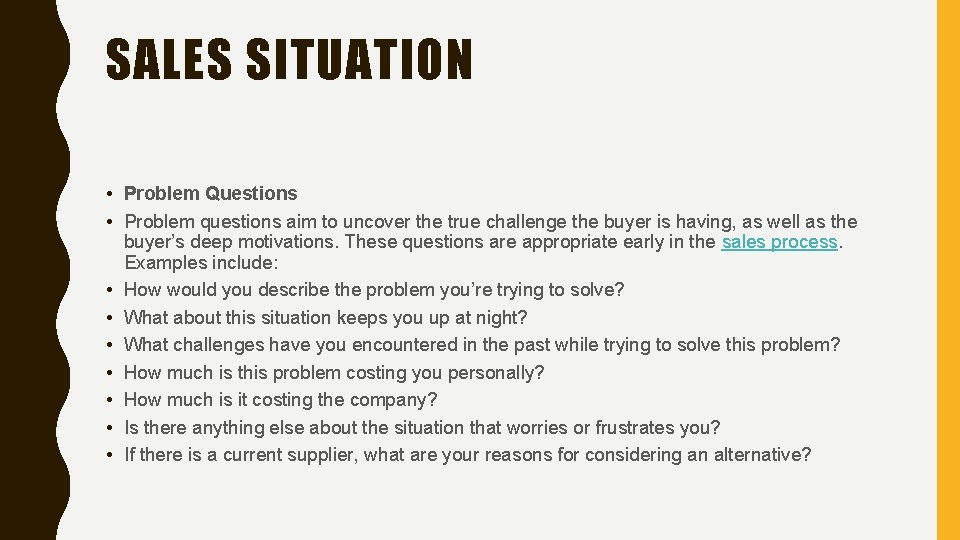
SALES SITUATION • Problem Questions • Problem questions aim to uncover the true challenge the buyer is having, as well as the buyer’s deep motivations. These questions are appropriate early in the sales process. Examples include: • How would you describe the problem you’re trying to solve? • What about this situation keeps you up at night? • What challenges have you encountered in the past while trying to solve this problem? • How much is this problem costing you personally? • How much is it costing the company? • Is there anything else about the situation that worries or frustrates you? • If there is a current supplier, what are your reasons for considering an alternative?
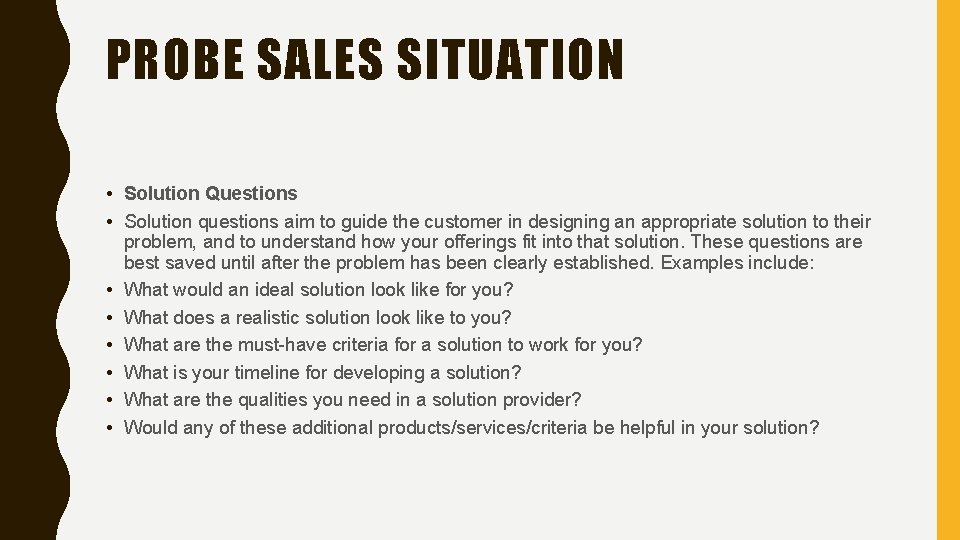
PROBE SALES SITUATION • Solution Questions • Solution questions aim to guide the customer in designing an appropriate solution to their problem, and to understand how your offerings fit into that solution. These questions are best saved until after the problem has been clearly established. Examples include: • What would an ideal solution look like for you? • What does a realistic solution look like to you? • What are the must-have criteria for a solution to work for you? • What is your timeline for developing a solution? • What are the qualities you need in a solution provider? • Would any of these additional products/services/criteria be helpful in your solution?
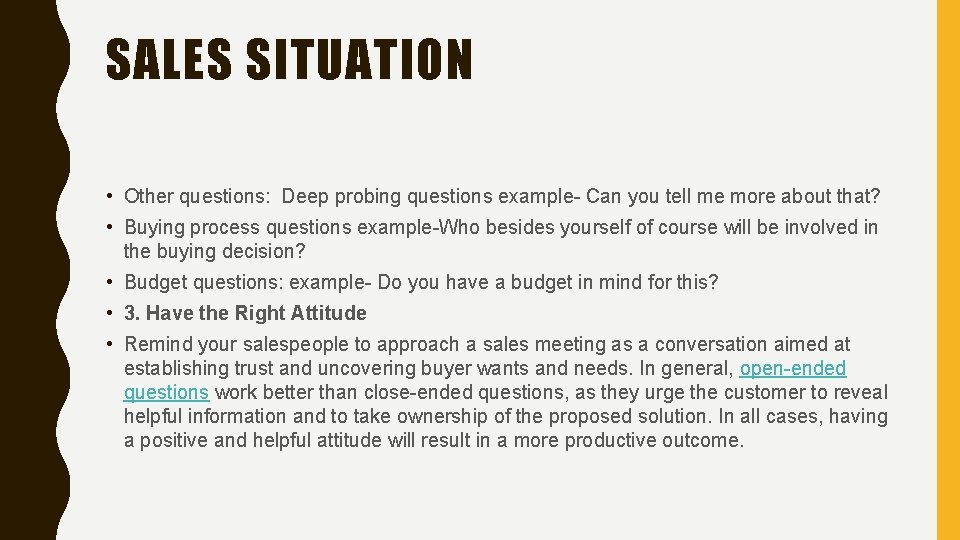
SALES SITUATION • Other questions: Deep probing questions example- Can you tell me more about that? • Buying process questions example-Who besides yourself of course will be involved in the buying decision? • Budget questions: example- Do you have a budget in mind for this? • 3. Have the Right Attitude • Remind your salespeople to approach a sales meeting as a conversation aimed at establishing trust and uncovering buyer wants and needs. In general, open-ended questions work better than close-ended questions, as they urge the customer to reveal helpful information and to take ownership of the proposed solution. In all cases, having a positive and helpful attitude will result in a more productive outcome.
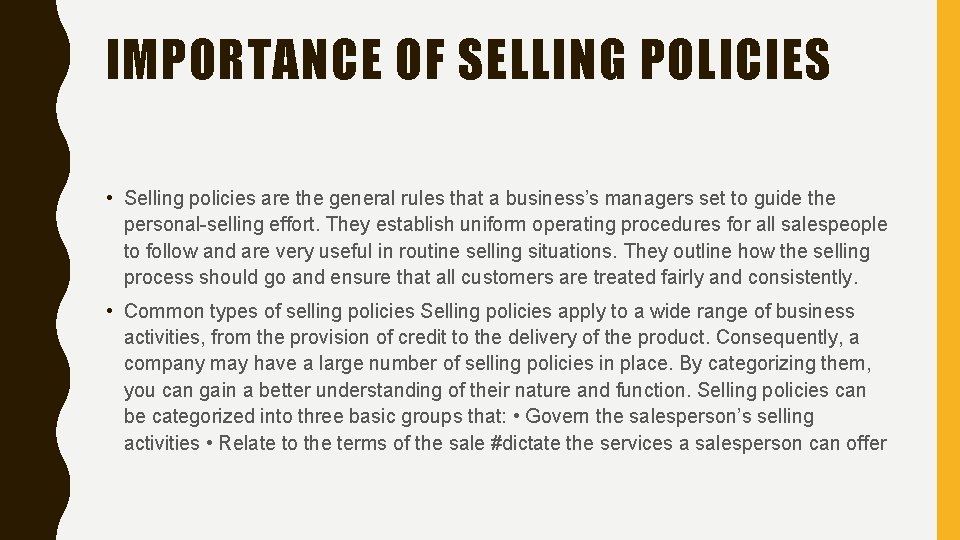
IMPORTANCE OF SELLING POLICIES • Selling policies are the general rules that a business’s managers set to guide the personal-selling effort. They establish uniform operating procedures for all salespeople to follow and are very useful in routine selling situations. They outline how the selling process should go and ensure that all customers are treated fairly and consistently. • Common types of selling policies Selling policies apply to a wide range of business activities, from the provision of credit to the delivery of the product. Consequently, a company may have a large number of selling policies in place. By categorizing them, you can gain a better understanding of their nature and function. Selling policies can be categorized into three basic groups that: • Govern the salesperson’s selling activities • Relate to the terms of the sale #dictate the services a salesperson can offer
SELLING POLICIES • Need for selling policies A business adopts selling policies to help meet its goals and increase profitability. Selling policies help to accomplish this by providing a framework in which to make appropriate decisions and establish good relationships with customers. These policies define the sales job for that particular business and ensure uniform action by salespeople. For example, going door to door selling cable and Internet services is a difficult job that requires aggressive sales techniques, while softdrink sales often are automatic, requiring less aggressive tactics by the salesperson. Selling policies benefit the salesperson, the company, and its customers. They can: • Prevent misunderstandings • Reduce confusion for employees • Keep salespeople from having to make decisions on their own • Make sure appropriate action is taken when necessary • Assure that customers receive fair and equal treatment
SELLING POLICIES • Salespeople may encounter difficulties when they are not knowledgeable of their company’s selling policies, are unable to explain the policies to a customer, or are asked to make an exception to a policy. For example, a salesperson who cannot explain his/her company’s delivery and installation policies is risking the sale. In an extreme case, poorly administered policies can force a company out of business. A company may offer prospective customers extremely liberal credit terms without checking their creditworthiness. If these customers do not pay, the company may have financial difficulties. To avoid some of these negative effects, managers should ensure that their selling policies do not: • Restrict the salesperson’s normal authority • Slow down the sales process • Restrict the salesperson with petty rules • Frustrate the salesperson and the customer • Give the customer the impression that the salesperson can act independently without considering what might be best for both the buyer and the seller
FACTORS WHICH DETERMINE SELLING POLICIES • Selling policies are influenced by many factors. These factors can be external, internal, or regulatory. External factors are those in the business environment over which the company has little or no control. Internal factors are those stemming from the limits of the organization and the goals the company seeks to achieve. Regulatory factors include federal and state antitrust and consumer regulations. Managers can take steps to reduce any negative effects of the selling policies they have established.
EXPLAIN THE IMPORTANCE OF SALES TRAINING • Helps develop you sales staff in areas of product, company policies, in the areas of customer service • Improve communications skills • Learning sales methodology • Over coming objections • Developing administrative skills