
Selfseeding effect of particle clusters for microfluidic crystallization
- Slides: 1
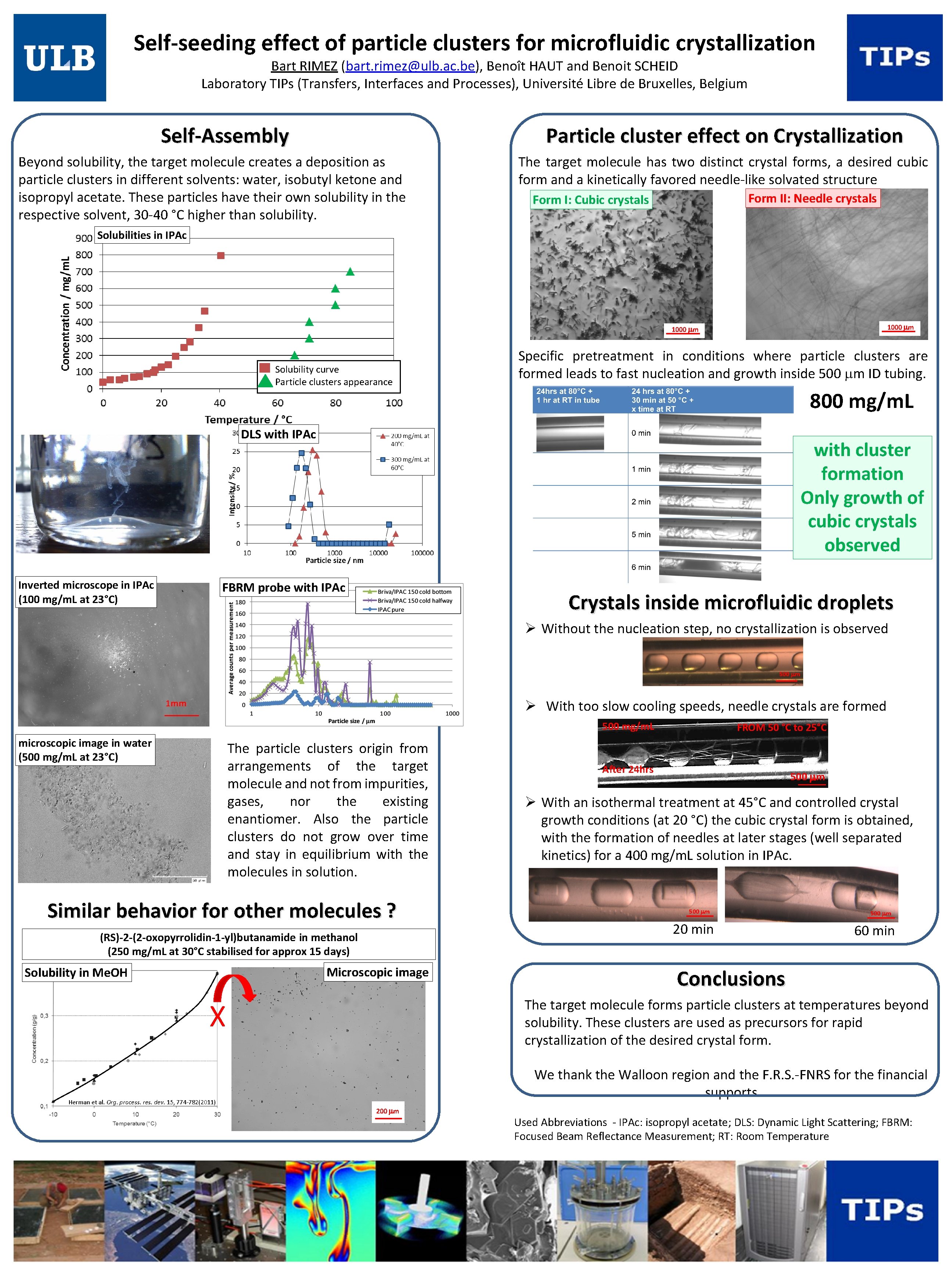
Self-seeding effect of particle clusters for microfluidic crystallization Bart RIMEZ (bart. rimez@ulb. ac. be), Benoît HAUT and Benoit SCHEID Laboratory TIPs (Transfers, Interfaces and Processes), Université Libre de Bruxelles, Belgium Self-Assembly Particle cluster effect on Crystallization Beyond solubility, the target molecule creates a deposition as particle clusters in different solvents: water, isobutyl ketone and isopropyl acetate. These particles have their own solubility in the respective solvent, 30 -40 °C higher than solubility. The target molecule has two distinct crystal forms, a desired cubic form and a kinetically favored needle-like solvated structure Form II: Needle crystals Form I: Cubic crystals Solubilities in IPAc 1000 mm Solubility curve Particle clusters appearance Specific pretreatment in conditions where particle clusters are formed leads to fast nucleation and growth inside 500 mm ID tubing. 800 mg/m. L DLS with IPAc Inverted microscope in IPAc (100 mg/m. L at 23°C) with cluster formation Only growth of cubic crystals observed FBRM probe with IPAc Crystals inside microfluidic droplets Ø Without the nucleation step, no crystallization is observed 500 mm Ø With too slow cooling speeds, needle crystals are formed 500 mg/m. L microscopic image in water (500 mg/m. L at 23°C) The particle clusters origin from arrangements of the target molecule and not from impurities, gases, nor the existing enantiomer. Also the particle clusters do not grow over time and stay in equilibrium with the molecules in solution. Similar behavior for other molecules ? (RS)-2 -(2 -oxopyrrolidin-1 -yl)butanamide in methanol (250 mg/m. L at 30°C stabilised for approx 15 days) Microscopic image Solubility in Me. OH After 24 hrs 500 mm Ø With an isothermal treatment at 45°C and controlled crystal growth conditions (at 20 °C) the cubic crystal form is obtained, with the formation of needles at later stages (well separated kinetics) for a 400 mg/m. L solution in IPAc. 500 mm 20 min 500 mm 60 min Conclusions The target molecule forms particle clusters at temperatures beyond solubility. These clusters are used as precursors for rapid crystallization of the desired crystal form. X Herman et al. Org. process. res. dev. 15, 774 -782(2011) FROM 50 °C to 25°C We thank the Walloon region and the F. R. S. -FNRS for the financial supports. 200 mm Used Abbreviations - IPAc: isopropyl acetate; DLS: Dynamic Light Scattering; FBRM: Focused Beam Reflectance Measurement; RT: Room Temperature