
SelfReport and Medication Possession Ratio are Accurate Measures
- Slides: 14
Self-Report and Medication Possession Ratio are Accurate Measures of HIV Pre-Exposure Prophylaxis Use in a Real-World Clinical Setting Rupa R. Patel 1, Laura C. Harrison 1, Albert Y. Liu 2, Philip A. Chan 3, Rachel Presti 1, Peter L. Anderson 4, Kenneth H. Mayer 5, Sujata Patil 6, William Powderly 1, K. Rivet Amico 7 1 Washington University in St. Louis, 2 San Francisco Department of Public Health, 3 The Miriam Hospital, 4 University of Colorado, 5 Fenway Institute, 6 Memorial Sloan Kettering, 7 University of Michigan
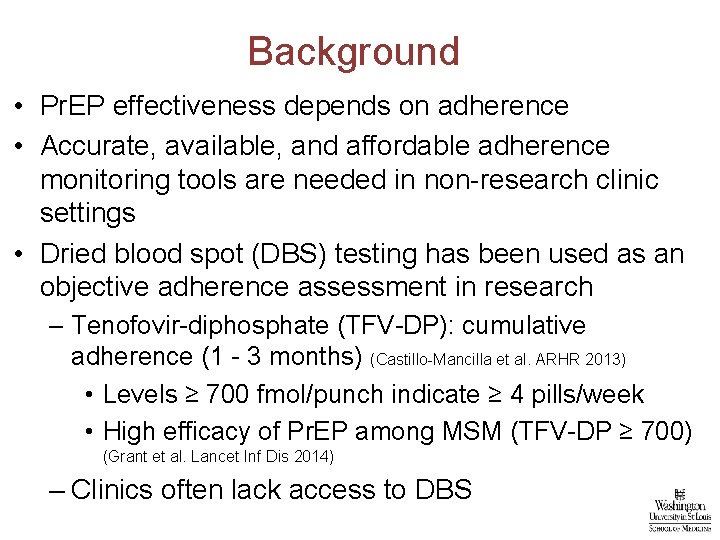
Background • Pr. EP effectiveness depends on adherence • Accurate, available, and affordable adherence monitoring tools are needed in non-research clinic settings • Dried blood spot (DBS) testing has been used as an objective adherence assessment in research – Tenofovir-diphosphate (TFV-DP): cumulative adherence (1 - 3 months) (Castillo-Mancilla et al. ARHR 2013) • Levels ≥ 700 fmol/punch indicate ≥ 4 pills/week • High efficacy of Pr. EP among MSM (TFV-DP ≥ 700) (Grant et al. Lancet Inf Dis 2014) – Clinics often lack access to DBS
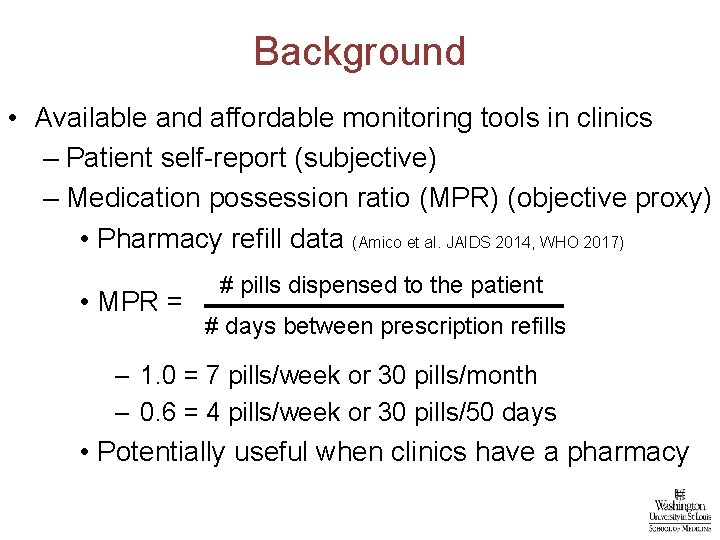
Background • Available and affordable monitoring tools in clinics – Patient self-report (subjective) – Medication possession ratio (MPR) (objective proxy) • Pharmacy refill data (Amico et al. JAIDS 2014, WHO 2017) • MPR = # pills dispensed to the patient # days between prescription refills – 1. 0 = 7 pills/week or 30 pills/month – 0. 6 = 4 pills/week or 30 pills/50 days • Potentially useful when clinics have a pharmacy
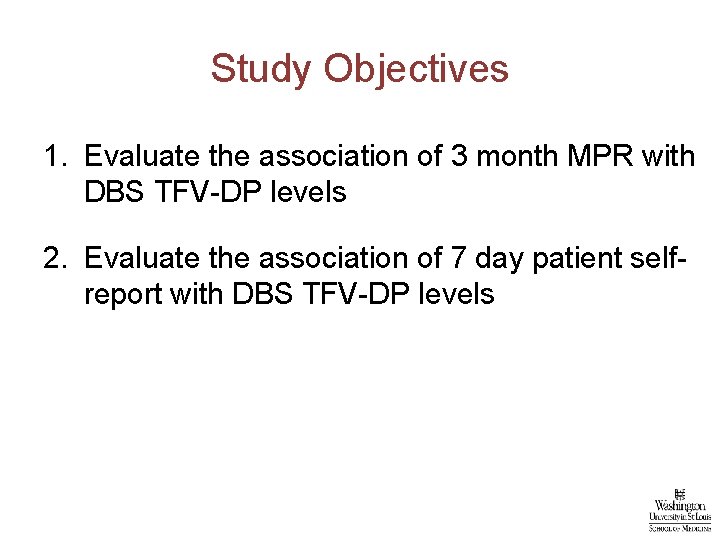
Study Objectives 1. Evaluate the association of 3 month MPR with DBS TFV-DP levels 2. Evaluate the association of 7 day patient selfreport with DBS TFV-DP levels
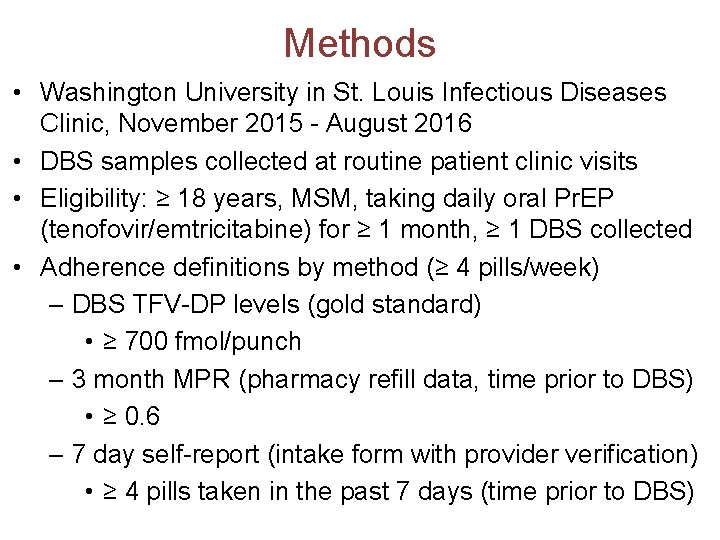
Methods • Washington University in St. Louis Infectious Diseases Clinic, November 2015 - August 2016 • DBS samples collected at routine patient clinic visits • Eligibility: ≥ 18 years, MSM, taking daily oral Pr. EP (tenofovir/emtricitabine) for ≥ 1 month, ≥ 1 DBS collected • Adherence definitions by method (≥ 4 pills/week) – DBS TFV-DP levels (gold standard) • ≥ 700 fmol/punch – 3 month MPR (pharmacy refill data, time prior to DBS) • ≥ 0. 6 – 7 day self-report (intake form with provider verification) • ≥ 4 pills taken in the past 7 days (time prior to DBS)
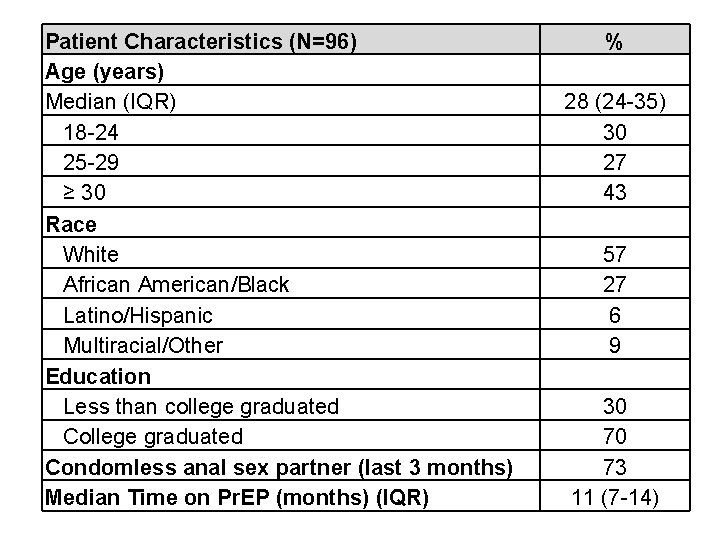
Patient Characteristics (N=96) Age (years) Median (IQR) 18 -24 25 -29 ≥ 30 Race White African American/Black Latino/Hispanic Multiracial/Other Education Less than college graduated Condomless anal sex partner (last 3 months) Median Time on Pr. EP (months) (IQR) % 28 (24 -35) 30 27 43 57 27 6 9 30 70 73 11 (7 -14)
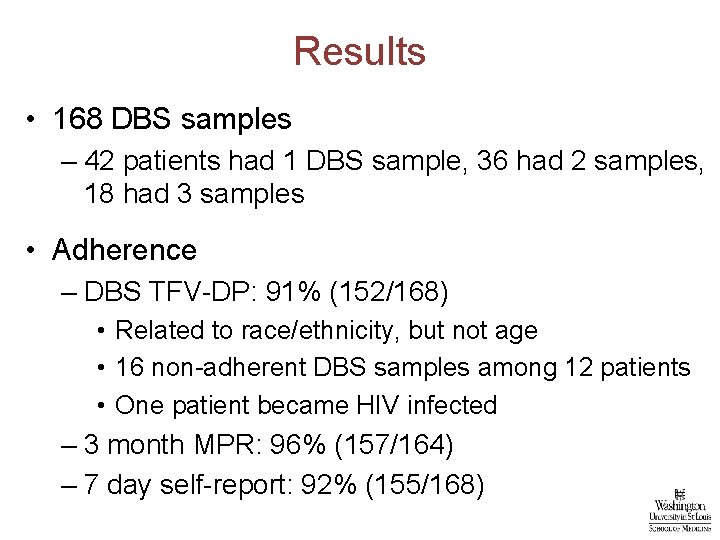
Results • 168 DBS samples – 42 patients had 1 DBS sample, 36 had 2 samples, 18 had 3 samples • Adherence – DBS TFV-DP: 91% (152/168) • Related to race/ethnicity, but not age • 16 non-adherent DBS samples among 12 patients • One patient became HIV infected – 3 month MPR: 96% (157/164) – 7 day self-report: 92% (155/168)
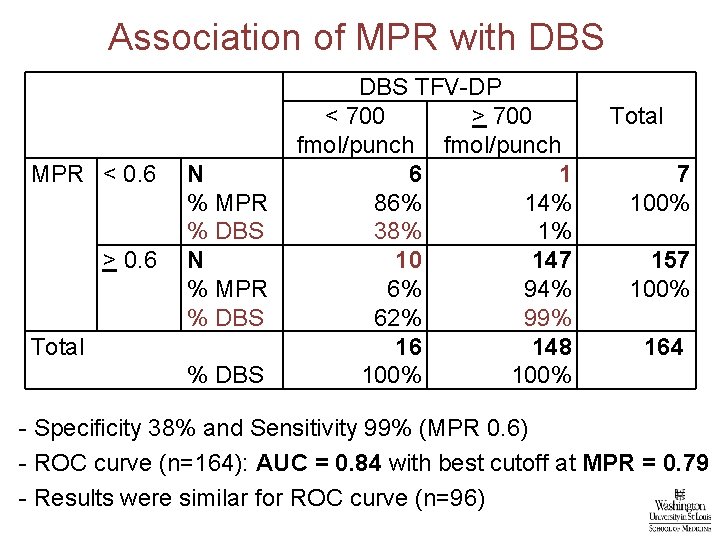
Association of MPR with DBS MPR < 0. 6 > 0. 6 N % MPR % DBS Total % DBS TFV-DP < 700 > 700 fmol/punch 6 1 86% 14% 38% 1% 10 147 6% 94% 62% 99% 16 148 100% Total 7 100% 157 100% 164 - Specificity 38% and Sensitivity 99% (MPR 0. 6) - ROC curve (n=164): AUC = 0. 84 with best cutoff at MPR = 0. 79 - Results were similar for ROC curve (n=96)
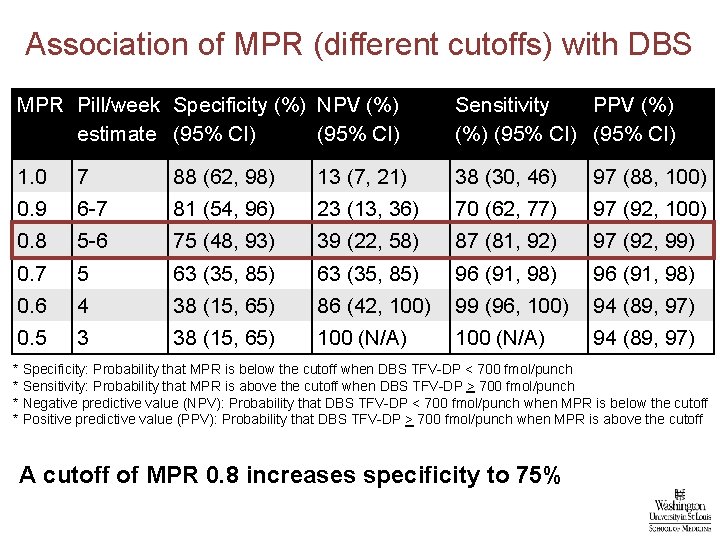
Association of MPR (different cutoffs) with DBS MPR Pill/week Specificity (%) NPV (%) estimate (95% CI) Sensitivity PPV (%) (95% CI) 1. 0 7 88 (62, 98) 13 (7, 21) 38 (30, 46) 97 (88, 100) 0. 9 6 -7 81 (54, 96) 23 (13, 36) 70 (62, 77) 97 (92, 100) 0. 8 5 -6 75 (48, 93) 39 (22, 58) 87 (81, 92) 97 (92, 99) 0. 7 5 63 (35, 85) 96 (91, 98) 0. 6 4 38 (15, 65) 86 (42, 100) 99 (96, 100) 94 (89, 97) 0. 5 3 38 (15, 65) 100 (N/A) 94 (89, 97) * Specificity: Probability that MPR is below the cutoff when DBS TFV-DP < 700 fmol/punch * Sensitivity: Probability that MPR is above the cutoff when DBS TFV-DP > 700 fmol/punch * Negative predictive value (NPV): Probability that DBS TFV-DP < 700 fmol/punch when MPR is below the cutoff * Positive predictive value (PPV): Probability that DBS TFV-DP > 700 fmol/punch when MPR is above the cutoff A cutoff of MPR 0. 8 increases specificity to 75%
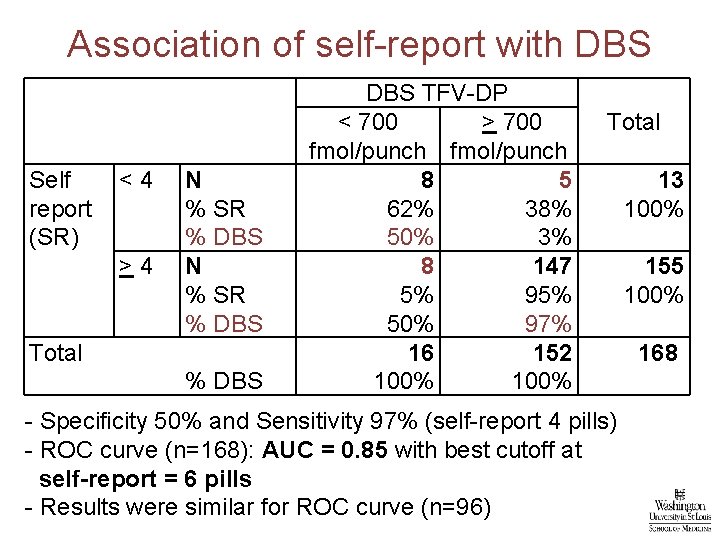
Association of self-report with DBS Self report (SR) <4 >4 N % SR % DBS Total % DBS TFV-DP < 700 > 700 fmol/punch 8 5 62% 38% 50% 3% 8 147 5% 95% 50% 97% 16 152 100% Total - Specificity 50% and Sensitivity 97% (self-report 4 pills) - ROC curve (n=168): AUC = 0. 85 with best cutoff at self-report = 6 pills - Results were similar for ROC curve (n=96) 13 100% 155 100% 168
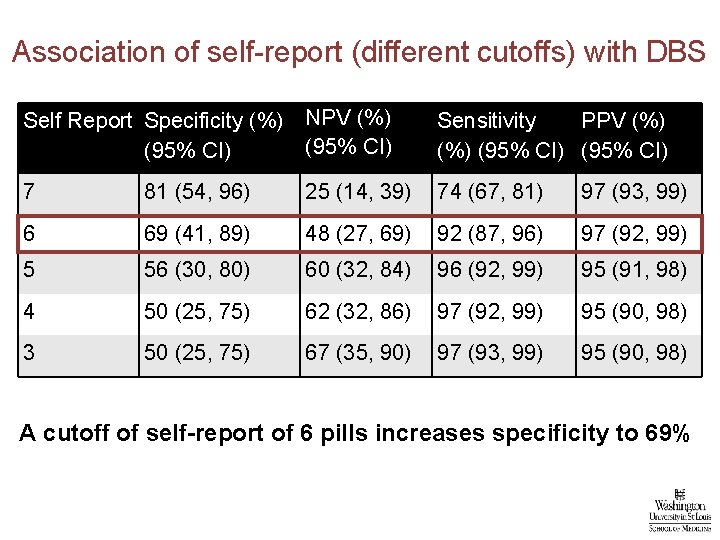
Association of self-report (different cutoffs) with DBS Self Report Specificity (%) NPV (%) (95% CI) Sensitivity PPV (%) (95% CI) 7 81 (54, 96) 25 (14, 39) 74 (67, 81) 97 (93, 99) 6 69 (41, 89) 48 (27, 69) 92 (87, 96) 97 (92, 99) 5 56 (30, 80) 60 (32, 84) 96 (92, 99) 95 (91, 98) 4 50 (25, 75) 62 (32, 86) 97 (92, 99) 95 (90, 98) 3 50 (25, 75) 67 (35, 90) 97 (93, 99) 95 (90, 98) A cutoff of self-report of 6 pills increases specificity to 69%
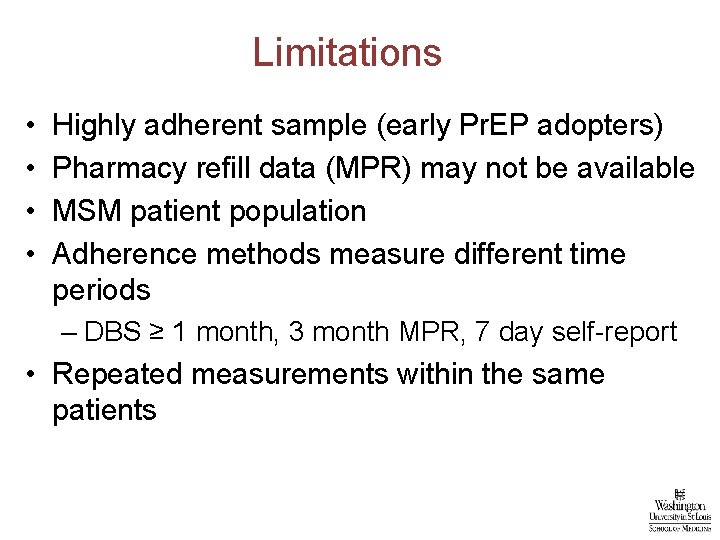
Limitations • • Highly adherent sample (early Pr. EP adopters) Pharmacy refill data (MPR) may not be available MSM patient population Adherence methods measure different time periods – DBS ≥ 1 month, 3 month MPR, 7 day self-report • Repeated measurements within the same patients
Conclusions • There was high adherence in this sample via three measures (DBS TFV-DP, MPR, self-report) • There was good concordance of MPR and self-report with DBS despite different time windows • In this sample, optimally performing cutoffs were: – Prior 3 month MPR of 0. 8 – Report of taking 6 pills in the past week • Larger studies with non-adherent patients are needed to further define cutoffs • MPR and self-report are potentially accurate adherence monitoring tools for clinical practice
Acknowledgements • Washington University in St. Louis Infectious Diseases Clinic Patients and Staff • Washington University in St. Louis ACTU Staff • Washington University in St. Louis Pr. EP Program Research Team • Community Partners • Gateway Apothecary Pharmacy Staff