
SELFREGULATED STRATEGY DEVELOPMENT IN WRITING TE 848 730
- Slides: 26
SELF-REGULATED STRATEGY DEVELOPMENT IN WRITING TE 848 - 730 Summer 2013 Sarah (Sparks) Bowen
RATIONALE National Assessment of Educational Progress Studies Show: � In 2011, only 27% of 12 th grade students achieved a proficient writing score & only 45% of students met the SAT writing benchmark proficiency. � Only one out of every 5 high school seniors are currently obtaining the required writing knowledge and skills for their grade level � Only 23% of 4 th graders, 26% of 8 th graders, and 22% of 12 th graders performed at or above grade level in writing (Santangelo, Harris, Graham, 2008, Harris, Graham, Mason, 2006, Graham, Harris 2005, Troia, Graham, 2003)
RATIONALE Struggling writers tend to have a difficult time: � � � Determining what qualifies as good writing Utilizing an effective writing approach/following the writing process Using graphic organizers/planning out writing assignments and providing enough details on their plan Spending a sufficient amount of time on the revising process Summarizing information Transferring ideas between drafts /transcription skills Struggling writers often focus simply on producing content known as “knowledge-telling. ” (Santangelo, Harris, Graham, 2008, Graham, Mc. Arthur, Fitzgerald , 2007, Frey, Fisher, Hernandez, 2003)
WHAT IS SRSD? SRSD is “ a writing strategies instruction approach developed over the past 2 decades which brings together powerful strategies for writing and critical strategies for self-regulation of the writing process, has been used in the elementary through high school grades” (Harris et. al, 2008). Process of goal setting and improving students’ writing skills (Schunk, 1990) “The ultimate goal of SRSD is to have students successfully apply strategies over time and in new situations” (Santangelo, Harris, & Graham, S 2008) Based on 6 principles: 1. 2. 3. 4. 5. 6. Develop background knowledge Discuss it! Model it! Memorize it! Support it! Independent performance (Graham, Mc. Arthur, & Fitzgerald , 2007, Harris et. al, 2008, Graham, Harris, Mc. Arthur, 2006)
SRSD VS. WRITERS WORKSHOP? Similarities: � � Emphasis on the writing process Practice frequent writing Encourage student decision making and interactions with peers Share work with teacher and peers Differences: SRSD is more explicit, systematic, and lengthier process. Focuses more on the written project with less drafting stages. � Writers’ workshop is a more student-centered approach than SRSD with multiple drafts � � “In comparison with children in the Writers’ Workshop condition, SRSDinstructed students were more knowledgeable about writing and evidenced stronger performance in the two instructed genres (story and persuasive writing) as well as two uninstructed genres (personal narrative and informative writing)” (Harris, Graham, Mason, 2006) (Harris, Graham, Mason, 2006, Lienermann, Reid, 2006)
REVIEW OF RESEARCH Over 40 studies have been conducted which show SRSD increases students: � � � Ability to brainstorm and organize their ideas Quality of writing Ability to edit and revise their work Motivation/level of engagement Ability to self-regulate and monitor their own writing progress through goal setting (Santangelo, Harris, Graham, 2008 , Harris et. al, 2008, Harris, Graham, Mason, 2006, Troia, Graham, 2003) “Helps students gain greater awareness of their writing strengths and limitations and consequently be more strategic in their attempts to accomplish writing tasks” (Troia, Graham, 2003)
REVIEW OF RESEARCH CONT. Developed to build students behavior, knowledge, and motivation towards writing. Instruction is targeted towards building students planning, writing, and persuasive essay skills. Helps students monitor their own writing. Students learn goal setting, self monitoring, and self instruction (Harris, K. , Graham, S. , & Mason, L, 2006, Troia, G. , & Graham, S. 2003)
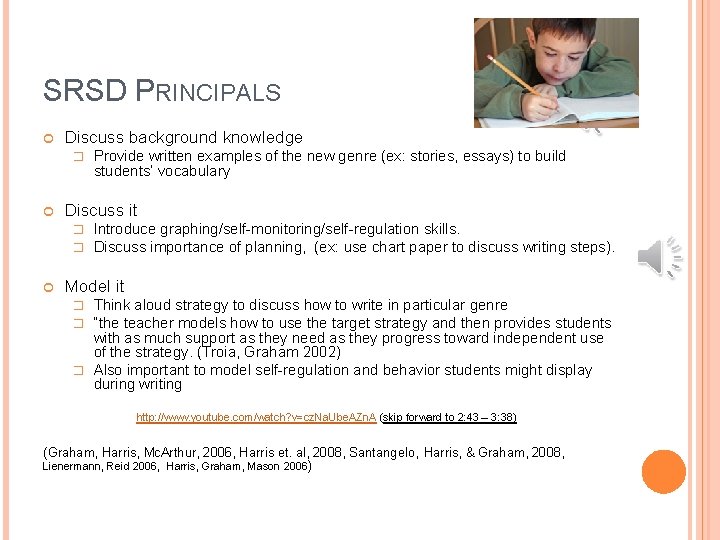
SRSD PRINCIPALS Discuss background knowledge � Discuss it � � Provide written examples of the new genre (ex: stories, essays) to build students’ vocabulary Introduce graphing/self-monitoring/self-regulation skills. Discuss importance of planning, (ex: use chart paper to discuss writing steps). Model it Think aloud strategy to discuss how to write in particular genre “the teacher models how to use the target strategy and then provides students with as much support as they need as they progress toward independent use of the strategy. (Troia, Graham 2002) � Also important to model self-regulation and behavior students might display during writing � � http: //www. youtube. com/watch? v=cz. Na. Ube. AZn. A (skip forward to 2: 43 – 3: 38) (Graham, Harris, Mc. Arthur, 2006, Harris et. al, 2008, Santangelo, Harris, & Graham, 2008, Lienermann, Reid 2006, Harris, Graham, Mason 2006)
SRSD PRINCIPALS CONT. Memorize it � Support it � � Homework- memorize the steps, explain steps and use mnemonics/songs Collaborate with struggling students Reflect on initial goals to determine if students’ mastered goals Independent performance Struggling learners will take more time/require more guidance on this step during the first writing assignment of the new genre � For those students who have mastered this step students can revise their work to meet goals. � Teacher modeling the steps of SRSD (Additional Resource): http: //www. youtube. com/watch? v=4 -z. VG 38 k. Bc. U (Graham, Harris, Mc. Arthur, 2006, Harris et. al, 2008, Santangelo, Harris, & Graham, 2008, Lienermann, Reid 2006, Harris, Graham, Mason 2006)
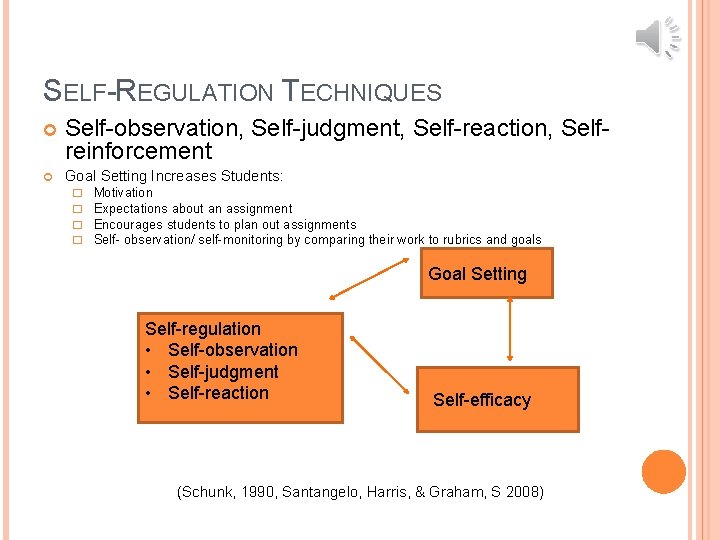
SELF-REGULATION TECHNIQUES Self-observation, Self-judgment, Self-reaction, Selfreinforcement Goal Setting Increases Students: � � Motivation Expectations about an assignment Encourages students to plan out assignments Self- observation/ self-monitoring by comparing their work to rubrics and goals Goal Setting Self-regulation • Self-observation • Self-judgment • Self-reaction Self-efficacy (Schunk, 1990, Santangelo, Harris, & Graham, S 2008)
HOW TO MONITOR AND EVALUATE SRSD? Collaborative between teacher & student Make it multidimensional Evaluate if students are beginning to spend more time on the writing process � Evaluate if their motivation and perception of the writing process has changed � On-going and continuous evaluations � � Helps monitor struggling students Allows teachers to reflect after each lesson Focus on how students use each strategy (Santangelo, Harris, & Graham, S 2008)
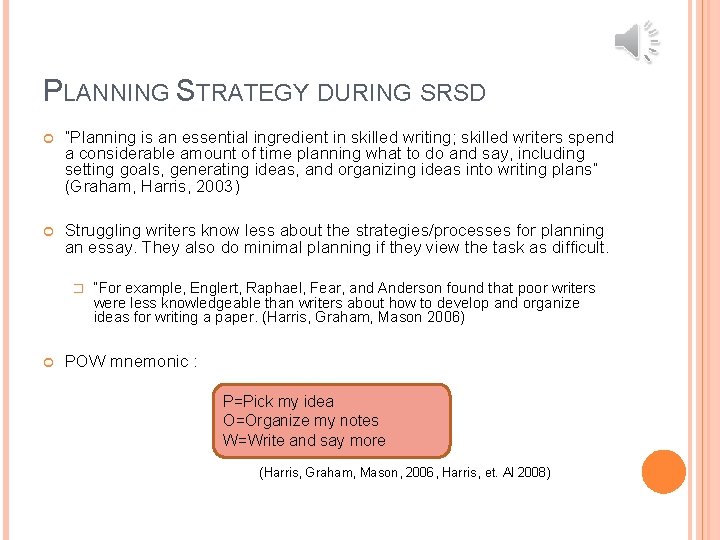
PLANNING STRATEGY DURING SRSD “Planning is an essential ingredient in skilled writing; skilled writers spend a considerable amount of time planning what to do and say, including setting goals, generating ideas, and organizing ideas into writing plans” (Graham, Harris, 2003) Struggling writers know less about the strategies/processes for planning an essay. They also do minimal planning if they view the task as difficult. � “For example, Englert, Raphael, Fear, and Anderson found that poor writers were less knowledgeable than writers about how to develop and organize ideas for writing a paper. (Harris, Graham, Mason 2006) POW mnemonic : P=Pick my idea O=Organize my notes W=Write and say more (Harris, Graham, Mason, 2006, Harris, et. Al 2008)
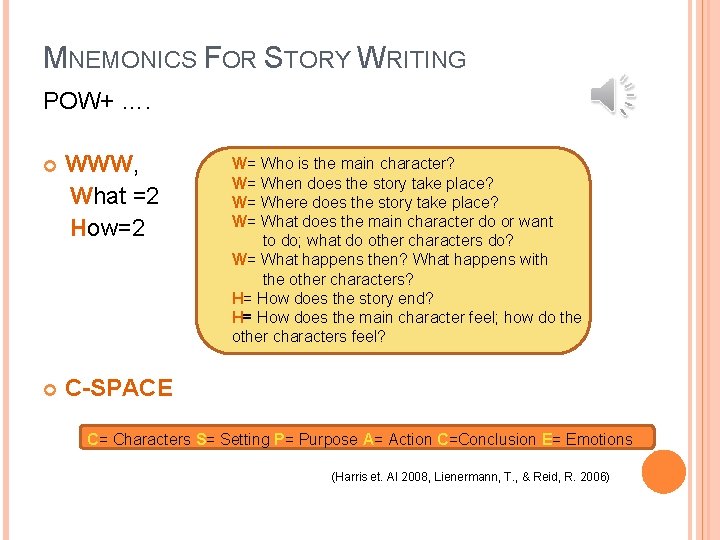
MNEMONICS FOR STORY WRITING POW+ …. WWW, What =2 How=2 C-SPACE W= Who is the main character? W= When does the story take place? W= Where does the story take place? W= What does the main character do or want to do; what do other characters do? W= What happens then? What happens with the other characters? H= How does the story end? H= How does the main character feel; how do the other characters feel? C= Characters S= Setting P= Purpose A= Action C=Conclusion E= Emotions (Harris et. Al 2008, Lienermann, T. , & Reid, R. 2006)
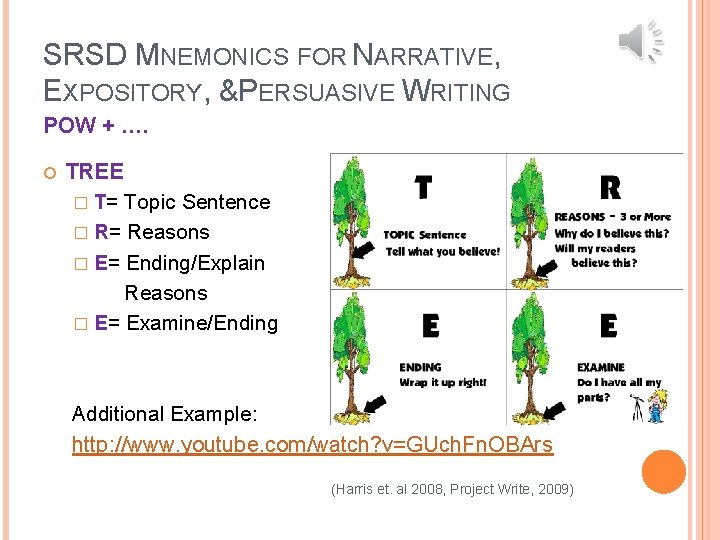
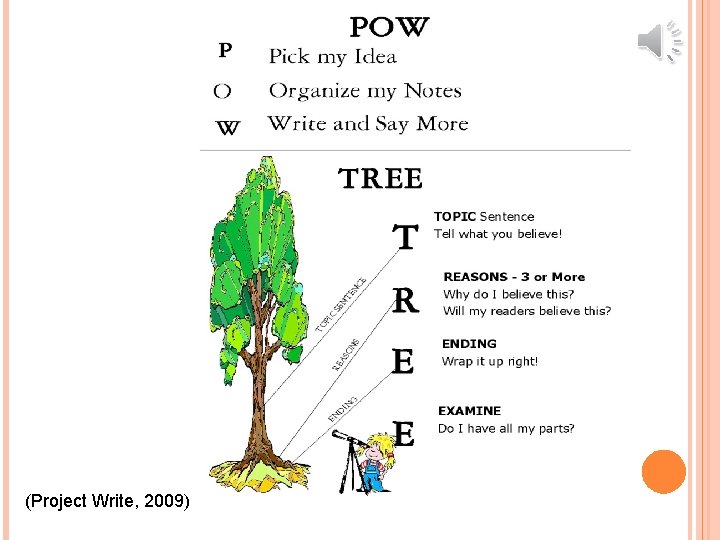
SRSD MNEMONICS FOR NARRATIVE, EXPOSITORY, &PERSUASIVE WRITING POW + …. TREE � T= Topic Sentence � R= Reasons � E= Ending/Explain Reasons � E= Examine/Ending Additional Example: http: //www. youtube. com/watch? v=GUch. Fn. OBArs (Harris et. al 2008, Project Write, 2009)
(Project Write, 2009)
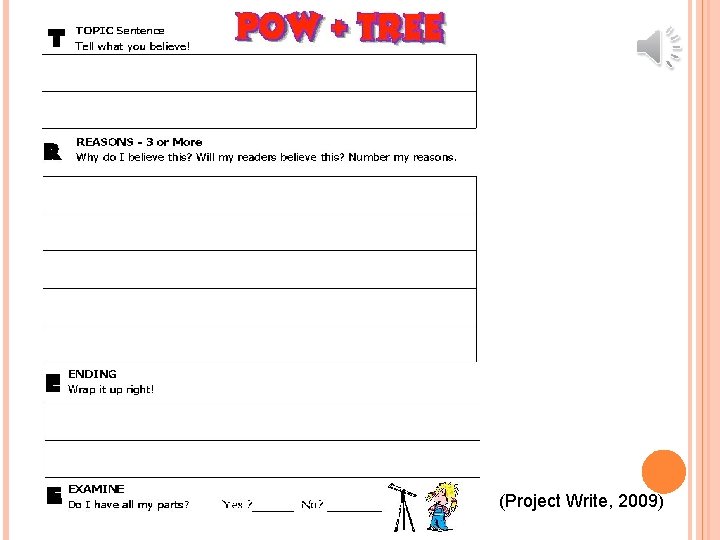
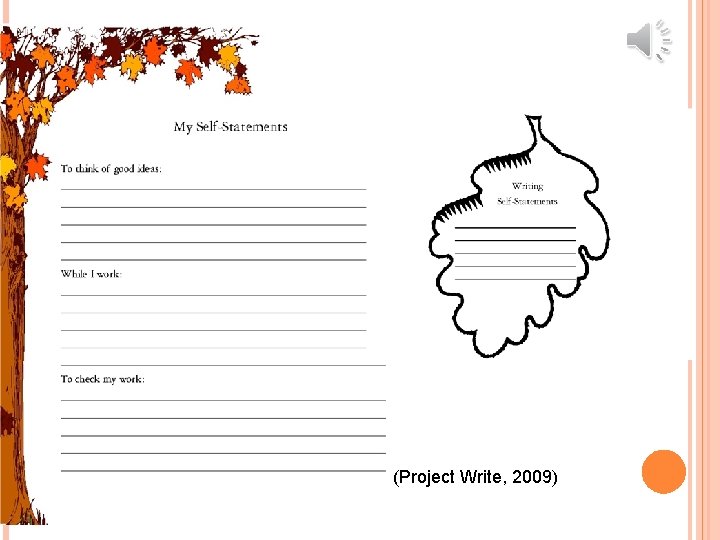
(Project Write, 2009)
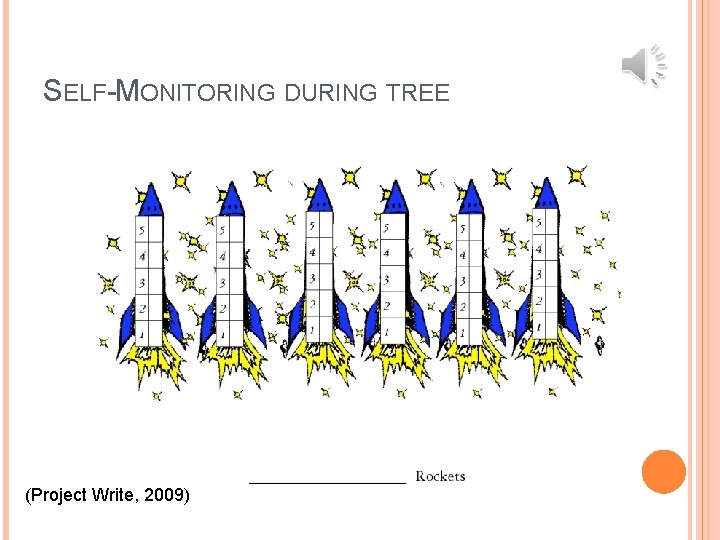
SELF-MONITORING DURING TREE (Project Write, 2009)
(Project Write, 2009)
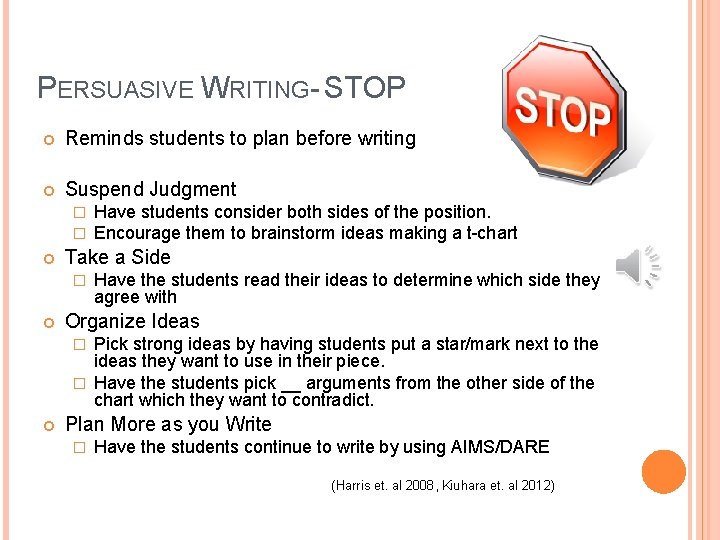
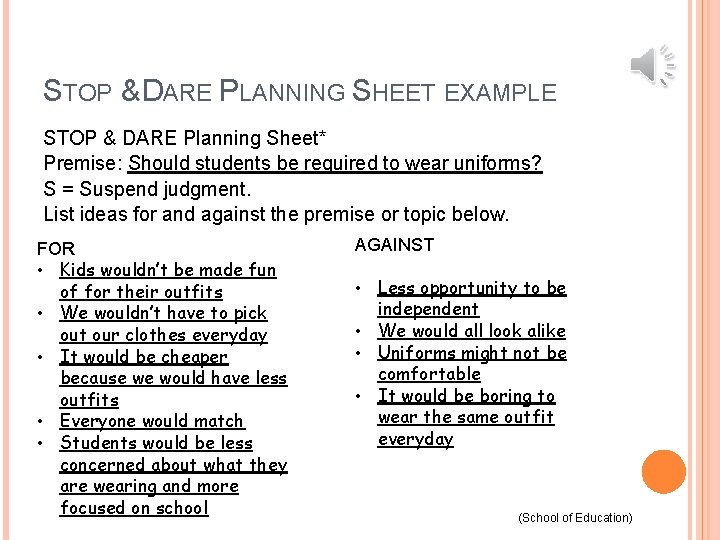
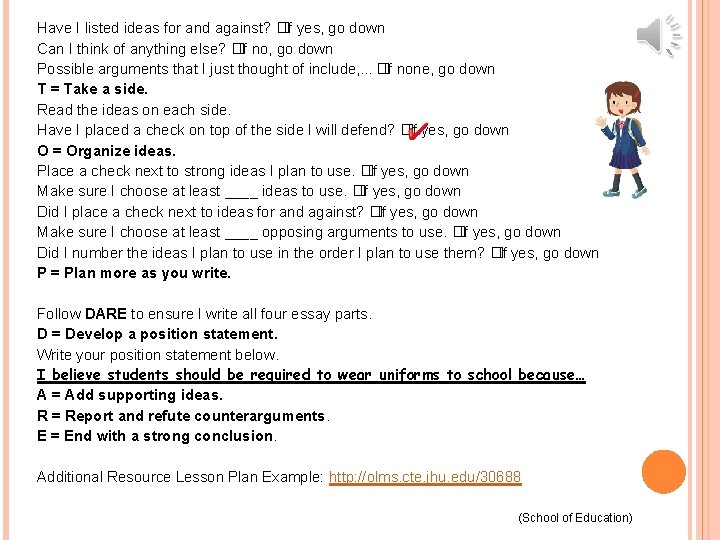
PERSUASIVE WRITING- STOP Reminds students to plan before writing Suspend Judgment � � Take a Side � Have students consider both sides of the position. Encourage them to brainstorm ideas making a t-chart Have the students read their ideas to determine which side they agree with Organize Ideas Pick strong ideas by having students put a star/mark next to the ideas they want to use in their piece. � Have the students pick __ arguments from the other side of the chart which they want to contradict. � Plan More as you Write � Have the students continue to write by using AIMS/DARE (Harris et. al 2008, Kiuhara et. al 2012)
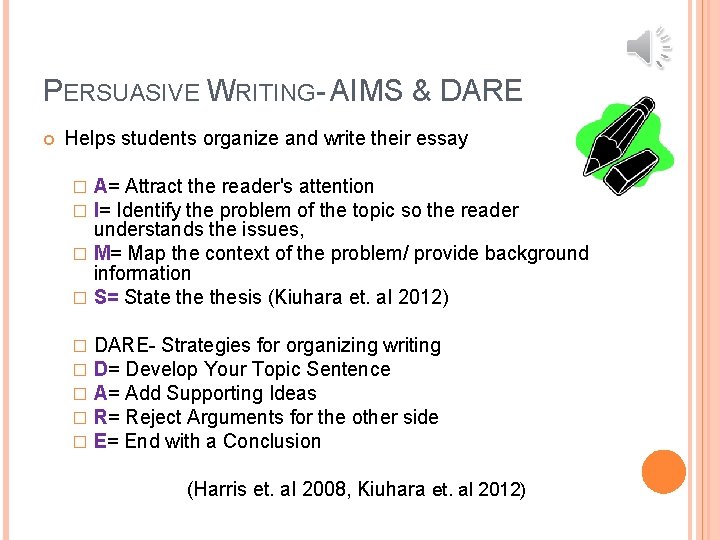
PERSUASIVE WRITING- AIMS & DARE Helps students organize and write their essay A= Attract the reader's attention I= Identify the problem of the topic so the reader understands the issues, � M= Map the context of the problem/ provide background information � S= State thesis (Kiuhara et. al 2012) � � � � DARE- Strategies for organizing writing D= Develop Your Topic Sentence A= Add Supporting Ideas R= Reject Arguments for the other side E= End with a Conclusion (Harris et. al 2008, Kiuhara et. al 2012)
STOP & DARE PLANNING SHEET EXAMPLE STOP & DARE Planning Sheet* Premise: Should students be required to wear uniforms? S = Suspend judgment. List ideas for and against the premise or topic below. FOR • Kids wouldn’t be made fun of for their outfits • We wouldn’t have to pick out our clothes everyday • It would be cheaper because we would have less outfits • Everyone would match • Students would be less concerned about what they are wearing and more focused on school AGAINST • Less opportunity to be independent • We would all look alike • Uniforms might not be comfortable • It would be boring to wear the same outfit everyday (School of Education)
Have I listed ideas for and against? �If yes, go down Can I think of anything else? �If no, go down Possible arguments that I just thought of include, …�If none, go down T = Take a side. Read the ideas on each side. Have I placed a check on top of the side I will defend? �If yes, go down O = Organize ideas. Place a check next to strong ideas I plan to use. �If yes, go down Make sure I choose at least ____ ideas to use. �If yes, go down Did I place a check next to ideas for and against? �If yes, go down Make sure I choose at least ____ opposing arguments to use. �If yes, go down Did I number the ideas I plan to use in the order I plan to use them? �If yes, go down P = Plan more as you write. Follow DARE to ensure I write all four essay parts. D = Develop a position statement. Write your position statement below. I believe students should be required to wear uniforms to school because… A = Add supporting ideas. R = Report and refute counterarguments. E = End with a strong conclusion. Additional Resource Lesson Plan Example: http: //olms. cte. jhu. edu/30688 (School of Education)
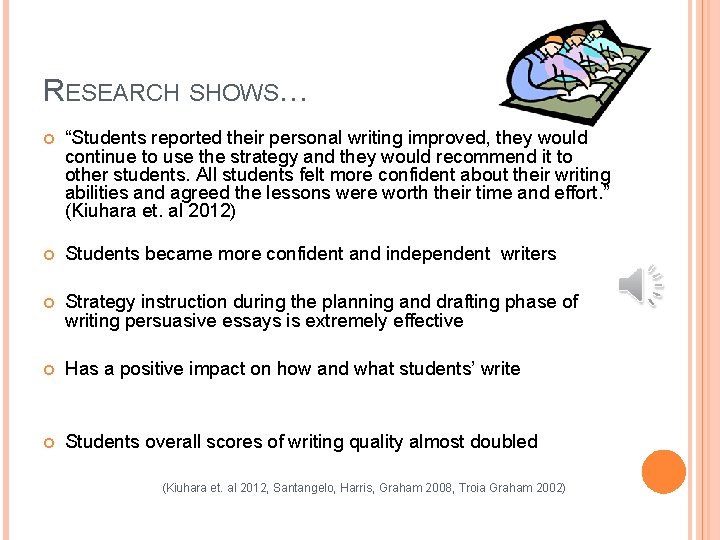
RESEARCH SHOWS… “Students reported their personal writing improved, they would continue to use the strategy and they would recommend it to other students. All students felt more confident about their writing abilities and agreed the lessons were worth their time and effort. ” (Kiuhara et. al 2012) Students became more confident and independent writers Strategy instruction during the planning and drafting phase of writing persuasive essays is extremely effective Has a positive impact on how and what students’ write Students overall scores of writing quality almost doubled (Kiuhara et. al 2012, Santangelo, Harris, Graham 2008, Troia Graham 2002)
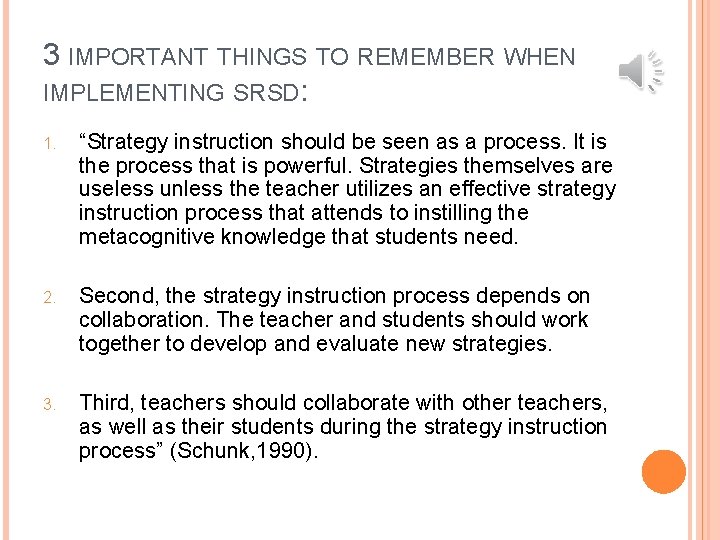
3 IMPORTANT THINGS TO REMEMBER WHEN IMPLEMENTING SRSD: 1. “Strategy instruction should be seen as a process. It is the process that is powerful. Strategies themselves are useless unless the teacher utilizes an effective strategy instruction process that attends to instilling the metacognitive knowledge that students need. 2. Second, the strategy instruction process depends on collaboration. The teacher and students should work together to develop and evaluate new strategies. 3. Third, teachers should collaborate with other teachers, as well as their students during the strategy instruction process” (Schunk, 1990).
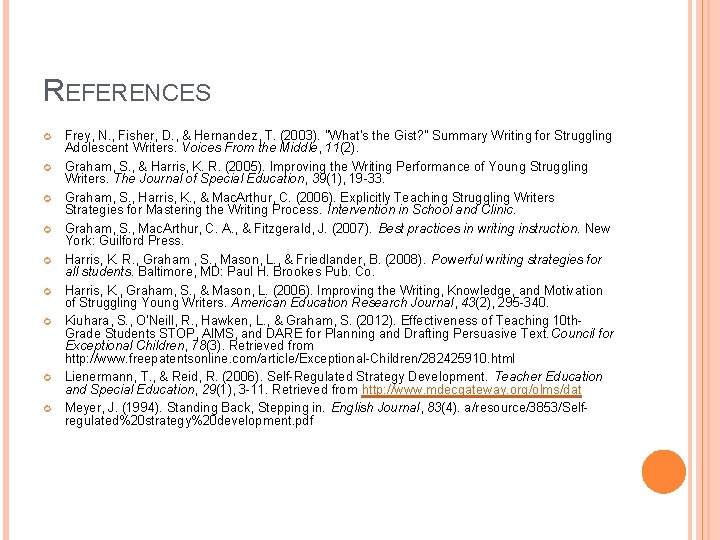
REFERENCES Frey, N. , Fisher, D. , & Hernandez, T. (2003). "What's the Gist? " Summary Writing for Struggling Adolescent Writers. Voices From the Middle, 11(2). Graham, S. , & Harris, K. R. (2005). Improving the Writing Performance of Young Struggling Writers. The Journal of Special Education, 39(1), 19 -33. Graham, S. , Harris, K. , & Mac. Arthur, C. (2006). Explicitly Teaching Struggling Writers Strategies for Mastering the Writing Process. Intervention in School and Clinic. Graham, S. , Mac. Arthur, C. A. , & Fitzgerald, J. (2007). Best practices in writing instruction. New York: Guilford Press. Harris, K. R. , Graham , S. , Mason, L. , & Friedlander, B. (2008). Powerful writing strategies for all students. Baltimore, MD: Paul H. Brookes Pub. Co. Harris, K. , Graham, S. , & Mason, L. (2006). Improving the Writing, Knowledge, and Motivation of Struggling Young Writers. American Education Research Journal, 43(2), 295 -340. Kiuhara, S. , O'Neill, R. , Hawken, L. , & Graham, S. (2012). Effectiveness of Teaching 10 th. Grade Students STOP, AIMS, and DARE for Planning and Drafting Persuasive Text. Council for Exceptional Children, 78(3). Retrieved from http: //www. freepatentsonline. com/article/Exceptional-Children/282425910. html Lienermann, T. , & Reid, R. (2006). Self-Regulated Strategy Development. Teacher Education and Special Education, 29(1), 3 -11. Retrieved from http: //www. mdecgateway. org/olms/dat Meyer, J. (1994). Standing Back, Stepping in. English Journal, 83(4). a/resource/3853/Selfregulated%20 strategy%20 development. pdf
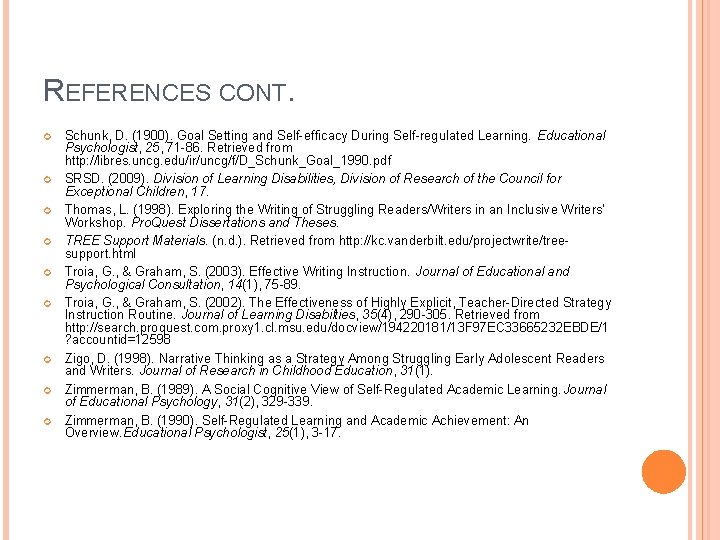
REFERENCES CONT. Schunk, D. (1900). Goal Setting and Self-efficacy During Self-regulated Learning. Educational Psychologist, 25, 71 -86. Retrieved from http: //libres. uncg. edu/ir/uncg/f/D_Schunk_Goal_1990. pdf SRSD. (2009). Division of Learning Disabilities, Division of Research of the Council for Exceptional Children, 17. Thomas, L. (1998). Exploring the Writing of Struggling Readers/Writers in an Inclusive Writers' Workshop. Pro. Quest Dissertations and Theses. TREE Support Materials. (n. d. ). Retrieved from http: //kc. vanderbilt. edu/projectwrite/treesupport. html Troia, G. , & Graham, S. (2003). Effective Writing Instruction. Journal of Educational and Psychological Consultation, 14(1), 75 -89. Troia, G. , & Graham, S. (2002). The Effectiveness of Highly Explicit, Teacher-Directed Strategy Instruction Routine. Journal of Learning Disabilties, 35(4), 290 -305. Retrieved from http: //search. proquest. com. proxy 1. cl. msu. edu/docview/194220181/13 F 97 EC 33665232 EBDE/1 ? accountid=12598 Zigo, D. (1998). Narrative Thinking as a Strategy Among Struggling Early Adolescent Readers and Writers. Journal of Research in Childhood Education, 31(1). Zimmerman, B. (1989). A Social Cognitive View of Self-Regulated Academic Learning. Journal of Educational Psychology, 31(2), 329 -339. Zimmerman, B. (1990). Self-Regulated Learning and Academic Achievement: An Overview. Educational Psychologist, 25(1), 3 -17.