
Selfregulated learners learning Kaatje van der Hoeven Kraft
- Slides: 22
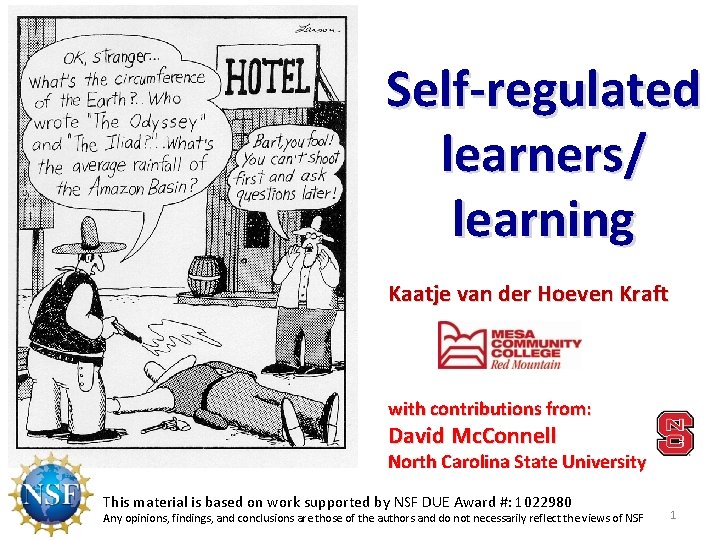
Self-regulated learners/ learning Kaatje van der Hoeven Kraft with contributions from: David Mc. Connell North Carolina State University This material is based on work supported by NSF DUE Award #: 1022980 Any opinions, findings, and conclusions are those of the authors and do not necessarily reflect the views of NSF 1
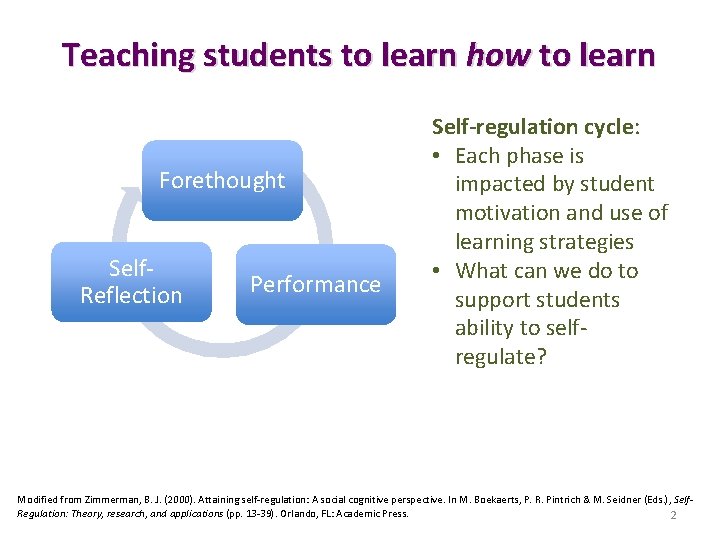
Teaching students to learn how to learn Forethought Self. Reflection Performance Self-regulation cycle: • Each phase is impacted by student motivation and use of learning strategies • What can we do to support students ability to selfregulate? Modified from Zimmerman, B. J. (2000). Attaining self-regulation: A social cognitive perspective. In M. Boekaerts, P. R. Pintrich & M. Seidner (Eds. ), Self. Regulation: Theory, research, and applications (pp. 13 -39). Orlando, FL: Academic Press. 2
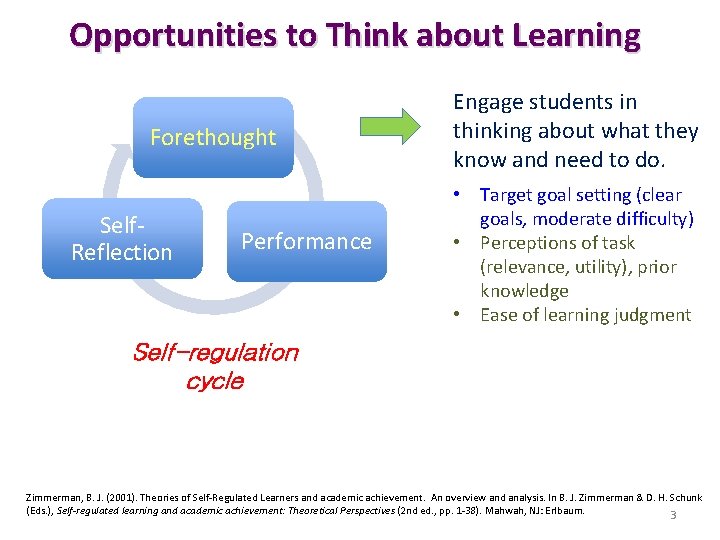
Opportunities to Think about Learning Forethought Self. Reflection Performance Engage students in thinking about what they know and need to do. • Target goal setting (clear goals, moderate difficulty) • Perceptions of task (relevance, utility), prior knowledge • Ease of learning judgment Self-regulation cycle Zimmerman, B. J. (2001). Theories of Self-Regulated Learners and academic achievement. An overview and analysis. In B. J. Zimmerman & D. H. Schunk (Eds. ), Self-regulated learning and academic achievement: Theoretical Perspectives (2 nd ed. , pp. 1 -38). Mahwah, NJ: Erlbaum. 3
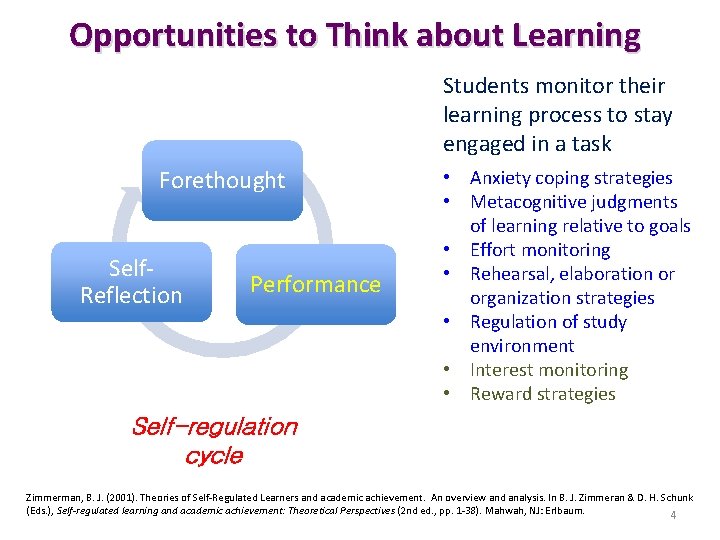
Opportunities to Think about Learning Students monitor their learning process to stay engaged in a task Forethought Self. Reflection Performance • Anxiety coping strategies • Metacognitive judgments of learning relative to goals • Effort monitoring • Rehearsal, elaboration or organization strategies • Regulation of study environment • Interest monitoring • Reward strategies Self-regulation cycle Zimmerman, B. J. (2001). Theories of Self-Regulated Learners and academic achievement. An overview and analysis. In B. J. Zimmeran & D. H. Schunk (Eds. ), Self-regulated learning and academic achievement: Theoretical Perspectives (2 nd ed. , pp. 1 -38). Mahwah, NJ: Erlbaum. 4
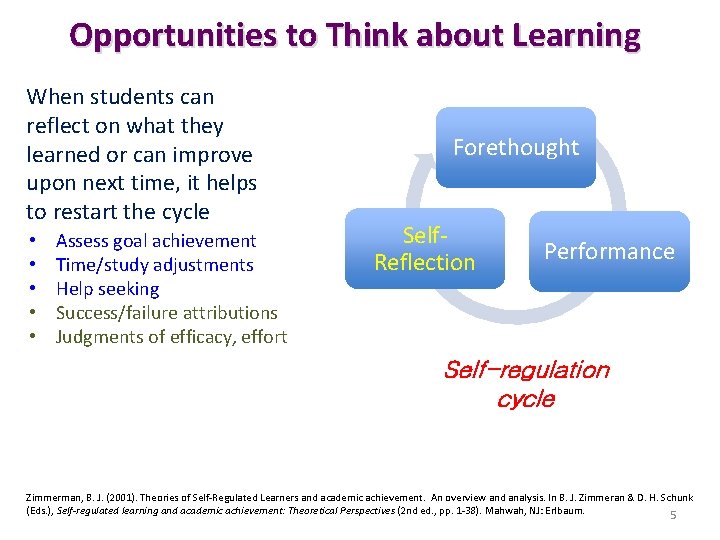
Opportunities to Think about Learning When students can reflect on what they learned or can improve upon next time, it helps to restart the cycle • • • Assess goal achievement Time/study adjustments Help seeking Success/failure attributions Judgments of efficacy, effort Forethought Self. Reflection Performance Self-regulation cycle Zimmerman, B. J. (2001). Theories of Self-Regulated Learners and academic achievement. An overview and analysis. In B. J. Zimmeran & D. H. Schunk (Eds. ), Self-regulated learning and academic achievement: Theoretical Perspectives (2 nd ed. , pp. 1 -38). Mahwah, NJ: Erlbaum. 5
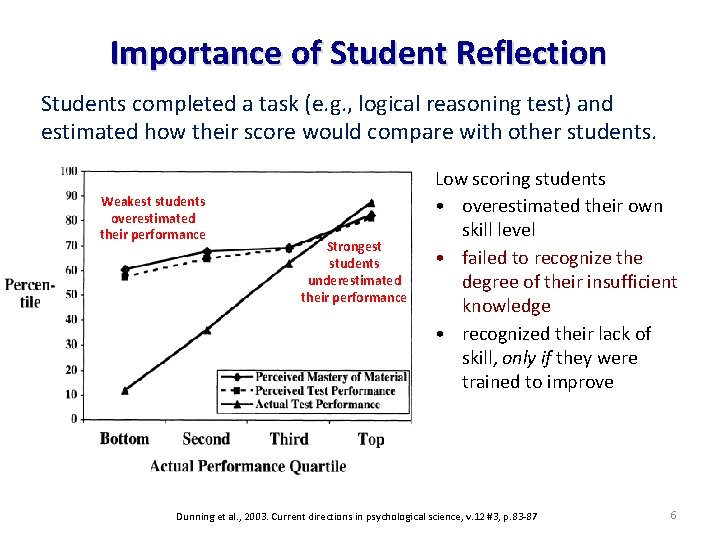
Importance of Student Reflection Students completed a task (e. g. , logical reasoning test) and estimated how their score would compare with other students. Weakest students overestimated their performance Strongest students underestimated their performance Low scoring students • overestimated their own skill level • failed to recognize the degree of their insufficient knowledge • recognized their lack of skill, only if they were trained to improve Dunning et al. , 2003. Current directions in psychological science, v. 12 #3, p. 83 -87 6
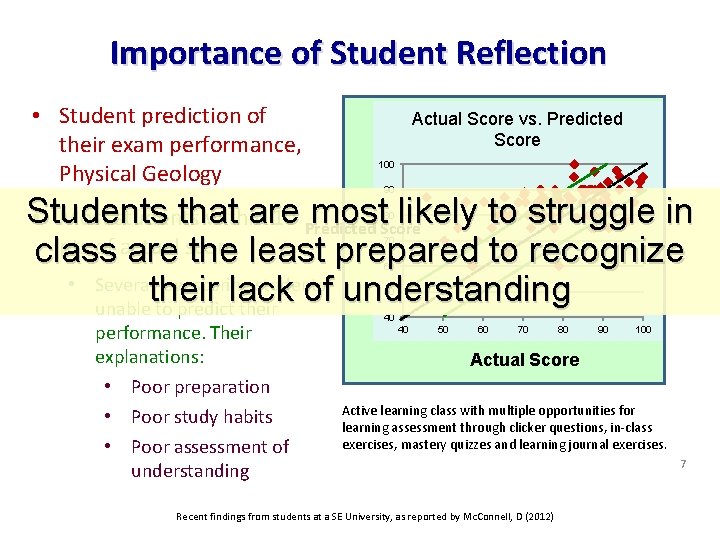
Importance of Student Reflection • Student prediction of their exam performance, Physical Geology Actual Score vs. Predicted Score 100 90 Students that are most. Score likely to struggle in • Most students within 10 Predicted pts of actual class are score the least prepared to recognize • Severaltheir low scoring students lack of understanding unable to predict their 80 70 60 50 performance. Their explanations: • Poor preparation • Poor study habits • Poor assessment of understanding 40 40 50 60 70 80 90 100 Actual Score Active learning class with multiple opportunities for learning assessment through clicker questions, in-class exercises, mastery quizzes and learning journal exercises. Recent findings from students at a SE University, as reported by Mc. Connell, D (2012) 7
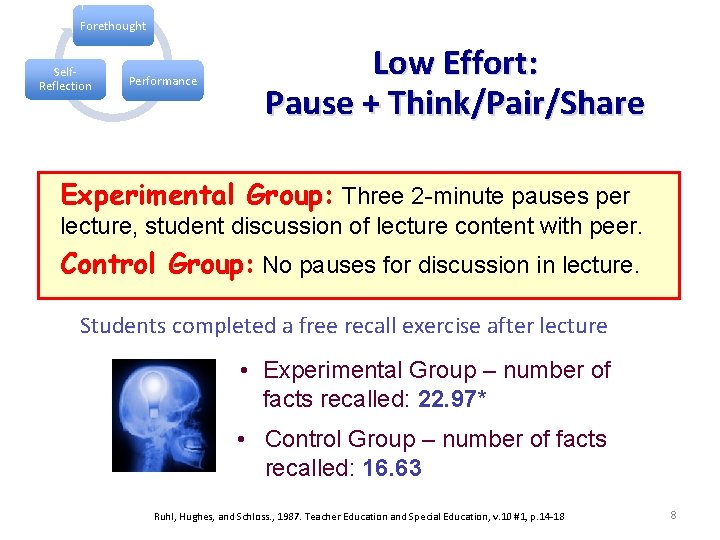
Forethought Self. Reflection Performance Low Effort: Pause + Think/Pair/Share Experimental Group: Three 2 -minute pauses per lecture, student discussion of lecture content with peer. Control Group: No pauses for discussion in lecture. Students completed a free recall exercise after lecture • Experimental Group – number of facts recalled: 22. 97* • Control Group – number of facts recalled: 16. 63 Ruhl, Hughes, and Schloss. , 1987. Teacher Education and Special Education, v. 10 #1, p. 14 -18 8
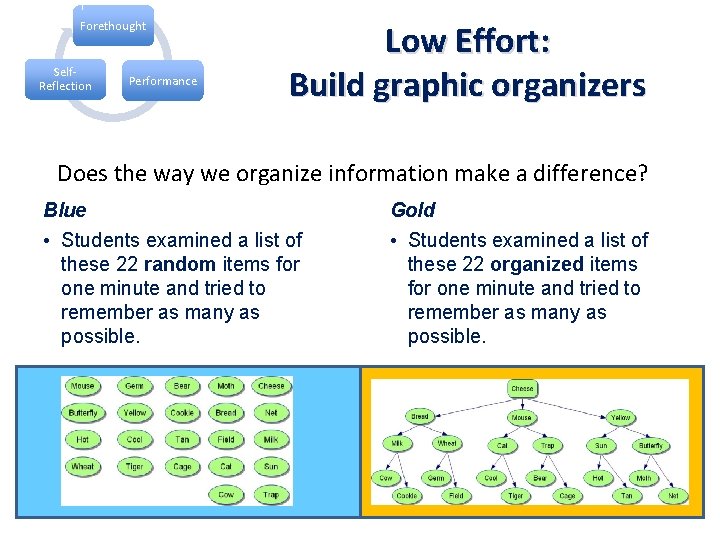
Forethought Self. Reflection Performance Low Effort: Build graphic organizers Does the way we organize information make a difference? Blue • Students examined a list of these 22 random items for one minute and tried to remember as many as possible. Gold • Students examined a list of these 22 organized items for one minute and tried to remember as many as possible.
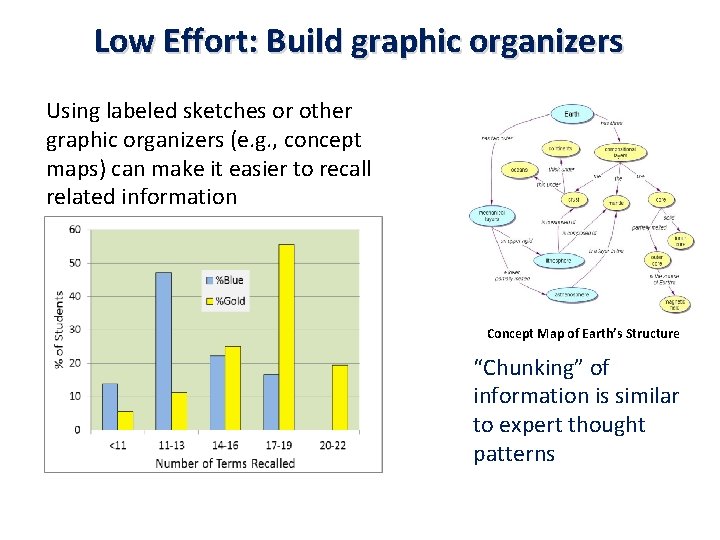
Low Effort: Build graphic organizers Using labeled sketches or other graphic organizers (e. g. , concept maps) can make it easier to recall related information Concept Map of Earth’s Structure “Chunking” of information is similar to expert thought patterns
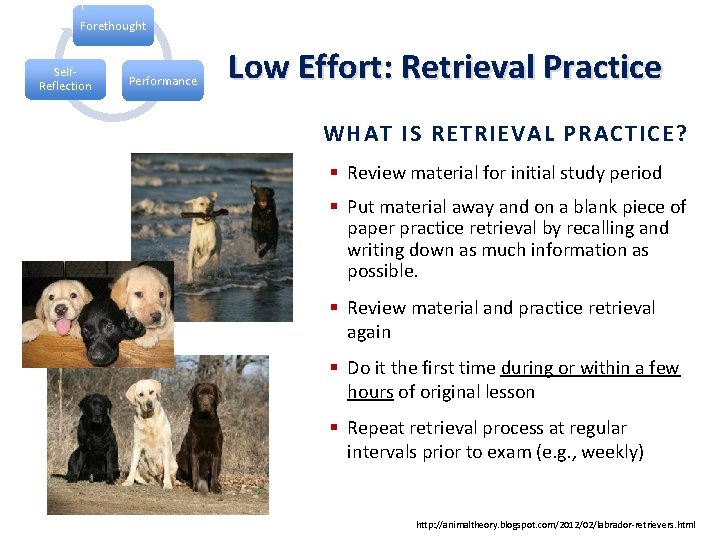
Forethought Self. Reflection Performance Low Effort: Retrieval Practice WHAT IS RETRIEVAL PRACTICE? § Review material for initial study period § Put material away and on a blank piece of paper practice retrieval by recalling and writing down as much information as possible. § Review material and practice retrieval again § Do it the first time during or within a few hours of original lesson § Repeat retrieval process at regular intervals prior to exam (e. g. , weekly) http: //animaltheory. blogspot. com/2012/02/labrador-retrievers. html
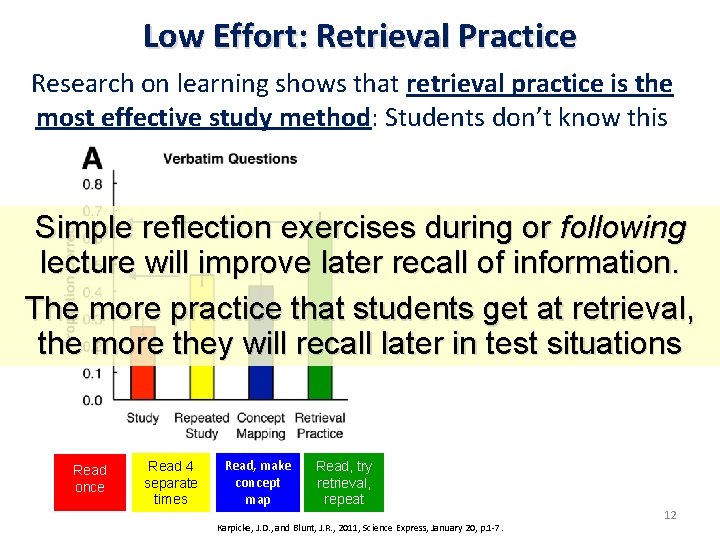
Low Effort: Retrieval Practice Research on learning shows that retrieval practice is the most effective study method: Students don’t know this Simple reflection exercises during or following lecture will improve later recall of information. The more practice that students get at retrieval, the more they will recall later in test situations Read once Read 4 separate times Read, make concept map Read, try retrieval, repeat Karpicke, J. D. , and Blunt, J. R. , 2011, Science Express, January 20, p. 1 -7. 12
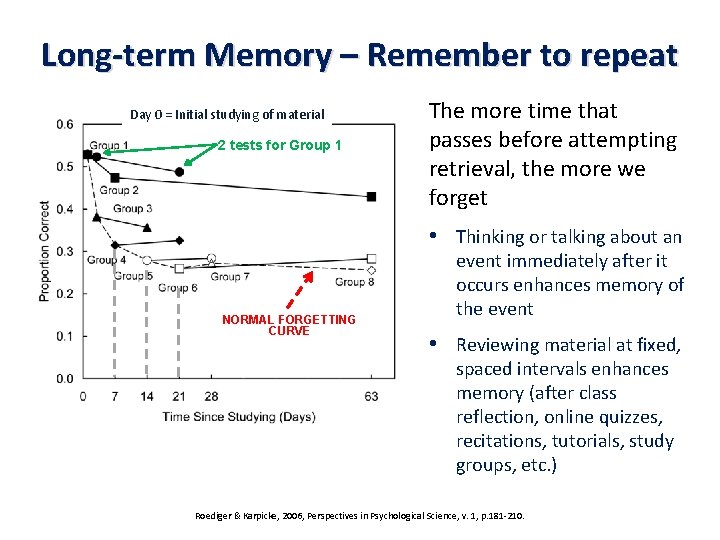
Long-term Memory – Remember to repeat Day 0 = Initial studying of material 2 tests for Group 1 The more time that passes before attempting retrieval, the more we forget • Thinking or talking about an NORMAL FORGETTING CURVE event immediately after it occurs enhances memory of the event • Reviewing material at fixed, spaced intervals enhances memory (after class reflection, online quizzes, recitations, tutorials, study groups, etc. ) Roediger & Karpicke, 2006, Perspectives in Psychological Science, v. 1, p. 181 -210.
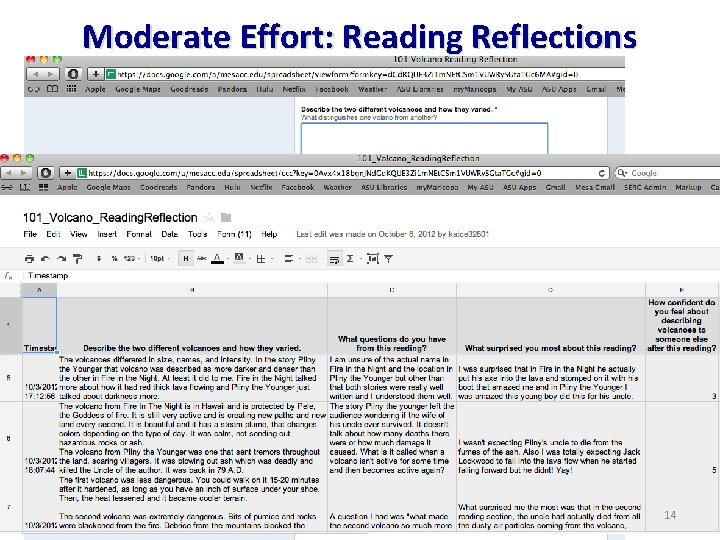
Moderate Effort: Reading Reflections 14
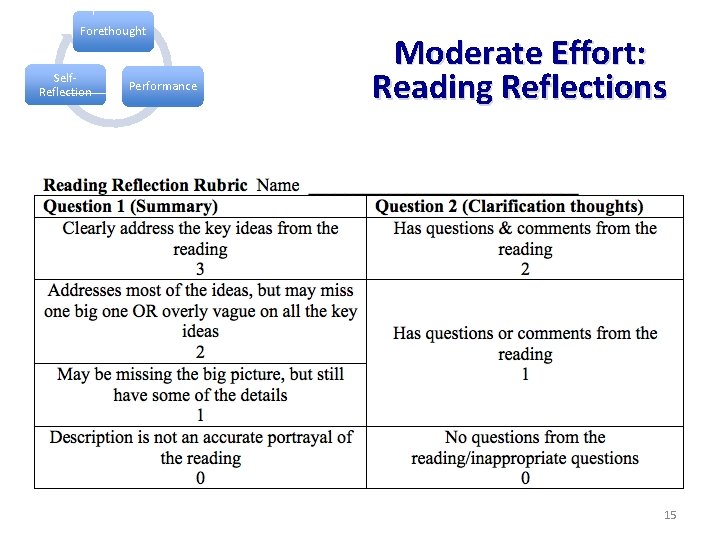
Forethought Self. Reflection Performance Moderate Effort: Reading Reflections 15
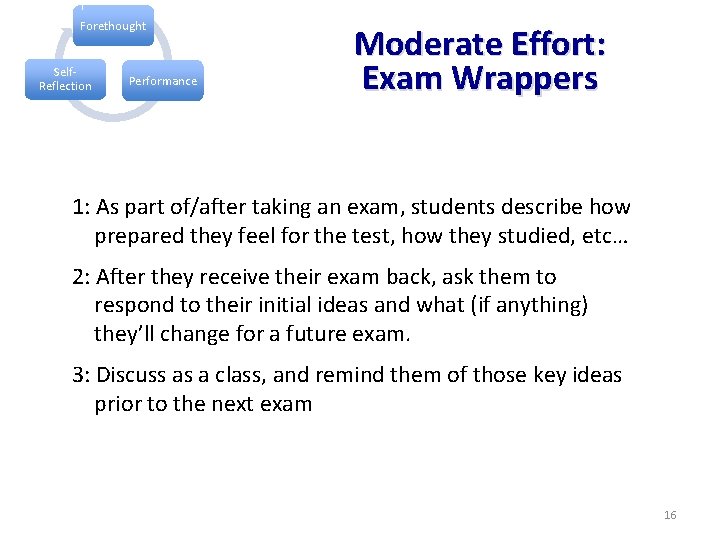
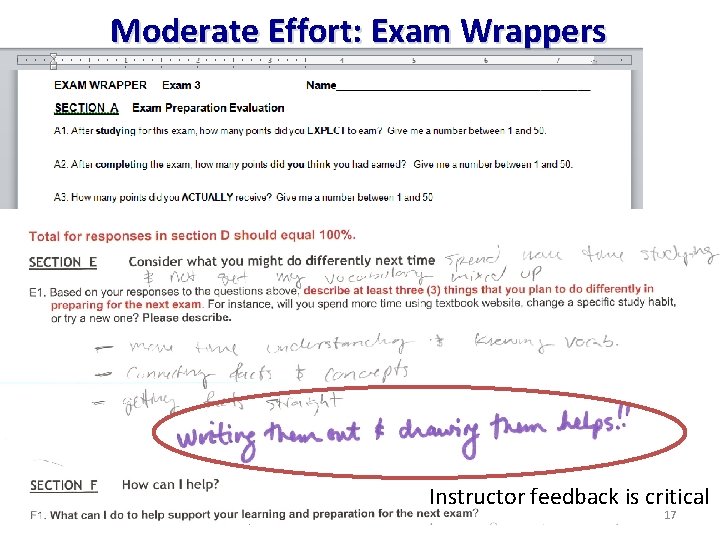
Forethought Self. Reflection Performance Moderate Effort: Exam Wrappers 1: As part of/after taking an exam, students describe how prepared they feel for the test, how they studied, etc… 2: After they receive their exam back, ask them to respond to their initial ideas and what (if anything) they’ll change for a future exam. 3: Discuss as a class, and remind them of those key ideas prior to the next exam 16
Moderate Effort: Exam Wrappers Instructor feedback is critical 17
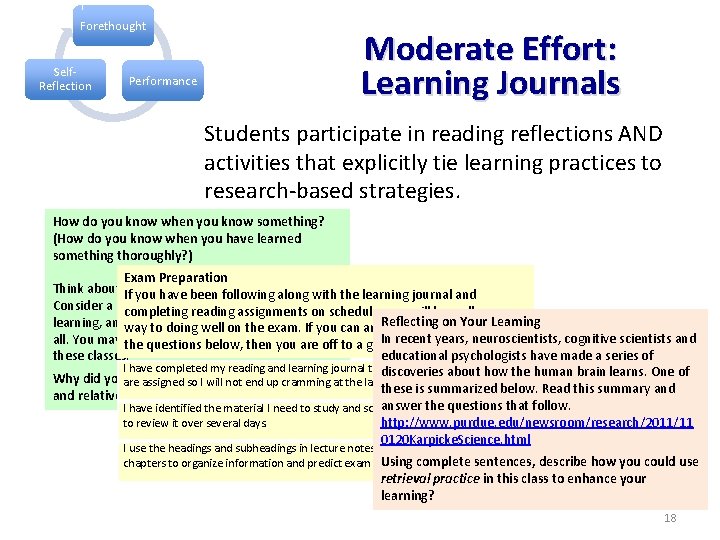
Forethought Self. Reflection Moderate Effort: Learning Journals Performance Students participate in reading reflections AND activities that explicitly tie learning practices to research-based strategies. How do you know when you know something? (How do you know when you have learned something thoroughly? ) Exam Preparation Think about two classes you have takenalong in thewith past. the learning journal and If you have been following Consider a class that resulted in aassignments lot of new on schedule, you will be well on your completing reading Reflecting onnearly Your Learning learning, andway oneto where learn much at can answer doingyou welldidn’t on the exam. If you “Yes” to all of In recent years, neuroscientists, cognitive scientists and all. You may the havequestions received below, the same grade in then you are off to a good start: educational psychologists have made a series of these classes. I have completed my reading and learning journal tasks as they about how the human brain learns. One of discoveries Why did youare think you learned a lot in one class Yes No assigned so I will not end up cramming at the last minute. these is summarized below. Read this summary and relatively little in the other? answertime the questions that follow. I have identified the material I need to study and scheduled Yes No to review it over several days. http: //www. purdue. edu/newsroom/research/2011/11 0120 Karpicke. Science. html I use the headings and subheadings in lecture notes and textbook Yessentences, No Using complete describe how you could use chapters to organize information and predict exam questions. retrieval practice in this class to enhance your learning? 18
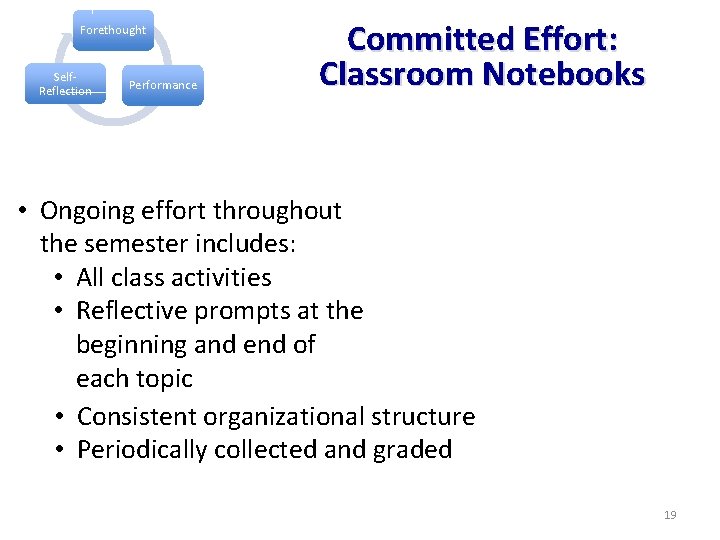
Forethought Self. Reflection Performance Committed Effort: Classroom Notebooks • Ongoing effort throughout the semester includes: • All class activities • Reflective prompts at the beginning and end of each topic • Consistent organizational structure • Periodically collected and graded 19
Instructor support for learning about learning Provide opportunities for students to self-evaluate their own learning • Provide models (coping are better than expert): • Think-Pair-Share • Provide opportunities for self-evaluation • • • Think-Pair-Share Reflective Prompts Exam Wrappers Learning Journals Classroom notebook 20 Based on research findings from Zimmeran, B. J. (1989). A social cognitive view of self-regulated academic learning. Journal of Educational Psychology, 81(3), 329 -339.
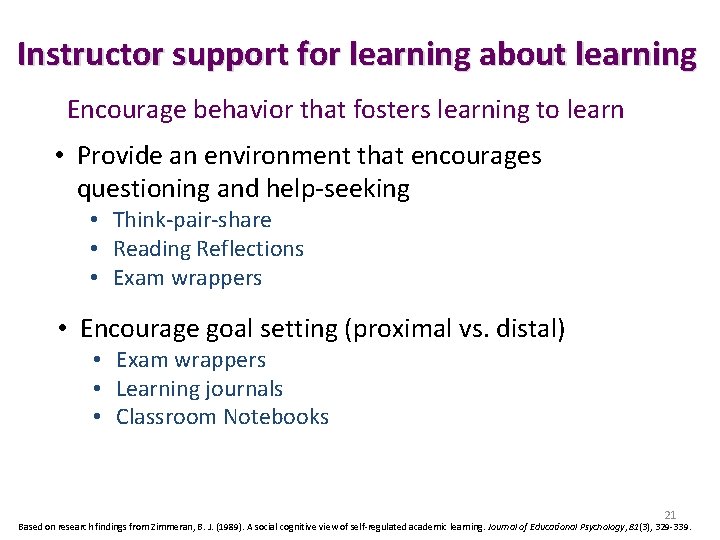
Instructor support for learning about learning Encourage behavior that fosters learning to learn • Provide an environment that encourages questioning and help-seeking • Think-pair-share • Reading Reflections • Exam wrappers • Encourage goal setting (proximal vs. distal) • Exam wrappers • Learning journals • Classroom Notebooks 21 Based on research findings from Zimmeran, B. J. (1989). A social cognitive view of self-regulated academic learning. Journal of Educational Psychology, 81(3), 329 -339.
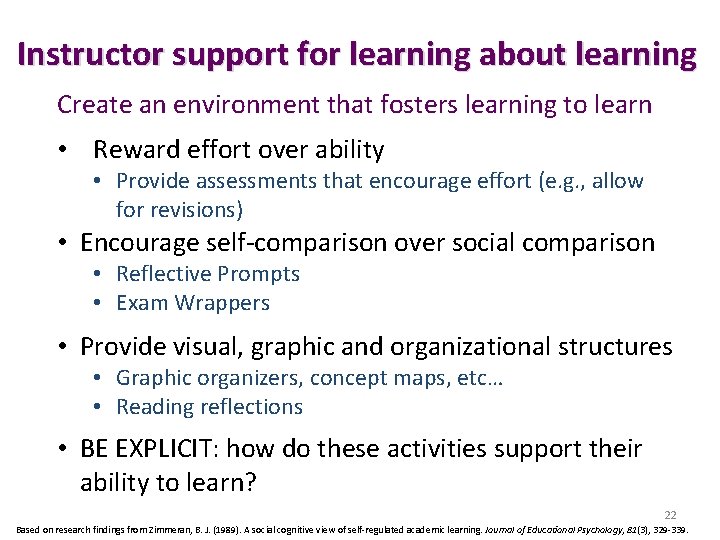
Instructor support for learning about learning Create an environment that fosters learning to learn • Reward effort over ability • Provide assessments that encourage effort (e. g. , allow for revisions) • Encourage self-comparison over social comparison • Reflective Prompts • Exam Wrappers • Provide visual, graphic and organizational structures • Graphic organizers, concept maps, etc… • Reading reflections • BE EXPLICIT: how do these activities support their ability to learn? 22 Based on research findings from Zimmeran, B. J. (1989). A social cognitive view of self-regulated academic learning. Journal of Educational Psychology, 81(3), 329 -339.