
Selforganized criticality as a fundamental property of neural






- Slides: 23
Self-organized criticality as a fundamental property of neural systems 20153124 Su Hyun Kim Department of Bio and Brain Engineering KAIST
Table of Contents 1. Self-organized Criticality 2. Criticality Hypothesis 3. Implications 4. Further Studies 5. Conclusion
1. Self-organized Criticality & Phase transition Self-organization Examples and properties
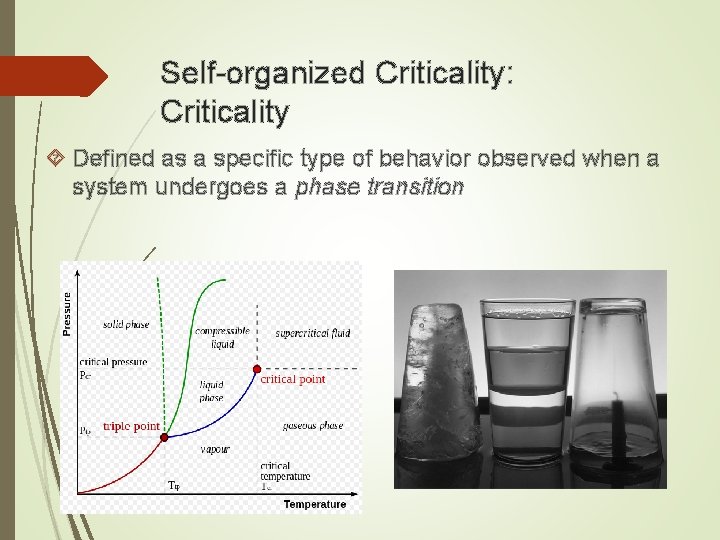
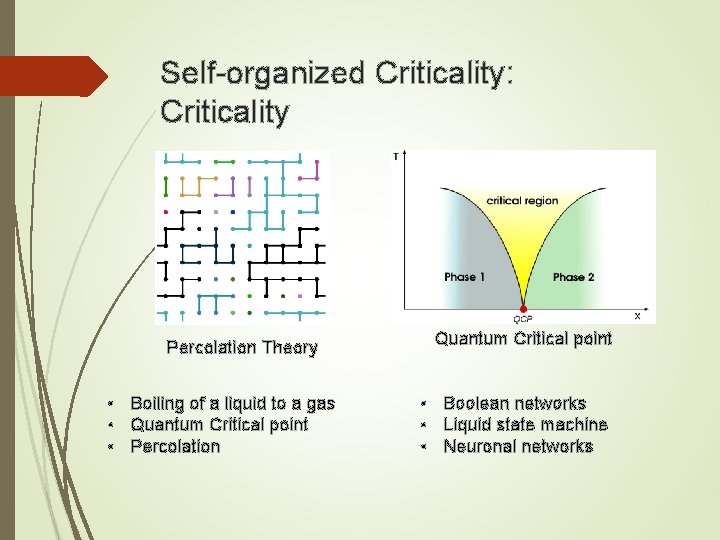
Self-organized Criticality: Criticality Defined as a specific type of behavior observed when a system undergoes a phase transition
Self-organized Criticality: Criticality Macroscopic measurable properties (order parameters) Ambient property (control parameter) The change in ambient property yields dramatic change in order parameters: Phase transition Critical state is the state on the edge between two qualitatively different types of behaviors Edge of Chaos
Self-organized Criticality: Criticality Percolation Theory • Boiling of a liquid to a gas • Quantum Critical point • Percolation Quantum Critical point • Boolean networks • Liquid state machine • Neuronal networks
Self-organized Criticality: Self-organization a process where some form of overall order or coordination arises out of the local interactions between the components of an initially disordered system. (wikipedia) It is often triggered by random fluctuations that are amplified by positive feedback. The resulting organization is wholly decentralized or distributed over all the components of the system. It gives the whole system resiliency and robustness.
Self-organized Criticality: Self-organization
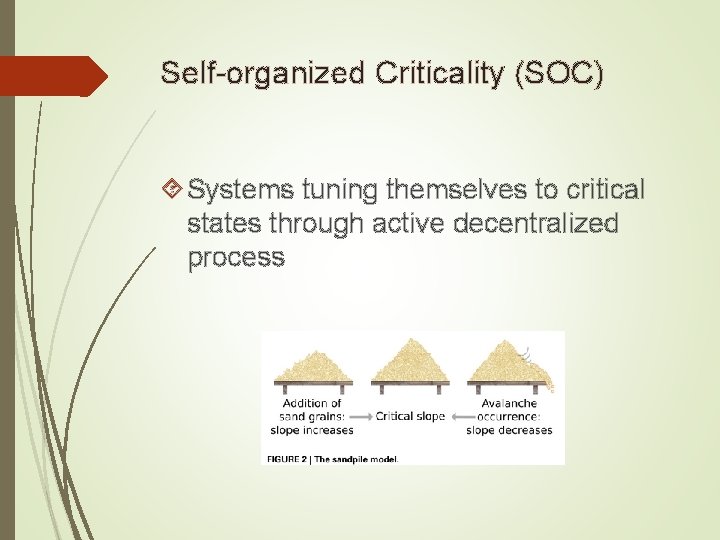
Self-organized Criticality (SOC) Systems tuning themselves to critical states through active decentralized process
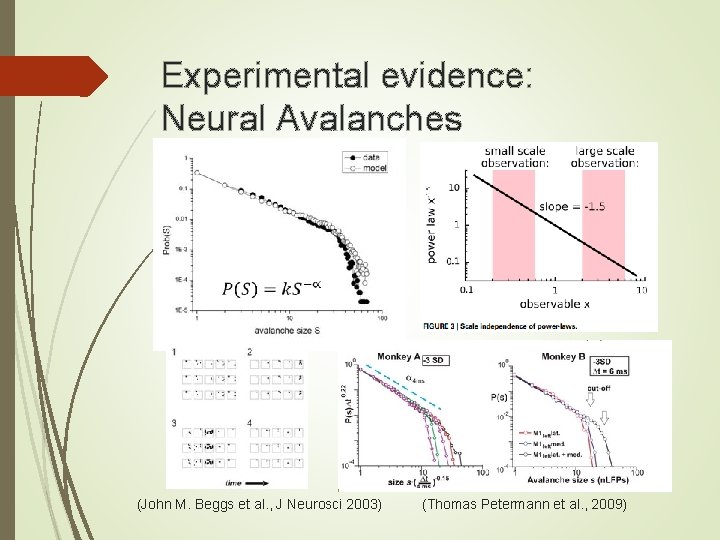
Self-organized Criticality: Properties Power law distribution Scale independence Self-similarity Emergent properties
2. Hypothesis: Criticality Hypothesis Toy Model Evidences Experiments: neural avalanches Theoretical Models
How are the brain and criticality related?
Criticality Hypothesis: The Brain operates in a critical state because optimal computational capabilities should be selected for.
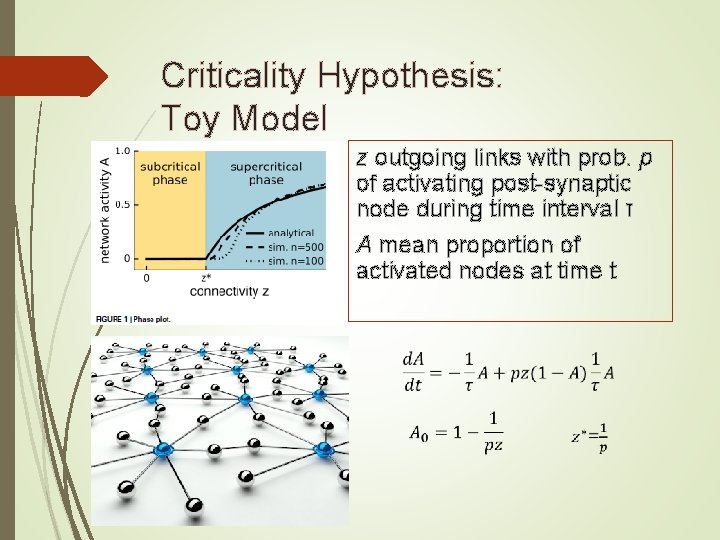
Criticality Hypothesis: Toy Model z outgoing links with prob. p of activating post-synaptic node during time interval τ A mean proportion of activated nodes at time t
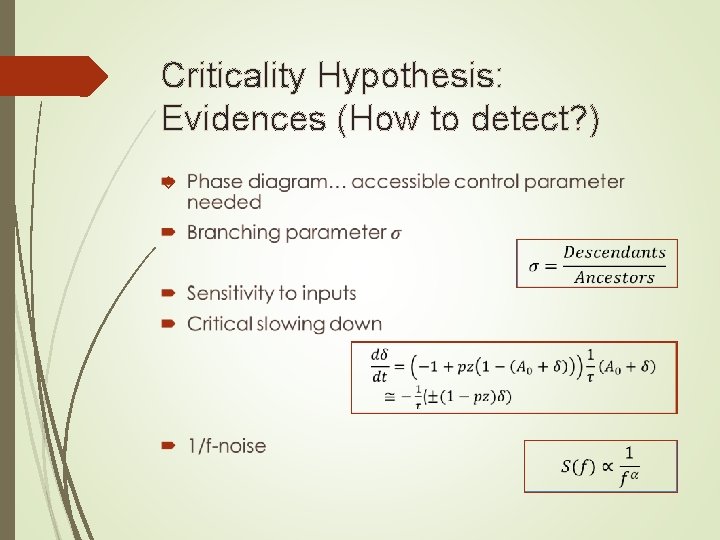
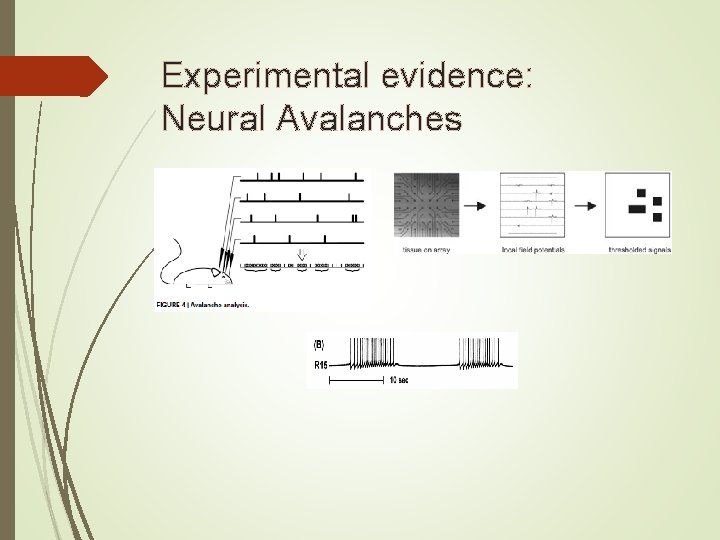
Criticality Hypothesis: Evidences (How to detect? )
Experimental evidence: Neural Avalanches
Experimental evidence: Neural Avalanches (John M. Beggs et al. , J Neurosci 2003) (Thomas Petermann et al. , 2009)
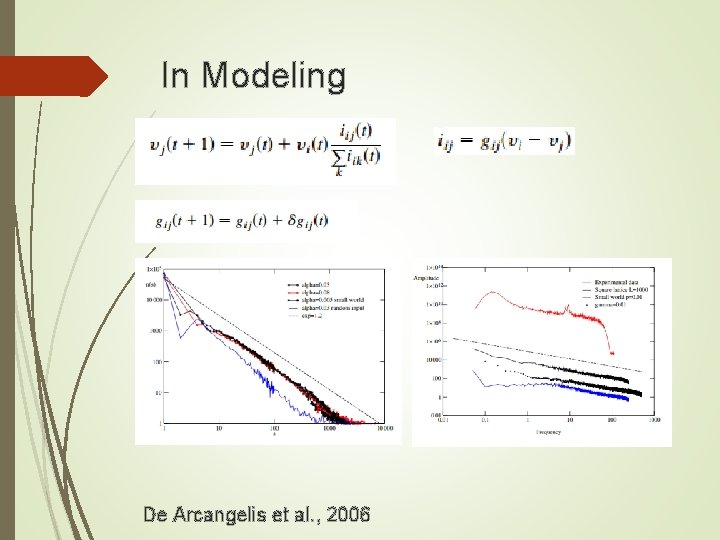
In Modeling De Arcangelis et al. , 2006
3. Implications -Information transmission. -Information storage. -Computational power -Stability.
Applications Disease detection (diagnostic tools & treatments) Insights into other phenomena (sleep, learning, root-causes of certain diseases) Prerequisite for efficient information processing in unstructured systems. (swarm intelligence)
4. Further Studies Experiments on low-input situations Relation with learning and sleep How do neuronal networks wire itself into a complex network?
5. Conclusion Self-organized criticality is hallmarks of complex network and nonlinear dynamics. Properties of SOC include power-law dist. , scale independence, and self-similarity(fractal). Neural criticality hypothesis is motivated by the relationship between criticality and optimal computational properties. The hypothesis is supported by experiments that observed hallmarks of criticality for a wide range of animals from leech to humans. Self-organization is preferable over alternative explanations because it provides an evolutionary-motivated explanation.
k n a Th ! u yo