
SelfOrganization SelfOrganizing Lists 1 Selforganizing lists modify the

- Slides: 9
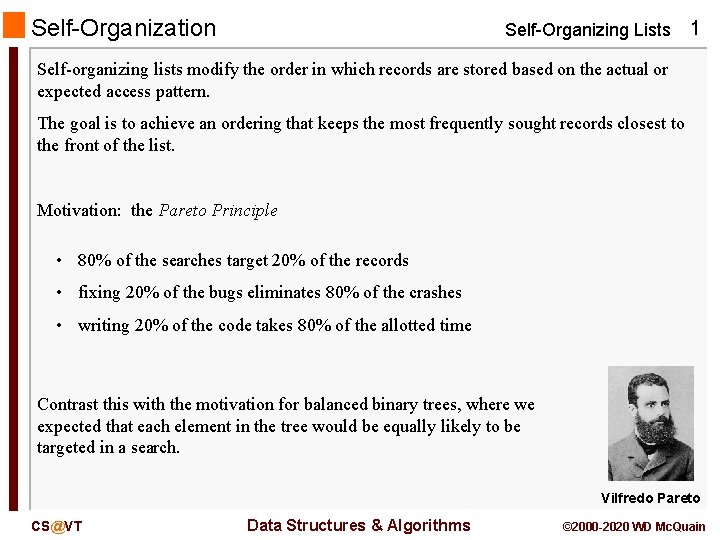
Self-Organization Self-Organizing Lists 1 Self-organizing lists modify the order in which records are stored based on the actual or expected access pattern. The goal is to achieve an ordering that keeps the most frequently sought records closest to the front of the list. Motivation: the Pareto Principle • 80% of the searches target 20% of the records • fixing 20% of the bugs eliminates 80% of the crashes • writing 20% of the code takes 80% of the allotted time Contrast this with the motivation for balanced binary trees, where we expected that each element in the tree would be equally likely to be targeted in a search. Vilfredo Pareto CS@VT Data Structures & Algorithms © 2000 -2020 WD Mc. Quain
Self-Organization Self-Organizing Lists 2 Observations: • the set of records being accessed may change over time, unpredictably • the interest set of those requesting the searches may change over time, unpredictably CS@VT Data Structures & Algorithms © 2000 -2020 WD Mc. Quain
Self-Organization Self-Organizing Lists 3 Common heuristics for reorganization: • frequency count: order by the actual historical frequency of access • move-to-front: when a record is accessed, move it to the front of the list (MRU) • transpose: when a record is accessed, swap it with the preceding record in the list, or move it some fixed distance/fraction of the way to the front CS@VT Data Structures & Algorithms © 2000 -2020 WD Mc. Quain
Frequency Count Self-Organizing Lists 4 Pros: • reflects the actual access pattern • likely to keep often-accessed elements near the front • list adjustments frequently require swaps of adjacent records, or at least near neighbors Cons: • must store and maintain a counter for each record • without modification, does not adapt quickly to changing access patterns CS@VT Data Structures & Algorithms © 2000 -2020 WD Mc. Quain
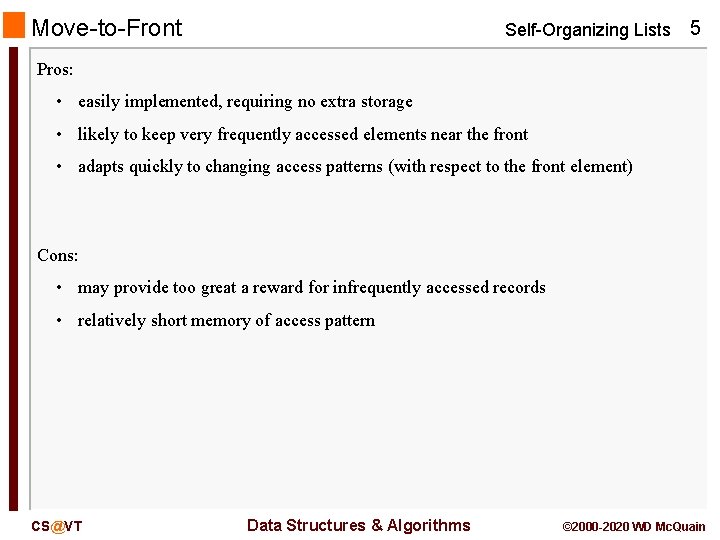
Move-to-Front Self-Organizing Lists 5 Pros: • easily implemented, requiring no extra storage • likely to keep very frequently accessed elements near the front • adapts quickly to changing access patterns (with respect to the front element) Cons: • may provide too great a reward for infrequently accessed records • relatively short memory of access pattern CS@VT Data Structures & Algorithms © 2000 -2020 WD Mc. Quain
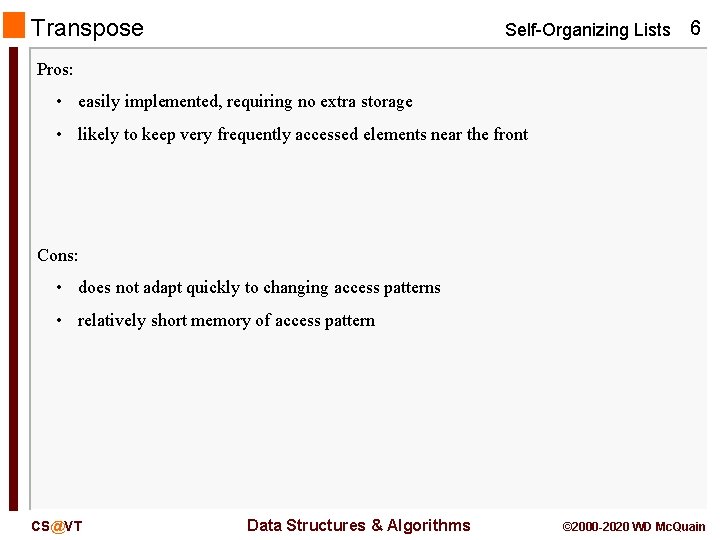
Transpose Self-Organizing Lists 6 Pros: • easily implemented, requiring no extra storage • likely to keep very frequently accessed elements near the front Cons: • does not adapt quickly to changing access patterns • relatively short memory of access pattern CS@VT Data Structures & Algorithms © 2000 -2020 WD Mc. Quain
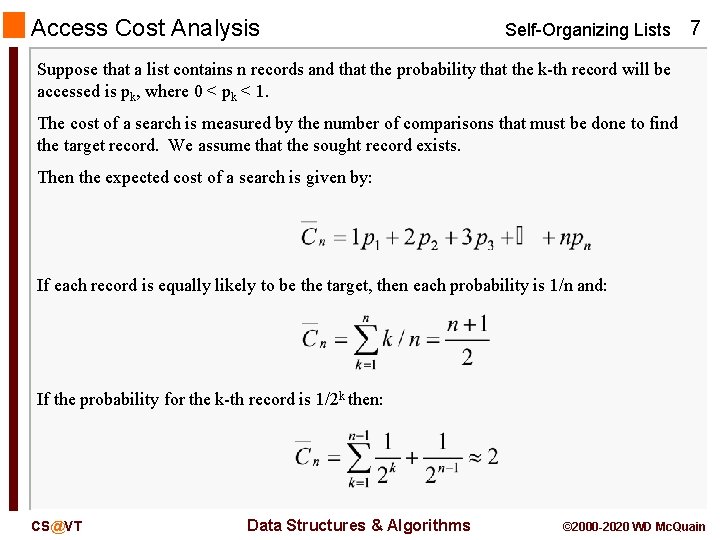
Access Cost Analysis Self-Organizing Lists 7 Suppose that a list contains n records and that the probability that the k-th record will be accessed is pk, where 0 < pk < 1. The cost of a search is measured by the number of comparisons that must be done to find the target record. We assume that the sought record exists. Then the expected cost of a search is given by: If each record is equally likely to be the target, then each probability is 1/n and: If the probability for the k-th record is 1/2 k then: CS@VT Data Structures & Algorithms © 2000 -2020 WD Mc. Quain
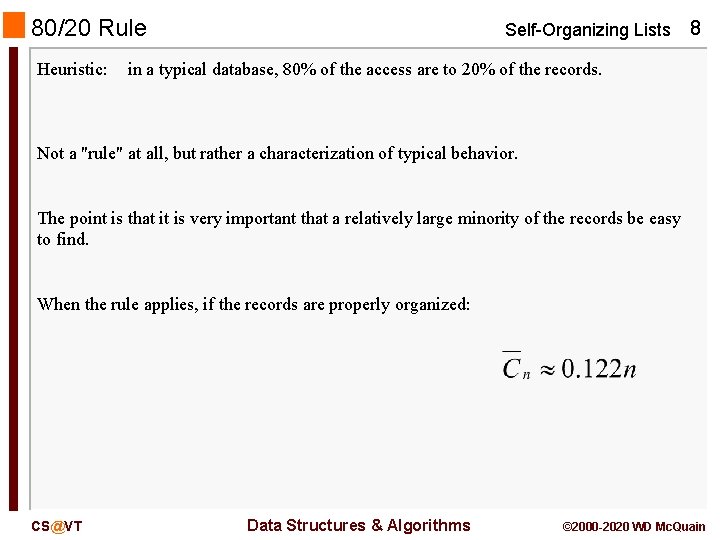
80/20 Rule Heuristic: Self-Organizing Lists 8 in a typical database, 80% of the access are to 20% of the records. Not a "rule" at all, but rather a characterization of typical behavior. The point is that it is very important that a relatively large minority of the records be easy to find. When the rule applies, if the records are properly organized: CS@VT Data Structures & Algorithms © 2000 -2020 WD Mc. Quain
Comparative Analysis Self-Organizing Lists 9 Given a set of search data, the optimal static ordering organizes the records precisely according to the frequency of their occurrence in the search data. The frequency count and move-to-front heuristics are, in the long run, at worst twice as costly as the optimal static ordering. The transpose heuristic appears, in the long run, to approach the cost of the move-to-front heuristic. However, any such results are somewhat imprecise since the exact relationship is sensitive to the particular data and access patterns in question. CS@VT Data Structures & Algorithms © 2000 -2020 WD Mc. Quain