
SELFORGANIZATION IN ATMOSPHERIC PRESSURE CARBON ARC DISCHARGES Material
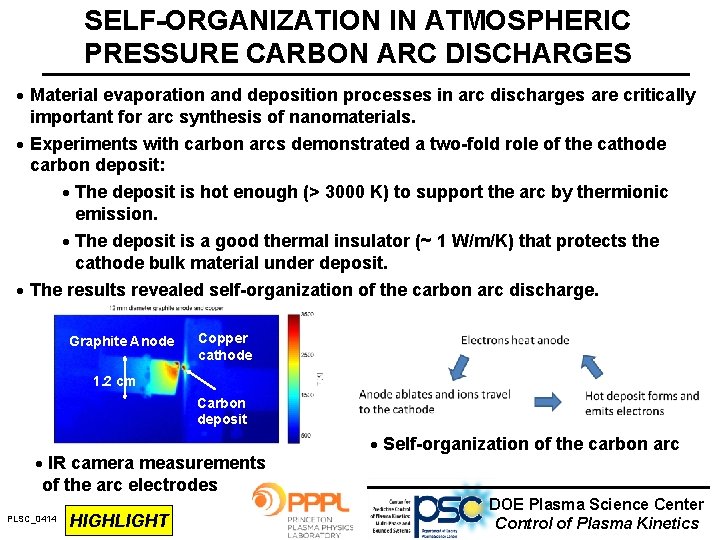
SELF-ORGANIZATION IN ATMOSPHERIC PRESSURE CARBON ARC DISCHARGES · Material evaporation and deposition processes in arc discharges are critically important for arc synthesis of nanomaterials. · Experiments with carbon arcs demonstrated a two-fold role of the cathode carbon deposit: · The deposit is hot enough (> 3000 K) to support the arc by thermionic emission. · The deposit is a good thermal insulator (~ 1 W/m/K) that protects the cathode bulk material under deposit. · The results revealed self-organization of the carbon arc discharge. b) b) Graphite Anode Copper cathode Anode 1. 2 cm Cathode 1. 2 cm Carbon deposit Deposit · IR camera measurements of the arc electrodes PLSC_0414 HIGHLIGHT · Self-organization of the carbon arc DOE Plasma Science Center Control of Plasma Kinetics
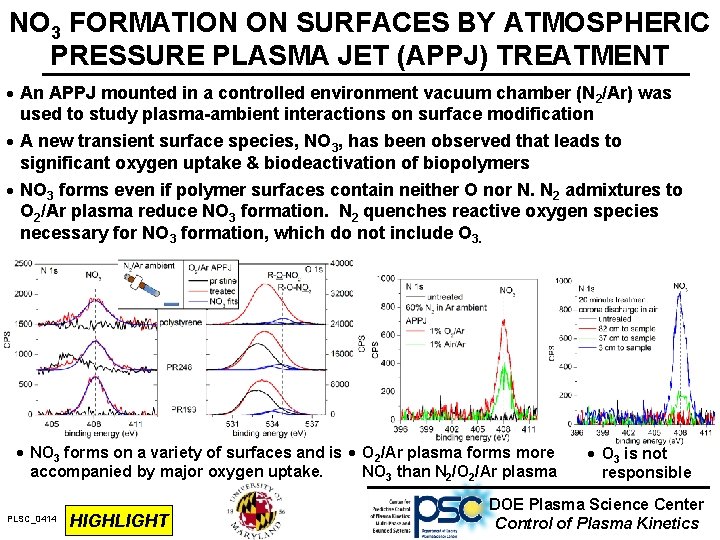
NO 3 FORMATION ON SURFACES BY ATMOSPHERIC PRESSURE PLASMA JET (APPJ) TREATMENT · An APPJ mounted in a controlled environment vacuum chamber (N 2/Ar) was used to study plasma-ambient interactions on surface modification · A new transient surface species, NO 3, has been observed that leads to significant oxygen uptake & biodeactivation of biopolymers · NO 3 forms even if polymer surfaces contain neither O nor N. N 2 admixtures to O 2/Ar plasma reduce NO 3 formation. N 2 quenches reactive oxygen species necessary for NO 3 formation, which do not include O 3. · NO 3 forms on a variety of surfaces and is · O 2/Ar plasma forms more accompanied by major oxygen uptake. NO 3 than N 2/O 2/Ar plasma PLSC_0414 HIGHLIGHT · O 3 is not responsible DOE Plasma Science Center Control of Plasma Kinetics
- Slides: 2