
SelfMedication Assessment for Providers 2020 Welcome Quick Zoom
- Slides: 33
Self-Medication Assessment for Providers 2020
Welcome! Quick Zoom tutorial Turn your camera on if you have one Keep your microphone muted unless you have a question If you are shy, you can type your questions into the chat bar I’ll stop for questions periodically. Please try to hold your questions or comments until you see the question bubbles. This session may be recorded and linked on our website so please turn off your camera if you need to do something embarrassing Materials have been sent out ahead of time. It may be helpful to reference them while we talk.
Past and Present Previously, the IC completed the Self-Medication Assessment, used the results for the plan and sent it to the Provider. The Provider needed to keep it on file for their Med QA. NOW, the Provider will complete or review the Self-Medication Assessment during the planning process and send a copy to the SSA. The SSA will keep a copy in the Master File and the Provide will keep a copy for their Med QA.
Why the change? Providers know the individuals and their medication routines the best! Individuals won’t feel pressure to perform if the IC comes to do the assessment.
Rights- it all comes down to RIGHTS Everyone has the right to administer their own medication if they have the ability. If someone doesn’t have the ability to administer their medication, they have the right to participate in the steps of medication administration if they want to. If someone has the ability to administer their own medication but the team feels there is an immediate risk to health if the person is allowed to do so then they need to get approval from the Human Rights Committee (HRC) to restrict the person’s right to self administer.
Who Needs an Assessment? If the individual is generally independent and capable then ask them, “Do you need staff to help you take your medication? ” If the answer is NO then you don’t need to do an assessment. The person is considered “self-administering” If the person is Self-Administering then staff should not do anything to help the person with their medications. The person should take responsibility for their own medications, including safeguarding them from others in the household. Individuals who are self-administering will not be included in your nursing Quality Assurance review.
Who Needs an Assessment? If the individual generally needs staff support in all areas of daily living (bathing, dressing, homemaking, accessing the community, decision making, etc. ) and does not express an interest in self-administration the guardian/team can decide that the person is not capable of Self-Administration. Answer all questions as a NO on the front of the assessment and mark the Assessment outcome as “Unable to self-administer with or without assistance. ” The ICs refer to this as a “desk review”. The individual doesn’t have to participate or answer any questions.
Who Needs an Assessment? When the individual and the team/guardian don’t agree if the individual is self-administering then the provider will go through the assessment with the individual so that they can demonstrate what they are capable of. An assessment should be done if the individual wants to learn how to self- administer. The assessment will help you decide which steps to focus on.
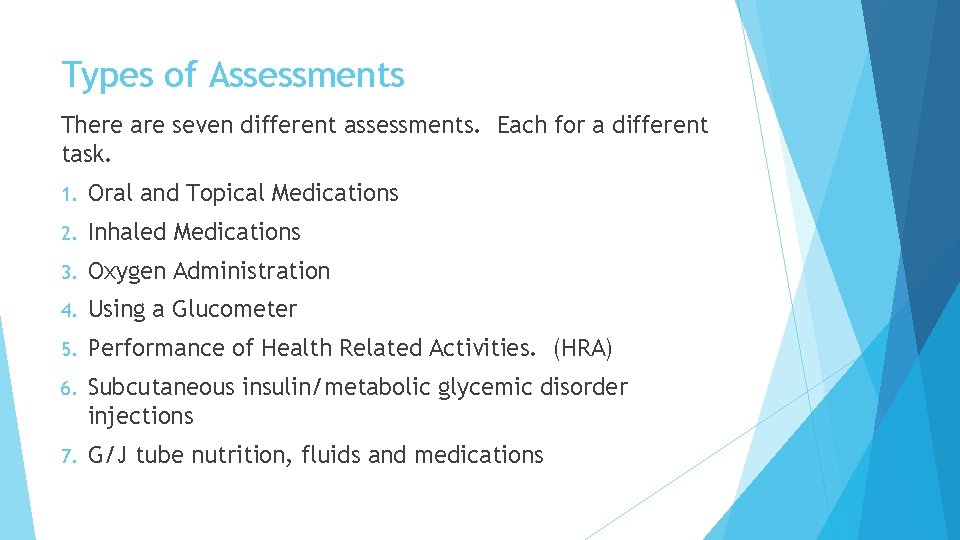
Types of Assessments There are seven different assessments. Each for a different task. 1. Oral and Topical Medications 2. Inhaled Medications 3. Oxygen Administration 4. Using a Glucometer 5. Performance of Health Related Activities. (HRA) 6. Subcutaneous insulin/metabolic glycemic disorder injections 7. G/J tube nutrition, fluids and medications
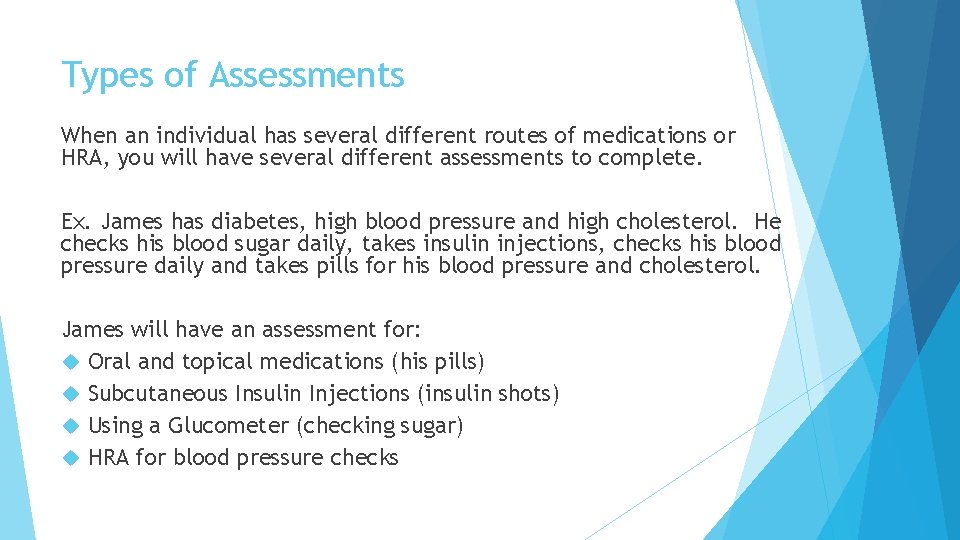
Types of Assessments When an individual has several different routes of medications or HRA, you will have several different assessments to complete. Ex. James has diabetes, high blood pressure and high cholesterol. He checks his blood sugar daily, takes insulin injections, checks his blood pressure daily and takes pills for his blood pressure and cholesterol. James will have an assessment for: Oral and topical medications (his pills) Subcutaneous Insulin Injections (insulin shots) Using a Glucometer (checking sugar) HRA for blood pressure checks
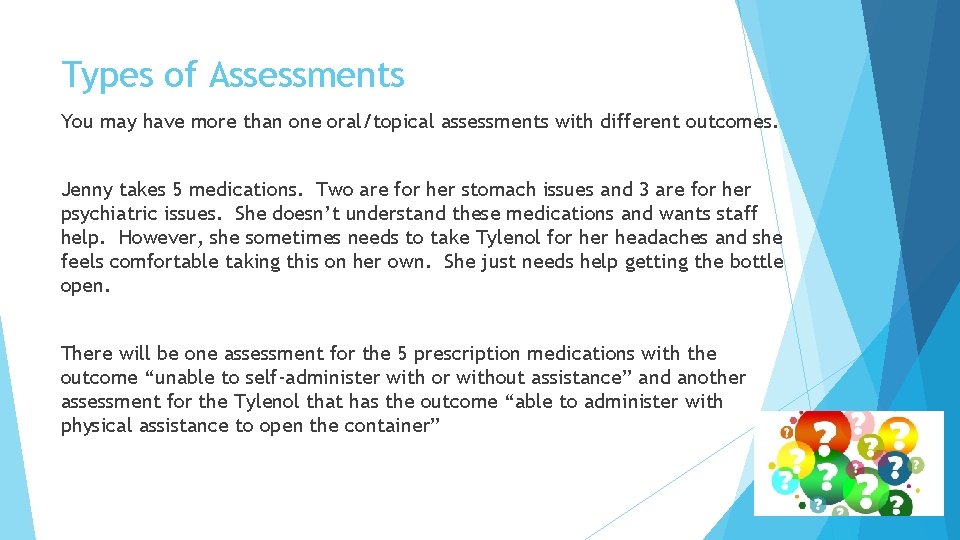
Types of Assessments You may have more than one oral/topical assessments with different outcomes. Jenny takes 5 medications. Two are for her stomach issues and 3 are for her psychiatric issues. She doesn’t understand these medications and wants staff help. However, she sometimes needs to take Tylenol for headaches and she feels comfortable taking this on her own. She just needs help getting the bottle open. There will be one assessment for the 5 prescription medications with the outcome “unable to self-administer with or without assistance” and another assessment for the Tylenol that has the outcome “able to administer with physical assistance to open the container”
Who Can Complete the Assessment? The assessment should be completed by a staff person who knows the individual well and understands their medications or HRA. The staff person needs to have ALL necessary information regarding the person’s medications or HRA including physician’s orders, medication name, dose, route, time, purpose of medication (diagnosis) and basic side effects. If it is an HRA or other task then the staff needs to know how to operate the involved machinery (bp cuff, glucometer, oxygen concentrator, pulse oximeter, etc. ) It makes sense that the person completing the assessment would have completed their Med Pass Cert 1 course.
Who Can Complete the Assessment? Staff can complete the assessments for 1. Oral and Topical Medications 2. Inhaled Medications 3. Oxygen Administration 4. Using a Glucometer 5. Performance of Health Related Activities. (HRA)
Who Can Complete the Assessment? Your Delegating Nurse has to complete the assessment for: 1. Subcutaneous insulin/metabolic glycemic disorder injections 2. G/J tube nutrition, fluids and medications This is because staff cannot administer these tasks without nurse delegation.
How do you complete the Assessment? When assessing an individual’s skills you should always be in the location where the individual usually takes the medication or completes the activity. If Maria always takes her medications at the kitchen table, it may be confusing if you do the assessment with her in your car outside the pharmacy. If Bob is self-administering with assistance at home, don’t assume that he has the same skill at day hab. The change in location may cause confusion
How do you complete the Assessment? You don’t need to read each question exactly as it is written on the form. Word things in a way that makes sense to the individual. Make it conversational. Avoid putting pressure on the individual by making it a pass or fail test. “Bob, what are the pills in this bottle for? Tell me about how you take them. ” The individual doesn’t have to know the exact names of the medication or the exact diagnosis. They just need to have a reasonable knowledge about what they are taking. “Those are my blood pressure pills. I take one every night before bed. They help me not to feel dizzy. ”
How do you complete the Assessment? Each assessment has between 8 -15 questions. You have to answer each question even if you reach the outcome on the first question. The first several questions are always about the individual’s cognitive/thinking ability to self administer the medication. The last few questions are about the individual’s physical ability to take the medication or complete the task.
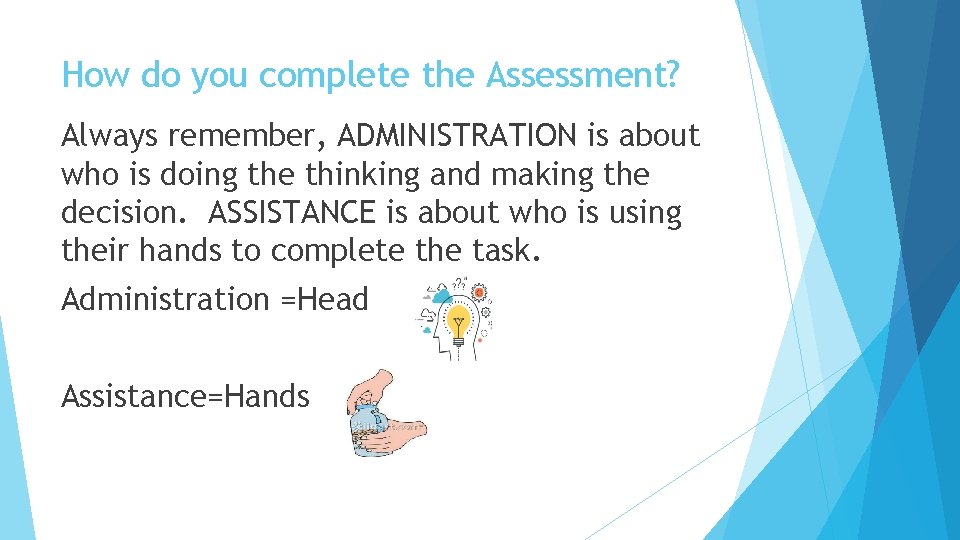
How do you complete the Assessment? Always remember, ADMINISTRATION is about who is doing the thinking and making the decision. ASSISTANCE is about who is using their hands to complete the task. Administration =Head Assistance=Hands
How do you complete the Assessment? After you have answered all of the numbered questions, turn the form over and look for the “Assessment Outcome” There are three possible outcomes: 1. Able to self-administer without assistance. 2. Able to self-administer with assistance. 3. (all questions were marked YES and the individual is the one using their head and hands to complete the task) (all the questions about cognitive ability were marked YES and one or more of the questions about physical ability was marked NO. The individual will be using their head but relying on staff to help with their hands. ) Be sure to check what kind of assistance is needed. Unable to self-administer with or without assistance. Staff will need to use their heads and hands to administer the medication. Be sure to check one of the two boxes below this outcome.
What ASSISTANCE can be offered? Oral and Topical Medications Staff can assist by: Reminding the person when it is time to take the medications and/or confirming direction on the container Helping the individual to remove the medication from storage, handing the container to the individual or helping the individual open the container Upon request, and at the individual’s direction, removing the medication from the container and helping them to take or apply the medication. If the individual is unable, putting the medication in their mouth or topically applying medication. The individual needs to make the decisions every time. Staff are only using their hands to assist.
What ASSISTANCE can be offered? Oxygen Staff can assist by: Reminding the person when it is time to use the oxygen and/or when to take oxygen saturation readings. Helping the individual to remove the oxygen tank/concentrator/supplies from storage. Upon request, and at the individual’s direction, provide physical assistance with any step of the process (application of oxygen mask/cannula, turning on oxygen, opening/closing the tank, cleaning equipment. )
What ASSISTANCE can be offered? Inhaled Medications Staff can assist by: Reminding the person when it is time to take the medications and/or confirming direction on the container Helping the individual to remove the medication from storage, handing the container to the individual or helping the individual open the container Upon request, and at the individual’s direction, providing physical assistance with any step of the process.
What ASSISTANCE can be offered? Health Related Activities Staff can assist by: Reminding the person when it is time to perform the task. Helping the individual to remove the equipment from storage. Upon request, and at the individual’s direction, getting supplies out of container, assembly of equipment.
What ASSISTANCE can be offered? Using a Glucometer Staff can assist by: Reminding the person when it is time to test Helping the individual to remove the glucometer from storage. Upon request, and at the individual’s direction, receiving help with use of lancet/unistick or pen; putting blood on the test strip; checking the glucometer with test solutions; cleaning the glucometer or disposing of equipment.
What ASSISTANCE can be offered? Medications, Nutrition, fluids per G/J Tube Staff can assist by: Reminding the person when it is time to administer food, fluids or medications and/or confirming directions on the container. Helping the individual to remove the supplies from storage, handing the container to the individual or helping the individual open the container. Upon request, and at the individual’s direction, provide physical assistance with any step of the process (opening containers, preparing medications or nutritional mixtures, cleaning equipment, etc. )
What ASSISTANCE can be offered? Insulin/Metabolic Glycemic Disorder Medications Staff can assist by: Reminding the person when it is time to take the medications and/or confirming directions on the container Helping the individual to remove the medication from storage, physically handing the vial or prefilled syringe/pen to the individual, returning it to storage and disposing of needles. Upon request, and at the individual’s direction, dialing the pen, insert the cartridge, rotate site, etc.
What ASSISTANCE can be offered? When providing assistance, be wary that you and the individual don’t get so comfortable that you stray from assistance and start providing administration. Always stop and think, “who is the one using their head for this task? ” If staff are the ones using the heads (making decisions) then they are administering. The assessment and the plan need to match what is happening in the home. You don’t want to be out of compliance with the plan. Example: Margaret
Unable to administer (with or without assistance) If the outcome is that the individual is unable to administer, then you need to choose one of the following: The individual can do some of the steps of administration and a properly licensed, certified or delegated person completes the other steps. Details of that steps the individual will do should be outlined in the plan (PCP) A properly licensed, certified or delegated person must do all the steps of administration.
Other Considerations If the team determines that the individual cannot safely self administer with or without assistance because of unsafe behaviors then that box will be marked, an explanation written in and the plan will have to get approval from HRC.
Review process The assessment has to be reviewed annually and completed fresh every 3 years. Each year you will send your assessment form to the IC during the annual planning process or whenever the outcome has changed. The PCP cannot be authorized without an updated review/assessment. The review/assessment does not need to be done on a certain date. Just ensure that you complete it a minimum of once a calendar year, roughly 12 months apart.
Review process It may be necessary to do a medication assessment more frequently than once per year. Consider if any of the following situation occur that may impact the outcome of the assessment: • A change in medication route, packaging, or medication delivery system • A change in service setting • A change in the person’s health status • A change in the usual medication routine (new location, new provider) • A change in functional status of other Activities of Daily Living (ADLs) • A change in nutritional formula packaging
Review process If, a person who has historically been able to self-administer but due to a change is unable to do so safely, the assessment is updated. The assistance and supports are provided according to the assessment result(s) and listed in the ISP. Training and support should be provided to help the person return to self-administration status. The person should be reassessed for the ability to resume selfadministration as soon as the circumstances allow. Examples of such occasions include, but are not limited to: • Physical/psychiatric illness affecting memory or functional capacity • New medications the person is not yet familiar with • Post-operative; post-sedation • Environmental changes during which time training is needed to transfer skills to the new environment
Thank You! If you have any questions or comments please send them to Jackie Fry, IC Manager jfry@rnewhope. org or call 567 -303 -4119. You can also talk with your delegating nurse or the QA nurse that does your review this year.