
Selfhelp Groups Social Capital NG Hangsau Chief Service

- Slides: 19
Self-help Groups & Social Capital NG Hang-sau Chief Service Supervisor Community Rehabilitation Network The Hong Kong Society for Rehabilitation Tel: 2794 3010 Fax: 2338 4820 E-mail: hsng@rehabsociety. org. hk 8 March, 2002
OUTLINE OF PRESENTATION > > > Introduction Changing environment Self-help development in Hong Kong Self-help groups and social capital Future development of self-help
CHANGING ENVIRONMENT > Advance medical technology > Change of disease pattern > Increased awareness of patients’ rights > Escalating health cost > Strong professionalization > Service fragmentation and dehumanization of institution > New services models
SELF-HELP DEVELOPMENT IN HONG KONG > What is self-help group/ organization > Historical development > Prevalence of self-help group > Characteristic of selfhelp groups in Hong Kong
WHAT IS SELF-HELP ORGANIZATIONS > groups of individuals in a group structure > to pursue common goals of furthering their own welfare and interests > group solidarity arises > people encountering similar problems > to overcome them > by sharing experience and exchanging information (White Paper on Rehabilitation)
DIFFERENCE BETWEEN SELF-HELP, SUPPORT & PSYCHOTHERAPY GROUPS > Self-help group > supportive, educational, usually changeoriented that addresses a single life problem, professionals rarely have an active role > Support > giving group emotional support and information to persons with a common problem, often facilitated by professionals
DIFFERENCE BETWEEN SELF-HELP, SUPPORT & PSYCHOTHERAPY GROUPS > Psychotherapy > seek group to produce individual growth & change through the relationship established among members with the help of a professional therapist
DEVELOPMENT OF SELF-HELP ORGANIZATIONS IN HONG KONG (I) > Deep rooted in the civilization of mankind > Early form of self-help and mutual help are based on consanguinity and clan > Address life problem or conditions shared by all members > Based on the concept of equality, fraternity and mutual help
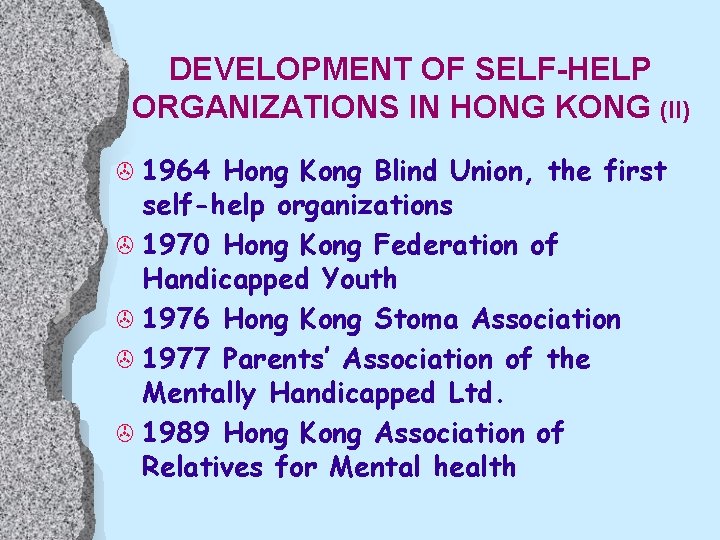
DEVELOPMENT OF SELF-HELP ORGANIZATIONS IN HONG KONG (II) > 1964 Hong Kong Blind Union, the first self-help organizations > 1970 Hong Kong Federation of Handicapped Youth > 1976 Hong Kong Stoma Association > 1977 Parents’ Association of the Mentally Handicapped Ltd. > 1989 Hong Kong Association of Relatives for Mental health
DEVELOPMENT OF SELF-HELP ORGANIZATIONS IN HONG KONG (III) > 1987 Hong Kong Joint Council of Parents of the Mentally Handicapped > 1995 Chosen Power, formed by people with mental handicap > 1993 Alliance for Patients’ Mutual Help Organizations
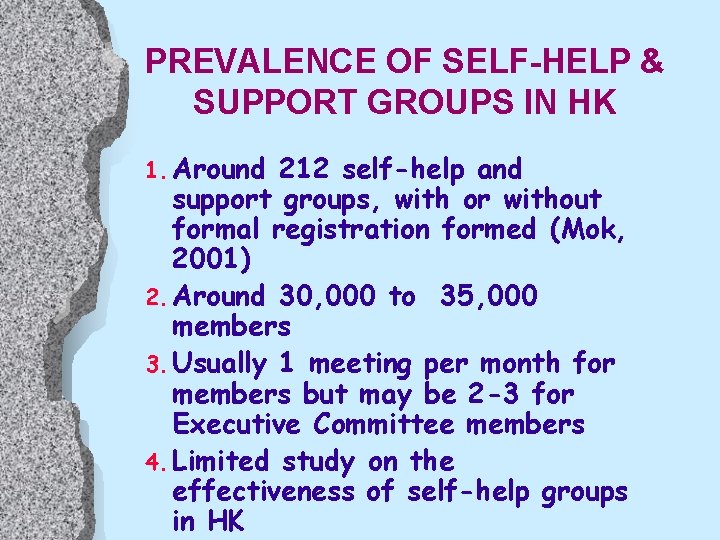
PREVALENCE OF SELF-HELP & SUPPORT GROUPS IN HK 1. Around 212 self-help and support groups, with or without formal registration formed (Mok, 2001) 2. Around 30, 000 to 35, 000 members 3. Usually 1 meeting per month for members but may be 2 -3 for Executive Committee members 4. Limited study on the effectiveness of self-help groups in HK
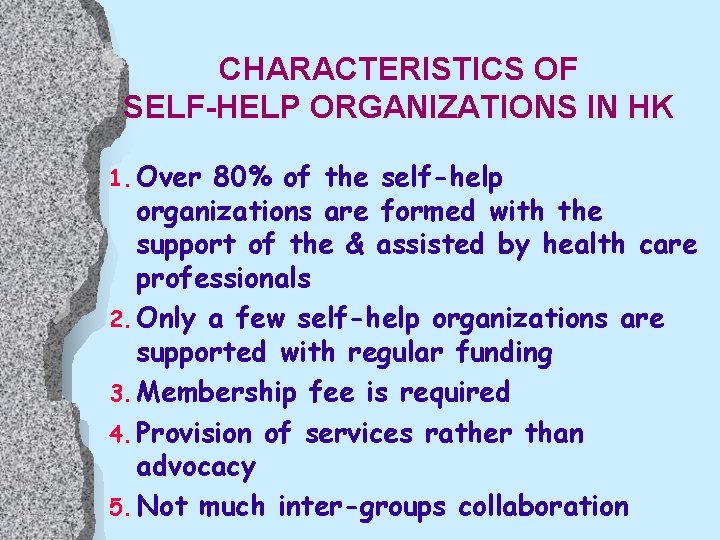
CHARACTERISTICS OF SELF-HELP ORGANIZATIONS IN HK 1. Over 80% of the self-help organizations are formed with the support of the & assisted by health care professionals 2. Only a few self-help organizations are supported with regular funding 3. Membership fee is required 4. Provision of services rather than advocacy 5. Not much inter-groups collaboration
ROLE & FUNCTIONS OF SELF-HELP ORGANIZATIONS > Emotional support > Information and advice > Pressure group activities and lobbying > Bulk purchase > Fund raising > Public education > Support research
INDIVIDUAL & SOCIAL BENEFITS OF SELF-HELP ORGANIZATIONS > Addressing behavior-control problem > Improved coping with chronic illness and life transitions > Friendship and belonging > Spiritual renewal > Increasing political activism > Enhanced civil society > Reduced health care resource use (by: Kieth Humphreys)
RELATION TO SOCIAL CAPITAL > Involves families/ carers > Forms support network > Develops mutual trust/ cooperation/ long-term relationships > Facilitates human functioning > Aids the formation of human capital
ROLE OF PROFESSIONALS IN SELF-HELP ORGANIZATIONS > Founder > Consultant > Resource provider > Referrer > Legitimizer (by: Bonnie Pape) Am I right? Go ahead!
FUTURE DEVELOPMENT OF SELF-HELP MOVEMENT > Develop membership vs mutuality > Organizational building vs locality MASH > Professional collaboration vs antiprofessional > Government’s funding vs advocacy > On-line self-help vs traditional > Training of self-helpers & professionals > Self-help research
CONCLUSION > Strengths & weaknesses > Not prefect: areas for improvement > Not an answer for all > Self-help to be all things to all people?
THANK YOU