
SelfGeneration Incentive Program SGIP SBCCOG Energy Management August
Self-Generation Incentive Program (SGIP) SBCCOG Energy Management August 24, 2016
Self-Generation Incentive Program (SGIP) • The Self-Generation Incentive Program (SGIP) provides financial incentives for the installation of new qualifying technologies that are installed to meet all or a portion of the electric energy needs of a facility. • Current Program Handbook can be found at www. sce. com/SGIP. 2
Self-Generation Incentive Program (SGIP) Decision introducing Program Modifications The major changes to SGIP effected by this decision include: • SGIP incentives shall be administered on a continuous basis with incentive levels declining based on the capacity reserved in the program, similar to the California Solar Initiative; • The incentive budgets divided between two broad categories: energy storage and generation. − Energy storage is allocated 75% of program funds, with 15% of the energy storage budget carved out for projects less than or equal to 10 kilowatts. − Generation is allocated the remaining 25%, with 10% carved out for renewable generation projects; • Beginning with program year 2017, generation projects consuming natural gas must use a minimum of 10% biogas to receive an SGIP incentive. The minimum requirement increases to 25% in 2018, 50% in 2019, and 100% in 2020; • Each participating project developer will be capped at a total of 20% of the incentive budget on a statewide basis. This replaces the previous 40% cap that applied to equipment manufacturers; 3
Self-Generation Incentive Program (SGIP) Eligible Technologies Basic Program Requirements • Wind Turbine • Waste Heat to Power Technologies • Pressure Reduction Turbine • Internal Combustion Engine – CHP • Microturbine – CHP • Gas Turbine – CHP • Steam Turbine – CHP • Fuel Cell – CHP or Electric only • Advanced Energy Storage • • Sized up to onsite demand Minimum /Maximum Size: None Incentive Limit: 3 MW Equipment must be commercially available, factory new generating equipment EE Audit by utility or 3 rd party Interconnection Application Fee 100% Site Inspection 4
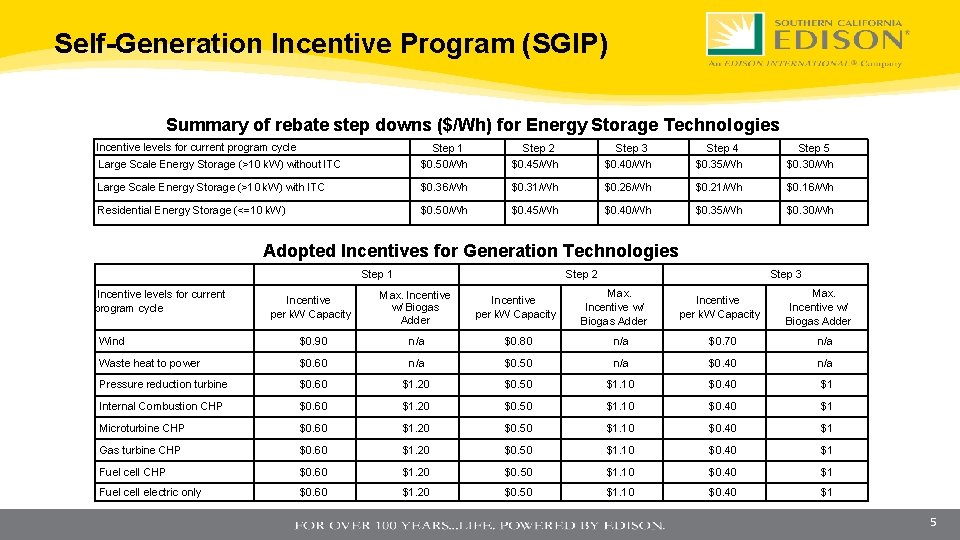
Self-Generation Incentive Program (SGIP) Summary of rebate step downs ($/Wh) for Energy Storage Technologies Incentive levels for current program cycle Large Scale Energy Storage (>10 k. W) without ITC Step 1 $0. 50/Wh Step 2 $0. 45/Wh Step 3 $0. 40/Wh Step 4 $0. 35/Wh Step 5 $0. 30/Wh Large Scale Energy Storage (>10 k. W) with ITC $0. 36/Wh $0. 31/Wh $0. 26/Wh $0. 21/Wh $0. 16/Wh Residential Energy Storage (<=10 k. W) $0. 50/Wh $0. 45/Wh $0. 40/Wh $0. 35/Wh $0. 30/Wh Adopted Incentives for Generation Technologies Step 1 Incentive levels for current program cycle Step 2 Step 3 Max. Incentive w/ Biogas Adder Incentive per k. W Capacity Wind $0. 90 n/a $0. 80 n/a $0. 70 n/a Waste heat to power $0. 60 n/a $0. 50 n/a $0. 40 n/a Pressure reduction turbine $0. 60 $1. 20 $0. 50 $1. 10 $0. 40 $1 Internal Combustion CHP $0. 60 $1. 20 $0. 50 $1. 10 $0. 40 $1 Microturbine CHP $0. 60 $1. 20 $0. 50 $1. 10 $0. 40 $1 Gas turbine CHP $0. 60 $1. 20 $0. 50 $1. 10 $0. 40 $1 Fuel cell electric only $0. 60 $1. 20 $0. 50 $1. 10 $0. 40 $1 Incentive per k. W Capacity 5
Self-Generation Incentive Program (SGIP) • Expectation − − − Program Handbook for with the SGIP program modifications should be available first quarter 2017. Current Program Handbook can be found at www. sce. com/SGIP. Once program opens under new guidelines it is anticipated incentives will go quickly. Once SGIP incentive funds are spent the Commission would have to additional funds to keep the program open. Projects must be completed 18 months after submittal of SGIP application When you reach the point in your project where you are ready to submit an application to SGIP, please go to our web site www. sce. com/sgip and www. selfgenca. com. Jim Stevenson, SCE SGIP Program Manager at SGIPGroup@sce. com
- Slides: 6