
SelfDriving Coalition for Safer Streets Presentation to the
- Slides: 27
Self-Driving Coalition for Safer Streets: Presentation to the Select Committee on Blockchain, Financial Technology and Digital Innovation Technology July 27, 2020 Ariel S. Wolf Counsel, Self-Driving Coalition for Safer Streets | Counsel, Venable LLP | +1 202. 344. 4013 | aswolf@Venable. com
Agenda 1. The Self-Driving Coalition for Safer Streets: Who We Are 1. Overview of AV Concepts and Technology 1. Coalition Approach to AV Policymaking 1. Questions?
The Self-Driving Coalition for Safer Streets: Who We Are
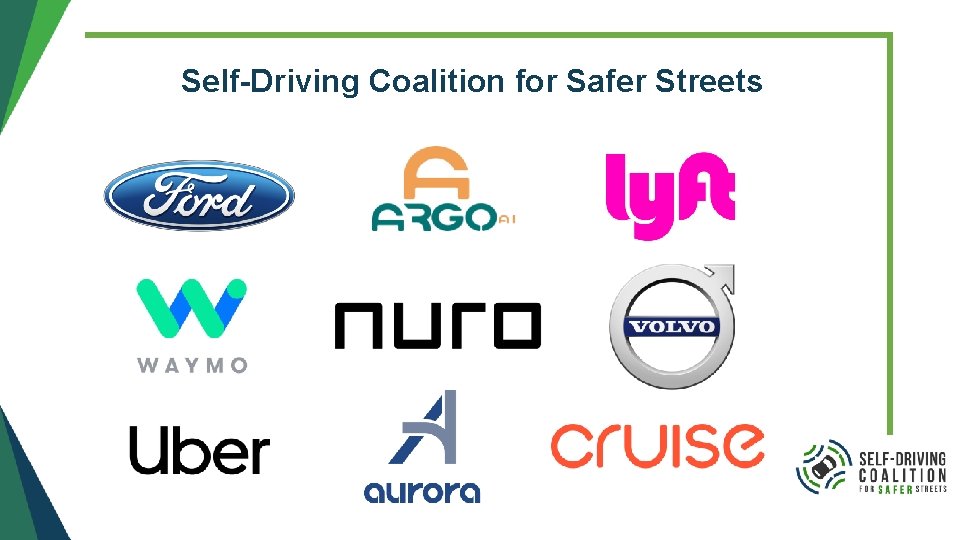
Self-Driving Coalition for Safer Streets
Our Mission The Self-Driving Coalition works collaboratively with lawmakers, regulators, and the public to accomplish the following: • Develop and promote policies that safely and thoughtfully advance fully self-driving vehicles in order for the technology to realize its full safety and mobility benefits; and • Work with stakeholders to understand the broader societal and economic opportunities of self-driving vehicles. State and local governments have an essential role to play in this process
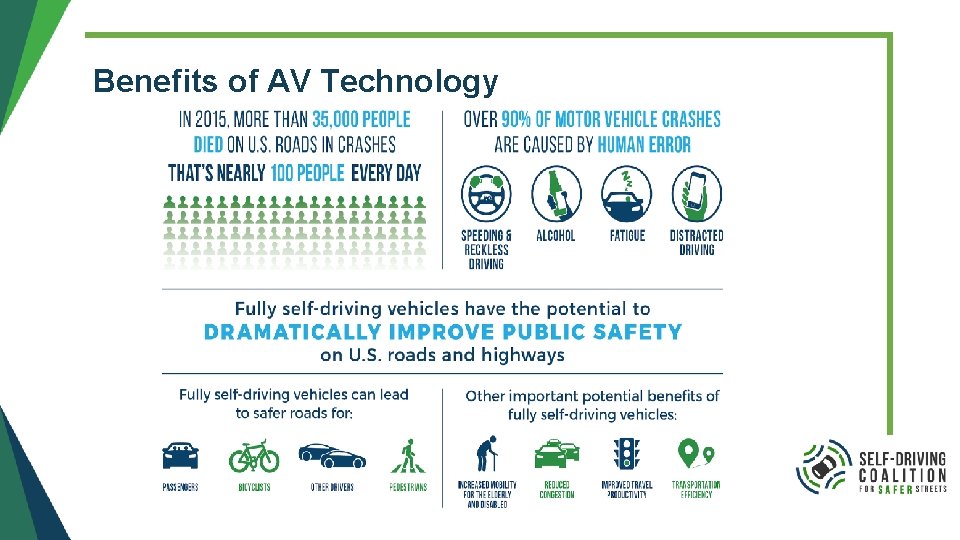
Benefits of AV Technology
Overview of AV Concepts and Technology
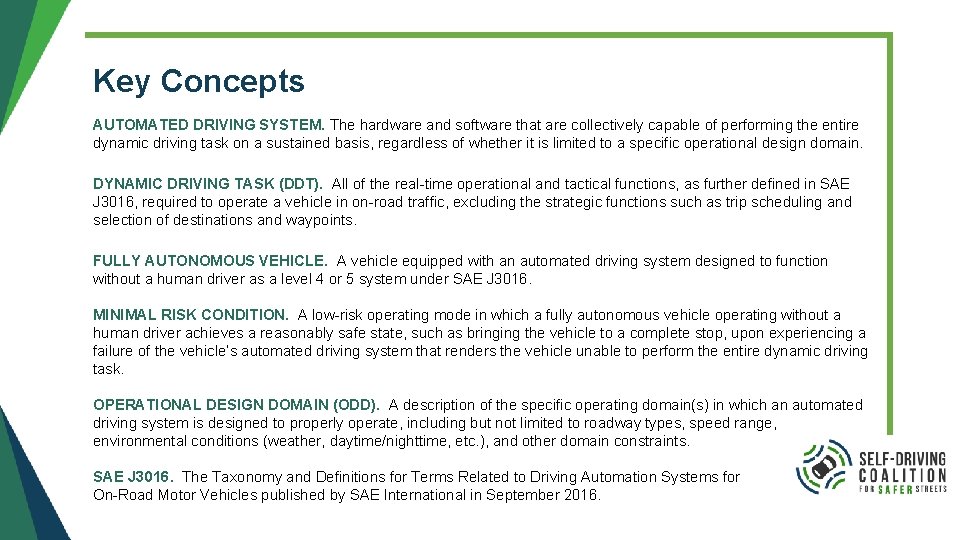
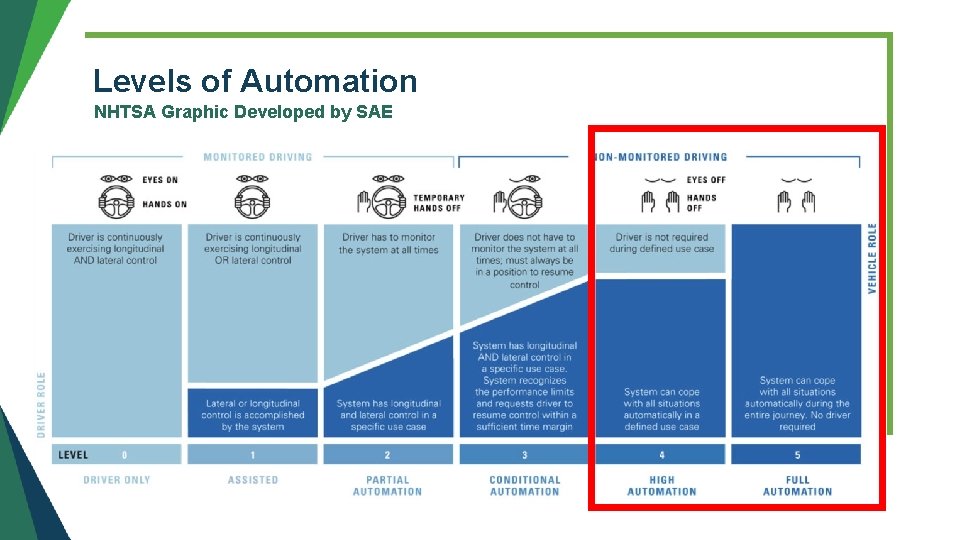
Key Concepts AUTOMATED DRIVING SYSTEM. The hardware and software that are collectively capable of performing the entire dynamic driving task on a sustained basis, regardless of whether it is limited to a specific operational design domain. DYNAMIC DRIVING TASK (DDT). All of the real-time operational and tactical functions, as further defined in SAE J 3016, required to operate a vehicle in on-road traffic, excluding the strategic functions such as trip scheduling and selection of destinations and waypoints. FULLY AUTONOMOUS VEHICLE. A vehicle equipped with an automated driving system designed to function without a human driver as a level 4 or 5 system under SAE J 3016. MINIMAL RISK CONDITION. A low-risk operating mode in which a fully autonomous vehicle operating without a human driver achieves a reasonably safe state, such as bringing the vehicle to a complete stop, upon experiencing a failure of the vehicle’s automated driving system that renders the vehicle unable to perform the entire dynamic driving task. OPERATIONAL DESIGN DOMAIN (ODD). A description of the specific operating domain(s) in which an automated driving system is designed to properly operate, including but not limited to roadway types, speed range, environmental conditions (weather, daytime/nighttime, etc. ), and other domain constraints. SAE J 3016. The Taxonomy and Definitions for Terms Related to Driving Automation Systems for On-Road Motor Vehicles published by SAE International in September 2016.
Levels of Automation NHTSA Graphic Developed by SAE
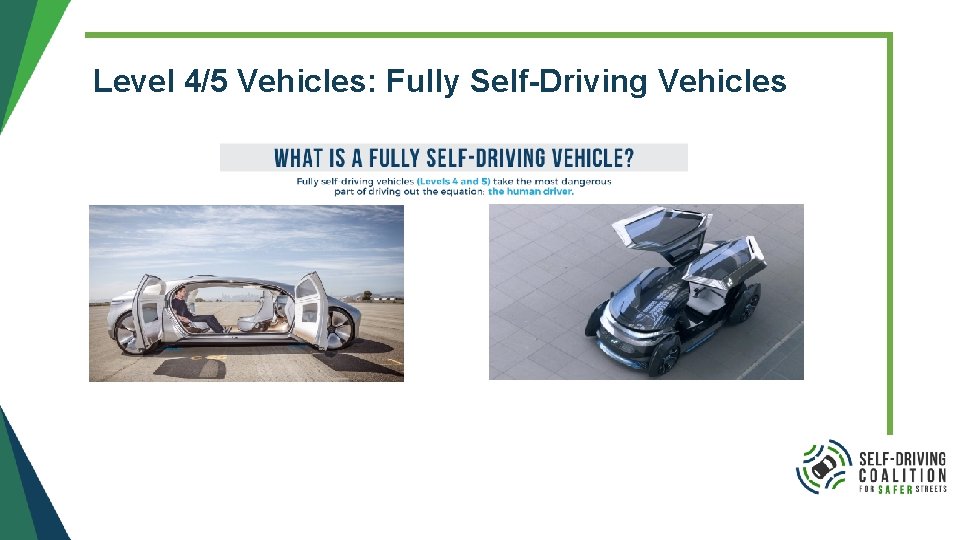
Level 4/5 Vehicles: Fully Self-Driving Vehicles
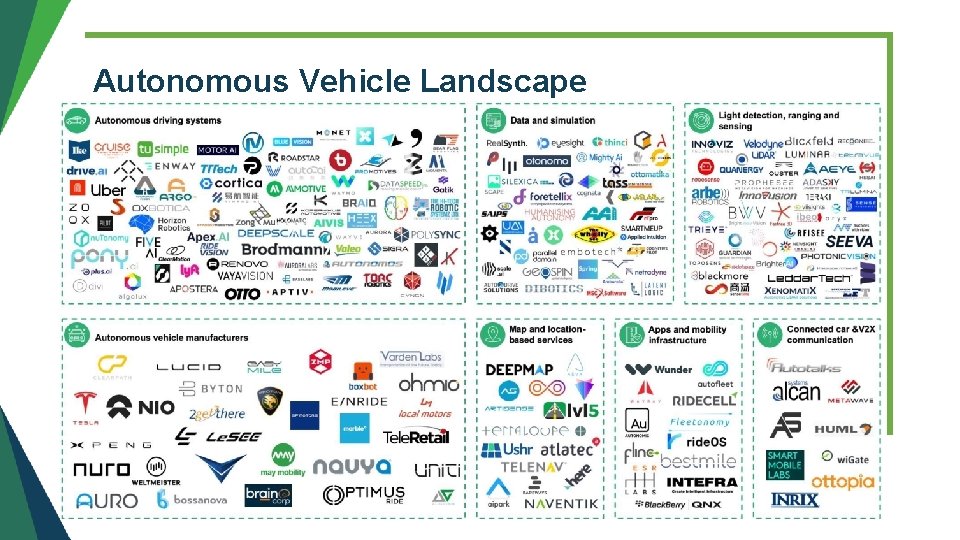
Autonomous Vehicle Landscape
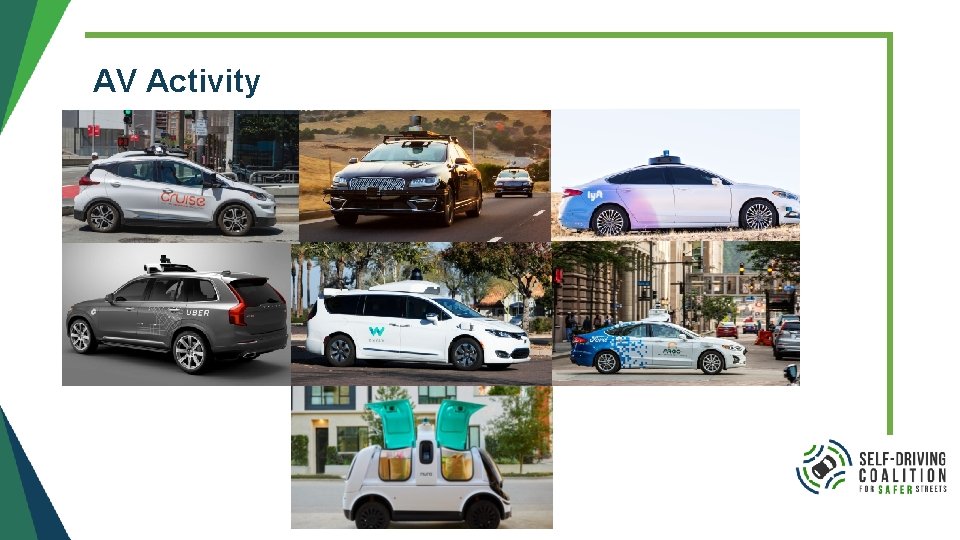
AV Activity
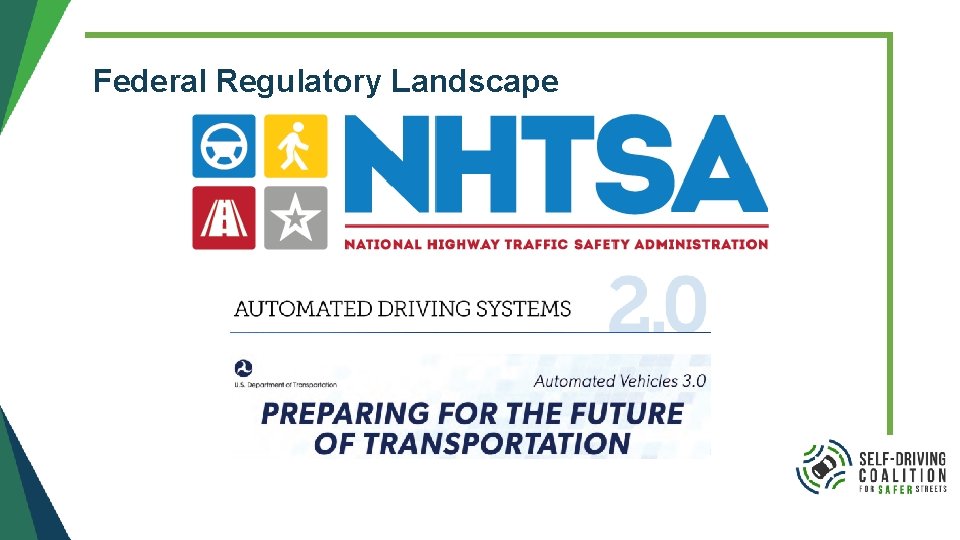
Federal Regulatory Landscape
Coalition Approach to AV Policymaking
Coalition’s Approach to AV Policymaking Core Principles I. Expanding testing and deployment of fully self-driving vehicles I. Preserving traditional state and federal roles I. Maintaining the existing liability regime
Coalition’s Approach to State Legislation • Support state efforts to facilitate AV testing and deployment of fully self-driving vehicles • Majority of states already have existing statutory and regulatory motor vehicle frameworks that permit AV testing and deployment • Coalition seeks to be a resource for state regulators and lawmakers
Coalition’s Model Legislation The Self-Driving Coalition’s model legislation would: • provide for the deployment of SAE Level 4/5 AV technology in a way that would promote safety while allowing innovation to flourish; • promote competition; and • avoid unnecessary restrictions on AV technology.
Coalition’s Model Legislation The model legislation addresses key issues, including: • Safety • Insurance • Accident reporting • Registration and titling
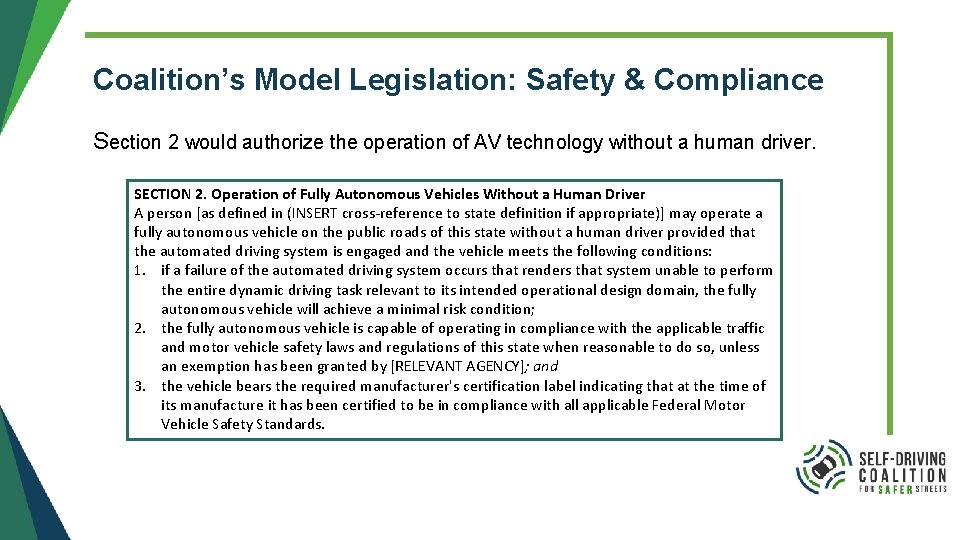
Coalition’s Model Legislation: Safety & Compliance Section 2 would authorize the operation of AV technology without a human driver. SECTION 2. Operation of Fully Autonomous Vehicles Without a Human Driver A person [as defined in (INSERT cross-reference to state definition if appropriate)] may operate a fully autonomous vehicle on the public roads of this state without a human driver provided that the automated driving system is engaged and the vehicle meets the following conditions: 1. if a failure of the automated driving system occurs that renders that system unable to perform the entire dynamic driving task relevant to its intended operational design domain, the fully autonomous vehicle will achieve a minimal risk condition; 2. the fully autonomous vehicle is capable of operating in compliance with the applicable traffic and motor vehicle safety laws and regulations of this state when reasonable to do so, unless an exemption has been granted by [RELEVANT AGENCY]; and 3. the vehicle bears the required manufacturer's certification label indicating that at the time of its manufacture it has been certified to be in compliance with all applicable Federal Motor Vehicle Safety Standards.
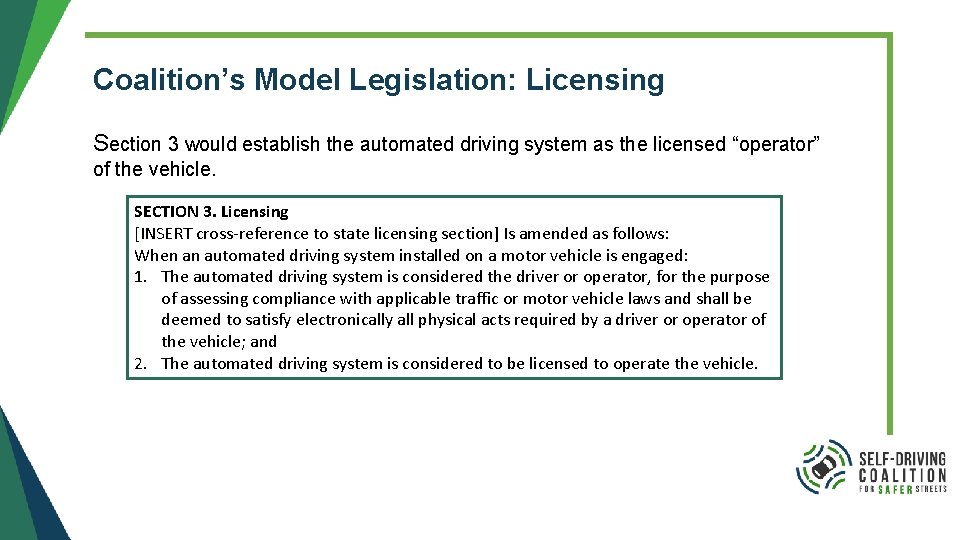
Coalition’s Model Legislation: Licensing Section 3 would establish the automated driving system as the licensed “operator” of the vehicle. SECTION 3. Licensing [INSERT cross-reference to state licensing section] Is amended as follows: When an automated driving system installed on a motor vehicle is engaged: 1. The automated driving system is considered the driver or operator, for the purpose of assessing compliance with applicable traffic or motor vehicle laws and shall be deemed to satisfy electronically all physical acts required by a driver or operator of the vehicle; and 2. The automated driving system is considered to be licensed to operate the vehicle.
Coalition’s Model Legislation: Insurance Section 4 would require the submission of proof of insurance in compliance with state law as a precondition to the operation of AV technology. SECTION 4. Insurance. Before operating a fully autonomous vehicle on public roads in this state without a human driver, a person shall submit proof of financial responsibility satisfactory to the [RELEVANT AGENCY] that the fully autonomous vehicle is covered by insurance or proof of self-insurance that satisfies the requirements of applicable [INSERT cross-reference to state motor vehicle financial responsibility laws, (e. g. the respective state laws for personal vehicle ownership, transportation network companies, leasing, vehicle rental, vehicle-for-hire, etc. )].
Coalition’s Model Legislation: Duties Following Crashes Section 5 would require AVs to remain on the scene following a crash and report crashes consistent with other state laws. SECTION 5. Duties following crashes involving fully autonomous vehicles. In the event of a crash: 1. The fully autonomous vehicle shall remain on the scene of the crash when required by [cross-reference to state laws pertaining to duties following crashes], consistent with its capability under Section 2(1). 2. The owner of the fully autonomous vehicle, or a person on behalf of the vehicle owner, shall report any crashes or collisions consistent with [cross-reference to state laws pertaining to crash reporting].
Coalition’s Model Legislation: On-Demand AV Networks Section 6 would authorize the operation of on-demand AV networks. SECTION 6. On-demand autonomous vehicle network. An on-demand autonomous vehicle network shall be permitted to operate pursuant to state laws governing the operation of transportation network companies, taxis, or any other ground transportation for-hire of passengers [or other relevant law governing transportation of goods, etc. ], with the exception that any provision of [the crossreferenced state laws] that reasonably applies only to a human driver would not apply to the operation of fully autonomous vehicles with the automated driving system engaged on an on-demand autonomous vehicle network.
Coalition’s Model Legislation: Registration and Titling Section 7 would require the submission of proper registration and titling for AVs in accordance with state law, as a condition of AV technology deployment. SECTION 7. Registration and title. a) A fully autonomous vehicle shall be properly registered in accordance with [INSERT cross-reference to background laws re: vehicle registration]. If a fully autonomous vehicle is registered in this state, the vehicle shall be identified on the registration as a fully autonomous vehicle. b) A fully autonomous vehicle shall be properly titled in accordance with [INSERT cross -reference to background law re: vehicle titles]. If a fully autonomous vehicle is titled in this state, the vehicle shall be identified on the title as a fully autonomous vehicle.
Coalition’s Model Legislation: Controlling Authority Section 8 would ensure that authority over AVs is vested in a single state agency to ensure that AVs are subject to a uniform regulatory framework across the state. SECTION 8. Controlling authority. a) Unless otherwise provided in this chapter and notwithstanding any other provision of law, fully autonomous vehicles and automated driving systems are governed exclusively by this [Act]. [RELEVANT AGENCY] is the sole and exclusive state agency that may implement the provisions of this [Act]. b) No state agency, political subdivision, municipality, or local entity may prohibit the operation of fully autonomous vehicles, automated driving systems, or on-demand autonomous vehicle networks, or otherwise enact or keep in force rules or ordinances that would impose taxes, fees, or other requirements (including performance standards), specific to the operation of fully autonomous vehicles, automated driving systems, or on-demand autonomous vehicle networks in addition to the requirements of this [Act].
Coalition’s Model Legislation: Human Driver Operation Section 9 would allow a human driver to operate a vehicle equipped with an ADS that is not fully autonomous and clarifies that human drivers may operate fully autonomous vehicles as well. SECTION 9. Operation of a motor vehicle with an automated driving system by a human driver. a) A human driver may operate a motor vehicle equipped with an automated driving system capable of performing the entire dynamic driving task but that is not a fully autonomous vehicle if -i. such automated driving system is designed with the expectation that the human driver will respond appropriately to a request to intervene and to issue such a request whenever the automated driving system is not capable of performing the entire dynamic driving task; and ii. the automated driving system is capable of being operated in compliance with [INSERT cross-reference to background law re: rules of the road] when reasonable to do so unless an exemption has been granted by [relevant Agency]. b) Nothing in this Act prohibits or restricts a human driver from operating a fully autonomous vehicle equipped with controls that allow for the human driver to control all or part of the dynamic driving task.
Questions?