
SELFCARE How to become a healthy professional CLASS

SELF-CARE How to become a healthy professional
CLASS INDEX 1. PROBLEM EXPLANATION 2. DEFINITIONS 3. HOW TO ACHIEVE BALANCE
What is happening to PC health professionals? • Research has identified various stressors to PC workers: o Constant exposure to death o Inadequate time with dying patients o Growing workload o Inadequate coping with their own emotional response to the dying o Increasing number of deaths • Those stressors leads to o Communication difficulties with dying patients and families o Feelings of grief, depression and guilt Kearney MK et al. JAMA 2009; 301: 1155– 1164.
DEFINITIONS 1. Burnout 2. Compassion Fatigue 3. Compassion Satisfaction
BURNOUT (Maslach & Jackson 1981) • Burnout is a prolonged response to chronic emotional and interpersonal stressors on the job. It is defined by the three dimensions of exhaustion, cynicism, and professional inefficacy • As a reliably identifiable job stress syndrome, burnout clearly places the individual stress experience within a larger organizational context of people's relation to their work • But Burnout impairs both personal and social functioning
COMPASSION FATIGUE (Figley 1995) • Compassion Fatigue has often been referred to as the emotional “cost of caring” for others and has led professionals to abandon their work with traumatized victims in their care. • It is portrayed as a stress response that emerges suddenly and without warning and includes a sense of helplessness, isolation and confusion • If not attended to, Compassion Fatigue may lead to depression and stress-related illnesses
COMPASSION SATISFACTION • Compassion Satisfaction stems from the emotional rewards of caring for others in a health care context; clinicians feel a sense of return or incentive by seeing a ‘change for the better’ in patients and families o It is a pleasure to help others through what you do o You may feel positively about your colleagues or your ability to contribute to the work setting o You feel positive the greater good of society through your work with people who need care
BALANCE Reducing the types of stresses that lead to Compassion Fatigue and fostering best practices that increase levels of Compassion Satisfaction.
End of life patient care implications • Intense affective involvement • Confrontation to unanswered questions • Emotions and personal feelings present • It makes us think and question ourselves: • • Our own death Our vulnerability Fears Sense of life and suffering 9
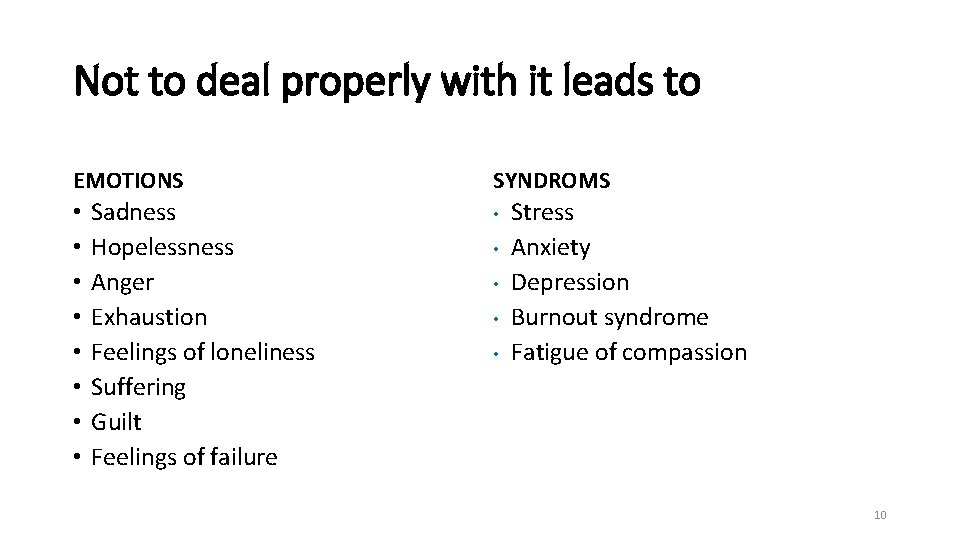
Not to deal properly with it leads to EMOTIONS • • Sadness Hopelessness Anger Exhaustion Feelings of loneliness Suffering Guilt Feelings of failure SYNDROMS • • • Stress Anxiety Depression Burnout syndrome Fatigue of compassion 10
Feelings of helplessness • Feelings of helplessness are common. It is necessary to learn how to deal with it • Understand our role as health care professionals , adjust our expectations to end-of-life patients necessities will change this feelings toward compassion satisfaction
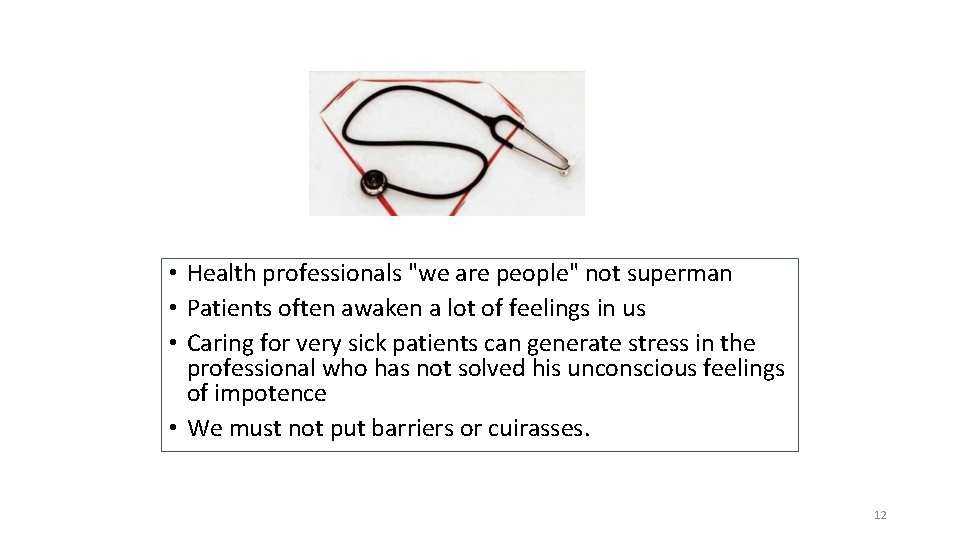
• Health professionals "we are people" not superman • Patients often awaken a lot of feelings in us • Caring for very sick patients can generate stress in the professional who has not solved his unconscious feelings of impotence • We must not put barriers or cuirasses. 12
Self care: what can I do? Self knowledge Expectations Team work Out of the work
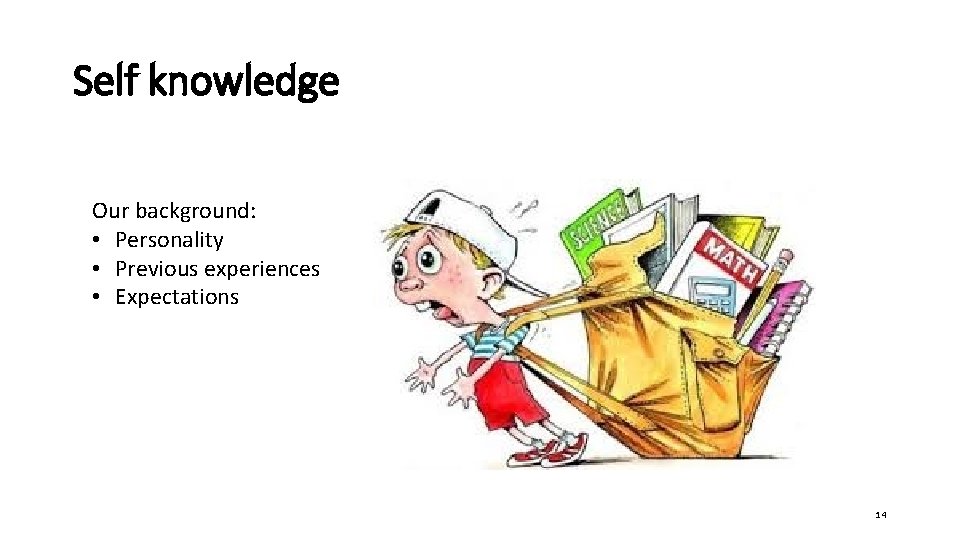
Self knowledge Our background: • Personality • Previous experiences • Expectations 14
Feelings of helplessness • Think about a situation that was difficult for you, that make you have feelings of helplessness: o What makes it difficult? o How can my feelings of impotence manifest in that situation? o Manage my emotions o Think about how I can react to different cases
Personal interior work: Understanding myself • How I deal with uncertainty? • How I deal with adversity? • How I deal with disease? • How I deal with death? 16
Real Expectations • Expectations = Formation “If we know palliative medicine, we will now how to respond to the challenging clinical situations that suffer end-of-life patients” HOLISTIC CARE: PSYMPTOM MANAGEMENT, COMMUNICATION SKILLS, SOCIAL and PSYCHOLOGICAL support, TEAMWORK…
Team Work • The work of the team as support for the team (specially useful to prevent Burn-out) • Team members must be supportive to other team members, specially at critical times • Create communication spaces where possible to talk about difficult situations without obstacles • Review difficult situations as a team: duel, difficult pain • Facilitate feelings expressions when desired • "Normalize" unexpected reactions from others
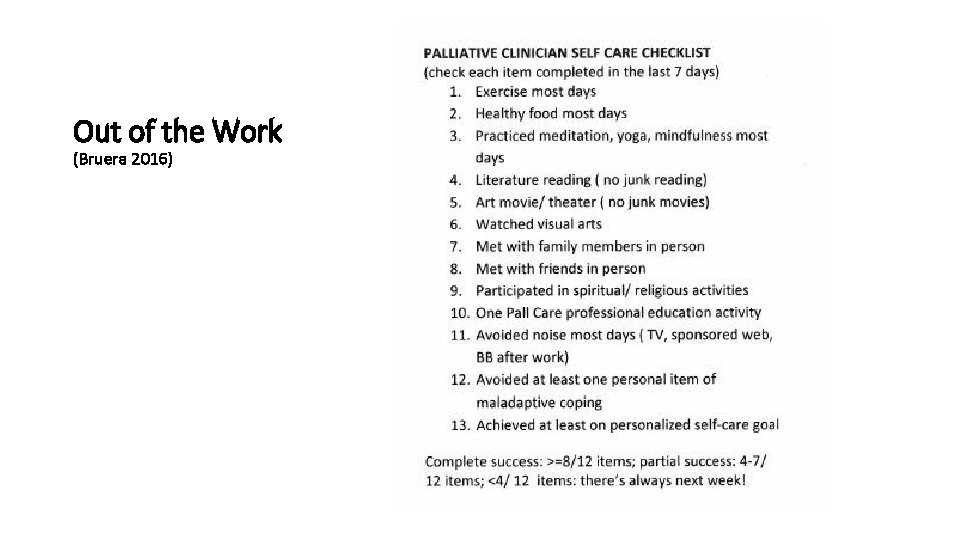
Out of the Work (Bruera 2016)

20

Results
We will become resilient professionals Resilience: Universal capacity to prevent, minimize or overcome the harmful effects of adversity • This will help us with our personal growth • It will enable us to confront stress in a way that promotes: • Self-confidence • Social competence • Responsibility
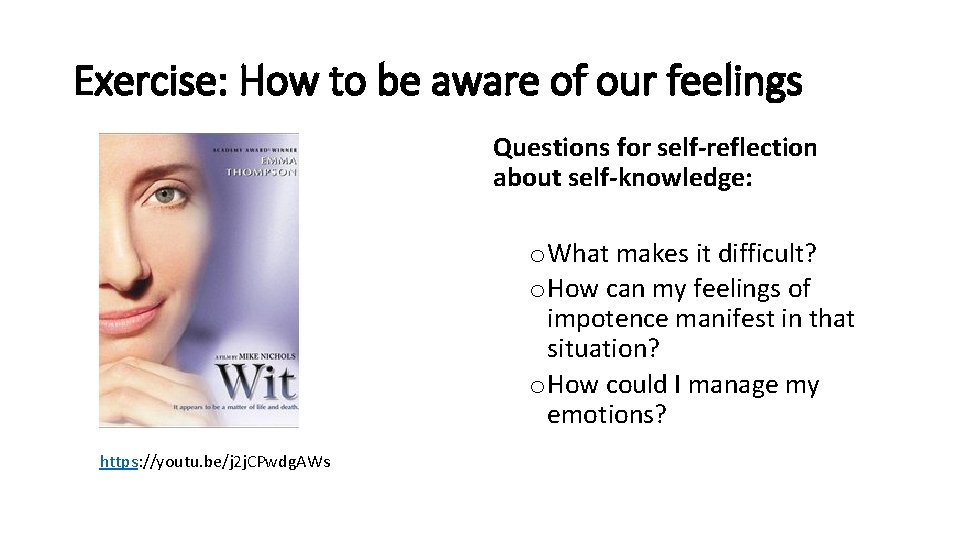
Exercise: How to be aware of our feelings Questions for self-reflection about self-knowledge: o What makes it difficult? o How can my feelings of impotence manifest in that situation? o How could I manage my emotions? https: //youtu. be/j 2 j. CPwdg. AWs
OTHER EXERCISE PROPOSALS • IT WOULD BE USEFULL TO PROVIDE A CLINICAL CASE OR EVEN BETTER A PERSONAL EXPERIENCE (IT CAN BE THE TEACHER OR OTHER HEALTH PROFESSIONAL) ABOUT SELF-CARE OR SOMEONE THAT HAVE SUFFERED ANY OF THE SYNDROMES DESCRIBED. o If possible this is the recommended one • A SELF REFLECTION OF THE STUDENT (WRITTEN OR SHARING A DISCUSSION WITH COLLEAGUES) ON AN END-OF-LIFE PERSONAL CLINICAL EXPERIENCE
- Slides: 24