
SELF NEGLECT HOARDING For Frontline practitioners WHAT IS

- Slides: 23
SELF- NEGLECT & HOARDING For Frontline practitioners
WHAT IS SELF-NEGLECT? NO SINGLE, SIMPLE ANSWER. . . • Statutory Guidance to the Care Act 2014: self-neglect “covers a wide range of behaviour neglecting to care for one’s personal hygiene, health or surroundings and includes behaviour such as hoarding. ” (para. 14. 7 of the Care Act Guidance)
SIGNS THAT AN ADULT MAY BE AT RISK OF SELFNEGLECT AND/OR HOARDING Include but not limited to: • Improperly attended medical conditions • Poor personal hygiene; • hazardous or unsafe living conditions/arrangements • unsanitary or unclean living quarters (e. g. , animal/insect infestation, no functioning toilet, faecal/urine smell); • inappropriate and/or inadequate clothing, • grossly inadequate housing
CONT’D • Repeated concerns about health and self care • Complaints from neighbours about ASB • Complaints about the state of the property
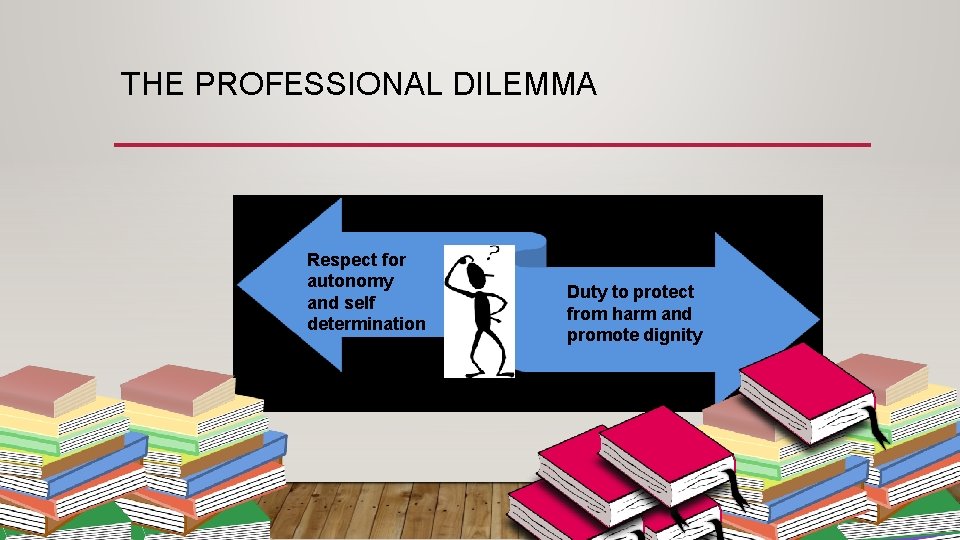
THE IMPLICATIONS FOR PRACTITIONERS • Respect for autonomy and self determination • Duty to protect from harm and promote dignity (duty of care). • Communities are also seen as having rights that counterbalance those of individuals. E. g. those living next to a property with vermin or that is a fire risk.
THE PROFESSIONAL DILEMMA Respect for autonomy and self determination Duty to protect from harm and promote dignity
RESPECT FOR AUTONOMY • Right to make decisions others may believe to be unwise (Mental Capacity Act 2005) • Unwise decision examples • European Convention of Human Rights articles 8 and 5 • Policy context of personalisation i. e. self determination
BUT • Respect for autonomy does not mean abandonment. • Working with self-neglecting adults often requires persistence over a long period rather than timelimited involvement.
UNDERSTANDING WHY PEOPLE SELF-NEGLECT? • Physical health issues - Impaired physical functioning; pain; nutritional deficiency • Mental health issues - Depression; mental health problems; frontal lobe dysfunction; impaired cognitive functioning • Substance misuse - alcohol; substance misuse • Psychological and social factors Diminished social networks; limited economic resources; lack of access to social or health services; personality traits; traumatic histories and life-changing events; high perceived self-efficacy; personal values, bereavement.
WHAT DO PEOPLE WHO USE SERVICES HAVE TO SAY ABOUT CAUSES OF THEIR SELFNEGLECT? • Demotivation: homelessness, health, loss, isolation – selfimage, negative cognitions • Different standards: being indifferent to social appearance, having other priorities • Inability to self-care: mental distress, physical ill-health, homelessness
CONT’D. • Influence of the past: childhood, loss, abuse, bereavement • Positive value of hoarding: emotional comfort, connection to something, “my family”, hobby, to be appreciated by others • Beyond their control: voices, obsessions, physical illhealth, lack of space
SO HOW CAN WE UNDERSTAND SELF-NEGLECT? • May involve a complex interplay between any or all of: • Underlying mental disorder, trauma response, and/or neuropsychological impairment • Physical and/or nutritional deterioration • Diminishing social networks and/or economic resources • Personal philosophy and identity • No single overarching explanatory model captures this diversity • Need for understanding of the meaning of self-neglect in the context of each individual’s life experience
BUT THIS CAN OFTEN BE DIFFICULT… • Refusal or withdrawal of permission for access • Avoidance or deflection of involvement • Permission for access and discussion, • Outright rejection of support • Partial acceptance of input • acceptance of input
A COLLABORATIVE APPROACH WORKS WHEN: • The adult is open to involvement, even if ambiguous • There is a good sense of timing • We ‘keep the door open’ • There is awareness and access to available help • There is an honest recognition with the adult when they may have little or no choice in the matter • Work with the adult to provide the right kind of input is not intrusive, but is encouraging, person-centred, reliable, and compassionate
COMMON FEARS • Loss of home or possessions • Loss of highly valued items • Shame and embarrassment • Loss of pets • Care home placement • Prosecution • Clear up costs • Fear of the unknown This Photo by Unknown Author is licensed under CC BY-SA
WHAT WORKS? • Harm reduction, not symptom reduction • Cleaning as a short term solution only • Assistance with routine daily living • Early intervention to prevent entrenched patterns • Combined approaches: e. g. CBT and sorting tasks • Medication in some cases
WHAT WORKS CONTD. • Building rapport and trust • Working at the pace of the individual • Keep mental capacity constantly in view • Open and honest communication about risks and options • Clear understanding of legal powers and duties • Creative building on relationships and networks • Working proactively to engage and co-ordinate agencies
A FRAMEWORK • Interagency strategy • Shared definitions and understandings • Clear communication and referral route • Scope for long-term relationship-based involvement • Management that enables and challenges
SELF-NEGLECT AND HOARDING PATHWAY FOR PROFESSIONALS MULTI-AGENCY PRACTICE GUIDANCE INTRODUCES: • The Multi-Agency self-neglect and hoarding risk assessment guidance tool • The referral form and professionals referral pathway
KEY MESSAGES WITHIN THE POLICY • Supporting you with your responsibilities • Need to consider mental capacity vs capability (executive capacity). • Relationship building and trust is the key. • No magic fairy
FURTHER INFORMATION AND LINKS: • www. suffolkas. org • MASH Consultation Line: 0345 606 1499 • Customer First can be contacted on 03456 066 167. • Suffolk Fire and Rescue Service • https: //www. suffolk. gov. uk/suffolk-fire-and-rescue-service/fire-safety-in-the-home/ • Suffolk Safeguarding Children’s Board • https: //www. rspca. org. uk/home • Mental Capacity Act 2005 Code of Practice: • https: //www. gov. uk/government/uploads/system/uploads/attachment_data/file/497253 /Mental-capacity-act-code-of-practice. pdf
RESEARCH REPORTS • Braye, S. , Orr, D. and Preston-Shoot, M. (2011) Self-Neglect and Adult Safeguarding: Findings from Research. London: SCIE. http: //www. scie. org. uk/publications/report 46. pdf • • Braye, S. , Orr, D. and Preston-Shoot, M. (2013) A Scoping Study of Workforce Development for Self-Neglect. London: Skills for Care. http: //www. skillsforcare. org. uk/NMDS-SC-intelligence-research-andinnovation/Research-reports/Workforce-development-for-self-neglect. aspx • • Braye. S. , Orr, D. and Preston-Shoot, M. (2014) Self-Neglect Policy & Practice: Building an Evidence Base for Adult Social Care. London: SCIE. http: //www. scie. org. uk/publications/reports/69 -self-neglect-policy-practice-building-anevidence-base-for-adult-social-care/
Questions / discussion