
Self contact in a professional relation Being me
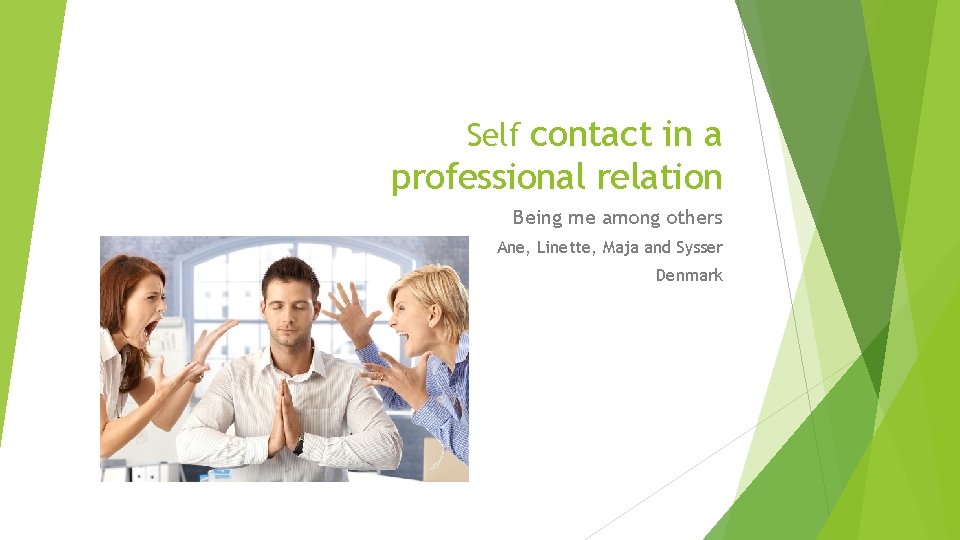
Self contact in a professional relation Being me among others Ane, Linette, Maja and Sysser Denmark

Question? Who is the most important? The therapist or the client?

Self contact Separate the feelings – shielding Prevent stress ”On the whole, I haven´t been conciuos of my own body or given it a chance at all. This is the very first time I am taking it seriously. I am wildly facinated by the personal development – both psykologially and phisically – which I have experienced in the last few minuts. Finally it occours to me as something very basic. One should of course be able to work with one self, before one can work with others. Today I learned to know my own body. ” - Winther, Helle
How? Center Grounding In the middle of the Physical abdomen, under the Sense your feet, bellybutton on the pressure from the frontside of the spine ground and the gravity You forget yourself, Seek away from the because you have to ground when you much focus on your experience big feelings client Energy comes from the ground to your head, What you feel can never be discussed and from your head to the ground Shielding Is it my feelings or the clients? Developes during childhood Train it by stimulating the tactil sense *Merete Brantbjerg

Grounding according to Lowen ”The practice of grounding for Lowen starts with the work of feet and legs that foster support, balance and rooting to the earth. The feet and legs lay ”the foundation and support of the egos structure” - Tord & Bräuninger, (2015) p. 16 ”Grounding can be described as one´s ability to percieve and to live in ´the here and now, ´and as ones contact with the ground” - Tord & Bräuninger (2015) p. 17
Hands on 2 and 2 – client and therapist Hands on the shoulders Contact to feet • Roll feet • Stanislawskis tree Again
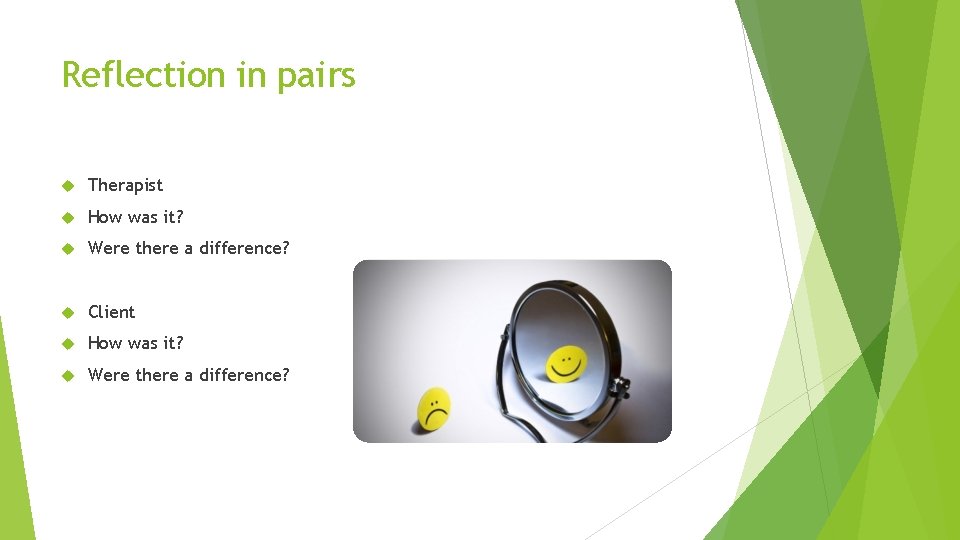
Reflection in pairs Therapist How was it? Were there a difference? Client How was it? Were there a difference?

Check out Who is the most important? The therapist or the client?
References Winther, Helle (2008); Body Contact and Body Language: Moments of Personal Developments and Social and Cultural Learning Processes and Movement Psychology and Education. FQS, volume 9, number 2, article 63. Tord, Patricia and Bräuninge, Iris (2015); Grounding: theoretical aplication and practise in dance movement therapy. Science direct Brantbjerg, Merete (2007); Tag vare på dig selv som behandler eller underviser. DAP afspænding-psykomotorik side 8 -1 www. moaiku. com
- Slides: 9