
SELF COMPACTING CONCRETE SCC What is SCC SCC
- Slides: 8
SELF COMPACTING CONCRETE (SCC) What is SCC § § § SCC is very flow able concrete that never needs to be consolidated to fill forms It looks a little like lumpy pancake batter Placed flat, like for a slab, it is virtually self-leveling The consistency is measured by what's called slump flow, where the width of the puddle left is measured when a slump cone is filled and lifted Slump flow for SCC varies from 18 to 30 inches. Thus: Self-Consolidating Concrete flows easily between obstructions to fill a form without vibration Ø But self-consolidating concrete is NOT simply concrete that flows. Ø If that's all then lots of water can be used. Ø The currently accepted definition of what makes good SCC has three parts: v High flow ability: Easy flow into the finest details of formwork and around reinforcement under its own weight. This is also called workability or filling ability. v Passing ability: Ability to flow through tight spaces, like congested steel reinforcing bars or narrow spots in the formwork 1
v Ø Ø Ø Stability: Stability implies that at very high slumps the concrete doesn't § segregate, § remains homogenous § No separation of the aggregate from the cement paste. v This is the big difference between SCC and simply wet sloppy concrete. v There actually two kinds of stability: v Dynamic Stability that is it stays stable while being transported and placed v Static Stability that is it stays stable--the aggregate doesn't settle and it doesn't bleed excessively--while it is in the forms but not yet hardened. Magically, it is not much different than conventional concrete. In fact, super plasticizers (high-range water reducers) are used to achieve the flowability, and lots of fines, the concrete can be proportioned for very low water-cement ratios and achieves very high strengths and low permeability. Self-consolidating concrete (SCC) is recognized as one of the greatest advances in the concrete industry over the past 20 years Using new admixtures and some mix modifications, concrete can be produce that flows easily without segregating. It is the self-consolidating nature of SCC that makes it so valuable in construction. SCC can flow into very intricate forms or forms that have a lot of reinforcing bars (rebar congestion) and still leave no voids. In such situation Normal concrete have to be heavily vibrated for proper compaction 2
Advantages of Self-Consolidating Concrete • • The advantages of using concrete that flows into place virtually effortlessly are obvious to anyone who works with concrete We've been getting that kind of concrete for years by adding water. Unfortunately, adding water decreases the concrete's strength and leads to segregation. Self-Consolidating Concrete flows easily under its own weight. There is no segregation, even on the leading edge of the concrete The ultimate dream is to set up the forms and then have the ready mix truck driver come and fill them up with no other workers on the job site. That may never happen, but SCC that has been properly proportioned and placed provides many advantages: v Reduced labour since no vibration is needed for concrete in forms v No need to worry about how good is the vibration v Faster construction since the concrete places very quickly—a truckload can be discharged in as little as one minute! v Easier to place SCC since it will flow so far. No need to move the truck to different placement locations. 3
v Reduced labour since no vibration is needed for concrete in forms v No need to worry about how good is the vibration v Faster construction since the concrete places very quickly—a truckload can be discharged in as little as one minute! v Easier to place SCC since it will flow so far. No need to move the truck to different placement locations. SCC flows easily and rapidly v Extremely good finished surface quality—SCC can from a ready mix truck take on nearly a mirror-like surface and can produce concrete with very fine detail. This is really advantageous with sculptures v Simpler to detail the reinforcing steel, since it can be fairly congested and still get completely filled with concrete v Quieter job sites or pre casting shops since there is no vibrator noise v Increased safety, since vibrator operators aren't up on the forms or dragging hoses and cords around the site With all these advantages, why use anything else? SCC can provide extremely detailed castings 4
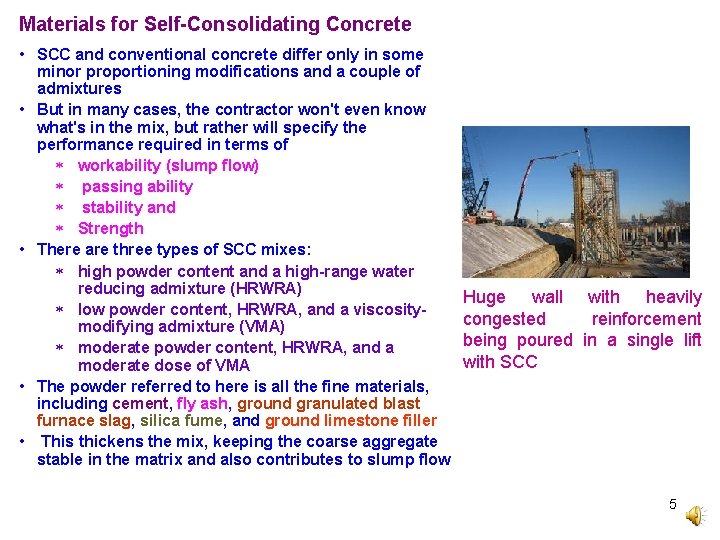
Materials for Self-Consolidating Concrete • SCC and conventional concrete differ only in some minor proportioning modifications and a couple of admixtures • But in many cases, the contractor won't even know what's in the mix, but rather will specify the performance required in terms of * workability (slump flow) * passing ability * stability and * Strength • There are three types of SCC mixes: * high powder content and a high-range water reducing admixture (HRWRA) * low powder content, HRWRA, and a viscositymodifying admixture (VMA) * moderate powder content, HRWRA, and a moderate dose of VMA • The powder referred to here is all the fine materials, including cement, fly ash, ground granulated blast furnace slag, silica fume, and ground limestone filler • This thickens the mix, keeping the coarse aggregate stable in the matrix and also contributes to slump flow Huge wall with heavily congested reinforcement being poured in a single lift with SCC 5
Some Points About SCC Mix • The fraction of coarse aggregate in the mix is much lower (about 30%) • The amount of portland cement is typically low—less than half of the total cementitious materials • Other cementitious materials are high: — v fly ash in the range of 20 to 40% of total cementitious materials; v slag in that range also, and often some silica fume • The powder may be supplemented with ground limestone • The water-cementitious materials ratio is often quite low—as low as 0. 27 in some mixes, although 0. 4 is more typical • Viscosity-modifying admixture (VMA) increases the viscosity to keep the mix stable 6
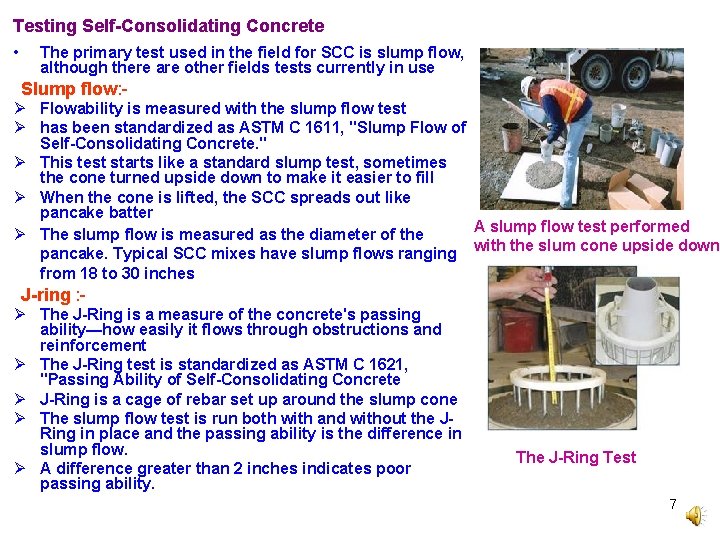
Testing Self-Consolidating Concrete • The primary test used in the field for SCC is slump flow, although there are other fields tests currently in use Slump flow: Ø Flowability is measured with the slump flow test Ø has been standardized as ASTM C 1611, "Slump Flow of Self-Consolidating Concrete. " Ø This test starts like a standard slump test, sometimes the cone turned upside down to make it easier to fill Ø When the cone is lifted, the SCC spreads out like pancake batter A slump flow test performed Ø The slump flow is measured as the diameter of the with the slum cone upside down pancake. Typical SCC mixes have slump flows ranging from 18 to 30 inches J-ring : Ø The J-Ring is a measure of the concrete's passing ability—how easily it flows through obstructions and reinforcement Ø The J-Ring test is standardized as ASTM C 1621, "Passing Ability of Self-Consolidating Concrete Ø J-Ring is a cage of rebar set up around the slump cone Ø The slump flow test is run both with and without the JRing in place and the passing ability is the difference in slump flow. Ø A difference greater than 2 inches indicates poor passing ability. The J-Ring Test 7
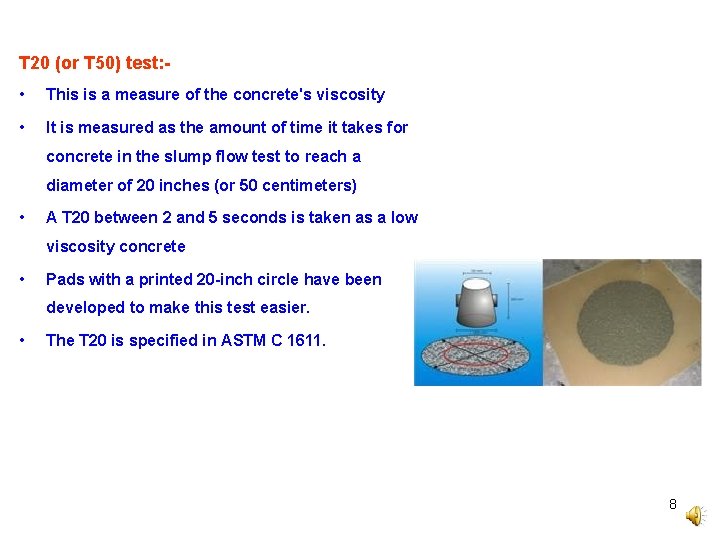
T 20 (or T 50) test: • This is a measure of the concrete's viscosity • It is measured as the amount of time it takes for concrete in the slump flow test to reach a diameter of 20 inches (or 50 centimeters) • A T 20 between 2 and 5 seconds is taken as a low viscosity concrete • Pads with a printed 20 -inch circle have been developed to make this test easier. • The T 20 is specified in ASTM C 1611. 8