
Selective Chlorination of Titanium Ore by Electrochemical Method
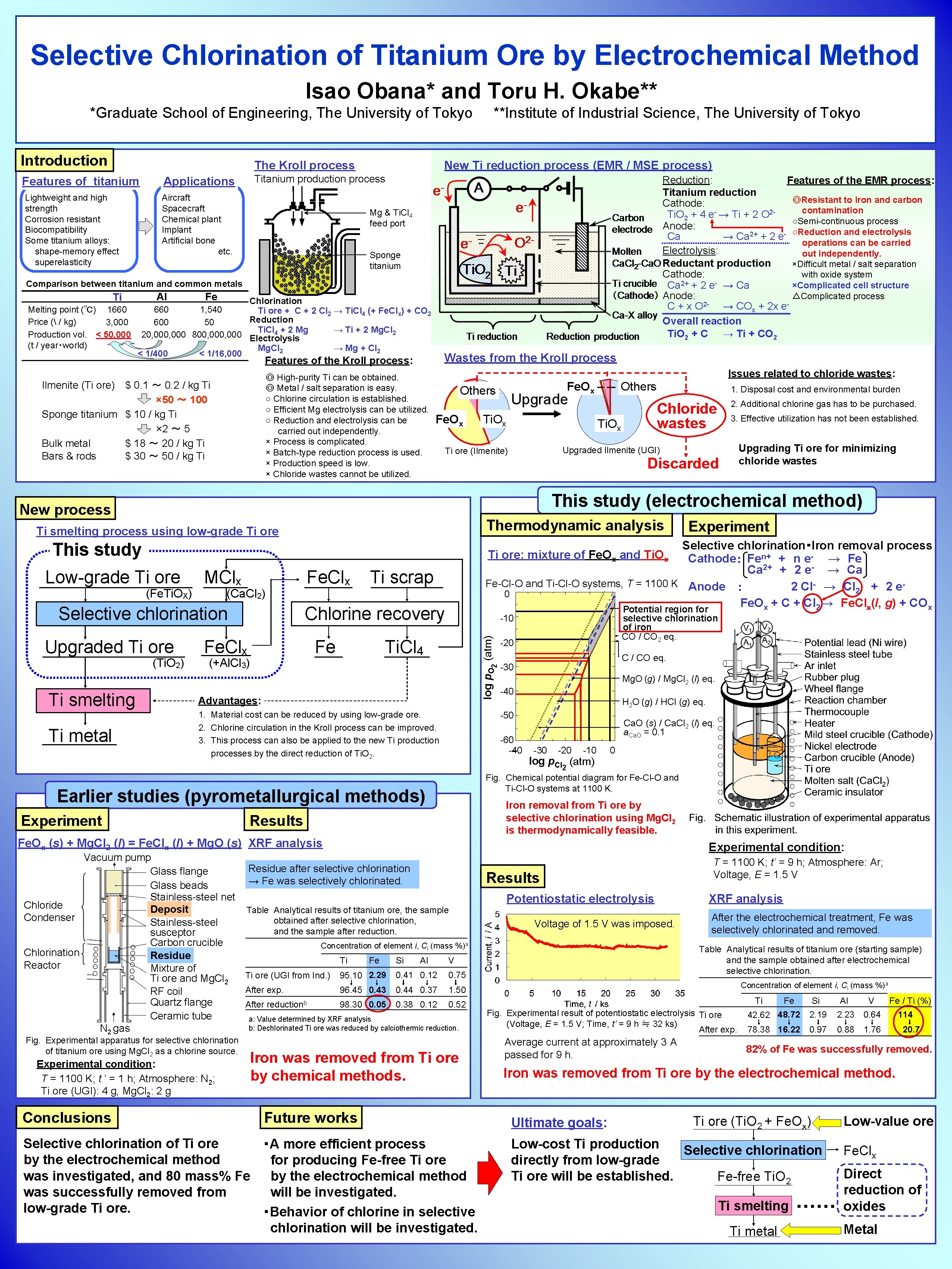
Selective Chlorination of Titanium Ore by Electrochemical Method Isao Obana* and Toru H. Okabe** *Graduate School of Engineering, The University of Tokyo Introduction New Ti reduction process (EMR / MSE process) The Kroll process Features of titanium Lightweight and high strength Corrosion resistant Biocompatibility Some titanium alloys: shape-memory effect superelasticity **Institute of Industrial Science, The University of Tokyo Titanium production process Applications Aircraft Spacecraft Chemical plant Implant Artificial bone etc. Reduction: Features of the EMR process: Titanium reduction ◎Resistant to iron and carbon Cathode: contamination Ti. O 2 + 4 e- → Ti + 2 O 2○Semi-continuous process Anode: Ca → Ca 2+ + 2 e- ○Reduction and electrolysis operations can be carried Electrolysis: out independently. Reductant production ×Difficult metal / salt separation with oxide system Cathode: ×Complicated cell structure Ca 2+ + 2 e- → Ca △Complicated process Anode: C + x O 2 - → COx + 2 x e. Overall reaction Ti. O 2 + C → Ti + CO 2 Mg & Ti. Cl 4 feed port Sponge titanium Comparison between titanium and common metals Al Fe Chlorination Melting point (℃) 1660 1, 540 Ti ore + C + 2 Cl 2 → Ti. Cl 4 (+ Fe. Clx) + CO 2 Reduction Price ( / kg) 600 50 3, 000 Ti. Cl 4 + 2 Mg → Ti + 2 Mg. Cl 2 Production vol. < 50, 000 20, 000 800, 000 Electrolysis (t / year・world) Mg. Cl 2 → Mg + Cl 2 < 1/400 < 1/16, 000 Wastes from the Kroll process Features of the Kroll process: ◎ High-purity Ti can be obtained. ◎ Metal / salt separation is easy. ○ Chlorine circulation is established. ○ Efficient Mg electrolysis can be utilized. ○ Reduction and electrolysis can be carried out independently. × Process is complicated. × Batch-type reduction process is used. × Production speed is low. × Chloride wastes cannot be utilized. Ilmenite (Ti ore) $ 0. 1 ~ 0. 2 / kg Ti × 50 ~ 100 Sponge titanium $ 10 / kg Ti × 2 ~ 5 Bulk metal $ 18 ~ 20 / kg Ti Bars & rods $ 30 ~ 50 / kg Ti Issues related to chloride wastes: Fe. Ox Ti. Ox 1. Disposal cost and environmental burden Chloride wastes Ti. Ox 3. Effective utilization has not been established. Upgrading Ti ore for minimizing chloride wastes Upgraded Ilmenite (UGI) Discarded Thermodynamic analysis This study Low-grade Ti ore (Fe. Ti. OX) MClx (Ca. Cl 2) Selective chlorination (Ti. O 2) Fe. Clx Ti scrap Chlorine recovery Fe. Clx Fe (+Al. Cl 3) Ti. Cl 4 Advantages: 1. Material cost can be reduced by using low-grade ore. 2. Chlorine circulation in the Kroll process can be improved. 3. This process can also be applied to the new Ti production processes by the direct reduction of Ti. O 2. Earlier studies (pyrometallurgical methods) Experiment Results selective chlorination of iron CO / CO 2 eq. -10 -20 C / CO eq. -30 Mg. O (g) / Mg. Cl 2 (l) eq. -40 H 2 O (g) / HCl (g) eq. -50 -60 -40 -– 40 Ca. O (s) / Ca. Cl 2 (l) eq. a. Ca. O = 0. 1 -30 -20 -10 log p. Cl (atm) 2 0 Fig. Chemical potential diagram for Fe-Cl-O and Ti-Cl-O systems at 1100 K. Iron removal from Ti ore by selective chlorination using Mg. Cl 2 is thermodynamically feasible. Fe. Ox (s) + Mg. Cl 2 (l) = Fe. Clx (l) + Mg. O (s) XRF analysis Vacuum pump Residue after selective chlorination Glass flange → Fe was selectively chlorinated. Glass beads Stainless-steel net Chloride Deposit Table Analytical results of titanium ore, the sample Condenser obtained after selective chlorination, Stainless-steel and the sample after reduction. susceptor Carbon crucible Concentration of element i, Ci (mass %)a Chlorination Residue Ti Fe Si Al V Reactor Mixture of Ti ore (UGI from Ind. ) 95. 10 2. 29 0. 41 0. 12 0. 75 Ti ore and Mg. Cl 2 After exp. 96. 45 0. 43 0. 44 0. 37 1. 50 RF coil Quartz flange 98. 30 0. 05 0. 38 0. 12 0. 52 After reductionb Ceramic tube a: Value determined by XRF analysis b: Dechlorinated Ti ore was reduced by calciothermic reduction. N 2 gas Fig. Experimental apparatus for selective chlorination of titanium ore using Mg. Cl 2 as a chlorine source. Experimental condition: T = 1100 K; t ’ = 1 h; Atmosphere: N 2; Ti ore (UGI): 4 g, Mg. Cl 2: 2 g Iron was removed from Ti ore by chemical methods. Future works Selective chlorination of Ti ore ・A more efficient process by the electrochemical method for producing Fe-free Ti ore was investigated, and 80 mass% Fe by the electrochemical method was successfully removed from will be investigated. low-grade Ti ore. ・Behavior of chlorine in selective chlorination will be investigated. Experiment Selective chlorination・Iron removal process Ti ore: mixture of Fe. Ox and Ti. Ox Cathode: Fen+ + n e- → Fe Ca 2+ + 2 e- → Ca Fe-Cl-O and Ti-Cl-O systems, T = 1100 K Anode : 2 Cl- → Cl 2 + 2 e 0 Fe. O + Cl → Fe. Cl (l, g) + CO x 2 x x Potential region for 2 Upgraded Ti ore Conclusions 2. Additional chlorine gas has to be purchased. This study (electrochemical method) Ti smelting process using low-grade Ti ore Ti metal Others Upgrade Ti ore (Ilmenite) New process Ti smelting Fe. Ox Others log p. O (atm) Ti Experimental condition: Results Potentiostatic electrolysis Voltage of 1. 5 V was imposed. T = 1100 K; t’ = 9 h; Atmosphere: Ar; Voltage, E = 1. 5 V XRF analysis After the electrochemical treatment, Fe was selectively chlorinated and removed. Table Analytical results of titanium ore (starting sample) and the sample obtained after electrochemical selective chlorination. Concentration of element i, Ci (mass %)a Ti Fig. Experimental result of potentiostatic electrolysis Ti ore (Voltage, E = 1. 5 V; Time, t’ = 9 h ≒ 32 ks) After exp. Average current at approximately 3 A passed for 9 h. Fe Si Al V 42. 62 48. 72 2. 19 2. 23 0. 64 78. 38 16. 22 0. 97 0. 88 1. 76 Fe / Ti (%) 114 20. 7 82% of Fe was successfully removed. Iron was removed from Ti ore by the electrochemical method. Ultimate goals: Ti ore (Ti. O 2 + Fe. Ox) Low-cost Ti production Selective chlorination directly from low-grade Ti ore will be established. Fe-free Ti. O 2 Low-value ore Fe. Clx Direct reduction of Ti smelting ・・・・・・ oxides Ti metal Metal
- Slides: 1