
SELECTION OF THE FORECASTING MODEL IN HEALTH CARE

- Slides: 26
SELECTION OF THE FORECASTING MODEL IN HEALTH CARE Özlem Akçay Kasapoğlu, Associate Professor Istanbul University Faculty of Business Operations Management Department ozlemak@istanbul. edu. tr
Abstract �Forecasting is one of the first steps in planning; the success of the plans depends on the accuracy of the forecasts. �In the service industries like the hospitals, there are many plans that depend on the forecasts, from capacity planning to aggregate planning, from layout decisions to the daily schedules. �The accuracy of the forecasts could be determined by the error indicators after the trial of the many methods that fits our data. �Key words: Forecasting, Error indicators, Hospital Management, Planning
Introduction �Hospital management experience fluctuations in patient volume which may be difficult to predict. � Patient volume forecast models might allow hospital managers to prospectively adjust staffing levels. �The objective of this paper is to evaluate the predictability of patient beds in obstetric and gynecology department using different forecasting techniques. � The analysis methods are done with various time series methods. Patient volume data were collected from a private hospital chain data warehouse from November 2013 to November 2016. � Results from different methods were compared by error indicators. Mean absolute percentage error (MAPE), Mean absolute deviation (MAD) and Mean Square Error (MSD) were used to measure the accuracy of the forecasts.
Bed requirements for the obstetric and gynecology �Bed requirements for the obstetric and gynecology departments reflect the relationship between the price of the operations and the number of beds available in the private hospitals. �Pregnant women consider the success of the doctors in the hospitals but more on the treatment to the mother and the baby after giving birth. � Women are worried and looking for comfort after the birth, in feeding the baby, learning about breastfeeding after she is awake and out of the operating room and they prefer more the private hospitals in Turkey if they can afford it.
Around the globe, caesarean section rates have increased �The growing c section rate can be attributed to many factors, including more births among older women, multiple births through assisted reproduction, technological advances, as well as personal preference. � Across OECD countries, the c section rate currently stands at approximately 28 percent with some of the lowest rates occurring in northern Europe. Sweden is a notable example with 16. 4 c sections for every 100 live births. �Turkey is at the opposite end of the scale with just over half of all babies delivered via c section. The United States and Australia also have higher caesarean rates than average, 32. 5 and 32. 1 per 100 live births respectively. (Mc. Carthy, 2016)
Private hospitals need to forecast their patients for bed requirement to have higher service level �Caesarean section rate is still high in Turkey although women are more conscious and there is government push for the normal child birth for the low risk pregnancies. �For the caesarean sections whether it is done with a spinal block or under general anesthesia there is a standard days of stay for the recovery sufficient enough to return home like two days, and for natural child birth one or two day under normal circumstances. �In these circumstances private hospitals need to forecast their patients for bed requirement to have higher service level, and to be on the front lines in this competitive environment.
Forecasting is the art and science of predicting future events. �It may involve taking historical data and projecting them into the future with some sort of mathematical model. �There is seldom one superior method. What works best in one firm under one set of conditions may be a complete disaster in another organization, or even in a same department of the same firm. (Heizer and Render, 2001, p: 78) �Forecasts are seldom perfect. There are realities about forecasting. There are outside factors that can not be predicted or controlled often impact the forecast.
Literature � Vicente et al. , (2015) worked on the development of the certified environmental management in hospital and outpatient haemodialysis units. � Nicolas and Bliznakov (2016) Studied on the hospital technology management, in clinical engineering. � Ahayalimudin and Osman (2016), worked on disaster management: Emergency nursing and medical personnel’s knowledge, attitude and practices of the East Coast region hospitals of Malaysia. � Lee (2016), studied competitive strategy for successful national university hospital management in the Republic of Korea. � Zepeda, Nyaga, and Young (2016) worked on the supply chain risk management and hospital inventory and the effects of system � Sabapathy and Bhardwaj (2016), tried to set the goals in the management of mutilated injuries of the hand. � Yi et al. , (2016) worked on the discriminant analysis forecasting model of first trimester pregnancy outcomes � Nikolopoulos et. al. , (2015) studied on the forecasting branded and generic pharmaceuticals.
Literature �Laan et al. (2016) studied demand forecasting and order planning for humanitarian logistics they did an empirical assessment. �Baal and Wong, (2012) did the forecasting of macro level health care expenditures, time to death and some further considerations �Pirc et al. , (2016) worked on the threat forecasting. they worked on the high level concepts that are associated with big data collection and how they are applied to threat forecasting. I �Shynkevich et al. , (2016) worked on the forecasting movements of health care stock prices based on different categories of news articles using multiple kernel learning. �Laan et al. (2016) did demand forecasting and order planning for humanitarian logistics �Afilal et al. (2016), studied the emergency department flow with a new practical patients classification and forecasting daily attendance.
Literature � Maksimović et al, (2017) studied on management of health care expenditure by soft computing methodology. � Mladenović et al. (2016) analyzed and management of health care expenditure and gross domestic product (GDP) growth rate by adaptive neuro fuzzy technique. � Zepeda et al. , (2016) studied supply chain risk management and hospital inventory. � Jurado et al (2016) studied stock management in hospital pharmacy using chance constrained model predictive control. � Sabapathy and Bhardwaj 2016 studied on setting the goals in the management of mutilated injuries of the hand, impressions based on the ganga hospital experience. � Dai et al. (2016) worked in the in hospital st elevation myocardial ınfarction: clinical characteristics, management challenges, and outcome. � Koh (2016) worked on the management of work place bullying in hospital made a review of the use of cognitive rehearsal as an alternative management strategy,
Methods and Application � 36 month data are taken from the hospital managements system to analyze the patients. Time series methods are used in the analysis. � The repeated observations of demand for a service or product in their order of occurrence form a pattern known as time series. �Time series analysis is a statistical approach that relies heavily on historical data to project the future size of demand and recognizes trends and seasonal patterns. (Krajewski et al. 2016 p: 484)
Five basic patterns of most demand time series: �The first one is horizontal which is the fluctuation of data around a constant mean. �The second is Trend which is the systematic increase or decrease in the mean of the series over time. �The third one is seasonal which is a repeatable pattern of increase or decrease in demand. �The fourth one is cyclical which is less predictable gradual increase or decrease in demand over longer periods of time. � The fifth one is random which the unforcastable variation in demand is.
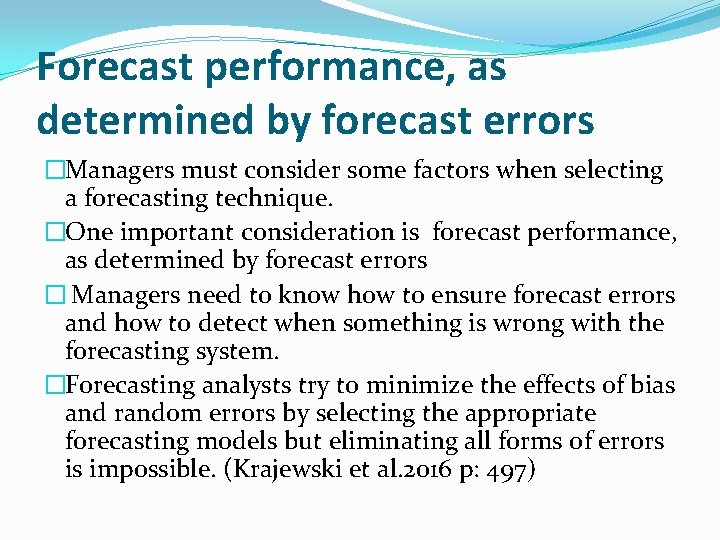
Forecast performance, as determined by forecast errors �Managers must consider some factors when selecting a forecasting technique. �One important consideration is forecast performance, as determined by forecast errors � Managers need to know how to ensure forecast errors and how to detect when something is wrong with the forecasting system. �Forecasting analysts try to minimize the effects of bias and random errors by selecting the appropriate forecasting models but eliminating all forms of errors is impossible. (Krajewski et al. 2016 p: 497)
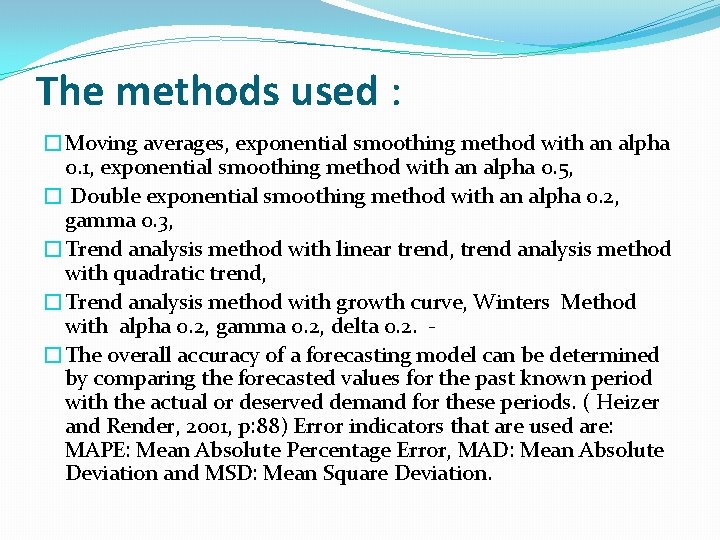
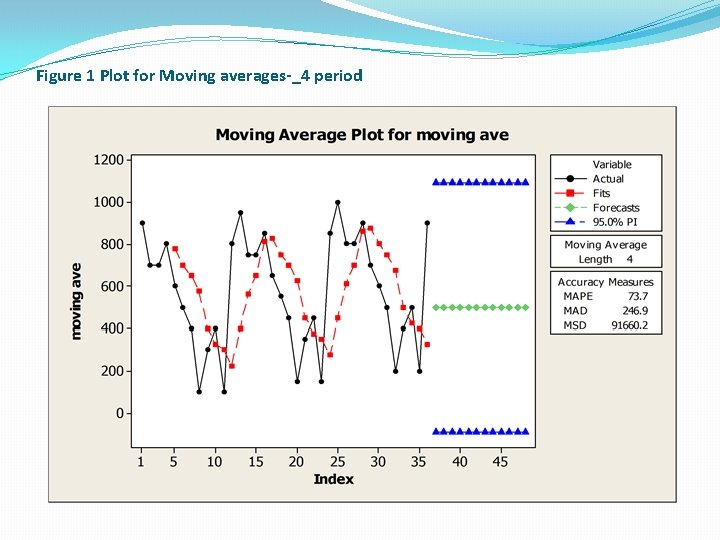
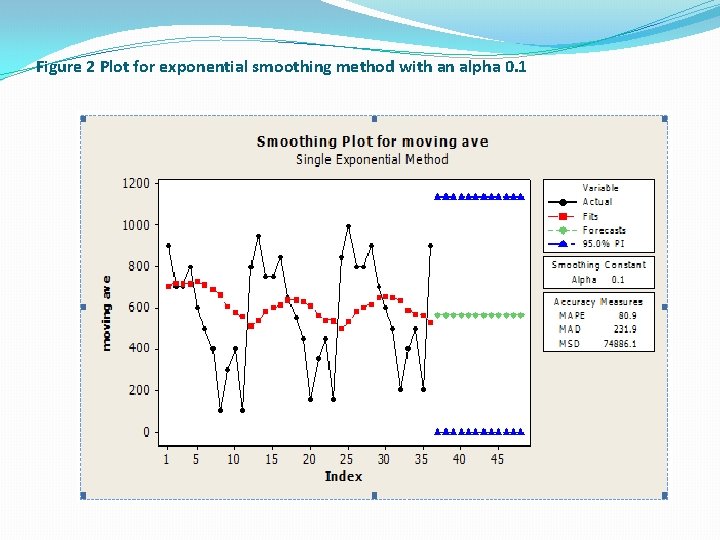
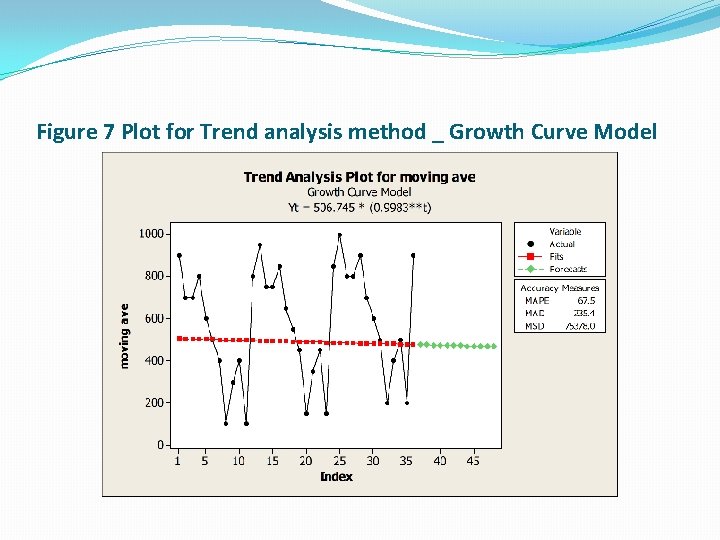
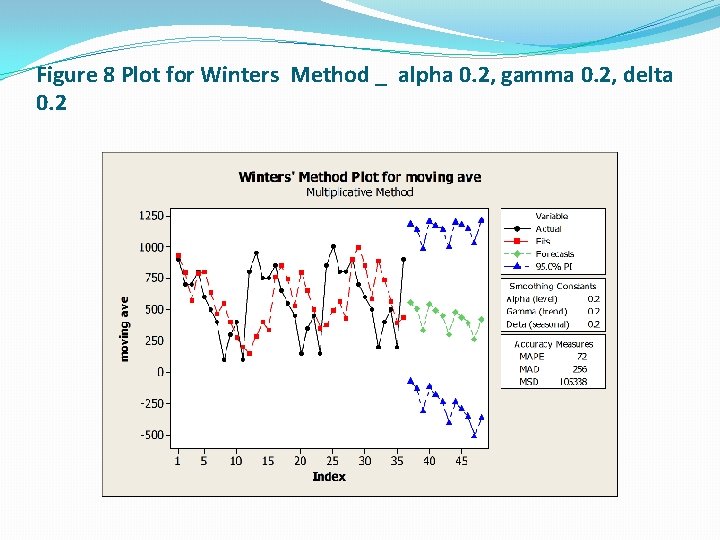
The methods used : �Moving averages, exponential smoothing method with an alpha 0. 1, exponential smoothing method with an alpha 0. 5, � Double exponential smoothing method with an alpha 0. 2, gamma 0. 3, �Trend analysis method with linear trend, trend analysis method with quadratic trend, �Trend analysis method with growth curve, Winters Method with alpha 0. 2, gamma 0. 2, delta 0. 2. �The overall accuracy of a forecasting model can be determined by comparing the forecasted values for the past known period with the actual or deserved demand for these periods. ( Heizer and Render, 2001, p: 88) Error indicators that are used are: MAPE: Mean Absolute Percentage Error, MAD: Mean Absolute Deviation and MSD: Mean Square Deviation.
Figure 1 Plot for Moving averages _4 period
Figure 2 Plot for exponential smoothing method with an alpha 0. 1
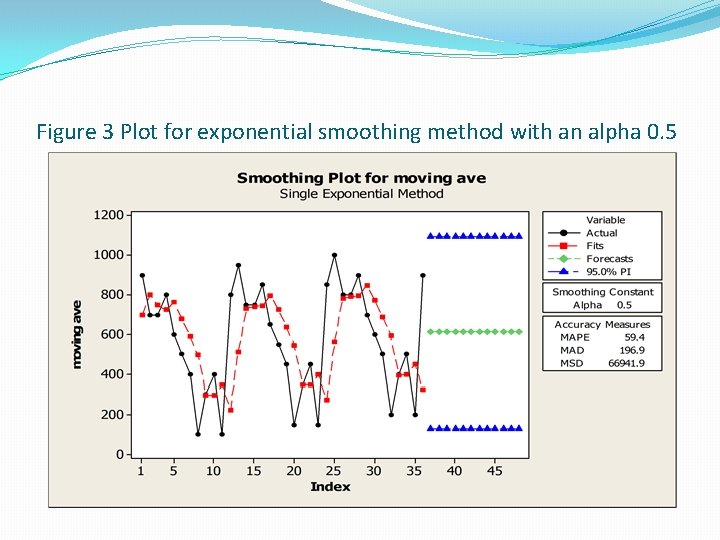
Figure 3 Plot for exponential smoothing method with an alpha 0. 5
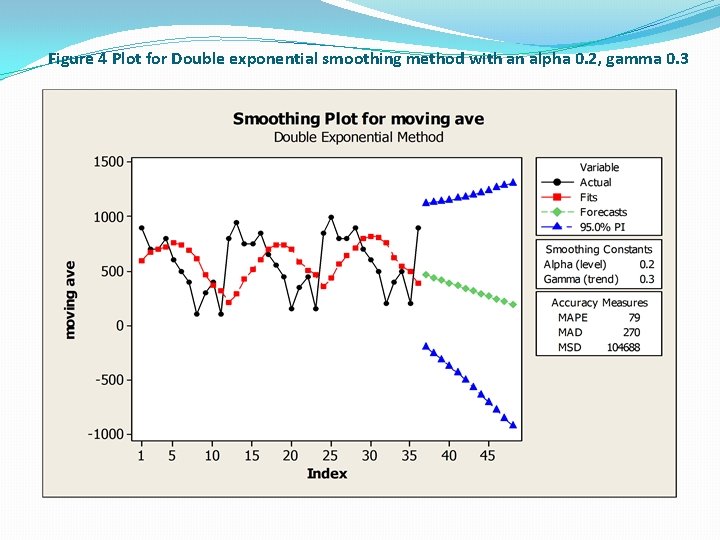
Figure 4 Plot for Double exponential smoothing method with an alpha 0. 2, gamma 0. 3
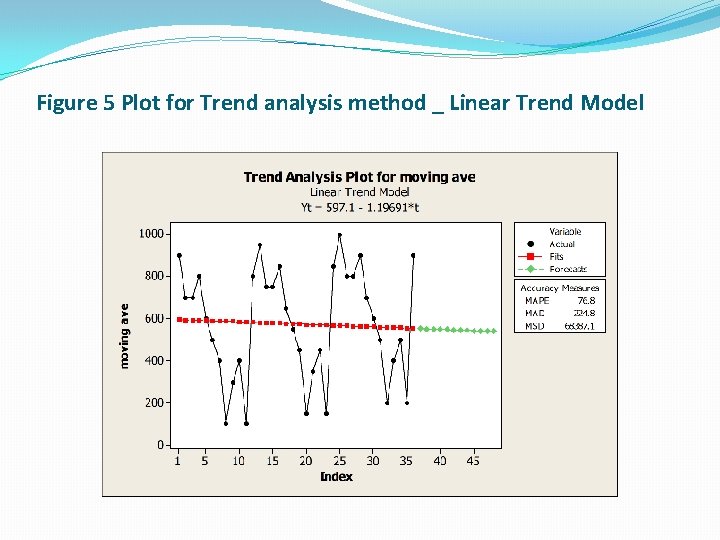
Figure 5 Plot for Trend analysis method _ Linear Trend Model
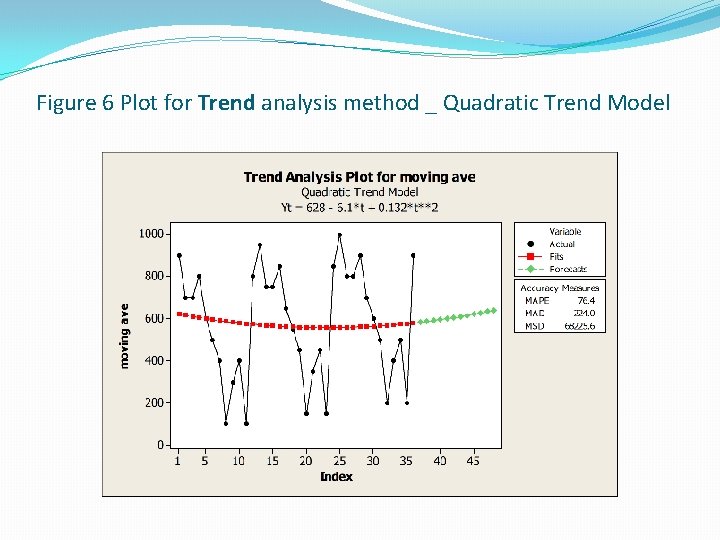
Figure 6 Plot for Trend analysis method _ Quadratic Trend Model
Figure 7 Plot for Trend analysis method _ Growth Curve Model
Figure 8 Plot for Winters Method _ alpha 0. 2, gamma 0. 2, delta 0. 2
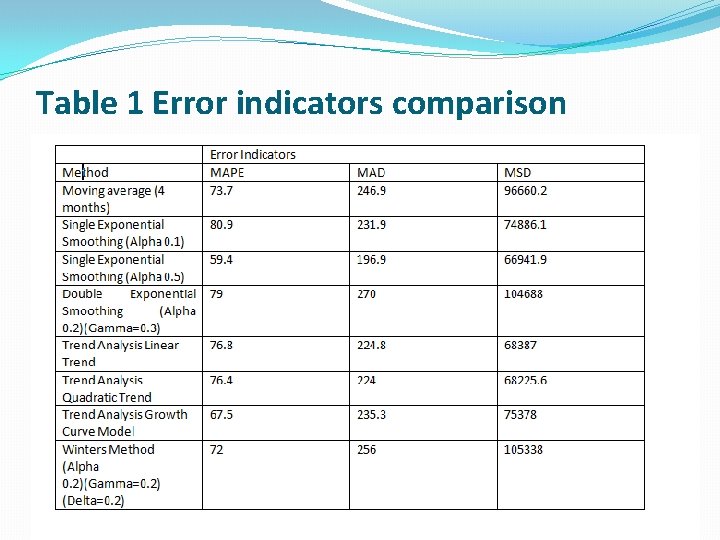
Table 1 Error indicators comparison
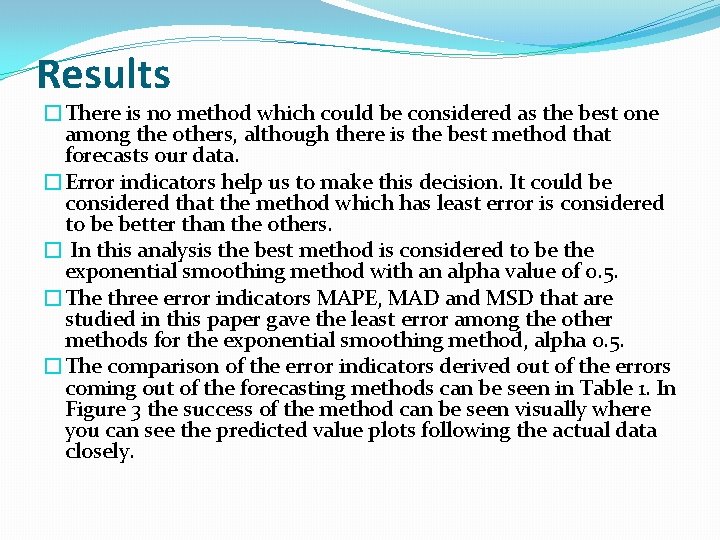
Results �There is no method which could be considered as the best one among the others, although there is the best method that forecasts our data. �Error indicators help us to make this decision. It could be considered that the method which has least error is considered to be better than the others. � In this analysis the best method is considered to be the exponential smoothing method with an alpha value of 0. 5. �The three error indicators MAPE, MAD and MSD that are studied in this paper gave the least error among the other methods for the exponential smoothing method, alpha 0. 5. �The comparison of the error indicators derived out of the errors coming out of the forecasting methods can be seen in Table 1. In Figure 3 the success of the method can be seen visually where you can see the predicted value plots following the actual data closely.
Conclusion �Hospitals experience fluctuations in patient volume that causes problems in planning the capacity and scheduling all kinds of operations, from surgeries to cleaning personnel. �Patient volume forecast models might allow hospital managers to prospectively adjust their staffing levels. � The forecasting models can not be generalized for all the hospitals, for all departments. �All the different data coming from all different sources, even the same source with different time periods require different analysis; demand is affected by many variables so forecasts should be updated. �Tracking signal could be used in monitoring the errors in different studies. This work is supported by Research Found of Istanbul University with the project number: 23306
�Thank you for listening…