
Selection of a Research Approaches Design Method What
- Slides: 13
Selection of a Research Approaches, Design & Method
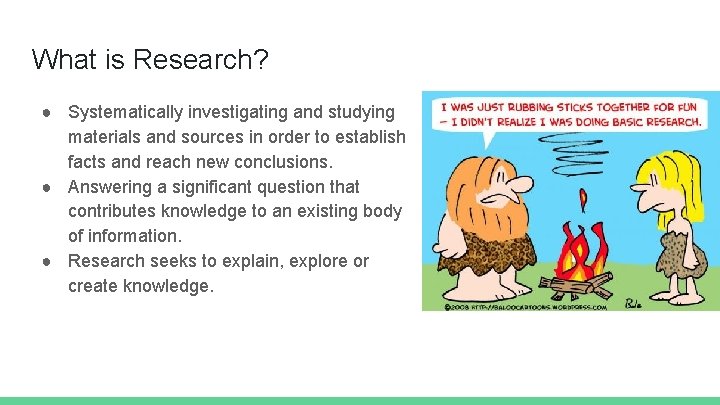
What is Research? ● Systematically investigating and studying materials and sources in order to establish facts and reach new conclusions. ● Answering a significant question that contributes knowledge to an existing body of information. ● Research seeks to explain, explore or create knowledge.
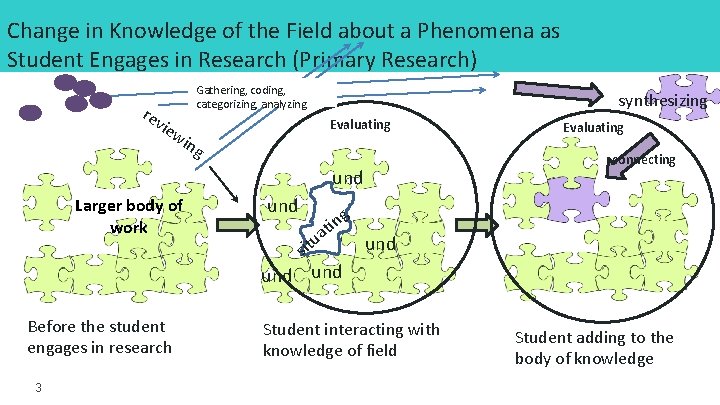
2016 Change in Knowledge of the Field about a Phenomena as Student Engages in Research (Primary Research) Gathering, coding, categorizing, analyzing rev iew synthesizing Evaluating connecting und Larger body of work und u sit ing t a Evaluating und und Before the student engages in research 3 Student interacting with knowledge of field Student adding to the body of knowledge 3
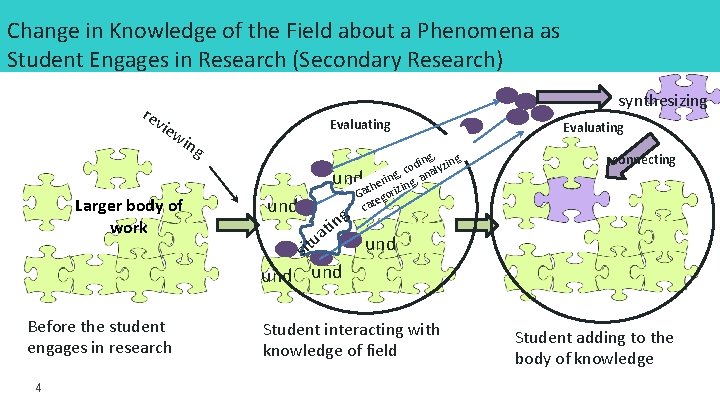
2016 Change in Knowledge of the Field about a Phenomena as Student Engages in Research (Secondary Research) synthesizing rev iew Evaluating , ing zing d o aly , c ing g, an r e in th Ga egoriz cat und Larger body of work und u sit ing t a Evaluating connecting und und Before the student engages in research 4 Student interacting with knowledge of field Student adding to the body of knowledge 4
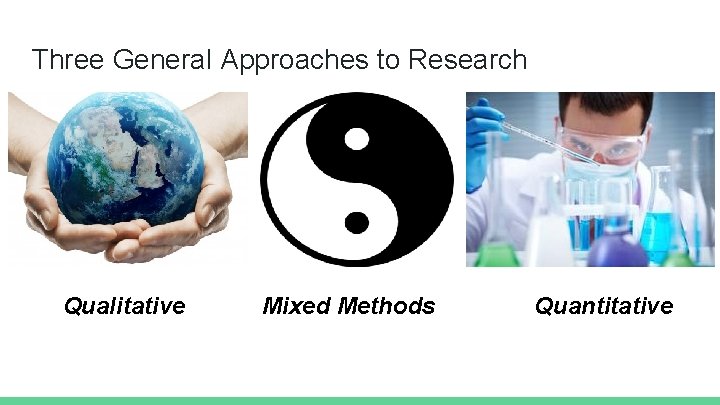
Three General Approaches to Research Qualitative Mixed Methods Quantitative
Qualitative Approach ● Exploration of social and human problems dealing with understandings or meanings for individuals and groups. ● More flexible in structure ● Inductive in nature and stresses the complexity of a situation.
Quantitative Approach ● Test of objective theories by examining relationship between variables. ● Set structure. ● Deductive in nature and establish parameters for generalization of findings by protecting against bias and controlling for alternative explanations.
Mixed Methods Approach ● Collection of both quantitative and qualitative data. ● Understanding that the combination of both processes provides a more complete understanding of the issue than a single approach (quantitative or qualitative).
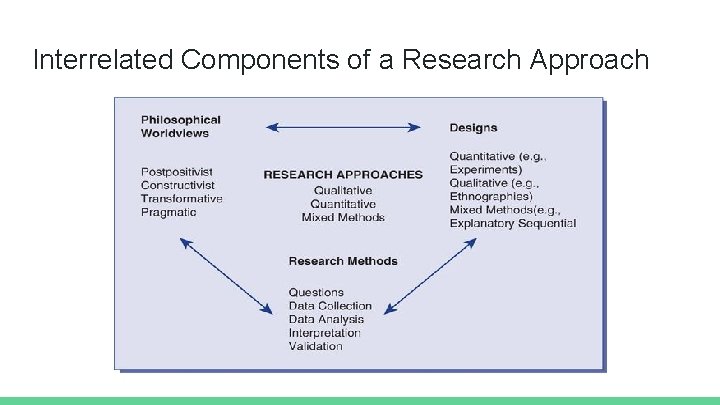
Interrelated Components of a Research Approach
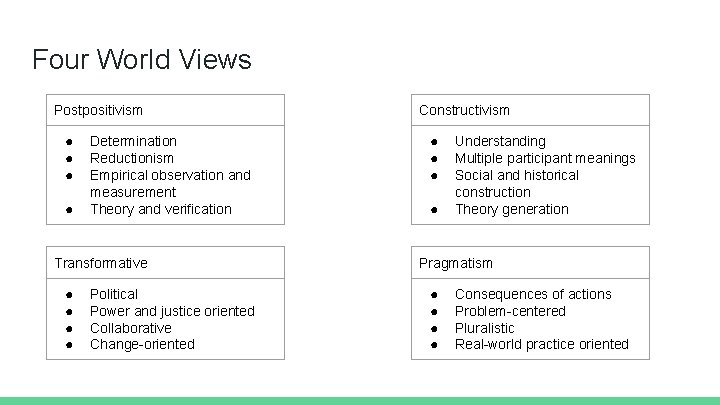
Four World Views Postpositivism ● ● Determination Reductionism Empirical observation and measurement Theory and verification Transformative ● ● Political Power and justice oriented Collaborative Change-oriented Constructivism ● ● Understanding Multiple participant meanings Social and historical construction Theory generation Pragmatism ● ● Consequences of actions Problem-centered Pluralistic Real-world practice oriented
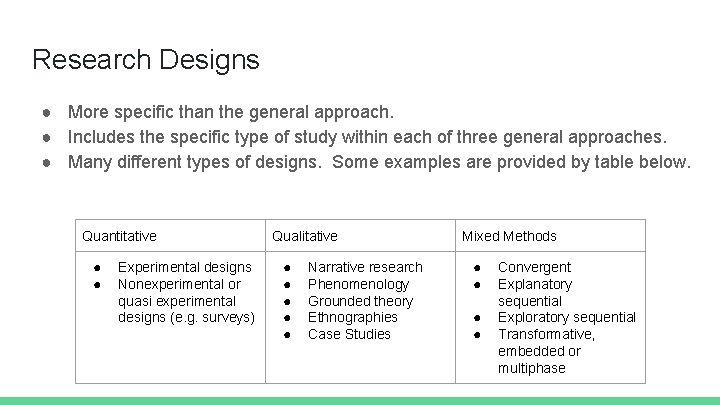
Research Designs ● More specific than the general approach. ● Includes the specific type of study within each of three general approaches. ● Many different types of designs. Some examples are provided by table below. Quantitative ● ● Experimental designs Nonexperimental or quasi experimental designs (e. g. surveys) Qualitative ● ● ● Narrative research Phenomenology Grounded theory Ethnographies Case Studies Mixed Methods ● ● Convergent Explanatory sequential Exploratory sequential Transformative, embedded or multiphase
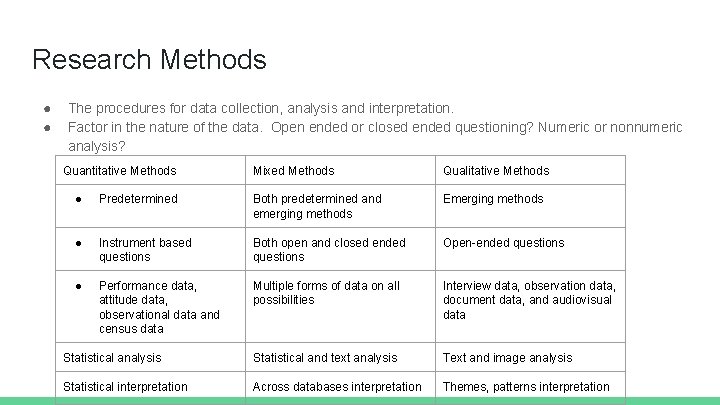
Research Methods ● ● The procedures for data collection, analysis and interpretation. Factor in the nature of the data. Open ended or closed ended questioning? Numeric or nonnumeric analysis? Quantitative Methods Mixed Methods Qualitative Methods ● Predetermined Both predetermined and emerging methods Emerging methods ● Instrument based questions Both open and closed ended questions Open-ended questions ● Performance data, attitude data, observational data and census data Multiple forms of data on all possibilities Interview data, observation data, document data, and audiovisual data Statistical analysis Statistical and text analysis Text and image analysis Statistical interpretation Across databases interpretation Themes, patterns interpretation
References: AP College Board. 14: Big Idea 4 -Synthesize Ideas-Moving from a Literature Review to Your Own Research. Retreived from https: //docs. google. com/presentation/d/1 w. QA 6 Wn 2 ZMs 7 i. GJ 9 PZ 3 e 2 DL 5 t. DPy. On. Kx 4 MBo 6 Ps/edit#slide=id. p 4, AP College Board, 2016. Creswell, John W. Research design: Qualitative, quantitative, and mixed methods approaches. Sage publications, 2013.