
Selection and Use of Open Standards Addressing limitations
- Slides: 1
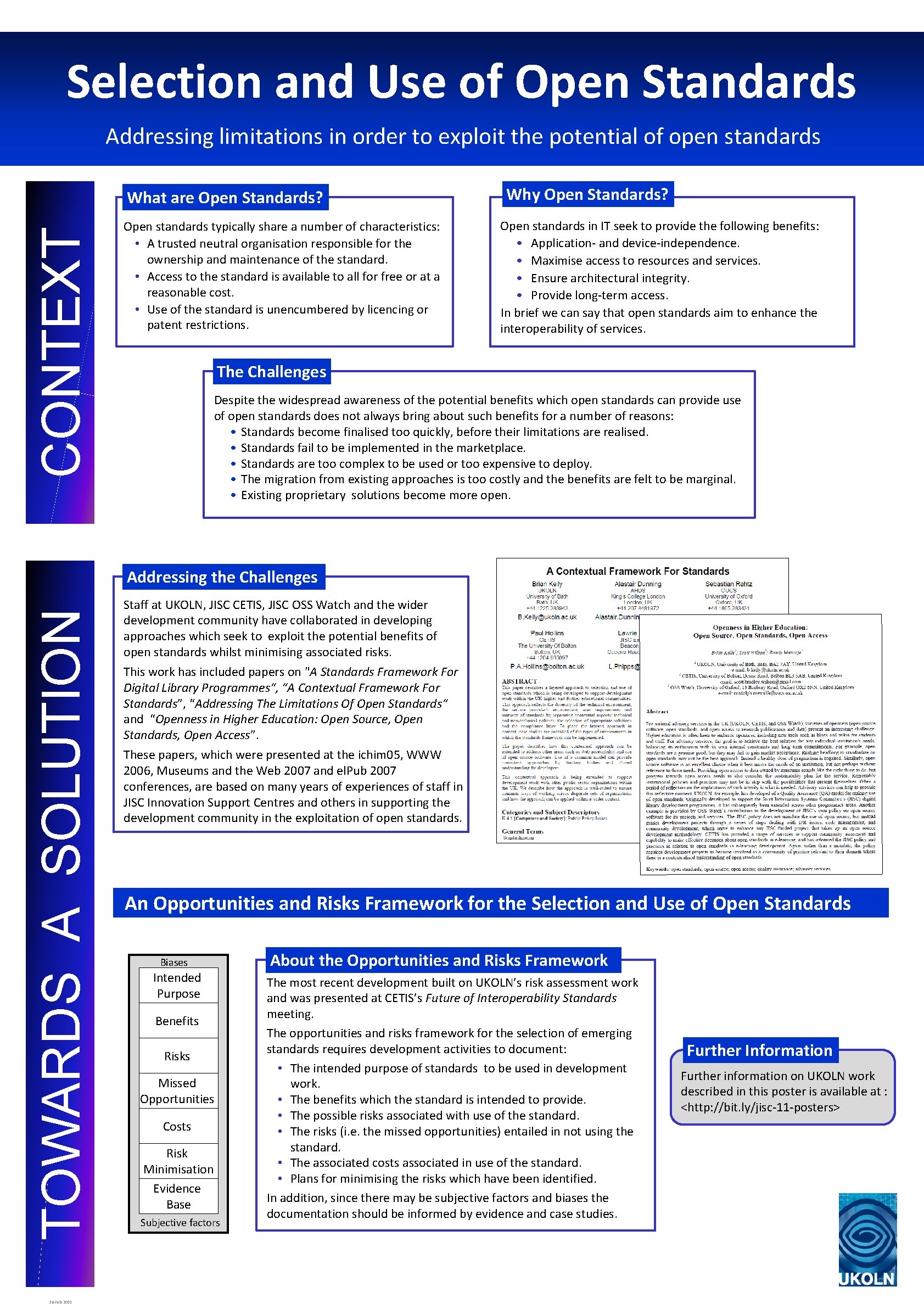
Selection and Use of Open Standards Addressing limitations in order to exploit the potential of open standards CONTEXT What are Open Standards? Open standards typically share a number of characteristics: • A trusted neutral organisation responsible for the ownership and maintenance of the standard. • Access to the standard is available to all for free or at a reasonable cost. • Use of the standard is unencumbered by licencing or patent restrictions. Why Open Standards? Open standards in IT seek to provide the following benefits: • Application- and device-independence. • Maximise access to resources and services. • Ensure architectural integrity. • Provide long-term access. In brief we can say that open standards aim to enhance the interoperability of services. The Challenges Despite the widespread awareness of the potential benefits which open standards can provide use of open standards does not always bring about such benefits for a number of reasons: • Standards become finalised too quickly, before their limitations are realised. • Standards fail to be implemented in the marketplace. • Standards are too complex to be used or too expensive to deploy. • The migration from existing approaches is too costly and the benefits are felt to be marginal. • Existing proprietary solutions become more open. TOWARDS A SOLUTION Addressing the Challenges 16 -Feb-2011 Staff at UKOLN, JISC CETIS, JISC OSS Watch and the wider development community have collaborated in developing approaches which seek to exploit the potential benefits of open standards whilst minimising associated risks. This work has included papers on "A Standards Framework For Digital Library Programmes“, “A Contextual Framework For Standards”, “Addressing The Limitations Of Open Standards“ and “Openness in Higher Education: Open Source, Open Standards, Open Access”. These papers, which were presented at the ichim 05, WWW 2006, Museums and the Web 2007 and el. Pub 2007 conferences, are based on many years of experiences of staff in JISC Innovation Support Centres and others in supporting the development community in the exploitation of open standards. An Opportunities and Risks Framework for the Selection and Use of Open Standards Biases Intended Purpose Benefits Risks Missed Opportunities Costs Risk Minimisation Evidence Base Subjective factors About the Opportunities and Risks Framework The most recent development built on UKOLN’s risk assessment work and was presented at CETIS’s Future of Interoperability Standards meeting. The opportunities and risks framework for the selection of emerging standards requires development activities to document: • The intended purpose of standards to be used in development work. • The benefits which the standard is intended to provide. • The possible risks associated with use of the standard. • The risks (i. e. the missed opportunities) entailed in not using the standard. • The associated costs associated in use of the standard. • Plans for minimising the risks which have been identified. In addition, since there may be subjective factors and biases the documentation should be informed by evidence and case studies. Further Information Further information on UKOLN work described in this poster is available at : <http: //bit. ly/jisc-11 -posters>