
Selection and Organization of Content There are dull




- Slides: 22
Selection and Organization of Content
“There are dull teachers, dull textbooks, dull films, but no dull subjects. ”
Guiding Principles in the Selection and Organization of Content
Ø 1. Observe the following qualities in the selection and organization of content: a. Validity b. Significance c. Balance d. Self-sufficiency e. Interest f. Utility h. Feasibility
2. Facts are basic in the structure of cognitive subject matter. But content must go beyond facts. a. Provide opportunities for experimentation. b. Present the ideas of others. c. Emphasize conceptual understanding.
Strategies to develop student’s conceptual understanding Organize units around a few core ideas and themes. Explore each topic in depths. Explain how new ideas relate to own experiences and to things they have previously learned.
Show students that conceptual understanding of subject matter is far more important than knowledge of isolated facts. Ask students to teach others what they have learned. Promote dialogue. Use authentic activities.
3. Subject matter content is an integration of cognitive, skills and affective elements.
Cognitive content Fact Concept Principle Hypotheses Theories Laws
Cognitive content ØFact Ø Is an idea or action that can be verified. Ø Concept Ø Categorization of events, places, people, ideas. Ø Principle Ø The relationship between and among facts and concepts.
Cognitive content Hypotheses Educated guesses about relationships (principles) Theories Refer to a set of facts, concepts and principles that describe underlying unobservable mechanisms that regulate human learning, development and behaviour. Laws Firmly established, thoroughly tested principle or theory
Skills Manipulative Skills Ø Thinking Skills 1. Divergent Thinking a. Fluent thinking b. Flexible thinking c. Original Thinking d. Elaborative Thinking 2. Convergent Thinking 3. Problem solving 4. Metaphoric Thinking 5. Critical Thinking 6. Creative Thinking Ø
Divergent Thinking a. Fluent thinking b. Flexible thinking c. Original Thinking d. Elaborative Thinking
Convergent Thinking It is narrowing down from many possible thoughts to end up on a single best thought or an answer to a problem.
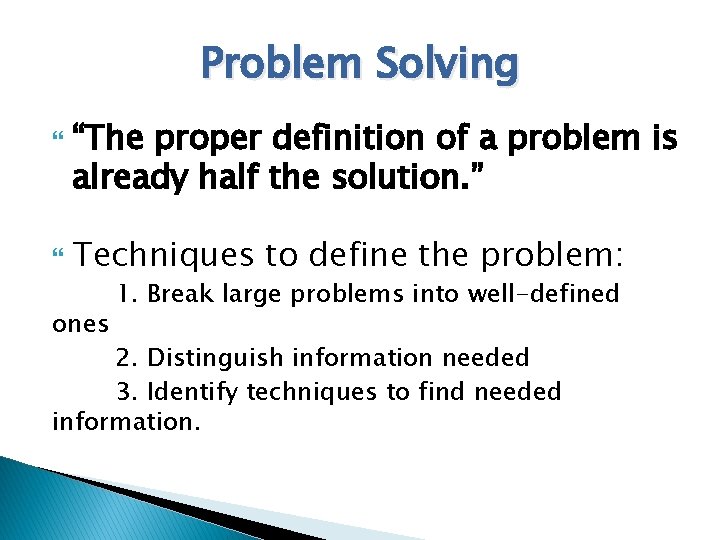
Problem Solving “The proper definition of a problem is already half the solution. ” Techniques to define the problem: ones 1. Break large problems into well-defined 2. Distinguish information needed 3. Identify techniques to find needed information.
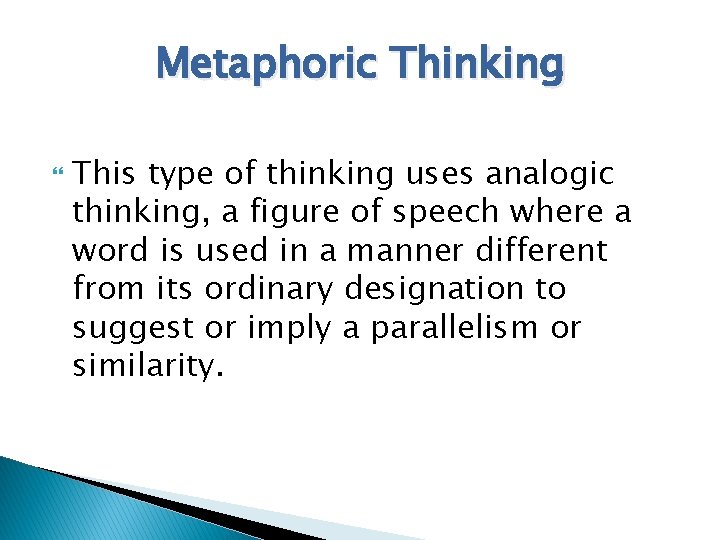
Metaphoric Thinking This type of thinking uses analogic thinking, a figure of speech where a word is used in a manner different from its ordinary designation to suggest or imply a parallelism or similarity.
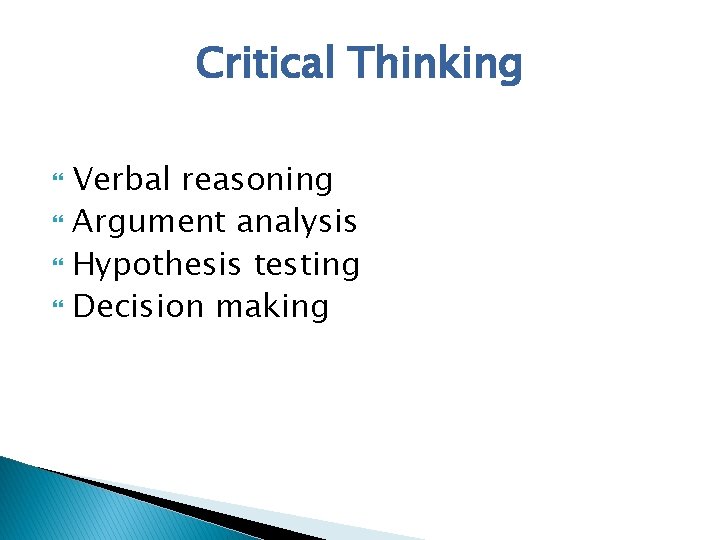
Critical Thinking Verbal reasoning Argument analysis Hypothesis testing Decision making
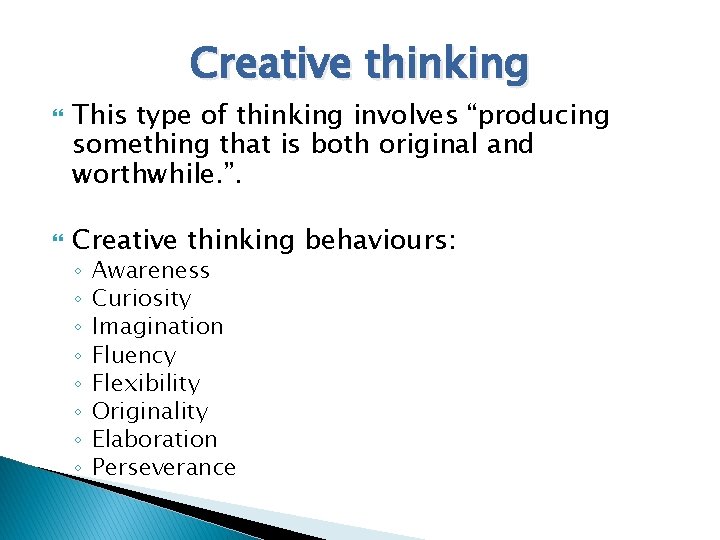
Creative thinking This type of thinking involves “producing something that is both original and worthwhile. ”. Creative thinking behaviours: ◦ ◦ ◦ ◦ Awareness Curiosity Imagination Fluency Flexibility Originality Elaboration Perseverance
3. Affective The affective component is concerned with values and attitudes. When we teach values, we connect facts, skills and concepts to the life of students.
Shall we teach values?
How can we teach values?
How can we teach values? By deutero-learning By positively reinforcing good behaviour. By teaching the cognitive component of values in the classroom.