
Selection and decisionmaking criteria for a Distributed Control
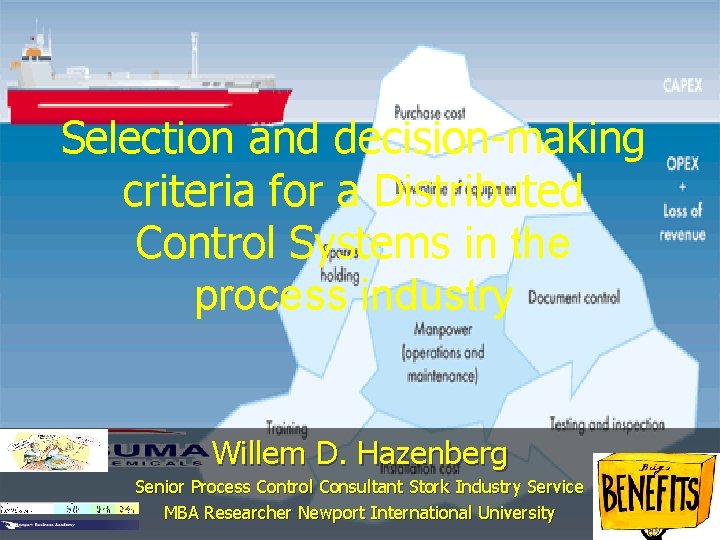
Selection and decision-making criteria for a Distributed Control Systems in the process industry Willem D. Hazenberg Senior Process Control Consultant Stork Industry Service MBA Researcher Newport International University
Inhoud n n n Intro & Framework Main objectives – Study and research questions Research project methodologie Customer Value Proposition Methodic: Multi attribute utility theory Main- and Sub sections Big- Short- Final list Business reason Economic Profile (EP) Conclusions (Dutch) More info – next steps
At Controls Manufacturing Community List Dear All Can anyone send me a single page comparison or presentation on PLC Vs DCS as on today's date? I shall be thankful for your kind inputs. Thanking you, Regards, (Name removed) Control System Staff Engineer
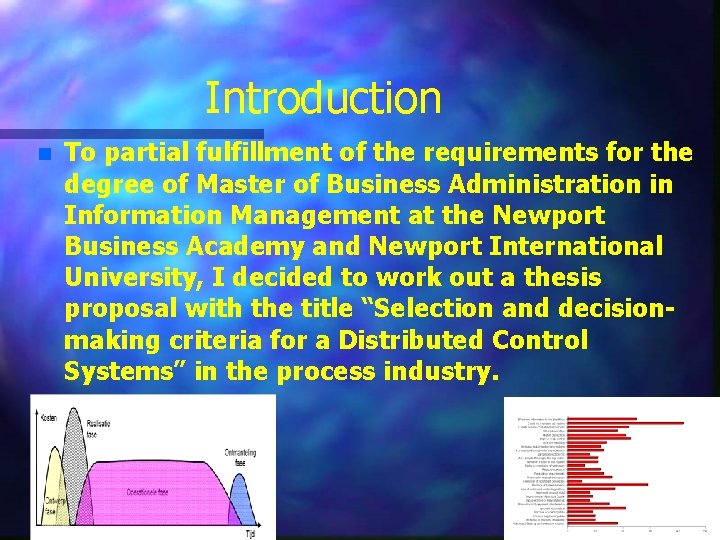
Introduction n To partial fulfillment of the requirements for the degree of Master of Business Administration in Information Management at the Newport Business Academy and Newport International University, I decided to work out a thesis proposal with the title “Selection and decisionmaking criteria for a Distributed Control Systems” in the process industry.
The project framework (1) n For the control of the chemical processes in the process “chemical” industry Distributed Control systems (DCS) are applied. These systems are the heart- and nerve system within these factories. n The choice of DCS for a concern is a matter of strategic importance. n n High demands are made to the availability of a DCS and if the concern made a choice, she is committed to it for a lengthy time. Replacing a DCS is a very valuable matter because of the arisen production loss at a reconstruction for example. The service costs of a DCS could be a multiple amount of the initial investment during the life span.
The project framework (2) n n The process industry in the world for approximately spends 65 billion dollar per year at the top 50 suppliers on process control systems (included DCS). (2006 data) n n The expenses of these investments often amount to more than 1 million Euro by per system. The selection process generally varies from 12 up to 24 months. At large DCS projects there sometimes are investments of more than 45 millions Euro. The total expenses, which are involved with the selection of one investment, amount more than 100, 000 Euro per system. To earn an order, the marketing/ sale expenses generally are more than 50. 000 Euro at a supplier.
The project framework (3) n Local employees of the establishments are involved frequently in the choice for a system. Because of the fact that this investment only takes place every 10 -17 years, they are lacked from experience and methods to be able to take this kind of decisions. The consequence is that the choice for a certain system is not always univocal at this moment and the relation between a business case, a chosen solution, and the selection process isn’t always there. This study has to contribute that we make the choice of a system in a more univocal way and the decision-making becomes more transparently.
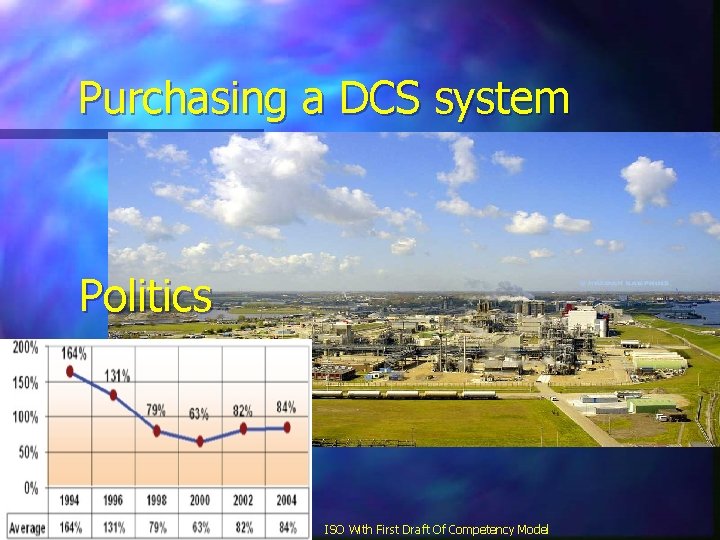
Purchasing a DCS system Politics ISO With First Draft Of Competency Model
Main objectives The goals of this research is: n The improvement of model-based consideration concerning a selection of a new distributed control system (DCS), by making an analysis of selected criteria within the “chemical” industry to choose a DCS and to establish an investment/ selection model with these insights/ ideas. n So that future investment can be bought faster and the decision-making will be more transparent.
Study n Define the core selection criteria and their priorities for the purchase of a Distributed Control system (DCS) in the chemical industry and a design a decision-making model so that the decision-making for new systems more balanced more consequent and faster can be carried out. n Interview employees who are involved in the purchase decision of DCS within large DCS using companies like Alcoa, Akzo Nobel, BP, Dow, Dupont, Exxon Mobil, DSM, Lyondell, P&G, Sabic, Shell etc. Also account managers and marketing managers of the chosen DCS have to be involved in this research. n
The areas of the study (1) 1. 2. 3. 4. 5. What is the business case of your investment in a new DCS system? What is the reason for this investment (migration, replacement or a new installation) and what are consequences of the choice of system? Which DCS supplier knows the person who is concerned in the company purchase of a new system? What decides whether the DCS supplier comes on the Big List for further evaluation? What decides whether the DCS supplier comes on the Short List for further evaluation?
The areas of the study (2) · · n Which staff functions are involved in the selection? At which components do these people pay attention and which priority do they give to the different components? Is there a difference between the ideas of DCS suppliers and users concerning these criteria?
Research project methodologie • Documents review more then 1000. • Online research (WWW. DCSSELECT. EU) • 167 respondents: End Users Engineers, Purchasing, line management and DCS vendors VP, Service – Accountmarketing managers and Business consultants • Across industries in 39 different countries: EMEA, Australia, America, Far east • Working for organizations ranging from: End Users – SI, Engineers Company’s, DCS vendors • Various industries:
Return Received survey documents End users
Involved Others
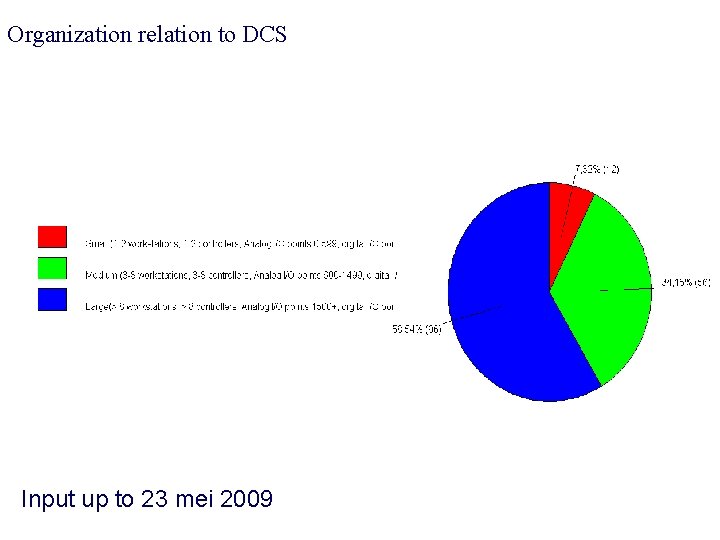
Organization relation to DCS Input up to 23 mei 2009
End User industry segment Organization relation to DCS

Job Title respondent
Reason last DCS project
Project size
Is your company a Technology trendsetter or more a follower? When you buy hardware or software for a DCS system you will buy it at?
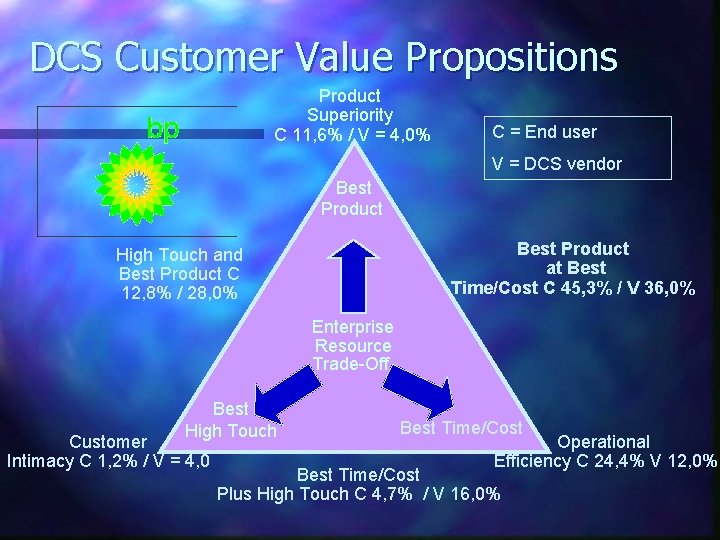
DCS Customer Value Propositions Product Superiority C 11, 6% / V = 4, 0% C = End user V = DCS vendor Best Product at Best Time/Cost C 45, 3% / V 36, 0% High Touch and Best Product C 12, 8% / 28, 0% Enterprise Resource Trade-Off Best High Touch Customer Intimacy C 1, 2% / V = 4, 0 Best Time/Cost Operational Efficiency C 24, 4% V 12, 0% Best Time/Cost Plus High Touch C 4, 7% / V 16, 0%
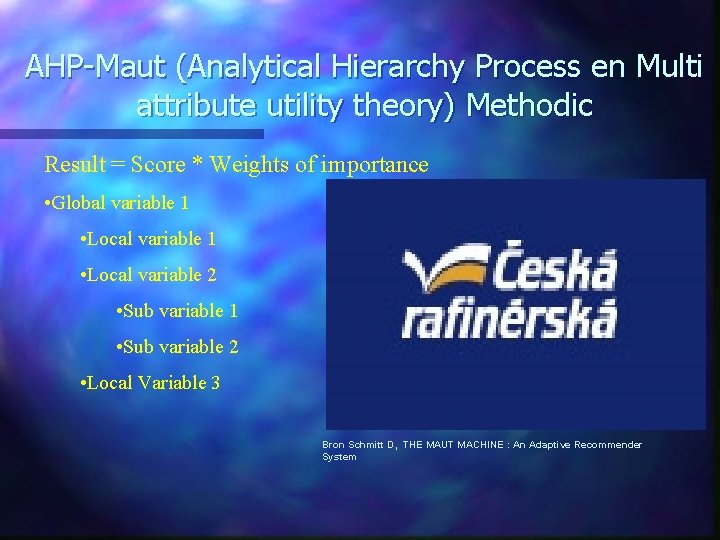
AHP-Maut (Analytical Hierarchy Process en Multi attribute utility theory) Methodic Result = Score * Weights of importance • Global variable 1 • Local variable 2 • Sub variable 1 • Sub variable 2 • Local Variable 3 Bron Schmitt D, THE MAUT MACHINE : An Adaptive Recommender System
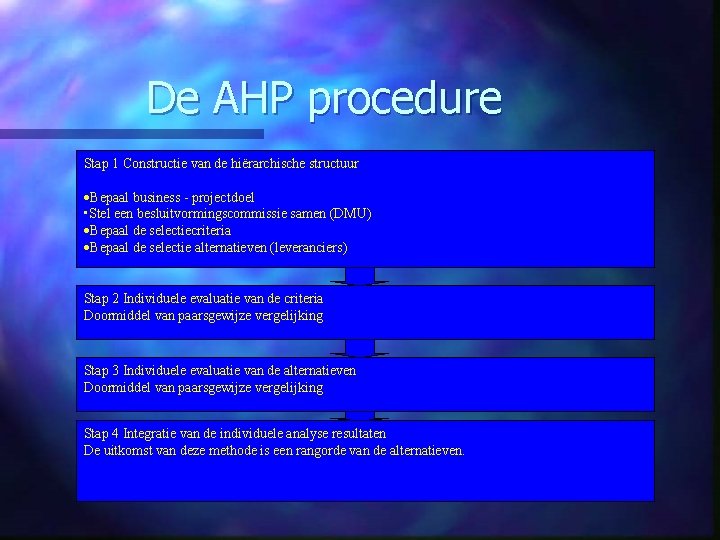
De AHP procedure Stap 1 Constructie van de hiërarchische structuur ·Bepaal business - projectdoel • Stel een besluitvormingscommissie samen (DMU) ·Bepaal de selectiecriteria ·Bepaal de selectie alternatieven (leveranciers) Stap 2 Individuele evaluatie van de criteria Doormiddel van paarsgewijze vergelijking Stap 3 Individuele evaluatie van de alternatieven Doormiddel van paarsgewijze vergelijking Stap 4 Integratie van de individuele analyse resultaten De uitkomst van deze methode is een rangorde van de alternatieven.
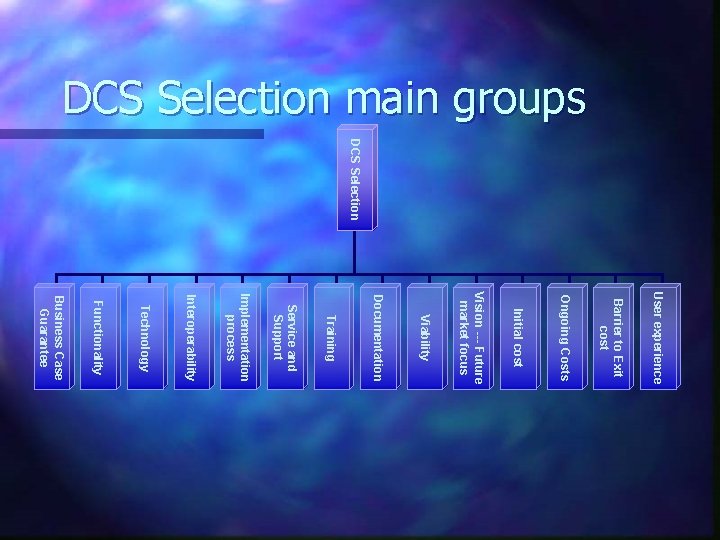
DCS Selection main groups DCS Selection User experience Barrier to Exit cost Ongoing Costs Initial cost Vision --- Future market focus Viability Documentation Training Service and Support Implementation process Interoperability Technology Functionality Business Case Guarantee
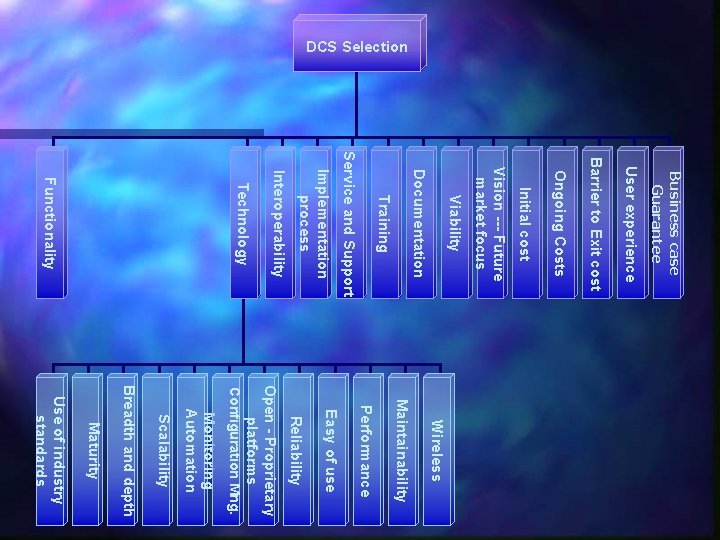
DCS Selection Business case Guarantee User experience Barrier to Exit cost Ongoing Costs Initial cost Vision --- Future market focus Viability Documentation Training Service and Support Implementation process Interoperability Technology Functionality Wireless Maintainability Performance Easy of use Reliability Open - Proprietary platforms Configuration Mng. Monitoring Automation Scalability Breadth and depth Maturity Use of industry standards
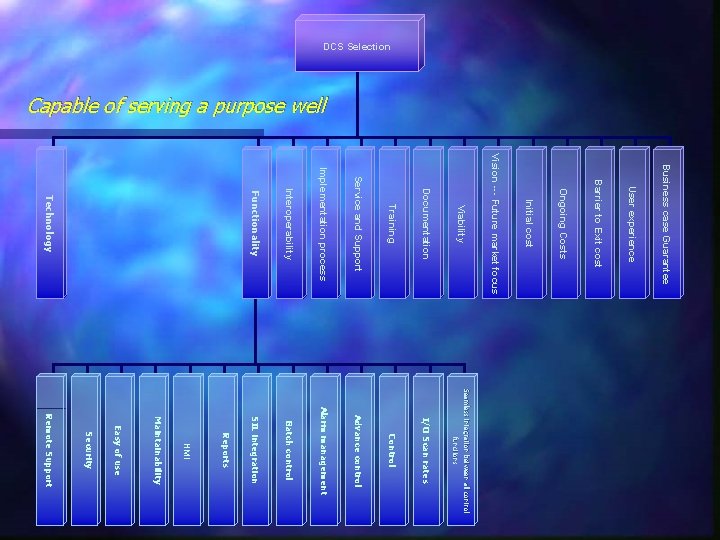
DCS Selection Capable of serving a purpose well Business case Guarantee User experience Barrier to Exit cost Ongoing Costs Initial cost Vision --- Future market focus Service and Support Training Documentation Alarm management Advance control Control I/O Scan rates functions Seamless integration between all control Implementation process Batch control Viability Interoperability SIL integration Remote Support Security Easy of use Maintainability HMI Reports Functionality Technology
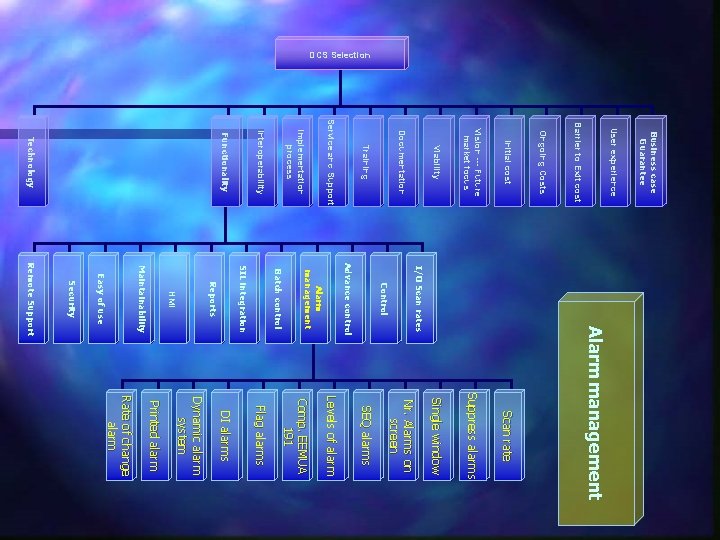
DCS Selection Business case Guarantee User experience Barrier to Exit cost Scan rate Alarm management Initial cost Suppress alarms Ongoing Costs Vision --- Future market focus Rate of change alarm Printed alarm Dynamic alarm system DI alarms Flag alarms Comp. EEMUA 191 Levels of alarm SEQ alarms Nr. Alarms on screen Single window I/O Scan rates Remote Support Security Easy of use Maintainability HMI Reports SIL integration Batch control Alarm management Advance control Control Viability Documentation Training Service and Support Implementation process Interoperability Functionality Technology

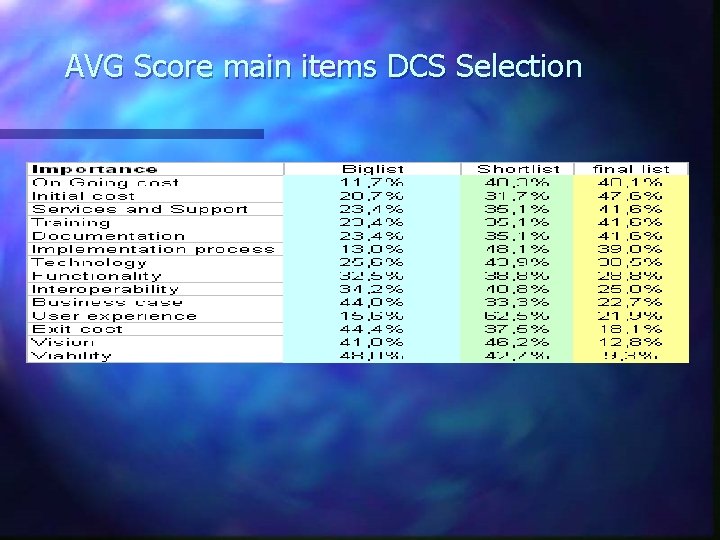
AVG Score main items DCS Selection
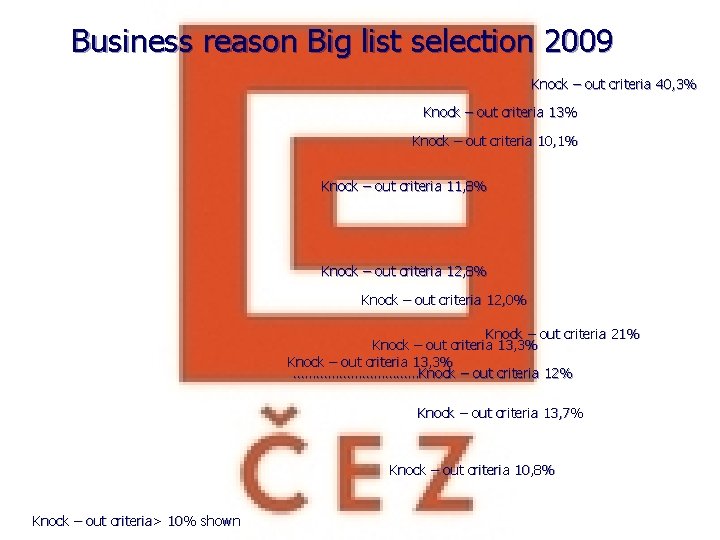
Business reason Big list selection 2009 Knock – out criteria 40, 3% Knock – out criteria 10, 1% Knock – out criteria 11, 8% Knock – out criteria 12, 0% Knock – out criteria 21% Knock – out criteria 13, 3% ………………Knock – out criteria 12% Knock – out criteria 13, 7% Knock – out criteria 10, 8% Knock – out criteria> 10% shown
Business reason Final selection 2009 Knock – out criteria> 10% shown
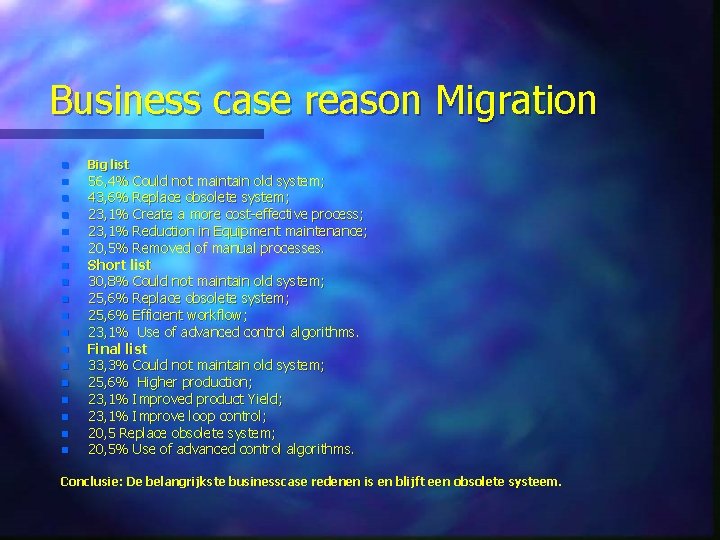
Business case reason Migration n n n n Big list 56, 4% Could not maintain old system; 43, 6% Replace obsolete system; 23, 1% Create a more cost-effective process; 23, 1% Reduction in Equipment maintenance; 20, 5% Removed of manual processes. Short list 30, 8% Could not maintain old system; 25, 6% Replace obsolete system; 25, 6% Efficient workflow; 23, 1% Use of advanced control algorithms. Final list 33, 3% Could not maintain old system; 25, 6% Higher production; 23, 1% Improved product Yield; 23, 1% Improve loop control; 20, 5 Replace obsolete system; 20, 5% Use of advanced control algorithms. Conclusie: De belangrijkste businesscase redenen is en blijft een obsolete systeem.
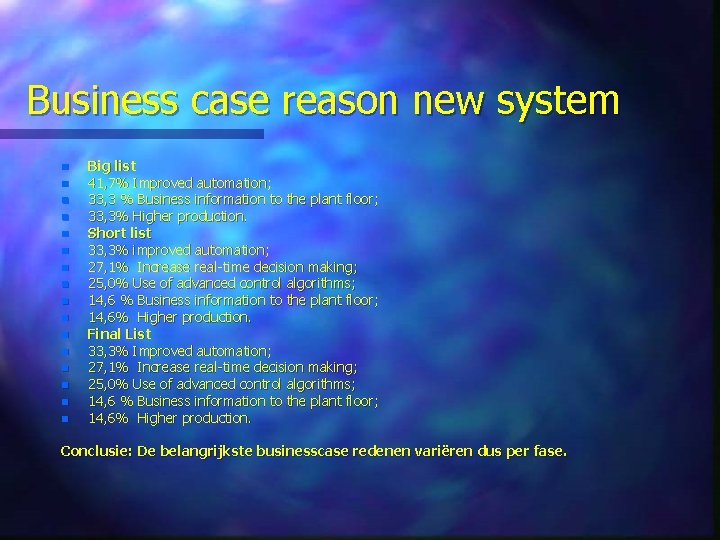
Business case reason new system n n n n Big list 41, 7% Improved automation; 33, 3 % Business information to the plant floor; 33, 3% Higher production. Short list 33, 3% improved automation; 27, 1% Increase real-time decision making; 25, 0% Use of advanced control algorithms; 14, 6 % Business information to the plant floor; 14, 6% Higher production. Final List 33, 3% Improved automation; 27, 1% Increase real-time decision making; 25, 0% Use of advanced control algorithms; 14, 6 % Business information to the plant floor; 14, 6% Higher production. Conclusie: De belangrijkste businesscase redenen variëren dus per fase.
Selection criteria in Phase
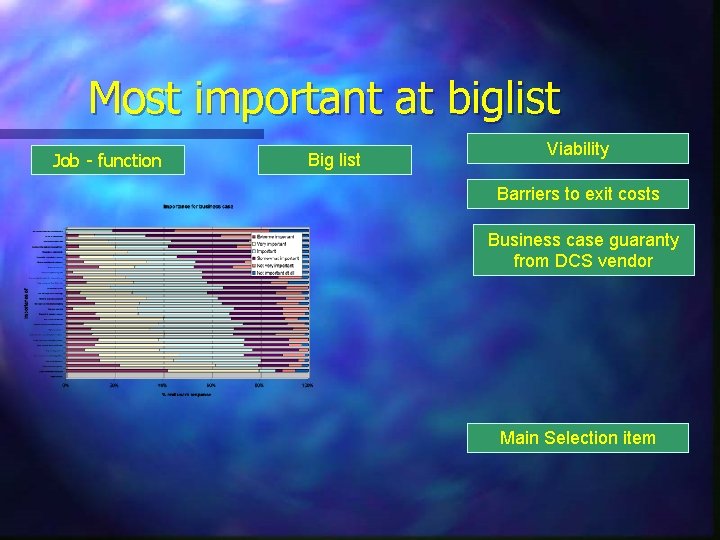
Most important at biglist Job - function Big list Viability Barriers to exit costs Business case guaranty from DCS vendor Main Selection item
Most important at short list Job- function Short list Vision DCS vendor Functionality Implementation process Technology Interoperability User Experion Main Selection item
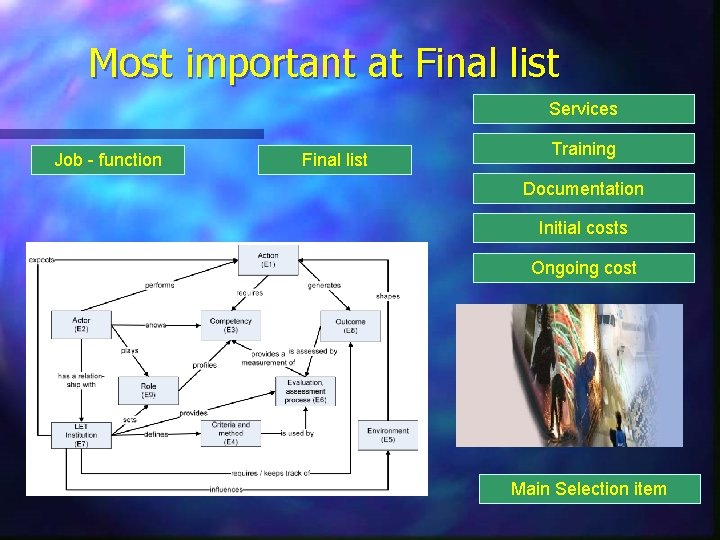
Most important at Final list Services Job - function Final list Training Documentation Initial costs Ongoing cost Main Selection item
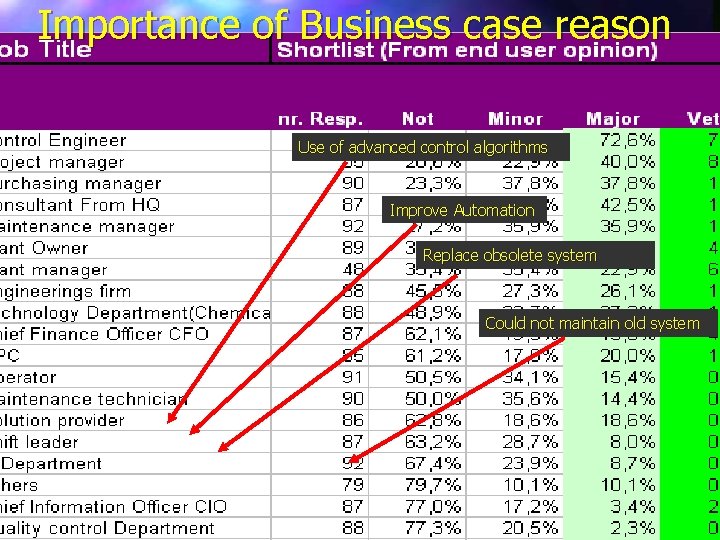
Importance of Business case reason Use of advanced control algorithms Improve Automation Replace obsolete system Could not maintain old system

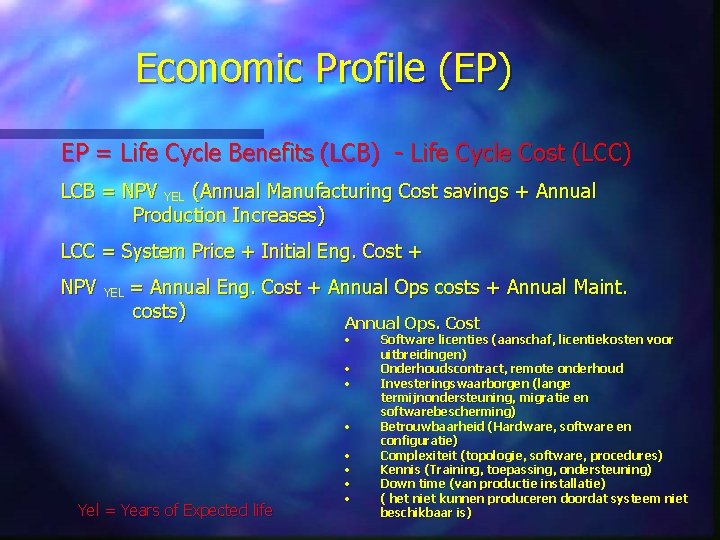
Economic Profile (EP) EP = Life Cycle Benefits (LCB) - Life Cycle Cost (LCC) LCB = NPV YEL (Annual Manufacturing Cost savings + Annual Production Increases) LCC = System Price + Initial Eng. Cost + NPV YEL = Annual Eng. Cost + Annual Ops costs + Annual Maint. costs) Annual Ops. Cost • • Yel = Years of Expected life • • Software licenties (aanschaf, licentiekosten voor uitbreidingen) Onderhoudscontract, remote onderhoud Investeringswaarborgen (lange termijnondersteuning, migratie en softwarebescherming) Betrouwbaarheid (Hardware, software en configuratie) Complexiteit (topologie, software, procedures) Kennis (Training, toepassing, ondersteuning) Down time (van productie installatie) ( het niet kunnen produceren doordat systeem niet beschikbaar is)
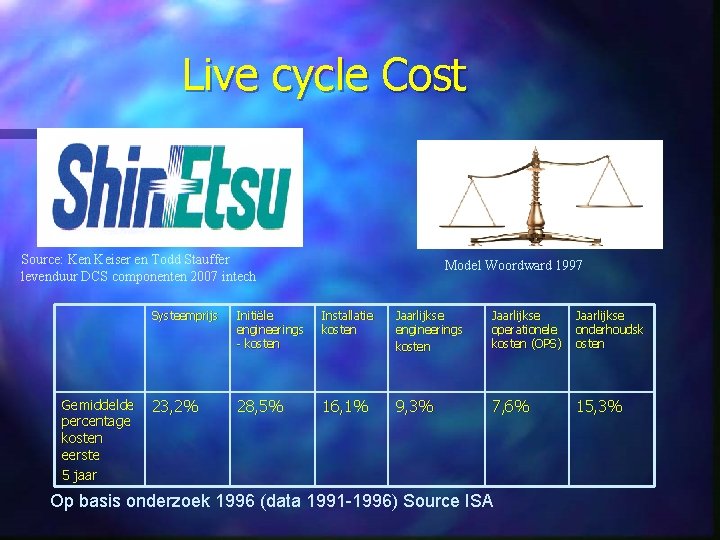
Live cycle Cost Source: Ken Keiser en Todd Stauffer levenduur DCS componenten 2007 intech Systeemprijs Gemiddelde 23, 2% percentage kosten eerste 5 jaar Model Woordward 1997 Initiële engineerings - kosten Installatie kosten Jaarlijkse engineerings kosten Jaarlijkse operationele kosten (OPS) Jaarlijkse onderhoudsk osten 28, 5% 16, 1% 9, 3% 7, 6% 15, 3% Op basis onderzoek 1996 (data 1991 -1996) Source ISA
Migration Risk v. s. Benefits
Conclusies n Migraties en vervangingen van een DCS systeem worden veel meer gedreven door de angst voor een obsolete systeem dan door de terugverdiencapaciteit en betere besturing of andere functionele mogelijkheden van een nieuw systeem. Zoals bijv. zaken zoals procesverbeteringen en hogere productie.
n Een groot percentage DCS en ICT-projecten haalt niet succesvol de eindstreep, de businesscase wordt niet gehaald, de projectduur is langer en de kosten zijn hoger als oorspronkelijk bepaald. De hoofdredenen zijn het onvoldoende functioneel te specificeren van de projecteisen en tussentijdse wijzigingen.
n Vroegtijdig inspelen op de specificaties geeft maximale manoeuvreerruimte voor besparingen (dan wel minimale kosten voor een verandering) daarnaast is het vroegtijdig bestrekken van inkoop in de specificatiefase een kostenbesparing en zou je hiermee zo vroeg als mogelijk hiermee moeten beginnen. Doordat er een tekort aan deskundige (interne) mensen is, zal het verstandig zijn om een externe consultant in te huren om te helpen in de startfase van het project om deze besparingen ook te realiseren.
Uiteindelijk wordt dit de keuze n n Dat de beste keuze een systeem is waar de sterkten van het systeem overeenkomen met de behoeftes van de plant. Dat is altijd beter dan een systeem dat bijna alles kan, maar de belangrijke zaken voor de plant niet; ”Die leverancier te kiezen die voor de onderneming op lange termijn het geringste risico vormt. Door het kleinste risico te combineren met de hoogste (tevredenheid) score op de selectiecriteria resulteert in een aanbeveling voor die betreffende leverancier”.
Het zijn de mensen die het doen, zowel in de selectie als in de implementatie en onderhoud, zorgvuldige selectie van de juiste teams is dan ook belangrijker dan veel technische aspecten.
End n Contact information for more information n Willem. Hazenberg@dcsselect. eu Willem. hazenberg@Stork. com n n Website WWW. DCSSELECT. EU 1 e results http: //www. dcsselect. eu/RES_ENDUSER/_frame. htm Concept Thesis n http: //www. dcsselect. eu/Concept%20 Thesis. htm n n n
- Slides: 49