
Selecting the Most Effective Stormwater Treatment Practice Presented
- Slides: 10
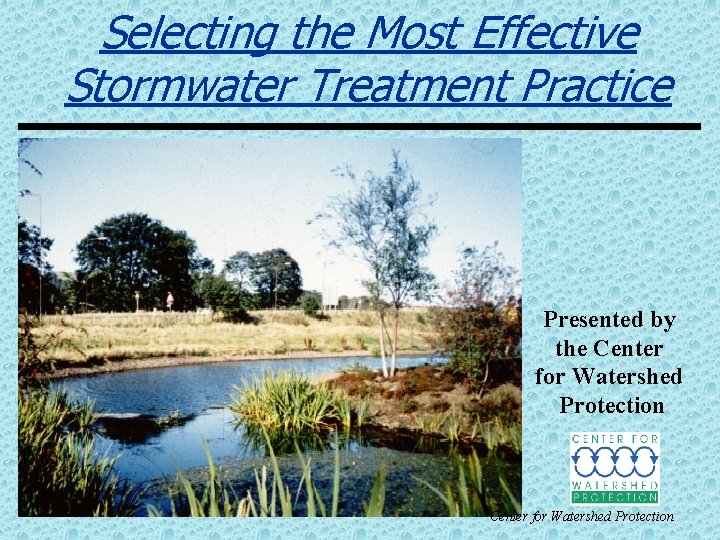
Selecting the Most Effective Stormwater Treatment Practice Presented by the Center for Watershed Protection
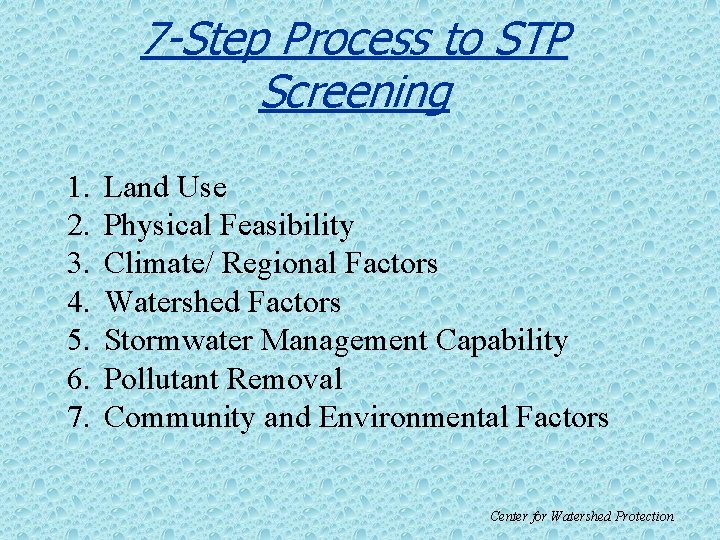
7 -Step Process to STP Screening 1. 2. 3. 4. 5. 6. 7. Land Use Physical Feasibility Climate/ Regional Factors Watershed Factors Stormwater Management Capability Pollutant Removal Community and Environmental Factors Center for Watershed Protection
Customizing Matrices to Local Needs • Matrices are not necessarily exhaustive. • Specific additional criteria may be incorporated or removed depending on local goals. • Most of the material in the screening matrices provides technical guidance, and is not necessarily a regulatory mandate. Center for Watershed Protection
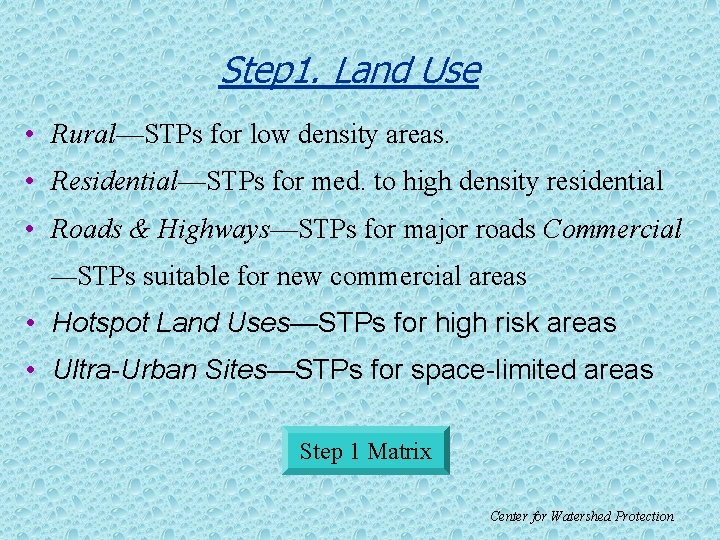
Step 1. Land Use • Rural—STPs for low density areas. • Residential—STPs for med. to high density residential • Roads & Highways—STPs for major roads Commercial —STPs suitable for new commercial areas • Hotspot Land Uses—STPs for high risk areas • Ultra-Urban Sites—STPs for space-limited areas Step 1 Matrix Center for Watershed Protection
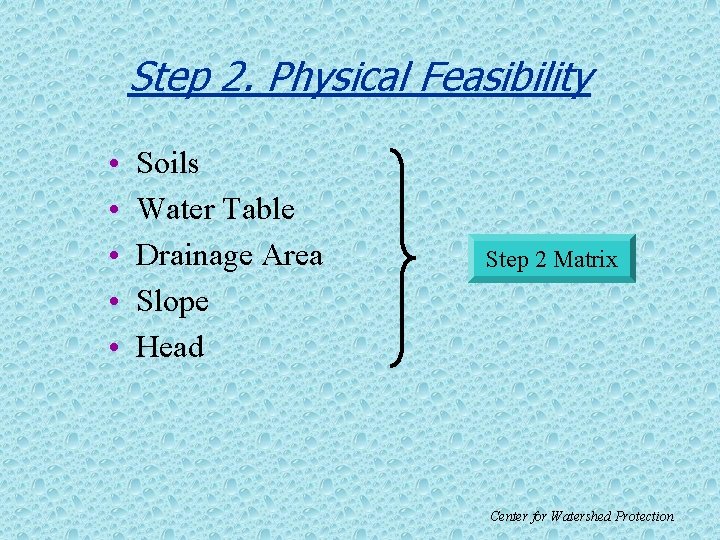
Step 2. Physical Feasibility • • • Soils Water Table Drainage Area Slope Head Step 2 Matrix Center for Watershed Protection
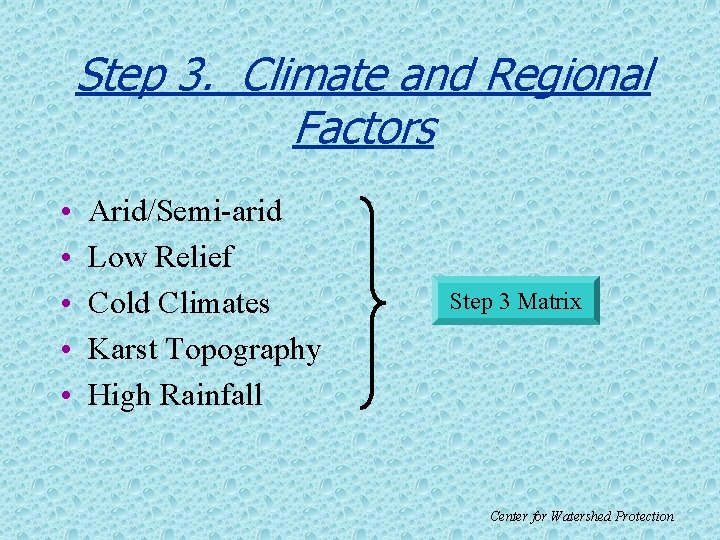
Step 3. Climate and Regional Factors • • • Arid/Semi-arid Low Relief Cold Climates Karst Topography High Rainfall Step 3 Matrix Center for Watershed Protection
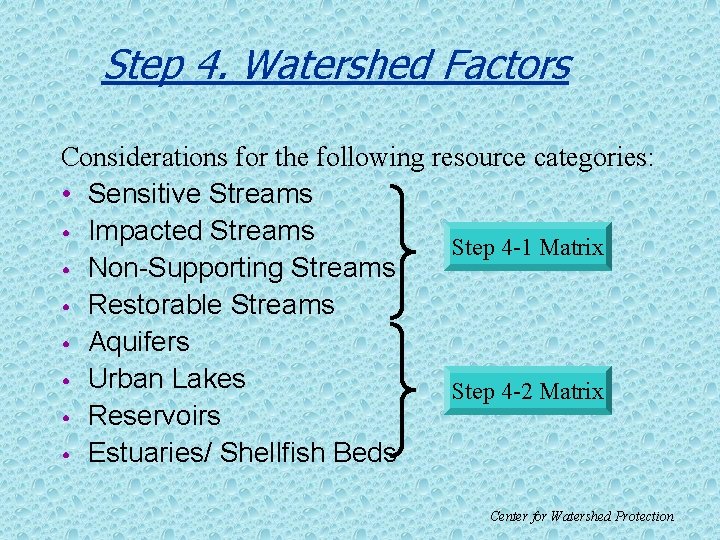
Step 4. Watershed Factors Considerations for the following resource categories: • Sensitive Streams • Impacted Streams Step 4 -1 Matrix • Non-Supporting Streams • Restorable Streams • Aquifers • Urban Lakes Step 4 -2 Matrix • Reservoirs • Estuaries/ Shellfish Beds Center for Watershed Protection
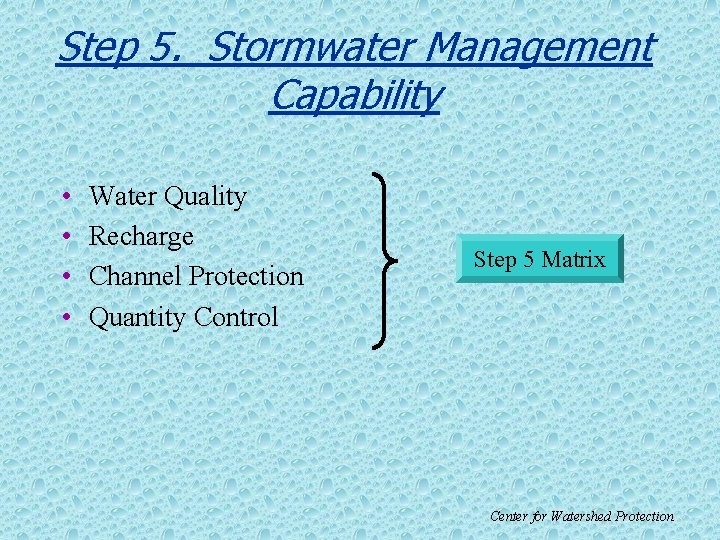
Step 5. Stormwater Management Capability • • Water Quality Recharge Channel Protection Quantity Control Step 5 Matrix Center for Watershed Protection
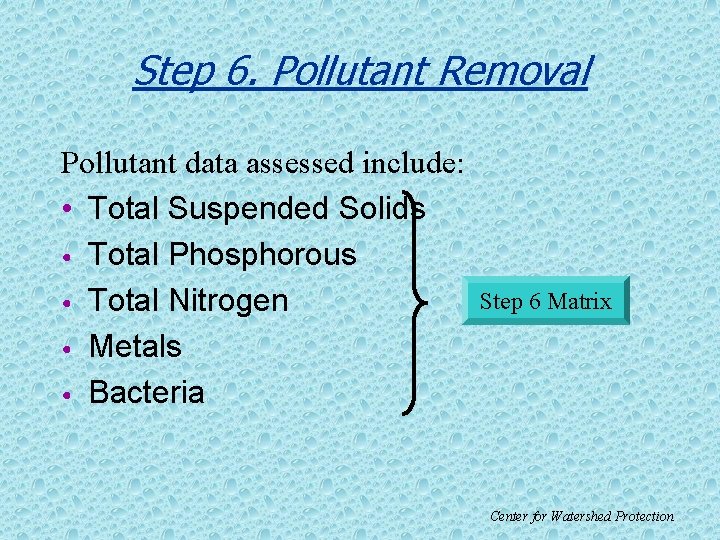
Step 6. Pollutant Removal Pollutant data assessed include: • Total Suspended Solids • Total Phosphorous • Total Nitrogen • Metals • Bacteria Step 6 Matrix Center for Watershed Protection
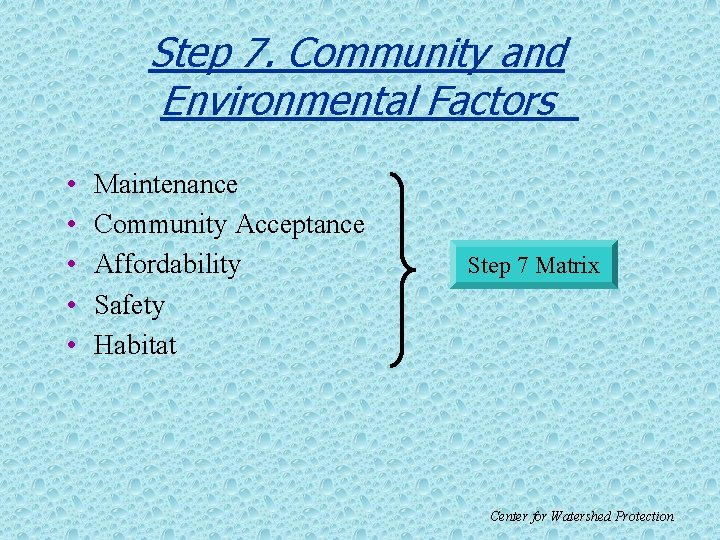
Step 7. Community and Environmental Factors • • • Maintenance Community Acceptance Affordability Safety Habitat Step 7 Matrix Center for Watershed Protection