
Selecting Students for Success DLAB and DLAB 2
Selecting Students for Success: DLAB and DLAB 2 Dr. Donald C. Fischer Dr. Shannon Salyer Defense Language Institute May 2010
Presentation Outline • • 2 Overview of DLIFLC Overview of the DLAB and selection Goals & history of the DLAB 2 project Constructs & Measures Field-test design Preliminary field-test findings
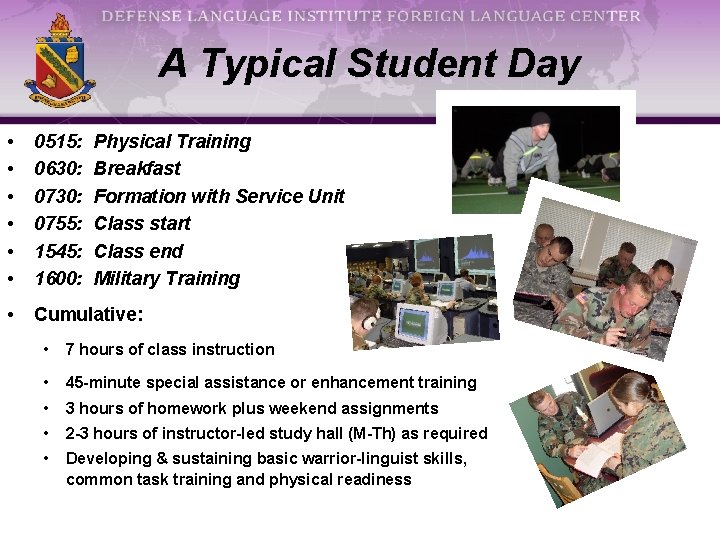
A Typical Student Day • • • 0515: 0630: 0755: 1545: 1600: • Cumulative: Physical Training Breakfast Formation with Service Unit Class start Class end Military Training • 7 hours of class instruction • 45 -minute special assistance or enhancement training • 3 hours of homework plus weekend assignments • 2 -3 hours of instructor-led study hall (M-Th) as required • Developing & sustaining basic warrior-linguist skills, common task training and physical readiness
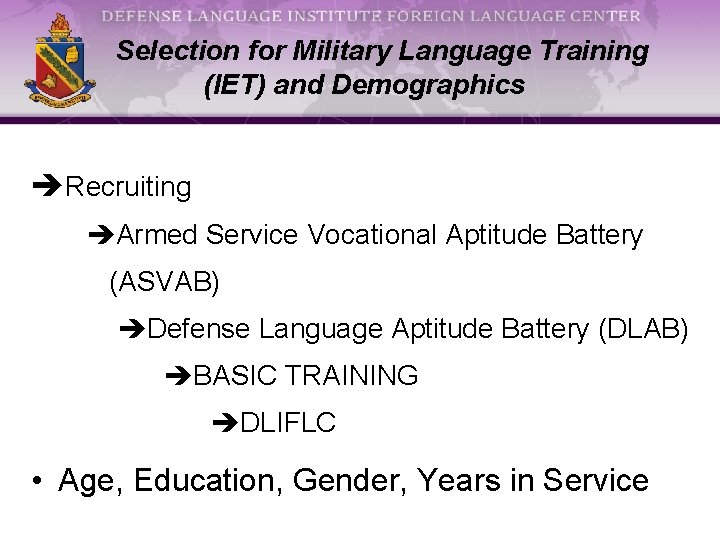
Selection for Military Language Training (IET) and Demographics Recruiting Armed Service Vocational Aptitude Battery (ASVAB) Defense Language Aptitude Battery (DLAB) BASIC TRAINING DLIFLC • Age, Education, Gender, Years in Service
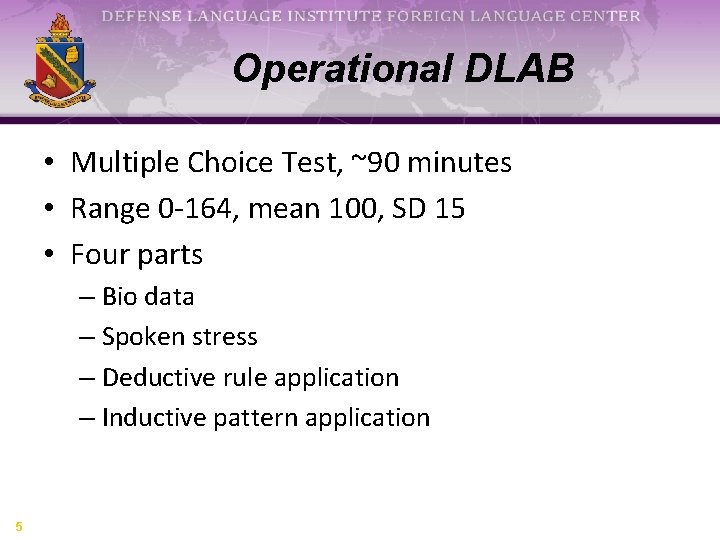
Operational DLAB • Multiple Choice Test, ~90 minutes • Range 0 -164, mean 100, SD 15 • Four parts – Bio data – Spoken stress – Deductive rule application – Inductive pattern application 5
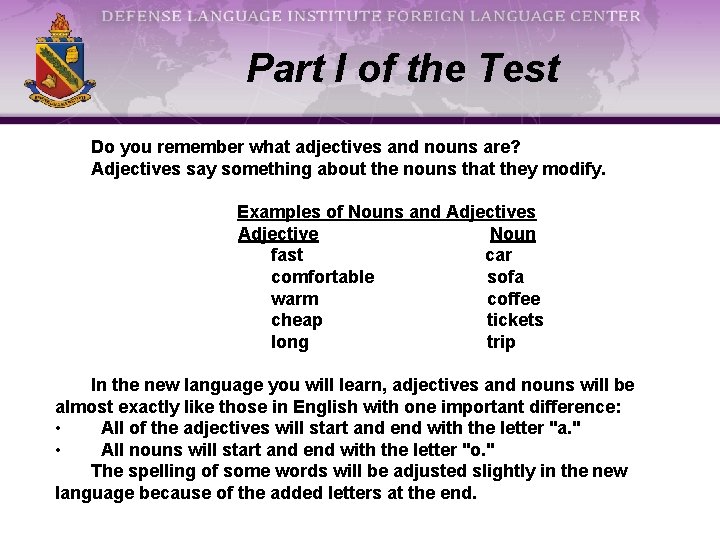
Part I of the Test Do you remember what adjectives and nouns are? Adjectives say something about the nouns that they modify. Examples of Nouns and Adjectives Adjective Noun fast car comfortable sofa warm coffee cheap tickets long trip In the new language you will learn, adjectives and nouns will be almost exactly like those in English with one important difference: • All of the adjectives will start and end with the letter "a. " • All nouns will start and end with the letter "o. " The spelling of some words will be adjusted slightly in the new language because of the added letters at the end.
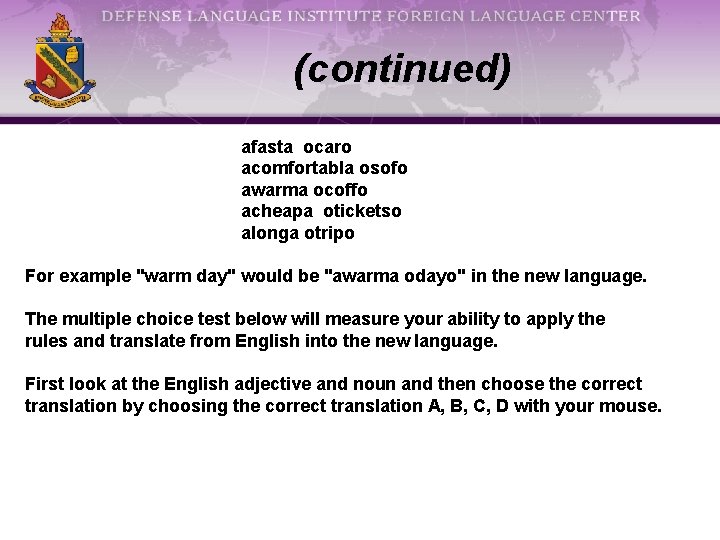
(continued) afasta ocaro acomfortabla osofo awarma ocoffo acheapa oticketso alonga otripo For example "warm day" would be "awarma odayo" in the new language. The multiple choice test below will measure your ability to apply the rules and translate from English into the new language. First look at the English adjective and noun and then choose the correct translation by choosing the correct translation A, B, C, D with your mouse.
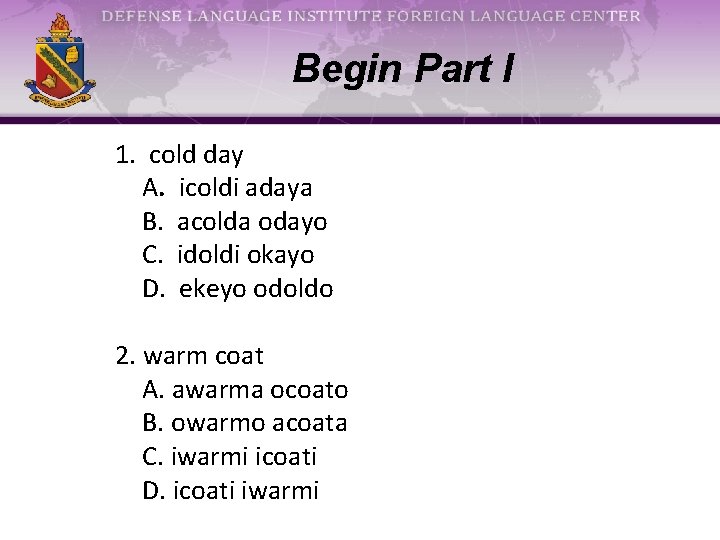
Begin Part I 1. cold day A. icoldi adaya B. acolda odayo C. idoldi okayo D. ekeyo odoldo 2. warm coat A. awarma ocoato B. owarmo acoata C. iwarmi icoati D. icoati iwarmi
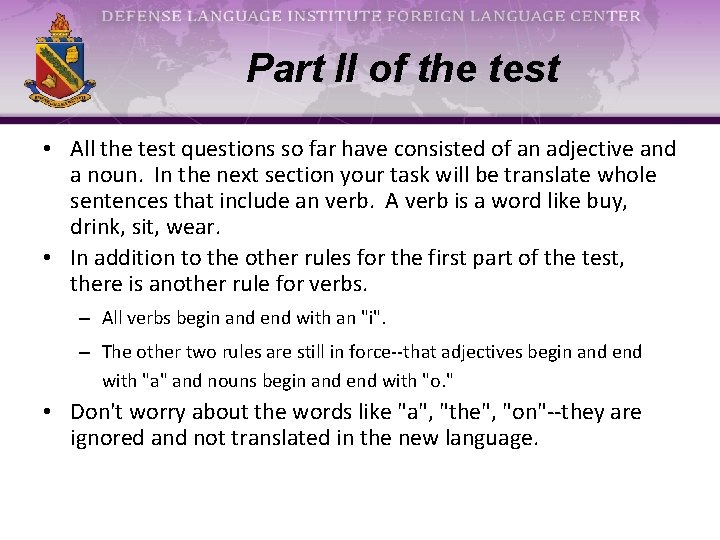
Part II of the test • All the test questions so far have consisted of an adjective and a noun. In the next section your task will be translate whole sentences that include an verb. A verb is a word like buy, drink, sit, wear. • In addition to the other rules for the first part of the test, there is another rule for verbs. – All verbs begin and end with an "i". – The other two rules are still in force--that adjectives begin and end with "a" and nouns begin and end with "o. " • Don't worry about the words like "a", "the", "on"--they are ignored and not translated in the new language.
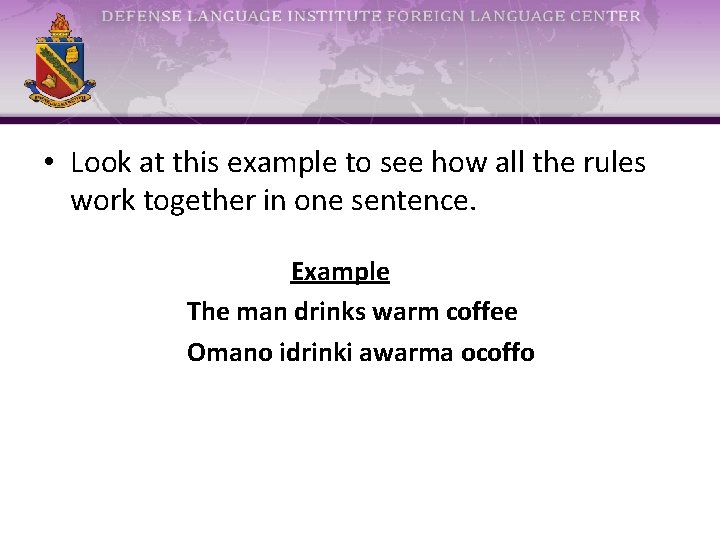
• Look at this example to see how all the rules work together in one sentence. Example The man drinks warm coffee Omano idrinki awarma ocoffo
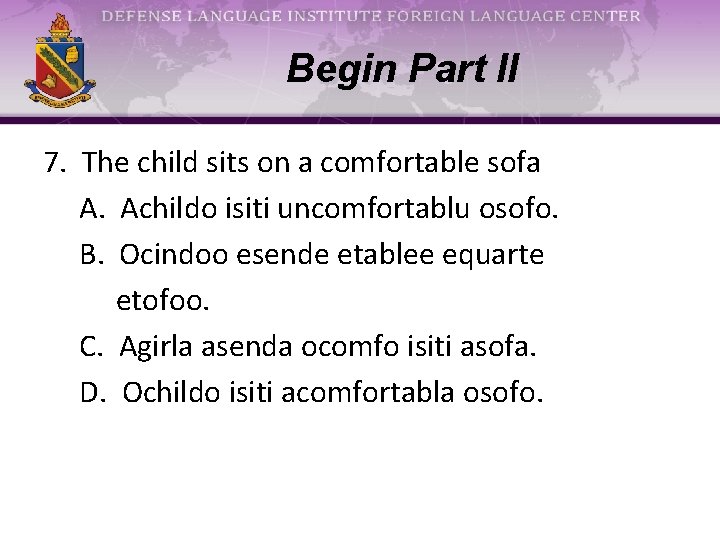
Begin Part II 7. The child sits on a comfortable sofa A. Achildo isiti uncomfortablu osofo. B. Ocindoo esende etablee equarte etofoo. C. Agirla asenda ocomfo isiti asofa. D. Ochildo isiti acomfortabla osofo.

Part III In the last section of the test, first you will study the four correct model examples below. After you read each of the choices, choose the correct translation. FOUR CORRECT MODELS: REFER BACK TO THESE MODELS WHEN CHOOSING CORRECT ANSWER TO QUESTIONS 8 -10 The boy will sit on the chair = Oboyo isitiro ochairo The girl will drive the car = Ogirlo idriviro ocaro. The boy drove the big car = Oboyo idrivado abiga ocaro. The woman sat on the big chair = Owomano isitado abiga ochairo
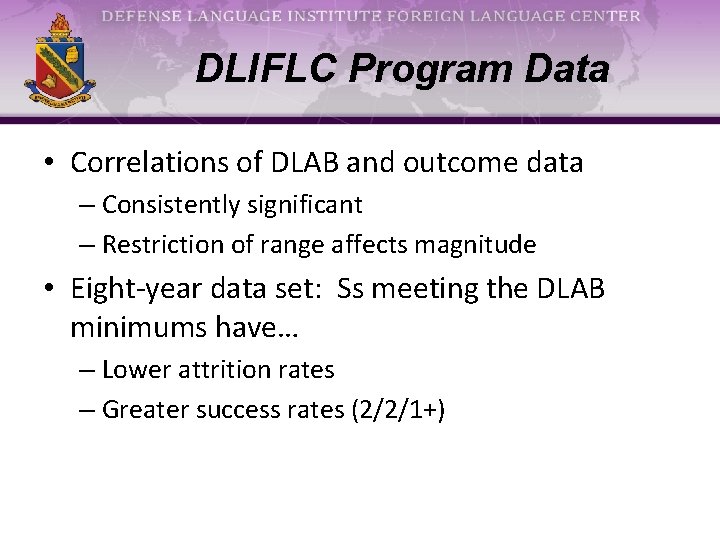
DLIFLC Program Data • Correlations of DLAB and outcome data – Consistently significant – Restriction of range affects magnitude • Eight-year data set: Ss meeting the DLAB minimums have… – Lower attrition rates – Greater success rates (2/2/1+)
Revision of DLAB DLIFLC’s 4 reasons for revising DLAB: • Current DLAB forms in use for 30+ years • Need to update the science behind DLAB • DLPT, the current standardized criterion measure, is much newer than DLAB • Pressure for testing and training more people in harder languages 14 • Enlisted the help of CASL (Center for the Advanced Study of Language)
Project Goals • Propose new cognitive and non-cognitive constructs • Field test proposed constructs to determine which – Improve Selection – Improve Language Assignment – Improve Language Skill Prediction • Develop secure measures of retained constructs 15
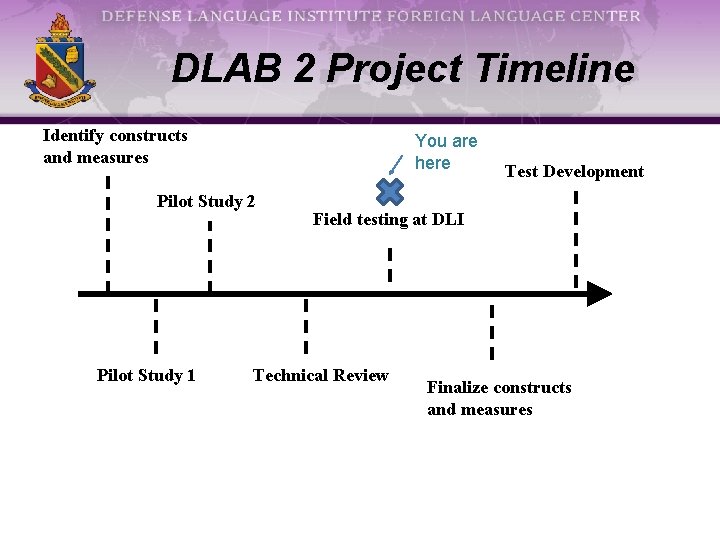
DLAB 2 Project Timeline Identify constructs and measures You are here Pilot Study 2 Pilot Study 1 Test Development Field testing at DLI Technical Review Finalize constructs and measures
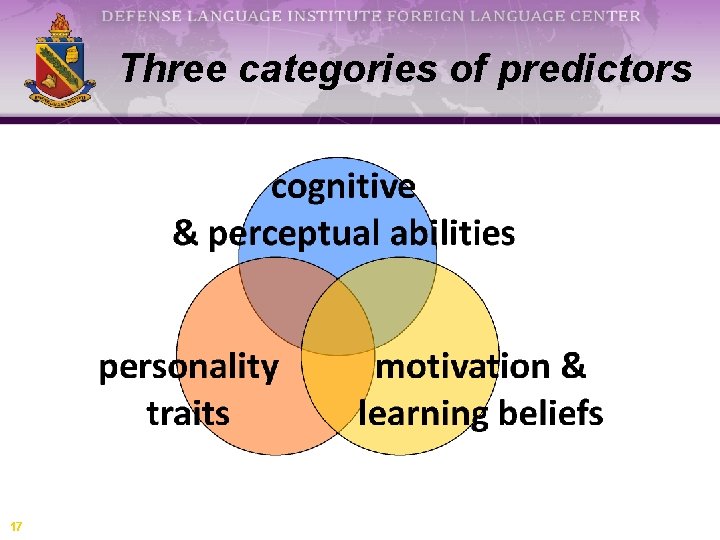
Three categories of predictors 17
Cognitive & Perceptual Abilities • Cognitive – Working memory; executive control; general intelligence/reasoning; implicit induction; processing speed; priming; rote memory • Perceptual – Tests the ability to hear non-native phonological contrasts either before or after training 18
Personality Traits • Constructs: Big 5 (narrow), Need for closure, Tolerance for Ambiguity, Self-Monitoring • Tailored Adaptive Personality Assessment System (TAPAS) – Choose the answer that is more like you: • I have to be very sick to miss a day of work or not complete a task on time. • I keep my appointment book well organized and up to date. • Most people would say I have a hot temper. • I only help people when I know I will get something in return. 19
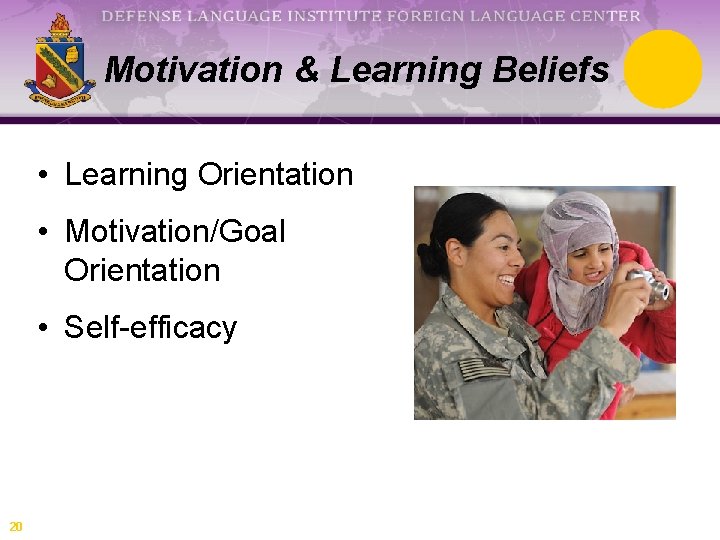
Motivation & Learning Beliefs • Learning Orientation • Motivation/Goal Orientation • Self-efficacy 20
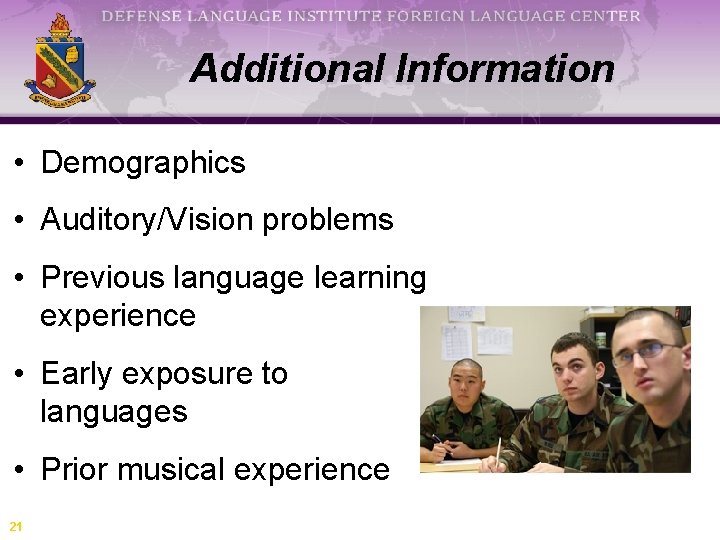
Additional Information • Demographics • Auditory/Vision problems • Previous language learning experience • Early exposure to languages • Prior musical experience 21
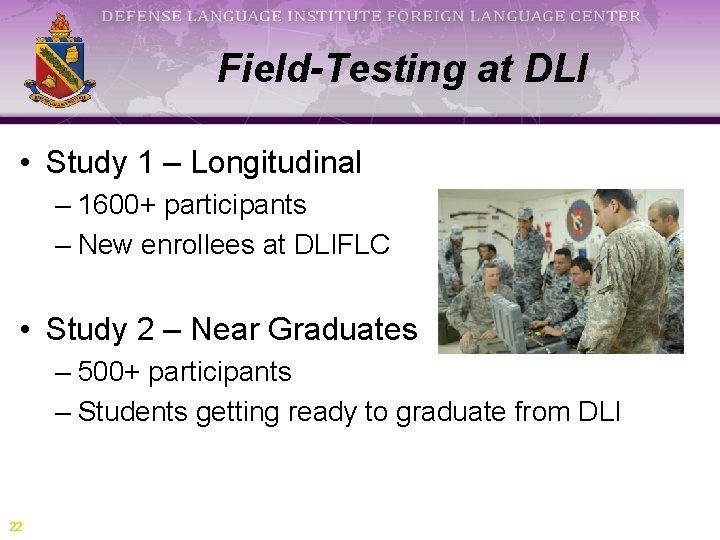
Field-Testing at DLI • Study 1 – Longitudinal – 1600+ participants – New enrollees at DLIFLC • Study 2 – Near Graduates – 500+ participants – Students getting ready to graduate from DLI 22
Criterion Measures Academic Attrition Recycling Re-languaging Non-Academic Attrition Disciplinary Medical Proficiency End of course DLPT (L/R/S) Academic Performance GPA In-class test/unit scores 23
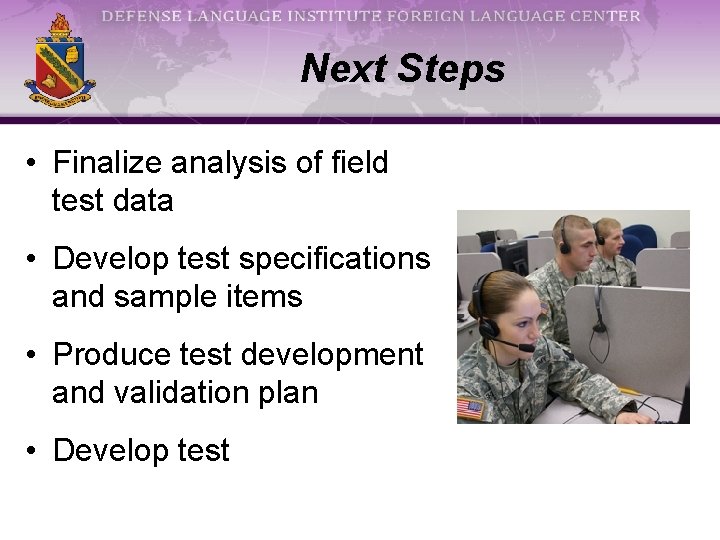
Next Steps • Finalize analysis of field test data • Develop test specifications and sample items • Produce test development and validation plan • Develop test
For more information… • Dr. Donald C. Fischer, Provost Donald. C. Fischer@us. army. mil • Dr. Shannon Salyer, Senior Research Scientist Shannon. Salyer@us. army. mil • Dr. John Lett, Dean, Research and Analysis John. Lett@us. army. mil
- Slides: 25