
SELECTING RESEARCH PARTICIPANTS Overview Population and samples Generalization

- Slides: 15
SELECTING RESEARCH PARTICIPANTS
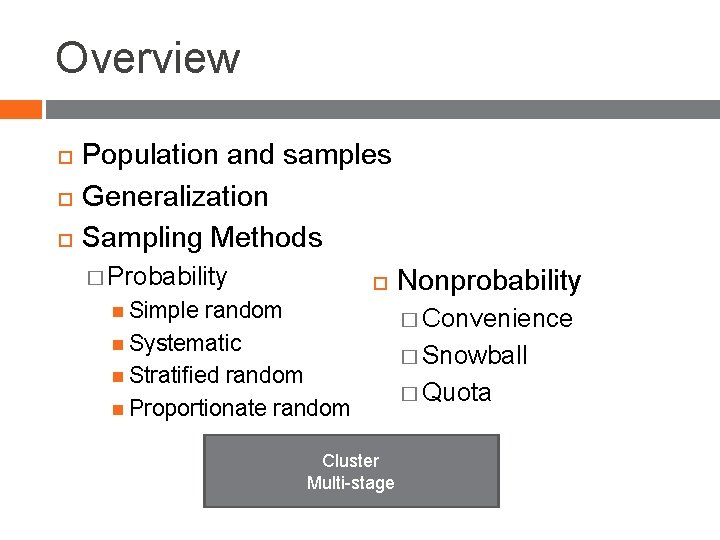
Overview Population and samples Generalization Sampling Methods � Probability Simple random Systematic Stratified random Proportionate random Cluster Multi-stage Nonprobability � Convenience � Snowball � Quota
Choosing Participants High school students’ attitudes towards unrestricted searches Who should take the survey? � All high school students in the nation? � All 5, 000 students in a local school district? � Only high schools that have reported problems with drugs & weapons? Bottom line: � Not everyone can participate � Interpretation of data depends on who are participants are and how they were selected
Populations & Samples Population � Entire set of individuals of interest � Usually targeted, not everyone on the planet Sample � Set of individuals selected from a population � Intended to represent the population
Sampling & Generalization � Apply results from sample to population � Depends on how representative the sample is Selection bias � Sampling sample method used that leads to biased
Sampling Methods Probability sampling � Can determine probability that each member of population will be selected for sample � Population known – to establish a sampling frame Even through random selection, sample may not be representative � Larger sample size increases the likelihood that sample looks like population
Probability Sampling Simple Random Sampling � Every member of population has an equal & independent chance of being selected � Reduces systematic bias Does not guarantee a representative sample � Can be difficult & time consuming, or even not possible
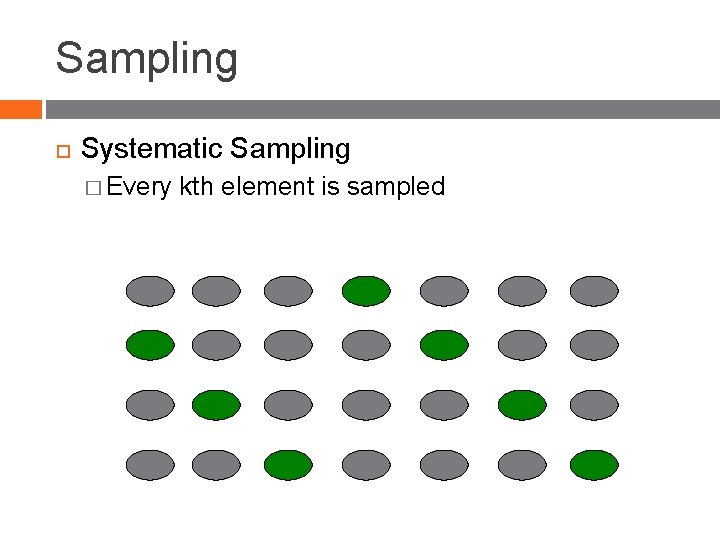
Sampling Systematic Sampling � Every kth element is sampled
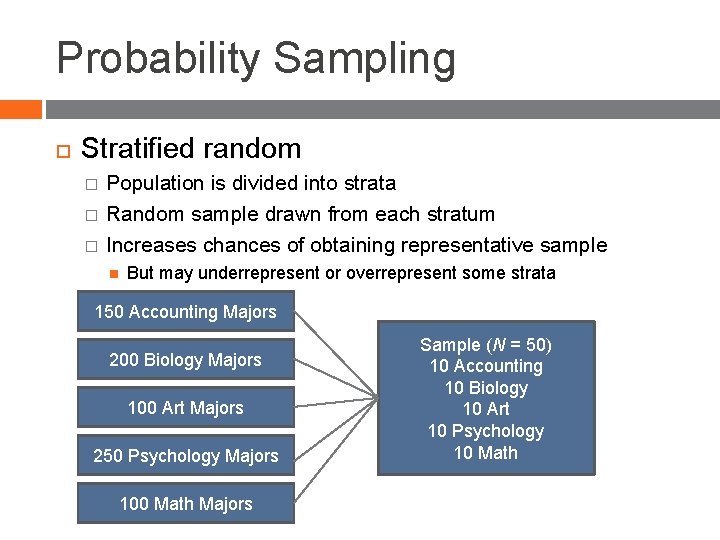
Probability Sampling Stratified random � � � Population is divided into strata Random sample drawn from each stratum Increases chances of obtaining representative sample But may underrepresent or overrepresent some strata 150 Accounting Majors 200 Biology Majors 100 Art Majors 250 Psychology Majors 100 Math Majors Sample (N = 50) 10 Accounting 10 Biology 10 Art 10 Psychology 10 Math
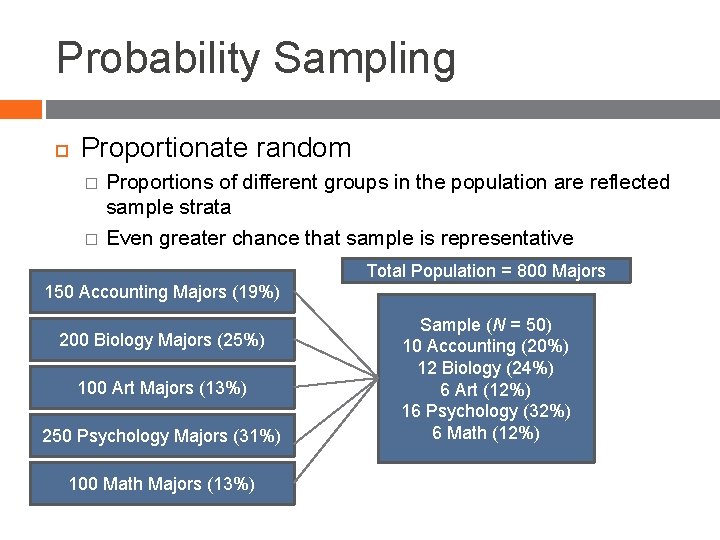
Probability Sampling Proportionate random � � Proportions of different groups in the population are reflected sample strata Even greater chance that sample is representative Total Population = 800 Majors 150 Accounting Majors (19%) 200 Biology Majors (25%) 100 Art Majors (13%) 250 Psychology Majors (31%) 100 Math Majors (13%) Sample (N = 50) 10 Accounting (20%) 12 Biology (24%) 6 Art (12%) 16 Psychology (32%) 6 Math (12%)
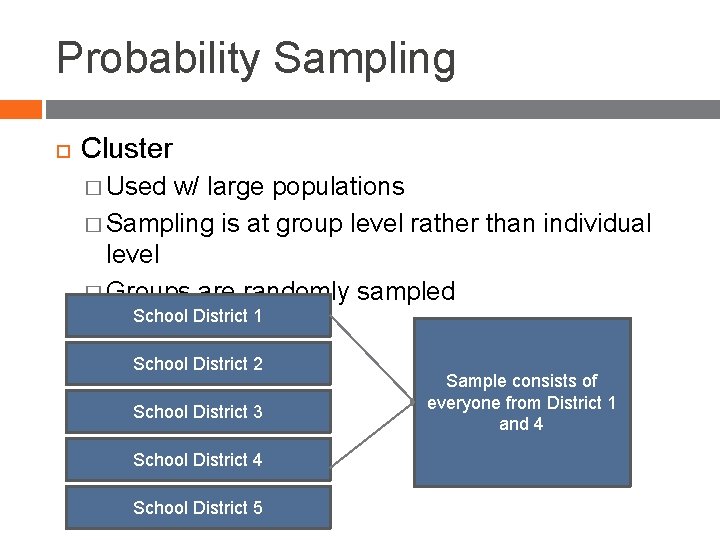
Probability Sampling Cluster � Used w/ large populations � Sampling is at group level rather than individual level � Groups are randomly sampled School District 1 School District 2 School District 3 School District 4 School District 5 Sample consists of everyone from District 1 and 4
Probability Sampling Multistage sampling � First, identify clusters Randomly � Next, � Note: sample individuals from clusters may be necessary to use more than 2 stages
Nonprobability Sampling Convenience Sampling � Sampling individuals who are readily available Advantages � Time, money � Might be the only method possible Disadvantages � Assumes characteristics that make your sample convenient are unrelated to variables of interest � Difficult to know if (or how) your sample is biased
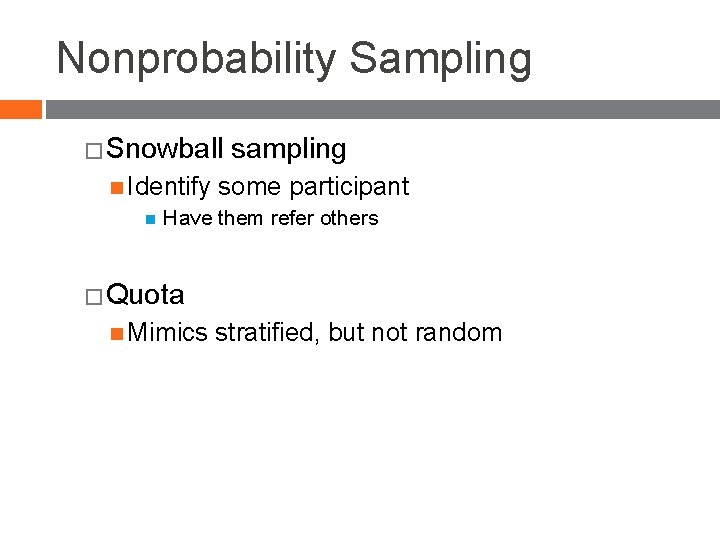
Nonprobability Sampling � Snowball Identify sampling some participant Have them refer others � Quota Mimics stratified, but not random
Mini-Review 1. 2. Explain how stratified and proportionate sampling are similar and how they are different. What sampling methods are likely to ensure the greatest chance that our sample will represent the population well? Why?