
Selecting and Evaluating Digital Learning Materials for Higher
- Slides: 17
Selecting and Evaluating Digital Learning Materials for Higher Education Joseph Tront Virginia Tech Engineering Pathway Brandon Muramatsu Utah State University Flora Mc. Martin MERLOT Cal State University Originally Published 2005. Republished 2013. This work is licensed under a Creative Commons Attribution. Noncommercial-Share Alike 3. 0 United States License (http: //creativecommons. org/licenses/by-nc-sa/3. 0/us/)
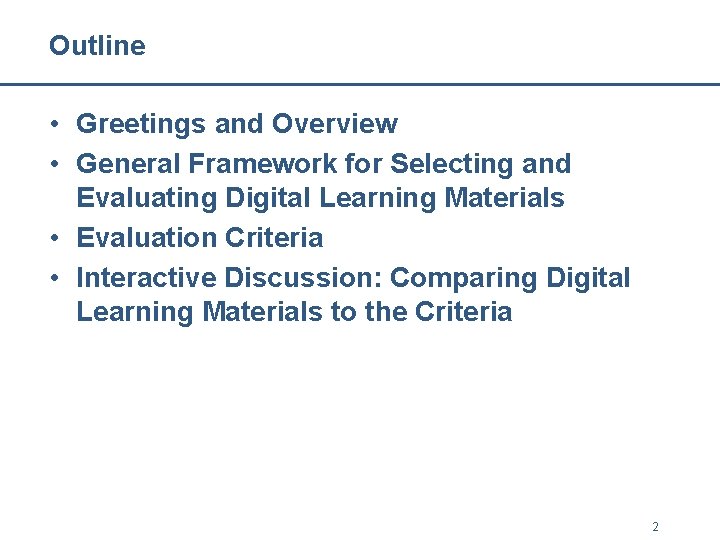
Outline • Greetings and Overview • General Framework for Selecting and Evaluating Digital Learning Materials • Evaluation Criteria • Interactive Discussion: Comparing Digital Learning Materials to the Criteria 2
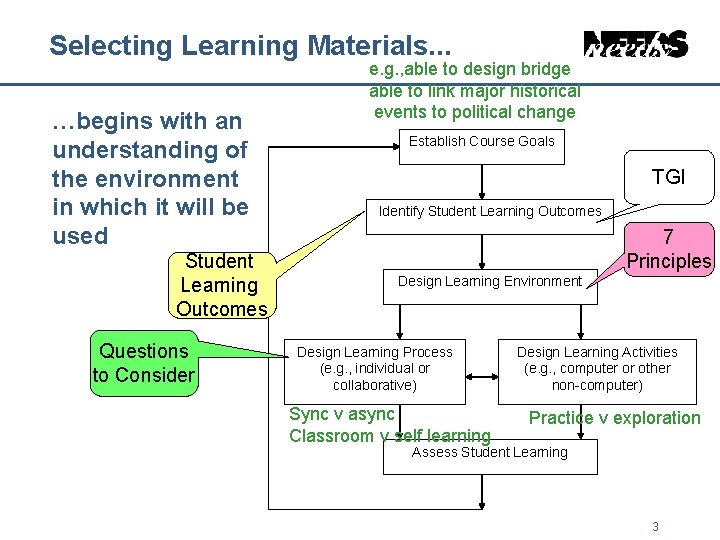
Selecting Learning Materials. . . …begins with an understanding of the environment in which it will be used Student Learning Outcomes Questions to Consider e. g. , able to design bridge able to link major historical events to political change Establish Course Goals TGI Identify Student Learning Outcomes 7 Principles Design Learning Environment Design Learning Process (e. g. , individual or collaborative) Sync v async Classroom v self learning Design Learning Activities (e. g. , computer or other non-computer) Practice v exploration Assess Student Learning 3
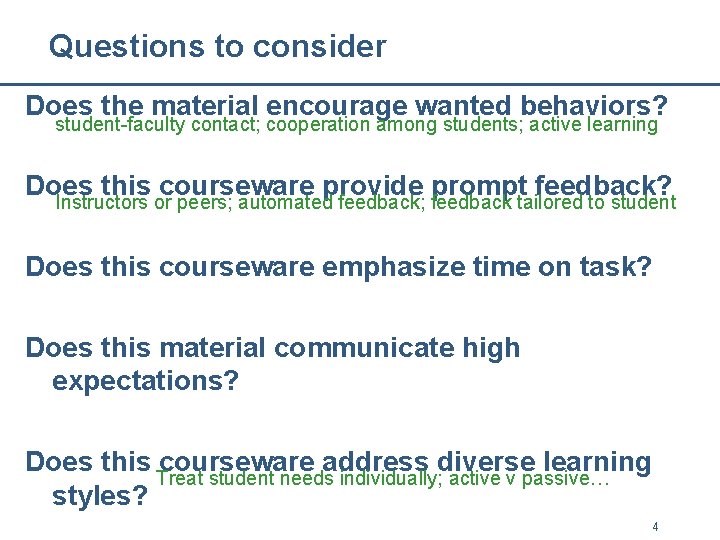
Questions to consider Does the material encourage wanted behaviors? student-faculty contact; cooperation among students; active learning Does this courseware provide prompt feedback? Instructors or peers; automated feedback; feedback tailored to student Does this courseware emphasize time on task? Does this material communicate high expectations? Does this courseware address diverse learning Treat student needs individually; active v passive… styles? 4
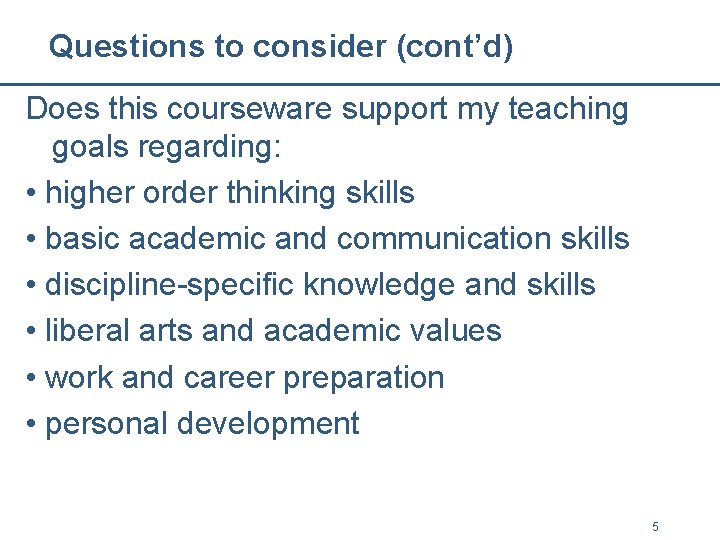
Questions to consider (cont’d) Does this courseware support my teaching goals regarding: • higher order thinking skills • basic academic and communication skills • discipline-specific knowledge and skills • liberal arts and academic values • work and career preparation • personal development 5
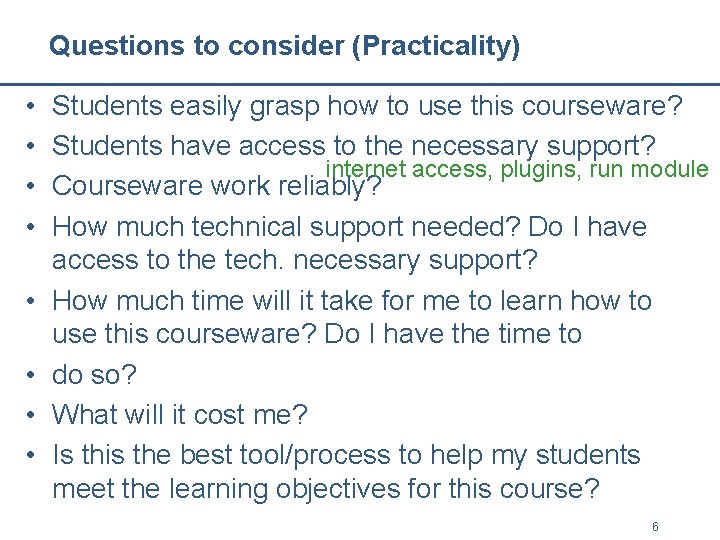
Questions to consider (Practicality) • • Students easily grasp how to use this courseware? Students have access to the necessary support? internet access, plugins, run module Courseware work reliably? How much technical support needed? Do I have access to the tech. necessary support? How much time will it take for me to learn how to use this courseware? Do I have the time to do so? What will it cost me? Is this the best tool/process to help my students meet the learning objectives for this course? 6
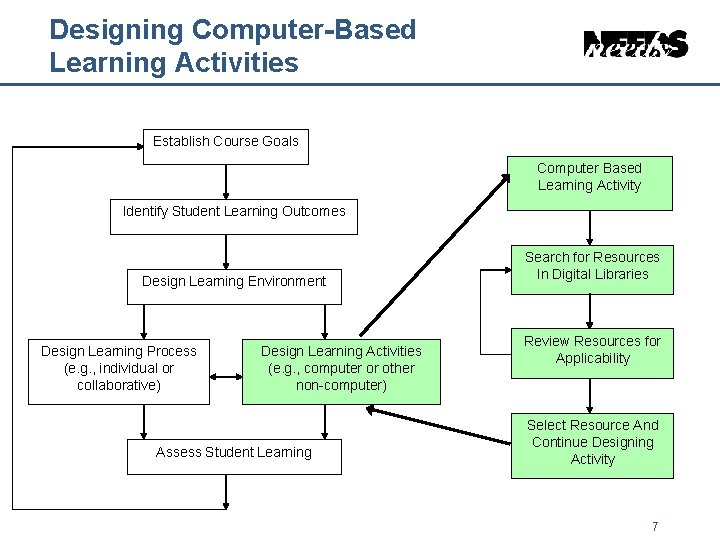
Designing Computer-Based Learning Activities Establish Course Goals Computer Based Learning Activity Identify Student Learning Outcomes Design Learning Environment Design Learning Process (e. g. , individual or collaborative) Design Learning Activities (e. g. , computer or other non-computer) Assess Student Learning Search for Resources In Digital Libraries Review Resources for Applicability Select Resource And Continue Designing Activity 7
Review Criteria • Premier Award Criteria – Developed in 1995 -1997, refined in 1998 – Used for six years in the Premier Award competition – Designed and used to find the “best of the best” • MERLOT Evaluation Standards – Developed in 1999 – Applied in MERLOT’s peer review process 8
The Premier Award for Excellence in Engineering Education Courseware • A national competition to identify and reward the authors of high-quality, non-commercial courseware designed to enhance engineering education – The Premier Award is about the entire experience of using the courseware by learners, not just the courseware itself • A dissemination system to distribute the Premier Courseware (via CD’s, ASEE Prism ads, presentations at FIE and ASEE) 9
Judging and Review Process • Convene Judging Panel – Professors and content experts, students, instructional designers, publishers • Review supporting material in the submission packet – Author supplied responses to criteria – Evidence of student learning and evaluation – Testimonials • Review and test the courseware 10
Premier Award Criteria: Instructional Design Does the courseware enhance learning? • • • Learning Objectives – Learning objectives are clearly stated and supported by the software. Interactivity – The learner is actively involved in the learning process—the interaction enhances learning. Cognition/Conceptual change – Learning appears to be significant and long lasting, and strong and useful cognitive models can be built. Content – The content is well chosen and structured. Multimedia use – Multimedia is used effectively and promotes the learning objectives and goals. Instructional use/Adaptability – The software can be used in a variety of settings. 11
Premier Award Criteria: Software Design Is the courseware well designed and usable? • Engagement – The software holds the interest of a diversity of learners. • Learner Interface and Navigation – The software is easy to use. • Technical Reliability – The software is free from technical problems. 12
Premier Award Criteria: Content Is the content appropriate and well presented in the courseware? • Accuracy of Content – The content is accurate and error free. • Appropriateness – The content is appropriate for the scope of the Premier Award. 13
Workshop Links • Access to materials and web sites used throughout the workshop: www. ee. vt. edu/~jgtront/workshop Need something else: jgtront@vt. edu 14
Action Plan Relate the workshop to your everyday activities • Teachers • Developers • Administrators 15
Workshop Evaluation Let us know what you think of the workshop • Click on the Workshop Evaluation link and give us your candid opinions www. ee. vt. edu/~jgtront/workshop_survey 16
Further Contact Joseph G. Tront 359 Durham Hall Virginia Tech Blacksburg, VA 24061 jgtront@vt. edu Brandon Muramatsu Instructional Technology 2830 Old Main Hill Logan, UT 84322 -2830 brandon. muramatsu@usu. edu Flora Mc. Martin Orchard Avenue Richmond, CA mcmartin@merlot. org 17