
Selected Max Compiler Examples Sasa Stojanovic stojsasaetf rs



- Slides: 21
Selected Max. Compiler Examples Sasa Stojanovic stojsasa@etf. rs Veljko Milutinovic vm@etf. rs
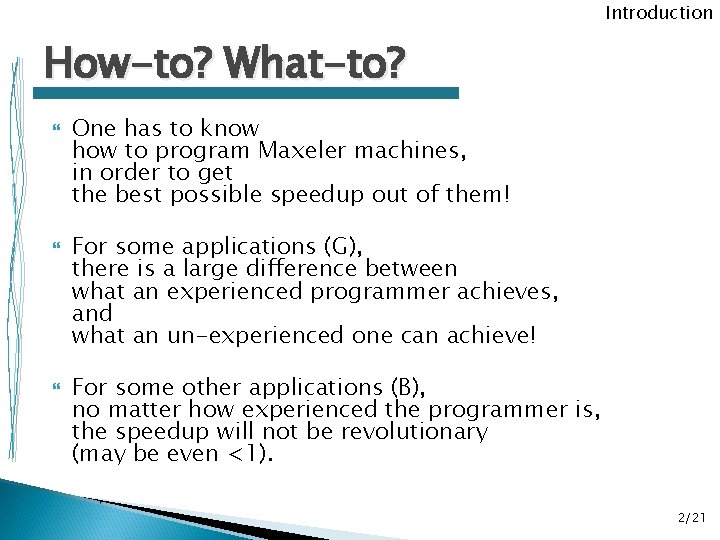
Introduction How-to? What-to? One has to know how to program Maxeler machines, in order to get the best possible speedup out of them! For some applications (G), there is a large difference between what an experienced programmer achieves, and what an un-experienced one can achieve! For some other applications (B), no matter how experienced the programmer is, the speedup will not be revolutionary (may be even <1). 2/21
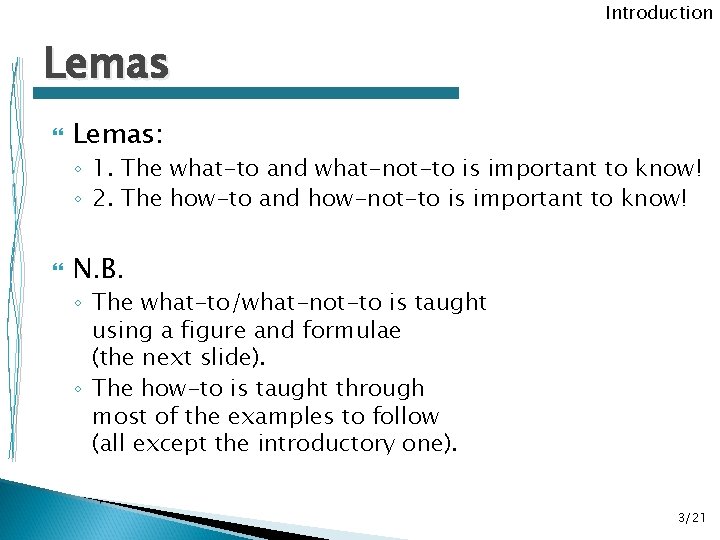
Introduction Lemas: ◦ 1. The what-to and what-not-to is important to know! ◦ 2. The how-to and how-not-to is important to know! N. B. ◦ The what-to/what-not-to is taught using a figure and formulae (the next slide). ◦ The how-to is taught through most of the examples to follow (all except the introductory one). 3/21
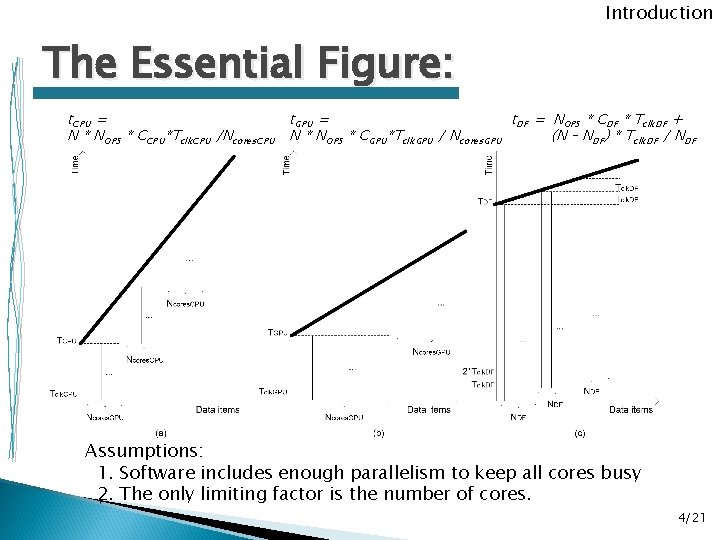
Introduction The Essential Figure: t. CPU = N * NOPS * CCPU*Tclk. CPU /Ncores. CPU t. GPU = t. DF = NOPS * CDF * Tclk. DF + N * NOPS * CGPU*Tclk. GPU / Ncores. GPU (N – NDF) * Tclk. DF / NDF Assumptions: 1. Software includes enough parallelism to keep all cores busy 2. The only limiting factor is the number of cores. 4/21
Introduction Bottomline: Communications are Expensive When is Maxeler better? ◦ If the number of operations in a single loop iteration is above some critical value ADDITIVE SPEEDUP ENABLER ◦ Then More data items means more advantage for Maxeler. In other words: Conclusion: ADDITIVE SPEEDUP MAKER ◦ More data does not mean better performance if the #operations/iteration is below a critical value. ◦ Ideal scenario is to bring data (PCIe relatively slow to Max. Card), and then to work on it a lot (the Max. Card is fast). ◦ If we see an application with a small #operations/iteration, it is possibly (not always) a “what-not-to” application, and we better execute it on the host; otherwise, we will (or may) have a slowdown. 5/21
Introduction A More Concrete Explanation: Maxeler: One new result in each cycle e. g. Clock = 200 MHz Period = 5 ns One result every 5 ns [No matter how many operations in each loop iteration] Consequently: More operations does not mean proportionally more time; however, more operations means higher latency till the first result. CPU: One new result after each iteration e. g. Clock=4 GHz Period = 250 ps One result every 250 ps times #ops [If #ops > 20 => Maxeler is better, although it uses a slower clock] Also: The CPU example will feature an additional slowdown, due to memory hierarchy access and pipeline related hazards => critical #ops (bringing the same performance) is significantly below 20!!! 6/21
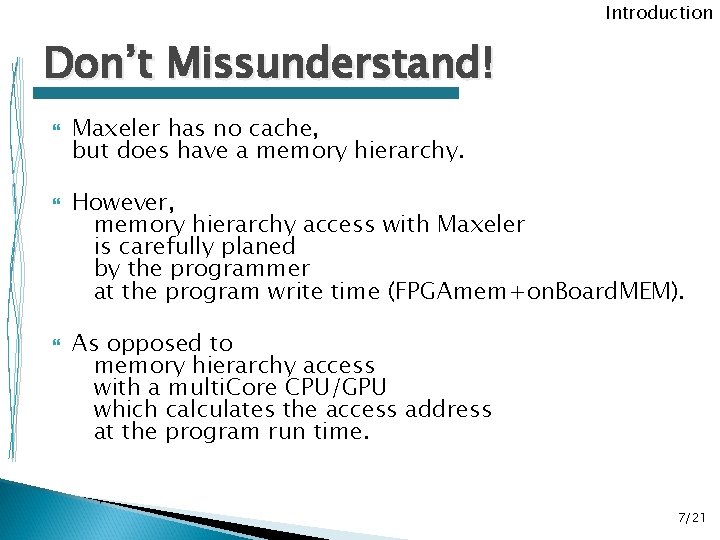
Introduction Don’t Missunderstand! Maxeler has no cache, but does have a memory hierarchy. However, memory hierarchy access with Maxeler is carefully planed by the programmer at the program write time (FPGAmem+on. Board. MEM). As opposed to memory hierarchy access with a multi. Core CPU/GPU which calculates the access address at the program run time. 7/21
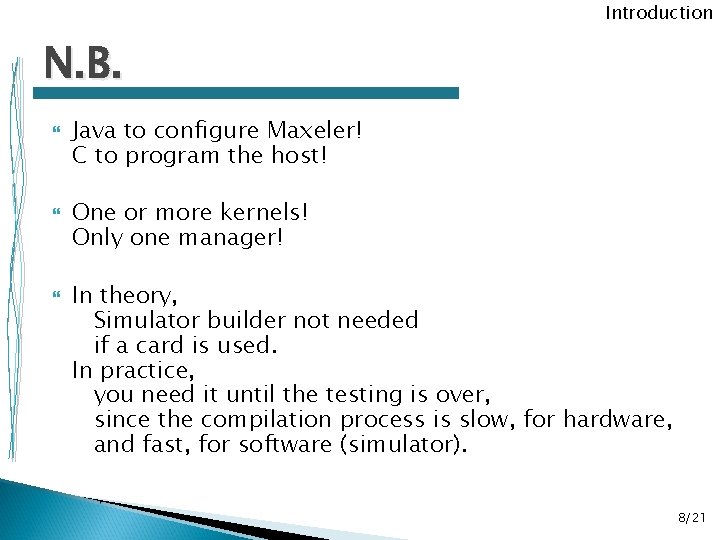
Introduction N. B. Java to configure Maxeler! C to program the host! One or more kernels! Only one manager! In theory, Simulator builder not needed if a card is used. In practice, you need it until the testing is over, since the compilation process is slow, for hardware, and fast, for software (simulator). 8/21
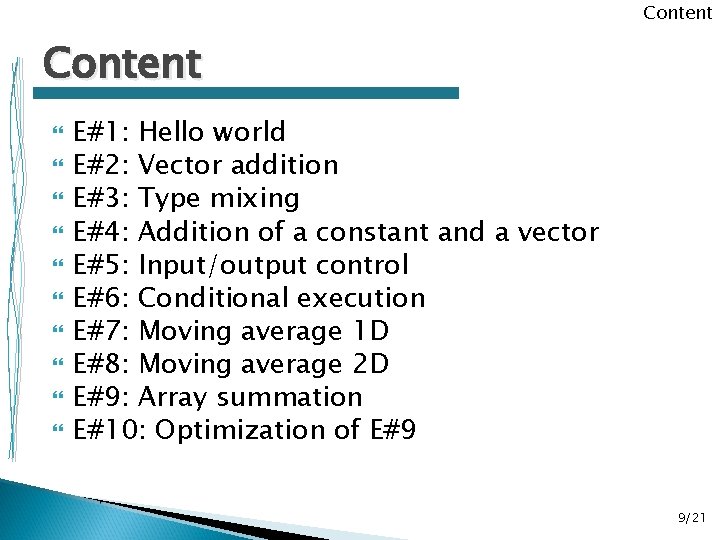
Content E#1: Hello world E#2: Vector addition E#3: Type mixing E#4: Addition of a constant and a vector E#5: Input/output control E#6: Conditional execution E#7: Moving average 1 D E#8: Moving average 2 D E#9: Array summation E#10: Optimization of E#9 9/21
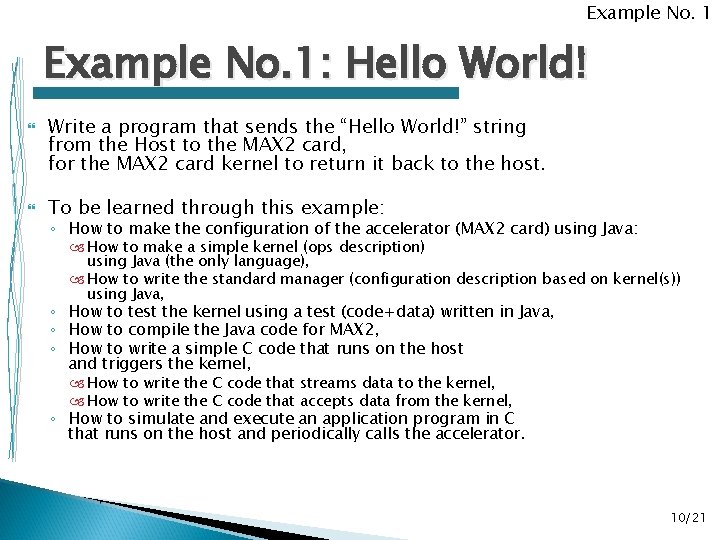
Example No. 1: Hello World! Write a program that sends the “Hello World!” string from the Host to the MAX 2 card, for the MAX 2 card kernel to return it back to the host. To be learned through this example: ◦ How to make the configuration of the accelerator (MAX 2 card) using Java: ◦ ◦ How to make a simple kernel (ops description) using Java (the only language), How to write the standard manager (configuration description based on kernel(s)) using Java, How to test the kernel using a test (code+data) written in Java, How to compile the Java code for MAX 2, How to write a simple C code that runs on the host and triggers the kernel, How to write the C code that streams data to the kernel, How to write the C code that accepts data from the kernel, How to simulate and execute an application program in C that runs on the host and periodically calls the accelerator. 10/21
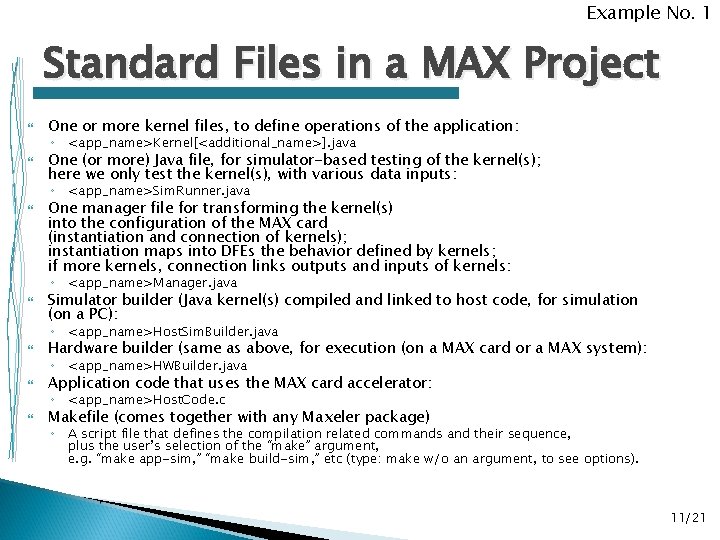
Example No. 1 Standard Files in a MAX Project One or more kernel files, to define operations of the application: ◦ <app_name>Kernel[<additional_name>]. java One (or more) Java file, for simulator-based testing of the kernel(s); here we only test the kernel(s), with various data inputs: ◦ <app_name>Sim. Runner. java One manager file for transforming the kernel(s) into the configuration of the MAX card (instantiation and connection of kernels); instantiation maps into DFEs the behavior defined by kernels; if more kernels, connection links outputs and inputs of kernels: ◦ <app_name>Manager. java Simulator builder (Java kernel(s) compiled and linked to host code, for simulation (on a PC): ◦ <app_name>Host. Sim. Builder. java Hardware builder (same as above, for execution (on a MAX card or a MAX system): Application code that uses the MAX card accelerator: Makefile (comes together with any Maxeler package) ◦ <app_name>HWBuilder. java ◦ <app_name>Host. Code. c ◦ A script file that defines the compilation related commands and their sequence, plus the user’s selection of the “make” argument, e. g. “make app-sim, ” “make build-sim, ” etc (type: make w/o an argument, to see options). 11/21
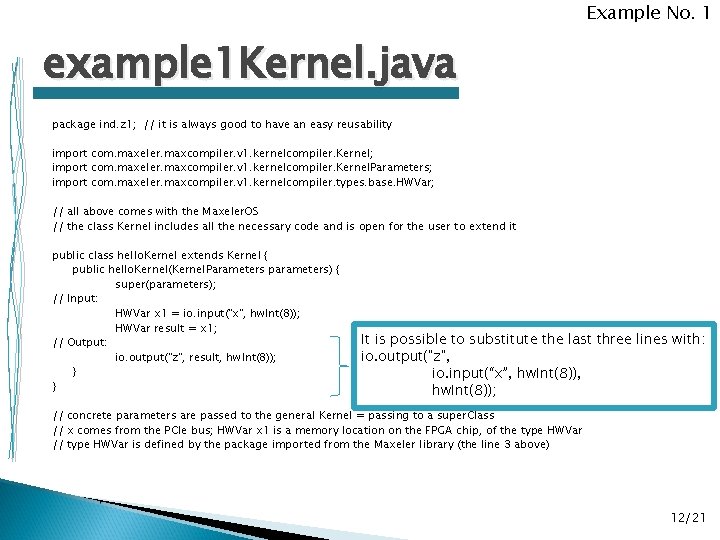
Example No. 1 example 1 Kernel. java package ind. z 1; // it is always good to have an easy reusability import com. maxeler. maxcompiler. v 1. kernelcompiler. Kernel; import com. maxeler. maxcompiler. v 1. kernelcompiler. Kernel. Parameters; import com. maxeler. maxcompiler. v 1. kernelcompiler. types. base. HWVar; // all above comes with the Maxeler. OS // the class Kernel includes all the necessary code and is open for the user to extend it public class hello. Kernel extends Kernel { public hello. Kernel(Kernel. Parameters parameters) { super(parameters); // Input: HWVar x 1 = io. input("x", hw. Int(8)); HWVar result = x 1; // Output: io. output("z", result, hw. Int(8)); } } It is possible to substitute the last three lines with: io. output("z", io. input(“x”, hw. Int(8)); // concrete parameters are passed to the general Kernel = passing to a super. Class // x comes from the PCIe bus; HWVar x 1 is a memory location on the FPGA chip, of the type HWVar // type HWVar is defined by the package imported from the Maxeler library (the line 3 above) 12/21
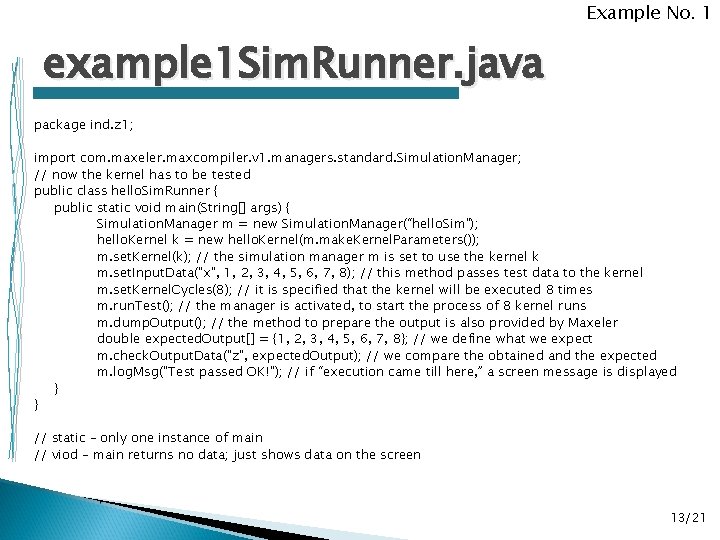
Example No. 1 example 1 Sim. Runner. java package ind. z 1; import com. maxeler. maxcompiler. v 1. managers. standard. Simulation. Manager; // now the kernel has to be tested public class hello. Sim. Runner { public static void main(String[] args) { Simulation. Manager m = new Simulation. Manager(“hello. Sim"); hello. Kernel k = new hello. Kernel(m. make. Kernel. Parameters()); m. set. Kernel(k); // the simulation manager m is set to use the kernel k m. set. Input. Data("x", 1, 2, 3, 4, 5, 6, 7, 8); // this method passes test data to the kernel m. set. Kernel. Cycles(8); // it is specified that the kernel will be executed 8 times m. run. Test(); // the manager is activated, to start the process of 8 kernel runs m. dump. Output(); // the method to prepare the output is also provided by Maxeler double expected. Output[] = {1, 2, 3, 4, 5, 6, 7, 8}; // we define what we expect m. check. Output. Data("z", expected. Output); // we compare the obtained and the expected m. log. Msg("Test passed OK!"); // if “execution came till here, ” a screen message is displayed } } // static – only one instance of main // viod – main returns no data; just shows data on the screen 13/21
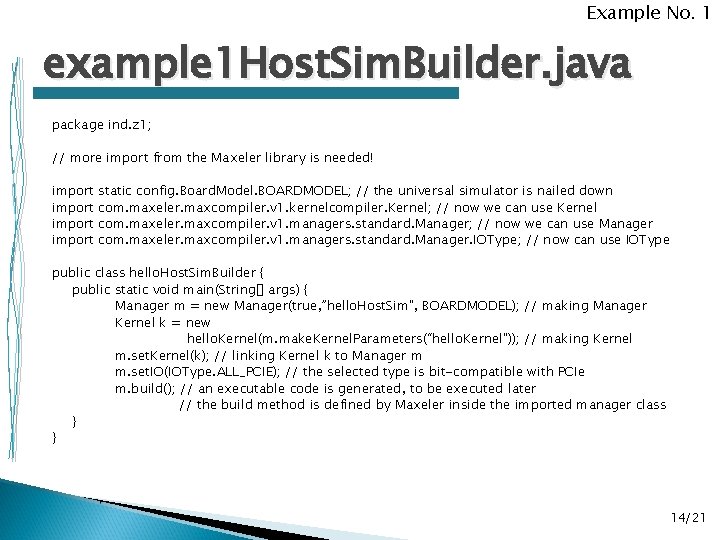
Example No. 1 example 1 Host. Sim. Builder. java package ind. z 1; // more import from the Maxeler library is needed! import static config. Board. Model. BOARDMODEL; // the universal simulator is nailed down com. maxeler. maxcompiler. v 1. kernelcompiler. Kernel; // now we can use Kernel com. maxeler. maxcompiler. v 1. managers. standard. Manager; // now we can use Manager com. maxeler. maxcompiler. v 1. managers. standard. Manager. IOType; // now can use IOType public class hello. Host. Sim. Builder { public static void main(String[] args) { Manager m = new Manager(true, ”hello. Host. Sim", BOARDMODEL); // making Manager Kernel k = new hello. Kernel(m. make. Kernel. Parameters(“hello. Kernel")); // making Kernel m. set. Kernel(k); // linking Kernel k to Manager m m. set. IO(IOType. ALL_PCIE); // the selected type is bit-compatible with PCIe m. build(); // an executable code is generated, to be executed later // the build method is defined by Maxeler inside the imported manager class } } 14/21
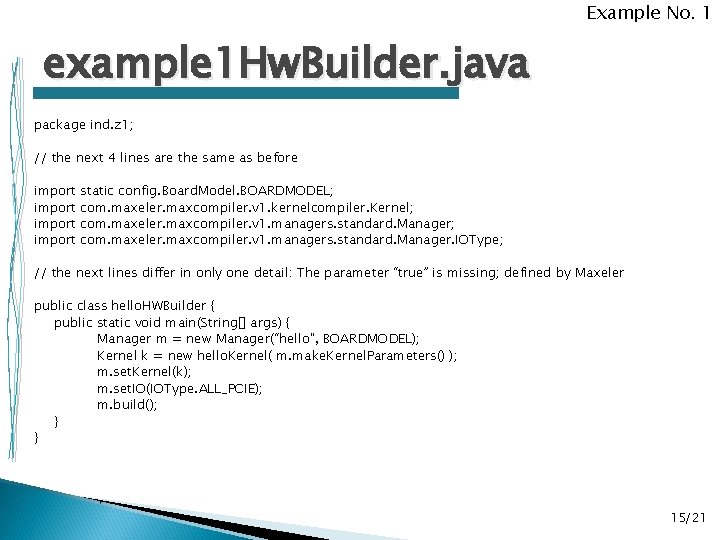
Example No. 1 example 1 Hw. Builder. java package ind. z 1; // the next 4 lines are the same as before import static config. Board. Model. BOARDMODEL; com. maxeler. maxcompiler. v 1. kernelcompiler. Kernel; com. maxeler. maxcompiler. v 1. managers. standard. Manager. IOType; // the next lines differ in only one detail: The parameter “true” is missing; defined by Maxeler public class hello. HWBuilder { public static void main(String[] args) { Manager m = new Manager(“hello", BOARDMODEL); Kernel k = new hello. Kernel( m. make. Kernel. Parameters() ); m. set. Kernel(k); m. set. IO(IOType. ALL_PCIE); m. build(); } } 15/21
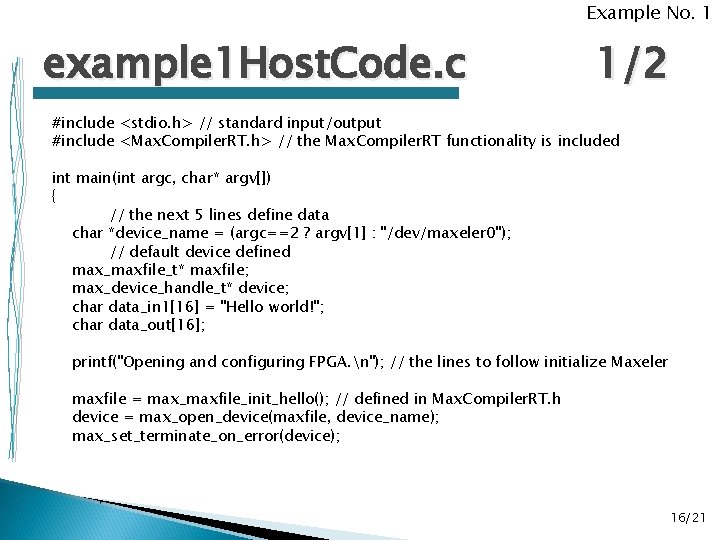
Example No. 1 example 1 Host. Code. c 1/2 #include <stdio. h> // standard input/output #include <Max. Compiler. RT. h> // the Max. Compiler. RT functionality is included int main(int argc, char* argv[]) { // the next 5 lines define data char *device_name = (argc==2 ? argv[1] : "/dev/maxeler 0"); // default device defined max_maxfile_t* maxfile; max_device_handle_t* device; char data_in 1[16] = "Hello world!"; char data_out[16]; printf("Opening and configuring FPGA. n"); // the lines to follow initialize Maxeler maxfile = max_maxfile_init_hello(); // defined in Max. Compiler. RT. h device = max_open_device(maxfile, device_name); max_set_terminate_on_error(device); 16/21
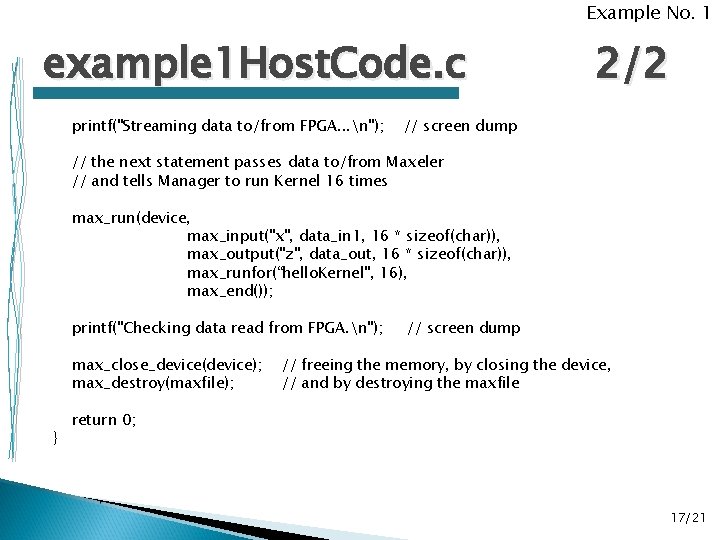
Example No. 1 example 1 Host. Code. c printf("Streaming data to/from FPGA. . . n"); 2/2 // screen dump // the next statement passes data to/from Maxeler // and tells Manager to run Kernel 16 times max_run(device, max_input("x", data_in 1, 16 * sizeof(char)), max_output("z", data_out, 16 * sizeof(char)), max_runfor(“hello. Kernel", 16), max_end()); printf("Checking data read from FPGA. n"); max_close_device(device); max_destroy(maxfile); } // screen dump // freeing the memory, by closing the device, // and by destroying the maxfile return 0; 17/21
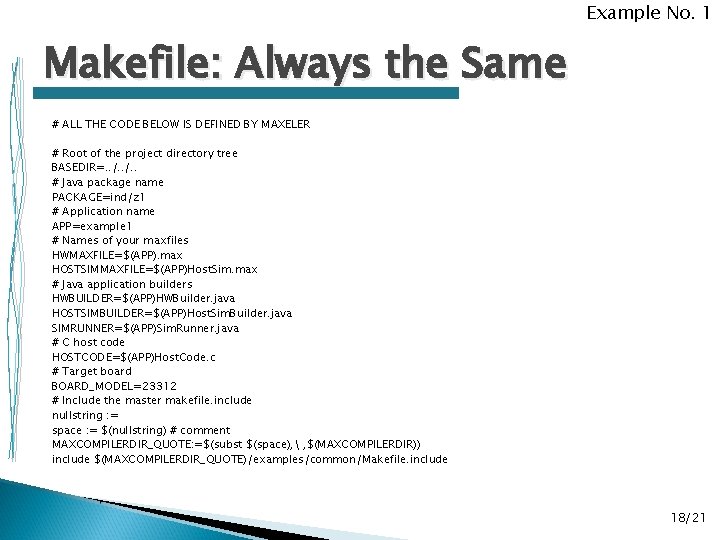
Example No. 1 Makefile: Always the Same # ALL THE CODE BELOW IS DEFINED BY MAXELER # Root of the project directory tree BASEDIR=. . /. . # Java package name PACKAGE=ind/z 1 # Application name APP=example 1 # Names of your maxfiles HWMAXFILE=$(APP). max HOSTSIMMAXFILE=$(APP)Host. Sim. max # Java application builders HWBUILDER=$(APP)HWBuilder. java HOSTSIMBUILDER=$(APP)Host. Sim. Builder. java SIMRUNNER=$(APP)Sim. Runner. java # C host code HOSTCODE=$(APP)Host. Code. c # Target board BOARD_MODEL=23312 # Include the master makefile. include nullstring : = space : = $(nullstring) # comment MAXCOMPILERDIR_QUOTE: =$(subst $(space), , $(MAXCOMPILERDIR)) include $(MAXCOMPILERDIR_QUOTE)/examples/common/Makefile. include 18/21
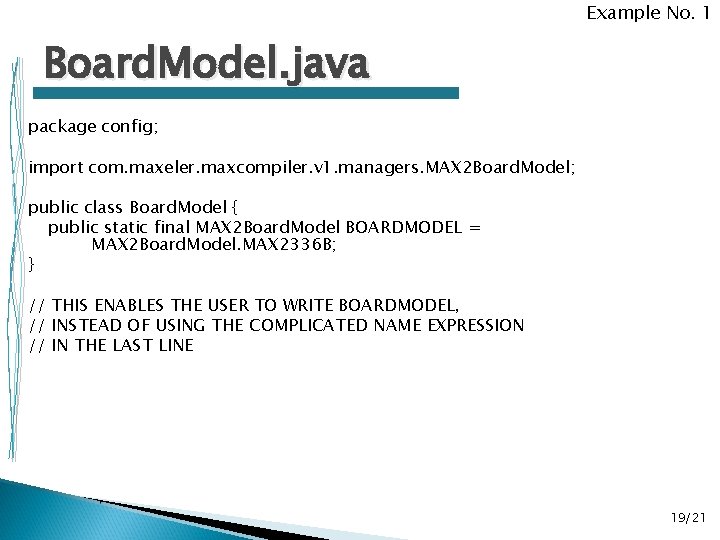
Example No. 1 Board. Model. java package config; import com. maxeler. maxcompiler. v 1. managers. MAX 2 Board. Model; public class Board. Model { public static final MAX 2 Board. Model BOARDMODEL = MAX 2 Board. Model. MAX 2336 B; } // THIS ENABLES THE USER TO WRITE BOARDMODEL, // INSTEAD OF USING THE COMPLICATED NAME EXPRESSION // IN THE LAST LINE 19/21
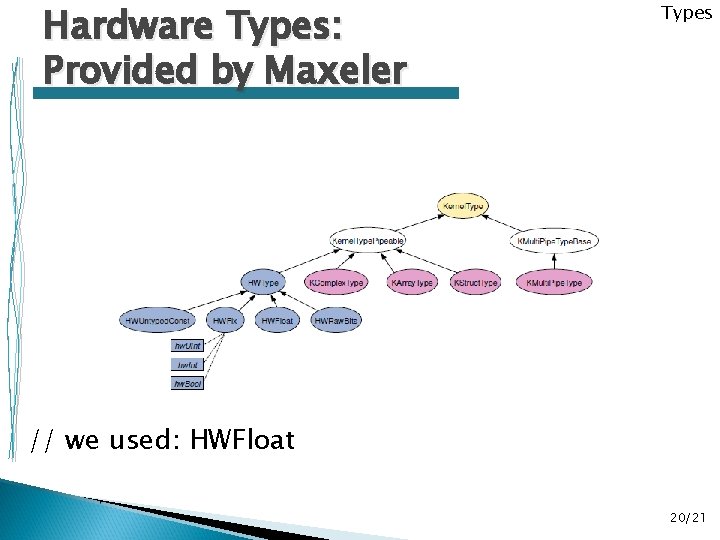
Hardware Types: Provided by Maxeler Types // we used: HWFloat 20/21
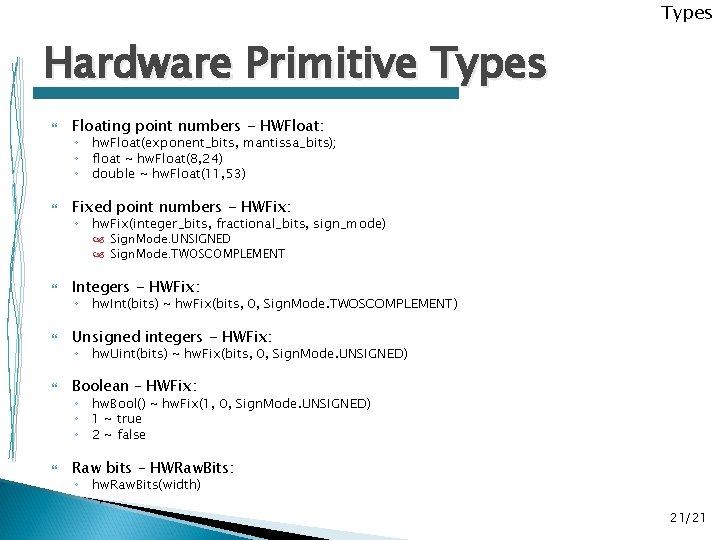
Types Hardware Primitive Types Floating point numbers - HWFloat: Fixed point numbers - HWFix: ◦ hw. Float(exponent_bits, mantissa_bits); ◦ float ~ hw. Float(8, 24) ◦ double ~ hw. Float(11, 53) ◦ hw. Fix(integer_bits, fractional_bits, sign_mode) Sign. Mode. UNSIGNED Sign. Mode. TWOSCOMPLEMENT Integers - HWFix: Unsigned integers - HWFix: Boolean – HWFix: Raw bits – HWRaw. Bits: ◦ hw. Int(bits) ~ hw. Fix(bits, 0, Sign. Mode. TWOSCOMPLEMENT) ◦ hw. Uint(bits) ~ hw. Fix(bits, 0, Sign. Mode. UNSIGNED) ◦ hw. Bool() ~ hw. Fix(1, 0, Sign. Mode. UNSIGNED) ◦ 1 ~ true ◦ 2 ~ false ◦ hw. Raw. Bits(width) 21/21