
SELECTED GERIATRIC NEUROLOGIC DISEASE Module 2 Essential Tremor
- Slides: 11
SELECTED GERIATRIC NEUROLOGIC DISEASE Module 2 Essential Tremor, PSP & Other Movement disorders Bill Lyons, M. D. UNMC Geriatrics Asst. Professor wlyons@unmc. edu
Objectives Upon completion the learner regarding Essential Tremor, Progressive Super nuclear Palsey ( PSP) and drug-induced movement disorders, will be able to: 1. Describe diagnostic features of each disease. . 2. Differentiate Parkinson’s disease from PSP
BENIGN ESSENTIAL TREMOR • • • Action tremor of hands, head, voice, legs Shaking while bringing cup to lips Ethanol may improve Many, but less than half, familial Treat: propranolol or primidone Less effective with head and voice tremor
PROGRESSIVE SUPRANUCLEAR PALSY (PSP) • M>F, starts when in 50 s or 60 s • About 1/10 th as common as idiopathic PD • Compare PSP and PD: – Early PSP greater tendency to falls – PSP patients often fall backwards – PSP patients may complain of vision – PSP patients less likely with tremor – PSP rigidity axial, PD in limbs
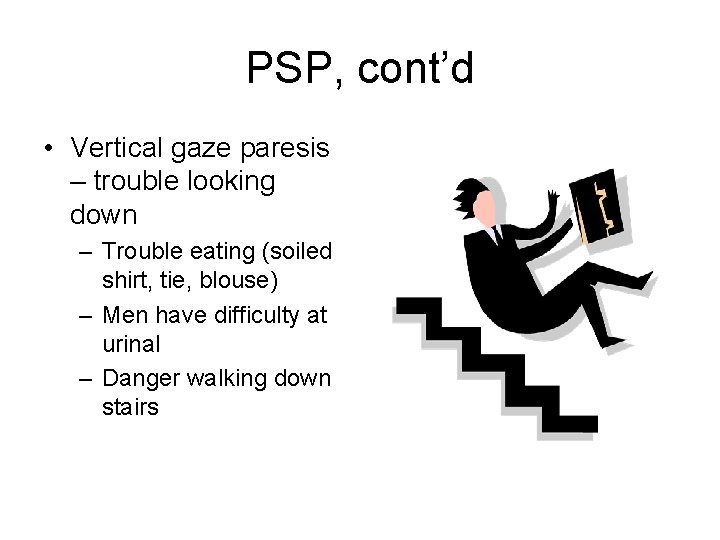
PSP, cont’d • Vertical gaze paresis – trouble looking down – Trouble eating (soiled shirt, tie, blouse) – Men have difficulty at urinal – Danger walking down stairs
PSP, cont’d • Speech troubles – Hypernasal, strained, monotone – Trouble initiating speech – Speech arrest • Trouble chewing and swallowing • Emotional incontinence
PSP, cont’d • Cognitive deficits – Memory (usually mild) – Executive dysfunction • Prognosis typically worse than PD • Little or no response to PD medications • Treat: PT, OT
DRUG-INDUCED MOVEMENT DISORDERS • Many from antipsychotics: – Parkinsonism – Akathisia – Acute dystonic reactions – Tardive dyskinesia – Chorea • Metoclopramide can cause parkinsonism, too
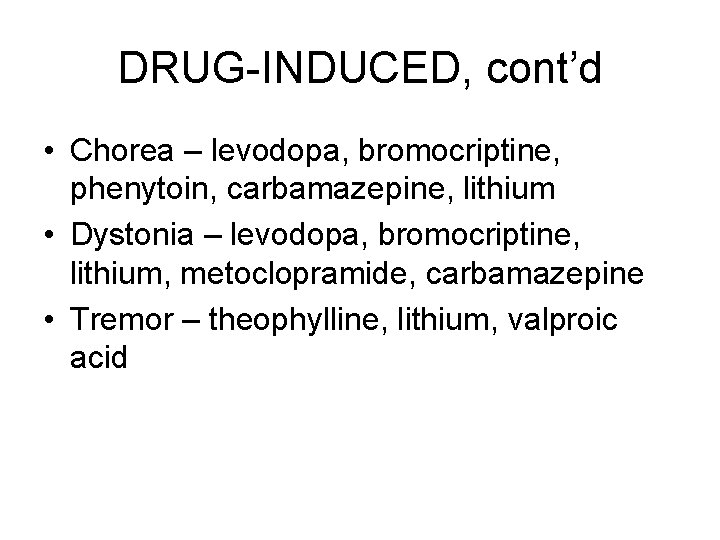
DRUG-INDUCED, cont’d • Chorea – levodopa, bromocriptine, phenytoin, carbamazepine, lithium • Dystonia – levodopa, bromocriptine, lithium, metoclopramide, carbamazepine • Tremor – theophylline, lithium, valproic acid
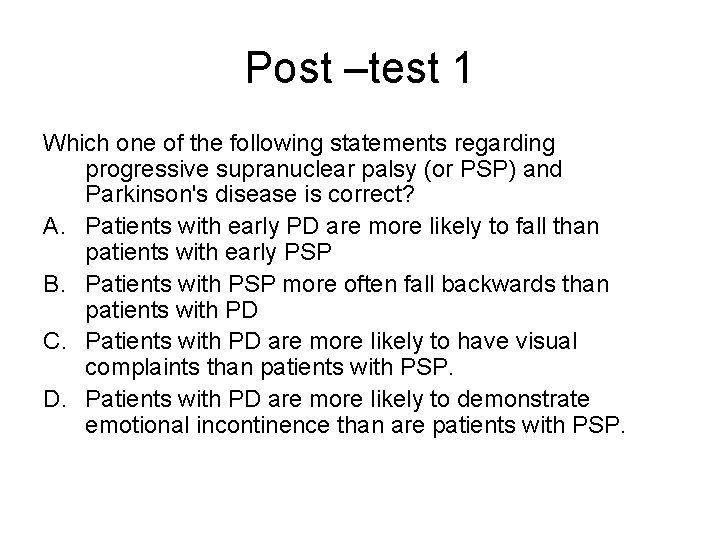
Post –test 1 Which one of the following statements regarding progressive supranuclear palsy (or PSP) and Parkinson's disease is correct? A. Patients with early PD are more likely to fall than patients with early PSP B. Patients with PSP more often fall backwards than patients with PD C. Patients with PD are more likely to have visual complaints than patients with PSP. D. Patients with PD are more likely to demonstrate emotional incontinence than are patients with PSP.
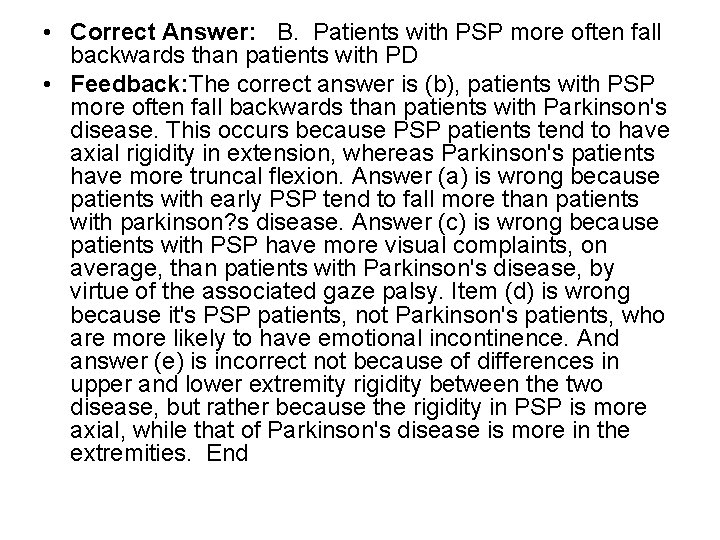
• Correct Answer: B. Patients with PSP more often fall backwards than patients with PD • Feedback: The correct answer is (b), patients with PSP more often fall backwards than patients with Parkinson's disease. This occurs because PSP patients tend to have axial rigidity in extension, whereas Parkinson's patients have more truncal flexion. Answer (a) is wrong because patients with early PSP tend to fall more than patients with parkinson? s disease. Answer (c) is wrong because patients with PSP have more visual complaints, on average, than patients with Parkinson's disease, by virtue of the associated gaze palsy. Item (d) is wrong because it's PSP patients, not Parkinson's patients, who are more likely to have emotional incontinence. And answer (e) is incorrect not because of differences in upper and lower extremity rigidity between the two disease, but rather because the rigidity in PSP is more axial, while that of Parkinson's disease is more in the extremities. End