
Selected bioavailability and pharmacokinetic calculations Dr Osama A
Selected bioavailability and pharmacokinetic calculations Dr. Osama A. A. Ahmed
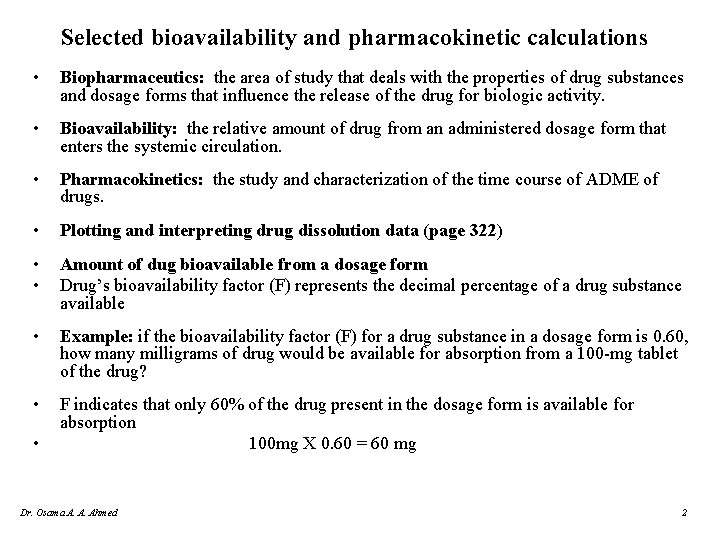
Selected bioavailability and pharmacokinetic calculations • Biopharmaceutics: the area of study that deals with the properties of drug substances and dosage forms that influence the release of the drug for biologic activity. • Bioavailability: the relative amount of drug from an administered dosage form that enters the systemic circulation. • Pharmacokinetics: the study and characterization of the time course of ADME of drugs. • Plotting and interpreting drug dissolution data (page 322) • • Amount of dug bioavailable from a dosage form Drug’s bioavailability factor (F) represents the decimal percentage of a drug substance available • Example: if the bioavailability factor (F) for a drug substance in a dosage form is 0. 60, how many milligrams of drug would be available for absorption from a 100 -mg tablet of the drug? • F indicates that only 60% of the drug present in the dosage form is available for absorption 100 mg X 0. 60 = 60 mg • Dr. Osama A. A. Ahmed 2

Selected bioavailability and pharmacokinetic calculations • • Bioequivalent amounts of bioinequivalent dosage forms: The bioavailability of a given drug substance may vary when in different dosage forms or in the same dosage form but from a different manufacturer. Thus, it may be desired to calculate the equivalent doses for two bioinequivalent products • Example: If the biovailability (F) of digoxin in a 0. 25 -mg tablet is 0. 60 compared to the bioavailability (F) of 0. 75 in a digoxin elixir (0. 05 mg/ml), calculate the dose of the elixir equivalent to the tablet? • • Digoxin biovailable from tablet = 0. 25 mg X 0. 60 = 0. 15 mg Digoxin biovailable per milliliter of the elixir = 0. 05 mg X 0. 75 = 0. 0375 mg • • 0. 0375 mg 0. 15 mg • Plotting and interpreting a blood-drug concentration-time curve (Page 323) Dr. Osama A. A. Ahmed 1 ml X = 4 ml 3

Selected bioavailability and pharmacokinetic calculations • The bioavailability of the drug may be determined by comparison of the AUC data for the particular dosage form against the intravenous form. • • Example: If the AUC for an oral dose of a drug administered by tablet is 4. 5 mg/ml/hr, and the intravenous dose is 11. 2 mg/ml/hr, caclculate the bioavailability of the oral dose of the drug? • Dr. Osama A. A. Ahmed F = 4. 5 mg/ml/hr / 11. 2 mg/ml/hr = 0. 4 or 40% 4

Selected bioavailability and pharmacokinetic calculations • Different drugs administered in the same amount will show different volumes of distribution because of distribution characteristics • • Where, Vd is volume of distribution, D is the amount of drug in the body, and Cp is the drug’s plasma concentration. • Example: A patient received a single intravenous dose of 300 mg of a drug substance that produced an immediate blood concentration of 8. 2 mg of drug per ml. Calculate the apparent volume of distribution? Vd = 300 mg / 8. 2 mg/ml = 300 mg / 8. 2 mg/L = 36. 6 L • • Elimination half life and elimination rate constant Elimination t 1/2 is the time takes for the plasma drug conc. to fall by one half Elimination rate constant (Kel) is the fractional rate of drug removal per unit time e. g. Kel = 0. 01 min-1, meaning 1 % per minute Kel = 0. 693/ t 1/2 Example: Page 327 Dr. Osama A. A. Ahmed 5
- Slides: 5