
Selected Aspects on Beam Position Monitors BPM Manfred
Selected Aspects on Beam Position Monitors (BPM) Manfred Wendt CERN
Contents • Introduction – Examples of BPM measurements and applications • BPM Pickup and Signals – – • BPM Signal Processing – – • • broadband BPM pickups (button & stripline BPMs) BPM Pre-alignment Correction of Non-linear Position Behavior Wakefield effects Typical read-out electronics Signal-to-noise ratio Long-term drift effects and compensation Examples of BPM electronics and their performance Estimation of the BPM resolution Summary November 4, 2015 – XRING 2015 Beam Dynamics meets Diagnostics – M. Wendt Page 2
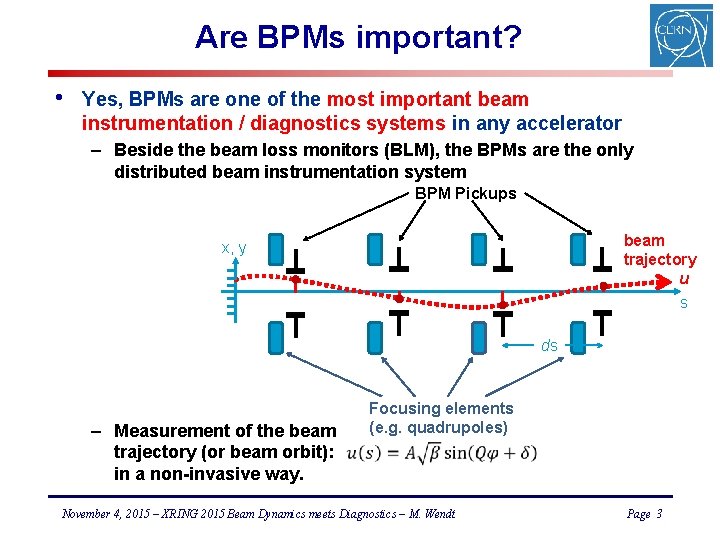
Are BPMs important? • Yes, BPMs are one of the most important beam instrumentation / diagnostics systems in any accelerator – Beside the beam loss monitors (BLM), the BPMs are the only distributed beam instrumentation system BPM Pickups beam trajectory u s x, y ds – Measurement of the beam trajectory (or beam orbit): in a non-invasive way. Focusing elements (e. g. quadrupoles) November 4, 2015 – XRING 2015 Beam Dynamics meets Diagnostics – M. Wendt Page 3
Introduction • • Beam position / orbit measurements require – Synchronous operation and data acquisition of all individual BPMs – The same measurement (or integration) time BPM systems allow… (depeding on BPM performance and measurement capabilities) – Machine commissioning, trouble shooting, basic beam optics verification – Measurement of injection oscillations, betatron and synchrotron tune measurement – Beam injection / extraction optimization – Chromaticity measurements – Dispersion and beam energy measurements – x-y coupling analysis – Detailed beam optics studies, including mismatch and error location Ø Magnet alignment and errors, non-linear field effects, etc. – Beam phase and bunch arrival time measurements – Orbit stabilization through BPM-based feedback systems –. . . and many other things I probably forgot to mention. November 4, 2015 – XRING 2015 Beam Dynamics meets Diagnostics – M. Wendt Page 4
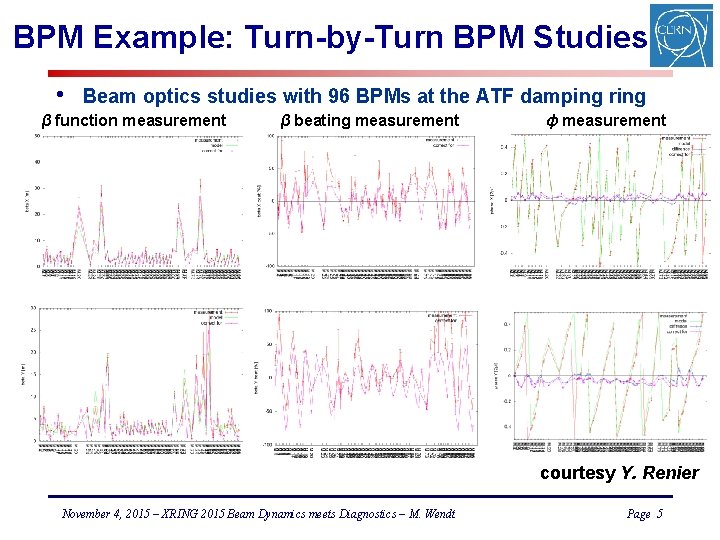
BPM Example: Turn-by-Turn BPM Studies • Beam optics studies with 96 BPMs at the ATF damping ring β function measurement β beating measurement ϕ measurement courtesy Y. Renier November 4, 2015 – XRING 2015 Beam Dynamics meets Diagnostics – M. Wendt Page 5
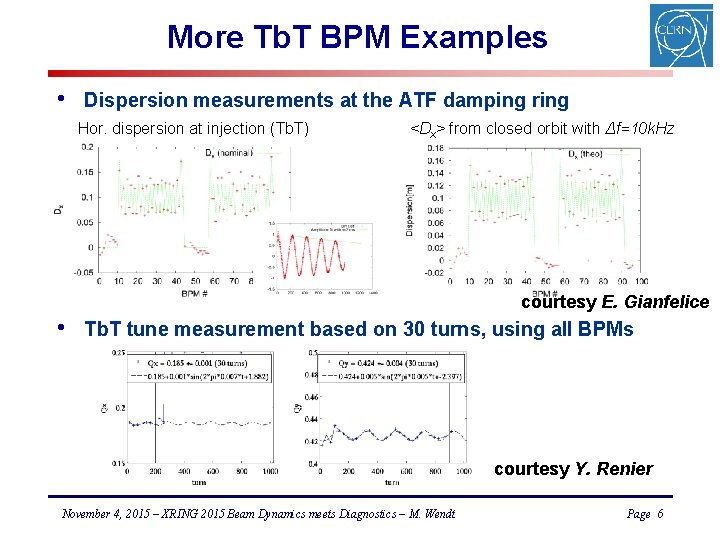
More Tb. T BPM Examples • Dispersion measurements at the ATF damping ring Hor. dispersion at injection (Tb. T) <Dx> from closed orbit with Δf=10 k. Hz courtesy E. Gianfelice • Tb. T tune measurement based on 30 turns, using all BPMs courtesy Y. Renier November 4, 2015 – XRING 2015 Beam Dynamics meets Diagnostics – M. Wendt Page 6
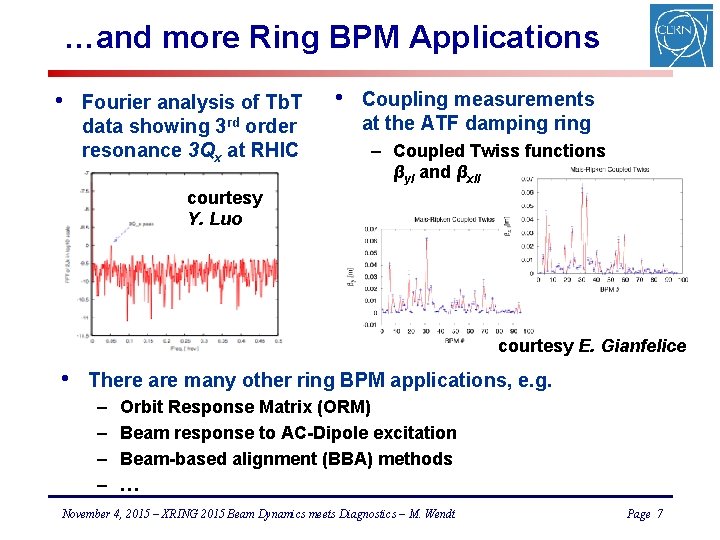
…and more Ring BPM Applications • Fourier analysis of Tb. T data showing 3 rd order resonance 3 Qx at RHIC • Coupling measurements at the ATF damping ring – Coupled Twiss functions βy. I and βx. II courtesy Y. Luo courtesy E. Gianfelice • There are many other ring BPM applications, e. g. – – Orbit Response Matrix (ORM) Beam response to AC-Dipole excitation Beam-based alignment (BBA) methods … November 4, 2015 – XRING 2015 Beam Dynamics meets Diagnostics – M. Wendt Page 7
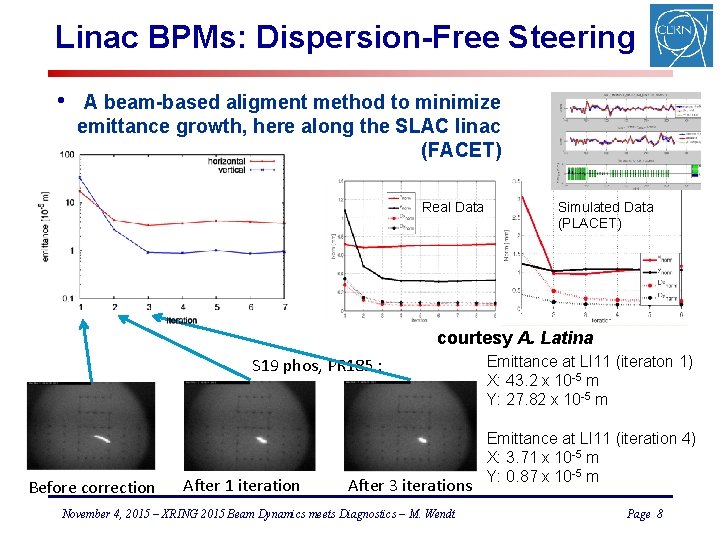
Linac BPMs: Dispersion-Free Steering • A beam-based aligment method to minimize emittance growth, here along the SLAC linac (FACET) Real Data Simulated Data (PLACET) courtesy A. Latina S 19 phos, PR 185 : Before correction After 1 iteration After 3 iterations November 4, 2015 – XRING 2015 Beam Dynamics meets Diagnostics – M. Wendt Emittance at LI 11 (iteraton 1) X: 43. 2 x 10 -5 m Y: 27. 82 x 10 -5 m Emittance at LI 11 (iteration 4) X: 3. 71 x 10 -5 m Y: 0. 87 x 10 -5 m Page 8

BPM Building Blocks feedback bus (if applicable) BPM Pickup C A L Analog Signal Conditioning A D C position data control system (LAN) Digital Signal Processing Data Acquisition Power Supply & Misc. Trigger & Timing Control • BPM pickup • – RF device, EM field detection, center of charge timing, – Symmetrically arranged electrodes, trigger or resonant structure signals – Data acquisition and control Read-out electronics system interface – Analog signal conditioning – Trigger, CLK & timing signals – Signal sampling (ADC) – Provides calibration signals or – Digital signal processing other drift compensation methods CLK November 4, 2015 – XRING 2015 Beam Dynamics meets Diagnostics – M. Wendt Page 9
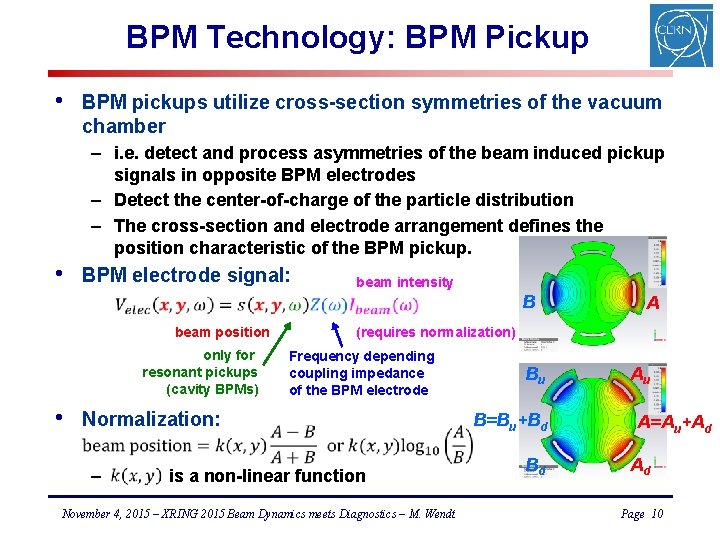
BPM Technology: BPM Pickup • BPM pickups utilize cross-section symmetries of the vacuum chamber – i. e. detect and process asymmetries of the beam induced pickup signals in opposite BPM electrodes – Detect the center-of-charge of the particle distribution – The cross-section and electrode arrangement defines the position characteristic of the BPM pickup. • BPM electrode signal: beam intensity B beam position only for resonant pickups (cavity BPMs) • (requires normalization) Frequency depending coupling impedance of the BPM electrode Normalization: – A is a non-linear function November 4, 2015 – XRING 2015 Beam Dynamics meets Diagnostics – M. Wendt Bu B=Bu+Bd Bd Au A=Au+Ad Ad Page 10
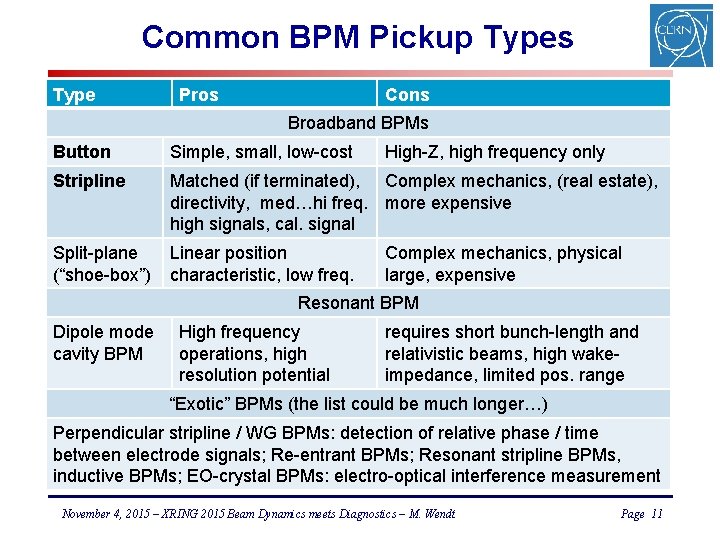
Common BPM Pickup Types Type Pros Cons Broadband BPMs Button Simple, small, low-cost High-Z, high frequency only Stripline Matched (if terminated), Complex mechanics, (real estate), directivity, med…hi freq. more expensive high signals, cal. signal Split-plane (“shoe-box”) Linear position characteristic, low freq. Complex mechanics, physical large, expensive Resonant BPM Dipole mode cavity BPM High frequency operations, high resolution potential requires short bunch-length and relativistic beams, high wakeimpedance, limited pos. range “Exotic” BPMs (the list could be much longer…) Perpendicular stripline / WG BPMs: detection of relative phase / time between electrode signals; Re-entrant BPMs; Resonant stripline BPMs, inductive BPMs; EO-crystal BPMs: electro-optical interference measurement November 4, 2015 – XRING 2015 Beam Dynamics meets Diagnostics – M. Wendt Page 11
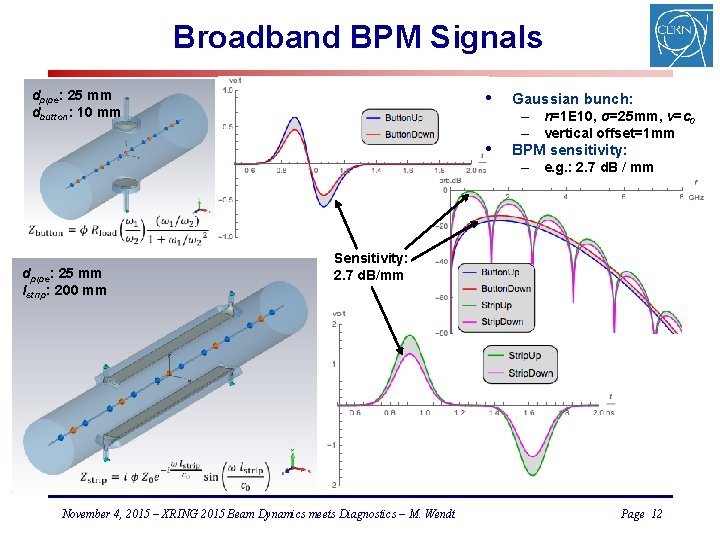
Broadband BPM Signals • dpipe: 25 mm dbutton: 10 mm • Gaussian bunch: – n=1 E 10, σ=25 mm, v=c 0 – vertical offset=1 mm BPM sensitivity: – e. g. : 2. 7 d. B / mm dpipe: 25 mm lstrip: 200 mm Sensitivity: 2. 7 d. B/mm November 4, 2015 – XRING 2015 Beam Dynamics meets Diagnostics – M. Wendt Page 12
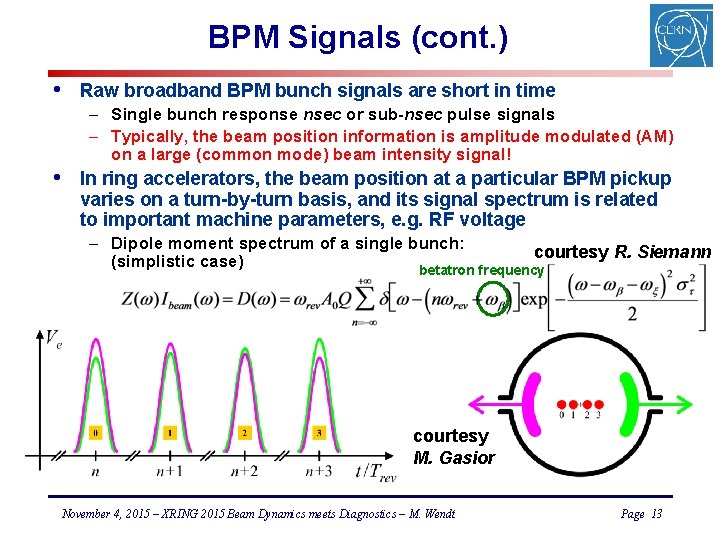
BPM Signals (cont. ) • • Raw broadband BPM bunch signals are short in time – Single bunch response nsec or sub-nsec pulse signals – Typically, the beam position information is amplitude modulated (AM) on a large (common mode) beam intensity signal! In ring accelerators, the beam position at a particular BPM pickup varies on a turn-by-turn basis, and its signal spectrum is related to important machine parameters, e. g. RF voltage – Dipole moment spectrum of a single bunch: courtesy R. Siemann (simplistic case) betatron frequency courtesy M. Gasior November 4, 2015 – XRING 2015 Beam Dynamics meets Diagnostics – M. Wendt Page 13

Examples of Button BPM Pickups ALBA Button BPM ATF Button BPM (KEK) NSLS-II Button BPM (BNL) SIRIUS Button BPM (LNLS) November 4, 2015 – XRING 2015 Beam Dynamics meets Diagnostics – M. Wendt Page 14
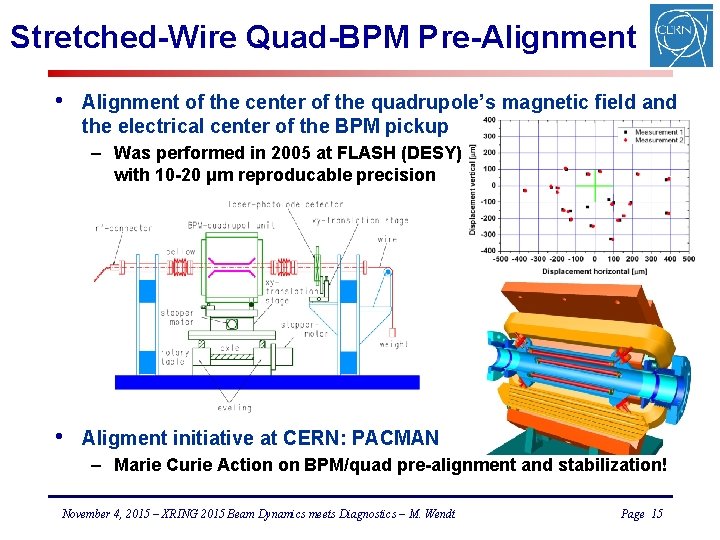
Stretched-Wire Quad-BPM Pre-Alignment • Alignment of the center of the quadrupole’s magnetic field and the electrical center of the BPM pickup – Was performed in 2005 at FLASH (DESY) with 10 -20 μm reproducable precision • Aligment initiative at CERN: PACMAN – Marie Curie Action on BPM/quad pre-alignment and stabilization! November 4, 2015 – XRING 2015 Beam Dynamics meets Diagnostics – M. Wendt Page 15
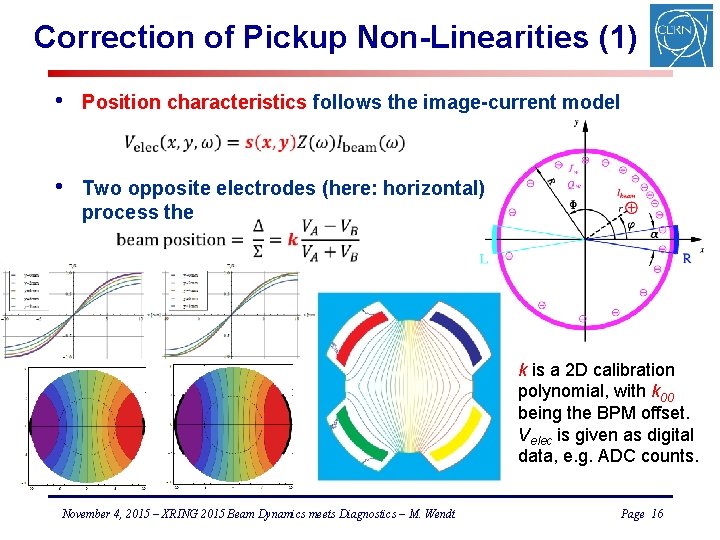
Correction of Pickup Non-Linearities (1) • Position characteristics follows the image-current model • Two opposite electrodes (here: horizontal) process the k is a 2 D calibration polynomial, with k 00 being the BPM offset. Velec is given as digital data, e. g. ADC counts. November 4, 2015 – XRING 2015 Beam Dynamics meets Diagnostics – M. Wendt Page 16
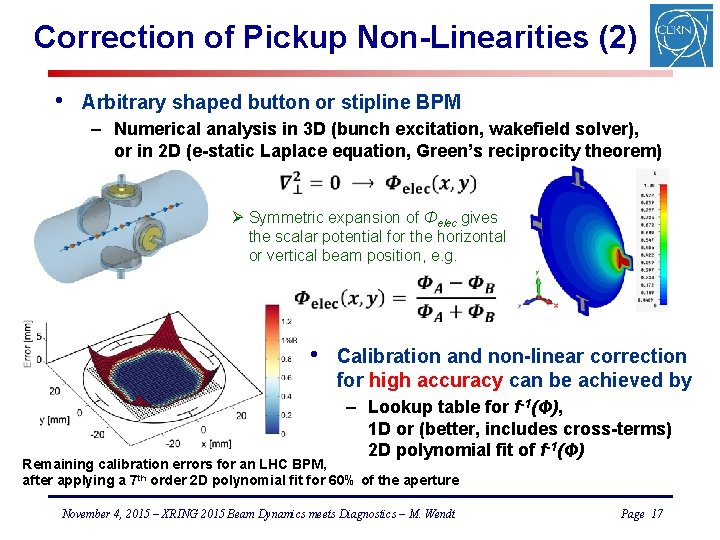
Correction of Pickup Non-Linearities (2) • Arbitrary shaped button or stipline BPM – Numerical analysis in 3 D (bunch excitation, wakefield solver), or in 2 D (e-static Laplace equation, Green’s reciprocity theorem) Ø Symmetric expansion of Φelec gives the scalar potential for the horizontal or vertical beam position, e. g. • Calibration and non-linear correction for high accuracy can be achieved by – Lookup table for f-1(Φ), 1 D or (better, includes cross-terms) 2 D polynomial fit of f-1(Φ) Remaining calibration errors for an LHC BPM, after applying a 7 th order 2 D polynomial fit for 60% of the aperture November 4, 2015 – XRING 2015 Beam Dynamics meets Diagnostics – M. Wendt Page 17
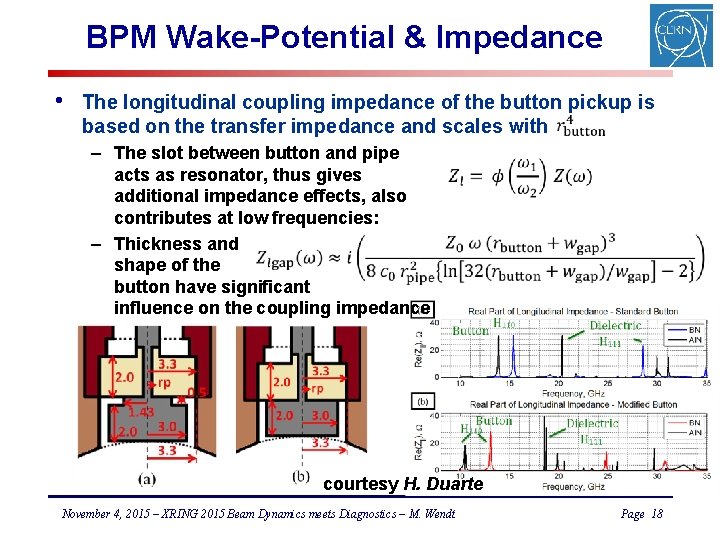
BPM Wake-Potential & Impedance • The longitudinal coupling impedance of the button pickup is based on the transfer impedance and scales with – The slot between button and pipe acts as resonator, thus gives additional impedance effects, also contributes at low frequencies: – Thickness and shape of the button have significant influence on the coupling impedance courtesy H. Duarte November 4, 2015 – XRING 2015 Beam Dynamics meets Diagnostics – M. Wendt Page 18
Signal Processing & Normalization • • • Extract the beam position information from the electrode signals: Normalization – Analog using Δ-Σ or 900 -hybrids, followed by filters, amplifiers mixers and other elements, or logarithmic amplifiers. – Digital, performing the math on individual digitized electrode signals. Decimation / processing of broadband signals – BPM data often is not required on a bunch-by-bunch basis Ø Exception: Fast feedback processors Ø Default: Turn-by-turn and “narrowband” beam positions – Filters, amplifiers, mixers and demodulators in analog and digital to decimate broadband signals to the necessary level. Other aspects – – – Generate calibration / test signals Correct for non-linearities of the beam position response of the BPM Synchronization of turn-by-turn data Optimization on the BPM system level to minimize cable expenses. BPM signals keep other very useful information other than that based on the beam displacement, e. g. Ø Beam intensity, beam phase (timing) November 4, 2015 – XRING 2015 Beam Dynamics meets Diagnostics – M. Wendt Page 19
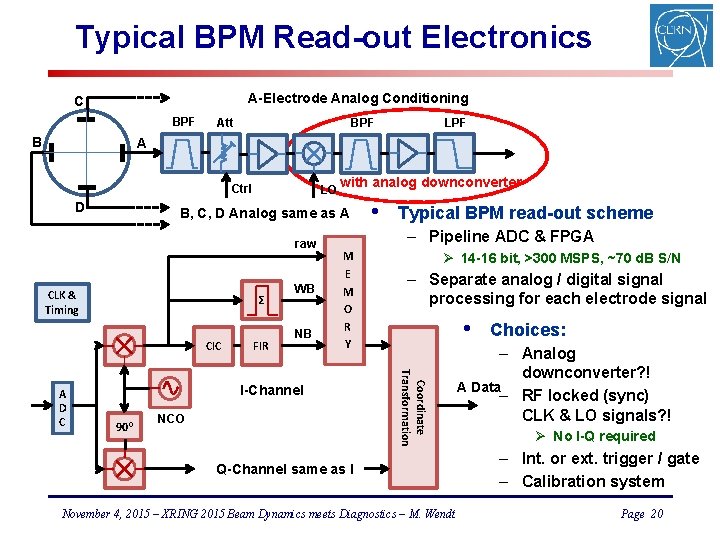
Typical BPM Read-out Electronics A-Electrode Analog Conditioning C BPF B Att BPF LPF A Ctrl D LO B, C, D Analog same as A raw CLK & Timing Σ CIC FIR WB NB Typical BPM read-out scheme – Pipeline ADC & FPGA M E M O R Y I-Channel 900 • NCO Ø 14 -16 bit, >300 MSPS, ~70 d. B S/N – Separate analog / digital signal processing for each electrode signal • Coordinate Transformation A D C with analog downconverter Q-Channel same as I November 4, 2015 – XRING 2015 Beam Dynamics meets Diagnostics – M. Wendt Choices: – Analog downconverter? ! A Data – RF locked (sync) CLK & LO signals? ! Ø No I-Q required – Int. or ext. trigger / gate – Calibration system Page 20
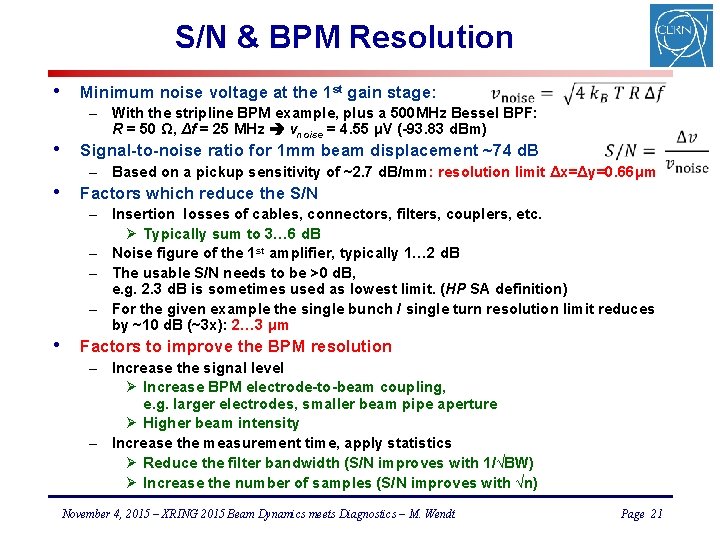
S/N & BPM Resolution • • Minimum noise voltage at the 1 st gain stage: – With the stripline BPM example, plus a 500 MHz Bessel BPF: R = 50 Ω, Δf = 25 MHz vnoise = 4. 55 μV (-93. 83 d. Bm) Signal-to-noise ratio for 1 mm beam displacement ~74 d. B – Based on a pickup sensitivity of ~2. 7 d. B/mm: resolution limit Δx=Δy=0. 66μm Factors which reduce the S/N – Insertion losses of cables, connectors, filters, couplers, etc. Ø Typically sum to 3… 6 d. B – Noise figure of the 1 st amplifier, typically 1… 2 d. B – The usable S/N needs to be >0 d. B, e. g. 2. 3 d. B is sometimes used as lowest limit. (HP SA definition) – For the given example the single bunch / single turn resolution limit reduces by ~10 d. B (~3 x): 2… 3 μm Factors to improve the BPM resolution – Increase the signal level Ø Increase BPM electrode-to-beam coupling, e. g. larger electrodes, smaller beam pipe aperture Ø Higher beam intensity – Increase the measurement time, apply statistics Ø Reduce the filter bandwidth (S/N improves with 1/√BW) Ø Increase the number of samples (S/N improves with √n) November 4, 2015 – XRING 2015 Beam Dynamics meets Diagnostics – M. Wendt Page 21
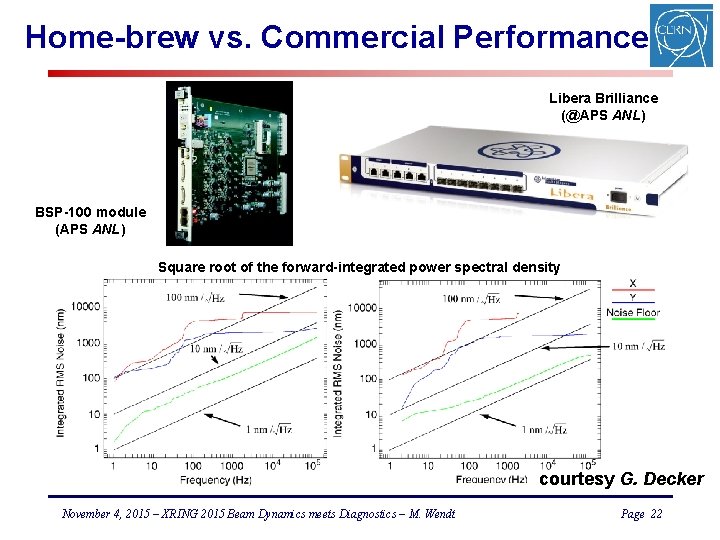
Home-brew vs. Commercial Performance Libera Brilliance (@APS ANL) BSP-100 module (APS ANL) Square root of the forward-integrated power spectral density courtesy G. Decker November 4, 2015 – XRING 2015 Beam Dynamics meets Diagnostics – M. Wendt Page 22
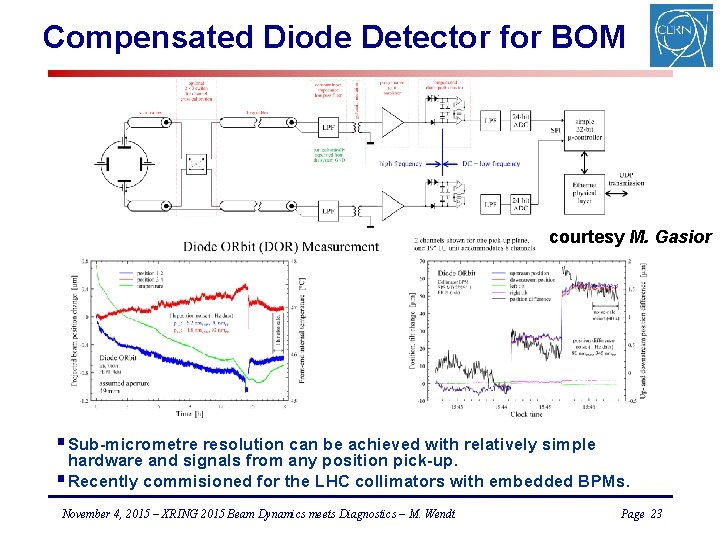
Compensated Diode Detector for BOM courtesy M. Gasior § Sub-micrometre resolution can be achieved with relatively simple hardware and signals from any position pick-up. § Recently commisioned for the LHC collimators with embedded BPMs. November 4, 2015 – XRING 2015 Beam Dynamics meets Diagnostics – M. Wendt Page 23
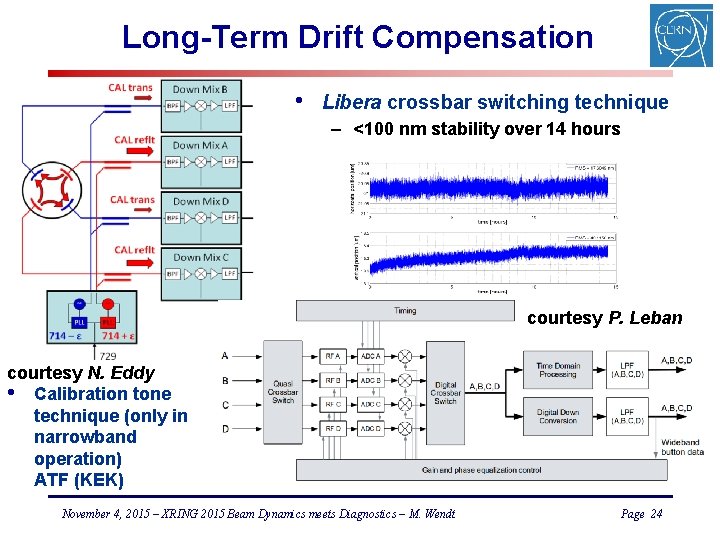
Long-Term Drift Compensation • Libera crossbar switching technique – <100 nm stability over 14 hours courtesy P. Leban courtesy N. Eddy • Calibration tone technique (only in narrowband operation) ATF (KEK) November 4, 2015 – XRING 2015 Beam Dynamics meets Diagnostics – M. Wendt Page 24
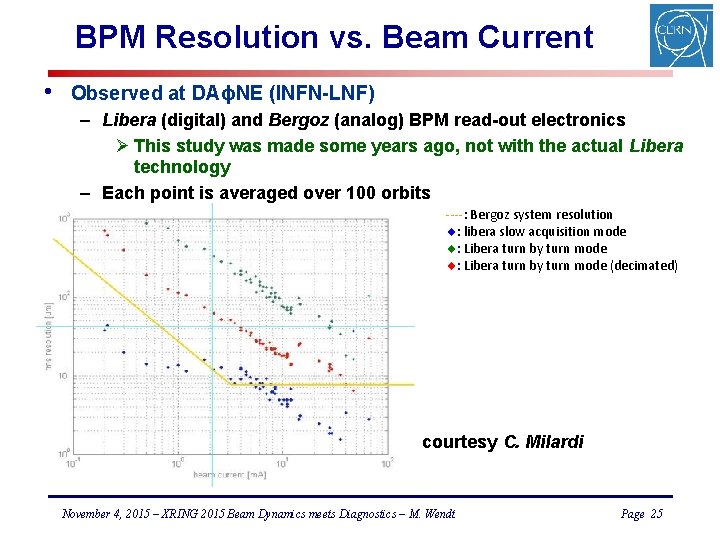
BPM Resolution vs. Beam Current • Observed at DAϕNE (INFN-LNF) – Libera (digital) and Bergoz (analog) BPM read-out electronics Ø This study was made some years ago, not with the actual Libera technology – Each point is averaged over 100 orbits ----: Bergoz system resolution : libera slow acquisition mode : Libera turn by turn mode (decimated) courtesy C. Milardi November 4, 2015 – XRING 2015 Beam Dynamics meets Diagnostics – M. Wendt Page 25
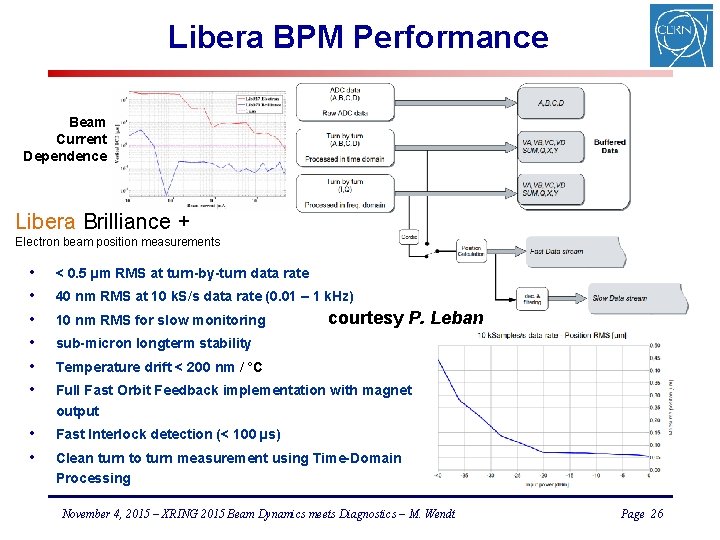
Libera BPM Performance Beam Current Dependence Libera Brilliance + Electron beam position measurements • • • < 0. 5 µm RMS at turn-by-turn data rate • • Fast Interlock detection (< 100 µs) 40 nm RMS at 10 k. S/s data rate (0. 01 – 1 k. Hz) 10 nm RMS for slow monitoring courtesy P. Leban sub-micron longterm stability Temperature drift < 200 nm / °C Full Fast Orbit Feedback implementation with magnet output Clean turn to turn measurement using Time-Domain Processing November 4, 2015 – XRING 2015 Beam Dynamics meets Diagnostics – M. Wendt Page 26
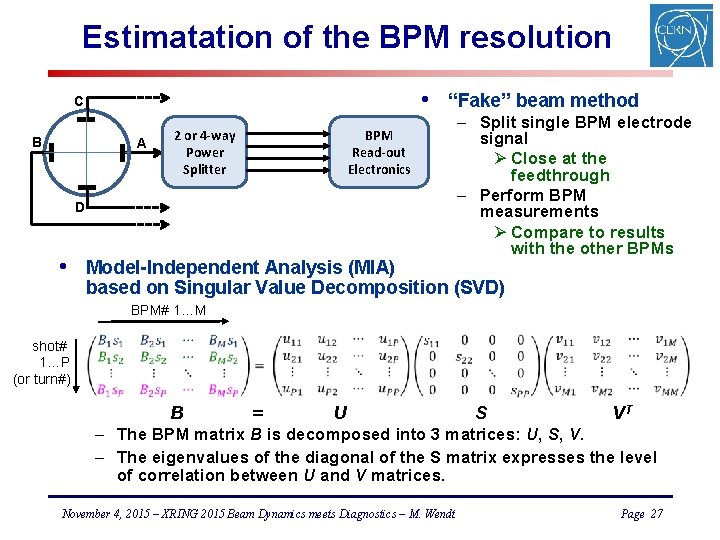
Estimatation of the BPM resolution • C B A 2 or 4 -way Power Splitter “Fake” beam method BPM Read-out Electronics D • – Split single BPM electrode signal Ø Close at the feedthrough – Perform BPM measurements Ø Compare to results with the other BPMs Model-Independent Analysis (MIA) based on Singular Value Decomposition (SVD) BPM# 1…M shot# 1…P (or turn#) B = U S VT – The BPM matrix B is decomposed into 3 matrices: U, S, V. – The eigenvalues of the diagonal of the S matrix expresses the level of correlation between U and V matrices. November 4, 2015 – XRING 2015 Beam Dynamics meets Diagnostics – M. Wendt Page 27
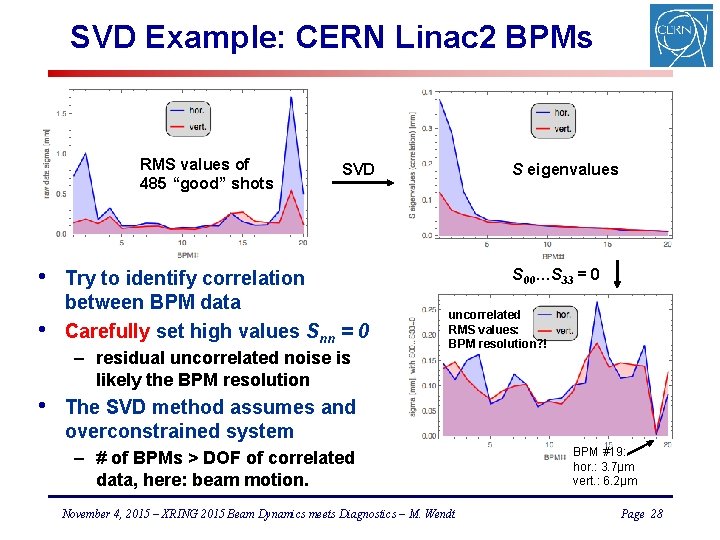
SVD Example: CERN Linac 2 BPMs RMS values of 485 “good” shots • • SVD Try to identify correlation between BPM data Carefully set high values Snn = 0 – residual uncorrelated noise is likely the BPM resolution • S eigenvalues S 00…S 33 = 0 uncorrelated RMS values: BPM resolution? ! The SVD method assumes and overconstrained system – # of BPMs > DOF of correlated data, here: beam motion. November 4, 2015 – XRING 2015 Beam Dynamics meets Diagnostics – M. Wendt BPM #19: hor. : 3. 7μm vert. : 6. 2μm Page 28
Wrap-up, Summary, Remarks • BPM systems are complex • A few typical questions to be addressed – Choices have to be made on requirements and technologies. – It is difficult, even impossible to simply expand / enhance the preformance of a given BPM system (analog as well as digital). – Mechanical boundaries for the BPM pickups Ø Beam pipe aperture, flanges, cryo, radiation, real-estate, … – Beam parameters (operational and commissioning) Ø Beam/bunch formatting, beam/bunch intensities Ø Non-relativistic beams, ions, two beams near Ips – BPM implementation and operation Ø BPM pickup type, elelctrode arrangement, pre-alignment, cabling Ø Analog / digital read-out electronics, operational modes, online calibration, external / internal trigger, Bb. B, Tb. T, narrow-band (orbit), . . . Ø Home-brew, tailored systems or general purpose BPM electronics? Ø DAQ, FB (latency!) –. . . and finally we have to discuss on BPM performance requirements: Ø Resolution, accuracy, reproducibility, offset stability, dynamic range, etc. THANK YOU! November 4, 2015 – XRING 2015 Beam Dynamics meets Diagnostics – M. Wendt Page 29
Backup Slides November 4, 2015 – XRING 2015 Beam Dynamics meets Diagnostics – M. Wendt Page 30
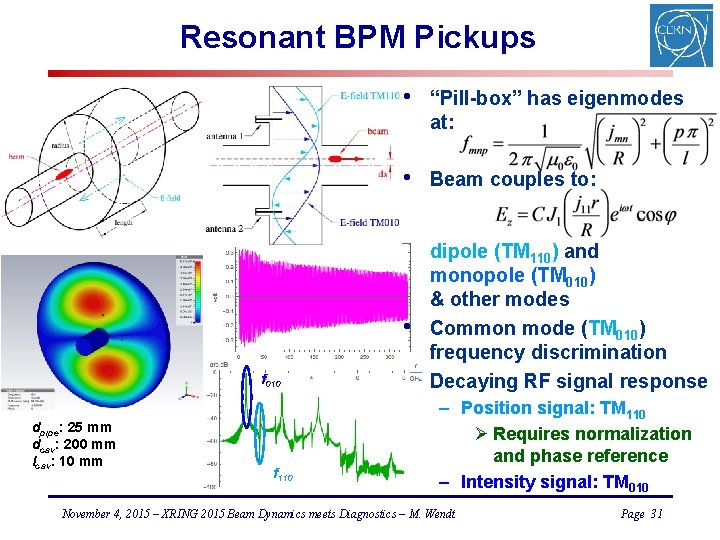
Resonant BPM Pickups • “Pill-box” has eigenmodes at: • Beam couples to: • f 010 dpipe: 25 mm dcav: 200 mm lcav: 10 mm f 110 • dipole (TM 110) and monopole (TM 010) & other modes Common mode (TM 010) frequency discrimination Decaying RF signal response – Position signal: TM 110 Ø Requires normalization and phase reference – Intensity signal: TM 010 November 4, 2015 – XRING 2015 Beam Dynamics meets Diagnostics – M. Wendt Page 31
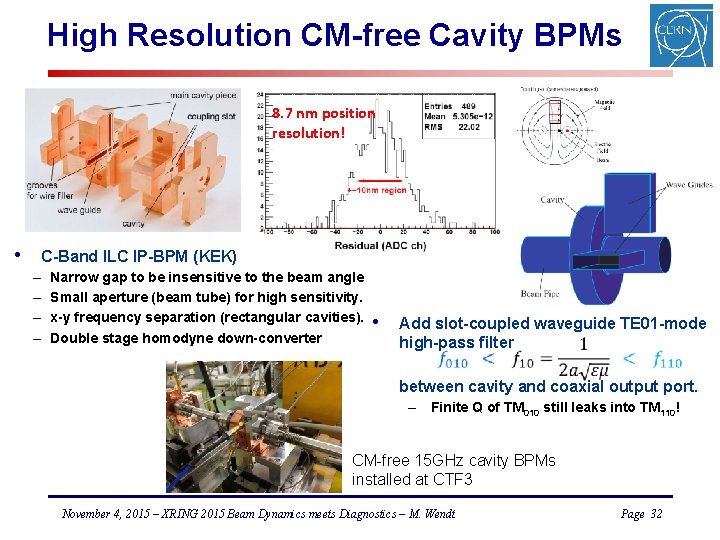
High Resolution CM-free Cavity BPMs 8. 7 nm position resolution! • C-Band ILC IP-BPM (KEK) – – Narrow gap to be insensitive to the beam angle Small aperture (beam tube) for high sensitivity. x-y frequency separation (rectangular cavities). Double stage homodyne down-converter • Add slot-coupled waveguide TE 01 -mode high-pass filter between cavity and coaxial output port. – Finite Q of TM 010 still leaks into TM 110! CM-free 15 GHz cavity BPMs installed at CTF 3 November 4, 2015 – XRING 2015 Beam Dynamics meets Diagnostics – M. Wendt Page 32
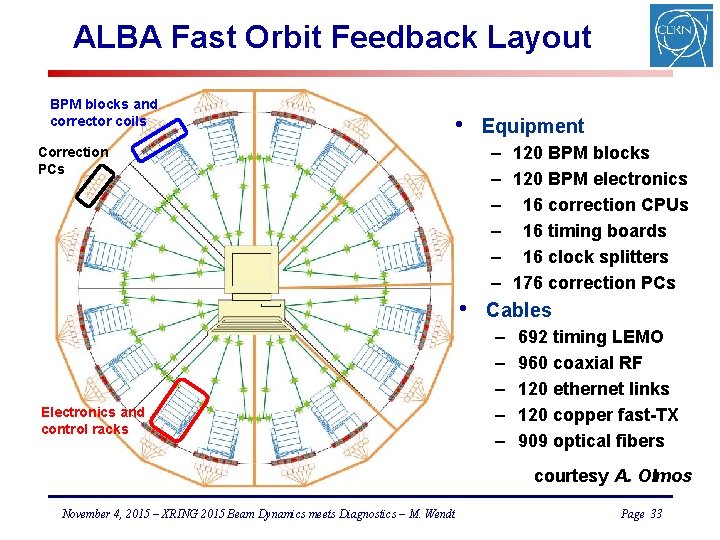
ALBA Fast Orbit Feedback Layout BPM blocks and corrector coils • – 120 BPM blocks – 120 BPM electronics – 16 correction CPUs – 16 timing boards – 16 clock splitters – 176 correction PCs Correction PCs • Electronics and control racks Equipment Cables – – – 692 timing LEMO 960 coaxial RF 120 ethernet links 120 copper fast-TX 909 optical fibers courtesy A. Olmos November 4, 2015 – XRING 2015 Beam Dynamics meets Diagnostics – M. Wendt Page 33
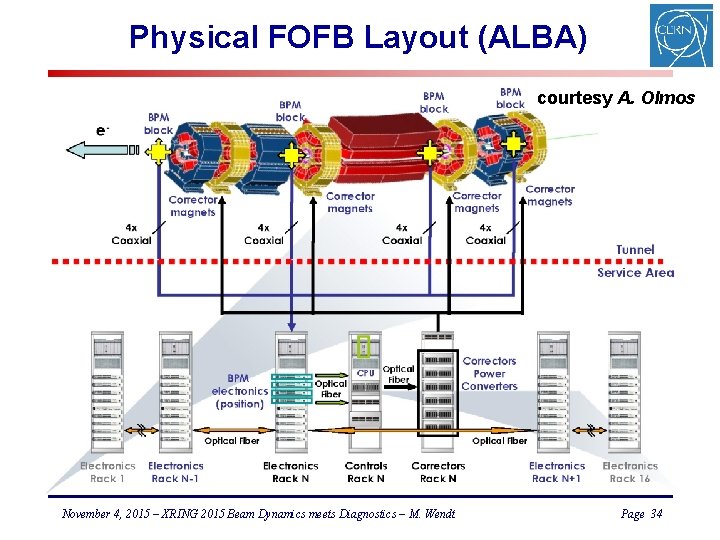
Physical FOFB Layout (ALBA) courtesy A. Olmos November 4, 2015 – XRING 2015 Beam Dynamics meets Diagnostics – M. Wendt Page 34
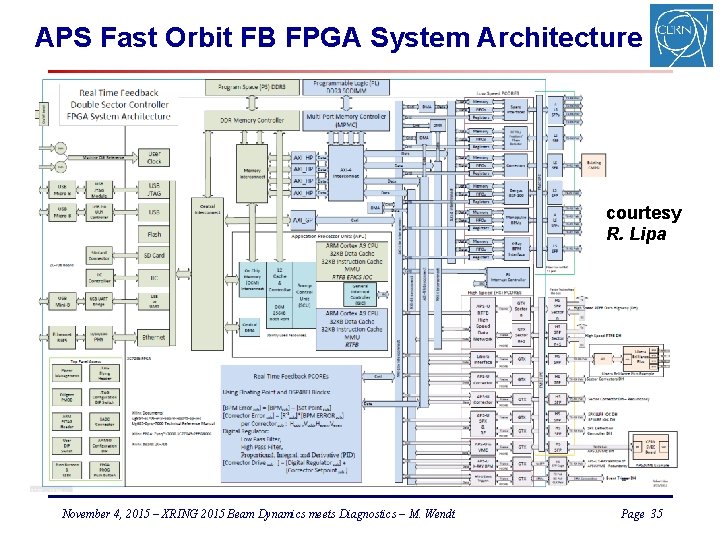
APS Fast Orbit FB FPGA System Architecture courtesy R. Lipa November 4, 2015 – XRING 2015 Beam Dynamics meets Diagnostics – M. Wendt Page 35
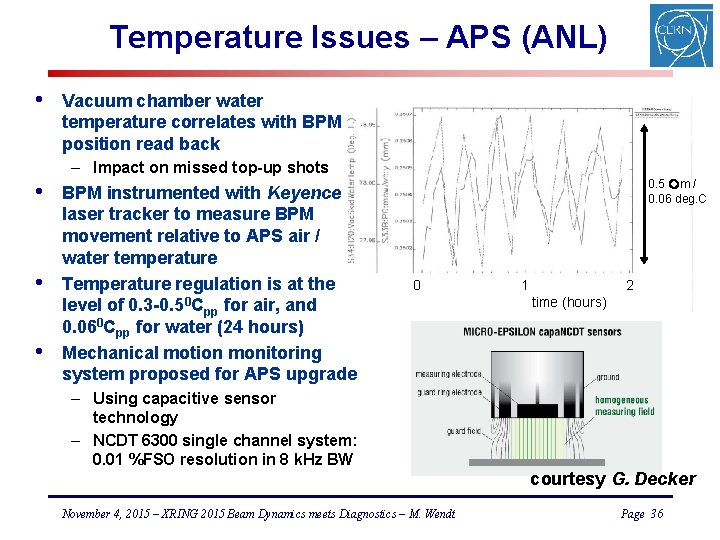
Temperature Issues – APS (ANL) • Vacuum chamber water temperature correlates with BPM position read back – Impact on missed top-up shots • • • BPM instrumented with Keyence laser tracker to measure BPM movement relative to APS air / water temperature Temperature regulation is at the level of 0. 3 -0. 50 Cpp for air, and 0. 060 Cpp for water (24 hours) Mechanical motion monitoring system proposed for APS upgrade 0. 5 m / 0. 06 deg. C 0 1 2 time (hours) – Using capacitive sensor technology – NCDT 6300 single channel system: 0. 01 %FSO resolution in 8 k. Hz BW November 4, 2015 – XRING 2015 Beam Dynamics meets Diagnostics – M. Wendt courtesy G. Decker Page 36
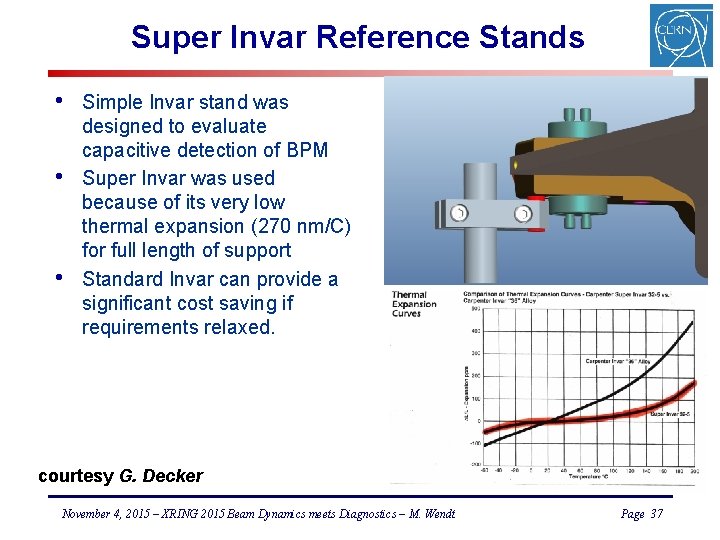
Super Invar Reference Stands • • • Simple Invar stand was designed to evaluate capacitive detection of BPM Super Invar was used because of its very low thermal expansion (270 nm/C) for full length of support Standard Invar can provide a significant cost saving if requirements relaxed. courtesy G. Decker November 4, 2015 – XRING 2015 Beam Dynamics meets Diagnostics – M. Wendt Page 37
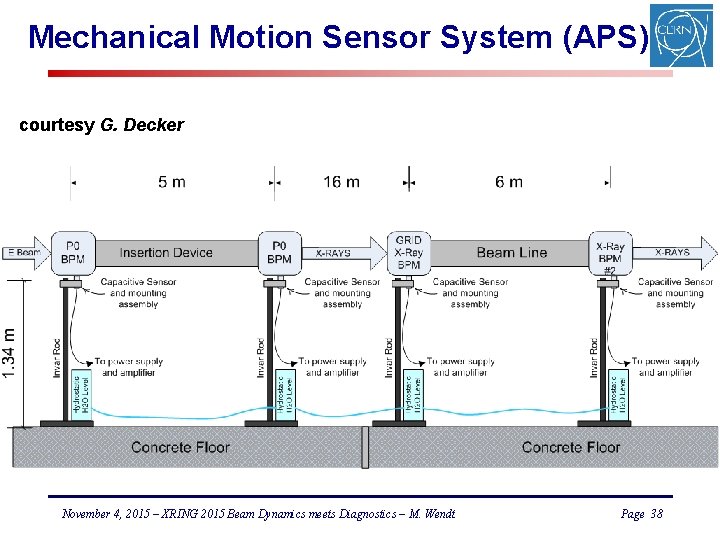
Mechanical Motion Sensor System (APS) courtesy G. Decker November 4, 2015 – XRING 2015 Beam Dynamics meets Diagnostics – M. Wendt Page 38
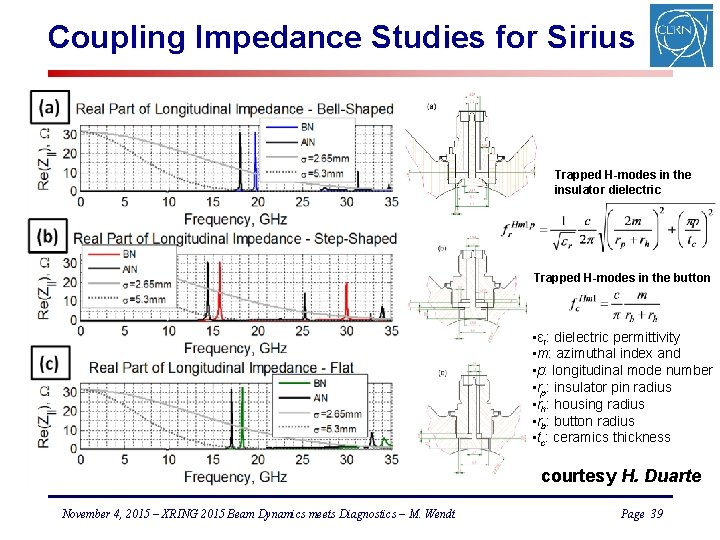
Coupling Impedance Studies for Sirius Trapped H-modes in the insulator dielectric Trapped H-modes in the button • εr: dielectric permittivity • m: azimuthal index and • p: longitudinal mode number • rp: insulator pin radius • rh: housing radius • rb: button radius • tc: ceramics thickness courtesy H. Duarte November 4, 2015 – XRING 2015 Beam Dynamics meets Diagnostics – M. Wendt Page 39
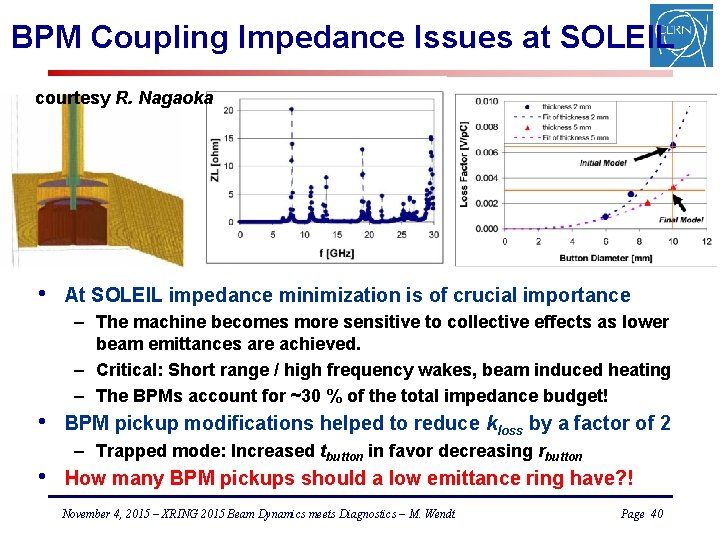
BPM Coupling Impedance Issues at SOLEIL courtesy R. Nagaoka • At SOLEIL impedance minimization is of crucial importance – The machine becomes more sensitive to collective effects as lower beam emittances are achieved. – Critical: Short range / high frequency wakes, beam induced heating – The BPMs account for ~30 % of the total impedance budget! • • BPM pickup modifications helped to reduce kloss by a factor of 2 – Trapped mode: Increased tbutton in favor decreasing rbutton How many BPM pickups should a low emittance ring have? ! November 4, 2015 – XRING 2015 Beam Dynamics meets Diagnostics – M. Wendt Page 40
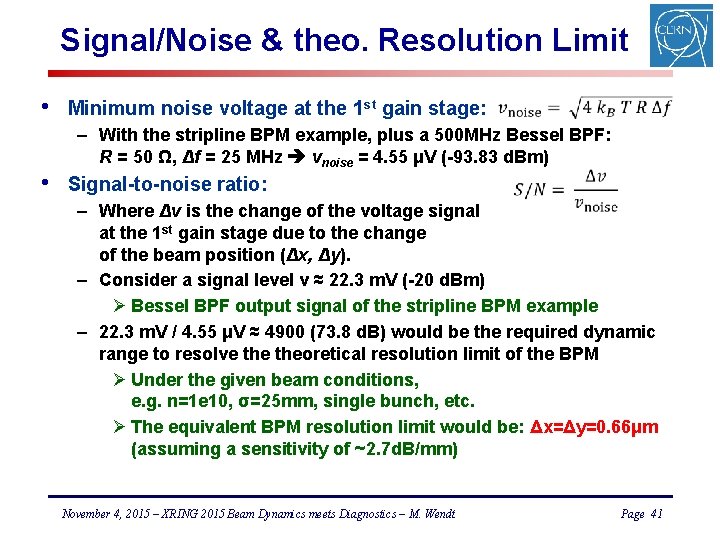
Signal/Noise & theo. Resolution Limit • Minimum noise voltage at the 1 st gain stage: • – With the stripline BPM example, plus a 500 MHz Bessel BPF: R = 50 Ω, Δf = 25 MHz vnoise = 4. 55 μV (-93. 83 d. Bm) Signal-to-noise ratio: – Where Δv is the change of the voltage signal at the 1 st gain stage due to the change of the beam position (Δx, Δy). – Consider a signal level v ≈ 22. 3 m. V (-20 d. Bm) Ø Bessel BPF output signal of the stripline BPM example – 22. 3 m. V / 4. 55 μV ≈ 4900 (73. 8 d. B) would be the required dynamic range to resolve theoretical resolution limit of the BPM Ø Under the given beam conditions, e. g. n=1 e 10, σ=25 mm, single bunch, etc. Ø The equivalent BPM resolution limit would be: Δx=Δy=0. 66μm (assuming a sensitivity of ~2. 7 d. B/mm) November 4, 2015 – XRING 2015 Beam Dynamics meets Diagnostics – M. Wendt Page 41
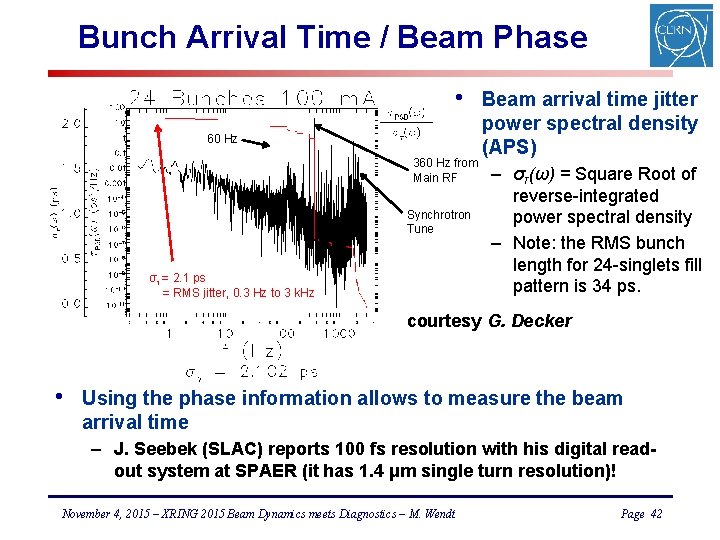
Bunch Arrival Time / Beam Phase • 60 Hz 360 Hz from Main RF Synchrotron Tune στ = 2. 1 ps = RMS jitter, 0. 3 Hz to 3 k. Hz Beam arrival time jitter power spectral density (APS) – στ(ω) = Square Root of reverse-integrated power spectral density – Note: the RMS bunch length for 24 -singlets fill pattern is 34 ps. courtesy G. Decker • Using the phase information allows to measure the beam arrival time – J. Seebek (SLAC) reports 100 fs resolution with his digital readout system at SPAER (it has 1. 4 μm single turn resolution)! November 4, 2015 – XRING 2015 Beam Dynamics meets Diagnostics – M. Wendt Page 42
- Slides: 42