
Select and Implement a Customer Relationship Management Platform
- Slides: 19
Select and Implement a Customer Relationship Management Platform Enable marketing, sales, and customer service teams by successfully choosing and implementing a suite for customer relationship management. Info-Tech Research Group, Inc. is a global leader in providing IT research and advice. Info-Tech’s products and services combine actionable insight and relevant advice with ready-to-use tools and templates that cover the full spectrum of IT concerns. © 1997 -2016 Info-Tech Research Group Inc. Info-Tech Research Group 1
ANALYST PERSPECTIVE A customer relationship management (CRM) platform is the cornerstone of your technology portfolio for creating world-class customer experiences. CRM platforms are the workhorses that provide functional capabilities and data for customer experience management. IT needs to be a trusted partner in CRM selection and implementation, but the business also needs to own the requirements and be involved from the get-go. Think of IT as a ‘conductor of the CRM orchestra. ’ CRM selection must be a multi-step process that involves mapping target capabilities for marketing, sales, and customer service, assigning requirements across functional categories, determining the architecture model to prioritize criteria, and developing a comprehensive RFP that can be scored in a weighted fashion. To succeed with CRM implementation, create a detailed roadmap that outlines milestones for configuration, security, points of implementation, data migration, training, and ongoing application maintenance. Ben Dickie, Senior Manager, Enterprise Applications Info-Tech Research Group 2
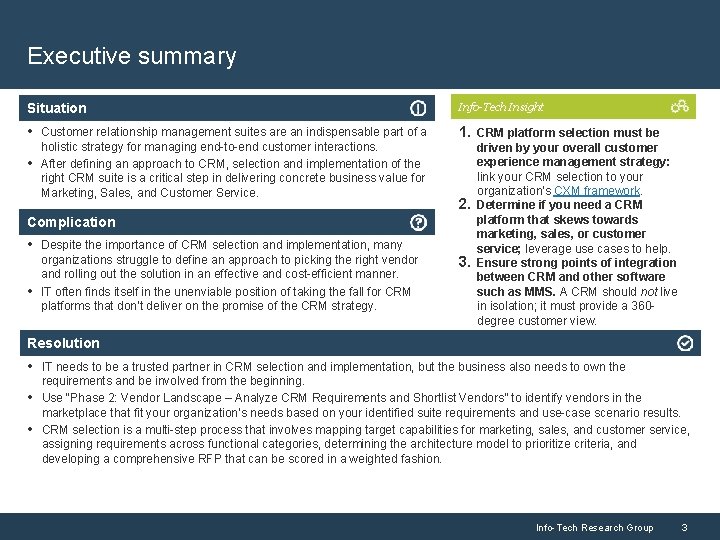
Executive summary Situation Info-Tech Insight • Customer relationship management suites are an indispensable part of a 1. CRM platform selection must be • holistic strategy for managing end-to-end customer interactions. After defining an approach to CRM, selection and implementation of the right CRM suite is a critical step in delivering concrete business value for Marketing, Sales, and Customer Service. 2. Complication • Despite the importance of CRM selection and implementation, many • organizations struggle to define an approach to picking the right vendor and rolling out the solution in an effective and cost-efficient manner. IT often finds itself in the unenviable position of taking the fall for CRM platforms that don’t deliver on the promise of the CRM strategy. 3. driven by your overall customer experience management strategy: link your CRM selection to your organization’s CXM framework. Determine if you need a CRM platform that skews towards marketing, sales, or customer service; leverage use cases to help. Ensure strong points of integration between CRM and other software such as MMS. A CRM should not live in isolation; it must provide a 360 degree customer view. Resolution • IT needs to be a trusted partner in CRM selection and implementation, but the business also needs to own the • • requirements and be involved from the beginning. Use “Phase 2: Vendor Landscape – Analyze CRM Requirements and Shortlist Vendors” to identify vendors in the marketplace that fit your organization’s needs based on your identified suite requirements and use-case scenario results. CRM selection is a multi-step process that involves mapping target capabilities for marketing, sales, and customer service, assigning requirements across functional categories, determining the architecture model to prioritize criteria, and developing a comprehensive RFP that can be scored in a weighted fashion. Info-Tech Research Group 3
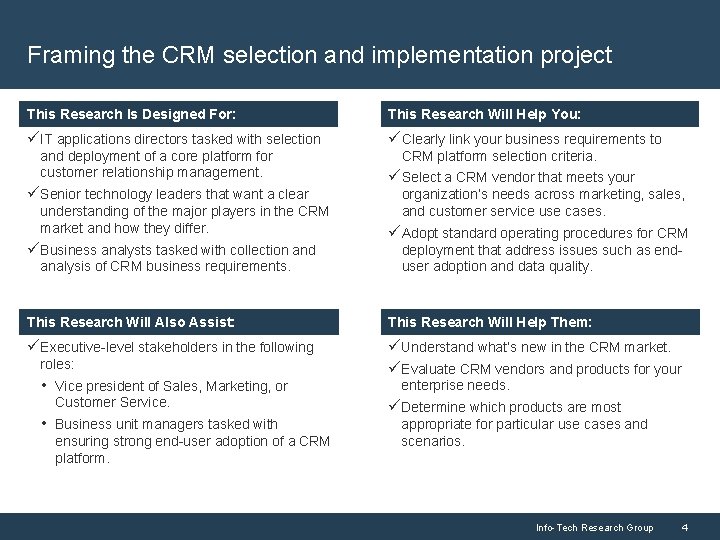
Framing the CRM selection and implementation project This Research is Is Designed For: This Research Will Help You: üIT applications directors tasked with selection üClearly link your business requirements to and deployment of a core platform for customer relationship management. üSenior technology leaders that want a clear understanding of the major players in the CRM market and how they differ. üBusiness analysts tasked with collection and analysis of CRM business requirements. CRM platform selection criteria. üSelect a CRM vendor that meets your organization’s needs across marketing, sales, and customer service use cases. üAdopt standard operating procedures for CRM deployment that address issues such as enduser adoption and data quality. This Research Will Also Assist: This Research Will Help You: Them: üExecutive-level stakeholders in the following üUnderstand what’s new in the CRM market. üEvaluate CRM vendors and products for your roles: • Vice president of Sales, Marketing, or Customer Service. • Business unit managers tasked with ensuring strong end-user adoption of a CRM platform. enterprise needs. üDetermine which products are most appropriate for particular use cases and scenarios. Info-Tech Research Group 4
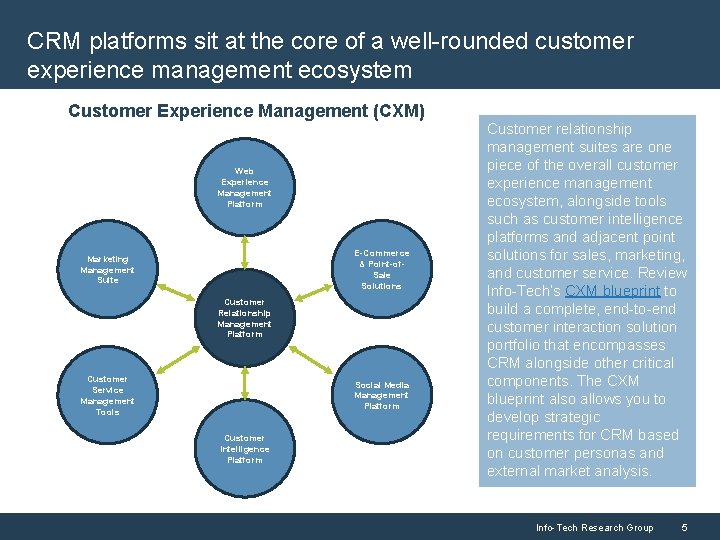
CRM platforms sit at the core of a well-rounded customer experience management ecosystem Customer Experience Management (CXM) Web Experience Management Platform E-Commerce & Point-of. Sale Solutions Marketing Management Suite Customer Relationship Management Platform Customer Service Management Tools Social Media Management Platform Customer Intelligence Platform Customer relationship management suites are one piece of the overall customer experience management ecosystem, alongside tools such as customer intelligence platforms and adjacent point solutions for sales, marketing, and customer service. Review Info-Tech’s CXM blueprint to build a complete, end-to-end customer interaction solution portfolio that encompasses CRM alongside other critical components. The CXM blueprint also allows you to develop strategic requirements for CRM based on customer personas and external market analysis. Info-Tech Research Group 5
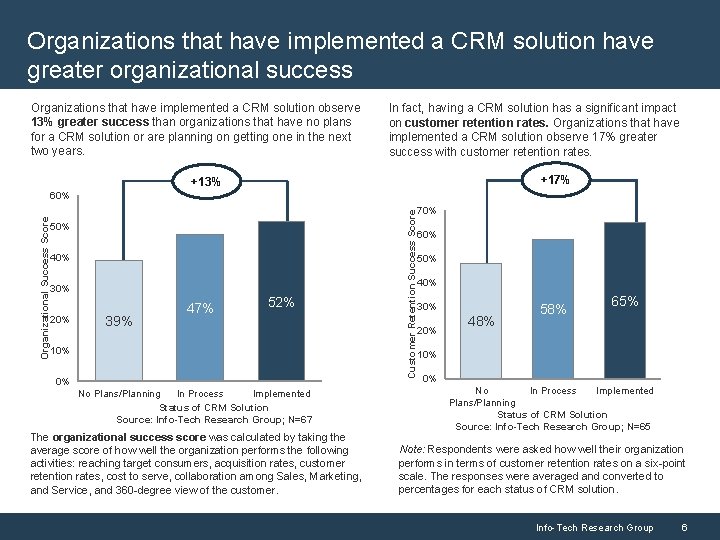
Organizations that have implemented a CRM solution have greater organizational success Organizations that have implemented a CRM solution observe 13% greater success than organizations that have no plans for a CRM solution or are planning on getting one in the next two years. In fact, having a CRM solution has a significant impact on customer retention rates. Organizations that have implemented a CRM solution observe 17% greater success with customer retention rates. +17% +13% 50% 40% 30% 20% 39% 47% 52% 10% 0% No Plans/Planning In Process Implemented Status of CRM Solution Source: Info-Tech Research Group; N=67 The organizational success score was calculated by taking the average score of how well the organization performs the following activities: reaching target consumers, acquisition rates, customer retention rates, cost to serve, collaboration among Sales, Marketing, and Service, and 360 -degree view of the customer. Customer Retention Success Score Organizational Success Score 60% 70% 60% 50% 40% 30% 20% 48% 58% 65% 10% 0% No In Process Implemented Plans/Planning Status of CRM Solution Source: Info-Tech Research Group; N=65 Note: Respondents were asked how well their organization performs in terms of customer retention rates on a six-point scale. The responses were averaged and converted to percentages for each status of CRM solution. Info-Tech Research Group 6
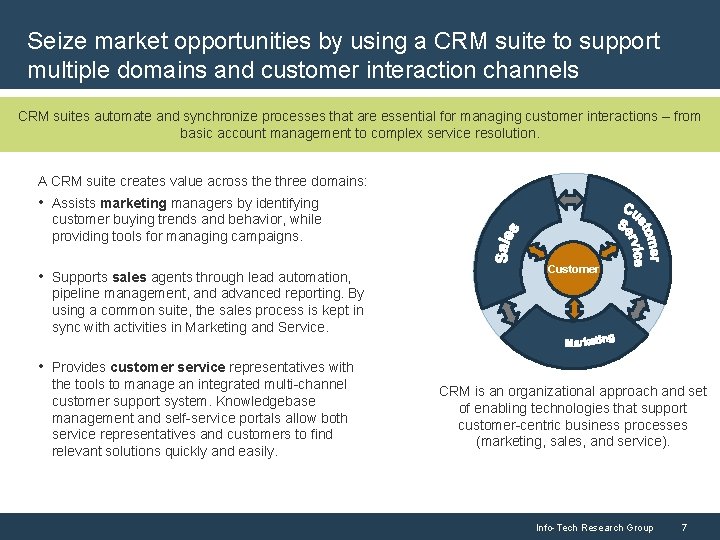
Seize market opportunities by using a CRM suite to support multiple domains and customer interaction channels CRM suites automate and synchronize processes that are essential for managing customer interactions – from basic account management to complex service resolution. A CRM suite creates value across the three domains: • Assists marketing managers by identifying customer buying trends and behavior, while providing tools for managing campaigns. • Supports sales agents through lead automation, Customer pipeline management, and advanced reporting. By using a common suite, the sales process is kept in sync with activities in Marketing and Service. • Provides customer service representatives with the tools to manage an integrated multi-channel customer support system. Knowledgebase management and self-service portals allow both service representatives and customers to find relevant solutions quickly and easily. CRM is an organizational approach and set of enabling technologies that support customer-centric business processes (marketing, sales, and service). Info-Tech Research Group 7
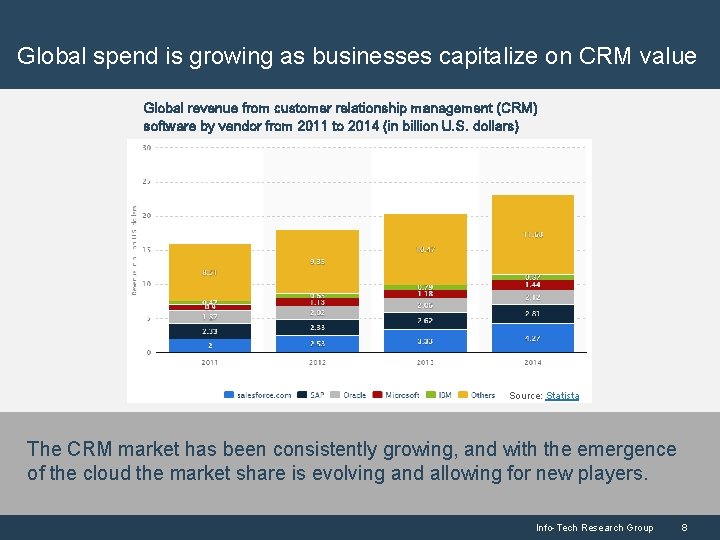
Global spend is growing as businesses capitalize on CRM value Global revenue from customer relationship management (CRM) software by vendor from 2011 to 2014 (in billion U. S. dollars) Source: Statista The CRM market has been consistently growing, and with the emergence of the cloud the market share is evolving and allowing for new players. Info-Tech Research Group 8
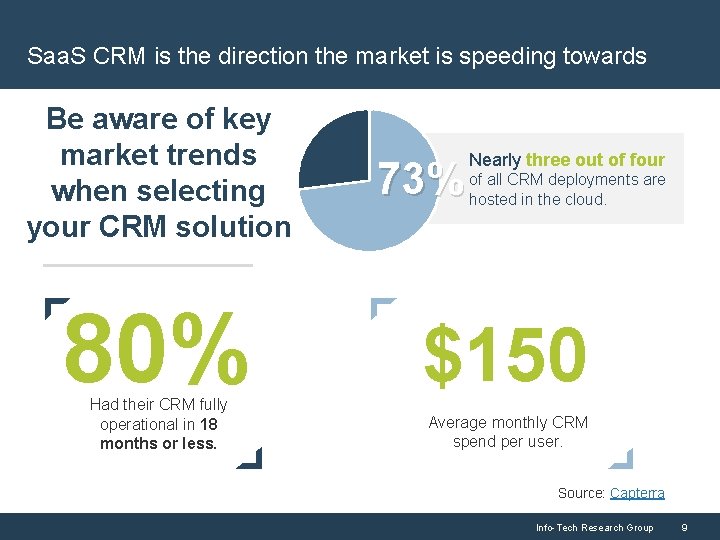
Saa. S CRM is the direction the market is speeding towards Be aware of key market trends when selecting your CRM solution 80% Had their CRM fully operational in 18 months or less. 73% Nearly three out of four of all CRM deployments are hosted in the cloud. $150 Average monthly CRM spend per user. Source: Capterra Info-Tech Research Group 9
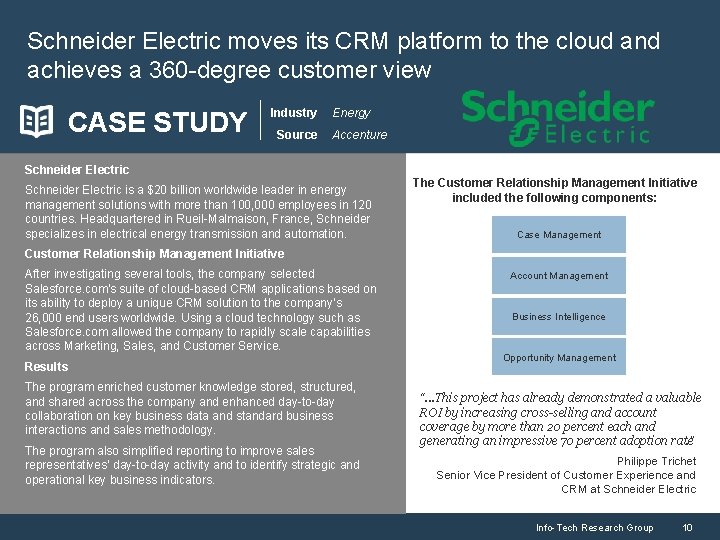
Schneider Electric moves its CRM platform to the cloud and achieves a 360 -degree customer view CASE STUDY Industry Source Energy Accenture Schneider Electric is a $20 billion worldwide leader in energy management solutions with more than 100, 000 employees in 120 countries. Headquartered in Rueil-Malmaison, France, Schneider specializes in electrical energy transmission and automation. The Customer Relationship Management Initiative included the following components: Case Management Customer Relationship Management Initiative After investigating several tools, the company selected Salesforce. com's suite of cloud-based CRM applications based on its ability to deploy a unique CRM solution to the company’s 26, 000 end users worldwide. Using a cloud technology such as Salesforce. com allowed the company to rapidly scale capabilities across Marketing, Sales, and Customer Service. Results The program enriched customer knowledge stored, structured, and shared across the company and enhanced day-to-day collaboration on key business data and standard business interactions and sales methodology. The program also simplified reporting to improve sales representatives’ day-to-day activity and to identify strategic and operational key business indicators. Account Management Business Intelligence Opportunity Management “. . . This project has already demonstrated a valuable ROI by increasing cross-selling and account coverage by more than 20 percent each and generating an impressive 70 percent adoption rate. ” Philippe Trichet Senior Vice President of Customer Experience and CRM at Schneider Electric Info-Tech Research Group 10
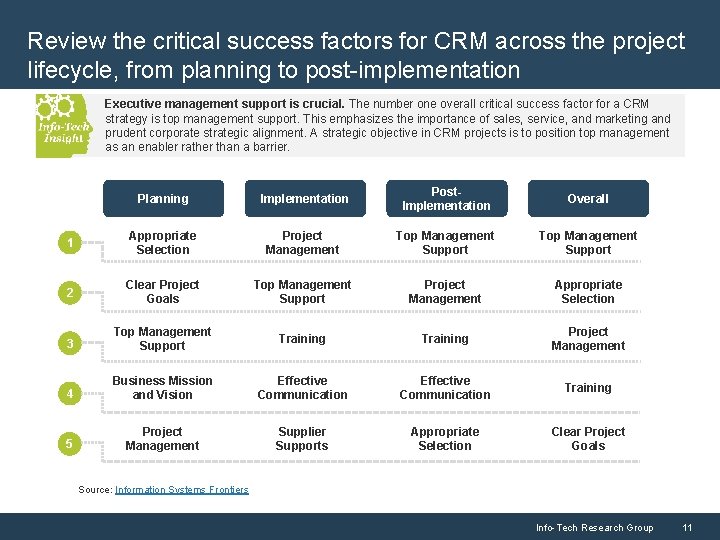
Review the critical success factors for CRM across the project lifecycle, from planning to post-implementation Executive management support is crucial. The number one overall critical success factor for a CRM strategy is top management support. This emphasizes the importance of sales, service, and marketing and prudent corporate strategic alignment. A strategic objective in CRM projects is to position top management as an enabler rather than a barrier. Planning Implementation Post. Implementation Overall 1 Appropriate Selection Project Management Top Management Support 2 Clear Project Goals Top Management Support Project Management Appropriate Selection 3 Top Management Support Training Project Management 4 Business Mission and Vision Effective Communication Training 5 Project Management Supplier Supports Appropriate Selection Clear Project Goals Source: Information Systems Frontiers Info-Tech Research Group 11
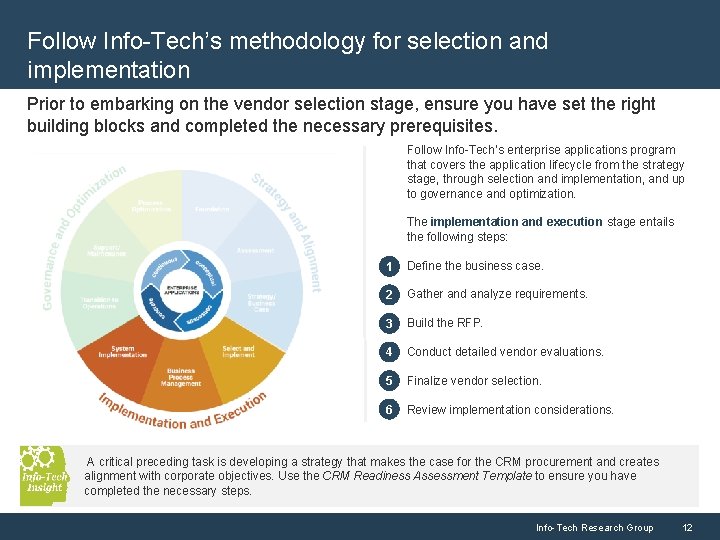
Follow Info-Tech’s methodology for selection and implementation Prior to embarking on the vendor selection stage, ensure you have set the right building blocks and completed the necessary prerequisites. Follow Info-Tech’s enterprise applications program that covers the application lifecycle from the strategy stage, through selection and implementation, and up to governance and optimization. The implementation and execution stage entails the following steps: 1 Define the business case. 2 Gather and analyze requirements. 3 Build the RFP. 4 Conduct detailed vendor evaluations. 5 Finalize vendor selection. 6 Review implementation considerations. A critical preceding task is developing a strategy that makes the case for the CRM procurement and creates alignment with corporate objectives. Use the CRM Readiness Assessment Template to ensure you have completed the necessary steps. Info-Tech Research Group 12
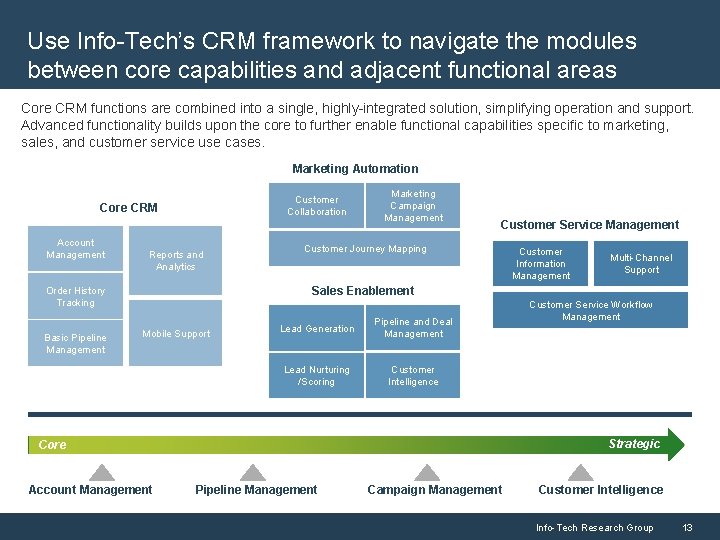
Use Info-Tech’s CRM framework to navigate the modules between core capabilities and adjacent functional areas Core CRM functions are combined into a single, highly-integrated solution, simplifying operation and support. Advanced functionality builds upon the core to further enable functional capabilities specific to marketing, sales, and customer service use cases. Marketing Automation Customer Collaboration Core CRM Account Management Reports and Analytics Customer Service Management Customer Journey Mapping Customer Information Management Multi-Channel Support Sales Enablement Order History Tracking Basic Pipeline Management Marketing Campaign Management Mobile Support Lead Generation Pipeline and Deal Management Lead Nurturing /Scoring Customer Intelligence Strategic Core Account Management Customer Service Workflow Management Pipeline Management Campaign Management Customer Intelligence Info-Tech Research Group 13
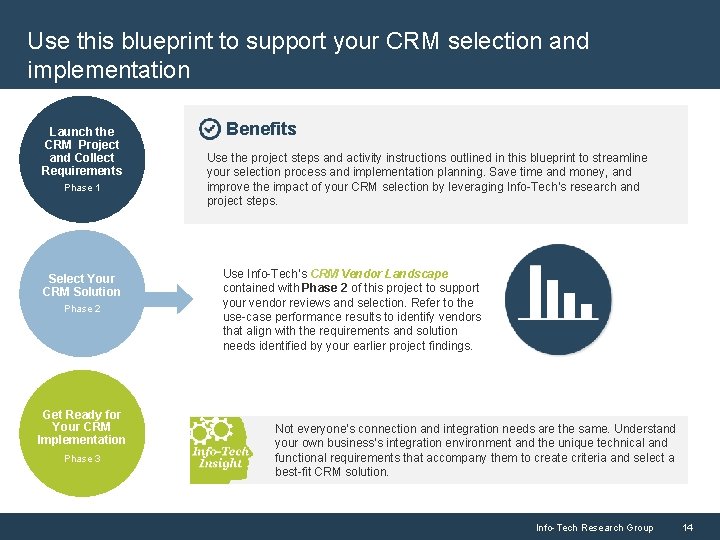
Use this blueprint to support your CRM selection and implementation Launch the CRM Project and Collect Requirements Phase 1 Select Your CRM Solution Phase 2 Get Ready for Your CRM Implementation Phase 3 Benefits Use the project steps and activity instructions outlined in this blueprint to streamline your selection process and implementation planning. Save time and money, and improve the impact of your CRM selection by leveraging Info-Tech’s research and project steps. Use Info-Tech’s CRM Vendor Landscape contained with Phase 2 of this project to support your vendor reviews and selection. Refer to the use-case performance results to identify vendors that align with the requirements and solution needs identified by your earlier project findings. Not everyone’s connection and integration needs are the same. Understand your own business’s integration environment and the unique technical and functional requirements that accompany them to create criteria and select a best-fit CRM solution. Info-Tech Research Group 14
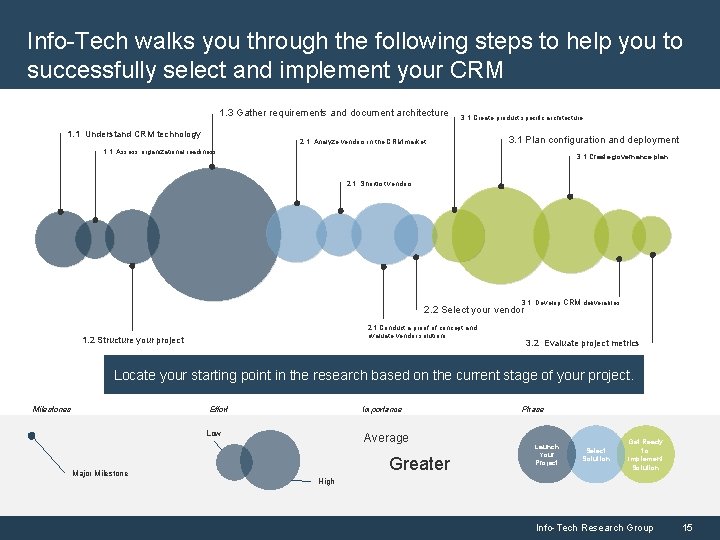
Info-Tech walks you through the following steps to help you to successfully select and implement your CRM 1. 3 Gather requirements and document architecture 1. 1 Understand CRM technology 3. 1 Create product specific architecture 2. 1 Analyze vendors in the CRM market 3. 1 Plan configuration and deployment 1. 1 Assess organizational readiness 3. 1 Create governance plan 2. 1 Shortlist vendors 3. 1 Develop CRM deliverables 2. 2 Select your vendor 2. 1 Conduct a proof of concept and evaluate vendor solutions 1. 2 Structure your project 3. 2 Evaluate project metrics Locate your starting point in the research based on the current stage of your project. Effort Milestones Importance Low Major Milestone Average Greater Phase Launch Your Project Select Solution Get Ready to Implement Solution High Info-Tech Research Group 15
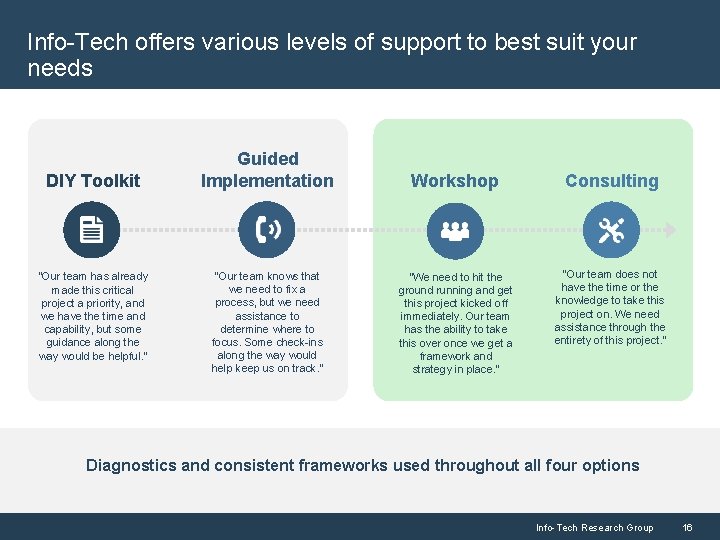
Info-Tech offers various levels of support to best suit your needs DIY Toolkit “Our team has already made this critical project a priority, and we have the time and capability, but some guidance along the way would be helpful. ” Guided Implementation Workshop Consulting “Our team knows that we need to fix a process, but we need assistance to determine where to focus. Some check-ins along the way would help keep us on track. ” “We need to hit the ground running and get this project kicked off immediately. Our team has the ability to take this over once we get a framework and strategy in place. ” “Our team does not have the time or the knowledge to take this project on. We need assistance through the entirety of this project. ” Diagnostics and consistent frameworks used throughout all four options Info-Tech Research Group 16
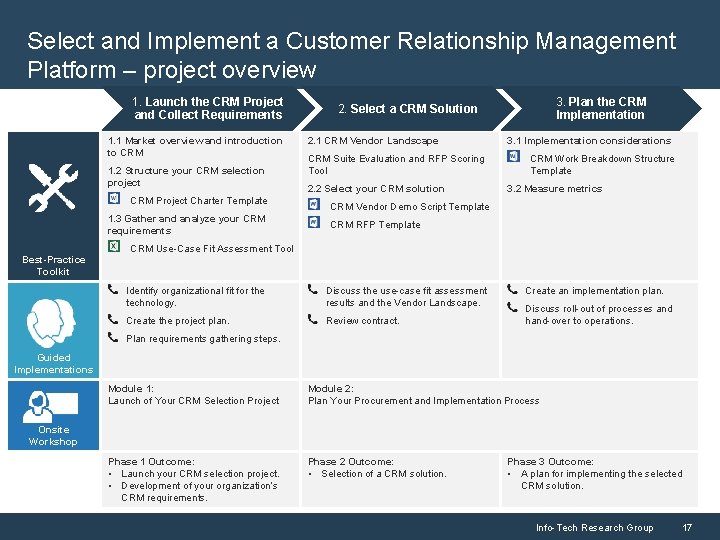
Select and Implement a Customer Relationship Management Platform – project overview 1. Launch the CRM Project and Collect Requirements 1. 1 Market overview and introduction to CRM 1. 2 Structure your CRM selection project CRM Project Charter Template 1. 3 Gather and analyze your CRM requirements Best-Practice Toolkit 3. Plan the CRM Implementation 2. Select a CRM Solution 2. 1 CRM Vendor Landscape CRM Suite Evaluation and RFP Scoring Tool 2. 2 Select your CRM solution 3. 1 Implementation considerations CRM Work Breakdown Structure Template 3. 2 Measure metrics CRM Vendor Demo Script Template CRM RFP Template CRM Use-Case Fit Assessment Tool Identify organizational fit for the technology. Discuss the use-case fit assessment results and the Vendor Landscape. Create the project plan. Review contract. Create an implementation plan. Discuss roll-out of processes and hand-over to operations. Plan requirements gathering steps. Guided Implementations Module 1: Launch of Your CRM Selection Project Module 2: Plan Your Procurement and Implementation Process Phase 1 Outcome: • Launch your CRM selection project. • Development of your organization’s CRM requirements. Phase 2 Outcome: • Selection of a CRM solution. Onsite Workshop Phase 3 Outcome: • A plan for implementing the selected CRM solution. Info-Tech Research Group 17
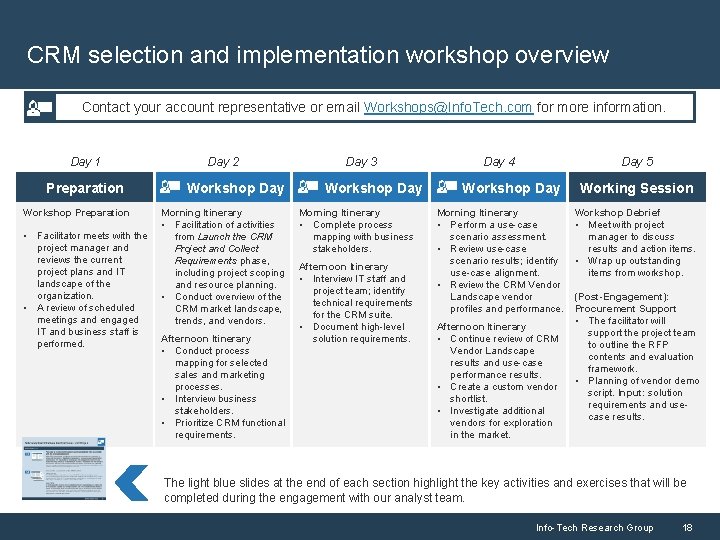
CRM selection and implementation workshop overview Contact your account representative or email Workshops@Info. Tech. com for more information. Day 1 Preparation Workshop Preparation • Facilitator meets with the project manager and reviews the current project plans and IT landscape of the organization. • A review of scheduled meetings and engaged IT and business staff is performed. Day 2 Workshop Day Morning Itinerary • Facilitation of activities from Launch the CRM Project and Collect Requirements phase, including project scoping and resource planning. • Conduct overview of the CRM market landscape, trends, and vendors. Afternoon Itinerary • Conduct process mapping for selected sales and marketing processes. • Interview business stakeholders. • Prioritize CRM functional requirements. Day 3 Workshop Day Morning Itinerary • Complete process mapping with business stakeholders. Afternoon Itinerary • Interview IT staff and project team; identify technical requirements for the CRM suite. • Document high-level solution requirements. Day 4 Day 5 Workshop Day Morning Itinerary • Perform a use-case scenario assessment. • Review use-case scenario results; identify use-case alignment. • Review the CRM Vendor Landscape vendor profiles and performance. Afternoon Itinerary • Continue review of CRM Vendor Landscape results and use-case performance results. • Create a custom vendor shortlist. • Investigate additional vendors for exploration in the market. Working Session Workshop Debrief • Meet with project manager to discuss results and action items. • Wrap up outstanding items from workshop. (Post-Engagement): Procurement Support • The facilitator will support the project team to outline the RFP contents and evaluation framework. • Planning of vendor demo script. Input: solution requirements and usecase results. The light blue slides at the end of each section highlight the key activities and exercises that will be completed during the engagement with our analyst team. Info-Tech Research Group 18
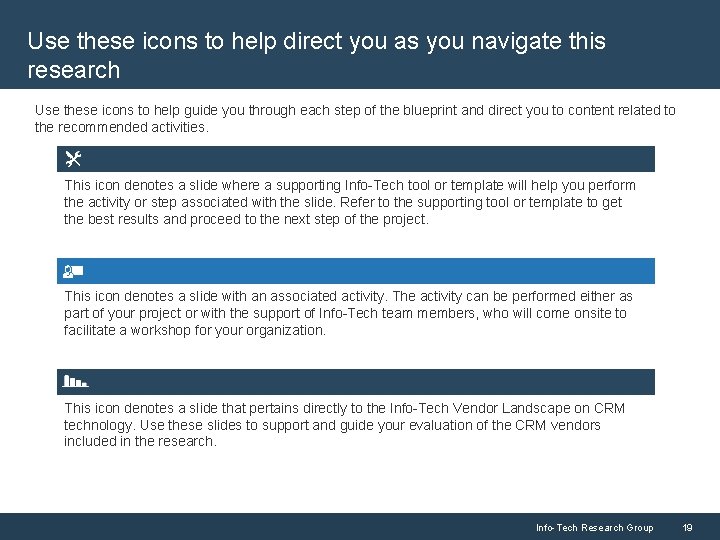
Use these icons to help direct you as you navigate this research Use these icons to help guide you through each step of the blueprint and direct you to content related to the recommended activities. This icon denotes a slide where a supporting Info-Tech tool or template will help you perform the activity or step associated with the slide. Refer to the supporting tool or template to get the best results and proceed to the next step of the project. This icon denotes a slide with an associated activity. The activity can be performed either as part of your project or with the support of Info-Tech team members, who will come onsite to facilitate a workshop for your organization. This icon denotes a slide that pertains directly to the Info-Tech Vendor Landscape on CRM technology. Use these slides to support and guide your evaluation of the CRM vendors included in the research. Info-Tech Research Group 19