
SEL PQA Basics Crash Course TRAINER Location Date
SEL PQA Basics Crash Course TRAINER/ Location/ Date TRAINER/ LOCATION/ DATE
About the Forum The Forum for Youth Investment provides products and services to help leaders improve partnerships, policies and practices to change the odds so all young people are ready for college, work and life. These products and services are based on best practices in youth development and on our experience working with hundreds of communities around the country since our founding in 1998. About the Forum’s Weikart Center David P. Weikart Center for Youth Program Quality is a leader in empowering education and human service leaders to adapt, implement and scale best-inclass, research-validated quality improvement systems to advance child and youth development. Training and technical assistance in quality improvement system design, effective performance data and lower stakes accountability has helped OST networks across the country be successful, scale-able and sustainable. The Weikart Center is a critical part of the Forum for Youth Investment’s overall effort to build leadership capacity to advance readiness and equity. David P. Weikart Center for Youth Program Quality · SEL PQA BASICS
Welcome Group Agreements Learning is social—we will be learning from one another as a community. Learning is emotional—we honor the emotions that we bring into this space as we engage in learning. Learning is cognitive—we focus our attention and fully engage our minds. In varying ways, background experiences, bias, racism, geography, age, cultural backgrounds, age, gender, etc. , affect our learning experiences today. What other group agreements do we want to make? David P. Weikart Center for Youth Program Quality · SEL PQA BASICS
Agenda Goals • Welcome Team members will: • Introduction to the SEL Program Quality Assessment Understand the team based, non-punitive nature of self assessment. • Card Sort Have a working understanding of the SEL PQA instrument) and what it measures. • Observation and Note Taking • Planning for Data • Collection and Scoring • Closing Reflection Grasp the importance of objective observations to drive scoring decisions. David P. Weikart Center for Youth Program Quality · SEL PQA BASICS
SEL Defined Social and emotional learning (SEL) is the process through which children and adults understand manage emotions, set and achieve positive goals, feel and show empathy for others, establish and maintain positive relationships, and make responsible decisions. CASEL

Long Time Research Consensus About What Youth Need— Physical and psychological safety Appropriate structure Supportive relationships Opportunities to belong Positive social norms Support for efficacy and mattering Opportunities for skill-building Integration of family, school and community efforts - Community Programs to Promote Youth Development, 2002 - National Research Council and Institute for Medicine David P. Weikart Center for Youth Program Quality · SEL PQA BASICS
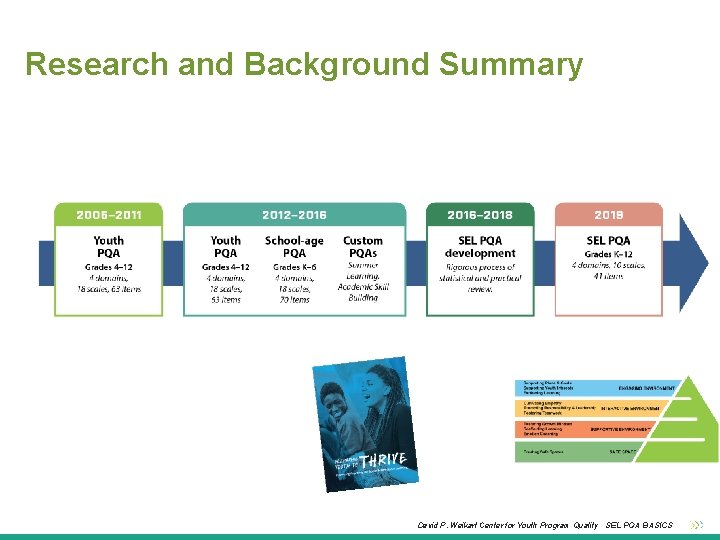
Research and Background Summary David P. Weikart Center for Youth Program Quality · SEL PQA BASICS

SEL Pyramid of Program Quality • Measures staff practices • Can be used for self (internal) or external assessment • Is based on observation (watch, write objective notes and score tool using notes David P. Weikart Center for Youth Program Quality · SEL PQA BASICS
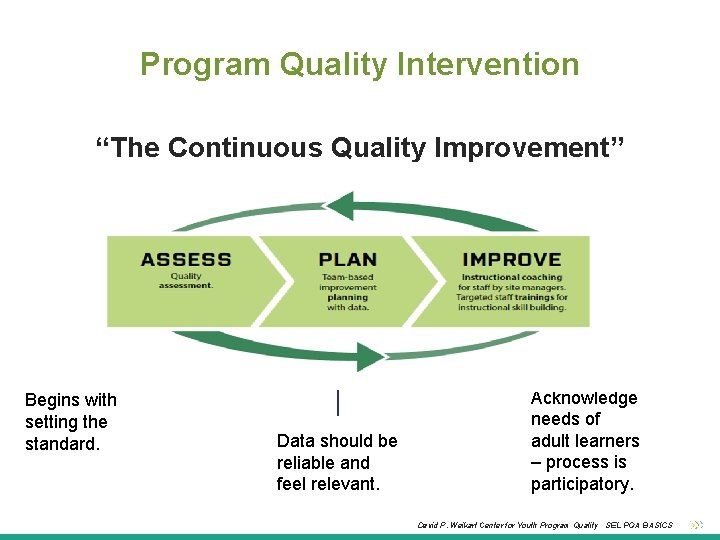
Program Quality Intervention “The Continuous Quality Improvement” Begins with setting the standard. Data should be reliable and feel relevant. Acknowledge needs of adult learners – process is participatory. David P. Weikart Center for Youth Program Quality · SEL PQA BASICS
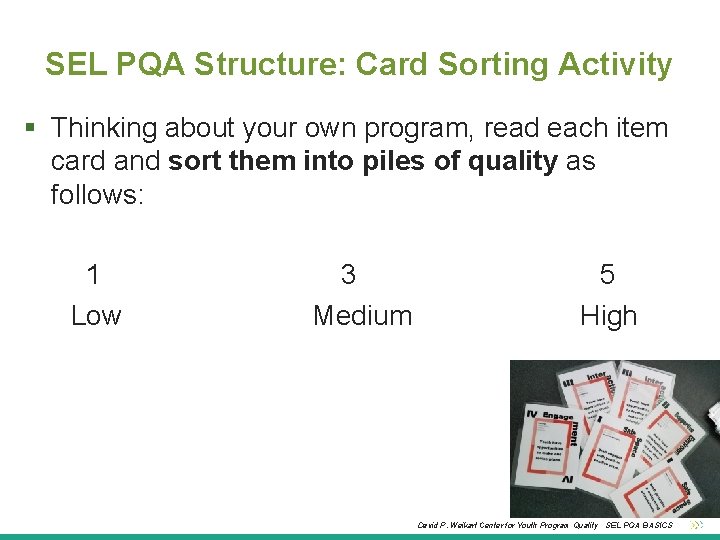
SEL PQA Structure: Card Sorting Activity Thinking about your own program, read each item card and sort them into piles of quality as follows: 1 Low 3 Medium 5 High David P. Weikart Center for Youth Program Quality · SEL PQA BASICS
Reflection • How did it feel to self- assess this way? • How did you know how to rate each card? • Were you surprised by any of the scores? • Did you disagree with any of the scores? • What were the limitations of this process? David P. Weikart Center for Youth Program Quality · SEL PQA BASICS
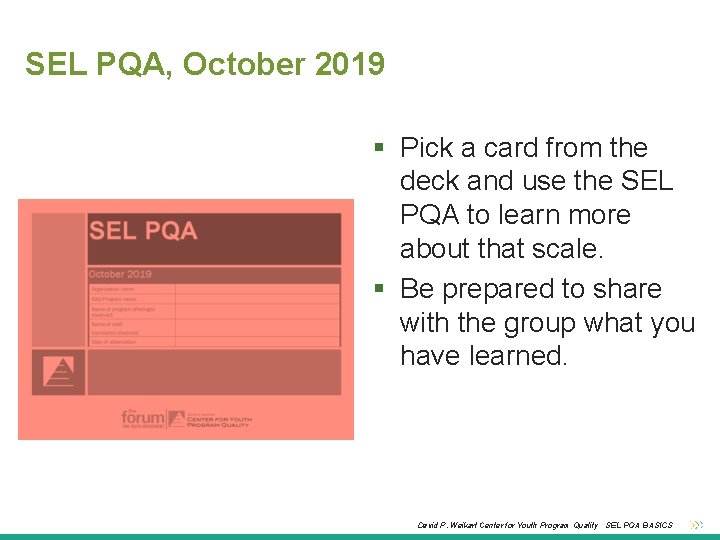
SEL PQA, October 2019 Pick a card from the deck and use the SEL PQA to learn more about that scale. Be prepared to share with the group what you have learned. David P. Weikart Center for Youth Program Quality · SEL PQA BASICS
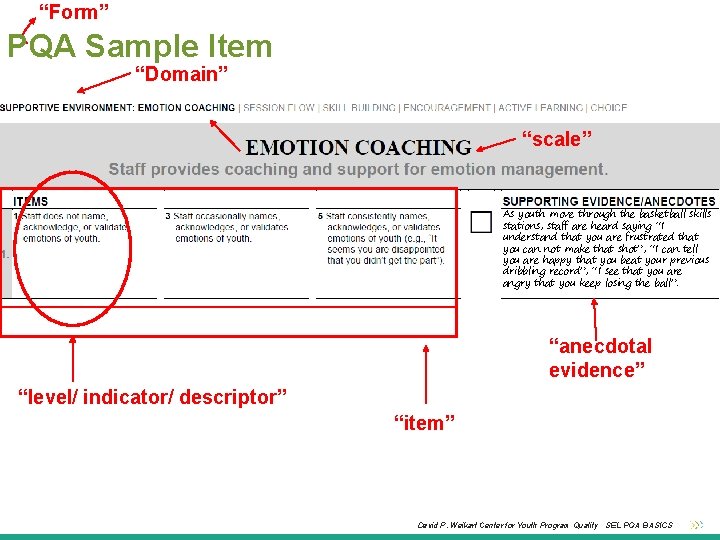
“Form” PQA Sample Item “Domain” “scale” As youth move through the basketball skills stations, staff are heard saying “I understand that you are frustrated that you can not make that shot”, “I can tell you are happy that you beat your previous dribbling record”, “I see that you are angry that you keep losing the ball”. “anecdotal evidence” “level/ indicator/ descriptor” “item” David P. Weikart Center for Youth Program Quality · SEL PQA BASICS

David P. Weikart Center for Youth Program Quality · SEL PQA BASICS
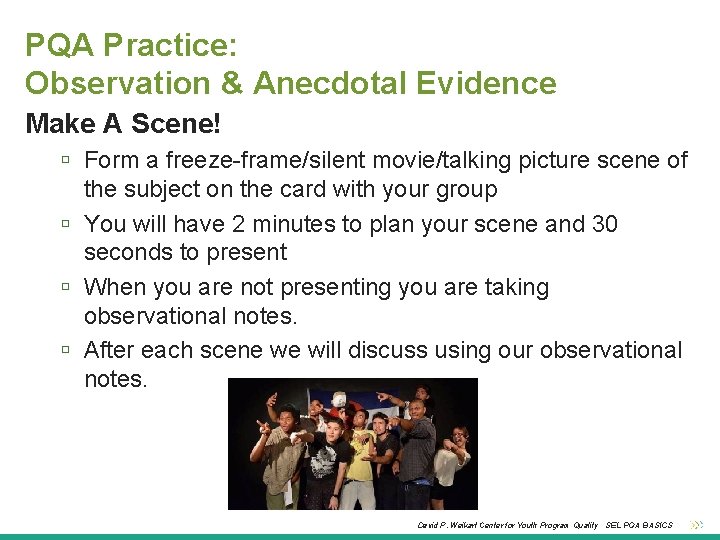
PQA Practice: Observation & Anecdotal Evidence Make A Scene! Form a freeze-frame/silent movie/talking picture scene of the subject on the card with your group You will have 2 minutes to plan your scene and 30 seconds to present When you are not presenting you are taking observational notes. After each scene we will discuss using our observational notes. David P. Weikart Center for Youth Program Quality · SEL PQA BASICS
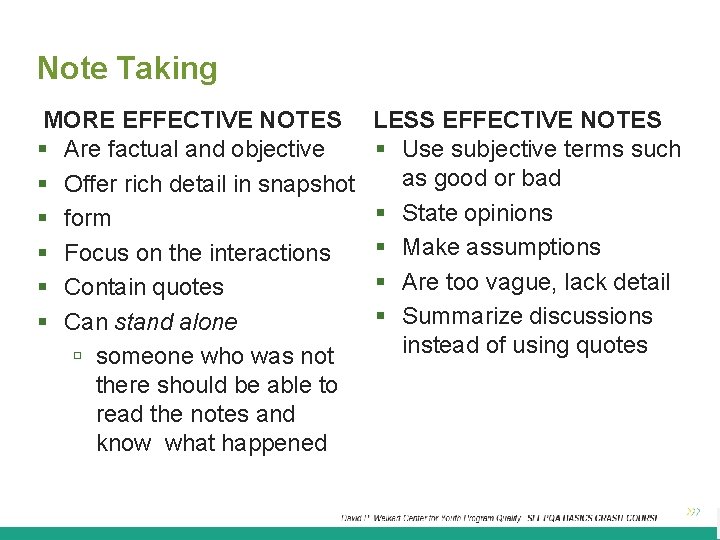
Note Taking MORE EFFECTIVE NOTES Are factual and objective Offer rich detail in snapshot form Focus on the interactions Contain quotes Can stand alone someone who was not there should be able to read the notes and know what happened LESS EFFECTIVE NOTES Use subjective terms such as good or bad State opinions Make assumptions Are too vague, lack detail Summarize discussions instead of using quotes David P. Weikart Center for Youth Program Quality · SEL PQA BASICS
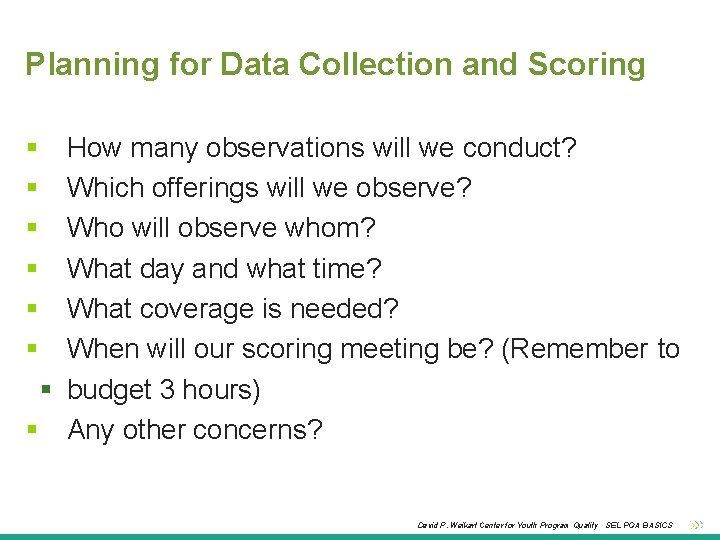
Planning for Data Collection and Scoring How many observations will we conduct? Which offerings will we observe? Who will observe whom? What day and what time? What coverage is needed? When will our scoring meeting be? (Remember to budget 3 hours) Any other concerns? David P. Weikart Center for Youth Program Quality · SEL PQA BASICS
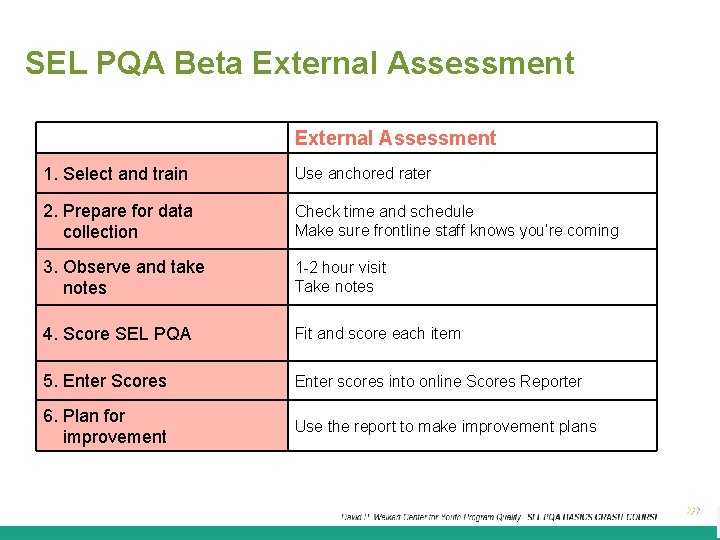
SEL PQA Beta External Assessment 1. Select and train Use anchored rater 2. Prepare for data collection Check time and schedule Make sure frontline staff knows you’re coming 3. Observe and take notes 1 -2 hour visit Take notes 4. Score SEL PQA Fit and score each item 5. Enter Scores Enter scores into online Scores Reporter 6. Plan for improvement Use the report to make improvement plans David P. Weikart Center for Youth Program Quality · SEL PQA BASICS
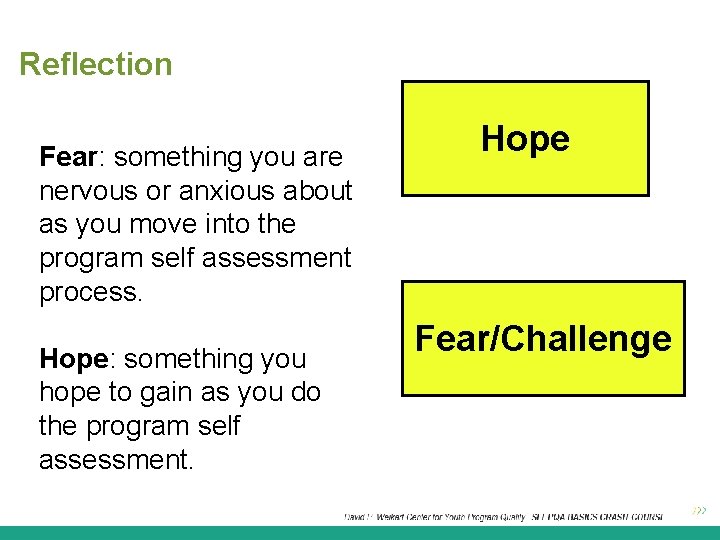
Reflection Fear: something you are nervous or anxious about as you move into the program self assessment process. Hope: something you hope to gain as you do the program self assessment. Hope Fear/Challenge David P. Weikart Center for Youth Program Quality · SEL PQA BASICS
- Slides: 19