
Seizures in Childhood Neurology Chapter of IAP Reference





- Slides: 26
Seizures in Childhood Neurology Chapter of IAP
Reference • Paediatrics & Child health Coovadia and Wittenberg p. 477 -483 • Lecture on AED Neurology Chapter of IAP
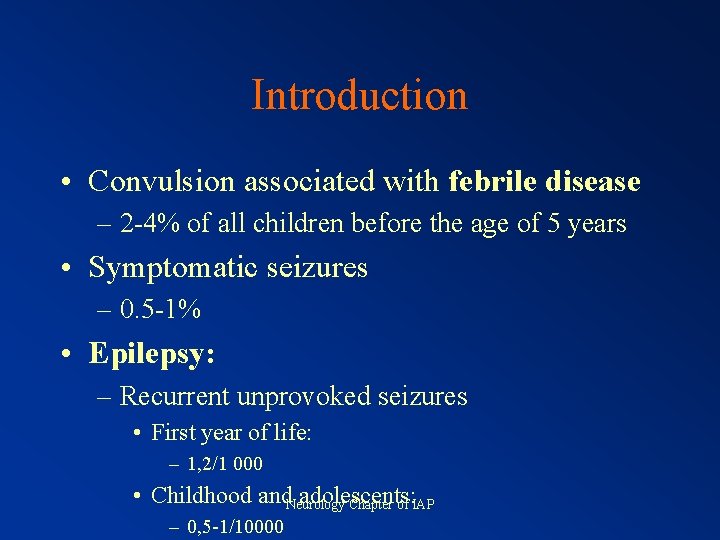
Introduction • Convulsion associated with febrile disease – 2 -4% of all children before the age of 5 years • Symptomatic seizures – 0. 5 -1% • Epilepsy: – Recurrent unprovoked seizures • First year of life: – 1, 2/1 000 • Childhood and. Neurology adolescents: Chapter of IAP – 0, 5 -1/10000
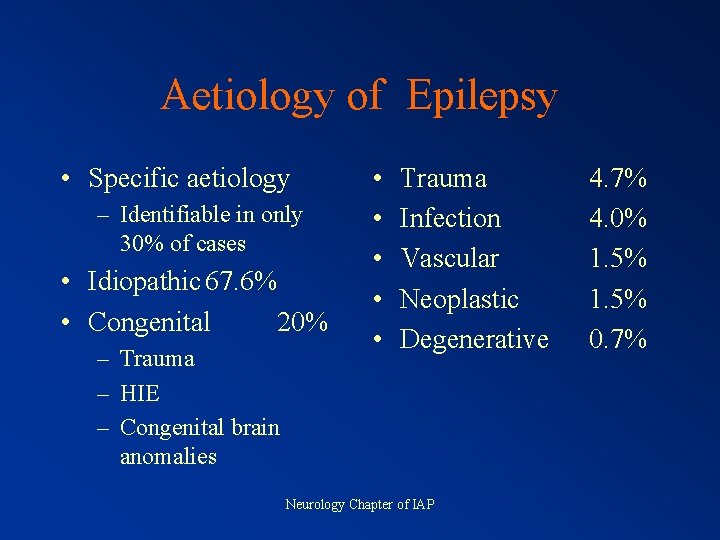
Aetiology of Epilepsy • Specific aetiology – Identifiable in only 30% of cases • Idiopathic 67. 6% • Congenital 20% – Trauma – HIE – Congenital brain anomalies • • • Trauma Infection Vascular Neoplastic Degenerative Neurology Chapter of IAP 4. 7% 4. 0% 1. 5% 0. 7%
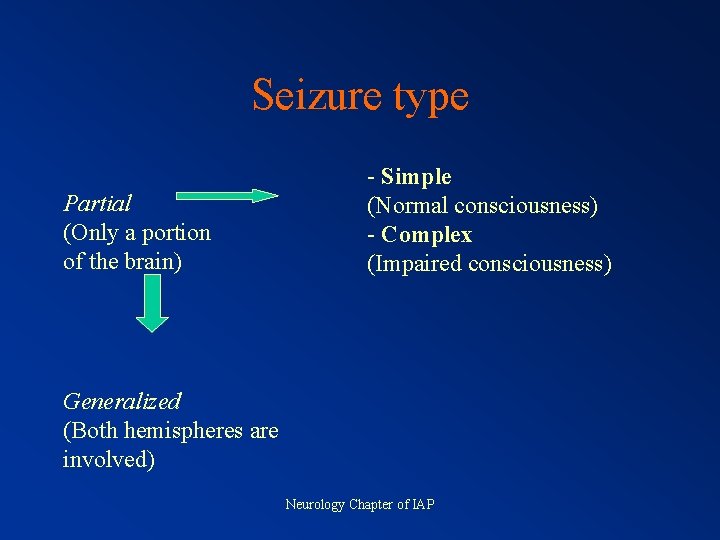
Seizure type Partial (Only a portion of the brain) - Simple (Normal consciousness) - Complex (Impaired consciousness) Generalized (Both hemispheres are involved) Neurology Chapter of IAP
Epilepsy classification • Clinical presentation is quite variable – age of onset – seizure type – interictal condition – EEG – Outcome • Evaluate the: – the epileptic syndrome – Possible aetiology • The seizure type and syndrome type determine the – Specific appropriate treatment – Further evaluation Neurology Chapter of IAP
Neurology Chapter of IAP
Neurology Chapter of IAP
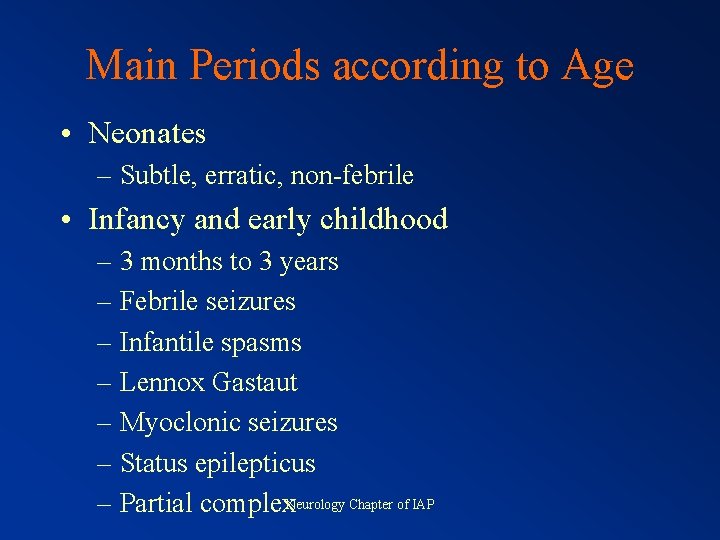
Main Periods according to Age • Neonates – Subtle, erratic, non-febrile • Infancy and early childhood – 3 months to 3 years – Febrile seizures – Infantile spasms – Lennox Gastaut – Myoclonic seizures – Status epilepticus – Partial complex. Neurology Chapter of IAP
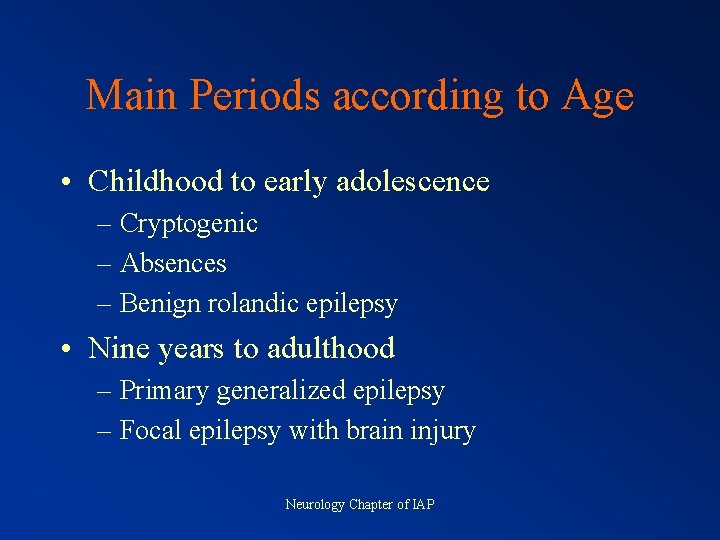
Main Periods according to Age • Childhood to early adolescence – Cryptogenic – Absences – Benign rolandic epilepsy • Nine years to adulthood – Primary generalized epilepsy – Focal epilepsy with brain injury Neurology Chapter of IAP
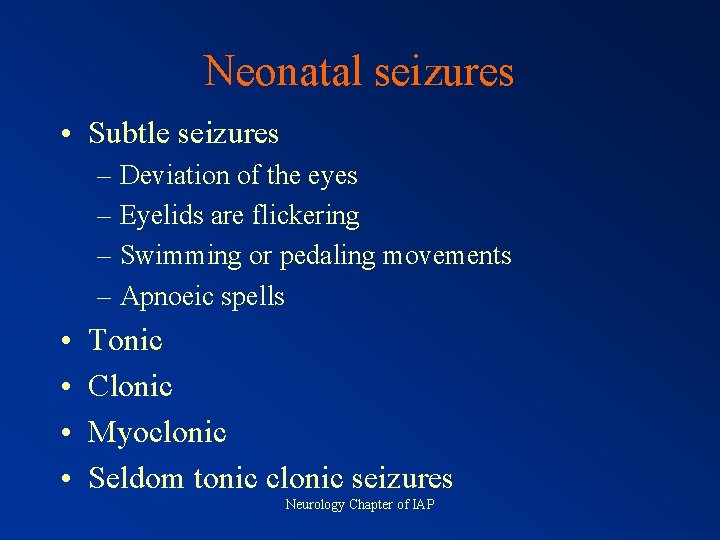
Neonatal seizures • Subtle seizures – Deviation of the eyes – Eyelids are flickering – Swimming or pedaling movements – Apnoeic spells • • Tonic Clonic Myoclonic Seldom tonic clonic seizures Neurology Chapter of IAP
Aetiology of neonatal seizures • Perinatal: • Infections • Structural abnormalities • Drug withdrawal – HIE – ICH • Metabolic – Hypoglycemia, hypocalcemia – hypomagnesemia – Other Neurology Chapter of IAP
Treatment of neonatal seizures • Optimize ventilation, cardiac output, BP, glucose, electrolytes and p. H. • Treat the underlying disease • Intravenous line is essential • Treat the seizures promptly and vigorously • Phenobarbitone • Phenytoin Neurology Chapter of IAP
Non-epileptic paroxysmal events in childhood • Syncope • Breath-holding spells – Pallid: Vagal asystole – Cyanotic: Cerebra ischaemia due to a sudden rise in the intra-thoracic pressure impeding the venous return to the heart • Night terrors • Nightmares • Masturbation • Cardiac disorders Neurology Chapter of IAP
Non-epileptic paroxysmal events in childhood • Complicated migraine • Movement disorders • Jitteriness – Absence of abnormal gaze movements – Provoked by passive flexion or extension – Seizure jerks tend to be 2 -3 Hz, clonus or jitteriness tend to be 5 -6 Hz – Normal EEG of IAP – No increase in Neurology blood. Chapter pressure or heart rate
Febrile seizures • Definition: – Seizure in children between the age of 6 months and 3 -4(5) years in association with fever but without evidence of an intracranial infection • Majority occurs before the age of 3 years • Average of onset: 18 months to 22 months • Boys more than girls Neurology Chapter of IAP
Febrile seizures • Recurrence – 1/3 may have at least one recurrence – The younger the age of onset the greater the risk of recurrence • Risk of developing epilepsy – 2% – Risk increases with: • Complex • Abnormal neurological state Chapter of IAP • Mesial temporal. Neurology sclerosis
Management of febrile seizures • Identify the underlying disease – LP? • CT or MRI is not warranted in the evaluation of febrile convulsions • Routine EEG is seldom necessary • Treatment: – Long-term use of AED is not indicated • Phenobarbitone • Sodium valproate – Rectal diazepam – Antipyretics Neurology Chapter of IAP
Treatment of Epilepsy – Drug treatment should be regular – Simple as possible – Minimum of side effects – Monotherapy – Changes should be made gradually – High initial dosages increases side effects – Rapid withdrawal carries the risk of provoking status – Always calculate the dosage according to the weight Neurology Chapter of IAP
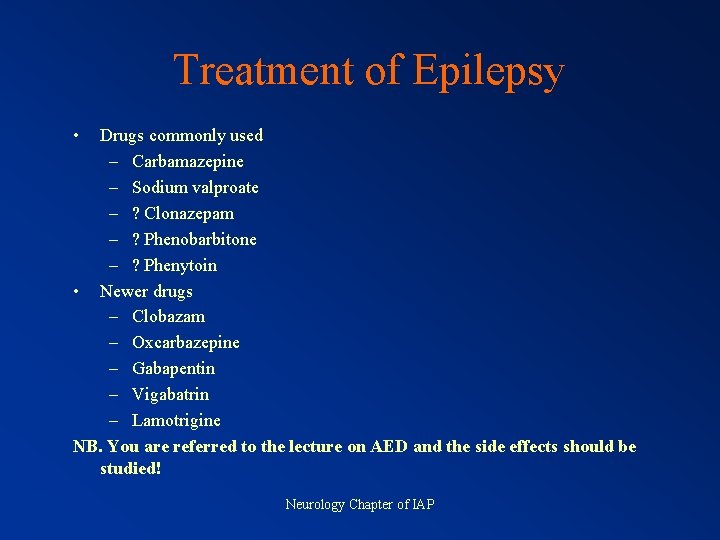
Treatment of Epilepsy • Drugs commonly used – Carbamazepine – Sodium valproate – ? Clonazepam – ? Phenobarbitone – ? Phenytoin • Newer drugs – Clobazam – Oxcarbazepine – Gabapentin – Vigabatrin – Lamotrigine NB. You are referred to the lecture on AED and the side effects should be studied! Neurology Chapter of IAP
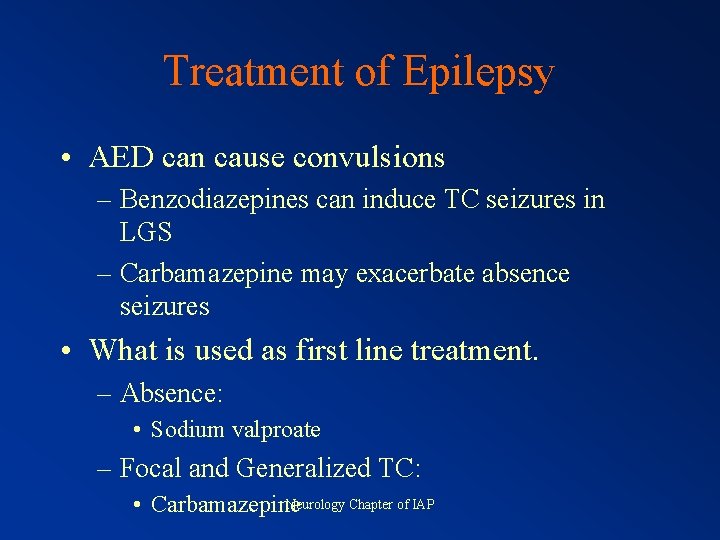
Treatment of Epilepsy • AED can cause convulsions – Benzodiazepines can induce TC seizures in LGS – Carbamazepine may exacerbate absence seizures • What is used as first line treatment. – Absence: • Sodium valproate – Focal and Generalized TC: Neurology Chapter of IAP • Carbamazepine
Neurology Chapter of IAP
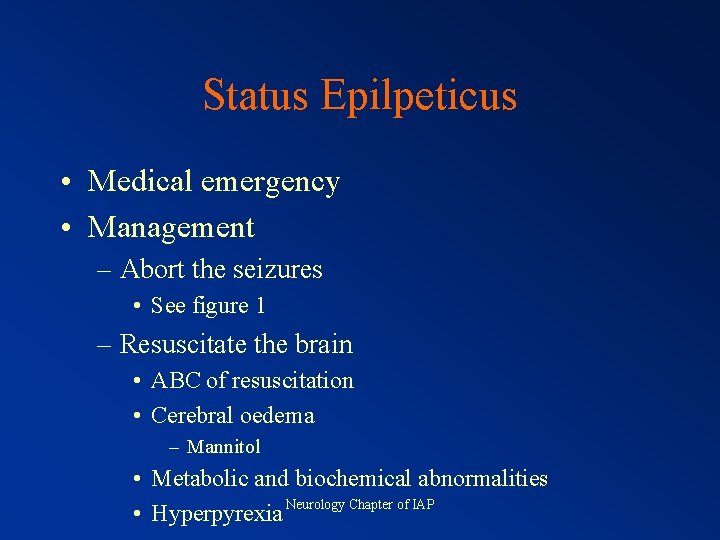
Status Epilpeticus • Medical emergency • Management – Abort the seizures • See figure 1 – Resuscitate the brain • ABC of resuscitation • Cerebral oedema – Mannitol • Metabolic and biochemical abnormalities • Hyperpyrexia Neurology Chapter of IAP
Neurology Chapter of IAP
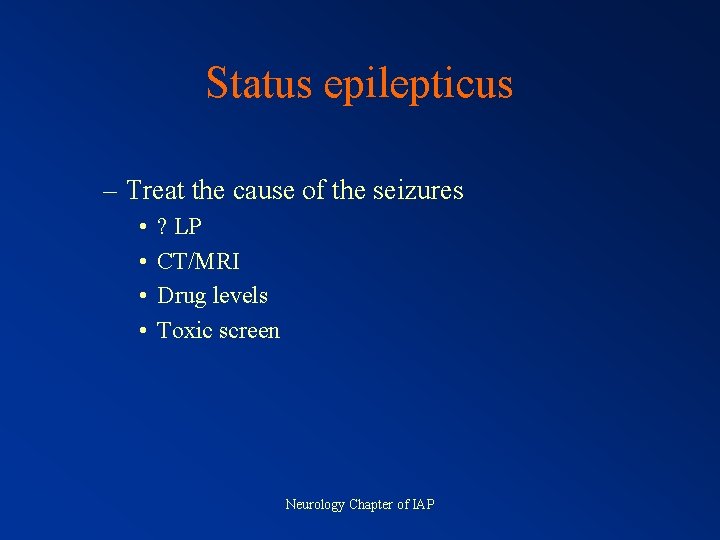
Status epilepticus – Treat the cause of the seizures • • ? LP CT/MRI Drug levels Toxic screen Neurology Chapter of IAP
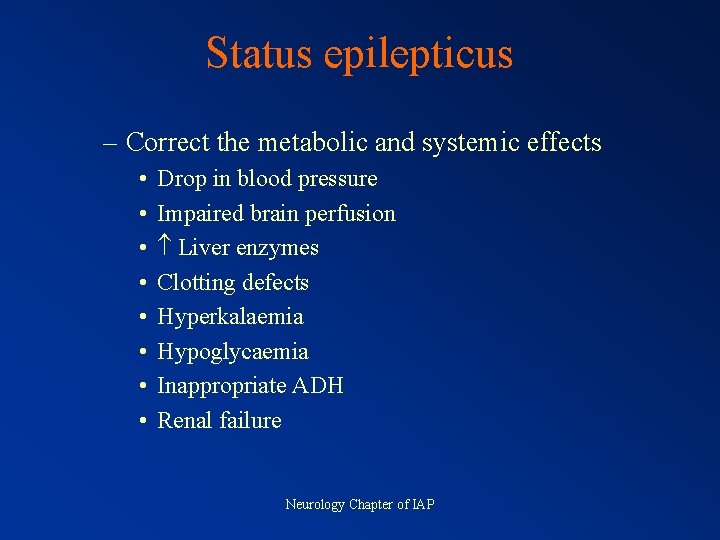
Status epilepticus – Correct the metabolic and systemic effects • • Drop in blood pressure Impaired brain perfusion Liver enzymes Clotting defects Hyperkalaemia Hypoglycaemia Inappropriate ADH Renal failure Neurology Chapter of IAP