
Seismogram Interpretation Travel times in the Earth Ray
- Slides: 52
Seismogram Interpretation • Travel times in the Earth • Ray paths, phases and their name • Wavefields in the Earth: SH waves, P-SV waves • Seismic Tomography • Receiver Functions Seismology and the Earth’s Deep Interior Seismogram Interpretation
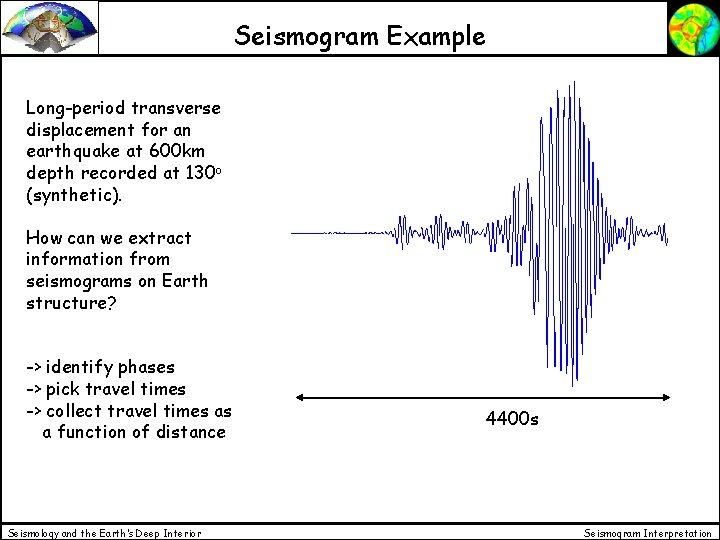
Seismogram Example Long-period transverse displacement for an earthquake at 600 km depth recorded at 130 o (synthetic). How can we extract information from seismograms on Earth structure? -> identify phases -> pick travel times -> collect travel times as a function of distance Seismology and the Earth’s Deep Interior 4400 s Seismogram Interpretation
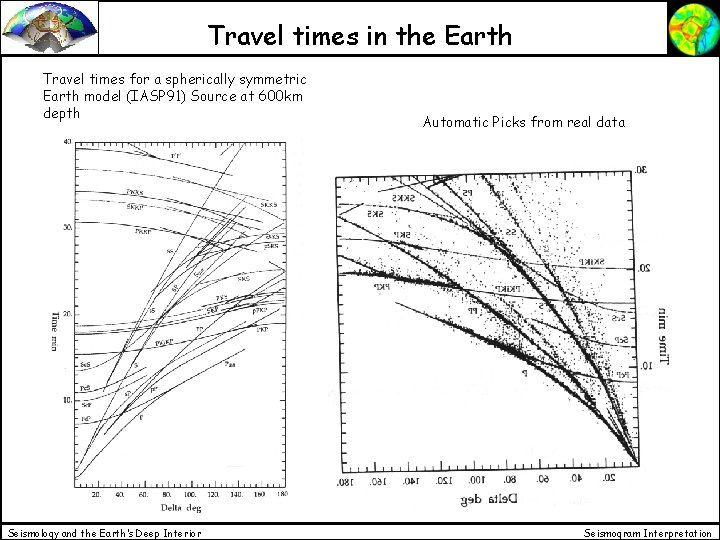
Travel times in the Earth Travel times for a spherically symmetric Earth model (IASP 91) Source at 600 km depth Seismology and the Earth’s Deep Interior Automatic Picks from real data Seismogram Interpretation
History of Travel-Times • Harrold Jeffreys and Keith Bullen (1940), (J-B) Remarkable accuracy for teleseismic travel times (below 1%)! • Herrin et al. (1968), with well located earthquakes. • Dziewonski and Anderson (1981), Preliminary Reference Earth Model (PREM) • Kennett and Engdahl (1991), most accurate radially symmetric model (iasp 91) • (2000), The first 3 -D reference model with travel times? Seismology and the Earth’s Deep Interior Seismogram Interpretation
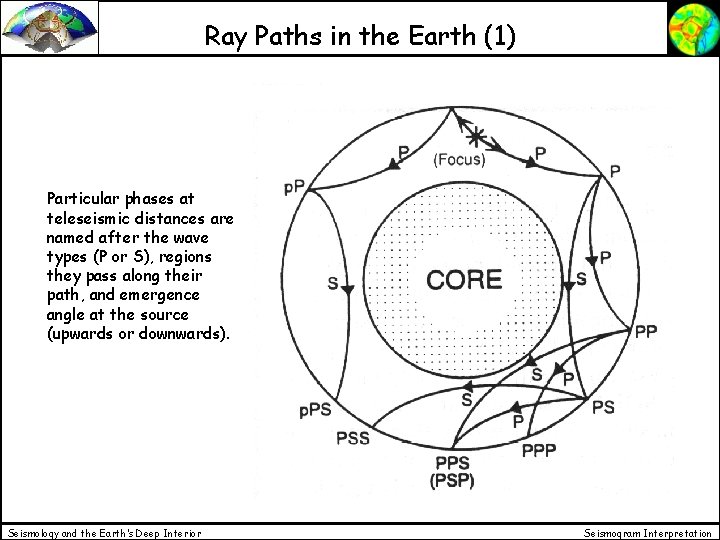
Ray Paths in the Earth (1) Particular phases at teleseismic distances are named after the wave types (P or S), regions they pass along their path, and emergence angle at the source (upwards or downwards). Seismology and the Earth’s Deep Interior Seismogram Interpretation
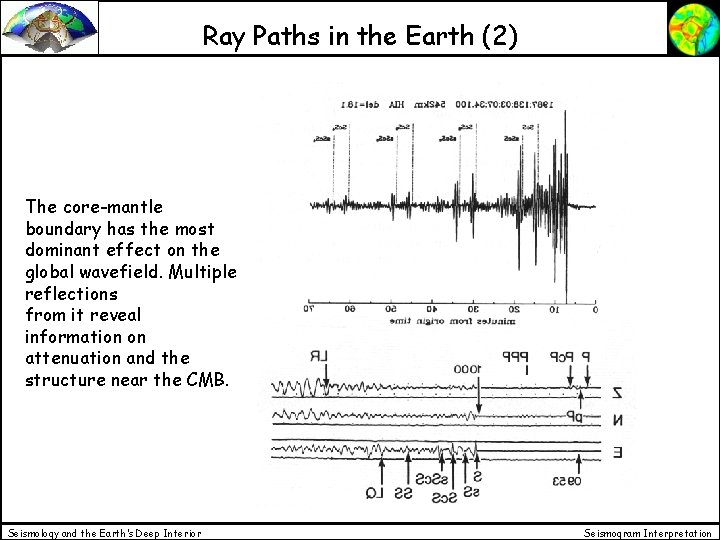
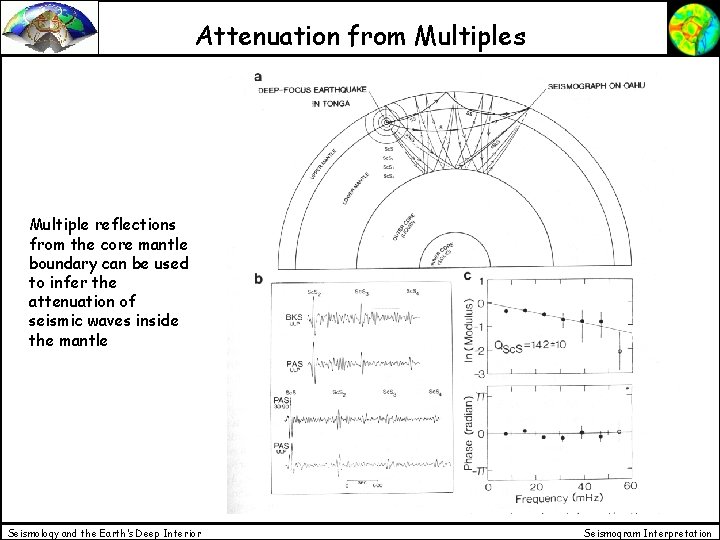
Ray Paths in the Earth (2) The core-mantle boundary has the most dominant effect on the global wavefield. Multiple reflections from it reveal information on attenuation and the structure near the CMB. Seismology and the Earth’s Deep Interior Seismogram Interpretation
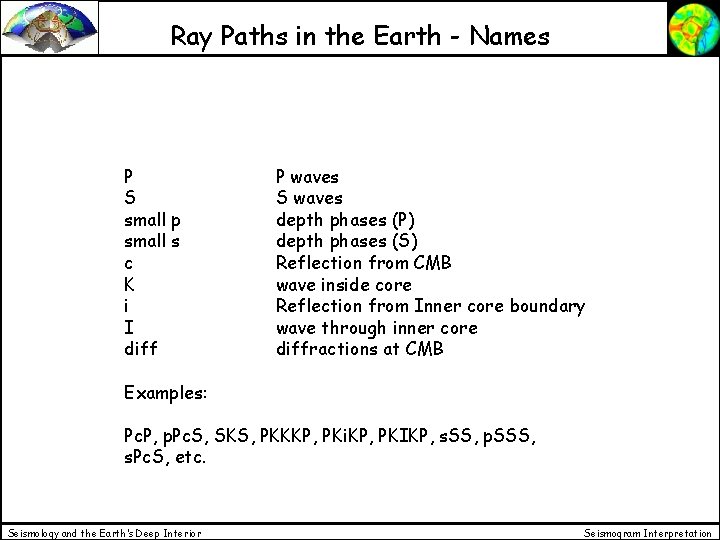
Ray Paths in the Earth - Names P S small p small s c K i I diff P waves S waves depth phases (P) depth phases (S) Reflection from CMB wave inside core Reflection from Inner core boundary wave through inner core diffractions at CMB Examples: Pc. P, p. Pc. S, SKS, PKKKP, PKi. KP, PKIKP, s. SS, p. SSS, s. Pc. S, etc. Seismology and the Earth’s Deep Interior Seismogram Interpretation
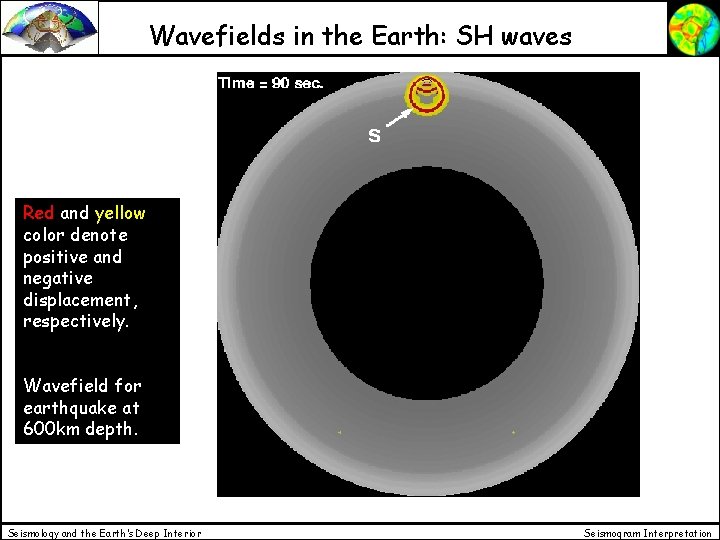
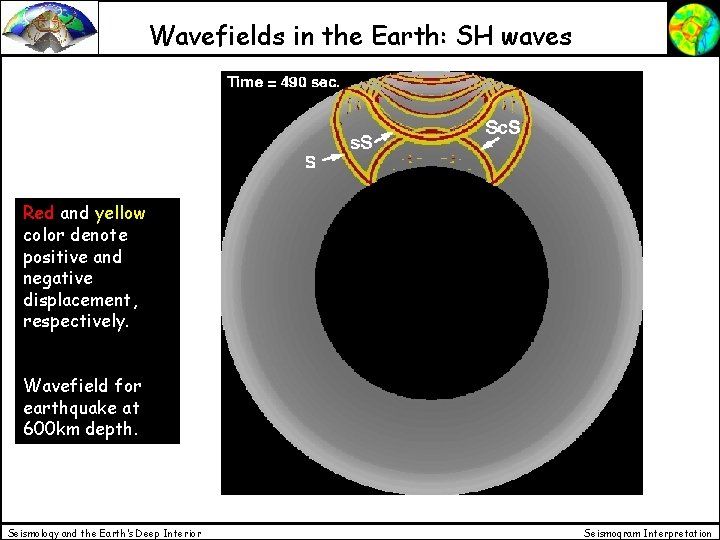
Wavefields in the Earth: SH waves Red and yellow color denote positive and negative displacement, respectively. Wavefield for earthquake at 600 km depth. Seismology and the Earth’s Deep Interior Seismogram Interpretation
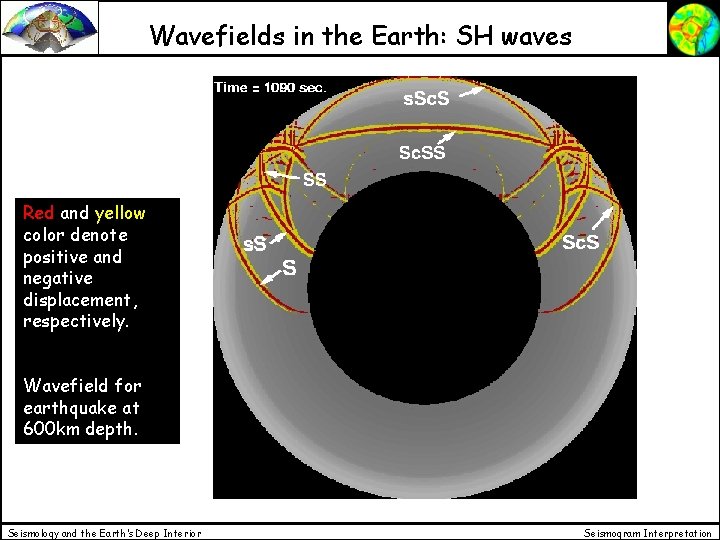
Wavefields in the Earth: SH waves Red and yellow color denote positive and negative displacement, respectively. Wavefield for earthquake at 600 km depth. Seismology and the Earth’s Deep Interior Seismogram Interpretation
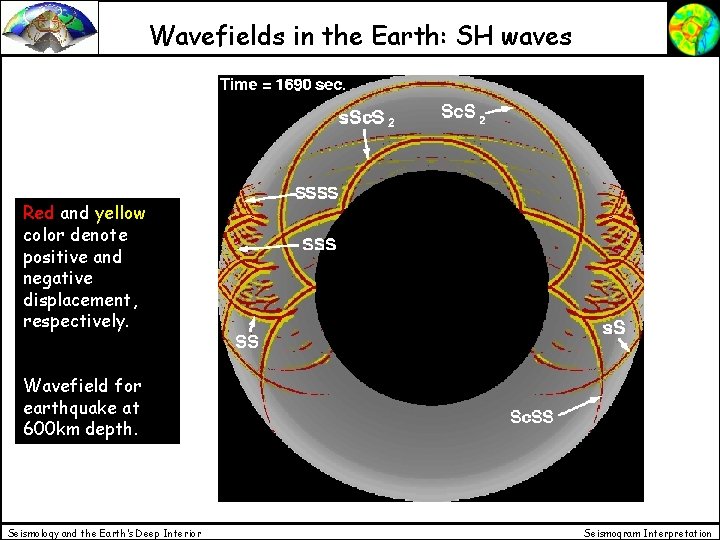
Wavefields in the Earth: SH waves Red and yellow color denote positive and negative displacement, respectively. Wavefield for earthquake at 600 km depth. Seismology and the Earth’s Deep Interior Seismogram Interpretation
Wavefields in the Earth: SH waves Red and yellow color denote positive and negative displacement, respectively. Wavefield for earthquake at 600 km depth. Seismology and the Earth’s Deep Interior Seismogram Interpretation
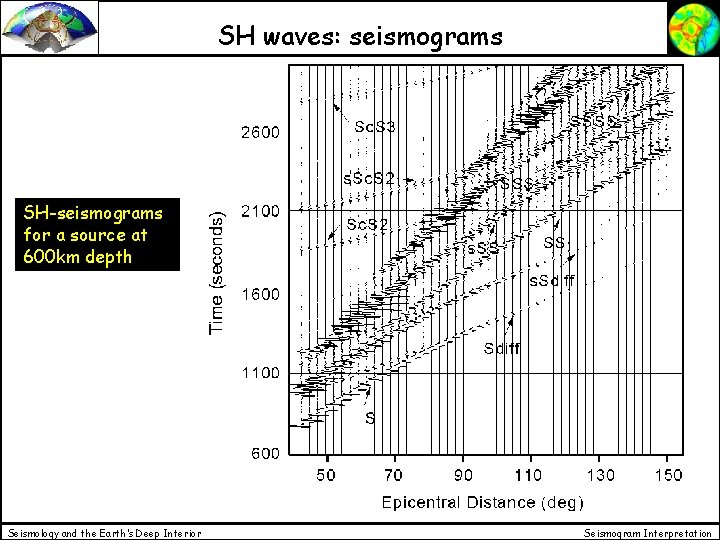
SH waves: seismograms SH-seismograms for a source at 600 km depth Seismology and the Earth’s Deep Interior Seismogram Interpretation
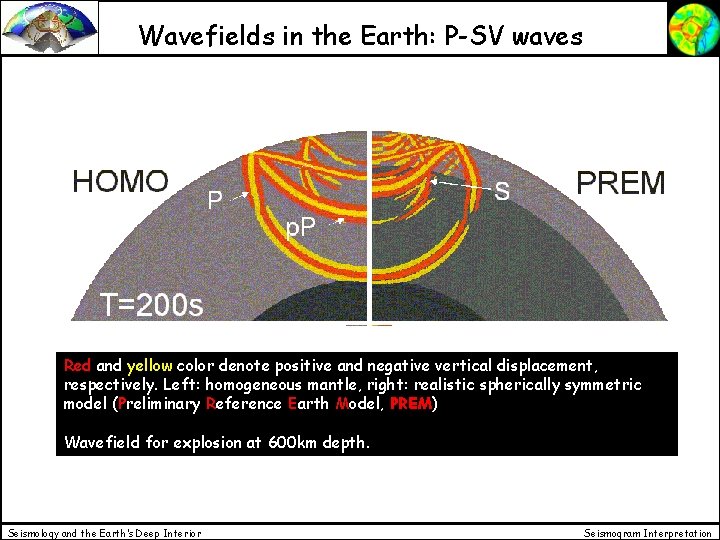
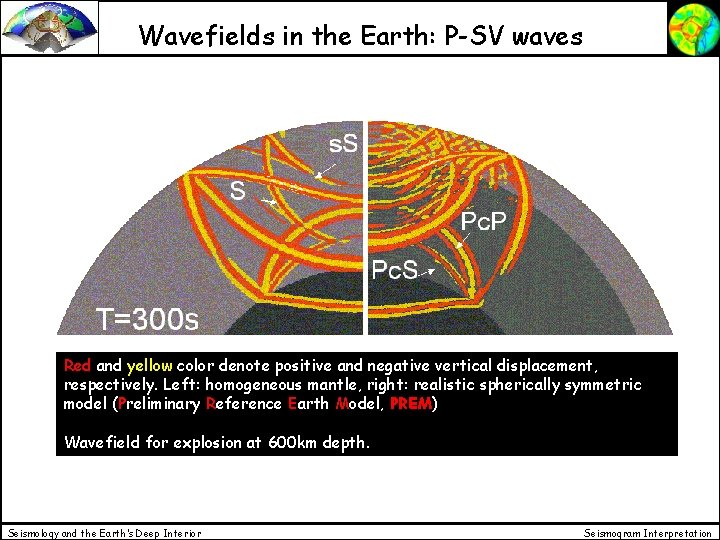
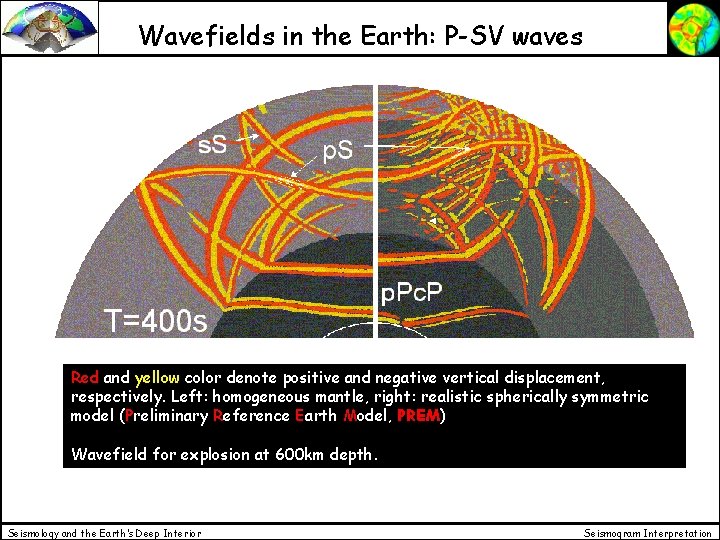
Wavefields in the Earth: P-SV waves Red and yellow color denote positive and negative vertical displacement, respectively. Left: homogeneous mantle, right: realistic spherically symmetric model (Preliminary Reference Earth Model, PREM) Wavefield for explosion at 600 km depth. Seismology and the Earth’s Deep Interior Seismogram Interpretation
Wavefields in the Earth: P-SV waves Red and yellow color denote positive and negative vertical displacement, respectively. Left: homogeneous mantle, right: realistic spherically symmetric model (Preliminary Reference Earth Model, PREM) Wavefield for explosion at 600 km depth. Seismology and the Earth’s Deep Interior Seismogram Interpretation
Wavefields in the Earth: P-SV waves Red and yellow color denote positive and negative vertical displacement, respectively. Left: homogeneous mantle, right: realistic spherically symmetric model (Preliminary Reference Earth Model, PREM) Wavefield for explosion at 600 km depth. Seismology and the Earth’s Deep Interior Seismogram Interpretation
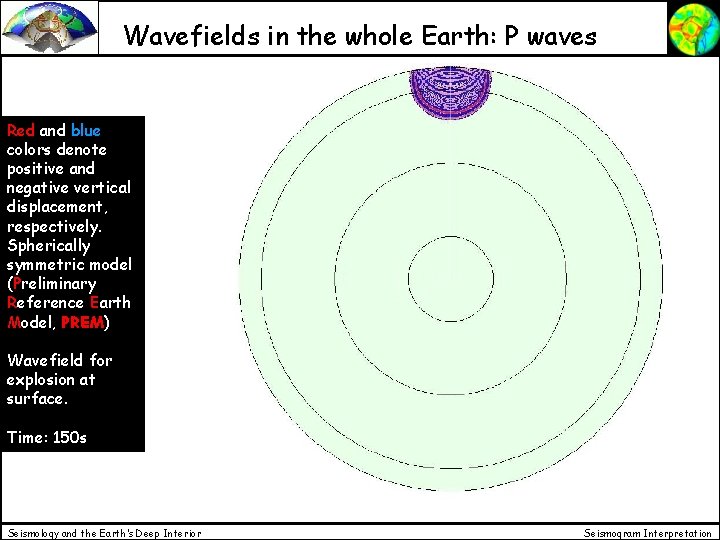
Wavefields in the whole Earth: P waves Red and blue colors denote positive and negative vertical displacement, respectively. Spherically symmetric model (Preliminary Reference Earth Model, PREM) Wavefield for explosion at surface. Time: 150 s Seismology and the Earth’s Deep Interior Seismogram Interpretation
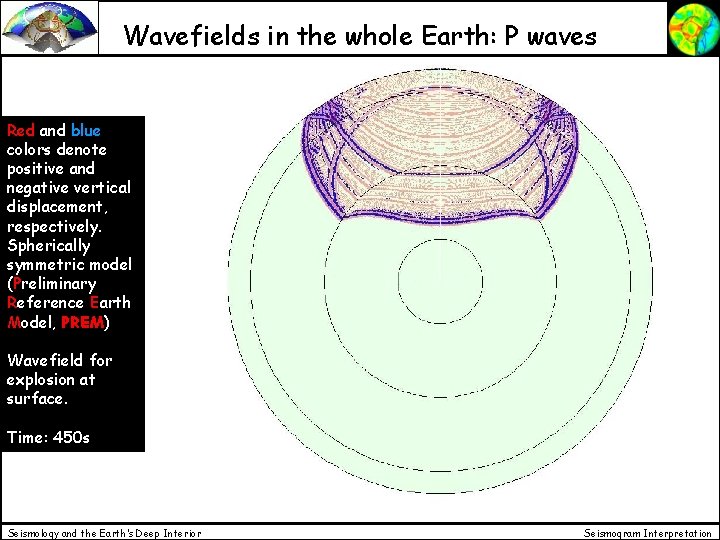
Wavefields in the whole Earth: P waves Red and blue colors denote positive and negative vertical displacement, respectively. Spherically symmetric model (Preliminary Reference Earth Model, PREM) Wavefield for explosion at surface. Time: 450 s Seismology and the Earth’s Deep Interior Seismogram Interpretation
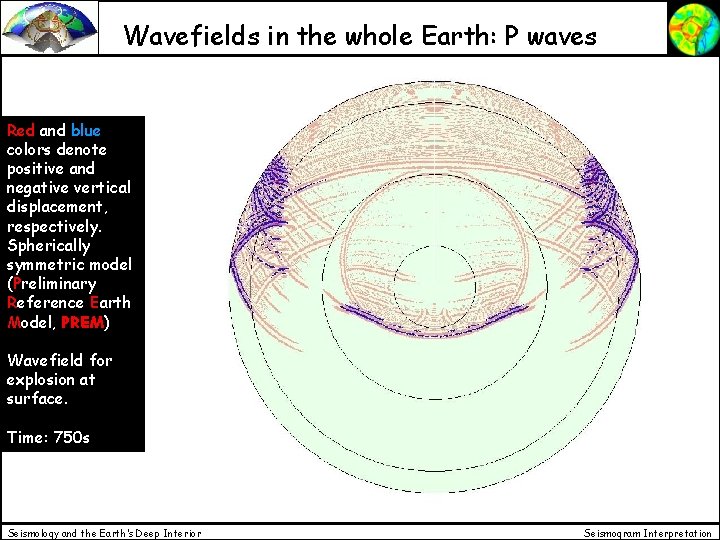
Wavefields in the whole Earth: P waves Red and blue colors denote positive and negative vertical displacement, respectively. Spherically symmetric model (Preliminary Reference Earth Model, PREM) Wavefield for explosion at surface. Time: 750 s Seismology and the Earth’s Deep Interior Seismogram Interpretation
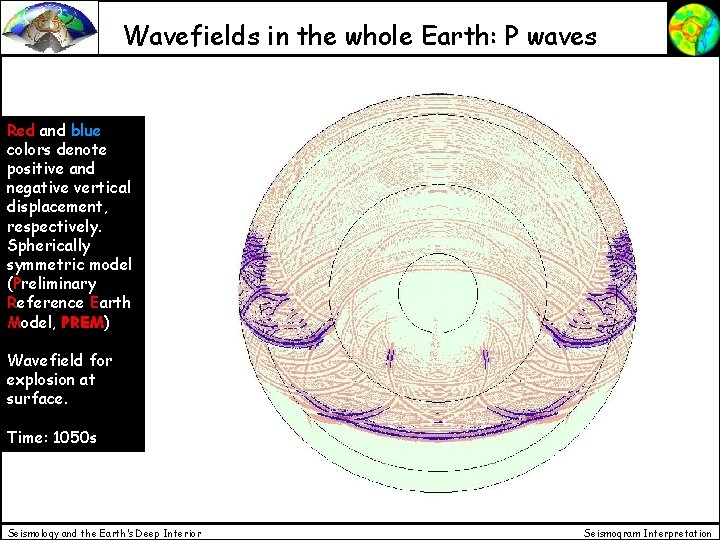
Wavefields in the whole Earth: P waves Red and blue colors denote positive and negative vertical displacement, respectively. Spherically symmetric model (Preliminary Reference Earth Model, PREM) Wavefield for explosion at surface. Time: 1050 s Seismology and the Earth’s Deep Interior Seismogram Interpretation
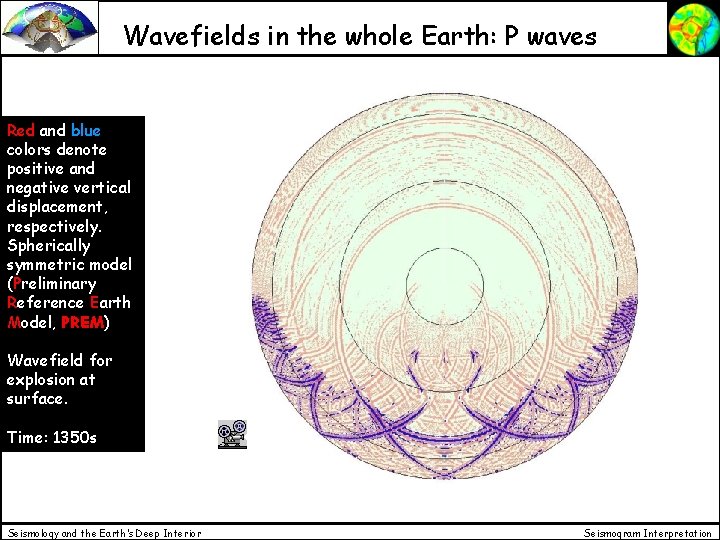
Wavefields in the whole Earth: P waves Red and blue colors denote positive and negative vertical displacement, respectively. Spherically symmetric model (Preliminary Reference Earth Model, PREM) Wavefield for explosion at surface. Time: 1350 s Seismology and the Earth’s Deep Interior Seismogram Interpretation
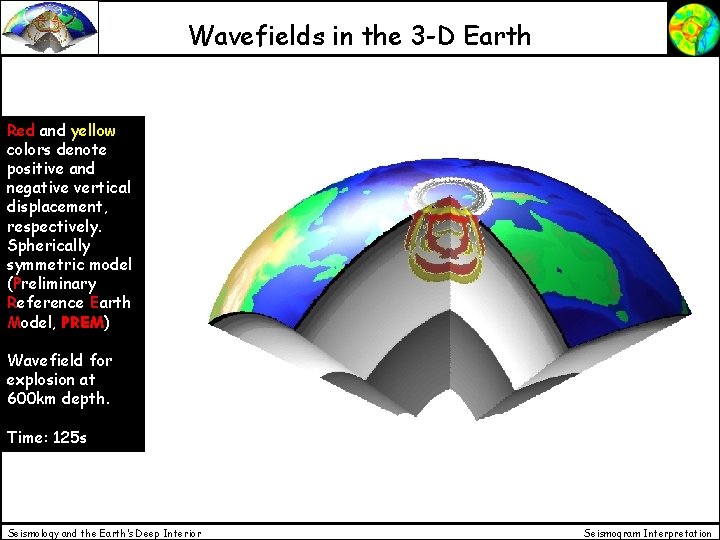
Wavefields in the 3 -D Earth Red and yellow colors denote positive and negative vertical displacement, respectively. Spherically symmetric model (Preliminary Reference Earth Model, PREM) Wavefield for explosion at 600 km depth. Time: 125 s Seismology and the Earth’s Deep Interior Seismogram Interpretation
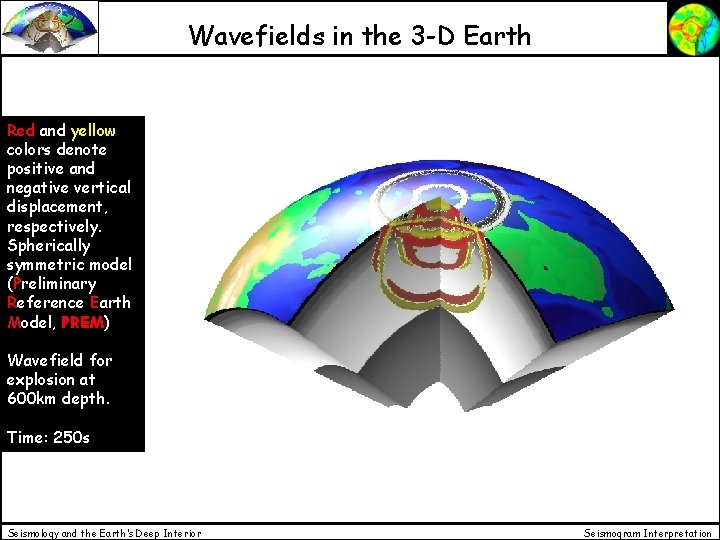
Wavefields in the 3 -D Earth Red and yellow colors denote positive and negative vertical displacement, respectively. Spherically symmetric model (Preliminary Reference Earth Model, PREM) Wavefield for explosion at 600 km depth. Time: 250 s Seismology and the Earth’s Deep Interior Seismogram Interpretation
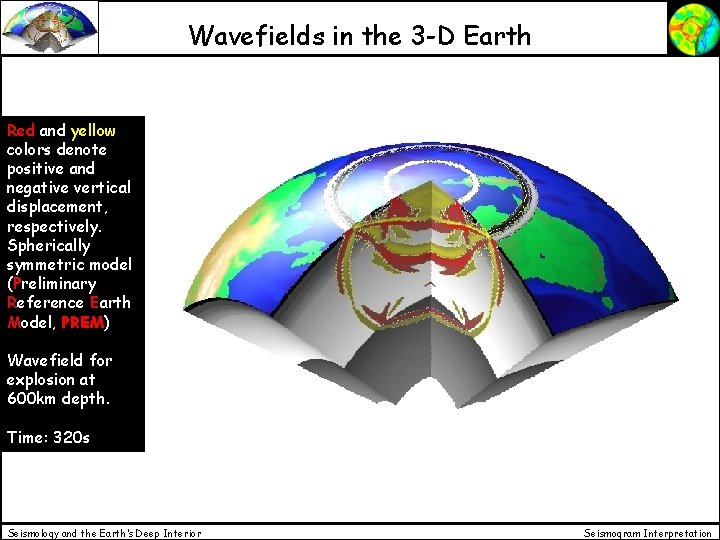
Wavefields in the 3 -D Earth Red and yellow colors denote positive and negative vertical displacement, respectively. Spherically symmetric model (Preliminary Reference Earth Model, PREM) Wavefield for explosion at 600 km depth. Time: 320 s Seismology and the Earth’s Deep Interior Seismogram Interpretation
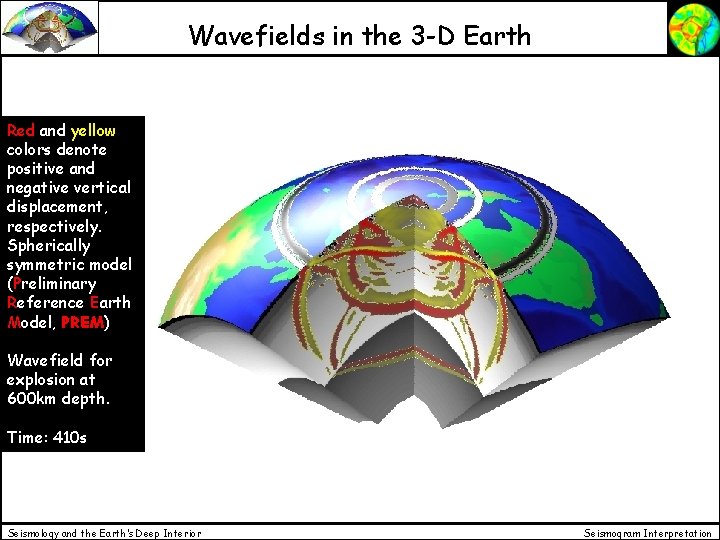
Wavefields in the 3 -D Earth Red and yellow colors denote positive and negative vertical displacement, respectively. Spherically symmetric model (Preliminary Reference Earth Model, PREM) Wavefield for explosion at 600 km depth. Time: 410 s Seismology and the Earth’s Deep Interior Seismogram Interpretation
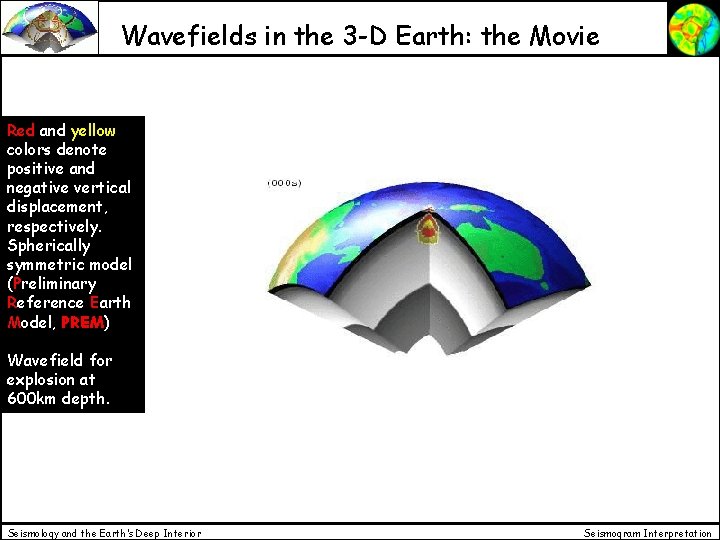
Wavefields in the 3 -D Earth: the Movie Red and yellow colors denote positive and negative vertical displacement, respectively. Spherically symmetric model (Preliminary Reference Earth Model, PREM) Wavefield for explosion at 600 km depth. Seismology and the Earth’s Deep Interior Seismogram Interpretation
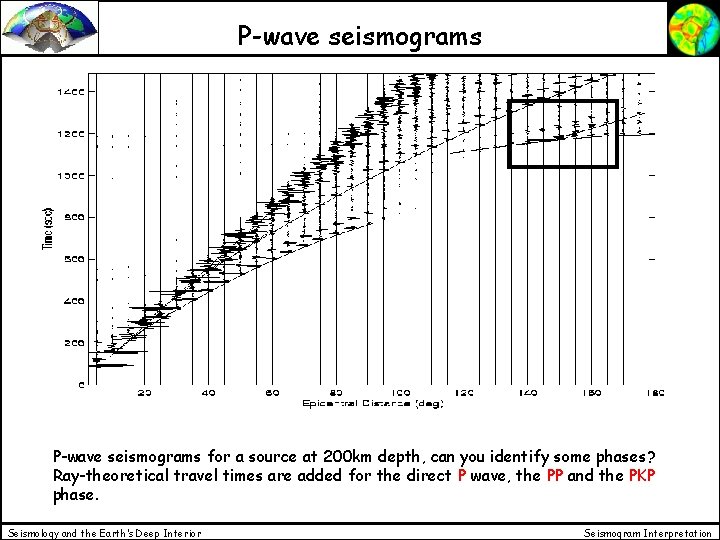
P-wave seismograms for a source at 200 km depth, can you identify some phases? Ray-theoretical travel times are added for the direct P wave, the PP and the PKP phase. Seismology and the Earth’s Deep Interior Seismogram Interpretation
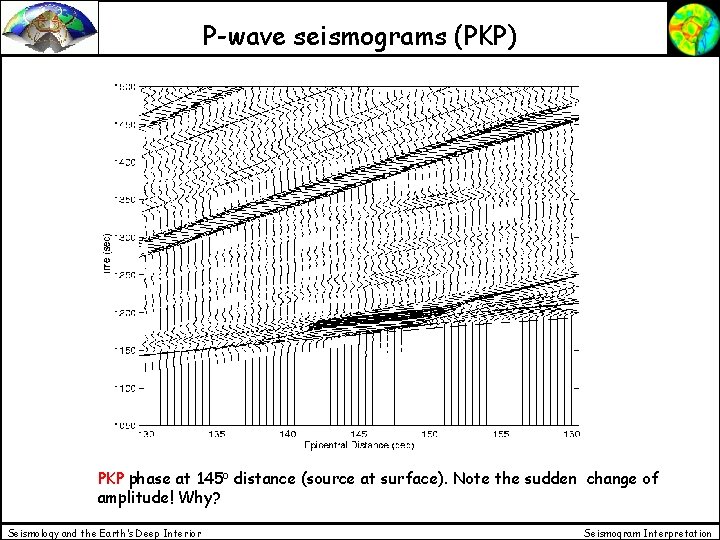
P-wave seismograms (PKP) PKP phase at 145 o distance (source at surface). Note the sudden change of amplitude! Why? Seismology and the Earth’s Deep Interior Seismogram Interpretation
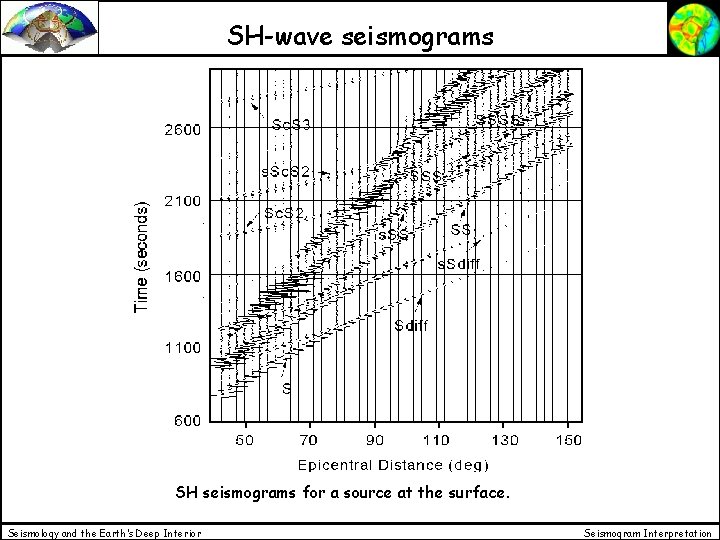
SH-wave seismograms SH seismograms for a source at the surface. Seismology and the Earth’s Deep Interior Seismogram Interpretation
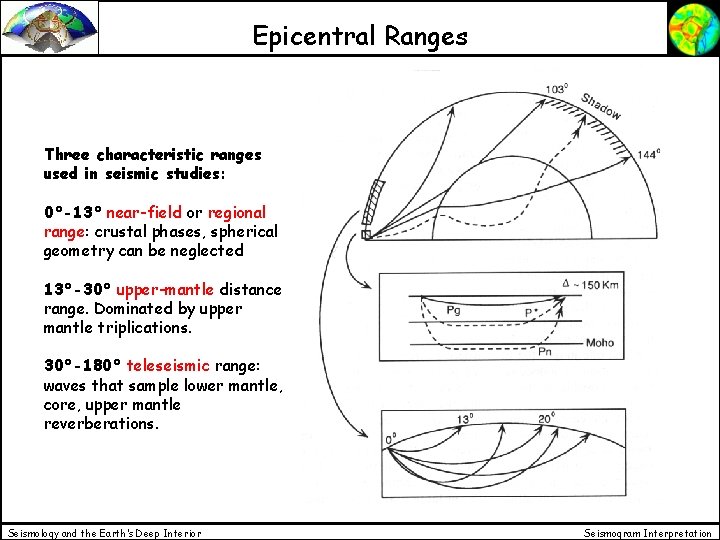
Epicentral Ranges Three characteristic ranges used in seismic studies: 0°-13° near-field or regional range: crustal phases, spherical geometry can be neglected 13°-30° upper-mantle distance range. Dominated by upper mantle triplications. 30°-180° teleseismic range: waves that sample lower mantle, core, upper mantle reverberations. Seismology and the Earth’s Deep Interior Seismogram Interpretation
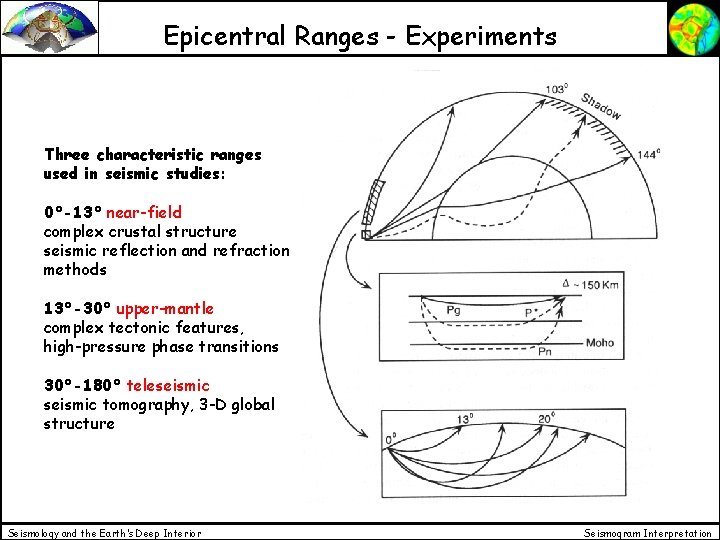
Epicentral Ranges - Experiments Three characteristic ranges used in seismic studies: 0°-13° near-field complex crustal structure seismic reflection and refraction methods 13°-30° upper-mantle complex tectonic features, high-pressure phase transitions 30°-180° teleseismic tomography, 3 -D global structure Seismology and the Earth’s Deep Interior Seismogram Interpretation
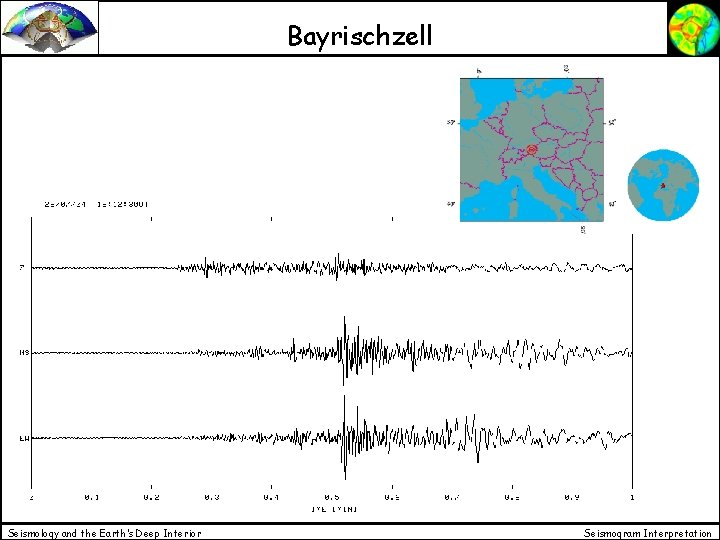
Bayrischzell Seismology and the Earth’s Deep Interior Seismogram Interpretation
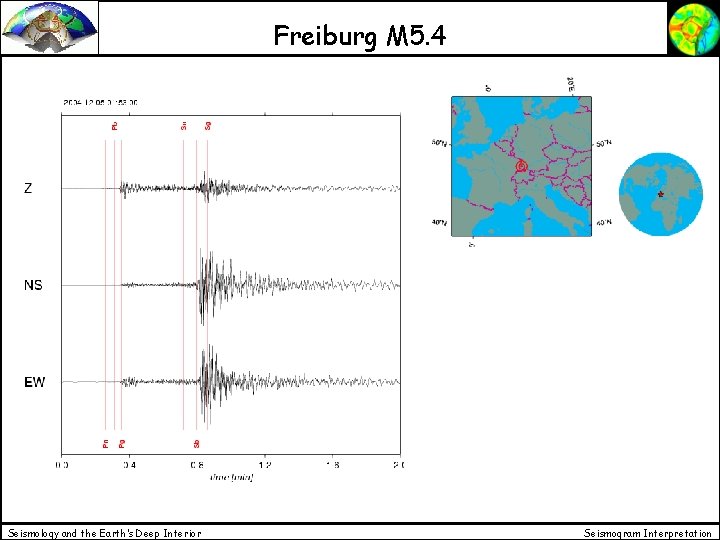
Freiburg M 5. 4 Seismology and the Earth’s Deep Interior Seismogram Interpretation
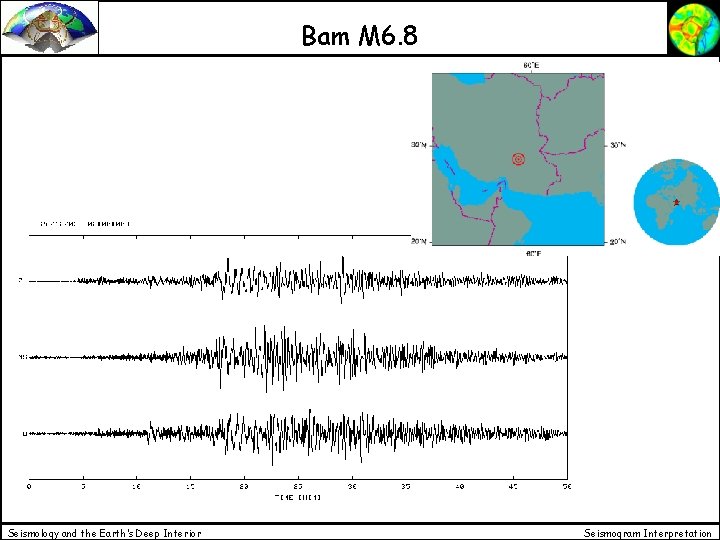
Bam M 6. 8 Seismology and the Earth’s Deep Interior Seismogram Interpretation
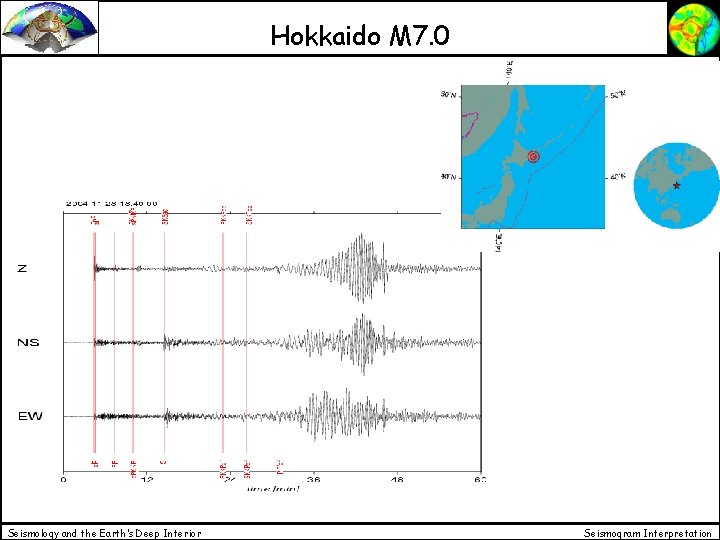
Hokkaido M 7. 0 Seismology and the Earth’s Deep Interior Seismogram Interpretation
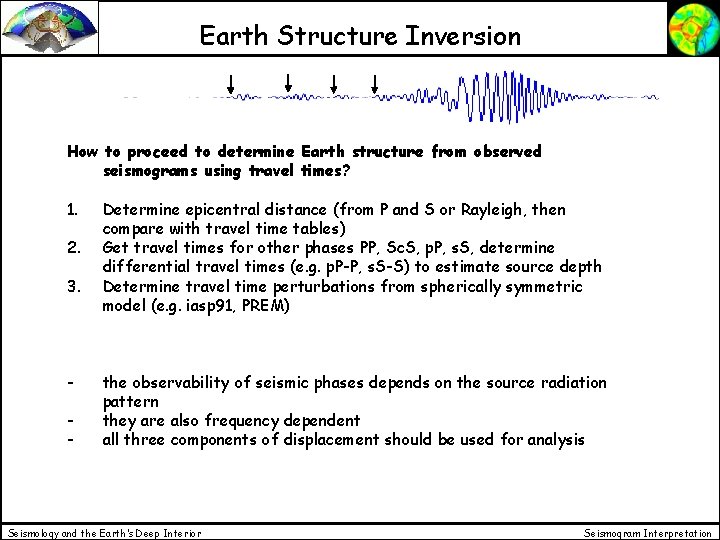
Earth Structure Inversion How to proceed to determine Earth structure from observed seismograms using travel times? 1. 2. 3. - Determine epicentral distance (from P and S or Rayleigh, then compare with travel time tables) Get travel times for other phases PP, Sc. S, p. P, s. S, determine differential travel times (e. g. p. P-P, s. S-S) to estimate source depth Determine travel time perturbations from spherically symmetric model (e. g. iasp 91, PREM) the observability of seismic phases depends on the source radiation pattern they are also frequency dependent all three components of displacement should be used for analysis Seismology and the Earth’s Deep Interior Seismogram Interpretation
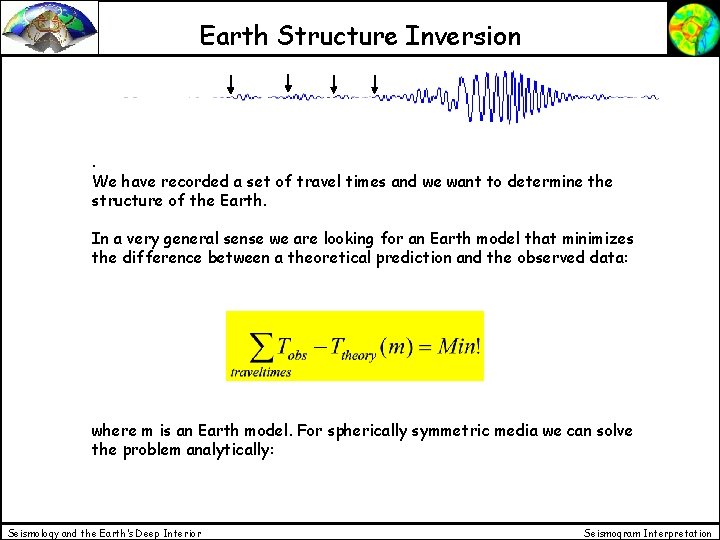
Earth Structure Inversion . We have recorded a set of travel times and we want to determine the structure of the Earth. In a very general sense we are looking for an Earth model that minimizes the difference between a theoretical prediction and the observed data: where m is an Earth model. For spherically symmetric media we can solve the problem analytically: Seismology and the Earth’s Deep Interior Seismogram Interpretation
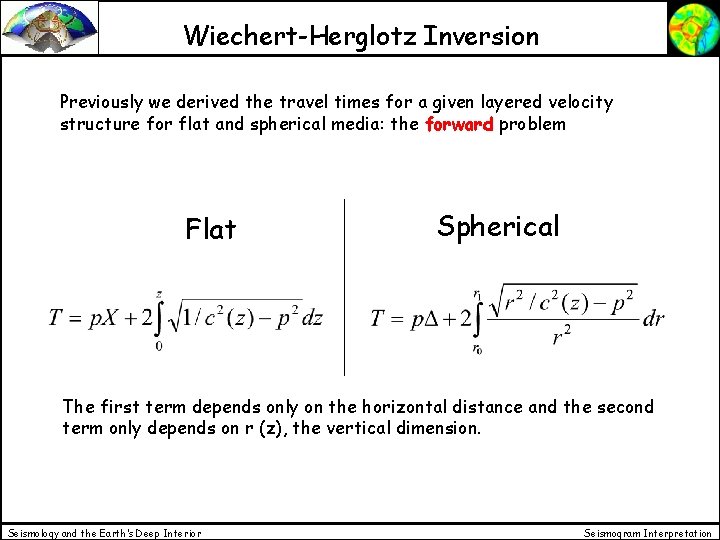
Wiechert-Herglotz Inversion Previously we derived the travel times for a given layered velocity structure for flat and spherical media: the forward problem Flat Spherical The first term depends only on the horizontal distance and the second term only depends on r (z), the vertical dimension. Seismology and the Earth’s Deep Interior Seismogram Interpretation
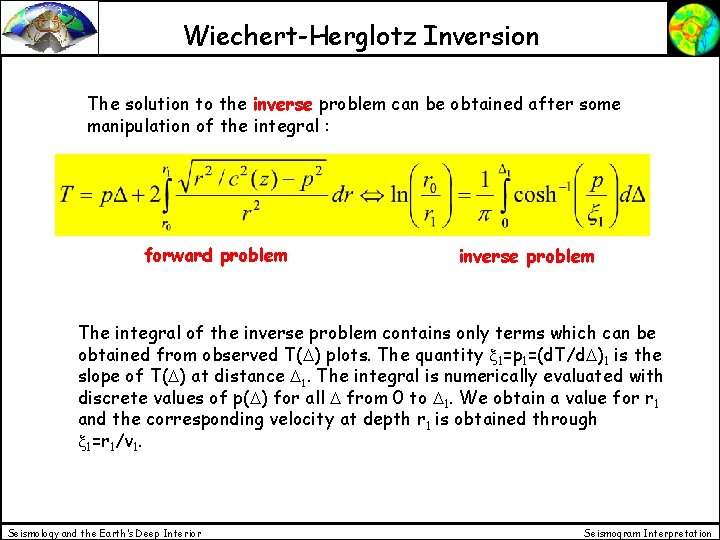
Wiechert-Herglotz Inversion The solution to the inverse problem can be obtained after some manipulation of the integral : forward problem inverse problem The integral of the inverse problem contains only terms which can be obtained from observed T(D) plots. The quantity 1=p 1=(d. T/d. D)1 is the slope of T(D) at distance D 1. The integral is numerically evaluated with discrete values of p(D) for all D from 0 to D 1. We obtain a value for r 1 and the corresponding velocity at depth r 1 is obtained through 1=r 1/v 1. Seismology and the Earth’s Deep Interior Seismogram Interpretation
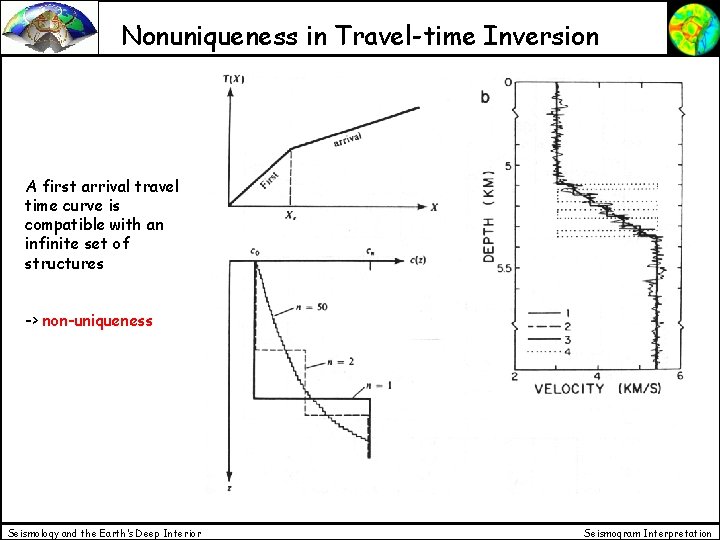
Nonuniqueness in Travel-time Inversion A first arrival travel time curve is compatible with an infinite set of structures -> non-uniqueness Seismology and the Earth’s Deep Interior Seismogram Interpretation
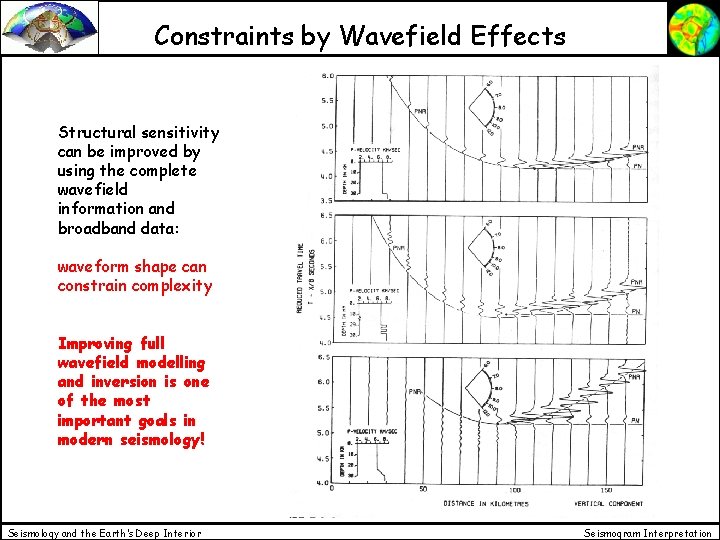
Constraints by Wavefield Effects Structural sensitivity can be improved by using the complete wavefield information and broadband data: waveform shape can constrain complexity Improving full wavefield modelling and inversion is one of the most important goals in modern seismology! Seismology and the Earth’s Deep Interior Seismogram Interpretation
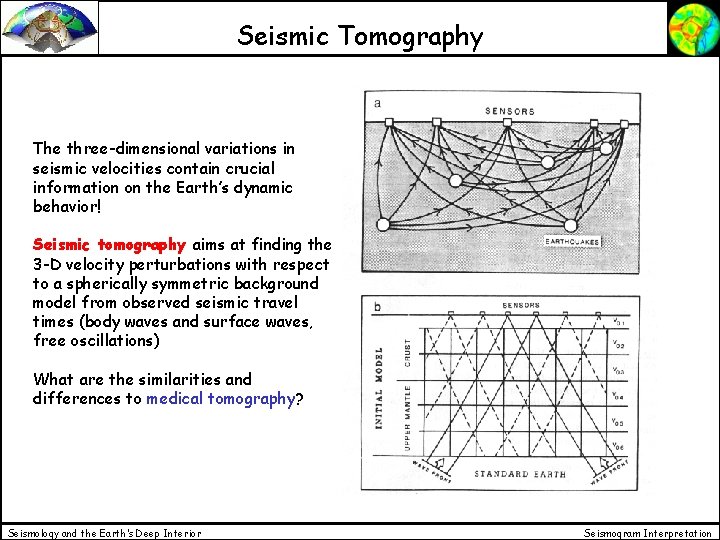
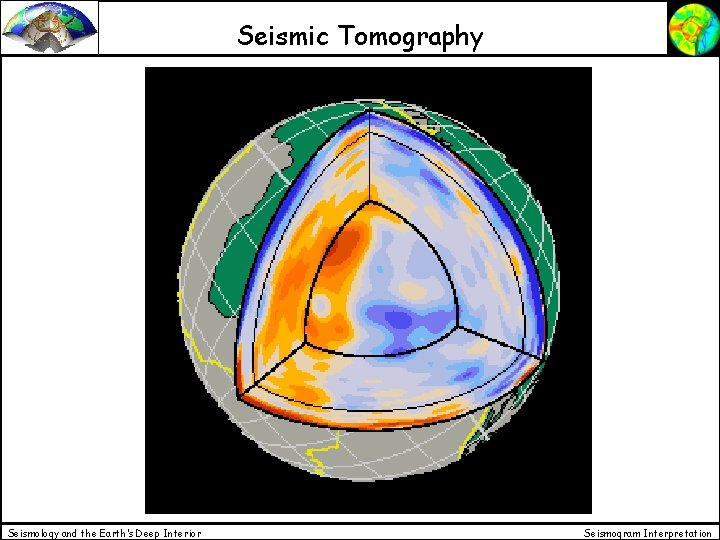
Seismic Tomography The three-dimensional variations in seismic velocities contain crucial information on the Earth’s dynamic behavior! Seismic tomography aims at finding the 3 -D velocity perturbations with respect to a spherically symmetric background model from observed seismic travel times (body waves and surface waves, free oscillations) What are the similarities and differences to medical tomography? Seismology and the Earth’s Deep Interior Seismogram Interpretation
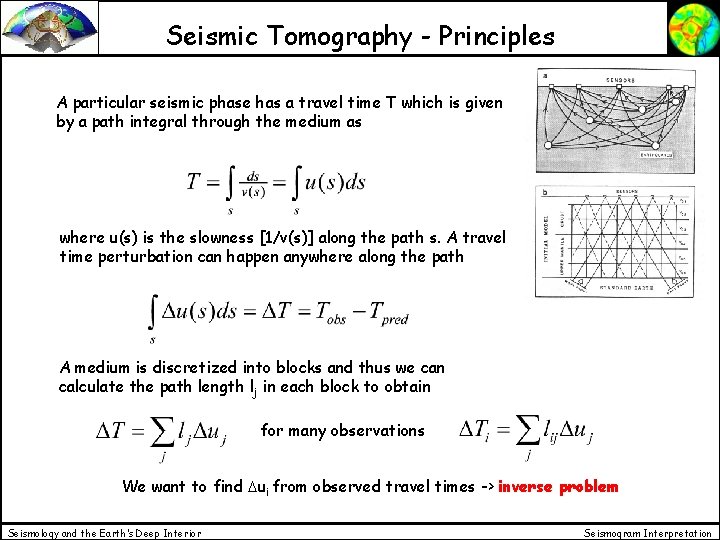
Seismic Tomography - Principles A particular seismic phase has a travel time T which is given by a path integral through the medium as where u(s) is the slowness [1/v(s)] along the path s. A travel time perturbation can happen anywhere along the path A medium is discretized into blocks and thus we can calculate the path length lj in each block to obtain for many observations We want to find Dui from observed travel times -> inverse problem Seismology and the Earth’s Deep Interior Seismogram Interpretation
Seismic Tomography Seismology and the Earth’s Deep Interior Seismogram Interpretation
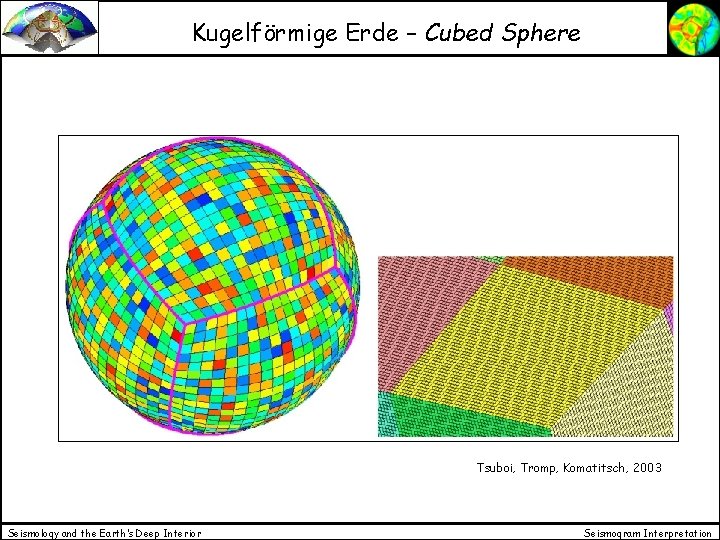
Kugelförmige Erde – Cubed Sphere Tsuboi, Tromp, Komatitsch, 2003 Seismology and the Earth’s Deep Interior Seismogram Interpretation
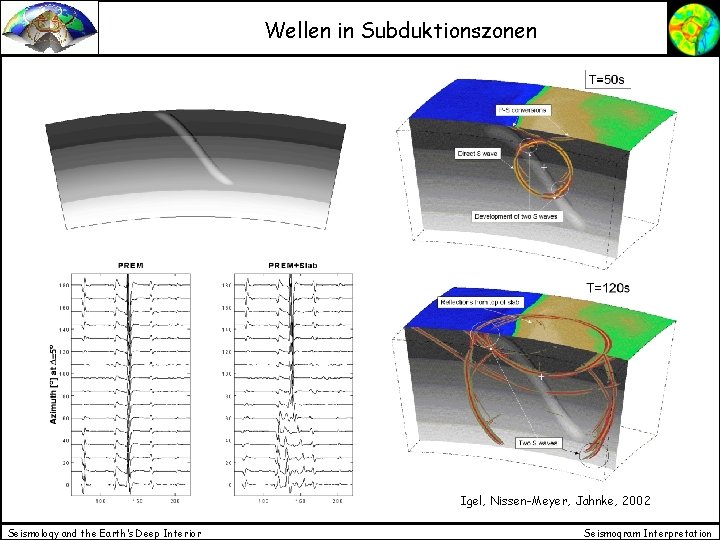
Wellen in Subduktionszonen Igel, Nissen-Meyer, Jahnke, 2002 Seismology and the Earth’s Deep Interior Seismogram Interpretation
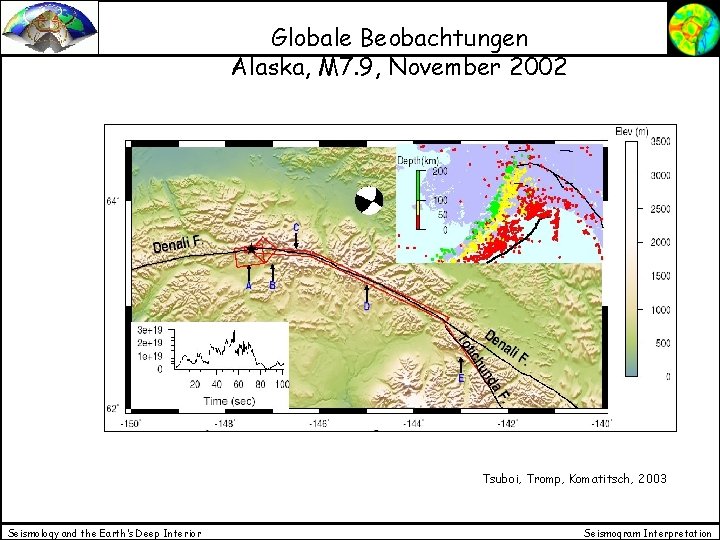
Globale Beobachtungen Alaska, M 7. 9, November 2002 Tsuboi, Tromp, Komatitsch, 2003 Seismology and the Earth’s Deep Interior Seismogram Interpretation
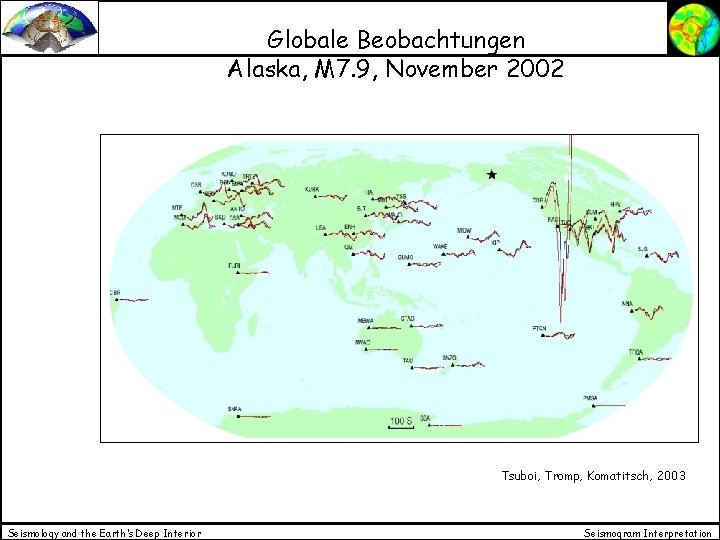
Globale Beobachtungen Alaska, M 7. 9, November 2002 Tsuboi, Tromp, Komatitsch, 2003 Seismology and the Earth’s Deep Interior Seismogram Interpretation
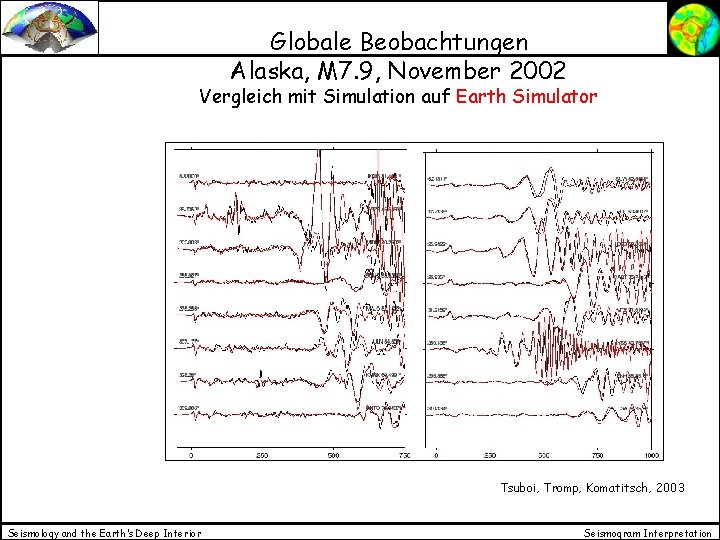
Globale Beobachtungen Alaska, M 7. 9, November 2002 Vergleich mit Simulation auf Earth Simulator Tsuboi, Tromp, Komatitsch, 2003 Seismology and the Earth’s Deep Interior Seismogram Interpretation
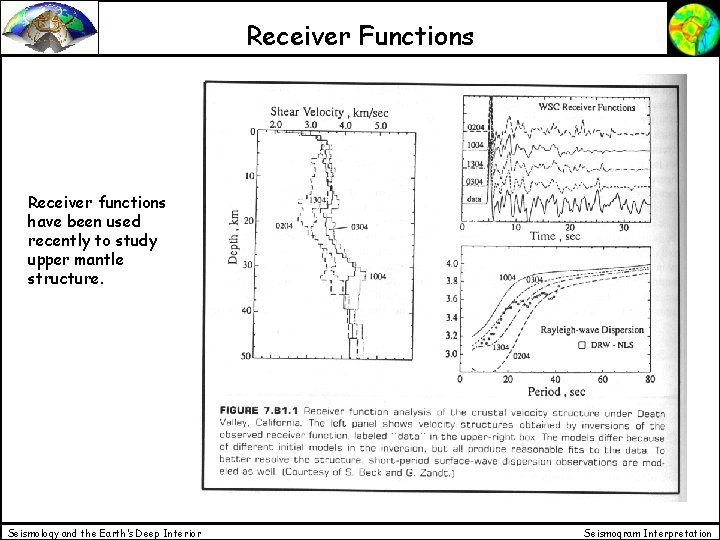
Receiver Functions Receiver functions have been used recently to study upper mantle structure. Seismology and the Earth’s Deep Interior Seismogram Interpretation
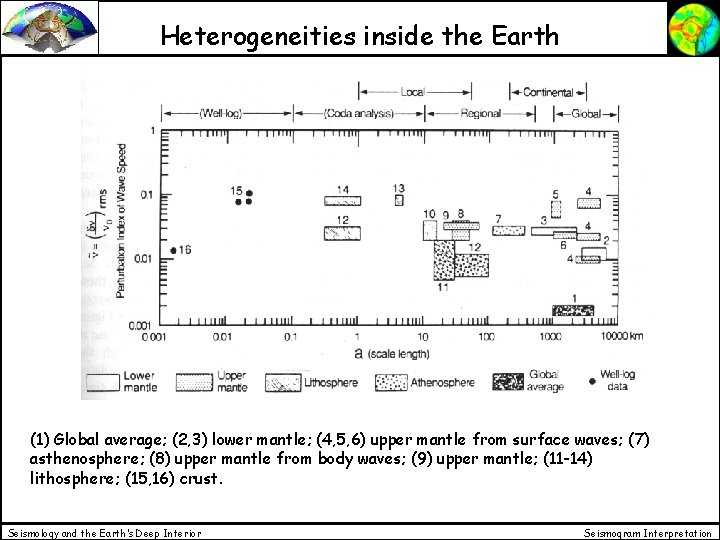
Heterogeneities inside the Earth (1) Global average; (2, 3) lower mantle; (4, 5, 6) upper mantle from surface waves; (7) asthenosphere; (8) upper mantle from body waves; (9) upper mantle; (11 -14) lithosphere; (15, 16) crust. Seismology and the Earth’s Deep Interior Seismogram Interpretation
Attenuation from Multiples Multiple reflections from the core mantle boundary can be used to infer the attenuation of seismic waves inside the mantle Seismology and the Earth’s Deep Interior Seismogram Interpretation
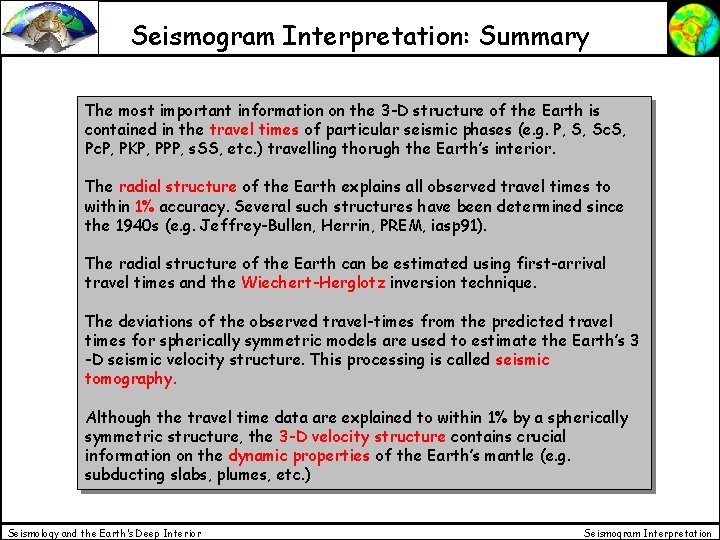
Seismogram Interpretation: Summary The most important information on the 3 -D structure of the Earth is contained in the travel times of particular seismic phases (e. g. P, S, Sc. S, Pc. P, PKP, PPP, s. SS, etc. ) travelling thorugh the Earth’s interior. The radial structure of the Earth explains all observed travel times to within 1% accuracy. Several such structures have been determined since the 1940 s (e. g. Jeffrey-Bullen, Herrin, PREM, iasp 91). The radial structure of the Earth can be estimated using first-arrival travel times and the Wiechert-Herglotz inversion technique. The deviations of the observed travel-times from the predicted travel times for spherically symmetric models are used to estimate the Earth’s 3 -D seismic velocity structure. This processing is called seismic tomography. Although the travel time data are explained to within 1% by a spherically symmetric structure, the 3 -D velocity structure contains crucial information on the dynamic properties of the Earth’s mantle (e. g. subducting slabs, plumes, etc. ) Seismology and the Earth’s Deep Interior Seismogram Interpretation