
Seismic wave Propagation and Imaging in Complex media



- Slides: 34
Seismic wave Propagation and Imaging in Complex media: a European network DANIEL PETER Early Stage Researcher Host Institution: ETH Zurich Place of Origin: Sargans, Switzerland Appointment Time: August 2004 Project: Membrane waves, sensitivity kernels, global tomography. Task Groups: TG Planetary Scale Cooperation: Oxford University, IPG Paris presentation SPICE Research and Training Workshop III, July 22 -28, Kinsale, Ireland www. spice-rtn. org
Surface wave tomography: membrane waves and adjoint methods Daniel Peter In collaboration with Lapo Boschi, Carl Tape*, John H. Woodhouse** ETH Zürich, Switzerland *Caltech, California, USA **University of Oxford, England SPICE Research and Training Workshop III, July 22 -28, Kinsale, Ireland title www. spice-rtn. org
Motivation Born sensitivity kernels consider single scattering in the Earth and should improve tomographic models, especially for surface waves. Computational costs of both numerical and analytical kernel construction techniques in 3 D are greatly reduced if membrane waves as an analogue for surface waves or adjoint methods are used. SPICE Research and Training Workshop III, July 22 -28, Kinsale, Ireland www. spice-rtn. org
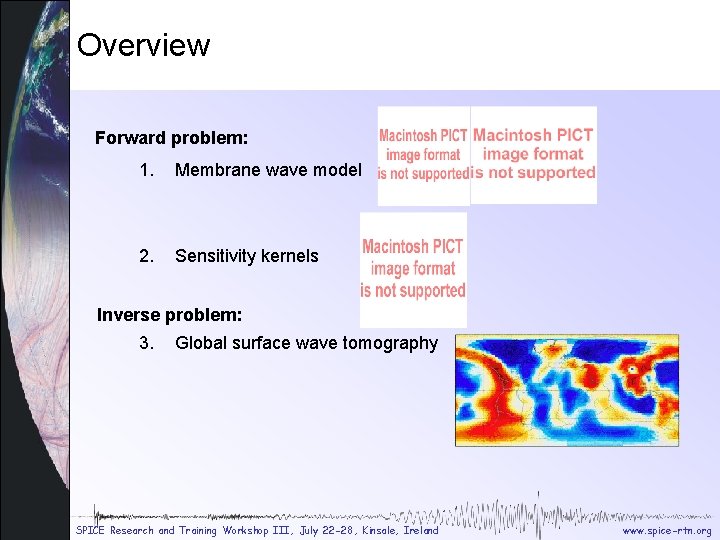
Overview Forward problem: 1. Membrane wave model 2. Sensitivity kernels Inverse problem: 3. Global surface wave tomography SPICE Research and Training Workshop III, July 22 -28, Kinsale, Ireland www. spice-rtn. org
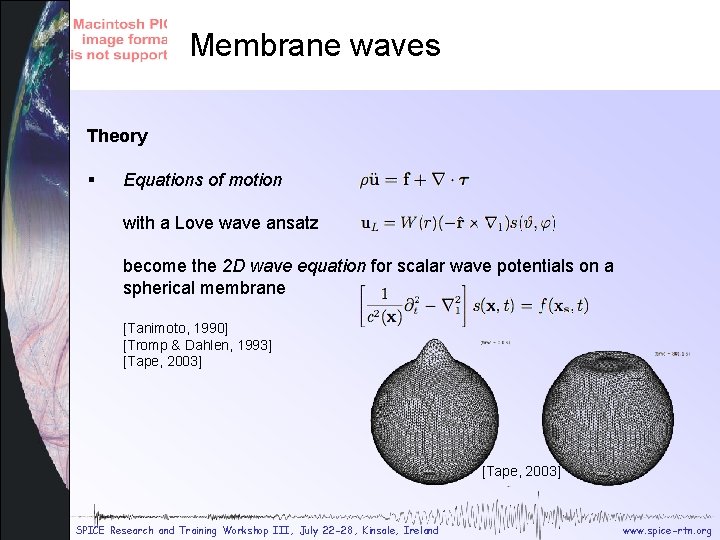
Membrane theory Membrane waves Theory § Equations of motion with a Love wave ansatz become the 2 D wave equation for scalar wave potentials on a spherical membrane [Tanimoto, 1990] [Tromp & Dahlen, 1993] [Tape, 2003] SPICE Research and Training Workshop III, July 22 -28, Kinsale, Ireland www. spice-rtn. org
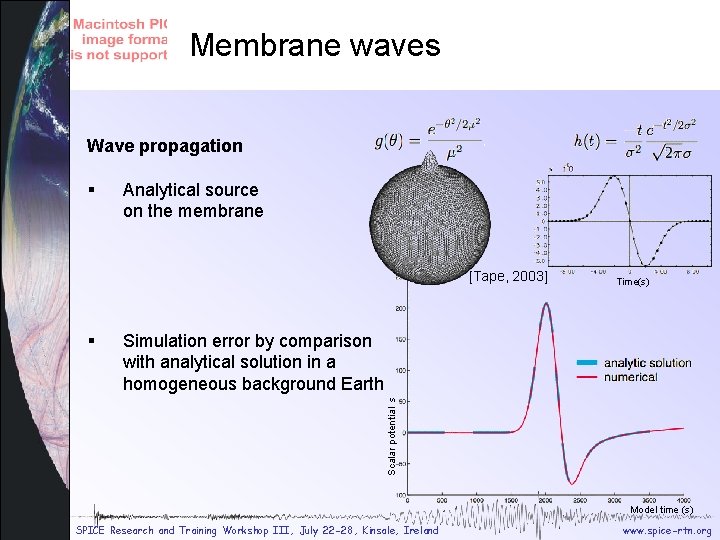
Membrane waves Wave propagation § Analytical source on the membrane [Tape, 2003] Simulation error by comparison with analytical solution in a homogeneous background Earth Scalar potential s § Time(s) Model time (s) SPICE Research and Training Workshop III, July 22 -28, Kinsale, Ireland www. spice-rtn. org
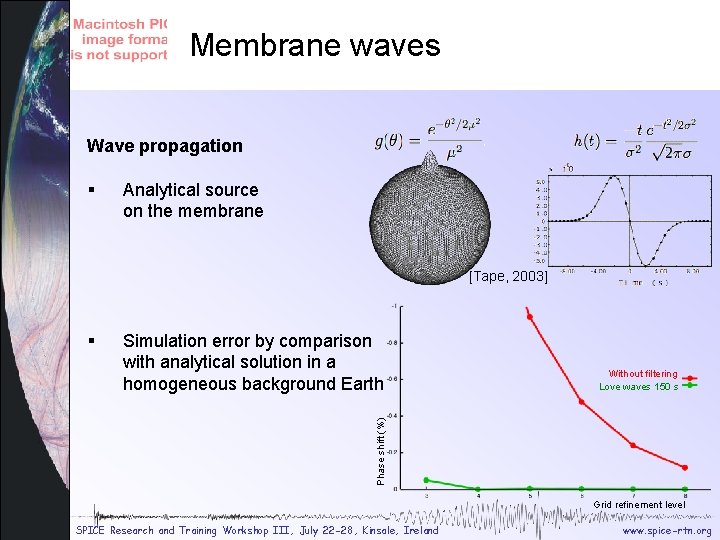
Membrane waves Wave propagation § Analytical source on the membrane [Tape, 2003] Simulation error by comparison with analytical solution in a homogeneous background Earth Without filtering Love waves 150 s Phase shift (%) § Grid refinement level SPICE Research and Training Workshop III, July 22 -28, Kinsale, Ireland www. spice-rtn. org
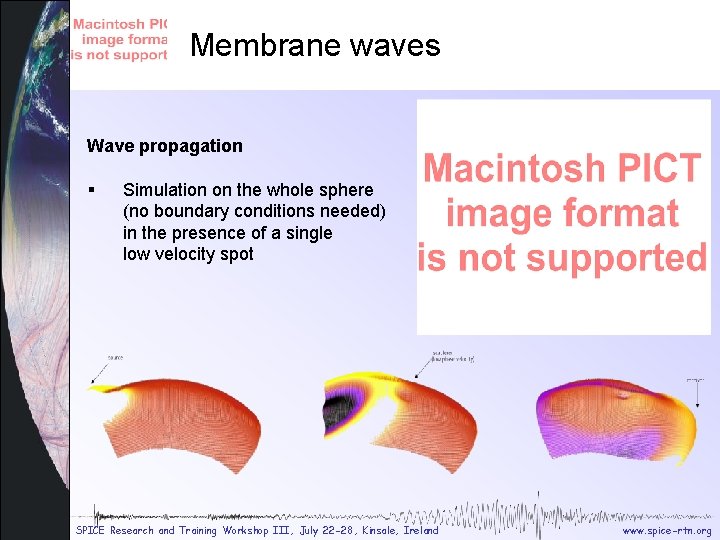
Membrane waves Membrane wave movie Wave propagation § Simulation on the whole sphere (no boundary conditions needed) in the presence of a single low velocity spot SPICE Research and Training Workshop III, July 22 -28, Kinsale, Ireland www. spice-rtn. org
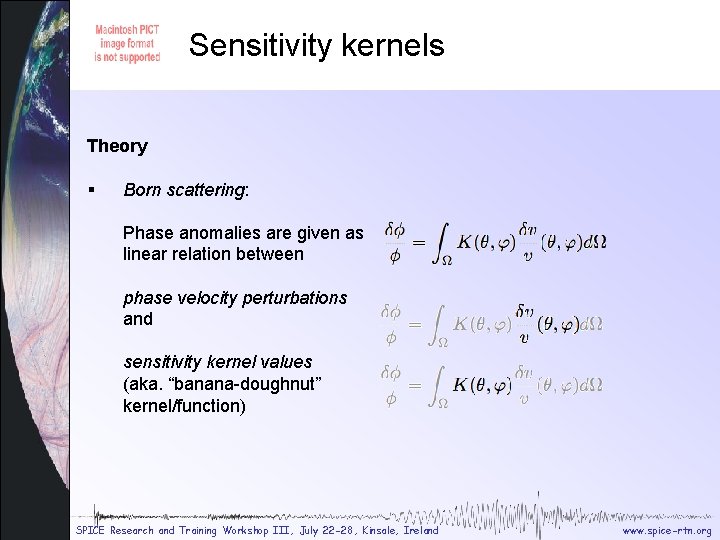
Sensitivity kernels Sensitivity theory Theory § Born scattering: Phase anomalies are given as linear relation between phase velocity perturbations and sensitivity kernel values (aka. “banana-doughnut” kernel/function) SPICE Research and Training Workshop III, July 22 -28, Kinsale, Ireland www. spice-rtn. org
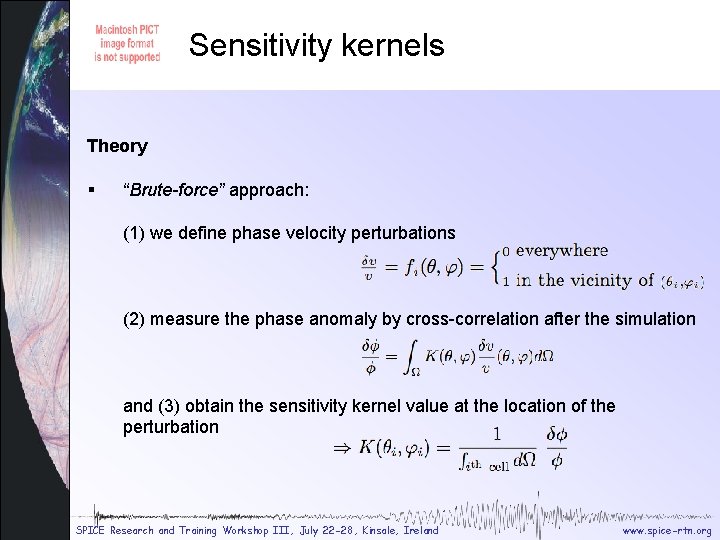
Sensitivity kernels Sensitivity theory Theory § “Brute-force” approach: (1) we define phase velocity perturbations (2) measure the phase anomaly by cross-correlation after the simulation and (3) obtain the sensitivity kernel value at the location of the perturbation SPICE Research and Training Workshop III, July 22 -28, Kinsale, Ireland www. spice-rtn. org
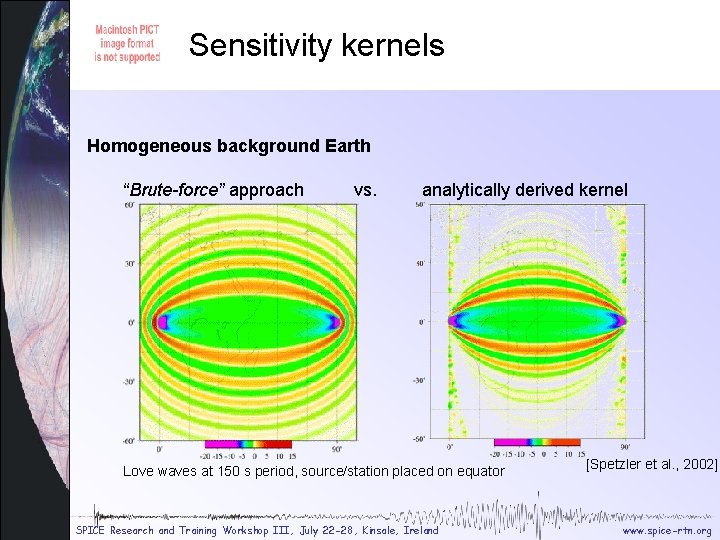
Sensitivity kernels Sensitivity direct vs analytical Homogeneous background Earth “Brute-force” approach vs. analytically derived kernel Love waves at 150 s period, source/station placed on equator SPICE Research and Training Workshop III, July 22 -28, Kinsale, Ireland [Spetzler et al. , 2002] www. spice-rtn. org
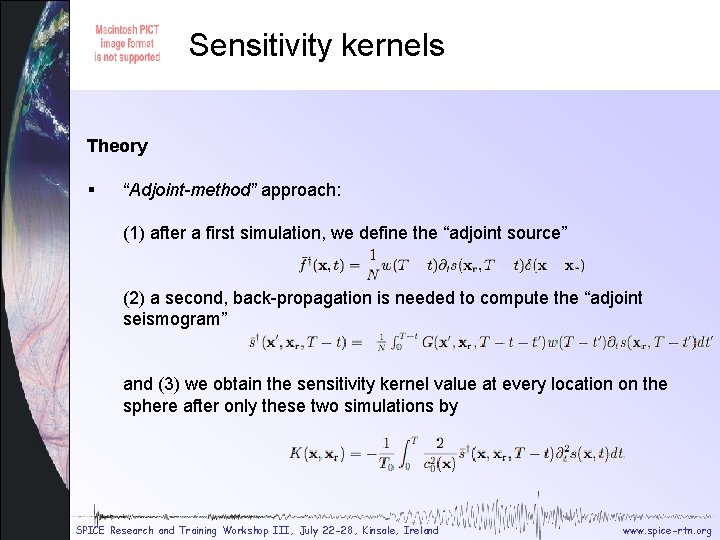
Sensitivity kernels Sensitivity theory Theory § “Adjoint-method” approach: (1) after a first simulation, we define the “adjoint source” (2) a second, back-propagation is needed to compute the “adjoint seismogram” and (3) we obtain the sensitivity kernel value at every location on the sphere after only these two simulations by SPICE Research and Training Workshop III, July 22 -28, Kinsale, Ireland www. spice-rtn. org
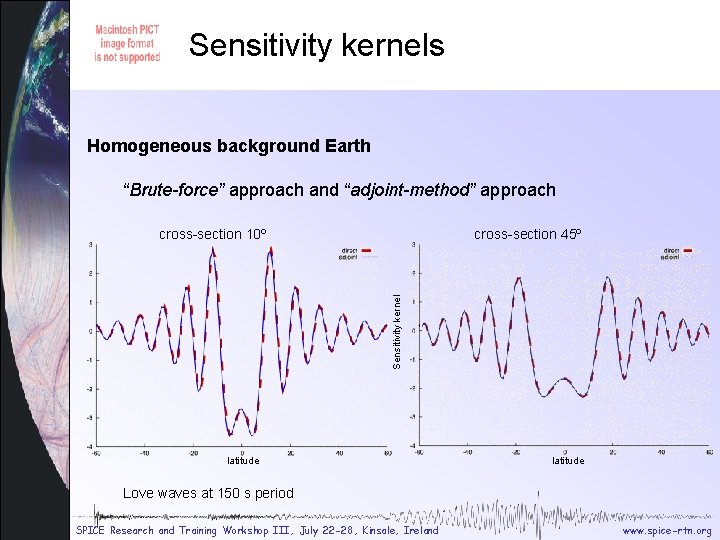
Sensitivity direct vs adjoint Sensitivity kernels Homogeneous background Earth “Brute-force” approach and “adjoint-method” approach cross-section 45º Sensitivity kernel cross-section 10º latitude Love waves at 150 s period SPICE Research and Training Workshop III, July 22 -28, Kinsale, Ireland www. spice-rtn. org
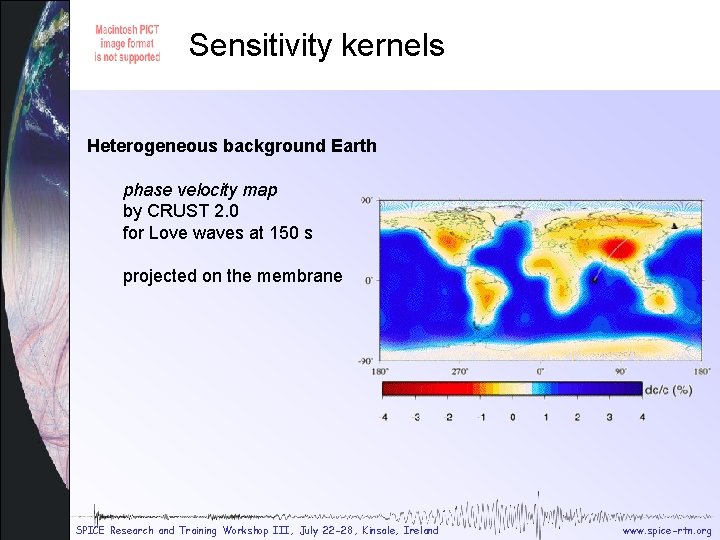
Sensitivity kernels Sensitivity heterogeneous Heterogeneous background Earth phase velocity map by CRUST 2. 0 for Love waves at 150 s projected on the membrane SPICE Research and Training Workshop III, July 22 -28, Kinsale, Ireland www. spice-rtn. org
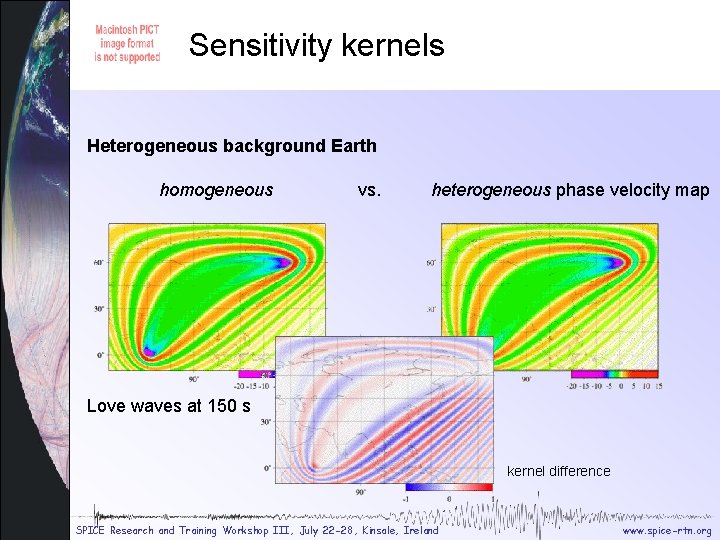
Sensitivity kernels Sensitivity heterogeneous Heterogeneous background Earth homogeneous vs. heterogeneous phase velocity map Love waves at 150 s kernel difference SPICE Research and Training Workshop III, July 22 -28, Kinsale, Ireland www. spice-rtn. org
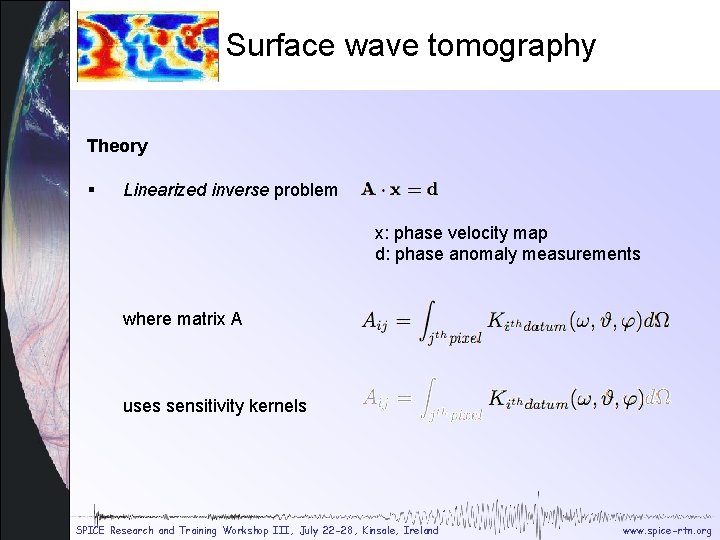
Tomography theory Surface wave tomography Theory § Linearized inverse problem x: phase velocity map d: phase anomaly measurements where matrix A uses sensitivity kernels SPICE Research and Training Workshop III, July 22 -28, Kinsale, Ireland www. spice-rtn. org
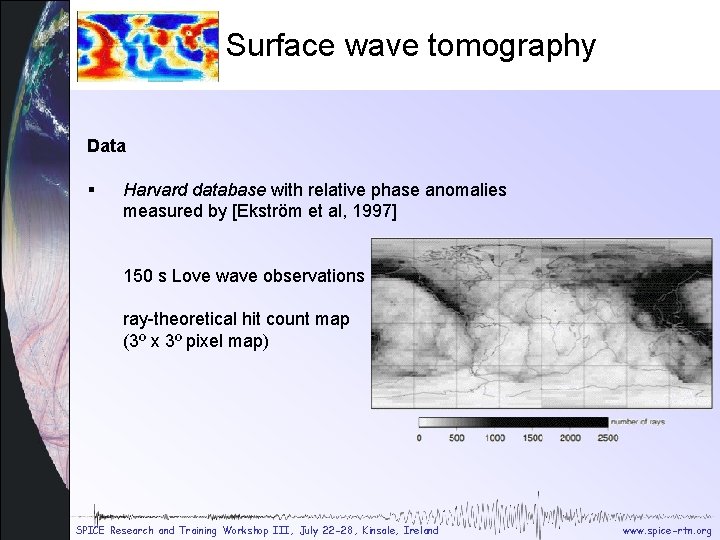
Tomography data Surface wave tomography Data § Harvard database with relative phase anomalies measured by [Ekström et al, 1997] 150 s Love wave observations ray-theoretical hit count map (3º x 3º pixel map) SPICE Research and Training Workshop III, July 22 -28, Kinsale, Ireland www. spice-rtn. org
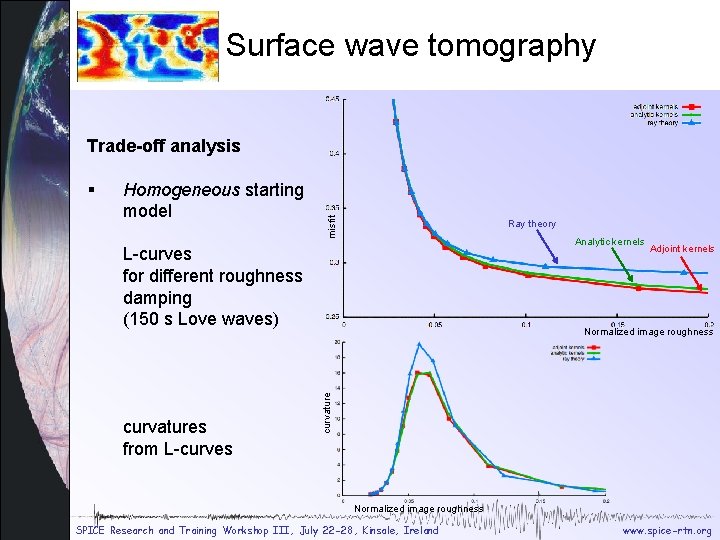
Tomography homogeneous Surface wave tomography § Homogeneous starting model misfit Trade-off analysis Ray theory Analytic kernels L-curves for different roughness damping (150 s Love waves) Normalized image roughness curvatures from L-curves Adjoint kernels Normalized image roughness SPICE Research and Training Workshop III, July 22 -28, Kinsale, Ireland www. spice-rtn. org
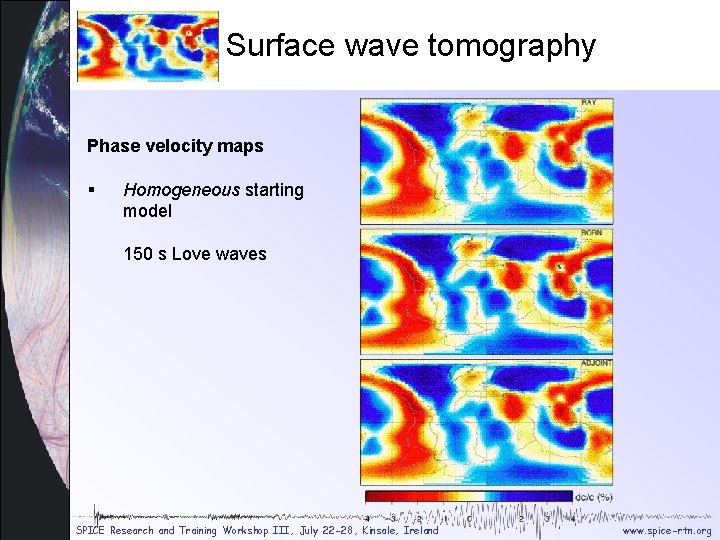
Tomography homogeneous Surface wave tomography Phase velocity maps § Homogeneous starting model 150 s Love waves SPICE Research and Training Workshop III, July 22 -28, Kinsale, Ireland www. spice-rtn. org
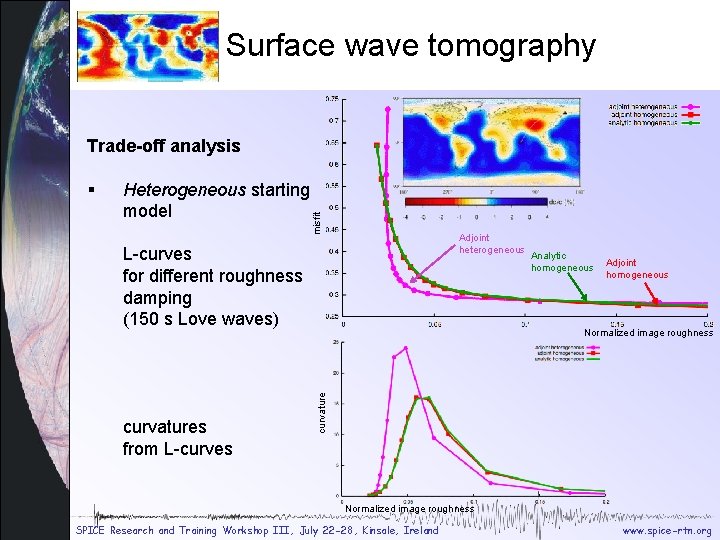
Tomography heterogeneous Surface wave tomography § Heterogeneous starting model misfit Trade-off analysis Adjoint heterogeneous L-curves for different roughness damping (150 s Love waves) Adjoint homogeneous Normalized image roughness curvatures from L-curves Analytic homogeneous Normalized image roughness SPICE Research and Training Workshop III, July 22 -28, Kinsale, Ireland www. spice-rtn. org
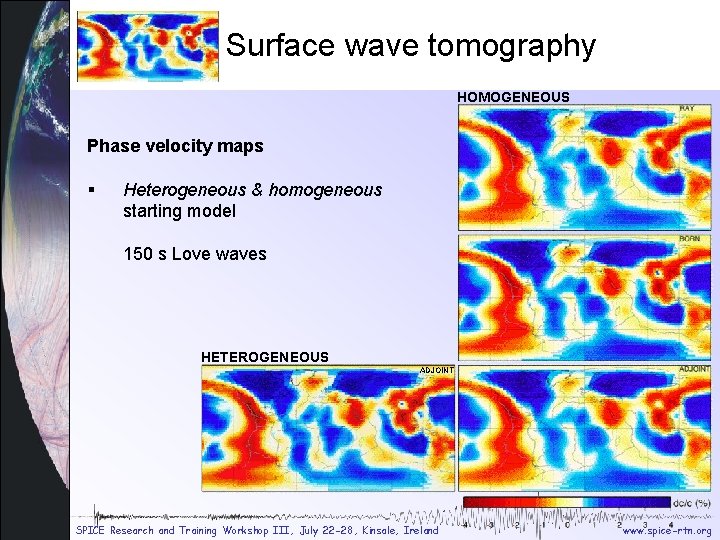
Tomography heterogeneous Surface wave tomography HOMOGENEOUS Phase velocity maps § Heterogeneous & homogeneous starting model 150 s Love waves HETEROGENEOUS ADJOINT SPICE Research and Training Workshop III, July 22 -28, Kinsale, Ireland www. spice-rtn. org
Conclusions § The membrane wave model can be used to derive numerically 2 D sensitivity kernels relating surface-wave phase anomaly data to phase velocity heterogeneities § The tomographic results and trade-off analysis suggest that this method is at least compatible with existing approaches (ray theory, analytical Born theory) § Improvement may become more significant in 3 D when inverting for shear velocity in the Earth’s upper mantle [Zhou, 2005] SPICE Research and Training Workshop III, July 22 -28, Kinsale, Ireland www. spice-rtn. org
Thank you for your attention! Thanks For many more details, please just ask… SPICE Research and Training Workshop III, July 22 -28, Kinsale, Ireland www. spice-rtn. org
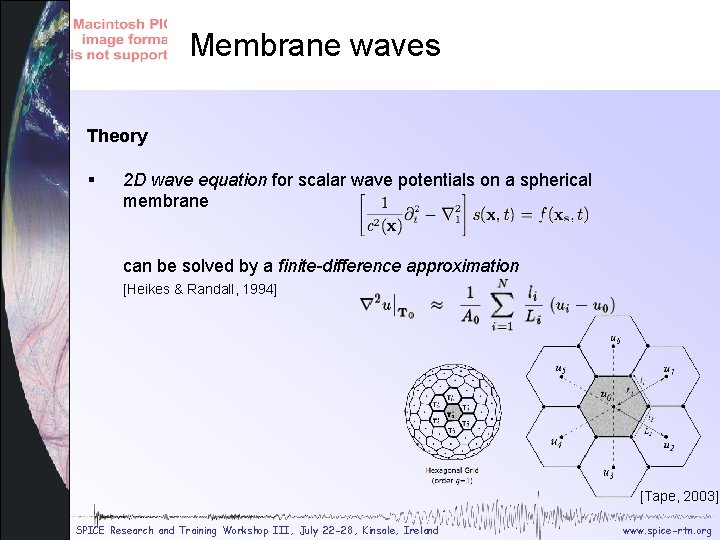
Membrane waves Membrane theory Theory § 2 D wave equation for scalar wave potentials on a spherical membrane can be solved by a finite-difference approximation [Heikes & Randall, 1994] [Tape, 2003] SPICE Research and Training Workshop III, July 22 -28, Kinsale, Ireland www. spice-rtn. org
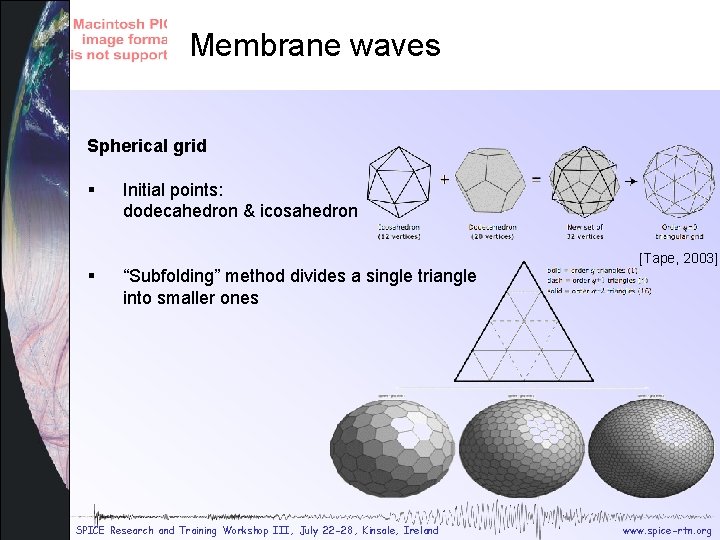
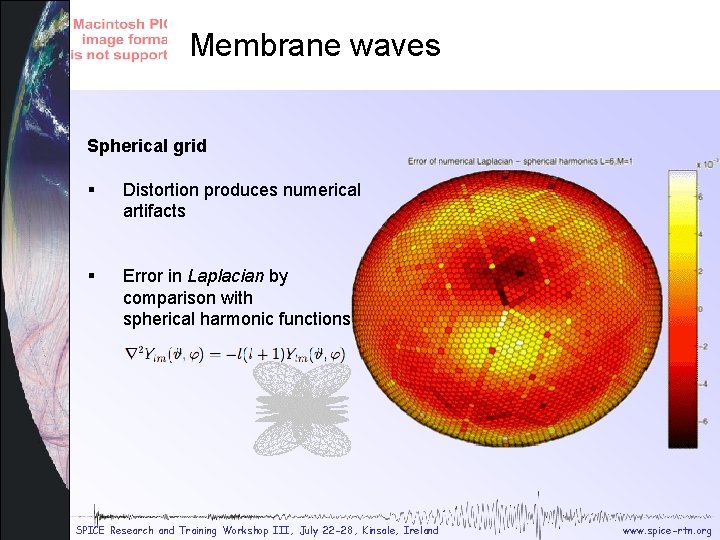
Membrane waves Membrane grid Spherical grid § § Initial points: dodecahedron & icosahedron “Subfolding” method divides a single triangle into smaller ones SPICE Research and Training Workshop III, July 22 -28, Kinsale, Ireland [Tape, 2003] www. spice-rtn. org
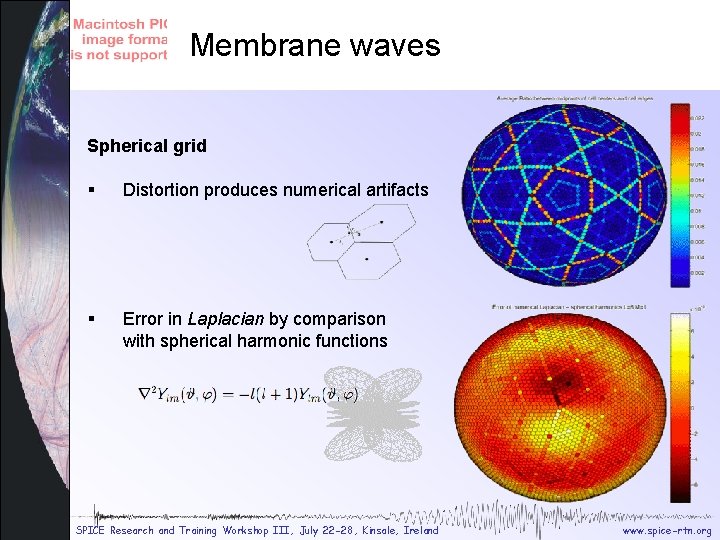
Membrane waves Membrane grid Spherical grid § Distortion produces numerical artifacts § Error in Laplacian by comparison with spherical harmonic functions SPICE Research and Training Workshop III, July 22 -28, Kinsale, Ireland www. spice-rtn. org
Membrane waves Membrane grid Spherical grid § Distortion produces numerical artifacts § Error in Laplacian by comparison with spherical harmonic functions SPICE Research and Training Workshop III, July 22 -28, Kinsale, Ireland www. spice-rtn. org
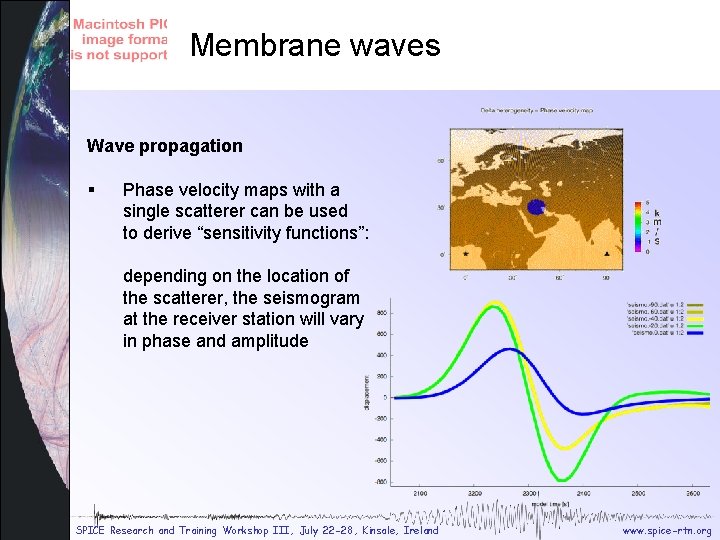
Membrane waves Membrane wave Wave propagation § Phase velocity maps with a single scatterer can be used to derive “sensitivity functions”: depending on the location of the scatterer, the seismogram at the receiver station will vary in phase and amplitude SPICE Research and Training Workshop III, July 22 -28, Kinsale, Ireland www. spice-rtn. org
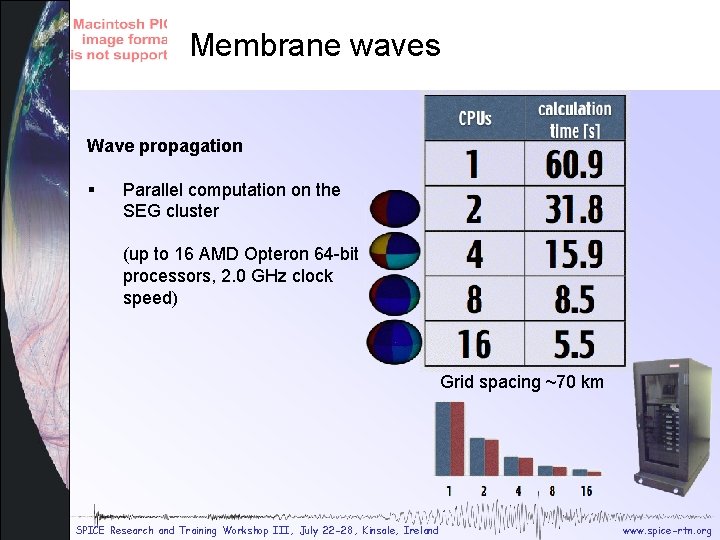
Membrane waves Membrane wave Wave propagation § Parallel computation on the SEG cluster (up to 16 AMD Opteron 64 -bit processors, 2. 0 GHz clock speed) Grid spacing ~70 km SPICE Research and Training Workshop III, July 22 -28, Kinsale, Ireland www. spice-rtn. org
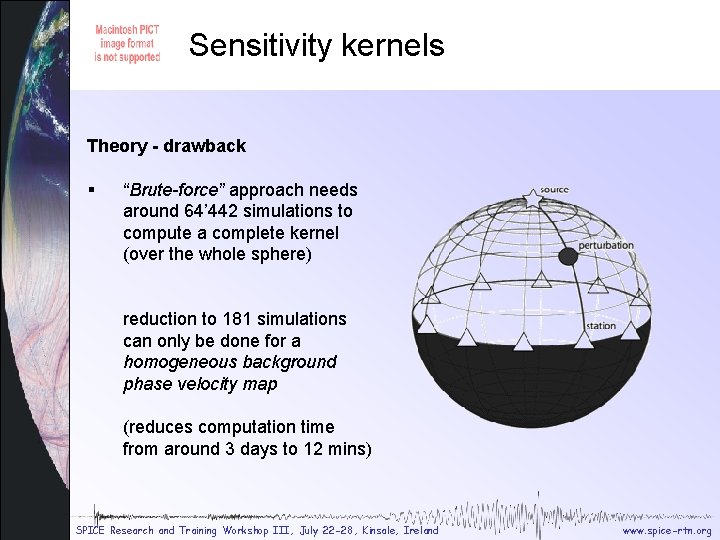
Sensitivity kernels Sensitivity theory Theory - drawback § “Brute-force” approach needs around 64’ 442 simulations to compute a complete kernel (over the whole sphere) reduction to 181 simulations can only be done for a homogeneous background phase velocity map (reduces computation time from around 3 days to 12 mins) SPICE Research and Training Workshop III, July 22 -28, Kinsale, Ireland www. spice-rtn. org
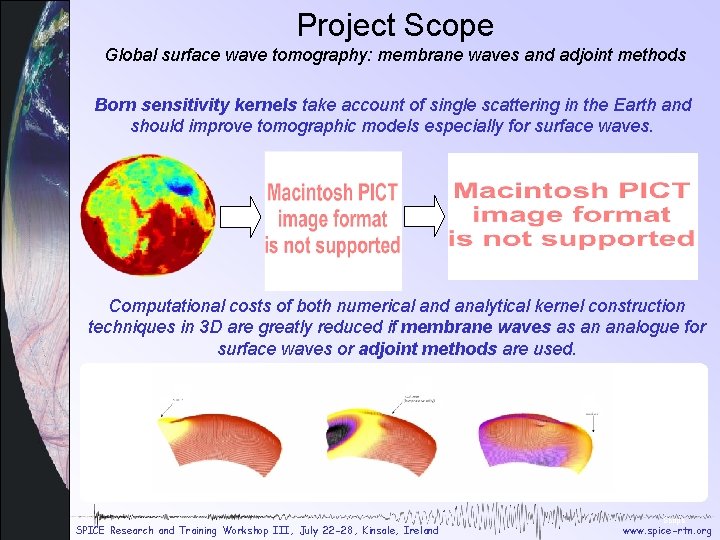
Project Scope Global surface wave tomography: membrane waves and adjoint methods Born sensitivity kernels take account of single scattering in the Earth and should improve tomographic models especially for surface waves. Computational costs of both numerical and analytical kernel construction techniques in 3 D are greatly reduced if membrane waves as an analogue for surface waves or adjoint methods are used. SPICE Research and Training Workshop III, July 22 -28, Kinsale, Ireland Scope www. spice-rtn. org
Main Results Grid analysis Membrane waves together with adjoint methods can be used to derive numerical sensitivity kernels including back-scattering. Benchmarking Sensitivity kernels analytical SPICE Research and Training Workshop III, July 22 -28, Kinsale, Ireland direct adjoint Results www. spice-rtn. org
Outlook Membrane kernels might slightly improve the resolution due to back-scattering and avoidance of far-field approximations. direct Love 150 s direct analytical Ray theory Full 3 D sensitivity kernels should allow for even better tomographic images. Adjoint methods may be a way to reach this. A next step will be the construction of 3 D kernels by normal modes and spectral element codes… Outlook SPICE Research and Training Workshop III, July 22 -28, Kinsale, Ireland www. spice-rtn. org
Thank you for your attention! SPICE Research and Training Workshop III, July 22 -28, Kinsale, Ireland Thanks www. spice-rtn. org