
Seismic Risk f Hazard Exposure Vulnerability Location HAZARD
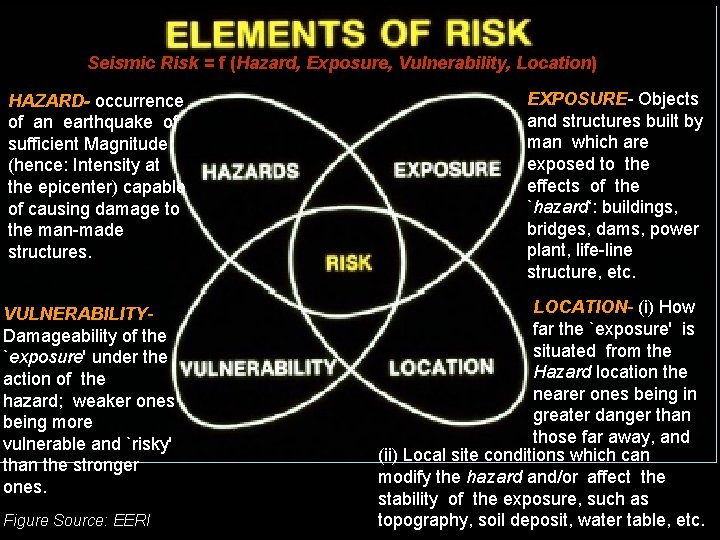
Seismic Risk = f (Hazard, Exposure, Vulnerability, Location) HAZARD- occurrence of an earthquake of sufficient Magnitude (hence: Intensity at the epicenter) capable of causing damage to the man-made structures. VULNERABILITYDamageability of the `exposure' under the action of the hazard; weaker ones being more vulnerable and `risky' than the stronger ones. Figure Source: EERI EXPOSURE- Objects and structures built by man which are exposed to the effects of the `hazard‘: buildings, bridges, dams, power plant, life-line structure, etc. LOCATION- (i) How far the `exposure' is situated from the Hazard location the nearer ones being in greater danger than those far away, and (ii) Local site conditions which can modify the hazard and/or affect the stability of the exposure, such as topography, soil deposit, water table, etc.
Primary Strategies under the School Awareness and Safety Programme § Place school safety on the education agenda § Form a School Safety Advisory Committee (. . pre-disaster) § Develop a District-wide School Safety Plan § Each school should prepare a Building Level Emergency Respone Plan § Draw in effective guidelines for safety regulations § Develop safety policies § Develop a school safety literature database on school safety issues
Comprehensive School Awareness and Safety Program Basic Components: A. Promoting Awareness and Education Activities B. Demonstrating Disaster Risk Management C. Training and Capacity Building D. Assessing Vulnerability and taking suitable Mitigation Options
A. Promoting Awareness & Education Activities Focus areas: § Disaster Management to be made a part of the normal school activities § Development of IEC materials § Initiate community based programmes
B. Demonstrating Disaster Risk Management Focus areas: § Acquire skills in many aspects (demonstrate through simulated mock drills) § Hazard hunt activity in schools and other simple exercises §Preparation of a Building Evacuation Plan for various hazards § School Disaster Management Plan / Building Level Emergency Response Plan §Simple structural and non-structural mitigation measures
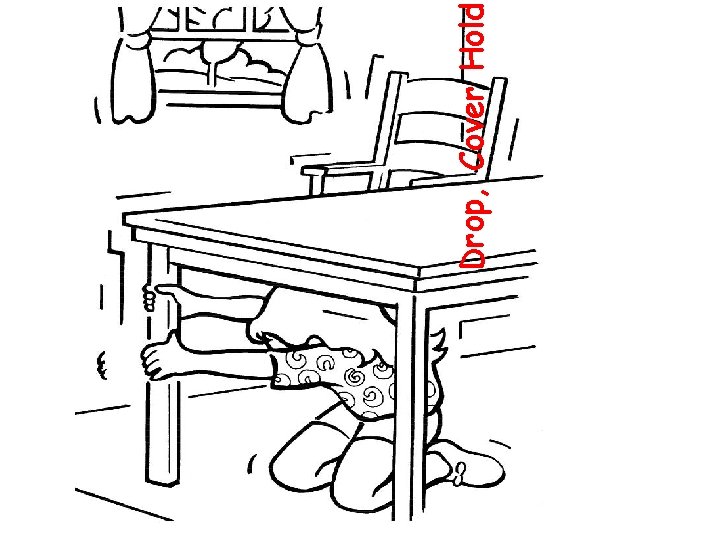
Drop, Cover Hold
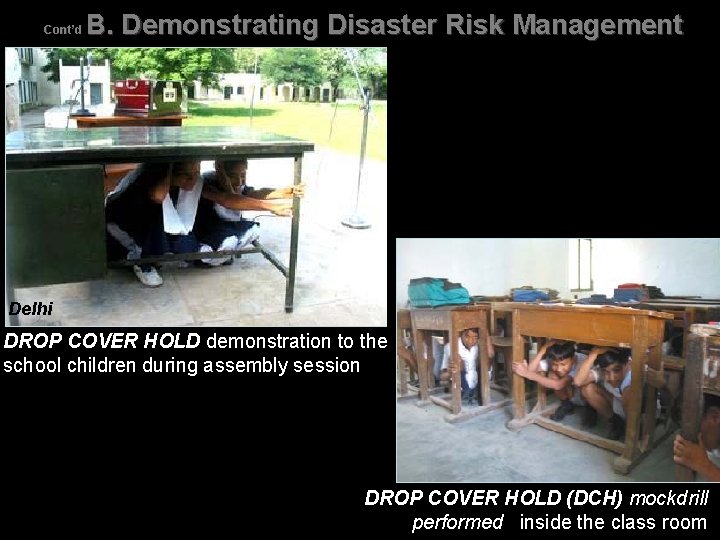
Cont’d B. Demonstrating Disaster Risk Management Delhi DROP COVER HOLD demonstration to the school children during assembly session DROP COVER HOLD (DCH) mockdrill performed inside the class room
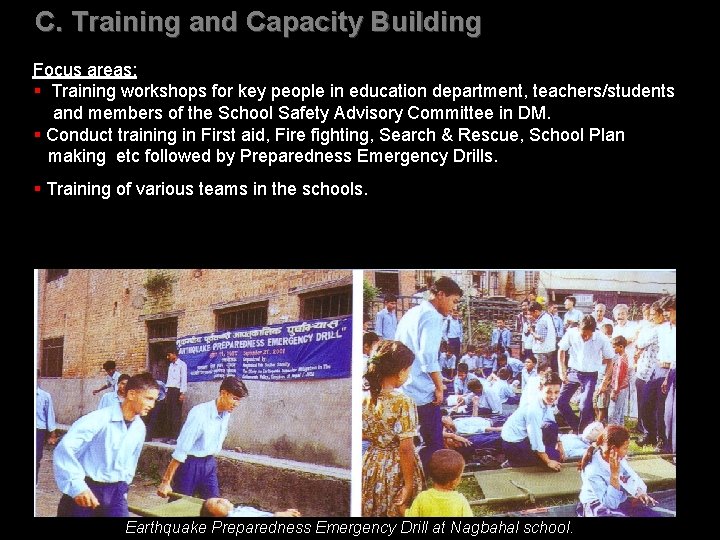
C. Training and Capacity Building Focus areas: § Training workshops for key people in education department, teachers/students and members of the School Safety Advisory Committee in DM. § Conduct training in First aid, Fire fighting, Search & Rescue, School Plan making etc followed by Preparedness Emergency Drills. § Training of various teams in the schools. Earthquake Preparedness Emergency Drill at Nagbahal school.
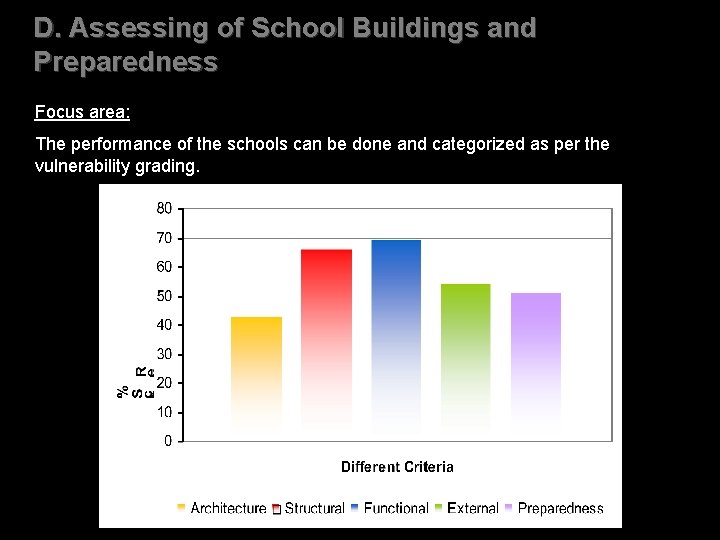
D. Assessing of School Buildings and Preparedness Focus area: The performance of the schools can be done and categorized as per the vulnerability grading.
Assessing Vulnerability and taking suitable Preparedness and Mitigation measures cont’d. Conducting the school assessment will: • promote student safety • increase school practices • to initiate aawareness process inabout the minds ofsafety the people who are directly or • provideassociated insight forwith newthe schools to adhere to school indirectly functioning of the schoolssafety to assess • help the schools toare prepare andper update response plans whether fulfillments made as the requirement of the National • identify and The manage safety. Primary and other risks Act 1947/ Local bylaws Building Code/ Bombay Education • assessment will help to prioritize immediate measures and act on it • foster the confidence of the parents and the community • assessment will demonstrate the commitment of the school mgmt
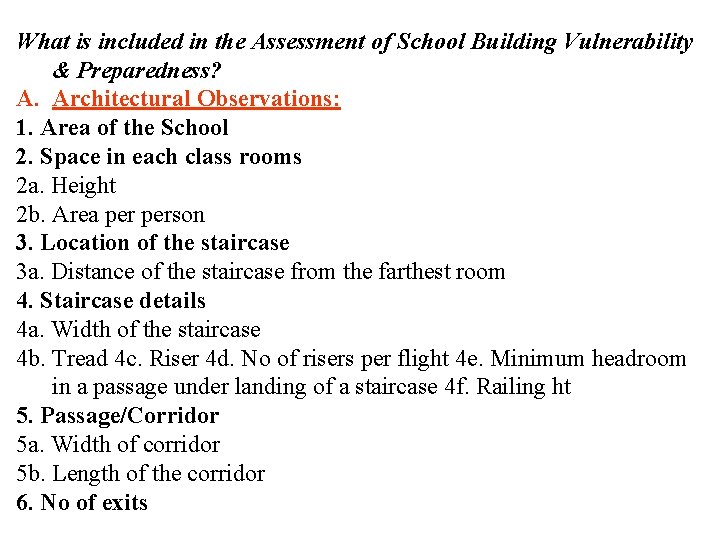
What is included in the Assessment of School Building Vulnerability & Preparedness? A. Architectural Observations: 1. Area of the School 2. Space in each class rooms 2 a. Height 2 b. Area person 3. Location of the staircase 3 a. Distance of the staircase from the farthest room 4. Staircase details 4 a. Width of the staircase 4 b. Tread 4 c. Riser 4 d. No of risers per flight 4 e. Minimum headroom in a passage under landing of a staircase 4 f. Railing ht 5. Passage/Corridor 5 a. Width of corridor 5 b. Length of the corridor 6. No of exits
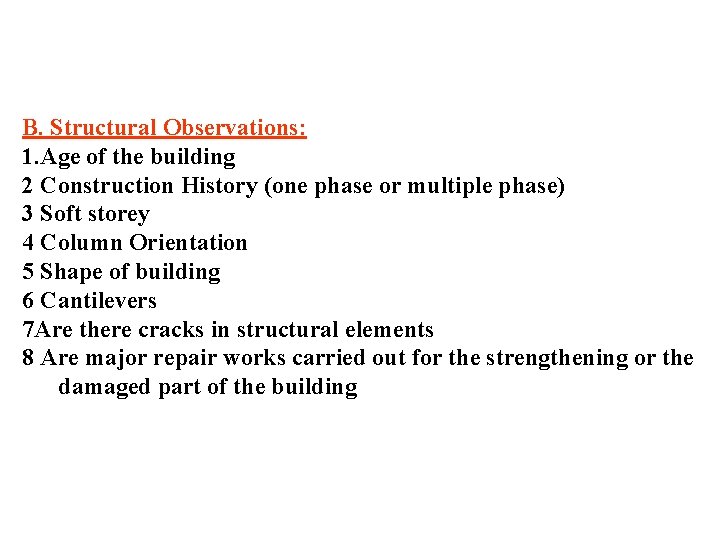
B. Structural Observations: 1. Age of the building 2 Construction History (one phase or multiple phase) 3 Soft storey 4 Column Orientation 5 Shape of building 6 Cantilevers 7 Are there cracks in structural elements 8 Are major repair works carried out for the strengthening or the damaged part of the building
C. Functional/Operational Observations: 1. Does the building have a Building Use Certificate 2. Condition of the Electrical panels/mains 3. Lightning Protection of buildings 4. Fixed fire fighting installation 5. Regular building maintenance works 6. Exit requirements 6 a. Type of exit (doorway/corridor/passageway) 6 b. Condition of the exit route eg: obstructions if any 7. Is adequate water/toilet facility available at each floor 8. Are staircase functional at all time or some exits are kept locked 9. Distance of Emergency Service from the school 10. Special Provisions for physically handicapped
D. External Observation: 1. Any hazardous unit near the vicinity? 2. Means of access 3. Traffic conditions on the road 4. Speed Breakers 5. Caution sign boards 6. Encroachment near the entrance of the building 7. Chances of water logging 8. Drains 9. Access of fire engine 10. Threat against falling of adjoining buildings/ compound walls/ parapet walls/ chimneys/talls structures/ electricity poles etc. 11. Open space 11 a. All round open space 12. Main entrance to the plot 13. Distance between two blocks or Separation between accessory and main building 14. Footpath width/Pathway
E. Preparedness Observations: 1. Are awareness programmes organized for the students and the staff 2. Are teachers and students aware of the vulnerability or vulnerable areas in the school 3. Are mock-drills performed regularly in the schools 4. Safe place/shelters identified in the school 5. Assignment of duties and responsibilities to the staff 6. Are staff trained for the first-aid 7. Provision for firefighting systems 8. Public addressal system in working condition



- Slides: 18