
Seismic Profiling of subduction zones Lithosphere above Benioff
Seismic Profiling of subduction zones – Lithosphere above Benioff zone Morphology of Benioff zones: Mexican arc Xyoli Pérez-Campos February 14, 2008
Outline • Introduction • Seismology techniques and their objectives – Local seismicity: Benioff zone; overriding plate stresses – Surface wave dispersion: continental crust – Ray tracing: continental and oceanic slab structure – Receiver functions: continental and oceanic crust lithosphere – Global tomography: Global view of the Cocos plate – P-wave tomography: Cocos plate in depth – Attenuation: mantle wedge
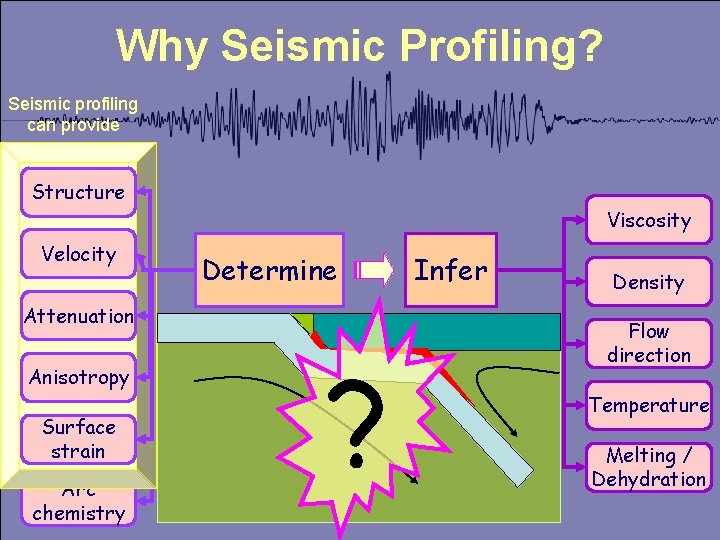
Why Seismic Profiling? Seismic profiling can provide Structure Viscosity Velocity Determine Infer Attenuation Anisotropy Surface strain Arc chemistry ? Density Flow direction Temperature Melting / Dehydration

Observations: Oblique arc: Trans. Mexican Volcanic Belt (TMVB) • Diference in subduction angles • Flat subduction under south-central Mexico Relation of Cocos plate subduction with volcanic activity Pardo and Suárez (1995)
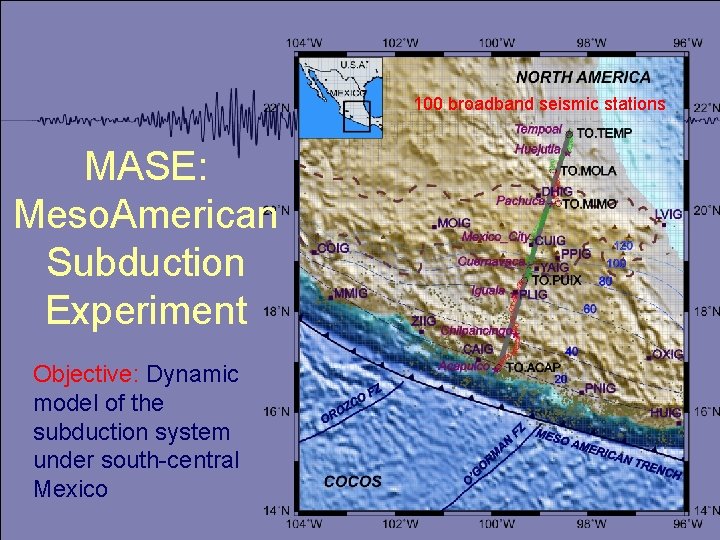
100 broadband seismic stations MASE: Meso. American Subduction Experiment Objective: Dynamic model of the subduction system under south-central Mexico
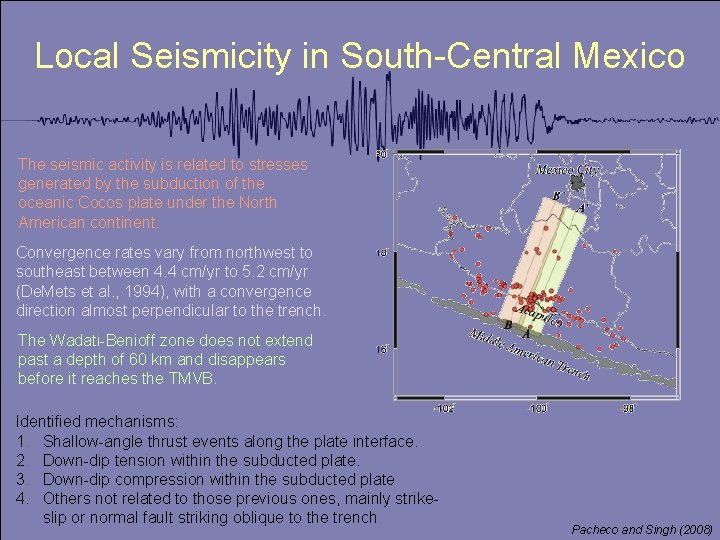
Local Seismicity in South-Central Mexico The seismic activity is related to stresses generated by the subduction of the oceanic Cocos plate under the North American continent. Convergence rates vary from northwest to southeast between 4. 4 cm/yr to 5. 2 cm/yr (De. Mets et al. , 1994), with a convergence direction almost perpendicular to the trench. The Wadati-Benioff zone does not extend past a depth of 60 km and disappears before it reaches the TMVB. Identified mechanisms: 1. Shallow-angle thrust events along the plate interface. 2. Down-dip tension within the subducted plate. 3. Down-dip compression within the subducted plate 4. Others not related to those previous ones, mainly strikeslip or normal fault striking oblique to the trench. Pacheco and Singh (2008)

Local seismicity Strike-slip or normal fault striking oblique to the trench Pacheco and Singh (2008) Shallow-angle thrust events along the plate interface
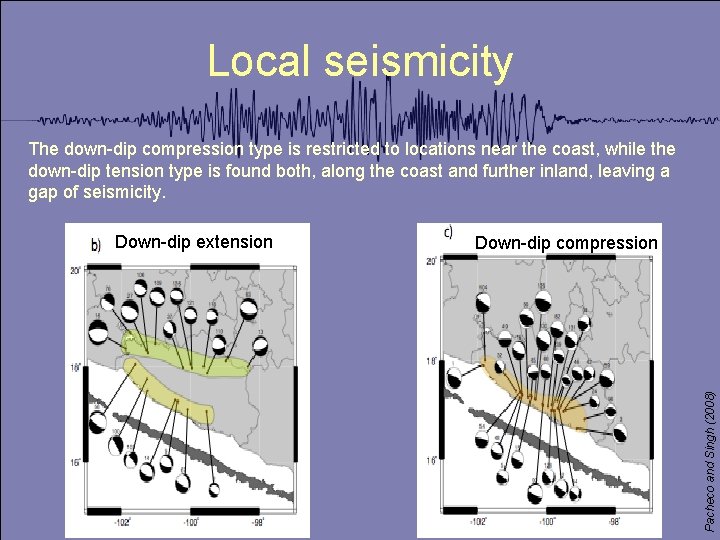
Local seismicity The down-dip compression type is restricted to locations near the coast, while the down-dip tension type is found both, along the coast and further inland, leaving a gap of seismicity. Down-dip compression Pacheco and Singh (2008) Down-dip extension
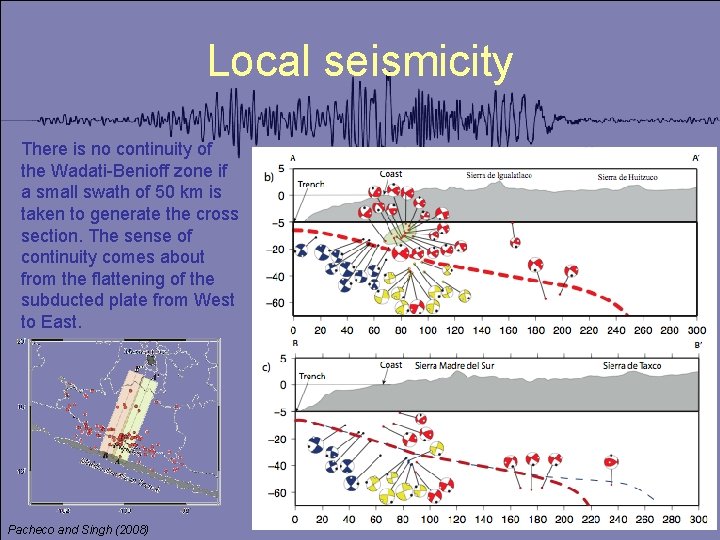
Local seismicity There is no continuity of the Wadati-Benioff zone if a small swath of 50 km is taken to generate the cross section. The sense of continuity comes about from the flattening of the subducted plate from West to East. Pacheco and Singh (2008)

Surface wave tomography Objective: Crustal structure Use surface waves from regional recording The dispersion curves for an earthquake recorded at two different stations are different. Dispersion curves Figure courtesy of Arturo Iglesias
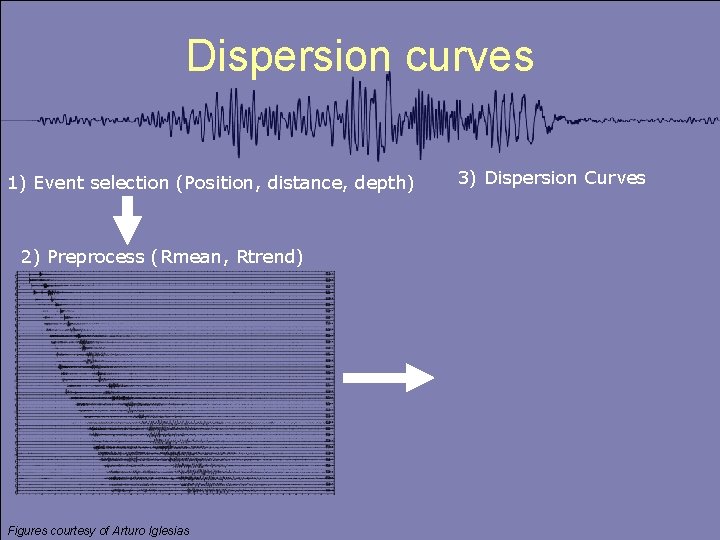
Dispersion curves 1) Event selection (Position, distance, depth) 2) Preprocess (Rmean, Rtrend) Figures courtesy of Arturo Iglesias 3) Dispersion Curves

Surface wave tomography 4) Tomographic images for each period (continuous regionalization: Debayle and Sambridge, 2004) Paths event-station Figures courtesy of Arturo Iglesias
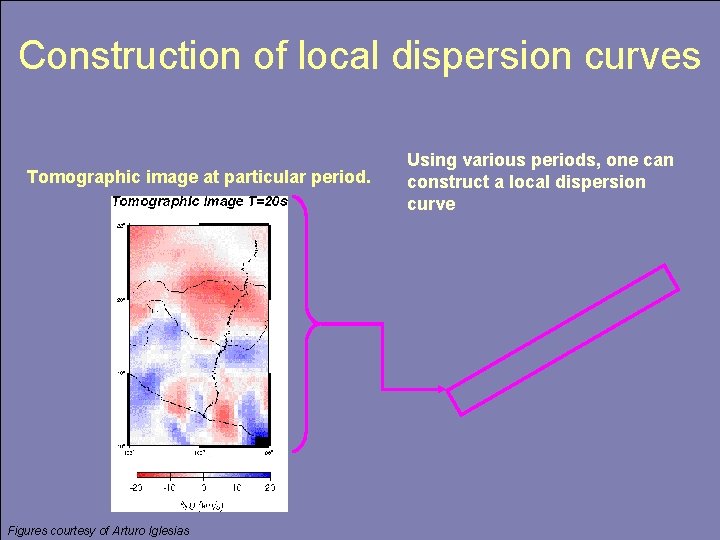
Construction of local dispersion curves Tomographic image at particular period. Figures courtesy of Arturo Iglesias Using various periods, one can construct a local dispersion curve
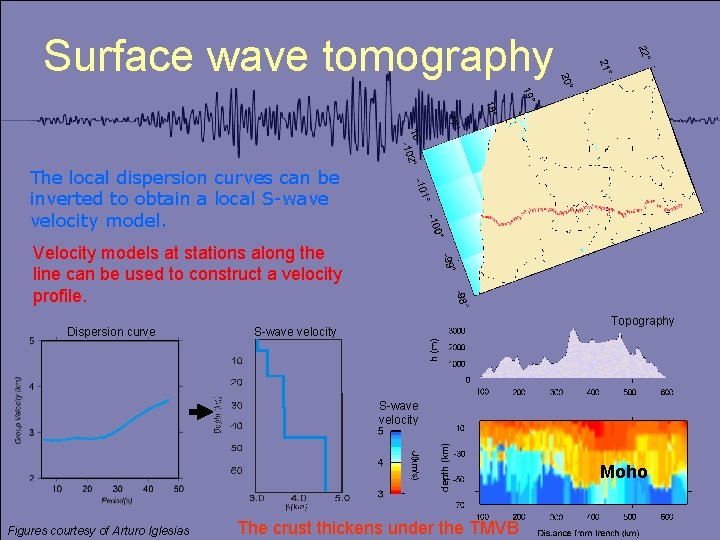
Surface wave tomography The local dispersion curves can be inverted to obtain a local S-wave velocity model. Velocity models at stations along the line can be used to construct a velocity profile. Dispersion curve Topography S-wave velocity Moho Figures courtesy of Arturo Iglesias The crust thickens under the TMVB
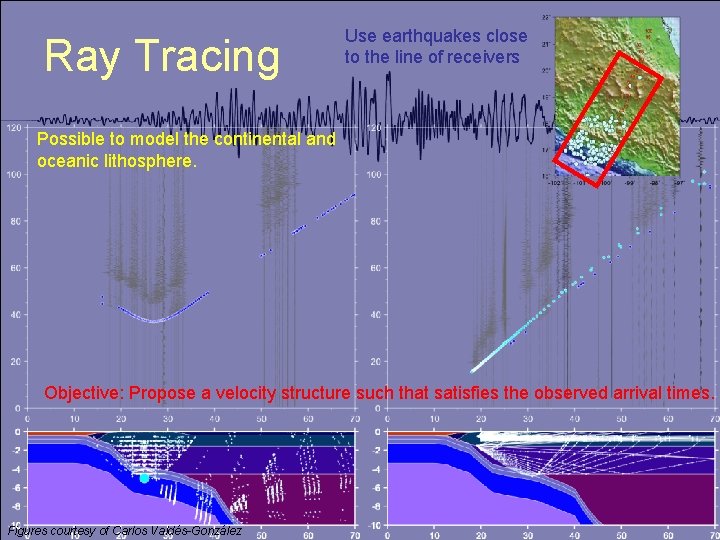
Ray Tracing Use earthquakes close to the line of receivers Possible to model the continental and oceanic lithosphere. Objective: Propose a velocity structure such that satisfies the observed arrival times. Figures courtesy of Carlos Valdés-González
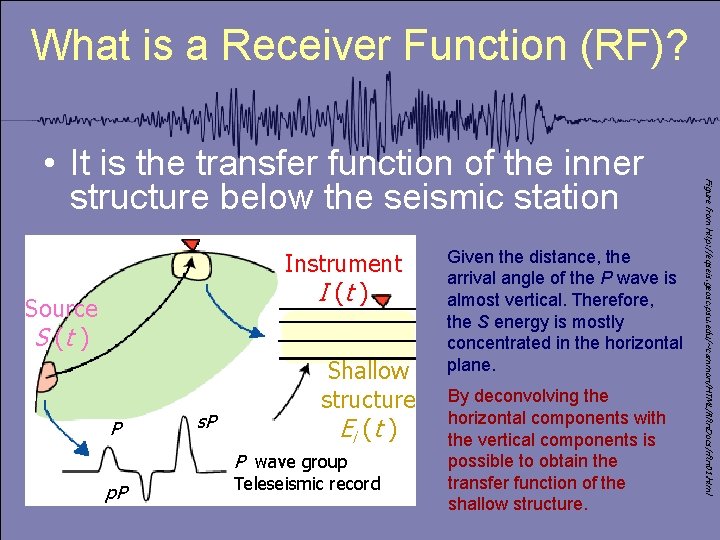
What is a Receiver Function (RF)? Instrument I (t ) Source S (t ) P s. P Shallow structure Ei ( t ) P wave group p. P Teleseismic record Given the distance, the arrival angle of the P wave is almost vertical. Therefore, the S energy is mostly concentrated in the horizontal plane. By deconvolving the horizontal components with the vertical components is possible to obtain the transfer function of the shallow structure. Figure from http: //eqseis. geosc. psu. edu/~cammon/HTML/Rftn. Docs/rftn 01. html • It is the transfer function of the inner structure below the seismic station
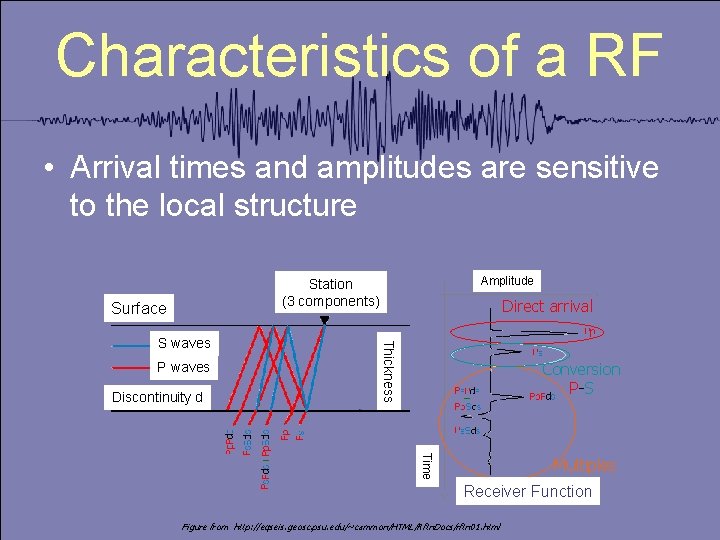
Characteristics of a RF • Arrival times and amplitudes are sensitive to the local structure Amplitude Station (3 components) Surface P waves Discontinuity d Thickness S waves Direct arrival Conversion P-S Time Multiples Receiver Function Figure from http: //eqseis. geosc. psu. edu/~cammon/HTML/Rftn. Docs/rftn 01. html
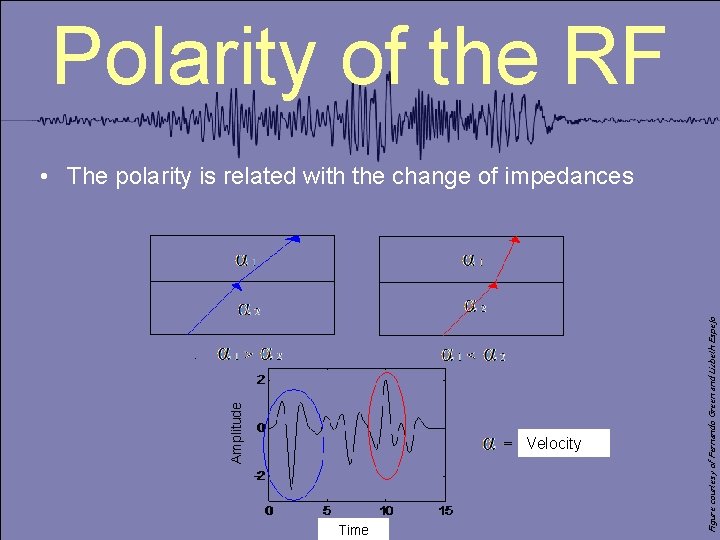
Polarity of the RF Velocity Time Figure courtesy of Fernando Green and Lizbeth Espejo Amplitude • The polarity is related with the change of impedances
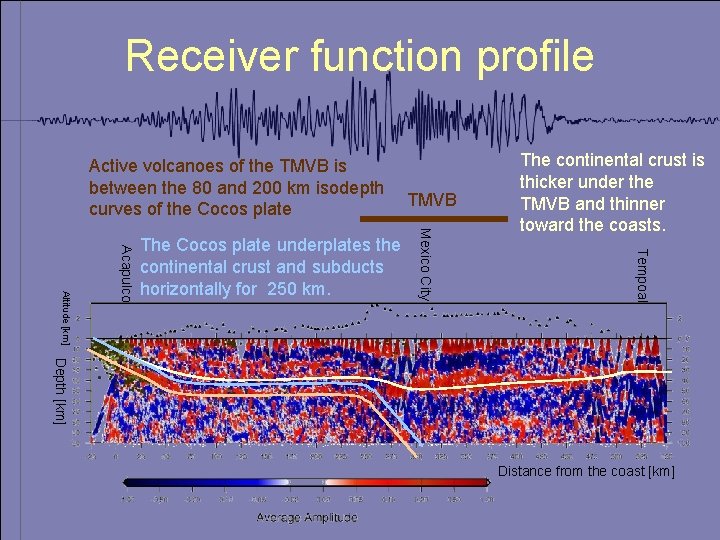
Receiver function profile Active volcanoes of the TMVB is between the 80 and 200 km isodepth curves of the Cocos plate Tempoal Mexico City Acapulco Altitude [km] The Cocos plate underplates the continental crust and subducts horizontally for 250 km. TMVB The continental crust is thicker under the TMVB and thinner toward the coasts. Depth [km] Distance from the coast [km]
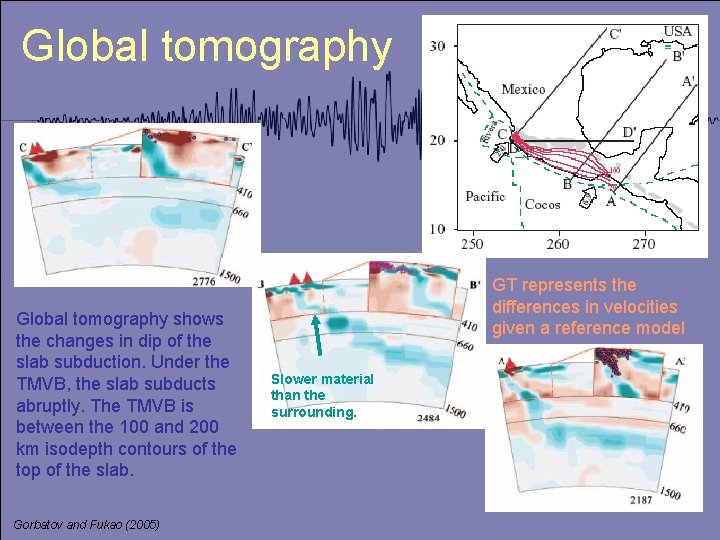
Global tomography shows the changes in dip of the slab subduction. Under the TMVB, the slab subducts abruptly. The TMVB is between the 100 and 200 km isodepth contours of the top of the slab. Gorbatov and Fukao (2005) GT represents the differences in velocities given a reference model Slower material than the surrounding.
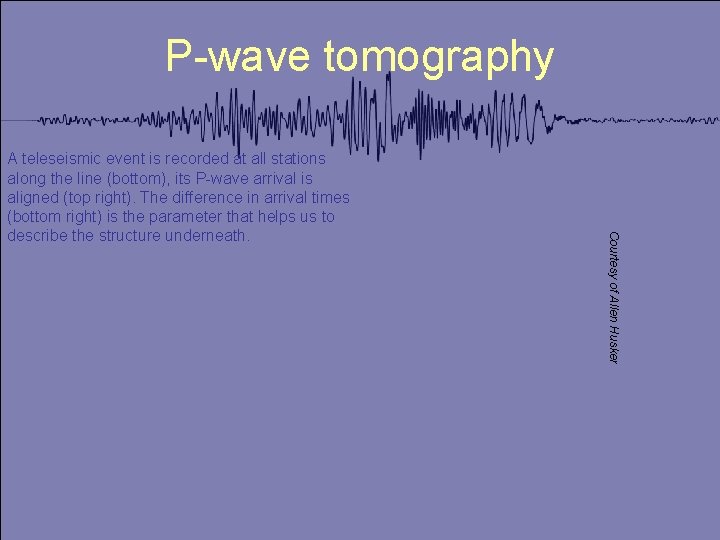
P-wave tomography Courtesy of Allen Husker A teleseismic event is recorded at all stations along the line (bottom), its P-wave arrival is aligned (top right). The difference in arrival times (bottom right) is the parameter that helps us to describe the structure underneath.
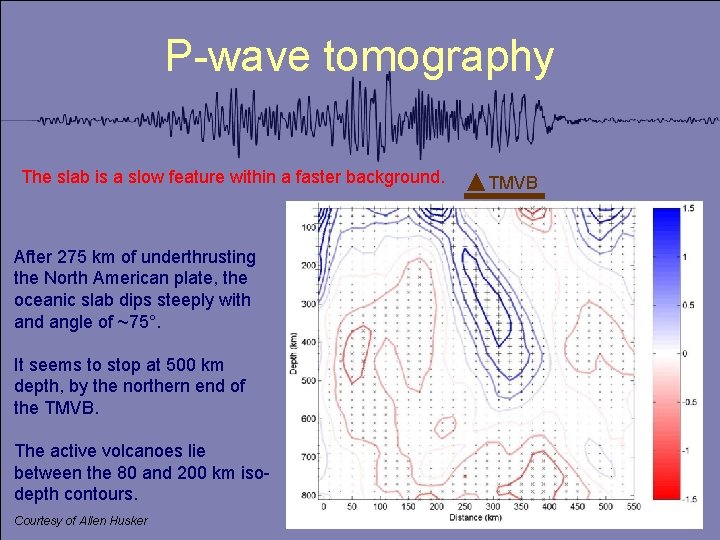
P-wave tomography The slab is a slow feature within a faster background. After 275 km of underthrusting the North American plate, the oceanic slab dips steeply with and angle of ~75°. It seems to stop at 500 km depth, by the northern end of the TMVB. The active volcanoes lie between the 80 and 200 km isodepth contours. Courtesy of Allen Husker TMVB
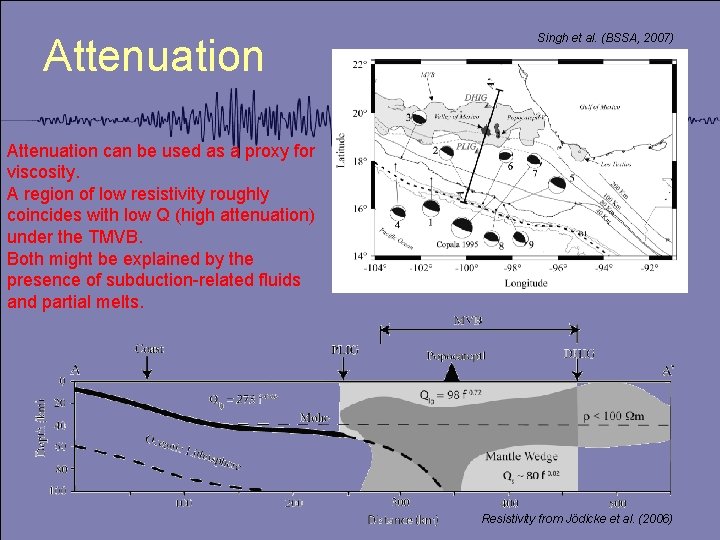
Attenuation Singh et al. (BSSA, 2007) Attenuation can be used as a proxy for viscosity. A region of low resistivity roughly coincides with low Q (high attenuation) under the TMVB. Both might be explained by the presence of subduction-related fluids and partial melts. Resistivity from Jödicke et al. (2006)
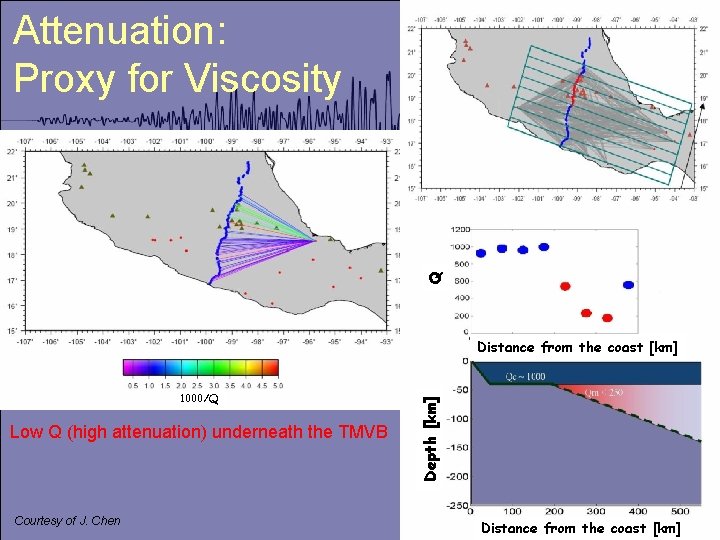
Q Attenuation: Proxy for Viscosity 1000/Q Low Q (high attenuation) underneath the TMVB Courtesy of J. Chen Depth [km] Distance from the coast [km]
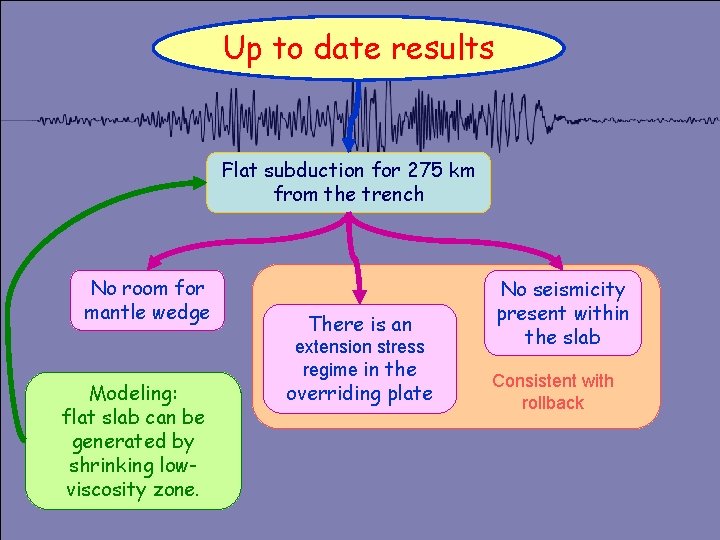
Up to date results Flat subduction for 275 km from the trench No room for mantle wedge Modeling: flat slab can be generated by shrinking lowviscosity zone. There is an extension stress regime in the overriding plate No seismicity present within the slab Consistent with rollback
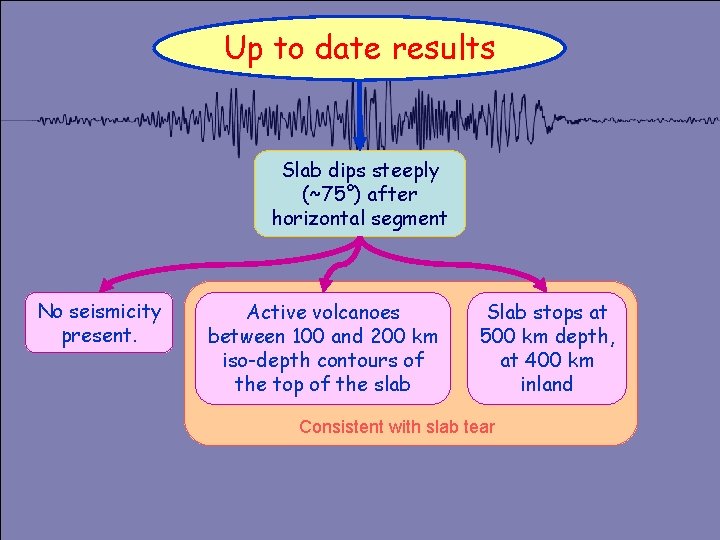
Up to date results Slab dips steeply (~75°) after horizontal segment No seismicity present. Active volcanoes between 100 and 200 km iso-depth contours of the top of the slab Slab stops at 500 km depth, at 400 km inland Consistent with slab tear
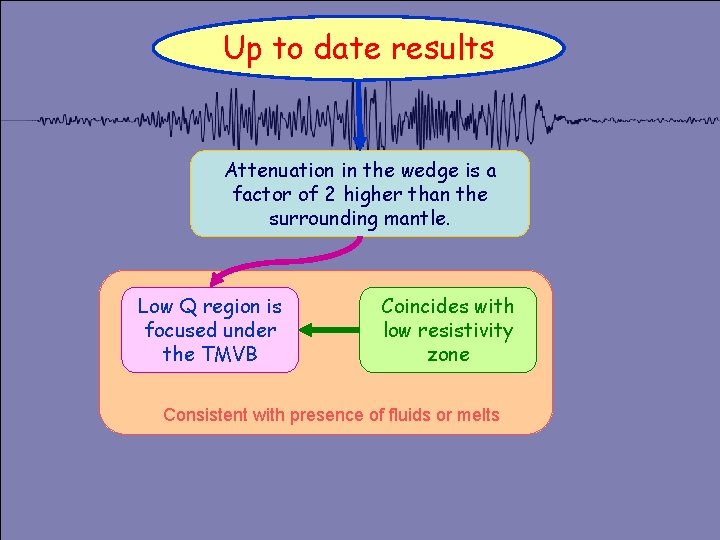
Up to date results Attenuation in the wedge is a factor of 2 higher than the surrounding mantle. Low Q region is focused under the TMVB Coincides with low resistivity zone Consistent with presence of fluids or melts
- Slides: 27