
Seismic Interferometry Instead of using just primary arrivals
- Slides: 16
Seismic Interferometry Instead of using just primary arrivals, you also use the multiples for a wider & more complete view Gerard Schuster University of Utah
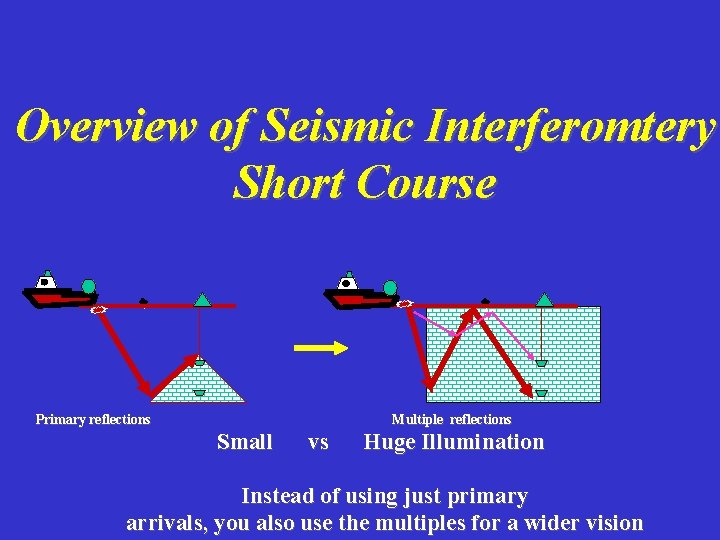
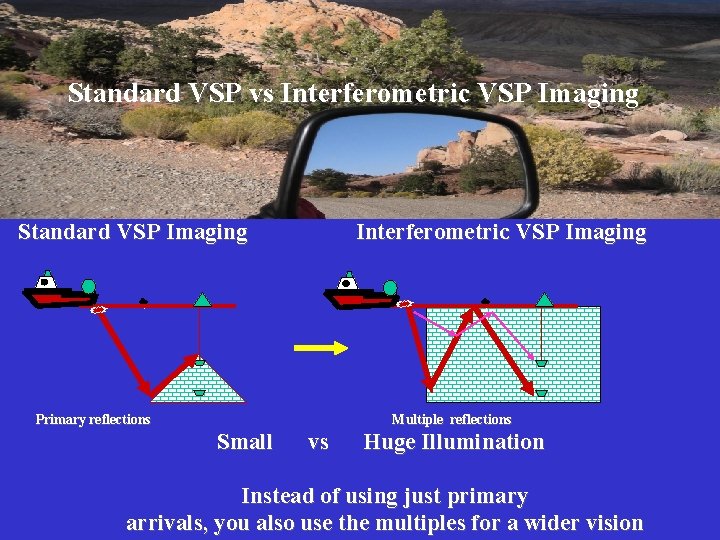
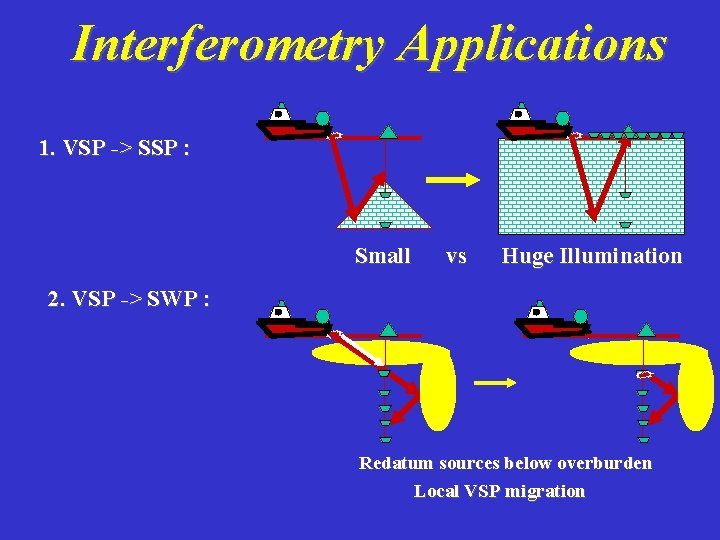
Overview of Seismic Interferomtery Short Course Primary reflections Multiple reflections Small vs Huge Illumination Instead of using just primary arrivals, you also use the multiples for a wider vision
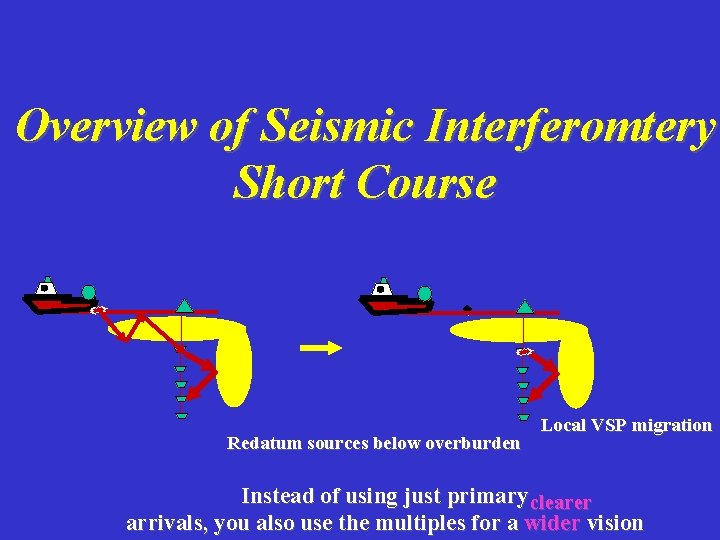
Overview of Seismic Interferomtery Short Course Redatum sources below overburden Local VSP migration Instead of using just primary clearer arrivals, you also use the multiples for a wider vision
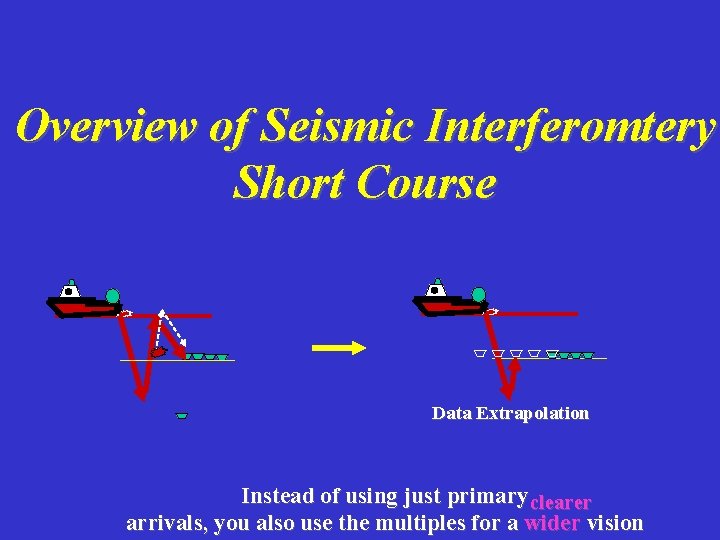
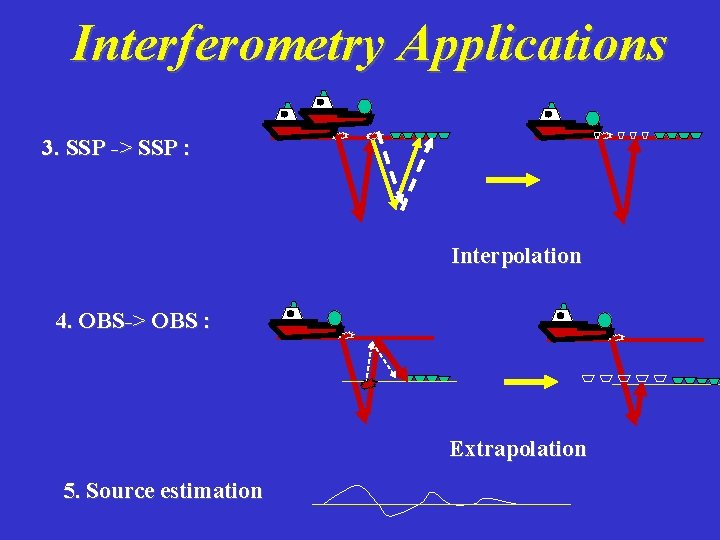
Overview of Seismic Interferomtery Short Course Data Extrapolation Instead of using just primary clearer arrivals, you also use the multiples for a wider vision
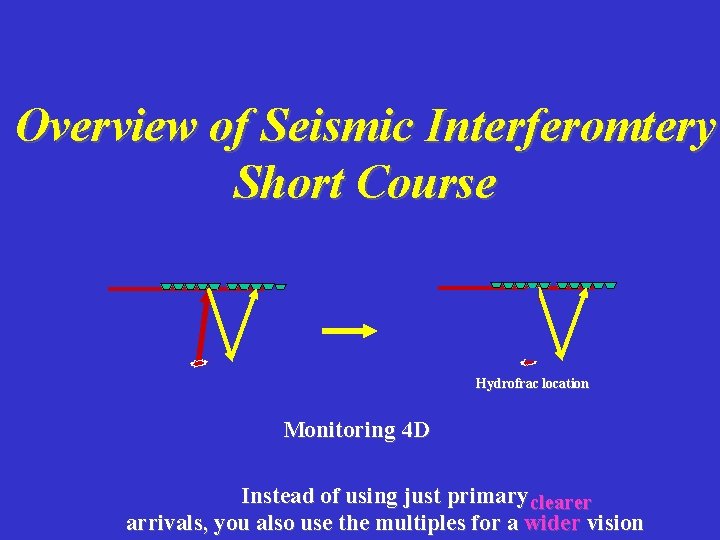
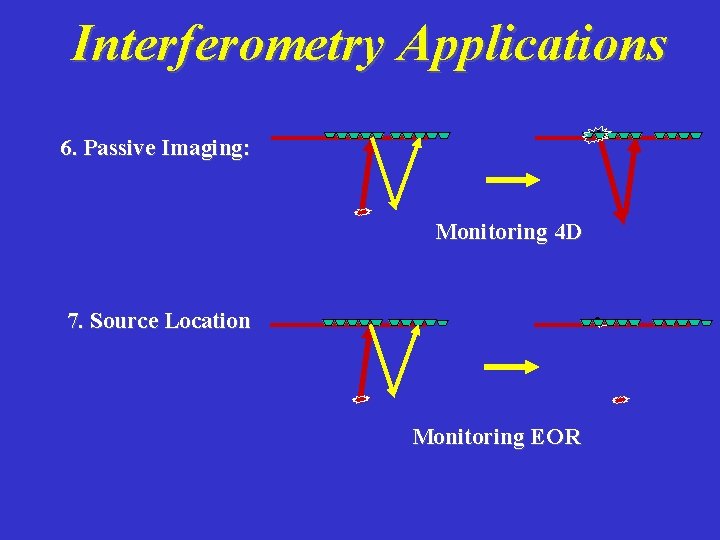
Overview of Seismic Interferomtery Short Course Hydrofrac location Monitoring 4 D Instead of using just primary clearer arrivals, you also use the multiples for a wider vision
Goal: Learn Principles and Algorithms in Seismic Interferometry Format Mornings: Lecture 50 minutes, followed by exercise or MATLAB lab. Format Afternoon: MATLAB labs+discussion. Topics: Deterministic interferometry, stochastic interferometry, 3 x 3 classification matrix, reciprocity theorems, applications to VSP, SSP, OBS, and Xwell data.
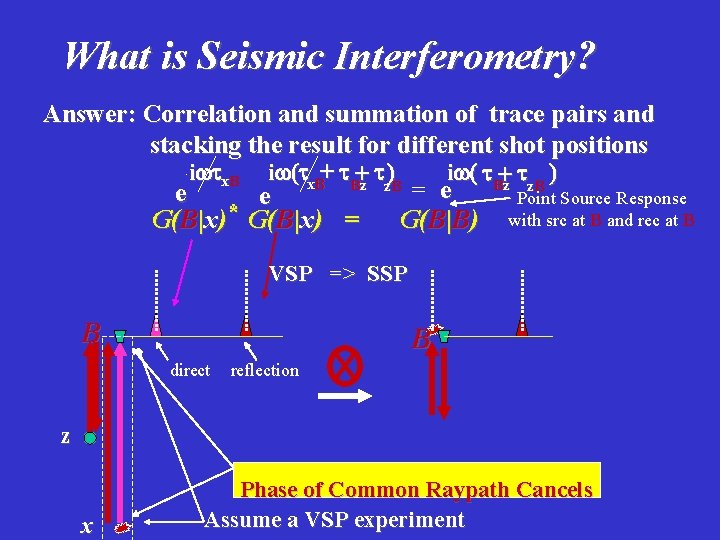
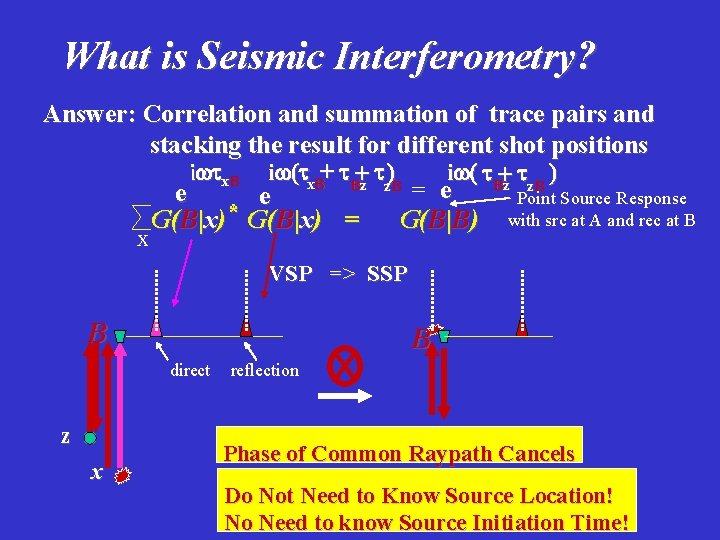
What is Seismic Interferometry? Answer: Correlation and summation of trace pairs and stacking the result for different shot positions iwtx. B e G(B|x)* iw(tx. B+ t. B+z tz)B e G(B|x) = iw( t. B+z tz. B ) = e G(B|B) Point Source Response with src at B and rec at B VSP => SSP B B direct z reflection A x G(A|B) Phase of Common Raypath Cancels Assume a VSP experiment
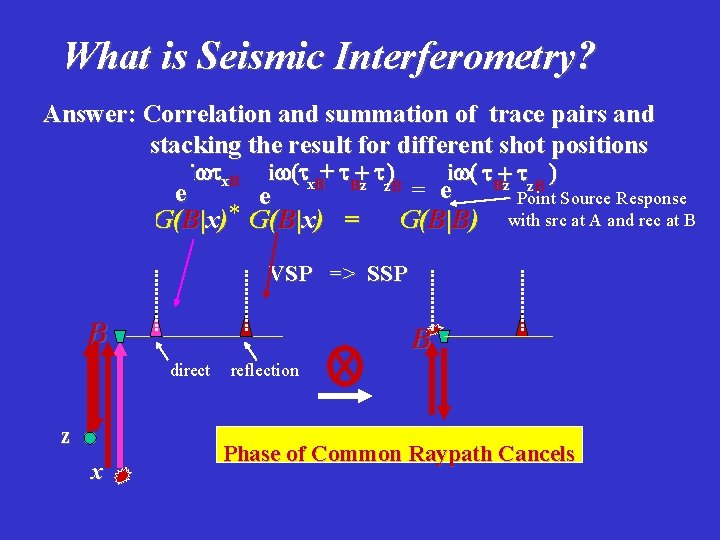
What is Seismic Interferometry? Answer: Correlation and summation of trace pairs and stacking the result for different shot positions - iwtx. B x e G(B|x)** iw(tx. B+ t. B+z tz)B e G(B|x) = iw( t. B+z tz. B ) = e G(B|B) Point Source Response with src at A and rec at B VSP => SSP B B direct z x x reflection G(A|B) A Phase of Common Raypath Cancels
What is Seismic Interferometry? Answer: Correlation and summation of trace pairs and stacking the result for different shot positions iwtx. B x e G(B|x)* iw(tx. B+ t. B+z tz)B e G(B|x) = iw( t. B+z tz. B ) = e G(B|B) Point Source Response with src at A and rec at B VSP => SSP B B direct z x x reflection G(A|B) A Phase of Common Raypath Cancels Do Not Need to Know Source Location! No Need to know Source Initiation Time!
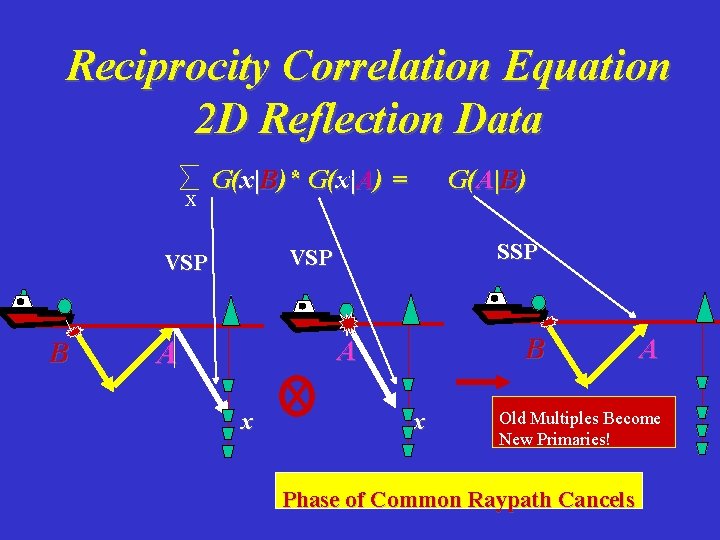
Reciprocity Correlation Equation 2 D Reflection Data x k A) = G(x|B)* G(x| SSP VSP B G(A|B) B A A x x A Old Multiples Become New Primaries! Phase of Common Raypath Cancels
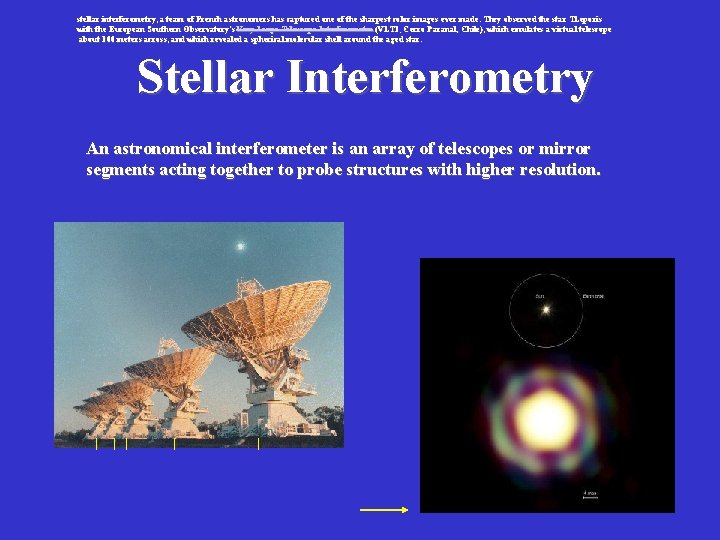
stellar interferometry, a team of French astronomers has captured one of the sharpest color images ever made. They observed the star TLeporis with the European Southern Observatory's Very Large Telescope Interferometer (VLTI; Cerro Paranal, Chile), which emulates a virtual telescope about 100 meters across, and which revealed a spherical molecular shell around the aged star. Stellar Interferometry An astronomical interferometer is an array of telescopes or mirror segments acting together to probe structures with higher resolution.
Standard VSP vs Interferometric VSP Imaging Standard VSP Imaging Interferometric VSP Imaging Primary reflections Multiple reflections Small vs Huge Illumination Instead of using just primary arrivals, you also use the multiples for a wider vision
Interferometry Applications 1. VSP -> SSP : Small vs Huge Illumination 2. VSP -> SWP : Redatum sources below overburden Local VSP migration
Interferometry Applications 3. SSP -> SSP : Interpolation 4. OBS-> OBS : Extrapolation 5. Source estimation
Interferometry Applications 6. Passive Imaging: Monitoring 4 D 7. Source Location Monitoring EOR
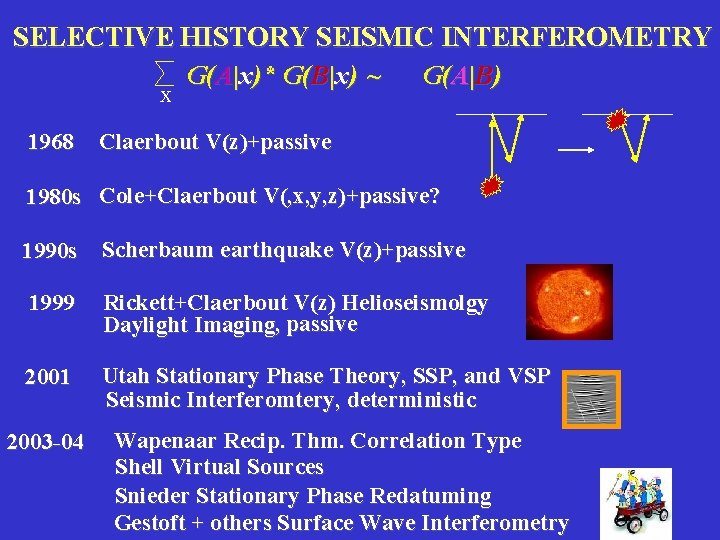
SELECTIVE HISTORY SEISMIC INTERFEROMETRY G(A|x)* G(B|x) ~ G(A|B) ! x 1968 Claerbout V(z)+passive 1980 s Cole+Claerbout V(, x, y, z)+passive? 1990 s Scherbaum earthquake V(z)+passive 1999 Rickett+Claerbout V(z) Helioseismolgy Daylight Imaging, passive 2001 Utah Stationary Phase Theory, SSP, and VSP Seismic Interferomtery, deterministic 2003 -04 Wapenaar Recip. Thm. Correlation Type Shell Virtual Sources Snieder Stationary Phase Redatuming Gestoft + others Surface Wave Interferometry