
Seismic Characteristics in Marine Hydrate Systems Guangsheng Gu
- Slides: 25
Seismic Characteristics in Marine Hydrate Systems Guangsheng Gu 1 Advisors: George J. Hirasaki 1, Walter G. Chapman 1 Collaborators: Colin A. Zelt 2, Priyank Jaiswal 2 1 Dept. of Chemical & Biomolecular Engineering 2 Dept. of Earth Science Rice University, Houston, TX, 77005 Consortium on Processes in Porous Media, 15 th, April 26, 2011 1 Rice University, Houston
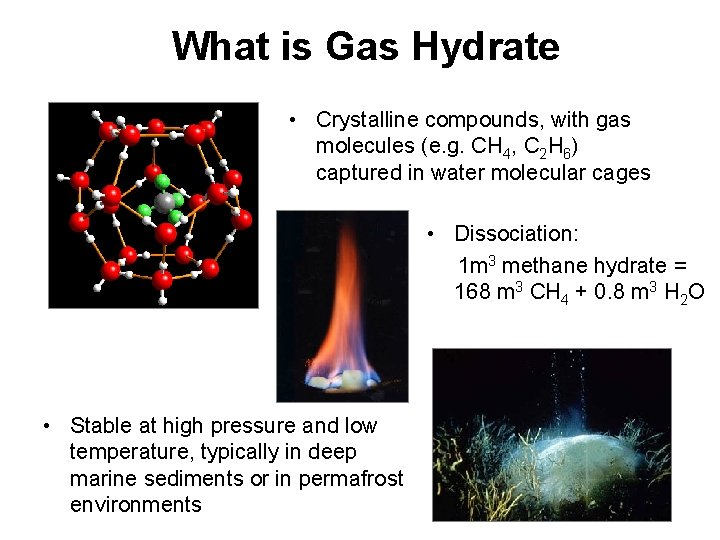
What is Gas Hydrate • Crystalline compounds, with gas molecules (e. g. CH 4, C 2 H 6) captured in water molecular cages • Dissociation: 1 m 3 methane hydrate = 168 m 3 CH 4 + 0. 8 m 3 H 2 O • Stable at high pressure and low temperature, typically in deep marine sediments or in permafrost environments 2
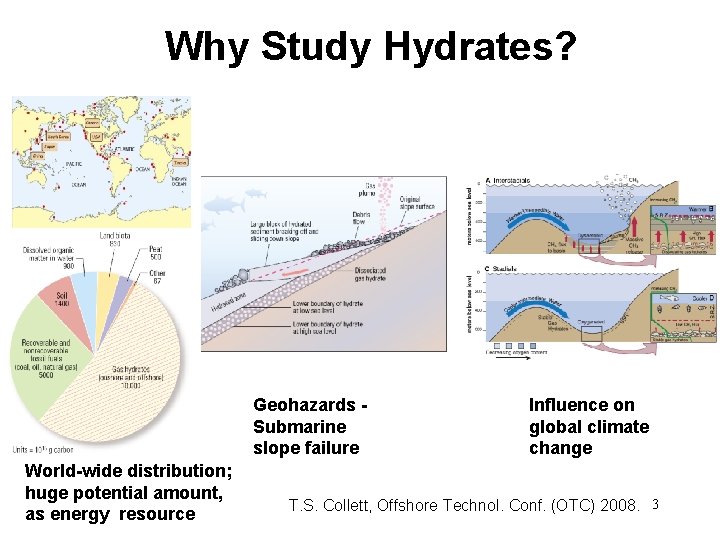
Why Study Hydrates? Geohazards Submarine slope failure World-wide distribution; huge potential amount, as energy resource Influence on global climate change T. S. Collett, Offshore Technol. Conf. (OTC) 2008. 3
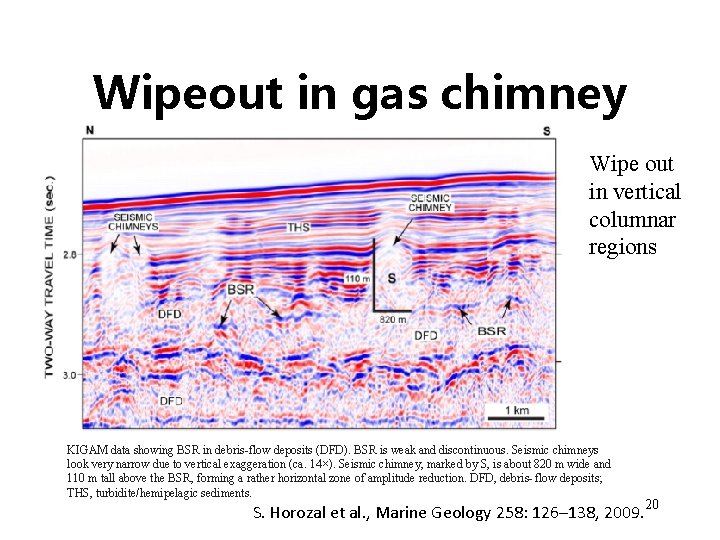
Major Seismic Characteristics • Used to identify hydrates in marine sediments • Bottom Simulating Reflector (BSR) • Seismic Blanking in Lateral Strata • Wipeout in Gas Chimeny 4
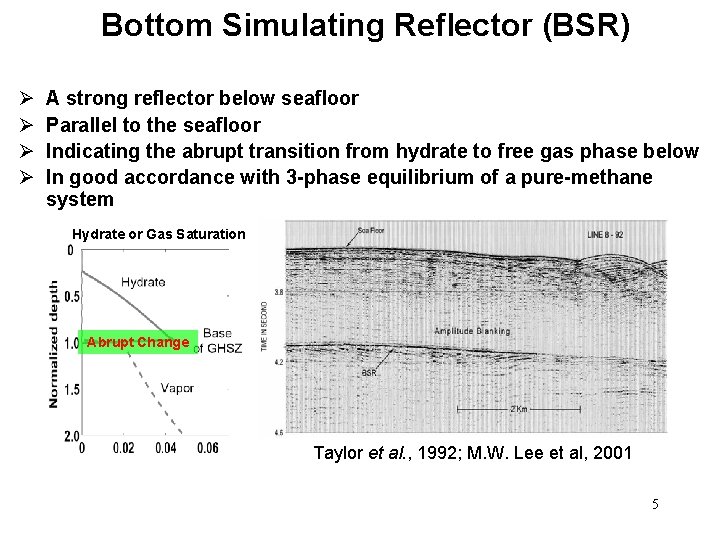
Bottom Simulating Reflector (BSR) Ø Ø A strong reflector below seafloor Parallel to the seafloor Indicating the abrupt transition from hydrate to free gas phase below In good accordance with 3 -phase equilibrium of a pure-methane system Hydrate or Gas Saturation Abrupt Change Taylor et al. , 1992; M. W. Lee et al, 2001 5
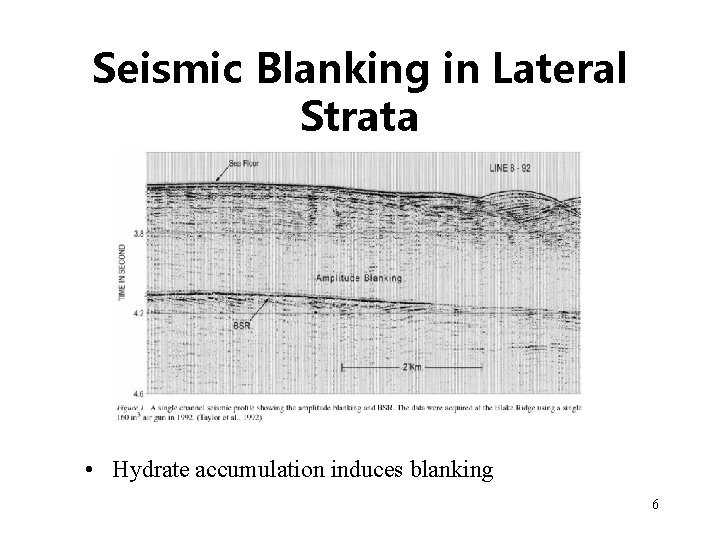
Seismic Blanking in Lateral Strata • Hydrate accumulation induces blanking 6
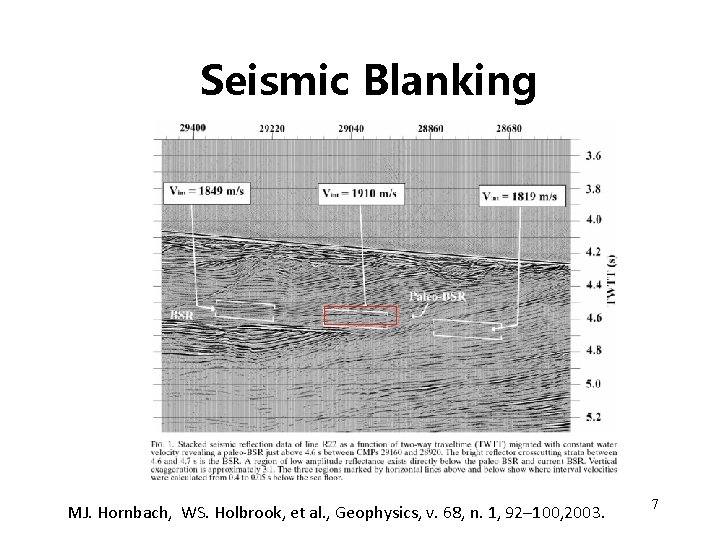
Seismic Blanking MJ. Hornbach, WS. Holbrook, et al. , Geophysics, v. 68, n. 1, 92– 100, 2003. 7
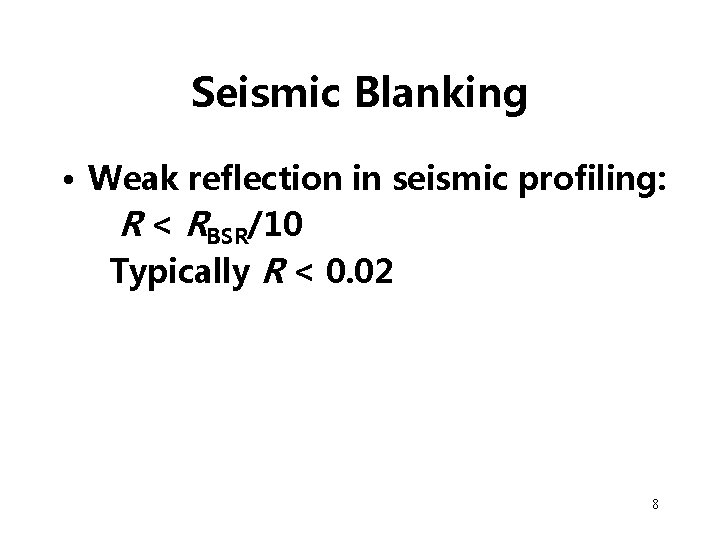
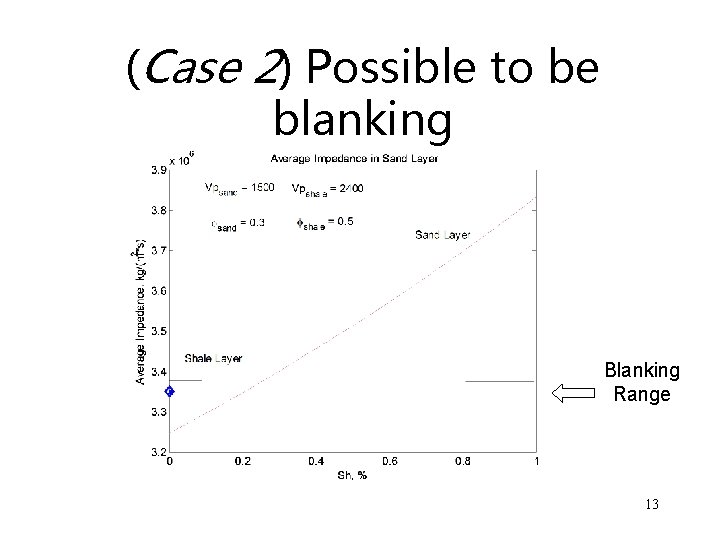
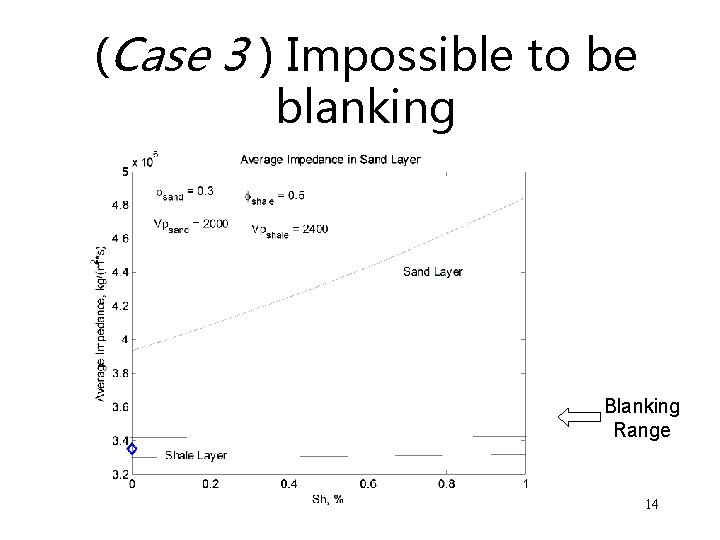
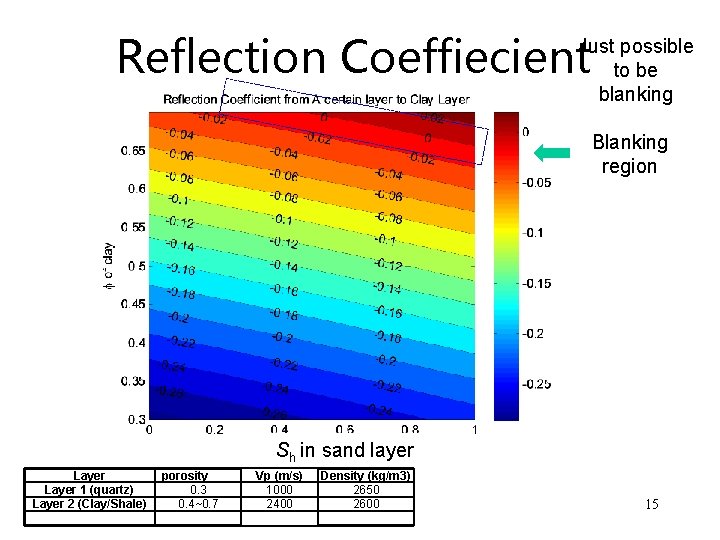
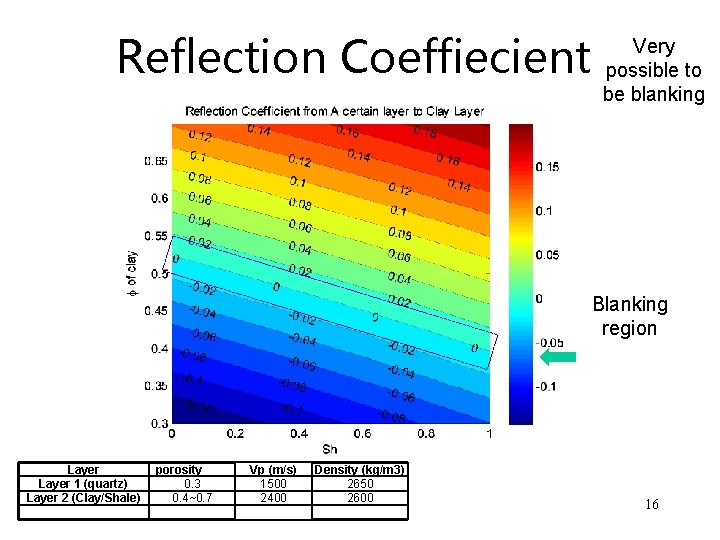
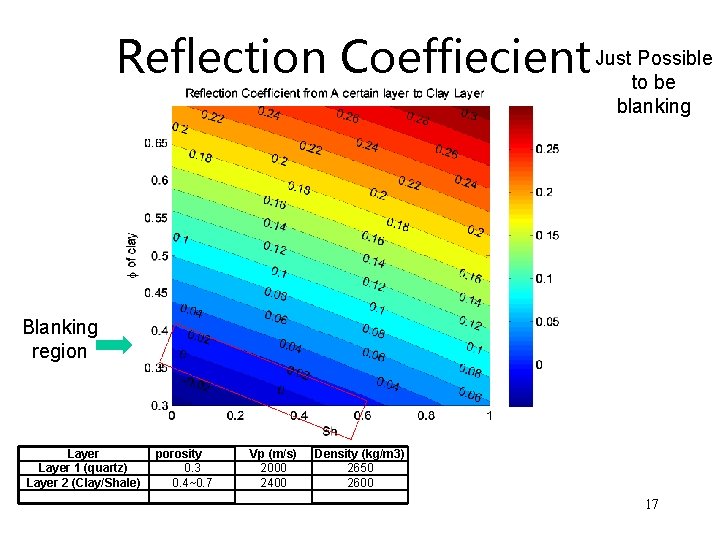
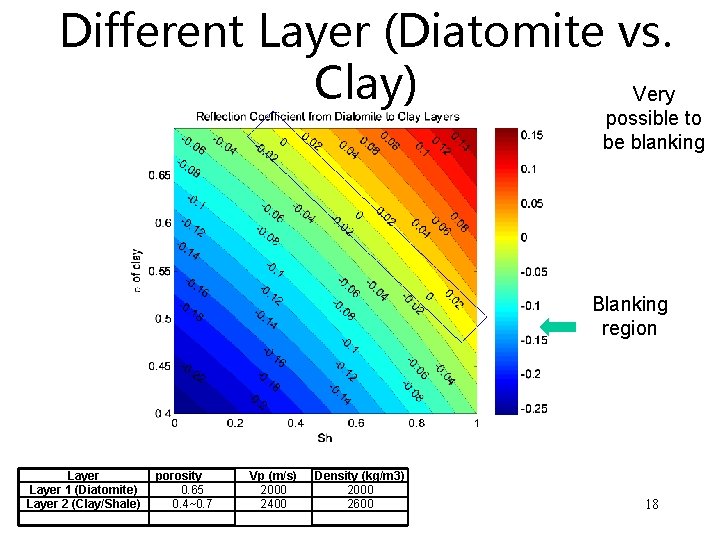
Seismic Blanking • Weak reflection in seismic profiling: R < RBSR/10 Typically R < 0. 02 8
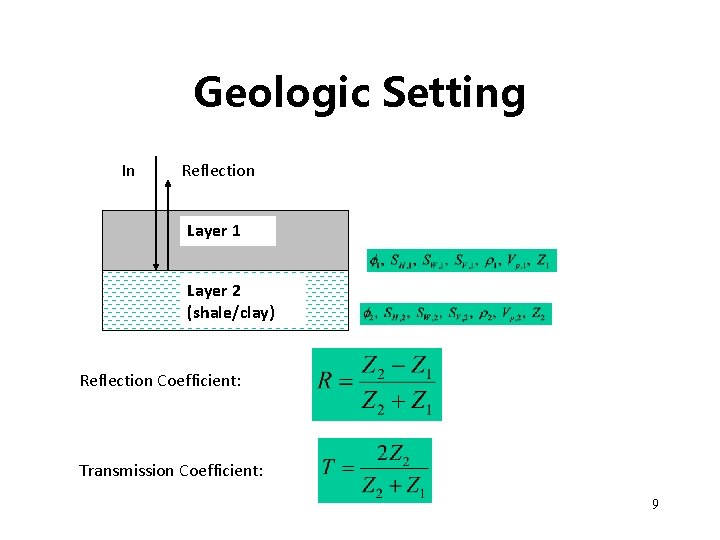
Geologic Setting In Reflection Layer 1 Layer 2 (shale/clay) Reflection Coefficient: Transmission Coefficient: 9
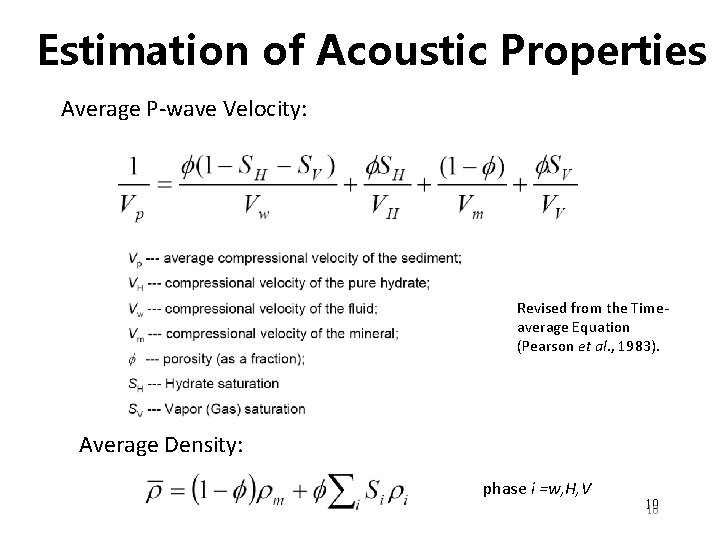
Estimation of Acoustic Properties Average P-wave Velocity: Revised from the Timeaverage Equation (Pearson et al. , 1983). Average Density: phase i =w, H, V 10 10
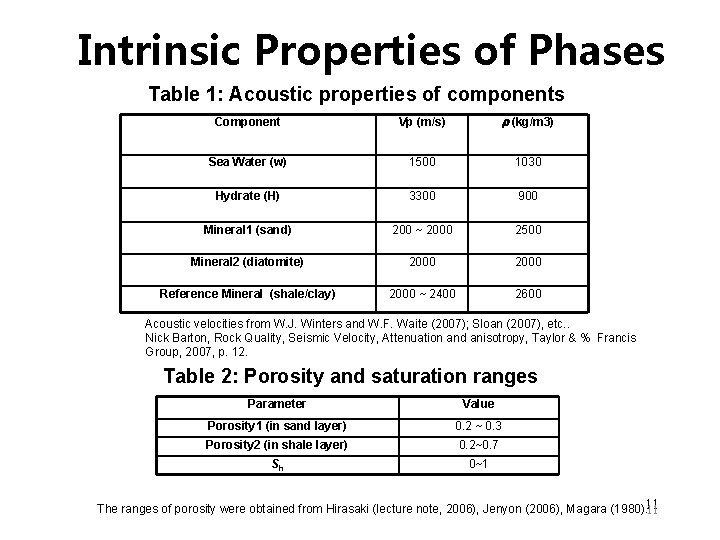
Intrinsic Properties of Phases Table 1: Acoustic properties of components Component Vp (m/s) r (kg/m 3) Sea Water (w) 1500 1030 Hydrate (H) 3300 900 Mineral 1 (sand) 200 ~ 2000 2500 Mineral 2 (diatomite) 2000 Reference Mineral (shale/clay) 2000 ~ 2400 2600 Acoustic velocities from W. J. Winters and W. F. Waite (2007); Sloan (2007), etc. . Nick Barton, Rock Quality, Seismic Velocity, Attenuation and anisotropy, Taylor & % Francis Group, 2007, p. 12. Table 2: Porosity and saturation ranges Parameter Value Porosity 1 (in sand layer) 0. 2 ~ 0. 3 Porosity 2 (in shale layer) 0. 2~0. 7 Sh 0~1 The ranges of porosity were obtained from Hirasaki (lecture note, 2006), Jenyon (2006), Magara (1980). 11 11
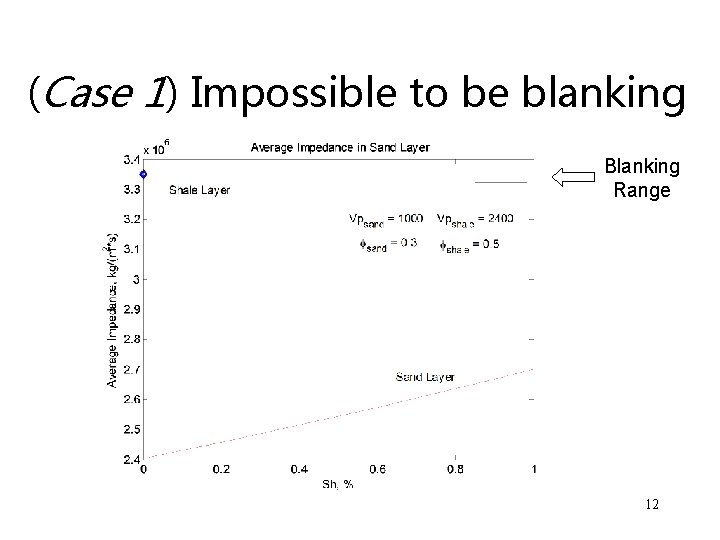
(Case 1) Impossible to be blanking Blanking Range 12
(Case 2) Possible to be blanking Blanking Range 13
(Case 3 ) Impossible to be blanking Blanking Range 14
Reflection Coeffiecient Just possible to be blanking Blanking region Sh in sand layer Layer 1 (quartz) Layer 2 (Clay/Shale) porosity 0. 3 0. 4~0. 7 Vp (m/s) 1000 2400 Density (kg/m 3) 2650 2600 15
Reflection Coeffiecient Very possible to be blanking Blanking region Layer 1 (quartz) Layer 2 (Clay/Shale) porosity 0. 3 0. 4~0. 7 Vp (m/s) 1500 2400 Density (kg/m 3) 2650 2600 16
Reflection Coeffiecient Justto. Possible be blanking Blanking region Layer 1 (quartz) Layer 2 (Clay/Shale) porosity 0. 3 0. 4~0. 7 Vp (m/s) 2000 2400 Density (kg/m 3) 2650 2600 17
Different Layer (Diatomite vs. Clay) Very possible to be blanking Blanking region Layer 1 (Diatomite) Layer 2 (Clay/Shale) porosity 0. 65 0. 4~0. 7 Vp (m/s) 2000 2400 Density (kg/m 3) 2000 2600 18
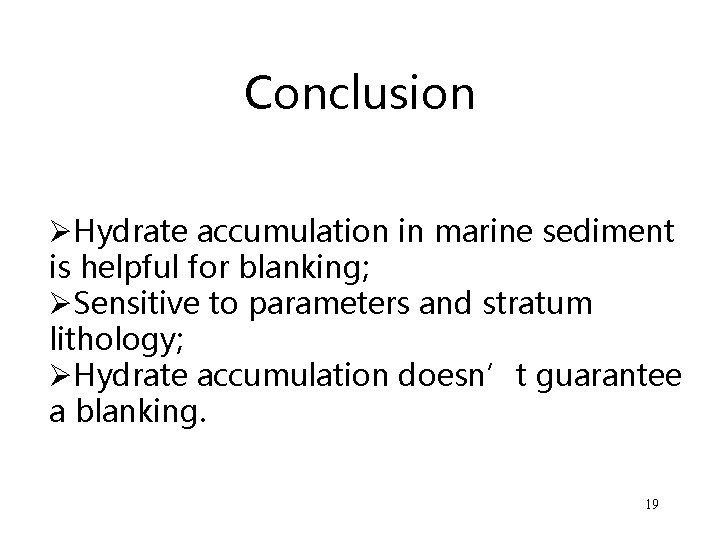
Conclusion ØHydrate accumulation in marine sediment is helpful for blanking; ØSensitive to parameters and stratum lithology; ØHydrate accumulation doesn’t guarantee a blanking. 19
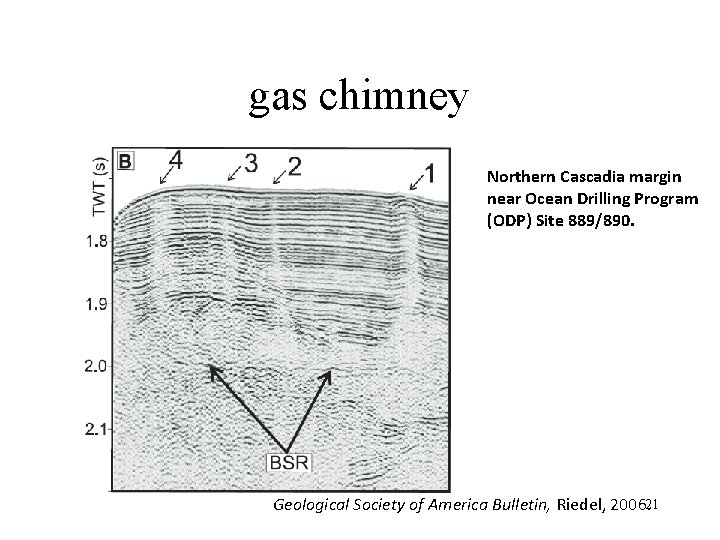
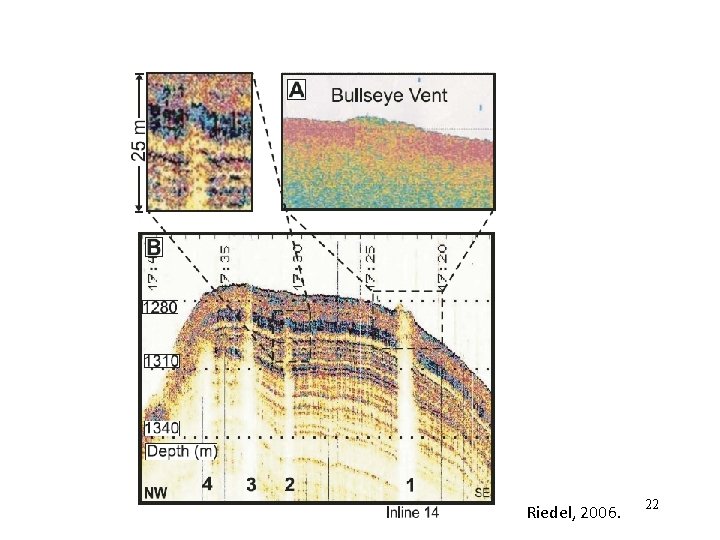
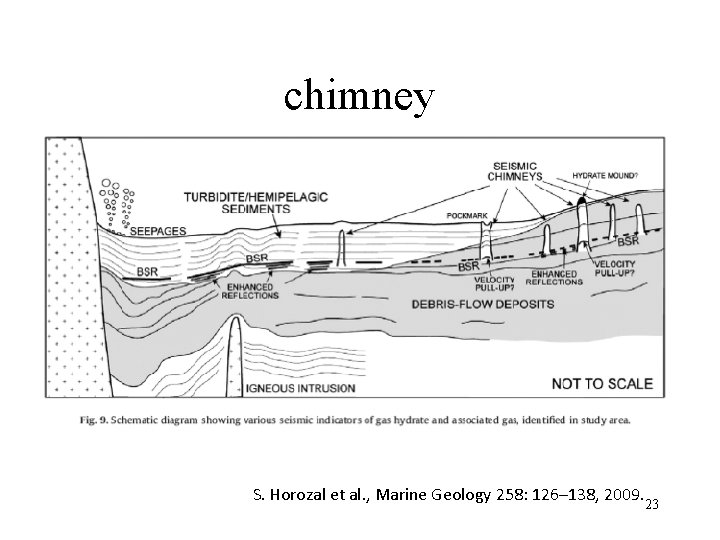
Wipeout in gas chimney Wipe out in vertical columnar regions KIGAM data showing BSR in debris-flow deposits (DFD). BSR is weak and discontinuous. Seismic chimneys look very narrow due to vertical exaggeration (ca. 14×). Seismic chimney, marked by S, is about 820 m wide and 110 m tall above the BSR, forming a rather horizontal zone of amplitude reduction. DFD, debris- flow deposits; THS, turbidite/hemipelagic sediments. 20 S. Horozal et al. , Marine Geology 258: 126– 138, 2009.
gas chimney Northern Cascadia margin near Ocean Drilling Program (ODP) Site 889/890. Geological Society of America Bulletin, Riedel, 2006. 21
Riedel, 2006. 22
chimney S. Horozal et al. , Marine Geology 258: 126– 138, 2009. 23
Mechanisms • Due to gas bubbles in the GHSZ in the Cascadia Margin (Wood et al. , 2002). These gas bubbles may be coated with hydrate that prevents the inflow of water (Riedel et al. , 2006). • Due to a thermal (Wood et al. , 2002) or a thermochemical effects (Hornbach et al. , 2005) • Due to presence of gas hydrate, and intrinsic acoustic properties in sediments (Chand Minshull, 2003. ). 24
Acknowledgement • DOE Grant (No. DE-FC 26 -06 NT 42960) • Rice University, Hirasaki Group, Chapman Group • Colleagues in Earth Science Department 25