
Seismic attributes of the Barnett and Bakken shales
Seismic attributes of the Barnett and Bakken shales Bode Omoboya 16 th May, 2013 q Introduction q Bakken Shale Case Study q Barnett Shale Case Study q Other Forward Modeling Projects 1

Bakken Shale Quick Facts Geologic Age VTI Anisotropy Isotropic or HTI Anisotropy Due Open Vertical Fractures VTI Anisotropy Most oil in the Bakken petroleum system resides in open fractures in the Middle Member (Pitman et al, 2001). Source: USGS Total Area (sq mi) Upper Devonian /Lower Miss Sandstone /Siltstone /Dolomite 200000 Total Gas (tcf) 945 Lithology (Middle Member) Producable Gas (tcf) 20 Depth (feet) 10000 Thickness (feet) 150 Pressure (psi) 5600 Porosity (%) 5 Matrix Permeability (n. D) Pressure Gradient (psi/ft) Clay Content (Middle Member %) Average Horz Well Cost ($M) 10000 0. 5 5 5. 5 2
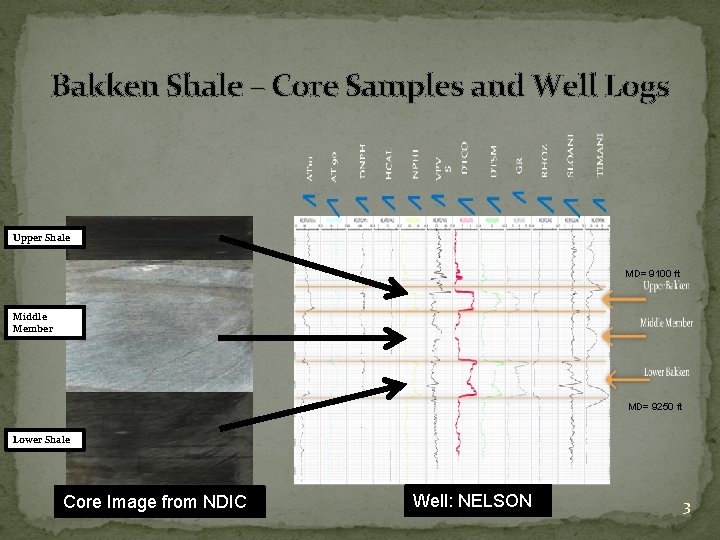
Bakken Shale – Core Samples and Well Logs Upper Shale MD= 9100 ft Middle Member MD= 9250 ft Lower Shale Core Image from NDIC Well: NELSON 3
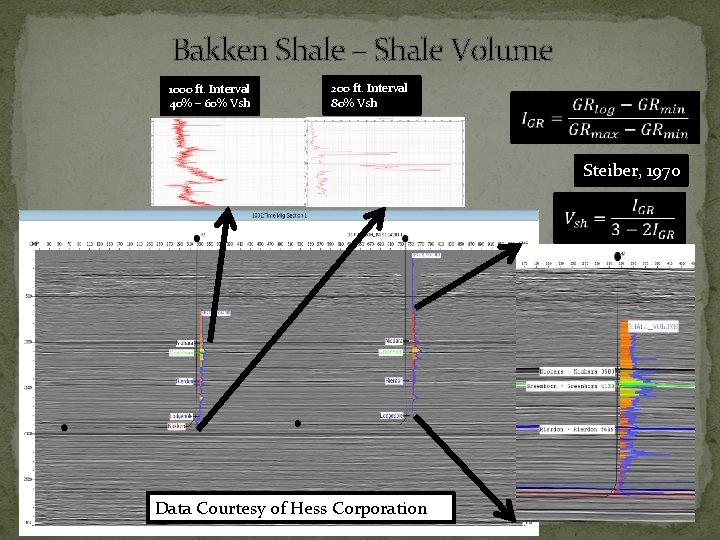
Bakken Shale – Shale Volume 1000 ft. Interval 40% – 60% Vsh 200 ft. Interval 80% Vsh Steiber, 1970 Data Courtesy of Hess Corporation 4

Bakken Shale – Non-Hyperbolic Moveout t=700 ms X/D=1 4500 ft (offset) t=1800 ms V=16000 ft/s V=3000 ft/s C 11 C 33 C 44 C 66 C 13 343 227 54 106 107 X= 15000 ft X= 0 ft e 0. 255 g 0. 481 d -0. 051 Jones and Wang, 1981 5

Bakken Shale – Forward Modeling Project Model C 1 Before Post-stack Migration After Post-stack Migration Physical modeling of anisotropic domains: Ultrasonic imaging of laser-etched fractures in glass (Geophysics, 2013 ) Robert. R. Stewart Nikolay Dyaur Bode Omoboya J. J. S de Figueiredo Mark Willis Samik Sil 6
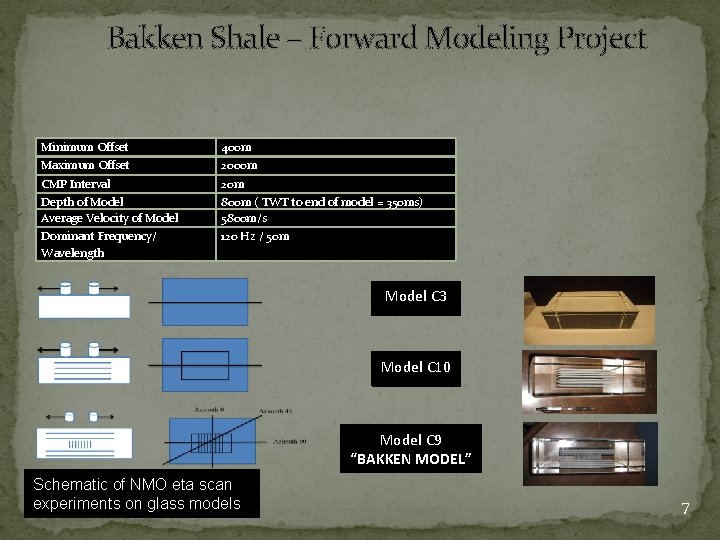
Bakken Shale – Forward Modeling Project Minimum Offset 400 m Maximum Offset 2000 m CMP Interval 20 m Depth of Model Average Velocity of Model Dominant Frequency/ Wavelength 800 m ( TWT to end of model = 350 ms) 5800 m/s 120 Hz / 50 m Model C 3 Model C 10 Model C 9 “BAKKEN MODEL” Schematic of NMO eta scan experiments on glass models 7
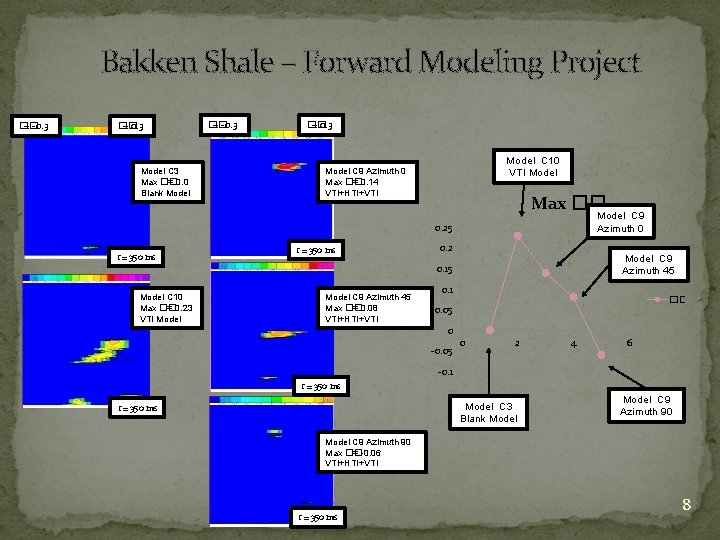
Bakken Shale – Forward Modeling Project �� = -0. 3 �� = 0. 3 Model C 3 Max �� = 0. 0 Blank Model �� = -0. 3 �� = 0. 3 Model C 10 VTI Model C 9 Azimuth 0 Max �� = 0. 14 VTI+HTI+VTI Max �� Model C 9 Azimuth 0 0. 25 t = 350 ms 0. 2 Model C 9 Azimuth 45 0. 15 Model C 10 Max �� = 0. 23 VTI Model C 9 Azimuth 45 Max �� = 0. 08 VTI+HTI+VTI 0. 1 �� 0. 05 0 -0. 05 0 2 4 6 -0. 1 t = 350 ms Model C 3 Blank Model t = 350 ms Model C 9 Azimuth 90 Max �� = -0. 06 VTI+HTI+VTI t = 350 ms 8

Barnett Shale Quick Facts Geologic Age Mississipian Lithology Dense Organic rich shale Water Saturation ((clay-bound) 20 -30% Gas Saturation 70 -80% Depth (feet) 4000 - 5000 Thickness (feet) 5 -1000 ft Pressure (psi) 5600 Porosity (%) 5 Natural fractures 100 to 120 deg Natural fractures More common in limestone interbeds Artificial fractures Oriented in the direction of minimal stress N-S structural cross section through the Newark Field in the Fort Worth Basin. Modified after Burna and Smosna, 2011
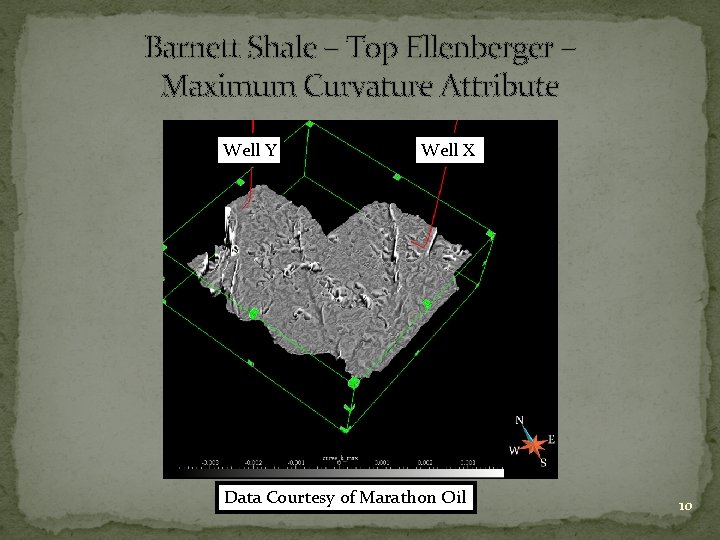
Barnett Shale – Top Ellenberger – Maximum Curvature Attribute Well Y Well X Data Courtesy of Marathon Oil 10
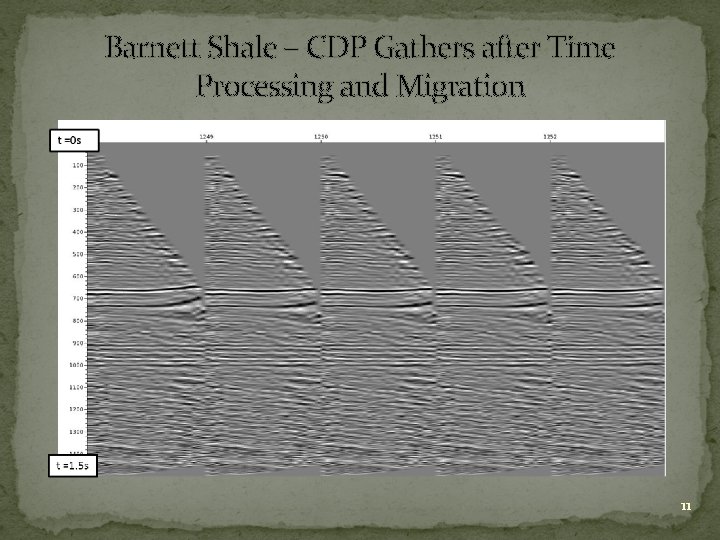
Barnett Shale – CDP Gathers after Time Processing and Migration 11

t = 0 s t = 1. 5 s Barnett Shale – Migrated Stack + FXY Decon
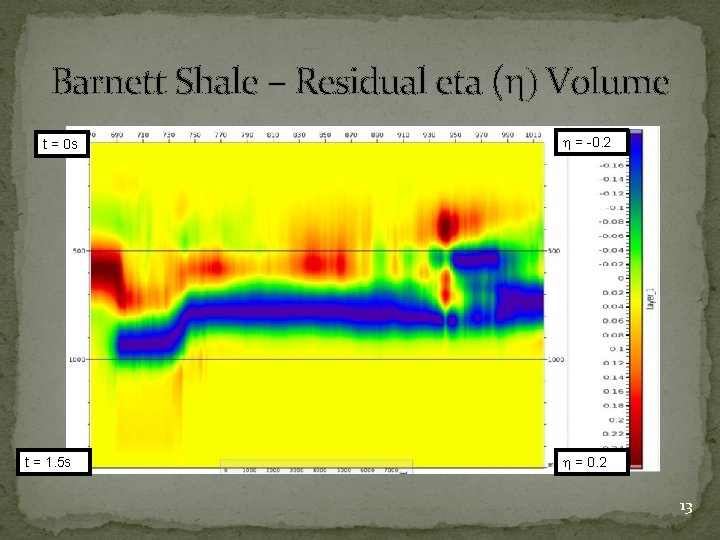
Barnett Shale – Residual eta (h) Volume t = 0 s t = 1. 5 s h = -0. 2 h = 0. 2 13
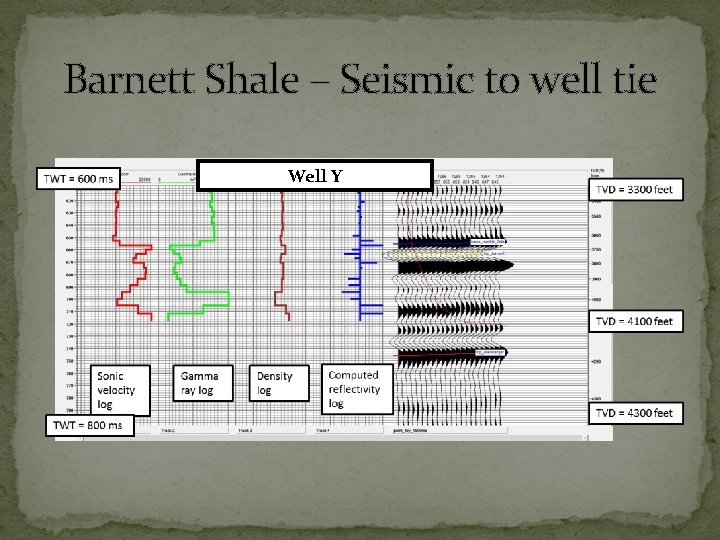
Barnett Shale – Seismic to well tie Well Y
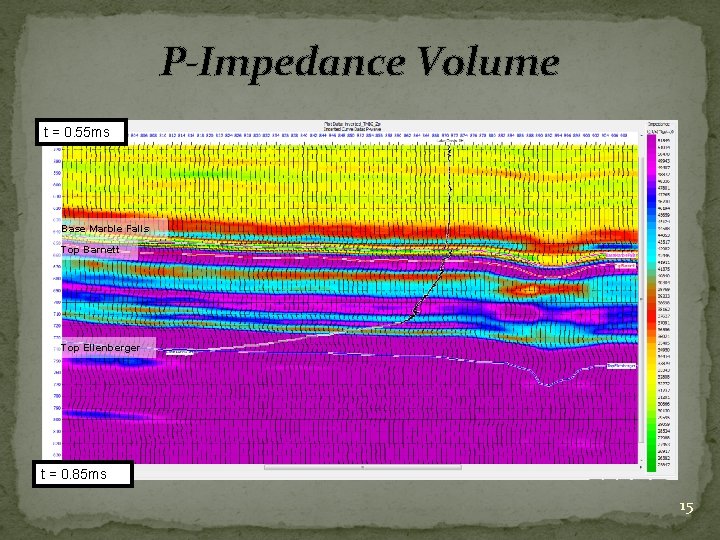
P-Impedance Volume t = 0. 55 ms Base Marble Falls Top Barnett Top Ellenberger t = 0. 85 ms 15
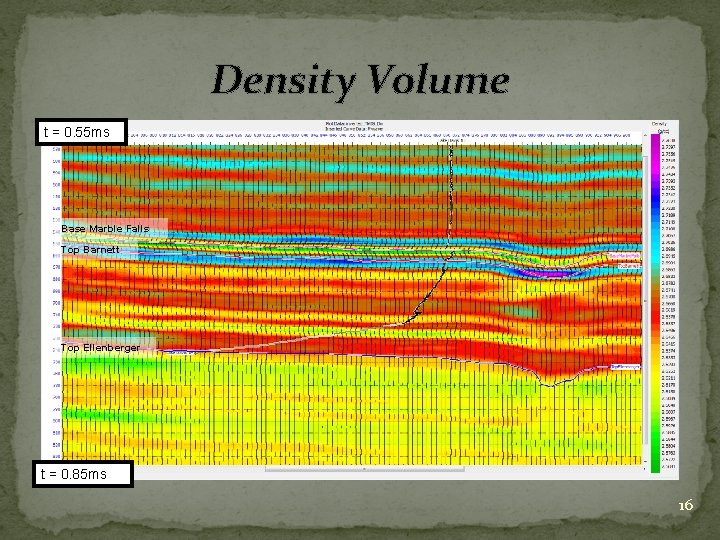
Density Volume t = 0. 55 ms Base Marble Falls Top Barnett Top Ellenberger t = 0. 85 ms 16
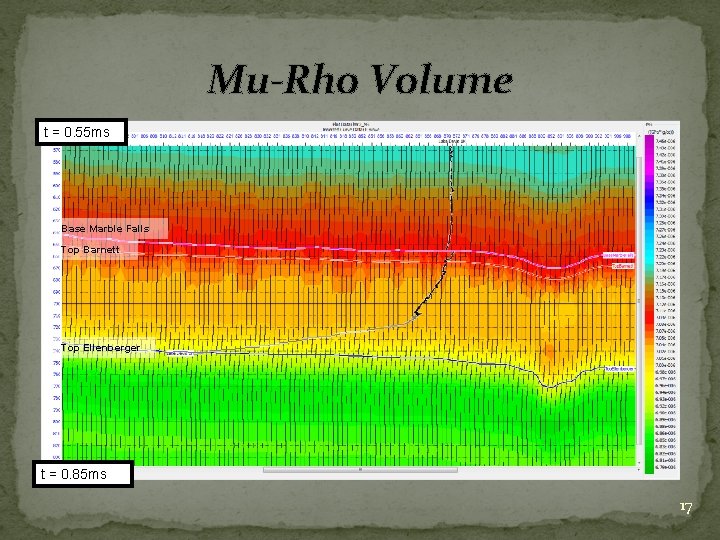
Mu-Rho Volume t = 0. 55 ms Base Marble Falls Top Barnett Top Ellenberger t = 0. 85 ms 17
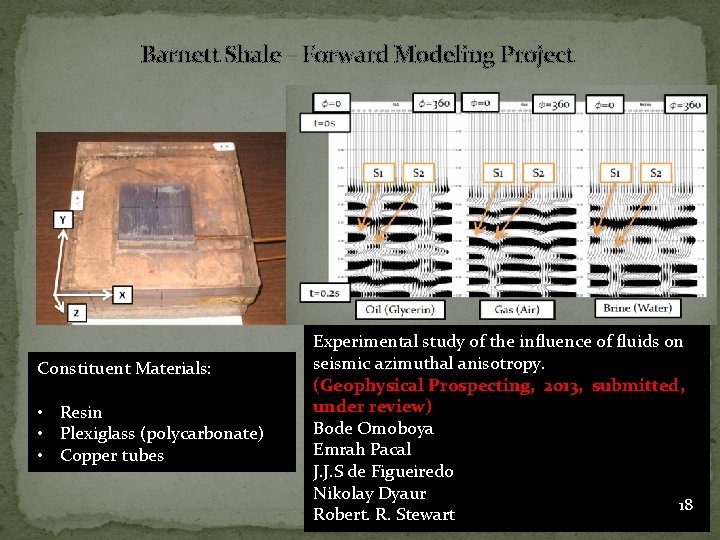
Barnett Shale – Forward Modeling Project Constituent Materials: • Resin • Plexiglass (polycarbonate) • Copper tubes Experimental study of the influence of fluids on seismic azimuthal anisotropy. (Geophysical Prospecting, 2013, submitted, under review) Bode Omoboya Emrah Pacal J. J. S de Figueiredo Nikolay Dyaur 18 Robert. R. Stewart
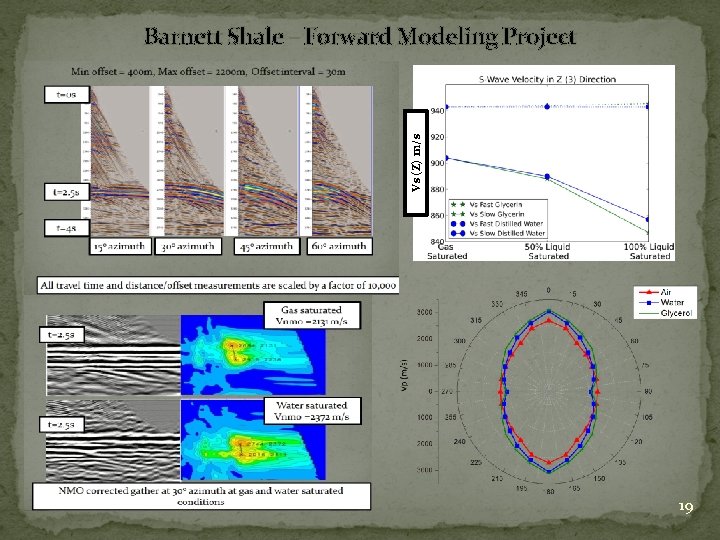
Vs (Z) m/s Barnett Shale – Forward Modeling Project 19
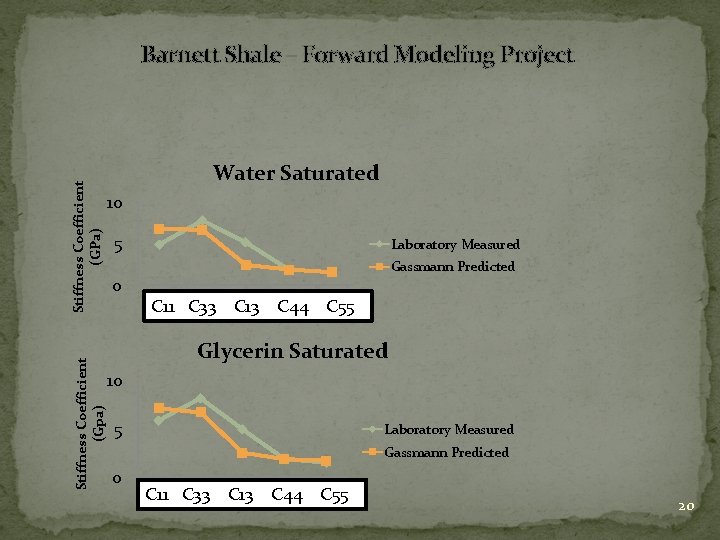
Stiffness Coefficient (Gpa) Stiffness Coefficient (GPa) Barnett Shale – Forward Modeling Project Water Saturated 10 5 0 Laboratory Measured Gassmann Predicted C 11 C 33 C 13 C 44 C 55 C 11 C 33 C 44 C 55 Glycerin Saturated 10 5 Laboratory Measured Gassmann Predicted 0 C 11 C 33 C 13 C 44 C 55 C 11 C 33 C 44 C 55 20
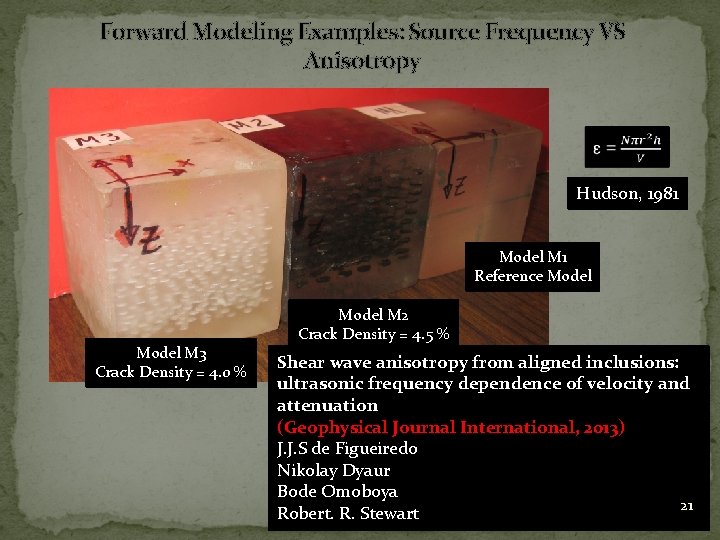
Forward Modeling Examples: Source Frequency VS Anisotropy Hudson, 1981 Model M 1 Reference Model M 3 Crack Density = 4. 0 % Model M 2 Crack Density = 4. 5 % Shear wave anisotropy from aligned inclusions: ultrasonic frequency dependence of velocity and attenuation (Geophysical Journal International, 2013) J. J. S de Figueiredo Nikolay Dyaur Bode Omoboya 21 Robert. R. Stewart
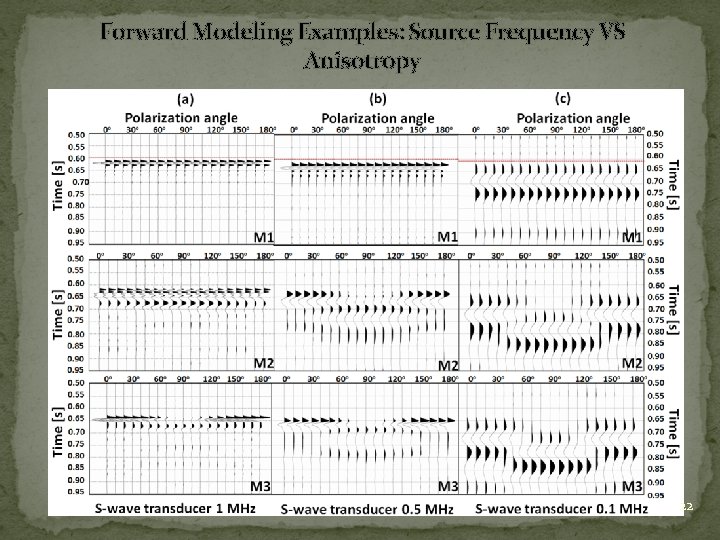
Forward Modeling Examples: Source Frequency VS Anisotropy 22
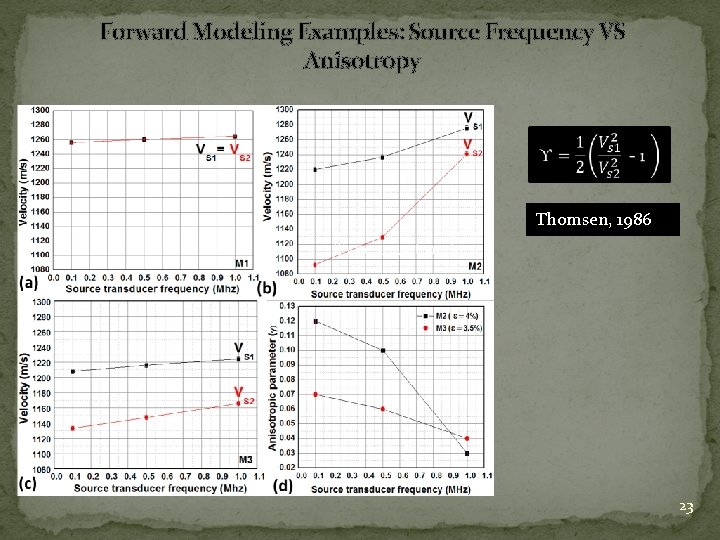
Forward Modeling Examples: Source Frequency VS Anisotropy Thomsen, 1986 23
Acknowledgement �Dr. Steve Peterson – Marathon Oil �Michelle Simon – Hess Corporation �Dr. Edip Baysal – Paradigm �Schlumberger (For VISTA Processing Software) 24
- Slides: 24