
Segregation Assortment and Dominance Relationships A B C
Segregation, Assortment, and Dominance Relationships A. B. C. D. E. Genes and alleles Random segregation Independent assortment Assortment vs. Linkage Dominance relationships
A. Genes and Alleles Gene Ø Classical definition: • A unit of inheritance • A factor transmitted during reproduction and responsible for the appearance of a given trait Ø Contemporary understanding: • A segment on a DNA molecule • Usually at a specific location (locus) on a chromosome • Characterized by its nucleotide sequence
A. Genes and Alleles Genes play three notable roles: Ø To encode the amino acid sequences of proteins Ø To encode the nucleotide sequences of t. RNA or r. RNA Ø To regulate the expression of other genes
A. Genes and Alleles: Ø Variant forms of a gene found within a population Ø Alleles of a gene usually have small differences in their nucleotide sequences Ø The differences can affect the trait for which the gene is responsible Ø Most genes have more than one allele
A. Genes and Alleles Homozygous and heterozygous: Ø In a diploid species, each individual carries two copies of each gene (with some exceptions) Ø The two copies are located on different members of a homologous chromosome pair Ø If the two copies of the gene are identical alleles, then the individual is homozygous for the gene Ø If the two copies are different alleles, then
A. Genes and Alleles Genotype: Ø The genetic makeup of an individual with reference to one or more specific traits Ø A genotype is designated by using symbols to represent the alleles of the gene
A. Genes and Alleles Example: Ø Consider a gene for plant height in the pea plant with two alleles, “D” and “d” Ø Each individual pea plant will carry two copies of the plant height gene, on a homologous chromosome pair Ø An individual pea plant will be one of three possible genotypes: • Homozygous “DD” • Homozygous “dd” • Heterozygous “Dd”
A. Genes and Alleles Dominant and recessive: A dominant allele is expressed over a recessive allele in a heterozygous individual Ø This means that a heterozygous individual and a homozygous dominant individual have identical phenotypes Ø Often, a dominant allele encodes a functional protein, such as an enzyme Ø The recessive allele is a mutation that no longer has the information for the correct amino acid sequence; Therefore, its protein product in nonfunctional Ø In the heterozygote, the dominant allele encodes sufficient production of the protein to produce the Ø
A. Genes and Alleles Phenotype: Ø The appearance or discernible characteristics of a trait in an individual Ø Phenotypes can be determined by a combination of genetic and environmental factors
A. Genes and Alleles Example: Ø In the pea plant height gene, the dominant allele “D” encodes a hormone that promotes tall growth Ø The recessive allele “d” is a mutation that does not produce functional hormone Ø If an individual pea plant has at least “one good copy” of the “D” allele, then it makes enough hormone to grow tall Ø Otherwise, the plant is dwarf in size
A. Genes and Alleles Example (continued): Ø Therefore, there are two possible phenotypes for plant height in peas: • Genotype “DD” produces tall plants • Genotype “Dd” produces tall plants • Genotype “dd” produces dwarf plants Ø Note that “D” is completely dominant over “d” Ø There is no observable difference in phenotype between “DD” (homozygous dominant) and “Dd” (heterozygous) plants

B. Random Segregation Mendel’s law of random segregation: Ø Diploid germ-line cells of sexually reproducing species contain two copies of almost every chromosomal gene Ø The two copies are located on members of a homologous chromosome pair Ø During meiosis, the two copies separate, so that a gamete receives only one copy of each gene
B. Random Segregation Random segregation can be demonstrated with a monohybrid cross experiment Monohybrid cross: A parental cross between two individuals that differ in the genotype of one gene Ø The offspring of the parental generation is called the F 1 (first filial) generation Ø The F 1 generation can be allowed to interbreed or self-fertilize (inter se cross, or “selfing”) to produce the F 2 (second filial) generation Ø
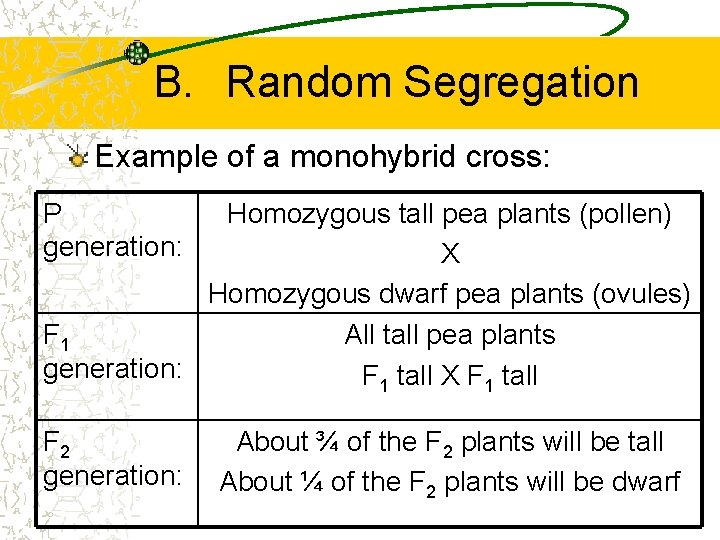
B. Random Segregation Example of a monohybrid cross: P generation: Homozygous tall pea plants (pollen) X Homozygous dwarf pea plants (ovules) F 1 All tall pea plants generation: F 1 tall X F 1 tall F 2 generation: About ¾ of the F 2 plants will be tall About ¼ of the F 2 plants will be dwarf
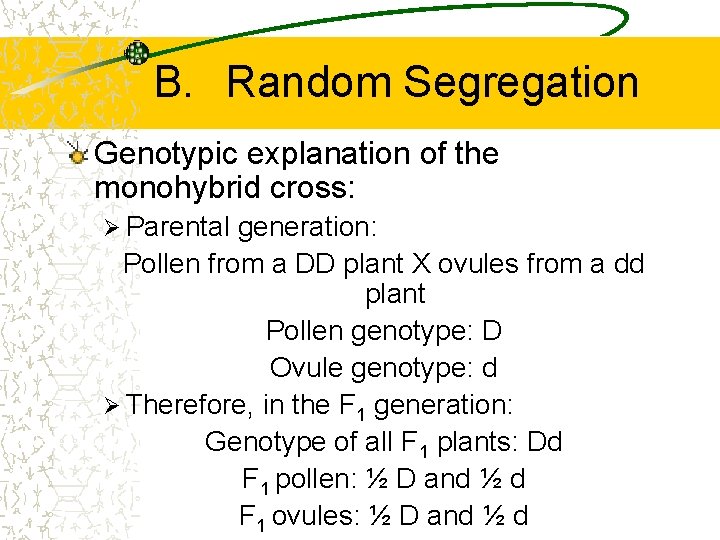
B. Random Segregation Genotypic explanation of the monohybrid cross: Ø Parental generation: Pollen from a DD plant X ovules from a dd plant Pollen genotype: D Ovule genotype: d Ø Therefore, in the F 1 generation: Genotype of all F 1 plants: Dd F 1 pollen: ½ D and ½ d F 1 ovules: ½ D and ½ d

B. Random Segregation Genotypic explanation (continued): Ø When the F 1 plants self-fertilize: F 1 pollen X F 1 ovule F 2 genotype ½D ½D ½ x½ =¼ DD ½D ½d (½ x ½ ) or + ½d ½ D (½ x ½) = ½ Dd F 2 phenotype ¼ DD+ ½ Dd = ¾ Tall
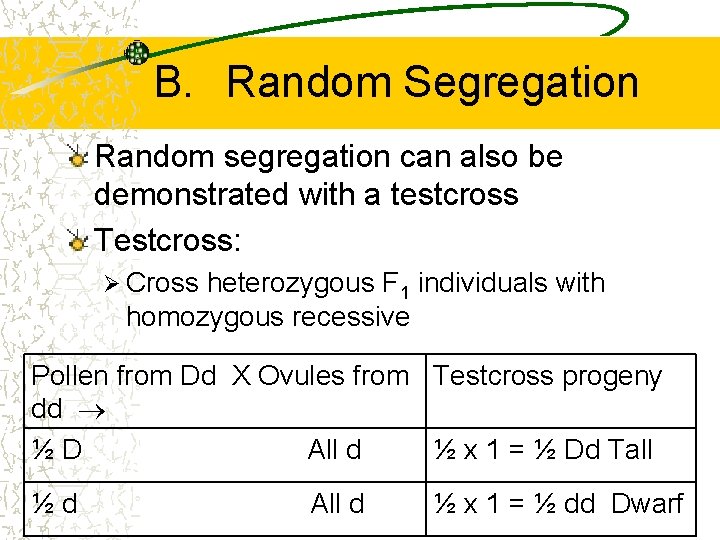
B. Random Segregation Random segregation can also be demonstrated with a testcross Testcross: Ø Cross heterozygous F 1 individuals with homozygous recessive Pollen from Dd X Ovules from Testcross progeny dd ½D All d ½ x 1 = ½ Dd Tall ½d All d ½ x 1 = ½ dd Dwarf
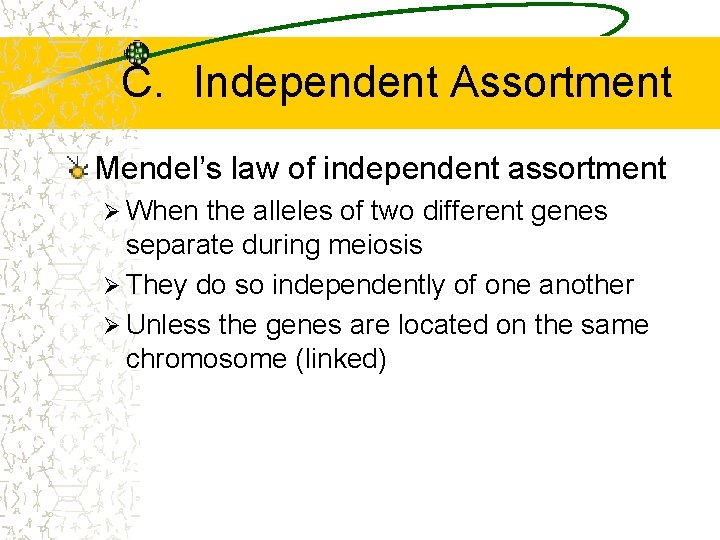
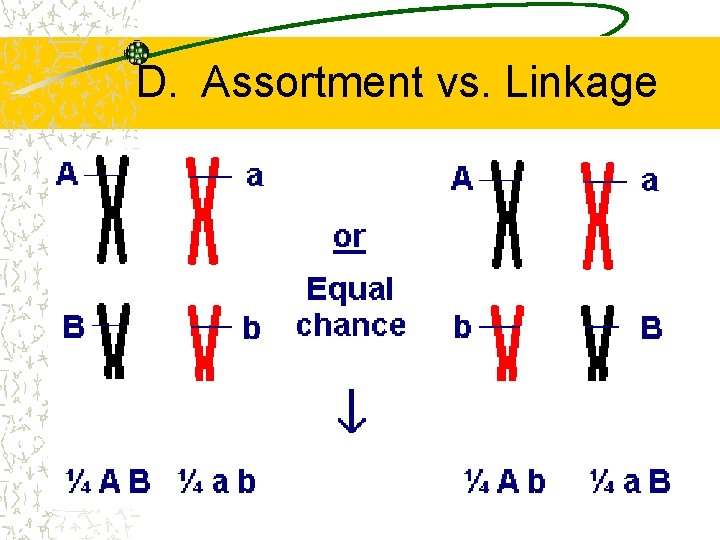
C. Independent Assortment Mendel’s law of independent assortment Ø When the alleles of two different genes separate during meiosis Ø They do so independently of one another Ø Unless the genes are located on the same chromosome (linked)
C. Independent Assortment Independent assortment is demonstrated by a dihybrid cross Dihybrid cross: ØA parental cross between two individuals that differ in the genotype of two different genes
C. Independent Assortment Example: Consider genes for vestigial wing shape and ebony body color in Drosophila melanogaster Ø Vestigial wing shape gene: vg+ allele: normal “wild type” wing shape; dominant vg allele: vestigial wing; recessive Ø Ebony body color gene: e+ allele: tan-colored “wild type” body; dominant
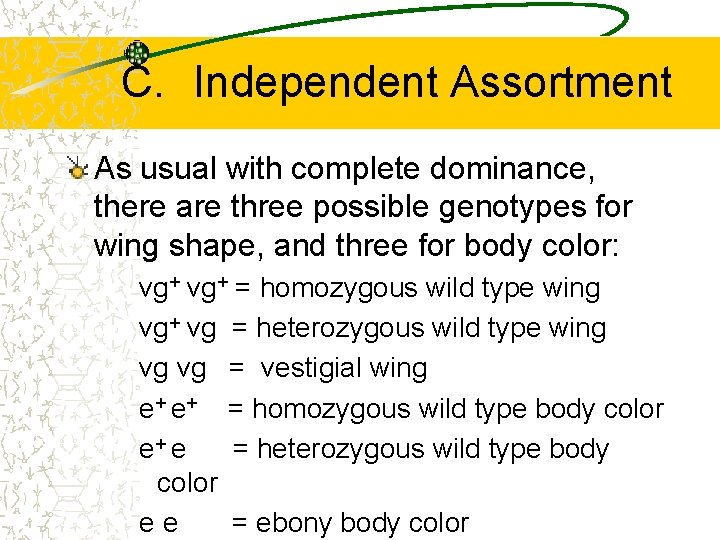
C. Independent Assortment As usual with complete dominance, there are three possible genotypes for wing shape, and three for body color: vg+ = homozygous wild type wing vg+ vg = heterozygous wild type wing vg vg = vestigial wing e+ e+ = homozygous wild type body color e+ e = heterozygous wild type body color ee = ebony body color
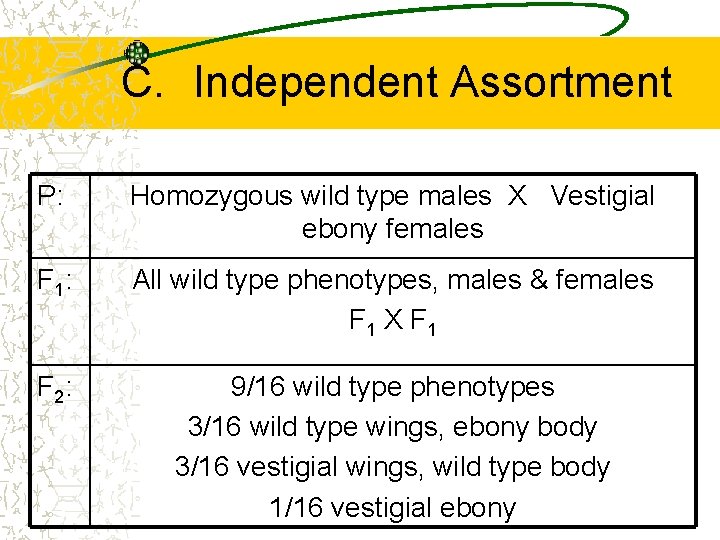
C. Independent Assortment P: Homozygous wild type males X Vestigial ebony females F 1: All wild type phenotypes, males & females F 1 X F 1 F 2: 9/16 wild type phenotypes 3/16 wild type wings, ebony body 3/16 vestigial wings, wild type body 1/16 vestigial ebony
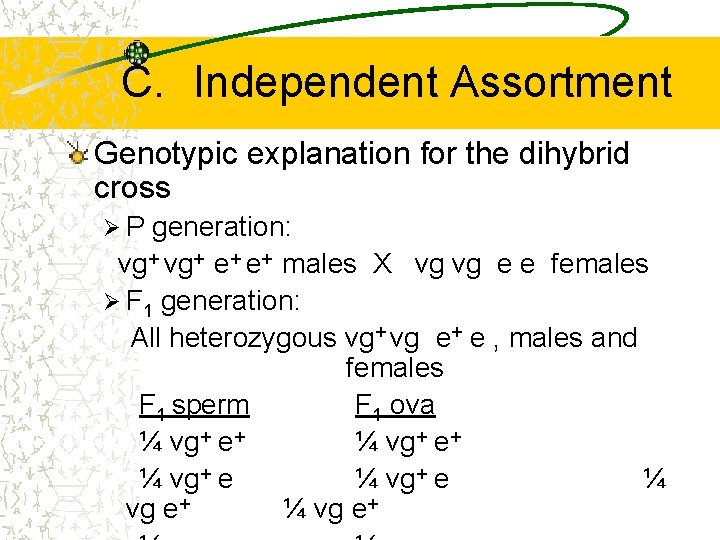
C. Independent Assortment Genotypic explanation for the dihybrid cross ØP generation: vg+ e+ e+ males X vg vg e e females Ø F 1 generation: All heterozygous vg+ vg e+ e , males and females F 1 sperm F 1 ova ¼ vg+ e+ ¼ vg+ e ¼ vg e+
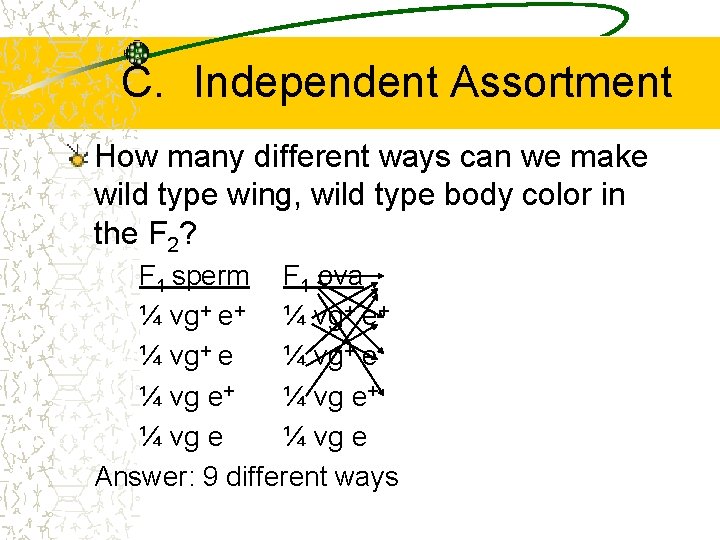
C. Independent Assortment How many different ways can we make wild type wing, wild type body color in the F 2? F 1 sperm F 1 ova ¼ vg+ e+ ¼ vg+ e ¼ vg e+ ¼ vg e Answer: 9 different ways
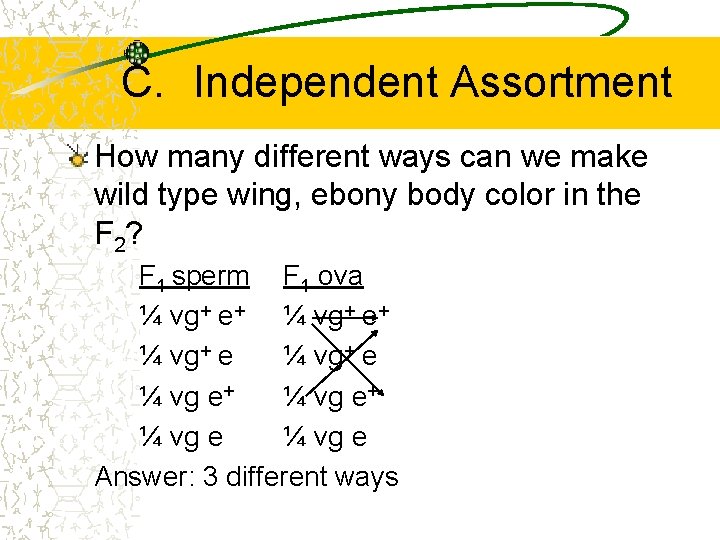
C. Independent Assortment How many different ways can we make wild type wing, ebony body color in the F 2? F 1 sperm F 1 ova ¼ vg+ e+ ¼ vg+ e ¼ vg e+ ¼ vg e Answer: 3 different ways
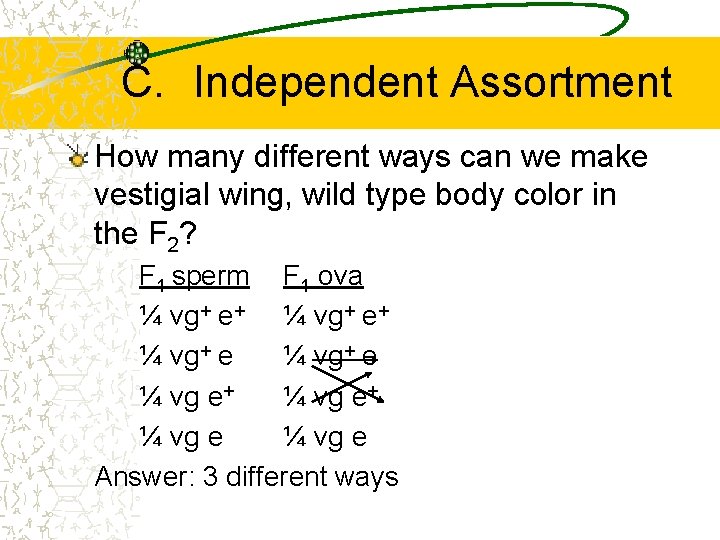
C. Independent Assortment How many different ways can we make vestigial wing, wild type body color in the F 2? F 1 sperm F 1 ova ¼ vg+ e+ ¼ vg+ e ¼ vg e+ ¼ vg e Answer: 3 different ways
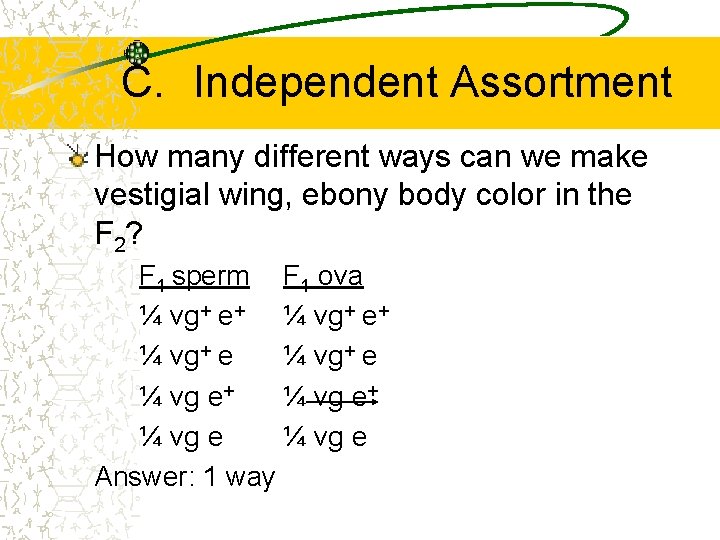
C. Independent Assortment How many different ways can we make vestigial wing, ebony body color in the F 2? F 1 sperm F 1 ova ¼ vg+ e+ ¼ vg+ e ¼ vg e+ ¼ vg e Answer: 1 way
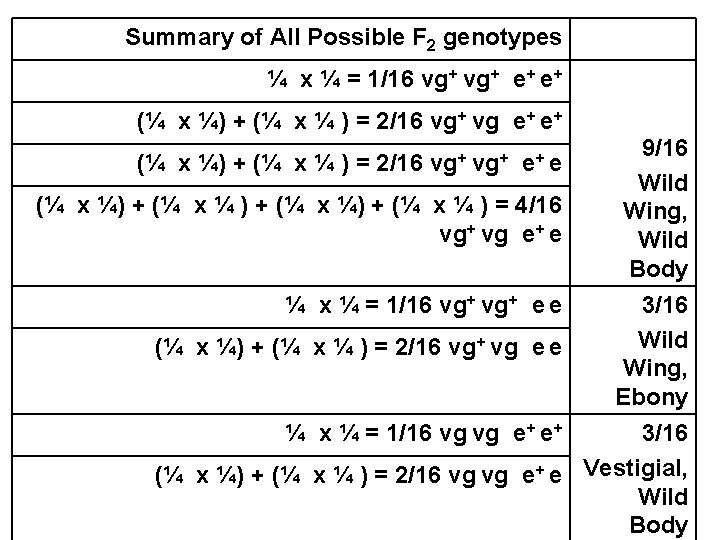
Summary of All Possible F 2 genotypes ¼ x ¼ = 1/16 vg+ e+ e+ (¼ x ¼) + (¼ x ¼ ) = 2/16 vg+ vg+ e+ e (¼ x ¼) + (¼ x ¼ ) = 4/16 vg+ vg e+ e ¼ x ¼ = 1/16 vg+ e e 9/16 Wild Wing, Wild Body 3/16 Wild (¼ x ¼) + (¼ x ¼ ) = 2/16 vg+ vg e e Wing, Ebony ¼ x ¼ = 1/16 vg vg e+ e+ 3/16 (¼ x ¼) + (¼ x ¼ ) = 2/16 vg vg e+ e Vestigial, Wild Body
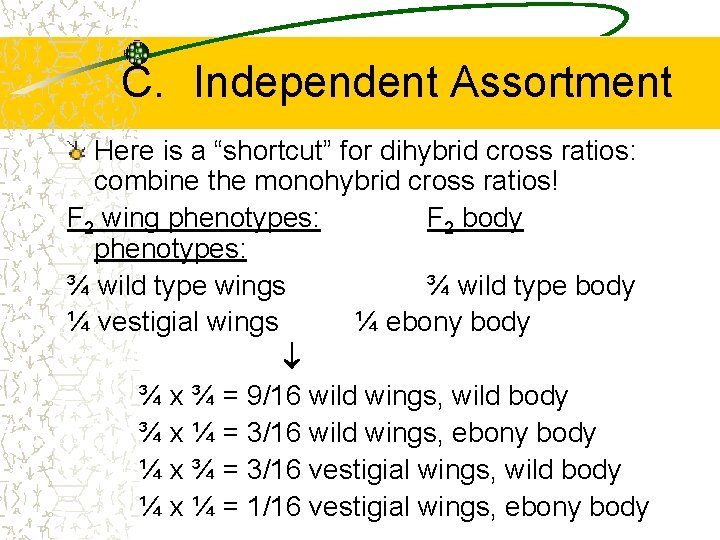
C. Independent Assortment Here is a “shortcut” for dihybrid cross ratios: combine the monohybrid cross ratios! F 2 wing phenotypes: F 2 body phenotypes: ¾ wild type wings ¾ wild type body ¼ vestigial wings ¼ ebony body ¾ x ¾ = 9/16 wild wings, wild body ¾ x ¼ = 3/16 wild wings, ebony body ¼ x ¾ = 3/16 vestigial wings, wild body ¼ x ¼ = 1/16 vestigial wings, ebony body
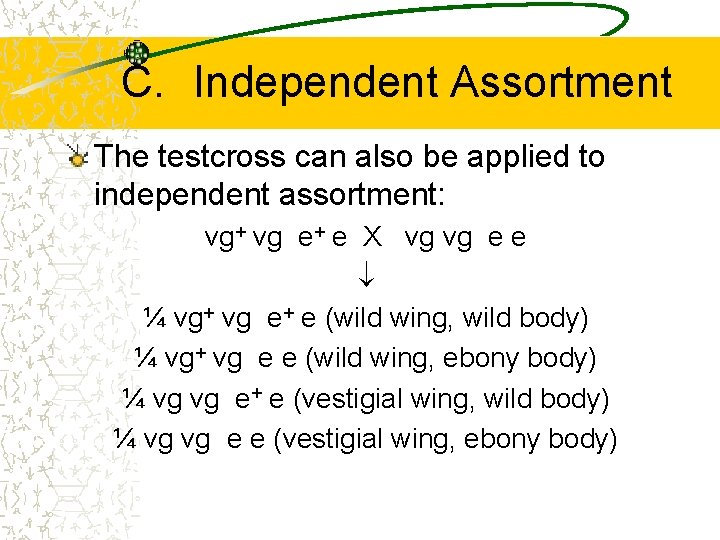
C. Independent Assortment The testcross can also be applied to independent assortment: vg+ vg e+ e X vg vg e e ¼ vg+ vg e+ e (wild wing, wild body) ¼ vg+ vg e e (wild wing, ebony body) ¼ vg vg e+ e (vestigial wing, wild body) ¼ vg vg e e (vestigial wing, ebony body)
D. Assortment vs. Linkage Independent assortment works because the two genes are located on separate homologous chromosomes pairs Their alleles assort independently during meiosis
D. Assortment vs. Linkage
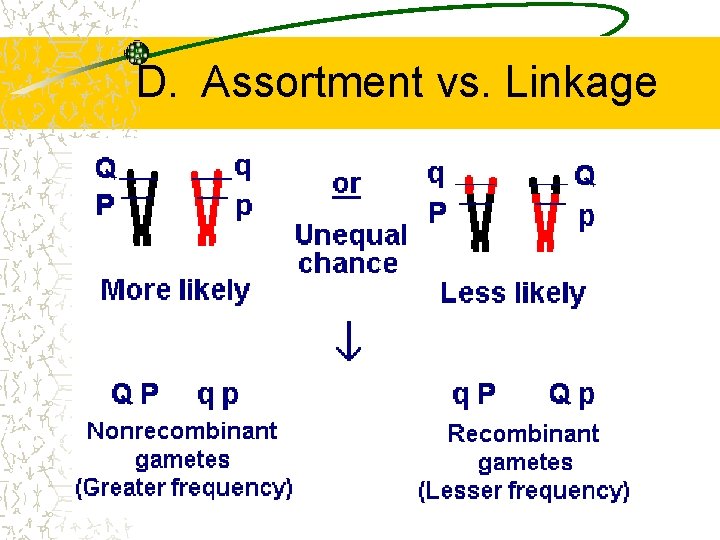
D. Assortment vs. Linkage If two genes are located on the same chromosome, their alleles can recombine only when there is crossing over during meiosis The probability that crossover will occur is proportional to the distance between the genes Typically, there are fewer recombinant (crossover) gametes than nonrecombinant gametes
D. Assortment vs. Linkage
E. Dominance Relationships Codominance Ø Two alleles are codominant if each encodes a different but functional protein product Ø In the heterozygote, the presence of two different functional proteins means that the phenotype of the heterozygote is different from either homozygous dominant or homozygous recessive Ø Example: M-N blood groups
E. Dominance Relationships Example of codiminance: M-N blood group gene in humans Ø Two alleles, LM & LN Ø Each produces a “functional” blood cell antigen (capable of causing an immunological reaction) Ø Three possible genotypes & phenotypes • LM LM: Produces group “M” blood • LM LN: Produces group “MN” blood • LN LN: Produces group “N” blood
E. Dominance Relationships Incomplete dominance Ø An incompletely dominant allele produces a functional protein product Ø However, in the heterozygote, there is insufficient protein production from the allele to produce the same phenotype as homozygous dominant Ø Therefore, the phenotype of the heterozygote is different from either homozygous dominant or homozygous recessive
E. Dominance Relationships Example of incomplete dominance: snapdragon flower color Ø Two alleles, “R” and “r” Ø “R” produces red pigment; “r” produces no pigment Ø Three possible genotypes & phenotypes • RR: Red flowers • Rr: Pink flowers (One copy of “R” produces less red pigment than two copies of “R”) • rr: White flowers
E. Dominance Relationships Because each genotype has a unique phenotype, the F 2 phenotypic ratio in codominance or incomplete dominance is 1: 2: 1
- Slides: 39