
Segmented Discourse Representation Theory A theory of discourse

![Rhetorical relations. . . continued Contrast πα π1: Conseq πb π2: [Molly sees cat]](https://slidetodoc.com/presentation_image_h2/4fee1b18af1a245d5ddfff2bc9bcf20e/image-39.jpg "Rhetorical relations. . . continued Contrast πα π1: Conseq πb π2: [Molly sees cat]")
![Unpacking truth conditions: Use of the satisfaction schema and recursively unpacking: (w, f)[[Explanation(π1, π2)]]M(w,](https://slidetodoc.com/presentation_image_h2/4fee1b18af1a245d5ddfff2bc9bcf20e/image-44.jpg "Unpacking truth conditions: Use of the satisfaction schema and recursively unpacking: (w, f)[[Explanation(π1, π2)]]M(w,")
- Slides: 50
Segmented Discourse Representation Theory A theory of discourse interpretation 14/05 Course: “Computerlinguistik II” Alexandros Tantos Alexandros. Tantos@uni-konstanz. de Segmented Discourse Representation Theory Alex Tantos
The structure of the session • The placement of computational discourse semantics and SDRT in NLP • The need for dynamic semantics in the discourse (inter-)(re-)presentation (Discourse Representation Theory: advantages and drawbacks) • Evidence for SDRT and rhetorical relations • Possible NLP applications based on such a framework: what comes next? Segmented Discourse Representation Theory Alex Tantos
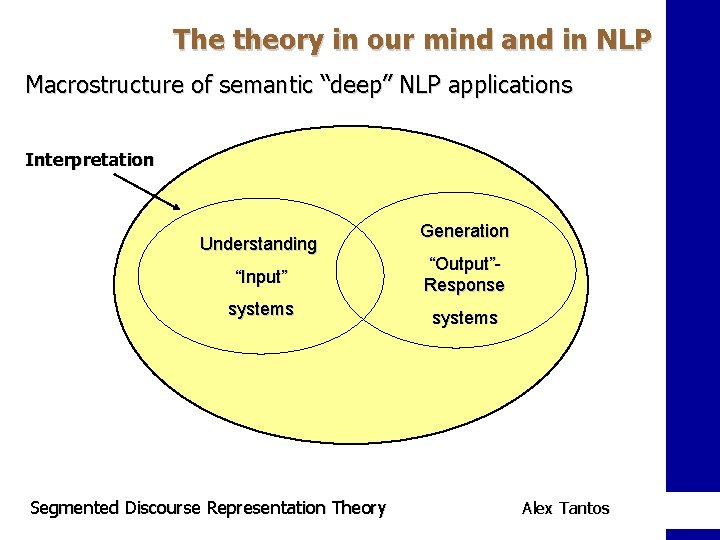
The theory in our mind and in NLP Macrostructure of semantic “deep” NLP applications Interpretation Understanding Generation “Input” “Output”Response systems Segmented Discourse Representation Theory Alex Tantos
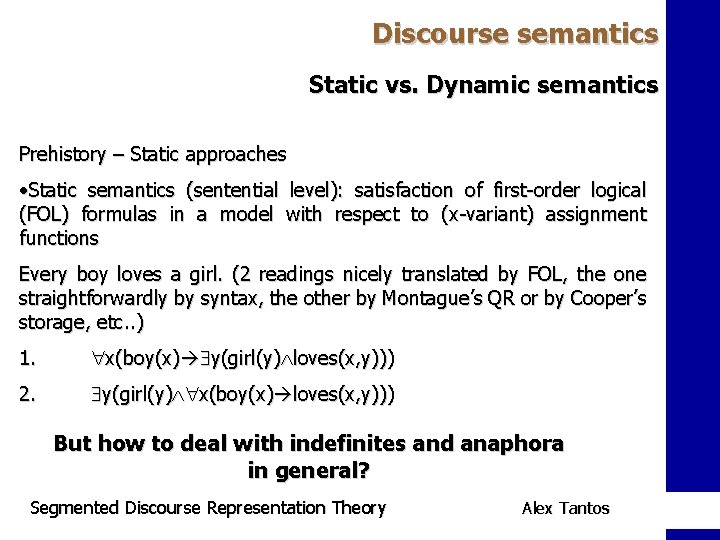
Discourse semantics Static vs. Dynamic semantics Prehistory – Static approaches • Static semantics (sentential level): satisfaction of first-order logical (FOL) formulas in a model with respect to (x-variant) assignment functions Every boy loves a girl. (2 readings nicely translated by FOL, the one straightforwardly by syntax, the other by Montague’s QR or by Cooper’s storage, etc. . ) 1. x(boy(x) y(girl(y) loves(x, y))) 2. y(girl(y) x(boy(x) loves(x, y))) But how to deal with indefinites and anaphora in general? Segmented Discourse Representation Theory Alex Tantos
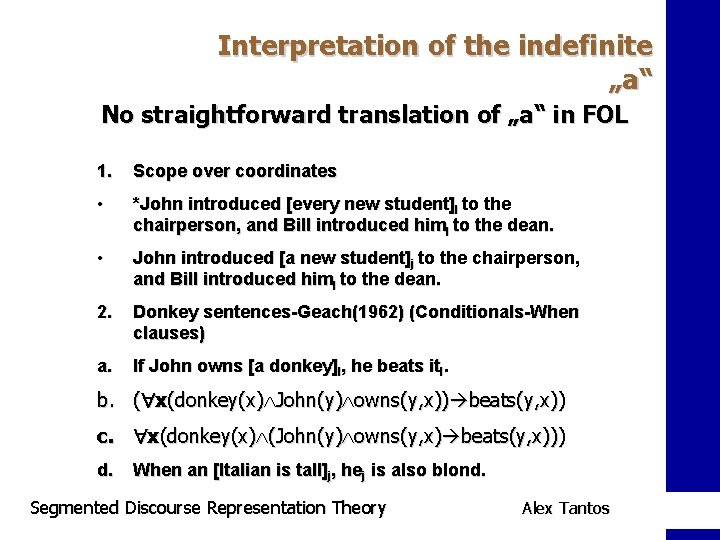
Interpretation of the indefinite „a“ No straightforward translation of „a“ in FOL 1. Scope over coordinates • *John introduced [every new student]I to the chairperson, and Bill introduced him. I to the dean. • John introduced [a new student]j to the chairperson, and Bill introduced him. I to the dean. 2. Donkey sentences-Geach(1962) (Conditionals-When clauses) a. If John owns [a donkey]I, he beats it. I. b. ( x(donkey(x) John(y) owns(y, x)) beats(y, x)) c. x(donkey(x) (John(y) owns(y, x) beats(y, x))) d. When an [Italian is tall]j, hej is also blond. Segmented Discourse Representation Theory Alex Tantos
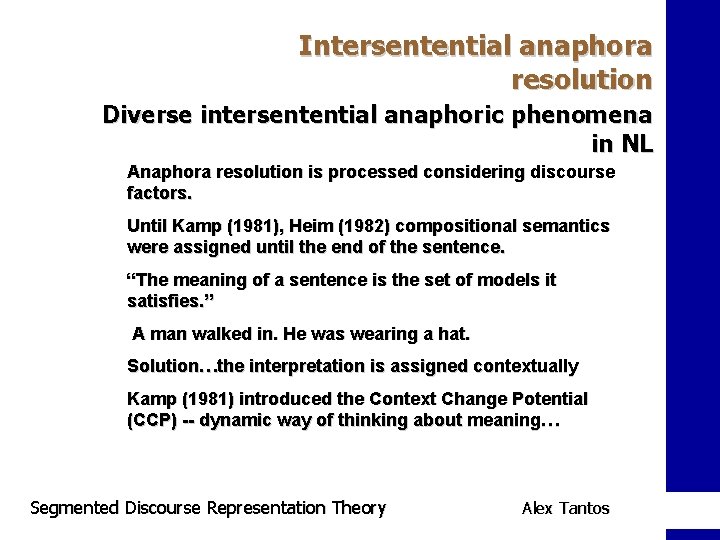
Intersentential anaphora resolution Diverse intersentential anaphoric phenomena in NL Anaphora resolution is processed considering discourse factors. Until Kamp (1981), Heim (1982) compositional semantics were assigned until the end of the sentence. “The meaning of a sentence is the set of models it satisfies. ” A man walked in. He was wearing a hat. Solution…the interpretation is assigned contextually Kamp (1981) introduced the Context Change Potential (CCP) -- dynamic way of thinking about meaning… Segmented Discourse Representation Theory Alex Tantos
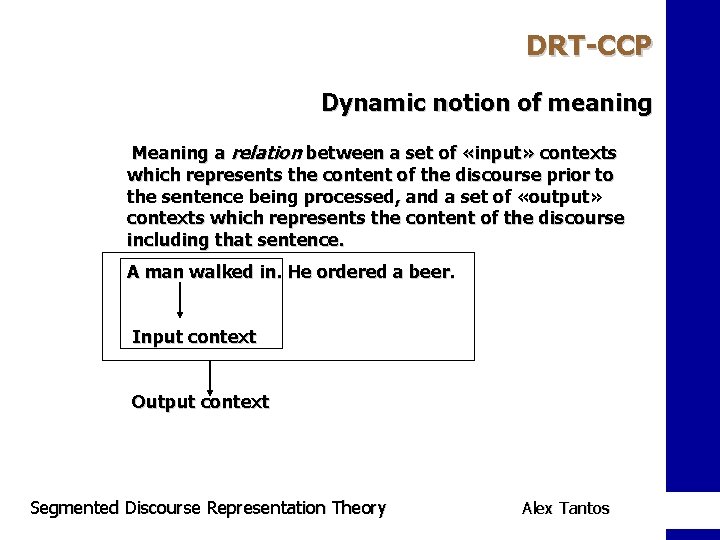
DRT-CCP Dynamic notion of meaning Meaning a relation between a set of «input» contexts which represents the content of the discourse prior to the sentence being processed, and a set of «output» contexts which represents the content of the discourse including that sentence. A man walked in. He ordered a beer. Input context Output context Segmented Discourse Representation Theory Alex Tantos
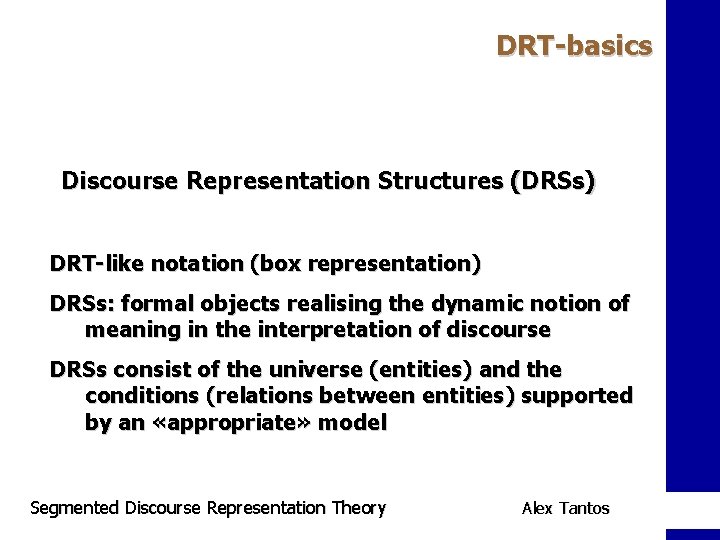
DRT-basics Discourse Representation Structures (DRSs) DRT-like notation (box representation) DRSs: formal objects realising the dynamic notion of meaning in the interpretation of discourse DRSs consist of the universe (entities) and the conditions (relations between entities) supported by an «appropriate» model Segmented Discourse Representation Theory Alex Tantos
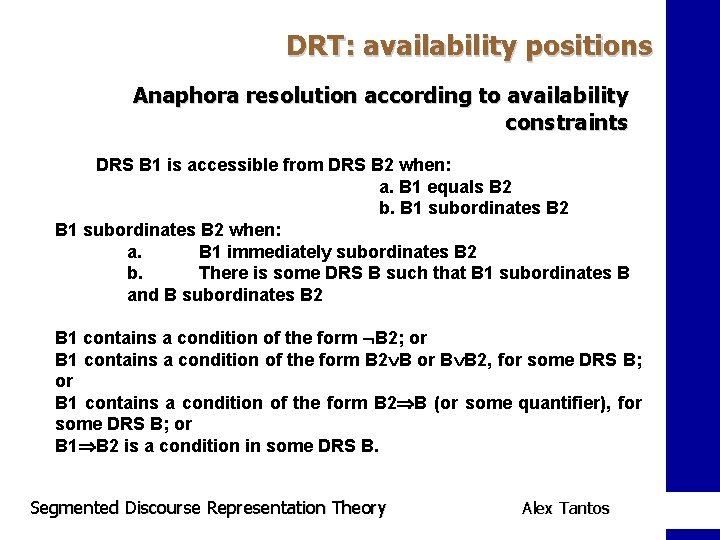
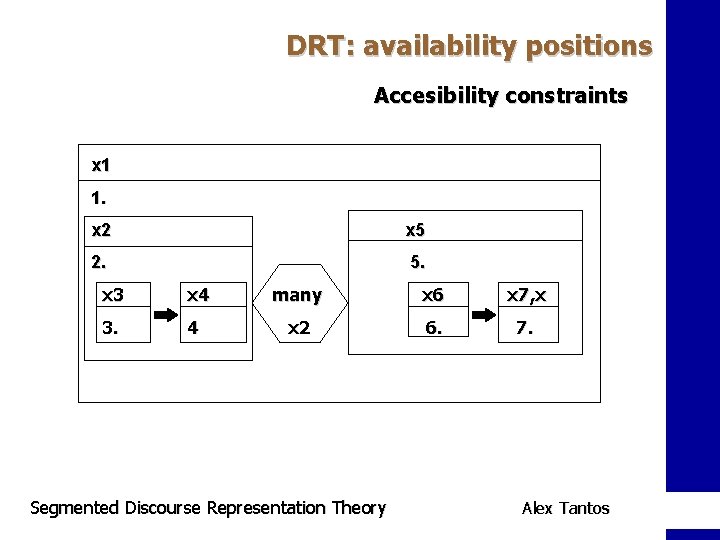
DRT: availability positions Anaphora resolution according to availability constraints DRS B 1 is accessible from DRS B 2 when: a. B 1 equals B 2 b. B 1 subordinates B 2 when: a. B 1 immediately subordinates B 2 b. There is some DRS B such that B 1 subordinates B and B subordinates B 2 B 1 contains a condition of the form B 2; or B 1 contains a condition of the form B 2 B or B B 2, for some DRS B; or B 1 contains a condition of the form B 2 B (or some quantifier), for some DRS B; or B 1 B 2 is a condition in some DRS B. Segmented Discourse Representation Theory Alex Tantos
DRT: availability positions Accesibility constraints x 1 1. x 2 x 5 2. 5. x 3 x 4 3. 4 many x 6 x 7, x x 2 6. 7. Segmented Discourse Representation Theory Alex Tantos
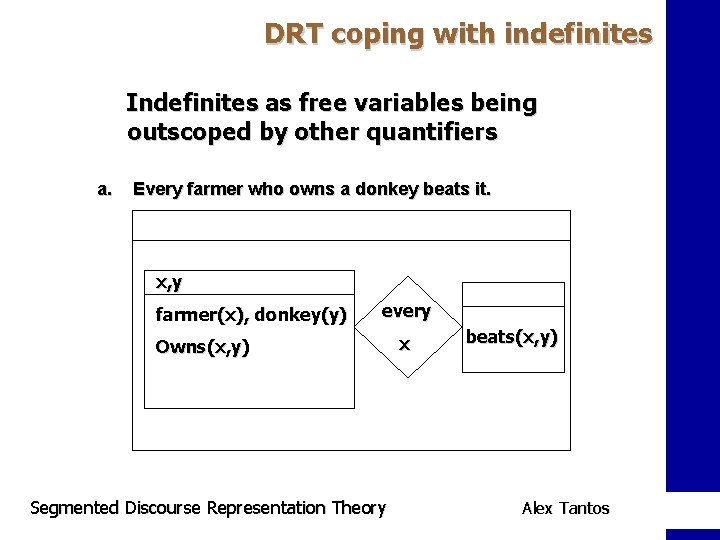
DRT coping with indefinites Indefinites as free variables being outscoped by other quantifiers a. Every farmer who owns a donkey beats it. x, y farmer(x), donkey(y) every Owns(x, y) Segmented Discourse Representation Theory x beats(x, y) Alex Tantos
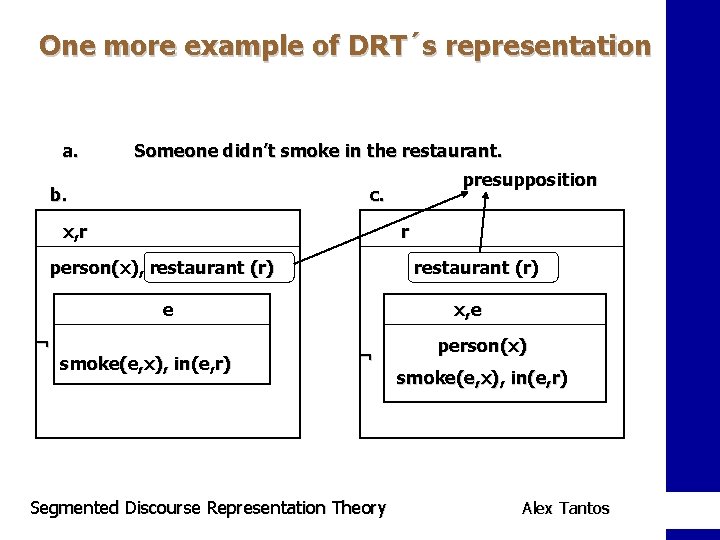
One more example of DRT´s representation a. Someone didn’t smoke in the restaurant. b. presupposition c. x, r r person(x), restaurant (r) e smoke(e, x), in(e, r) x, e Segmented Discourse Representation Theory person(x) smoke(e, x), in(e, r) Alex Tantos
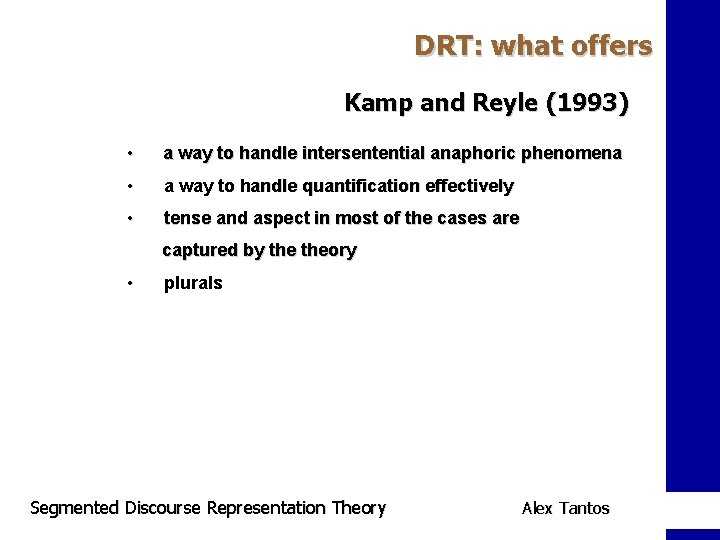
DRT: what offers Kamp and Reyle (1993) • a way to handle intersentential anaphoric phenomena • a way to handle quantification effectively • tense and aspect in most of the cases are captured by theory • plurals Segmented Discourse Representation Theory Alex Tantos
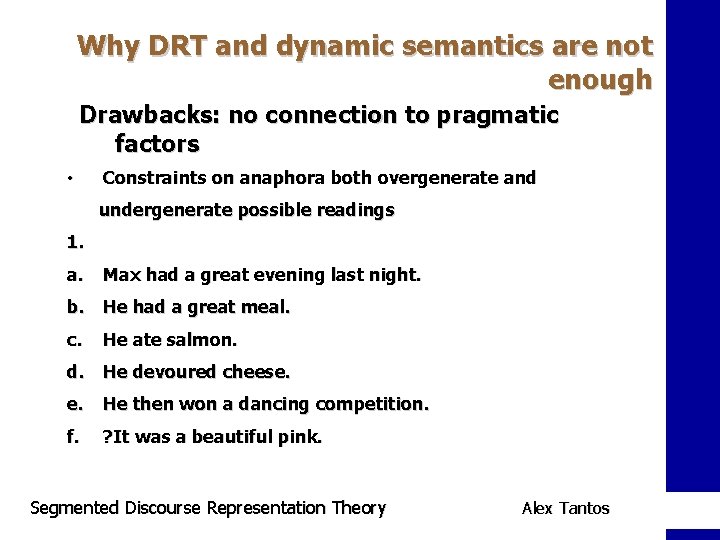
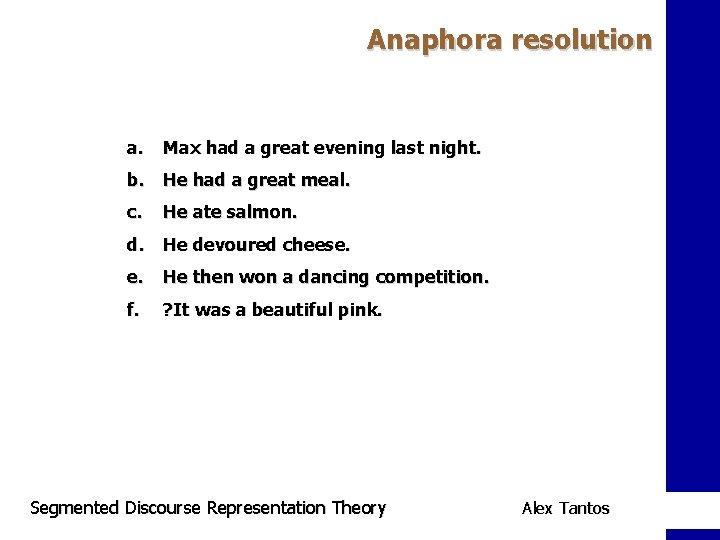
Why DRT and dynamic semantics are not enough Drawbacks: no connection to pragmatic factors • Constraints on anaphora both overgenerate and undergenerate possible readings 1. a. Max had a great evening last night. b. He had a great meal. c. He ate salmon. d. He devoured cheese. e. He then won a dancing competition. f. ? It was a beautiful pink. Segmented Discourse Representation Theory Alex Tantos
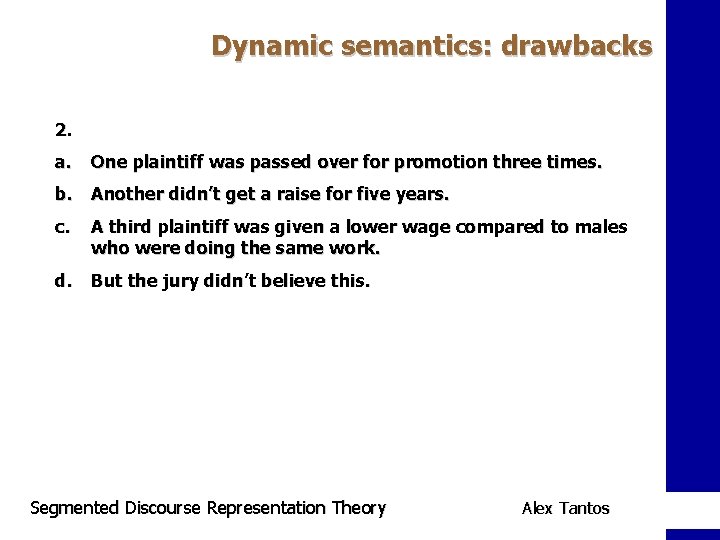
Dynamic semantics: drawbacks 2. a. One plaintiff was passed over for promotion three times. b. Another didn’t get a raise for five years. c. A third plaintiff was given a lower wage compared to males who were doing the same work. d. But the jury didn’t believe this. Segmented Discourse Representation Theory Alex Tantos
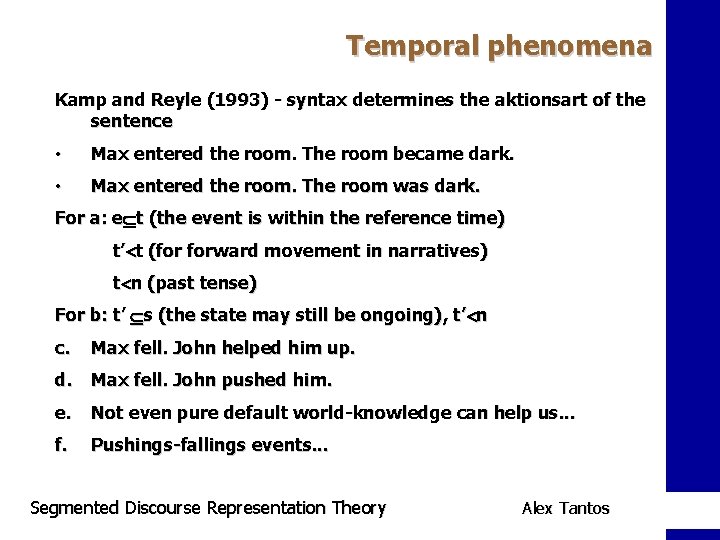
Temporal phenomena Kamp and Reyle (1993) - syntax determines the aktionsart of the sentence • Max entered the room. The room became dark. • Max entered the room. The room was dark. For a: e t (the event is within the reference time) t’ t (for forward movement in narratives) t n (past tense) For b: t’ s (the state may still be ongoing), t’ n c. Max fell. John helped him up. d. Max fell. John pushed him. e. Not even pure default world-knowledge can help us. . . f. Pushings-fallings events. . . Segmented Discourse Representation Theory Alex Tantos
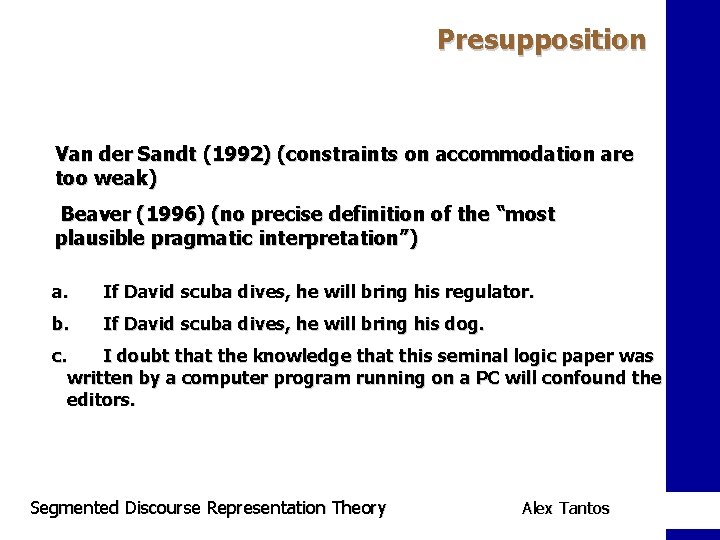
Presupposition Van der Sandt (1992) (constraints on accommodation are too weak) Beaver (1996) (no precise definition of the “most plausible pragmatic interpretation”) a. If David scuba dives, he will bring his regulator. b. If David scuba dives, he will bring his dog. c. I doubt that the knowledge that this seminal logic paper was written by a computer program running on a PC will confound the editors. Segmented Discourse Representation Theory Alex Tantos
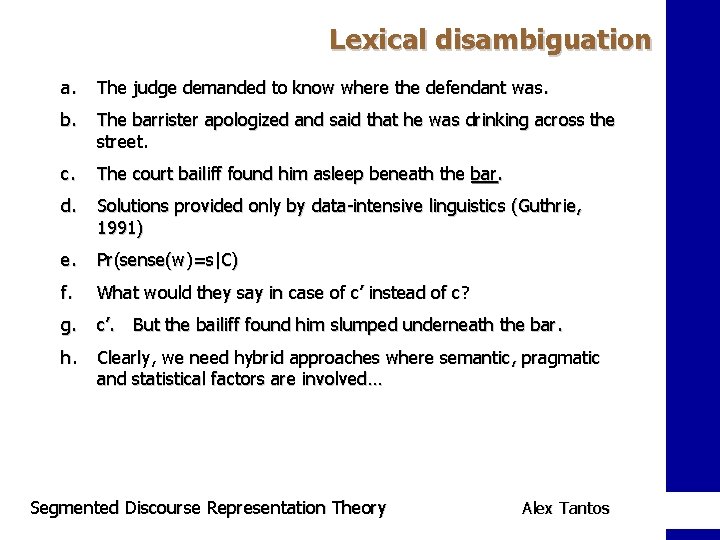
Lexical disambiguation a. The judge demanded to know where the defendant was. b. The barrister apologized and said that he was drinking across the street. c. The court bailiff found him asleep beneath the bar. d. Solutions provided only by data-intensive linguistics (Guthrie, 1991) e. Pr(sense(w)=s|C) f. What would they say in case of c’ instead of c? g. c’. But the bailiff found him slumped underneath the bar. h. Clearly, we need hybrid approaches where semantic, pragmatic and statistical factors are involved… Segmented Discourse Representation Theory Alex Tantos
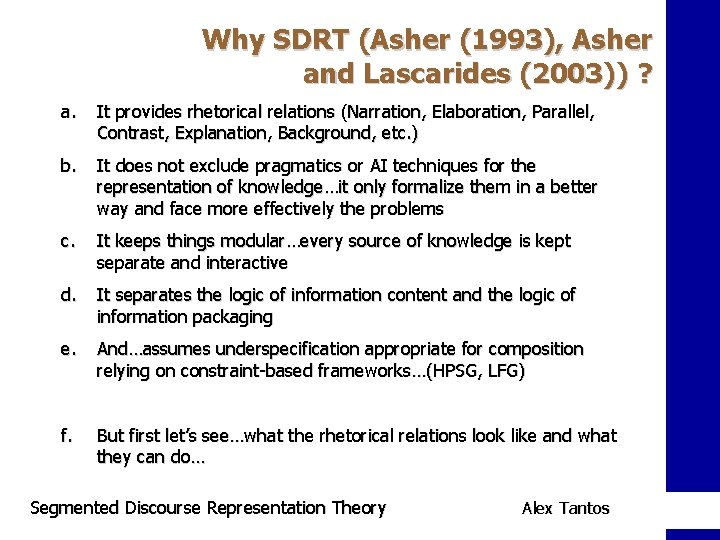
Why SDRT (Asher (1993), Asher and Lascarides (2003)) ? a. It provides rhetorical relations (Narration, Elaboration, Parallel, Contrast, Explanation, Background, etc. ) b. It does not exclude pragmatics or AI techniques for the representation of knowledge…it only formalize them in a better way and face more effectively the problems c. It keeps things modular…every source of knowledge is kept separate and interactive d. It separates the logic of information content and the logic of information packaging e. And…assumes underspecification appropriate for composition relying on constraint-based frameworks…(HPSG, LFG) f. But first let’s see…what the rhetorical relations look like and what they can do… Segmented Discourse Representation Theory Alex Tantos
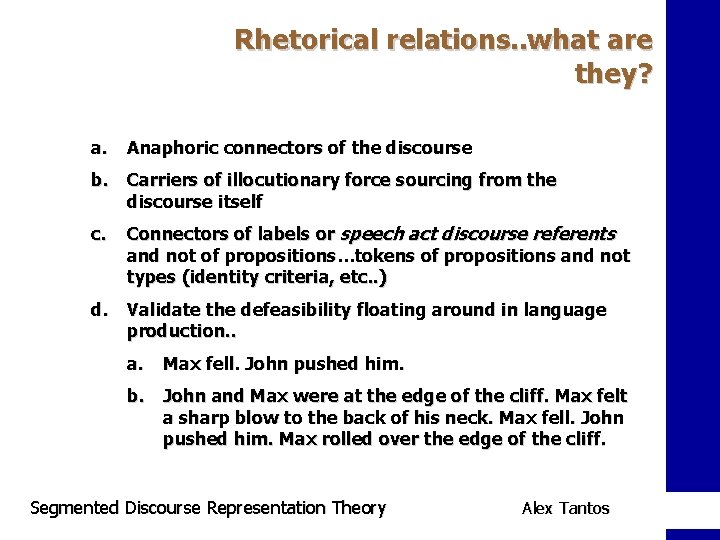
Rhetorical relations. . what are they? a. Anaphoric connectors of the discourse b. Carriers of illocutionary force sourcing from the discourse itself c. Connectors of labels or speech act discourse referents and not of propositions…tokens of propositions and not types (identity criteria, etc. . ) d. Validate the defeasibility floating around in language production. . a. Max fell. John pushed him. b. John and Max were at the edge of the cliff. Max felt a sharp blow to the back of his neck. Max fell. John pushed him. Max rolled over the edge of the cliff. Segmented Discourse Representation Theory Alex Tantos
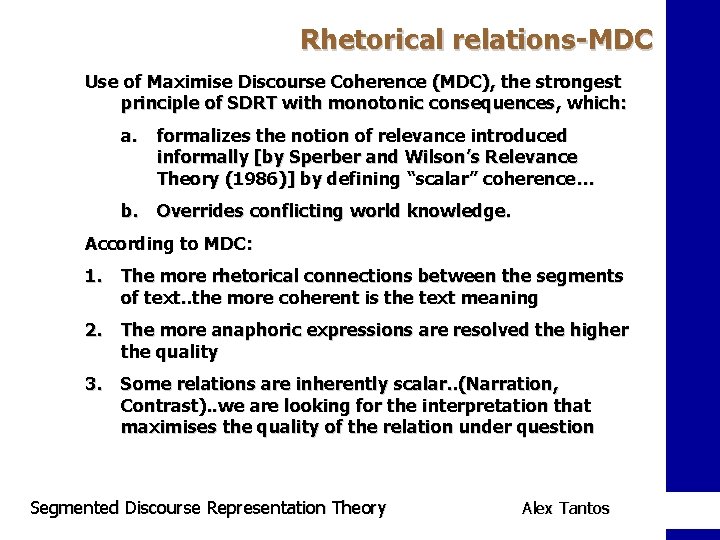
Rhetorical relations-MDC Use of Maximise Discourse Coherence (MDC), the strongest principle of SDRT with monotonic consequences, which: a. formalizes the notion of relevance introduced informally [by Sperber and Wilson’s Relevance Theory (1986)] by defining “scalar” coherence… b. Overrides conflicting world knowledge. According to MDC: 1. The more rhetorical connections between the segments of text. . the more coherent is the text meaning 2. The more anaphoric expressions are resolved the higher the quality 3. Some relations are inherently scalar. . (Narration, Contrast). . we are looking for the interpretation that maximises the quality of the relation under question Segmented Discourse Representation Theory Alex Tantos
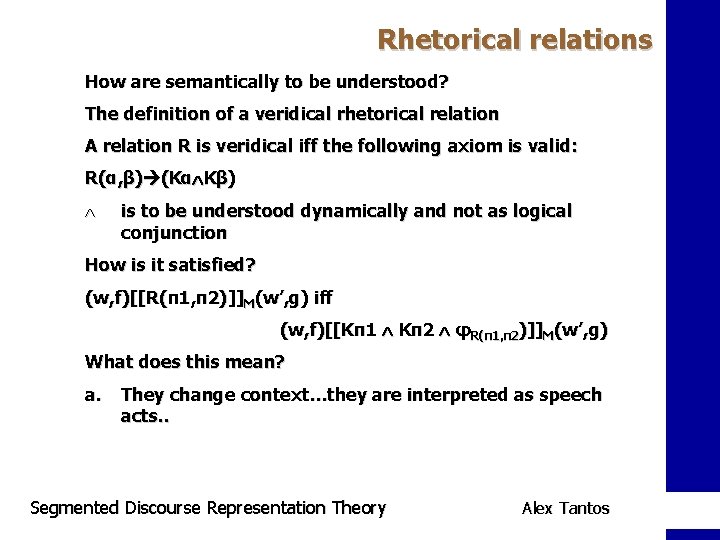
Rhetorical relations How are semantically to be understood? The definition of a veridical rhetorical relation A relation R is veridical iff the following axiom is valid: R(α, β) (Kα Κβ) is to be understood dynamically and not as logical conjunction How is it satisfied? (w, f)[[R(π1, π2)]]M(w’, g) iff (w, f)[[Kπ1 Kπ2 φR(π1, π2)]]M(w’, g) What does this mean? a. They change context…they are interpreted as speech acts. . Segmented Discourse Representation Theory Alex Tantos
Anaphora resolution a. Max had a great evening last night. b. He had a great meal. c. He ate salmon. d. He devoured cheese. e. He then won a dancing competition. f. ? It was a beautiful pink. Segmented Discourse Representation Theory Alex Tantos
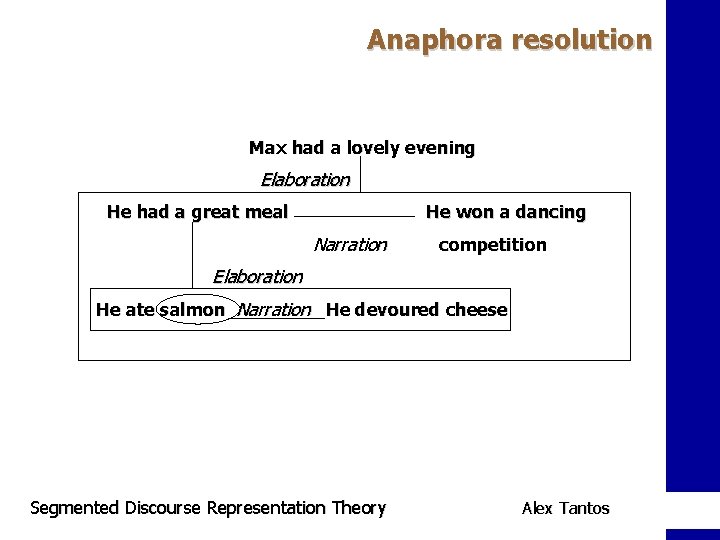
Anaphora resolution Max had a lovely evening Elaboration He had a great meal He won a dancing Narration competition Elaboration He ate salmon Narration He devoured cheese Segmented Discourse Representation Theory Alex Tantos
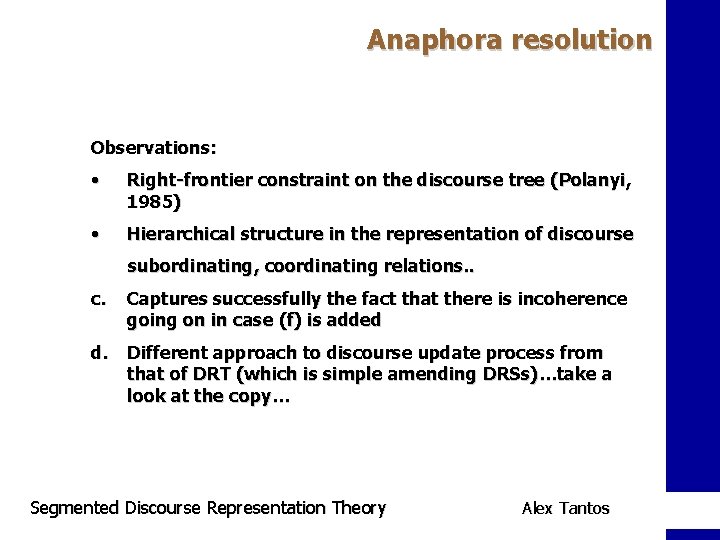
Anaphora resolution Observations: • Right-frontier constraint on the discourse tree (Polanyi, 1985) • Hierarchical structure in the representation of discourse subordinating, coordinating relations. . c. Captures successfully the fact that there is incoherence going on in case (f) is added d. Different approach to discourse update process from that of DRT (which is simple amending DRSs)…take a look at the copy… Segmented Discourse Representation Theory Alex Tantos
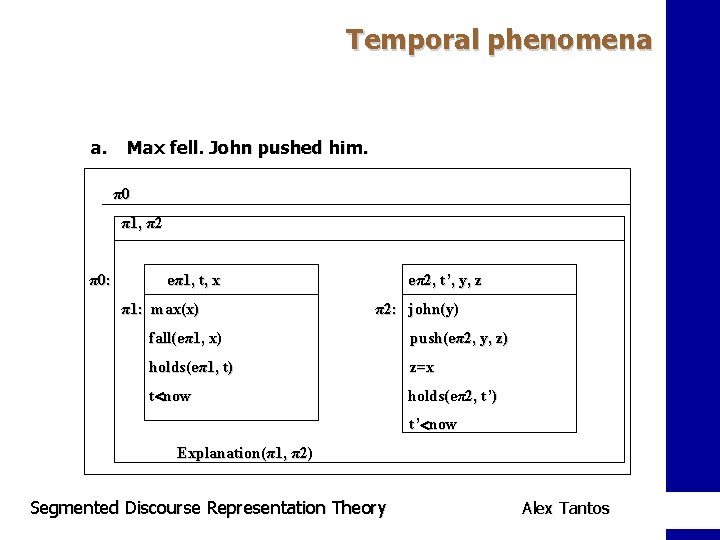
Temporal phenomena a. Max fell. John pushed him. π0 π1, π2 π0: eπ1, t, x π1: max(x) eπ2, t’, y, z π2: john(y) fall(eπ1, x) push(eπ2, y, z) holds(eπ1, t) z=x t now holds(eπ2, t’) t’ now Explanation(π1, π2) Segmented Discourse Representation Theory Alex Tantos
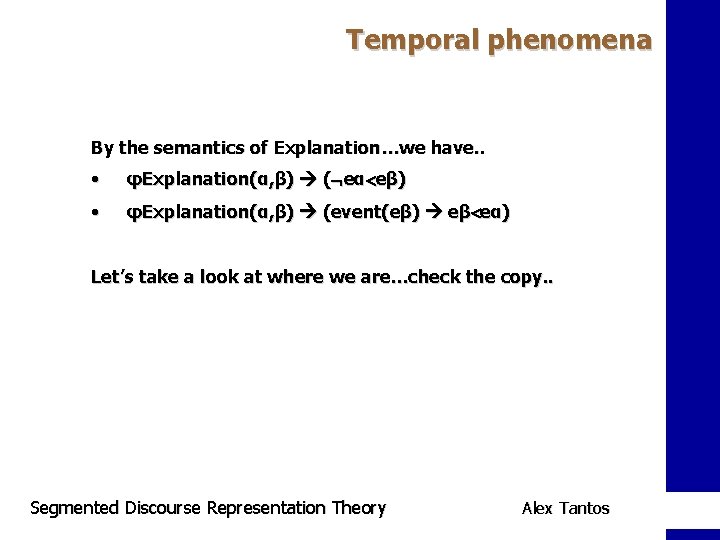
Temporal phenomena By the semantics of Explanation…we have. . • φExplanation(α, β) ( eα eβ) • φExplanation(α, β) (event(eβ) eβ eα) Let’s take a look at where we are…check the copy. . Segmented Discourse Representation Theory Alex Tantos
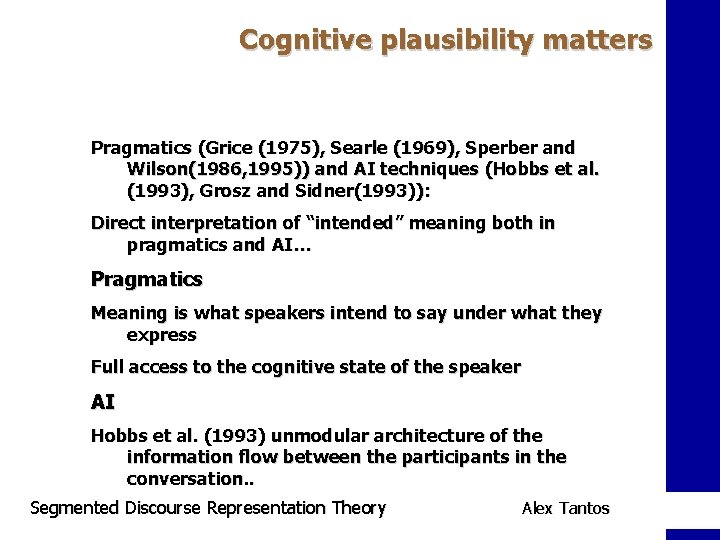
Cognitive plausibility matters Pragmatics (Grice (1975), Searle (1969), Sperber and Wilson(1986, 1995)) and AI techniques (Hobbs et al. (1993), Grosz and Sidner(1993)): Direct interpretation of “intended” meaning both in pragmatics and AI… Pragmatics Meaning is what speakers intend to say under what they express Full access to the cognitive state of the speaker AI Hobbs et al. (1993) unmodular architecture of the information flow between the participants in the conversation. . Segmented Discourse Representation Theory Alex Tantos
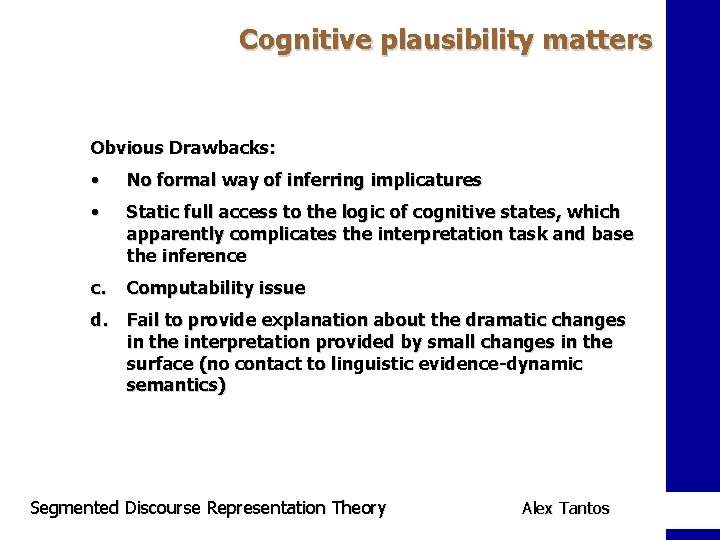
Cognitive plausibility matters Obvious Drawbacks: • No formal way of inferring implicatures • Static full access to the logic of cognitive states, which apparently complicates the interpretation task and base the inference c. Computability issue d. Fail to provide explanation about the dramatic changes in the interpretation provided by small changes in the surface (no contact to linguistic evidence-dynamic semantics) Segmented Discourse Representation Theory Alex Tantos
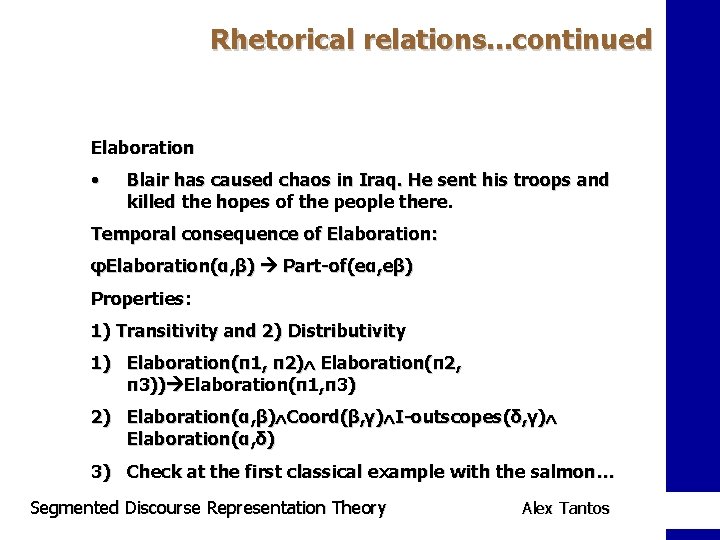
Rhetorical relations. . . continued Elaboration • Blair has caused chaos in Iraq. He sent his troops and killed the hopes of the people there. Temporal consequence of Elaboration: φElaboration(α, β) Part-of(eα, eβ) Properties: 1) Transitivity and 2) Distributivity 1) Elaboration(π1, π2) Elaboration(π2, π3)) Elaboration(π1, π3) 2) Elaboration(α, β) Coord(β, γ) I-outscopes(δ, γ) Elaboration(α, δ) 3) Check at the first classical example with the salmon… Segmented Discourse Representation Theory Alex Tantos
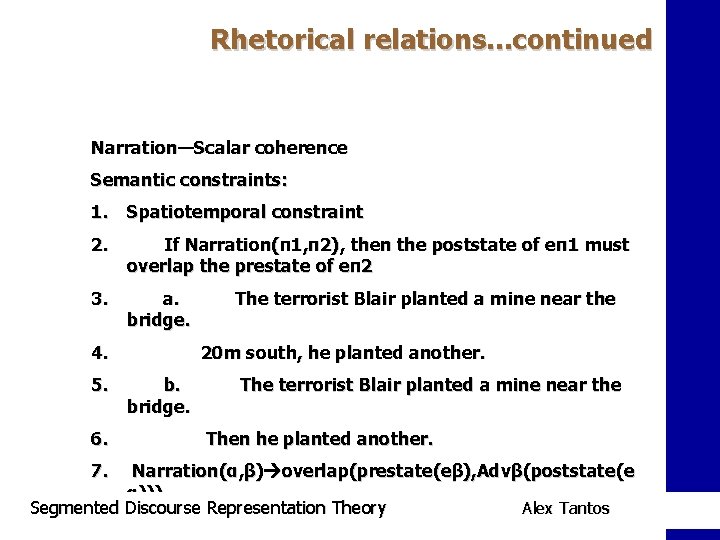
Rhetorical relations. . . continued Narration—Scalar coherence Semantic constraints: 1. Spatiotemporal constraint 2. If Narration(π1, π2), then the poststate of eπ1 must overlap the prestate of eπ2 3. a. bridge. 4. 5. 6. 7. The terrorist Blair planted a mine near the 20 m south, he planted another. b. bridge. The terrorist Blair planted a mine near the Then he planted another. Narration(α, β) overlap(prestate(eβ), Advβ(poststate(e α))) Segmented Discourse Representation Theory Alex Tantos
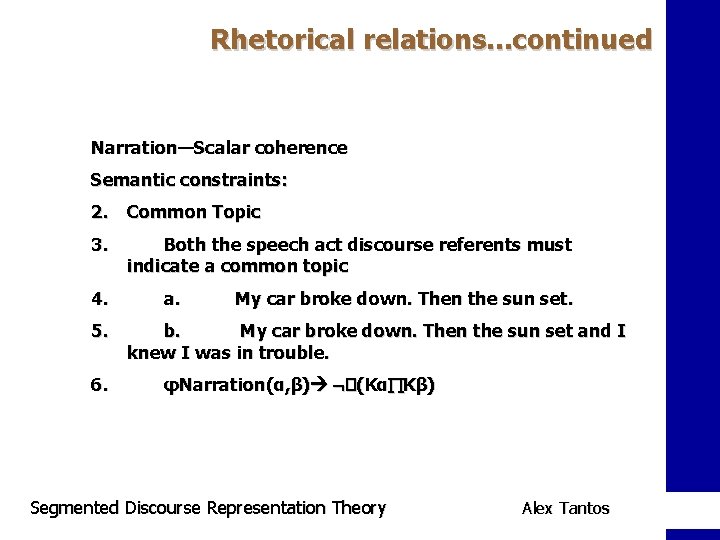
Rhetorical relations. . . continued Narration—Scalar coherence Semantic constraints: 2. Common Topic 3. 4. 5. 6. Both the speech act discourse referents must indicate a common topic a. My car broke down. Then the sun set. b. My car broke down. Then the sun set and I knew I was in trouble. φNarration(α, β) �(Kα Kβ) Segmented Discourse Representation Theory Alex Tantos
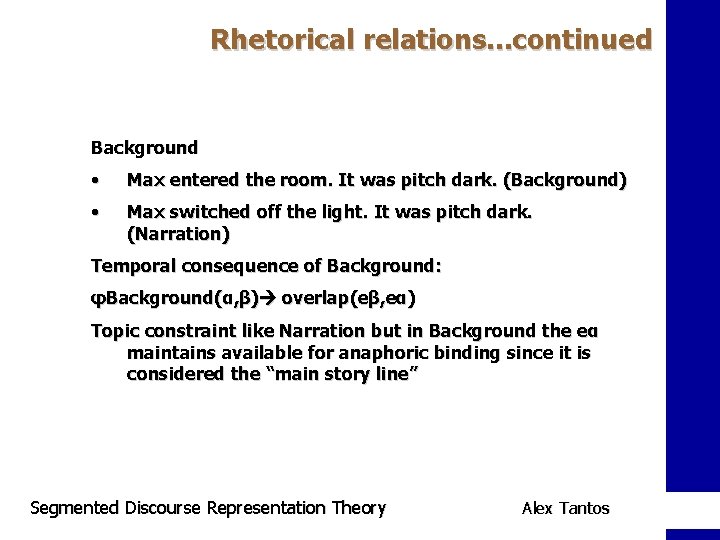
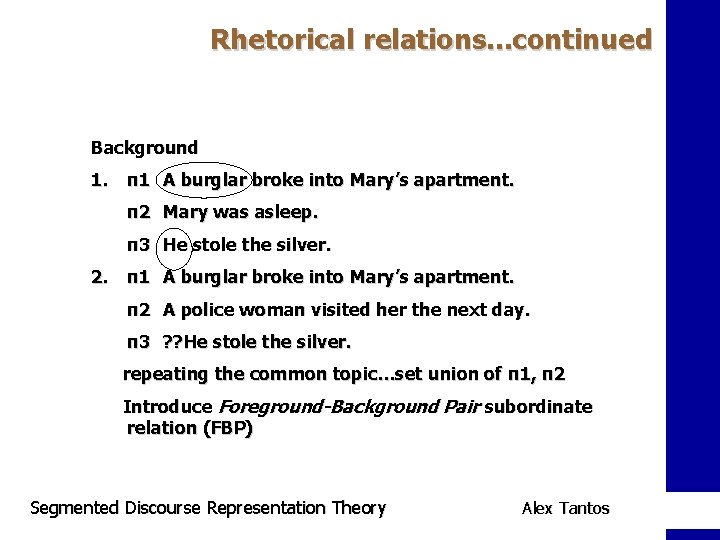
Rhetorical relations. . . continued Background • Max entered the room. It was pitch dark. (Background) • Max switched off the light. It was pitch dark. (Narration) Temporal consequence of Background: φBackground(α, β) overlap(eβ, eα) Topic constraint like Narration but in Background the eα maintains available for anaphoric binding since it is considered the “main story line” Segmented Discourse Representation Theory Alex Tantos
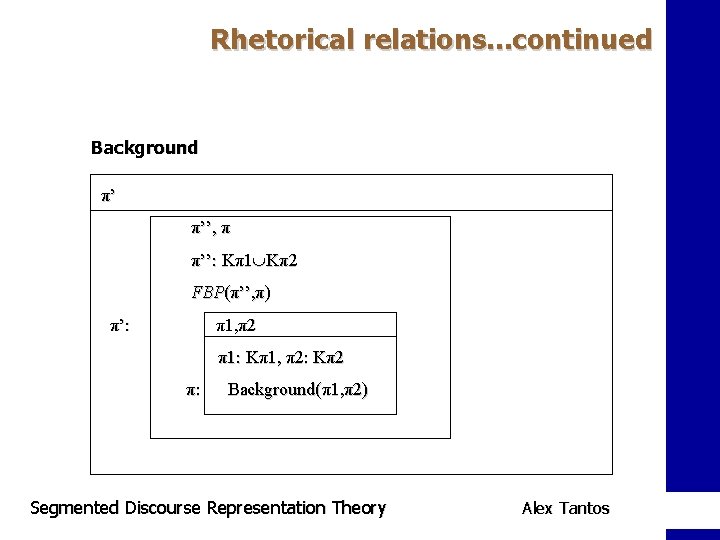
Rhetorical relations. . . continued Background 1. π1 A burglar broke into Mary’s apartment. π2 Mary was asleep. π3 He stole the silver. 2. π1 A burglar broke into Mary’s apartment. π2 A police woman visited her the next day. π3 ? ? He stole the silver. repeating the common topic…set union of π1, π2 Introduce Foreground-Background Pair subordinate relation (FBP) Segmented Discourse Representation Theory Alex Tantos
Rhetorical relations. . . continued Background π’ π’’, π π’’: Kπ1 Kπ2 FBP(π’’, π) π’: π1, π2 π1: Kπ1, π2: Kπ2 π: Background(π1, π2) Segmented Discourse Representation Theory Alex Tantos
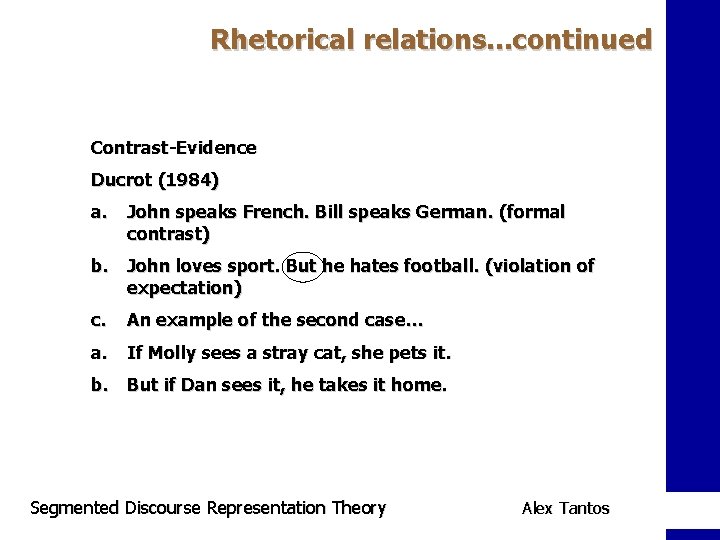
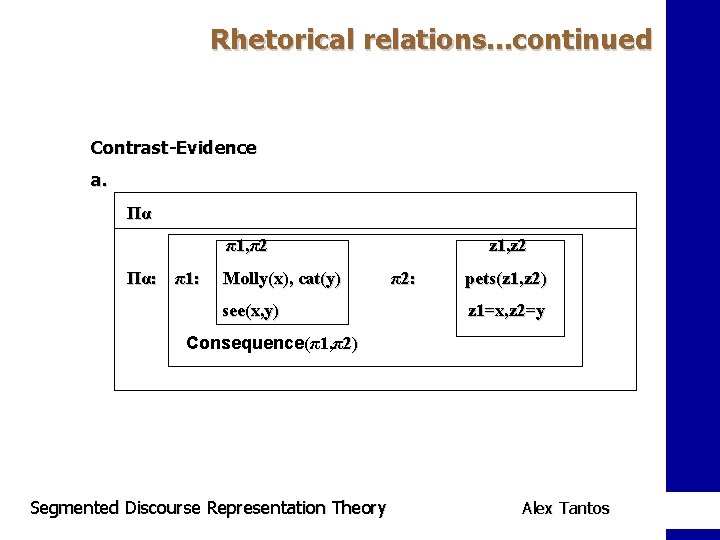
Rhetorical relations. . . continued Contrast-Evidence Ducrot (1984) a. John speaks French. Bill speaks German. (formal contrast) b. John loves sport. But he hates football. (violation of expectation) c. An example of the second case… a. If Molly sees a stray cat, she pets it. b. But if Dan sees it, he takes it home. Segmented Discourse Representation Theory Alex Tantos
Rhetorical relations. . . continued Contrast-Evidence a. Πα π1, π2 Πα: π1: Molly(x), cat(y) see(x, y) z 1, z 2 π2: pets(z 1, z 2) z 1=x, z 2=y Consequence(π1, π2) Segmented Discourse Representation Theory Alex Tantos
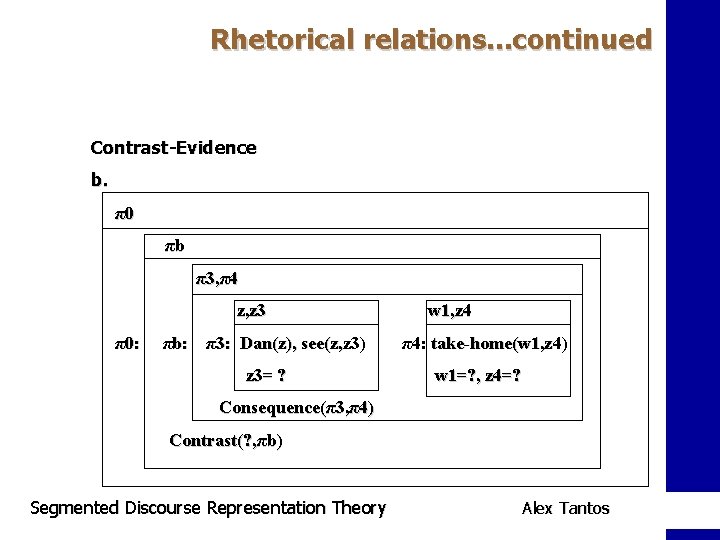
Rhetorical relations. . . continued Contrast-Evidence b. π0 πb π3, π4 z, z 3 π0: πb: π3: Dan(z), see(z, z 3) z 3= ? w 1, z 4 π4: take-home(w 1, z 4) w 1=? , z 4=? Consequence(π3, π4) Contrast(? , πb) Segmented Discourse Representation Theory Alex Tantos
Rhetorical relations. . . continued Contrast πα π1: Conseq πb π2: [Molly sees cat] [Molly pets cat] π3: Conseq [Dan sees ? ] π4: [Dan takes home ? ] For the mapping between the πs see Asher (1993) Segmented Discourse Representation Theory Alex Tantos
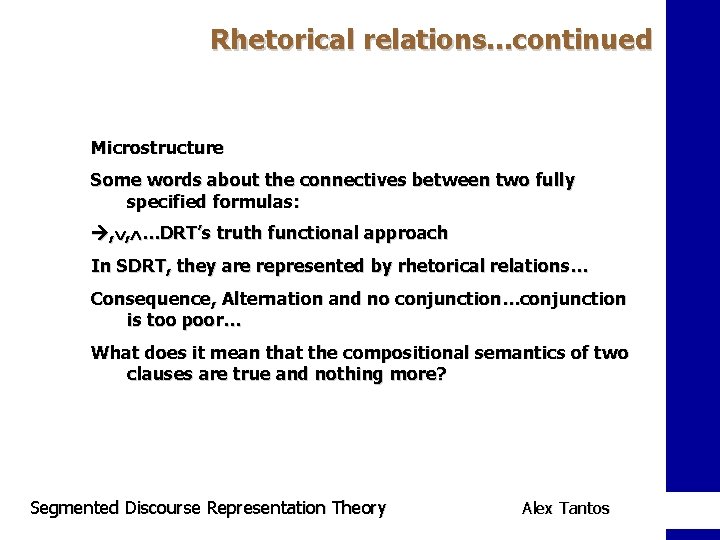
Rhetorical relations. . . continued Microstructure Some words about the connectives between two fully specified formulas: , , …DRT’s truth functional approach In SDRT, they are represented by rhetorical relations… Consequence, Alternation and no conjunction…conjunction is too poor… What does it mean that the compositional semantics of two clauses are true and nothing more? Segmented Discourse Representation Theory Alex Tantos
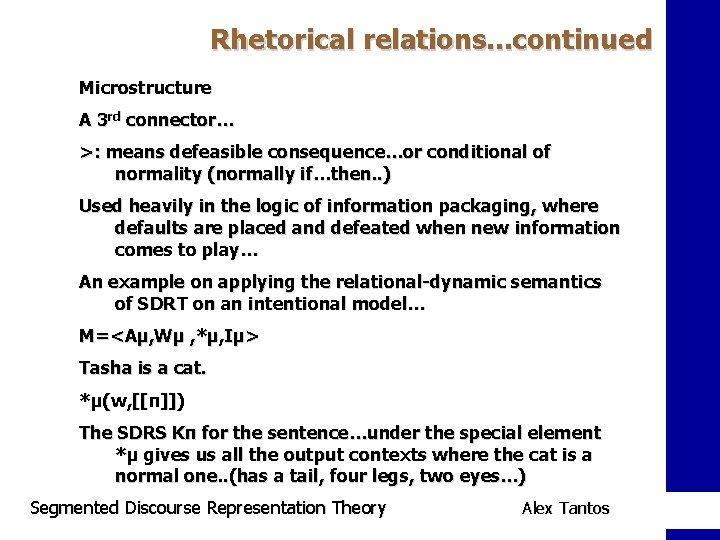
Rhetorical relations. . . continued Microstructure A 3 rd connector… >: means defeasible consequence…or conditional of normality (normally if…then. . ) Used heavily in the logic of information packaging, where defaults are placed and defeated when new information comes to play… An example on applying the relational-dynamic semantics of SDRT on an intentional model… M=<Aμ, Wμ , *μ, Iμ> Tasha is a cat. *μ(w, [[π]]) The SDRS Kπ for the sentence…under the special element *μ gives us all the output contexts where the cat is a normal one. . (has a tail, four legs, two eyes…) Segmented Discourse Representation Theory Alex Tantos
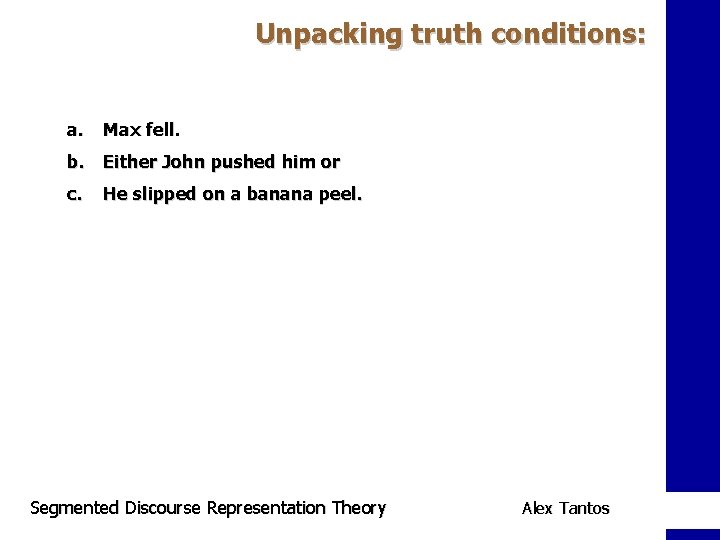
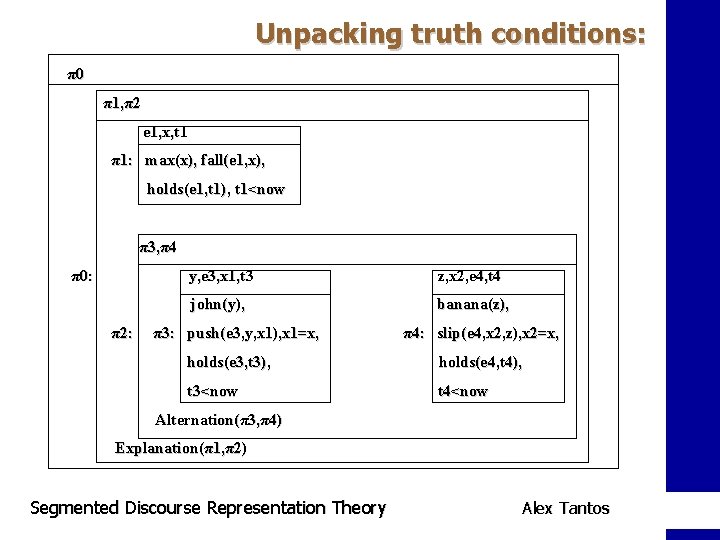
Unpacking truth conditions: a. Max fell. b. Either John pushed him or c. He slipped on a banana peel. Segmented Discourse Representation Theory Alex Tantos
Unpacking truth conditions: π0 π1, π2 e 1, x, t 1 π1: max(x), fall(e 1, x), holds(e 1, t 1), t 1<now π3, π4 π0: π2: y, e 3, x 1, t 3 z, x 2, e 4, t 4 john(y), banana(z), π3: push(e 3, y, x 1), x 1=x, π4: slip(e 4, x 2, z), x 2=x, holds(e 3, t 3), holds(e 4, t 4), t 3<now t 4<now Alternation(π3, π4) Explanation(π1, π2) Segmented Discourse Representation Theory Alex Tantos
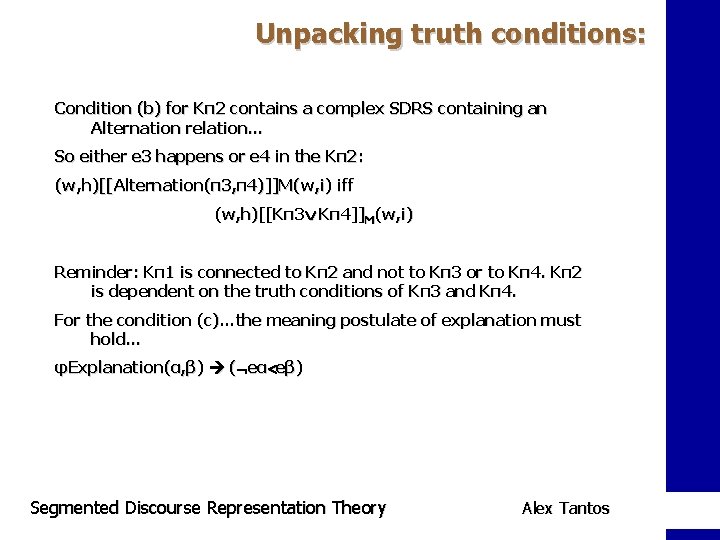
Unpacking truth conditions: Use of the satisfaction schema and recursively unpacking: (w, f)[[Explanation(π1, π2)]]M(w, g) iff (w, f)[[Kπ1 Kπ2 Explanation(π1, π2)]]M(w’, g) By the semantics of there are variable assignment functions h and i such that: a) (w, f)[[Kπ1]]M(w, h) b) (w, h)[[Kπ2]]M(w, i); and c) (w, i)[[Explanation(π1, π2)]]M(w, g) d) Let’s take the first condition: (a) Holds only if: 1. Dom(h)=dom(f) {e 1, x, t 1} and (w, h) satisfies the SDRSs conditions. . 2. <h(x)> IM(max)(w), <h(e 1), h(x)> IM(fall)(w), etc. . Segmented Discourse Representation Theory Alex Tantos
Unpacking truth conditions: Condition (b) for Kπ2 contains a complex SDRS containing an Alternation relation… So either e 3 happens or e 4 in the Kπ2: (w, h)[[Alternation(π3, π4)]]M(w, i) iff (w, h)[[Kπ3 Kπ4]]M(w, i) Reminder: Kπ1 is connected to Kπ2 and not to Kπ3 or to Kπ4. Kπ2 is dependent on the truth conditions of Kπ3 and Kπ4. For the condition (c)…the meaning postulate of explanation must hold… φExplanation(α, β) ( eα eβ) Segmented Discourse Representation Theory Alex Tantos
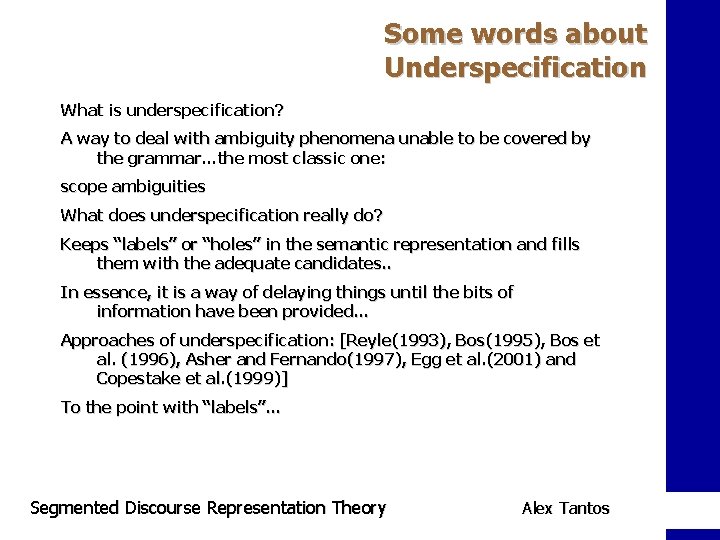
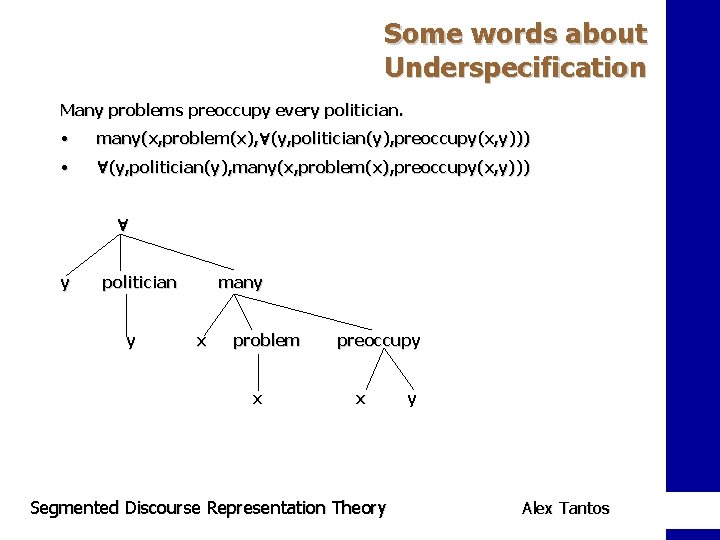
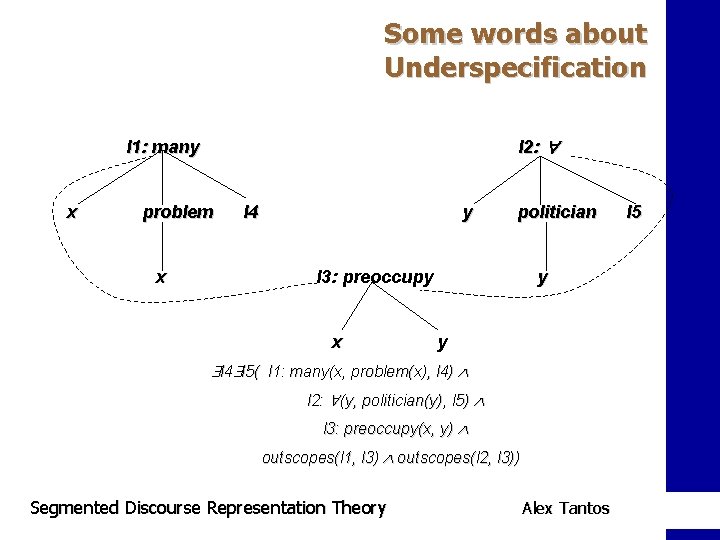
Some words about Underspecification What is underspecification? A way to deal with ambiguity phenomena unable to be covered by the grammar…the most classic one: scope ambiguities What does underspecification really do? Keeps “labels” or “holes” in the semantic representation and fills them with the adequate candidates. . In essence, it is a way of delaying things until the bits of information have been provided… Approaches of underspecification: [Reyle(1993), Bos(1995), Bos et al. (1996), Asher and Fernando(1997), Egg et al. (2001) and Copestake et al. (1999)] To the point with “labels”… Segmented Discourse Representation Theory Alex Tantos
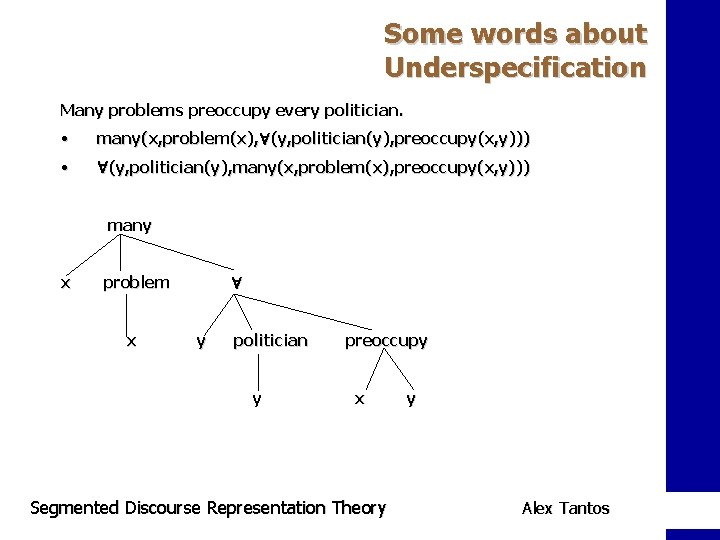
Some words about Underspecification Many problems preoccupy every politician. • many(x, problem(x), (y, politician(y), preoccupy(x, y))) • (y, politician(y), many(x, problem(x), preoccupy(x, y))) many x problem x y politician y preoccupy x Segmented Discourse Representation Theory y Alex Tantos
Some words about Underspecification Many problems preoccupy every politician. • many(x, problem(x), (y, politician(y), preoccupy(x, y))) • (y, politician(y), many(x, problem(x), preoccupy(x, y))) y politician y many x problem x preoccupy x Segmented Discourse Representation Theory y Alex Tantos
Some words about Underspecification l 2: l 1: many x problem x l 4 y politician l 3: preoccupy x y y l 4 l 5( l 1: many(x, problem(x), l 4) l 2: (y, politician(y), l 5) l 3: preoccupy(x, y) outscopes(l 1, l 3) outscopes(l 2, l 3)) Segmented Discourse Representation Theory Alex Tantos l 5
What is next? SDRT is a new theory. . it does not include… • Implicatures that follow from social status, gender and so on • The contents of dialogues where discourse participants have different communicative agendas • The repair strategies that occur when dialogue participants realise they have interpreted the dialogue differently Do you want some more? Contact me…Alexandros. Tantos@uni-konstanz. de Segmented Discourse Representation Theory Alex Tantos