
Segmentation Across Cultures z PEPSI IN TAIWAN yCome

- Slides: 52
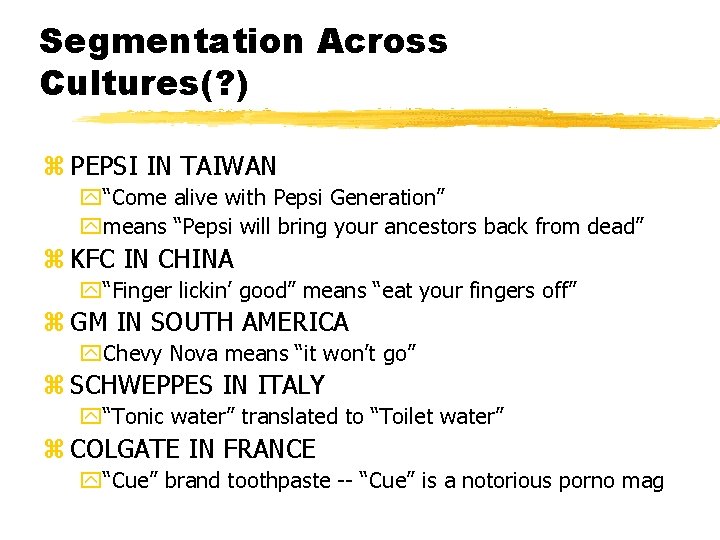
Segmentation Across Cultures(? ) z PEPSI IN TAIWAN y“Come alive with Pepsi Generation” ymeans “Pepsi will bring your ancestors back from dead” z KFC IN CHINA y“Finger lickin’ good” means “eat your fingers off” z GM IN SOUTH AMERICA y. Chevy Nova means “it won’t go” z SCHWEPPES IN ITALY y“Tonic water” translated to “Toilet water” z COLGATE IN FRANCE y“Cue” brand toothpaste -- “Cue” is a notorious porno mag
Chapter 5: Segmentation
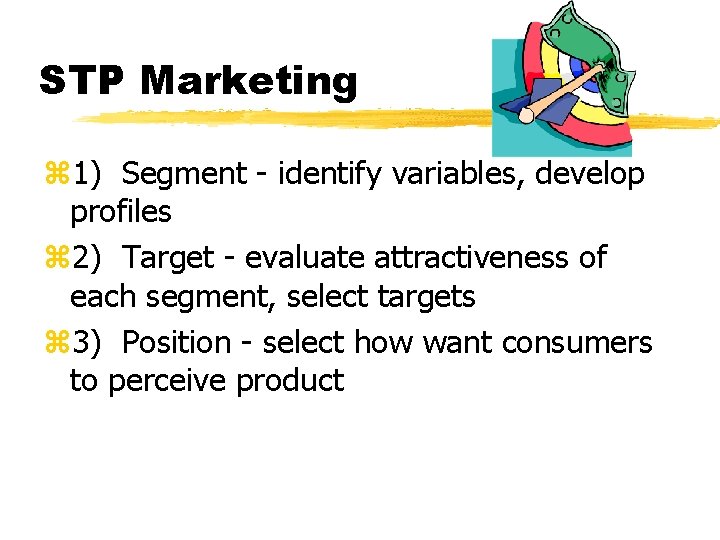
STP Marketing z 1) Segment - identify variables, develop profiles z 2) Target - evaluate attractiveness of each segment, select targets z 3) Position - select how want consumers to perceive product
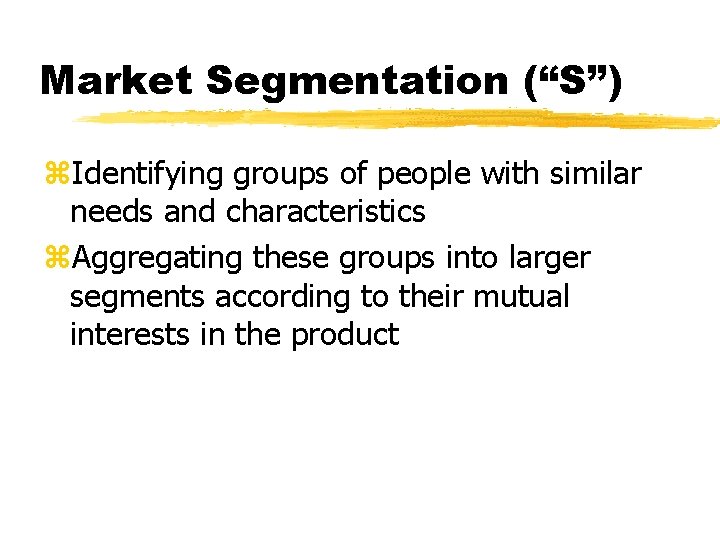
Market Segmentation (“S”) z. Identifying groups of people with similar needs and characteristics z. Aggregating these groups into larger segments according to their mutual interests in the product
Effective Segmentation: z 1) Measurability - can you measure segment? z 2) Accessibility - can segment be reached? z 3) Profitability - what’s the segment’s potential?
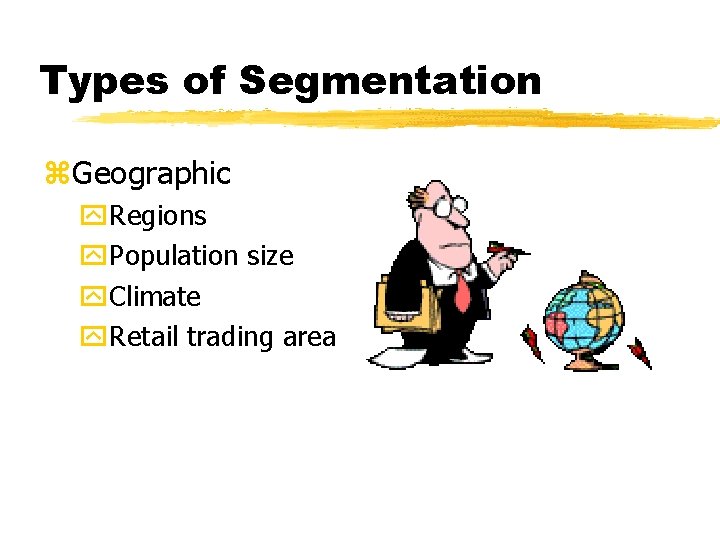
Types of Segmentation z. Geographic y. Regions y. Population size y. Climate y. Retail trading area
Types of Segmentation z. Demographic x. Age x. Gender x. Family size/life cycle x. Income x. Occupation x. Education x. Race y. Geodemographics -- PRIZM http: //www. claritasexpress. com
Demographic Trends y 1) Changing families xlater marriage xfewer kids xhigher divorce xworking spouses xaging parents y 2) y 3) y 4) y 5) Nonfamily households Geographic shifts Higher education Ethnic population
Emerging Markets z. People of Color y. Buying power has doubled in last decade y. Nearly 1 in 3 claims ethnic identity y. Companies struggling to understand develop multiethnic awareness and advertising know-how
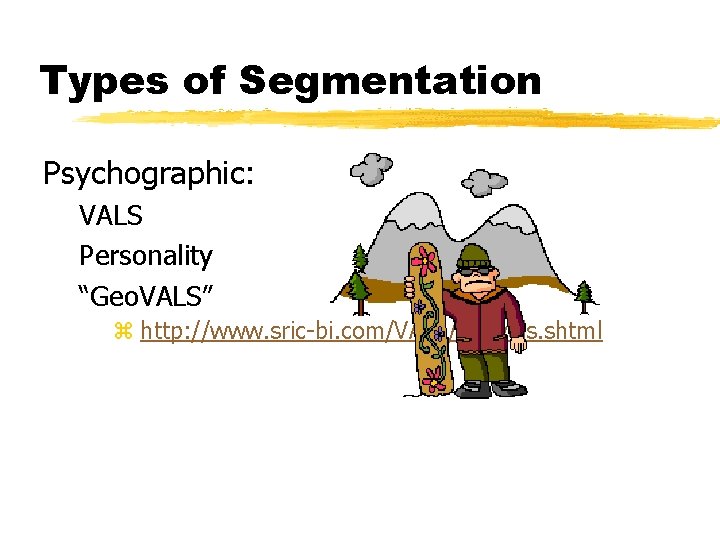
Types of Segmentation Psychographic: VALS Personality “Geo. VALS” z http: //www. sric-bi. com/VALS/geovals. shtml
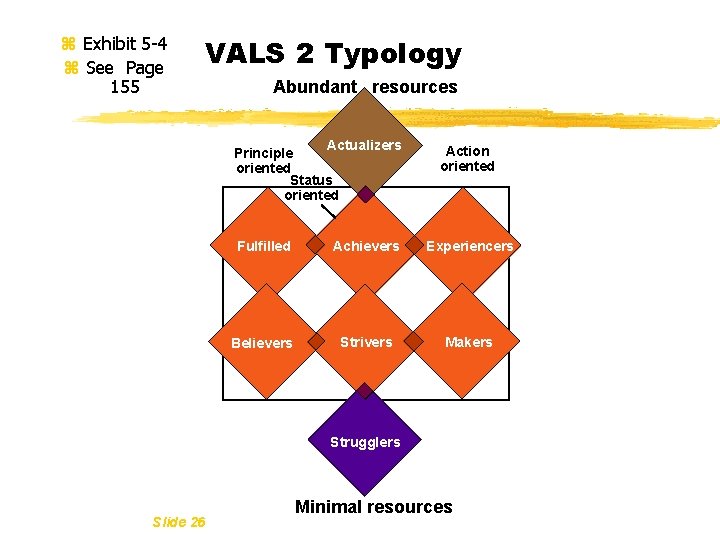
z Exhibit 5 -4 z See Page 155 VALS 2 Typology Abundant resources Actualizers Principle oriented Status oriented Action oriented Fulfilled Achievers Experiencers Believers Strivers Makers Strugglers Slide 26 Minimal resources
Types of Segmentation z. Behavioristic y. Purchase occasion y. Benefits sought y. User status y. Usage rate
Target Marketing (“T) z. Decide which segments offer the most potential (profit!) z. Design products and marketing activities toward target.
Product Positioning z“It’s not what you do to the product, but what you do to the mind!”
http: //www. adcritic. com/conte nt/ikea-boredtodeath. html
Positioning z 1) Find a difference -- USP: ya. yb. yc. yd. ye. yf. yg. Important Distinctive Superior Communicable Preemptive Affordable Profitable
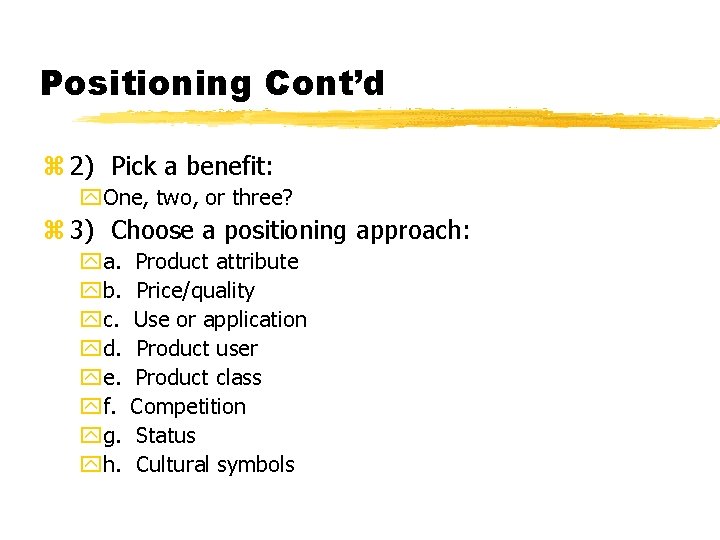
Positioning Cont’d z 2) Pick a benefit: y. One, two, or three? z 3) Choose a positioning approach: ya. yb. yc. yd. ye. yf. yg. yh. Product attribute Price/quality Use or application Product user Product class Competition Status Cultural symbols
Ch. 6: Research and Information Gathering
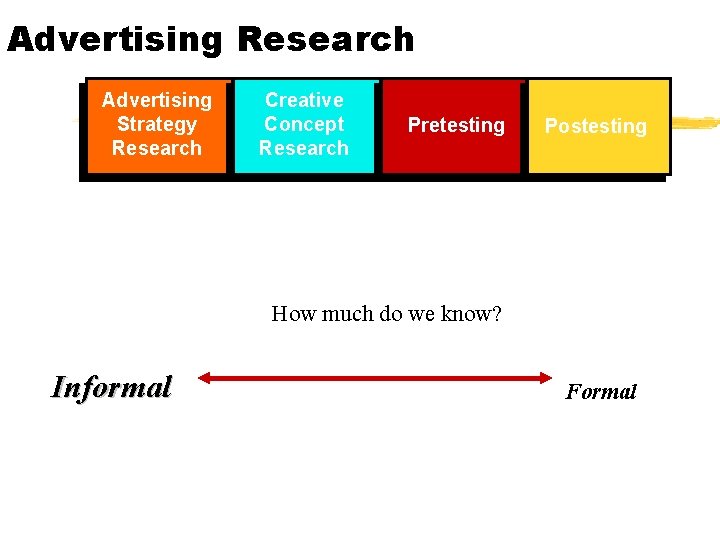
Advertising Research Advertising Strategy Research Creative Concept Research Pretesting Postesting How much do we know? Informal Formal
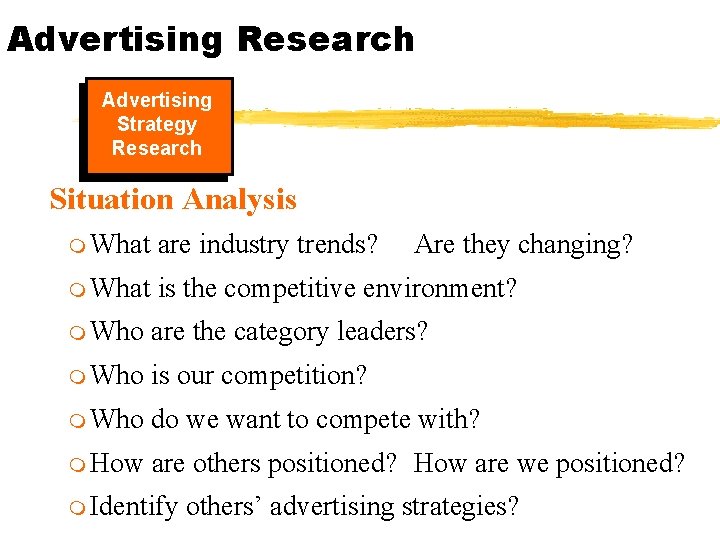
Advertising Research Advertising Strategy Research Situation Analysis m What are industry trends? Are they changing? m What is the competitive environment? m Who are the category leaders? m Who is our competition? m Who do we want to compete with? m How are others positioned? How are we positioned? m Identify others’ advertising strategies?
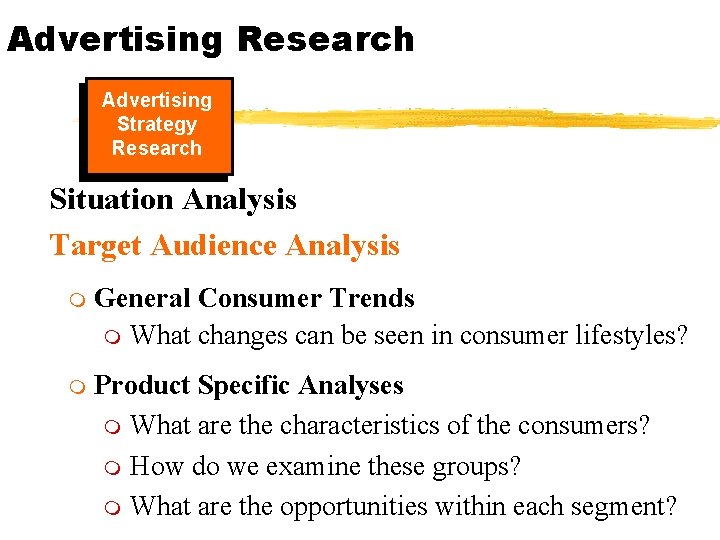
Advertising Research Advertising Strategy Research Situation Analysis Target Audience Analysis m General Consumer Trends m What changes can be seen in consumer lifestyles? m Product Specific Analyses m What are the characteristics of the consumers? m How do we examine these groups? m What are the opportunities within each segment?
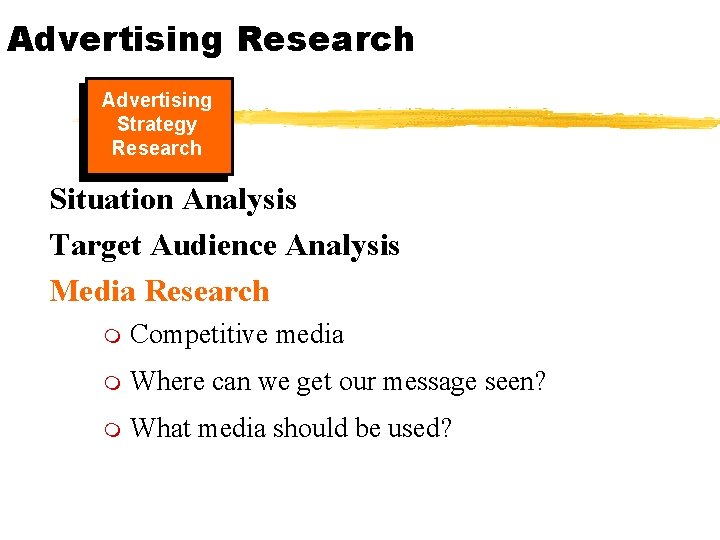
Advertising Research Advertising Strategy Research Situation Analysis Target Audience Analysis Media Research m Competitive media m Where can we get our message seen? m What media should be used?
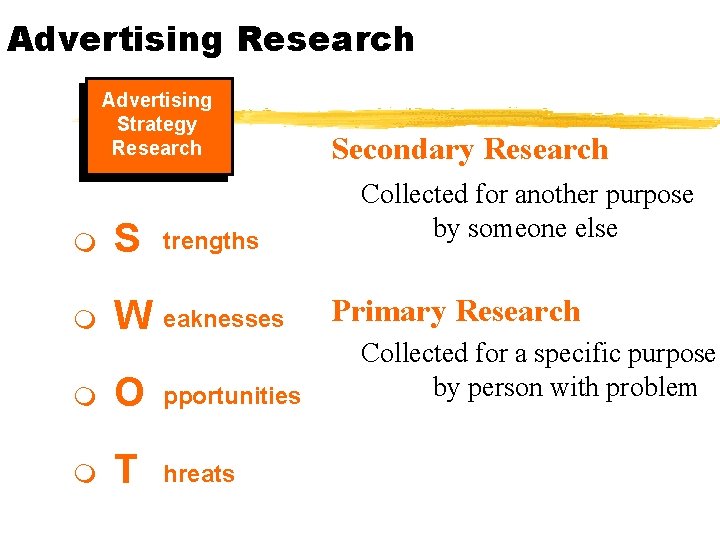
Advertising Research Advertising Strategy Research m S m W eaknesses trengths m O pportunities m T hreats Secondary Research Collected for another purpose by someone else Primary Research Collected for a specific purpose by person with problem
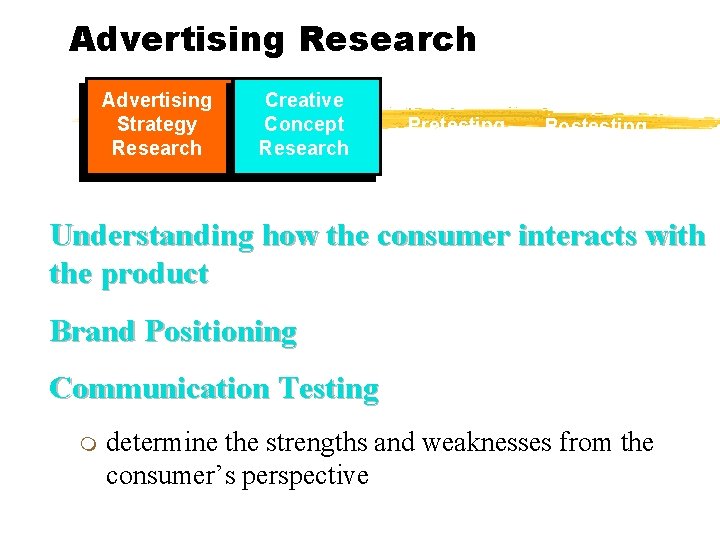
Advertising Research Advertising Strategy Research Creative Concept Research Pretesting Postesting Understanding how the consumer interacts with the product Brand Positioning Communication Testing m determine the strengths and weaknesses from the consumer’s perspective
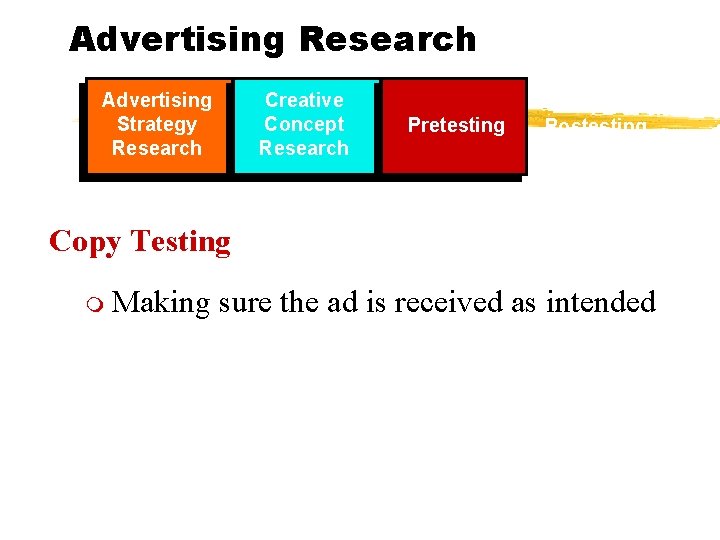
Advertising Research Creative Concept Research Advertising Strategy Research Pretesting Postesting Copy Testing m Making sure the ad is received as intended
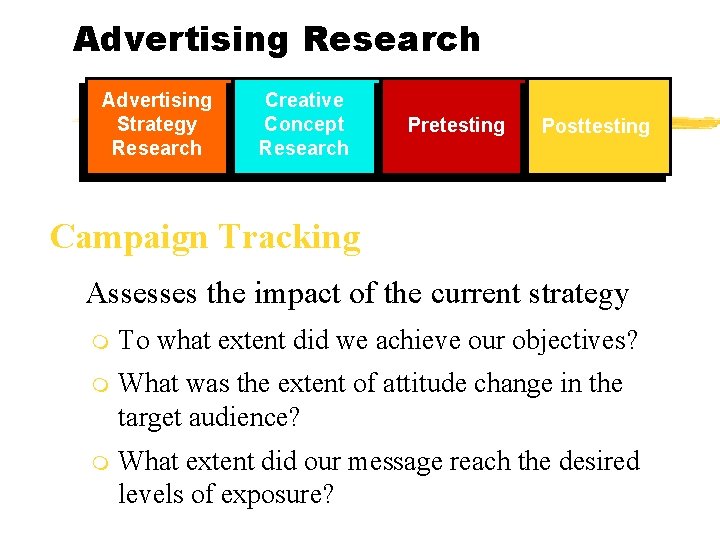
Advertising Research Advertising Strategy Research Creative Concept Research Pretesting Posttesting Campaign Tracking Assesses the impact of the current strategy m To what extent did we achieve our objectives? m What was the extent of attitude change in the target audience? m What extent did our message reach the desired levels of exposure?
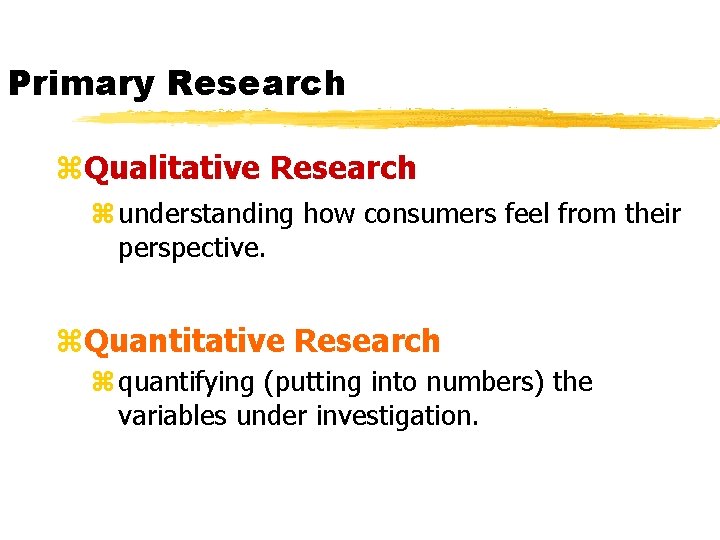
Primary Research z. Qualitative Research z understanding how consumers feel from their perspective. z. Quantitative Research z quantifying (putting into numbers) the variables under investigation.
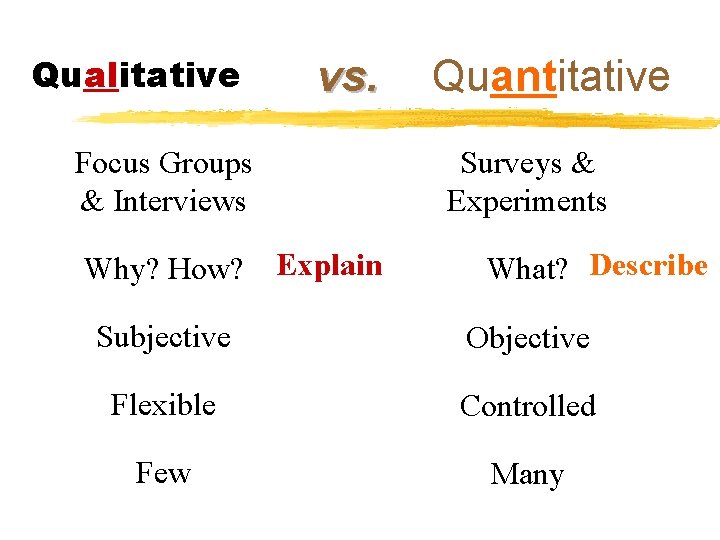
Qualitative vs. Focus Groups & Interviews Why? How? Quantitative Surveys & Experiments Explain What? Describe Subjective Objective Flexible Controlled Few Many
Qualitative Research Methods z Focus Groups z Projective Techniques z In-depth Interviews
Quantitative Research Methods z Observation z Surveys z Experiments
Validity Versus Reliability Validity m The degree to which we are measuring what we think we are measuring Reliability m The degree to which a measurement can be repeated
How to be a Consumer Detective: z 1) Watch first, ask questions later! y. Learn from the experts -- detective movies y. Put yourself in a situation where you never have to ask a question. y. Watch for the little things x. How do you know when two people are in love? x. How can you tell if someone likes/dislikes your food?
Consumer Detective Training: z 2) Little clues reveal big insights! y. A major university observed student paths before putting in sidewalks y. National children’s museum found out which exhibits were most popular by looking at fingerprints y. Cellular phone company used list of people with vanity plates for direct marketing y. Market researchers hang out in malls, salons, record stores, concerts to watch how teens
Detective Exercise: y 1) Get on public transportation or go to public place and deduce what the person next to you does for a living. y 2) Go to a restaurant you’ve never been to before and discern who they are trying to attract. y 3) Go to a mall and figure out what it is in a store that makes customers feel comfortable. Are there any stores that turn customers off? y 4) Go to someone’s house and deduce what their interests are and their lifestyle. You can
http: //www. adcritic. com/conte nt/bmw-bond-villaintraining. html
Building Relationships – Chapter 7 z“Customers, not products, are the lifeblood of the business. ”
Relationship Marketing z. Creating, maintaining, and enhancing long -term relationships with customers and other stakeholders that result in exchanges of information and other things of mutual value. z. STAKEHOLDERS: y. Employees, stockholders, financial community, press, etc.
Why? z 1) Cost of lost customers z 2) Cost of acquiring new customers z 3) Value of loyal customers
Relationships Communication z Customers and organizations must communicate with each other to be successful. z IMC!
IMC DEFINED: z. Process of building and reinforcing mutually profitable relationships with employees, customers and other stakeholders by developing and coordinating a strategic communications program that enables them to have a constructive encounter with the company/brand through a variety of media and other contacts. WHEW!
In other words: z. SYNERGY! z. The whole > sum of all parts. z. Recognize the many ways customers come in to contact with brand.
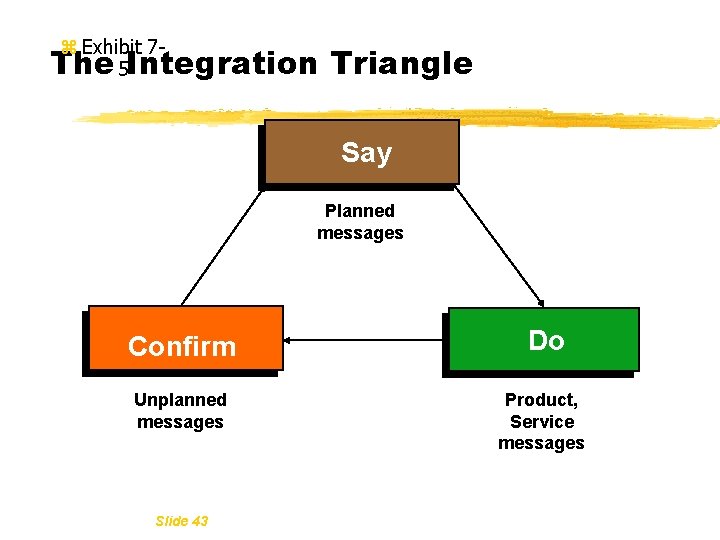
z Exhibit 7 The 5 Integration Triangle Say Planned messages Confirm Do Unplanned messages Product, Service messages Slide 43
It’s not just about ads: z. Sponsorship – ybrand name on a piece of entertainment y. With no involvement z. Product Placement – yplugging products into movie/TV show y. Eat a snickers on Survivor y. Gap store in Minority Report ($25 mill!)
Not just about ads (cont’d) z. Branded Content y. Creating an entertainment product to reflect a brand’s image y. Brand isn’t center of production y. Company now involved in production x. Nike’s Road to Paris documentary x. Musical, Ball, on broadway x. BMW movies on line.
Start with Basics: Plan the Ad Campaign z. Know what advertising can/can’t do! z. Advertising is only a PART of marketing z. Marketing sales z. Advertising communicates z“Marketing SELLS, advertising TELLS”
Ad objectives must be: z 1) communication oriented z 2) time bounded z 3) targeted
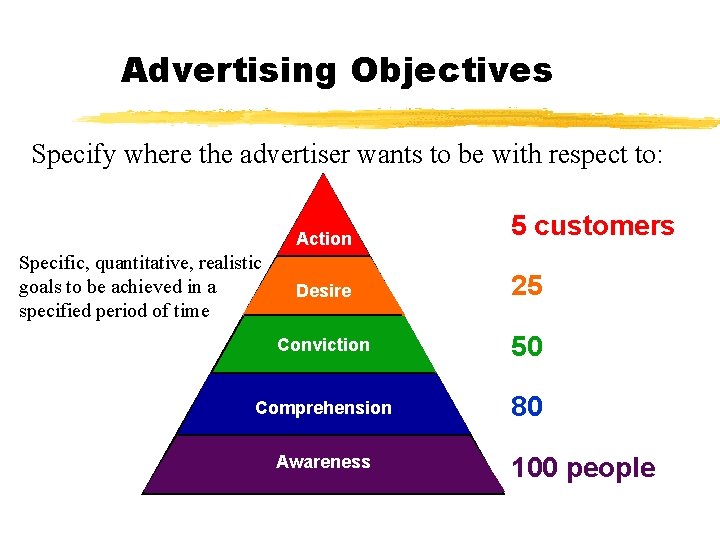
Advertising Objectives Specify where the advertiser wants to be with respect to: Action 5 customers Desire 25 Conviction 50 Comprehension 80 Specific, quantitative, realistic goals to be achieved in a specified period of time Awareness 100 people
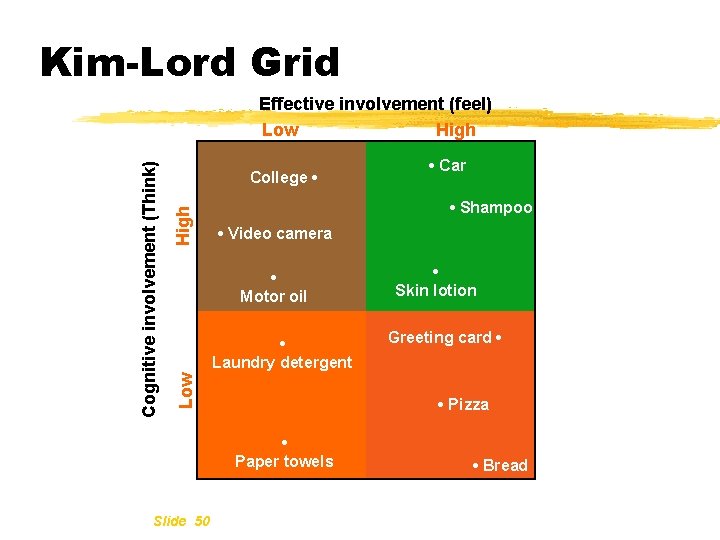
The Ad strategy blends elements of Creative mix: z 1) z 2) z 3) z 4) the the target audience product concept Kim-Lord grid media message
Kim-Lord Grid High College • • Video camera • Motor oil • Laundry detergent • Skin lotion Greeting card • • Pizza • Paper towels Slide 50 • Car • Shampoo Low Cognitive involvement (Think) Effective involvement (feel) Low High • Bread
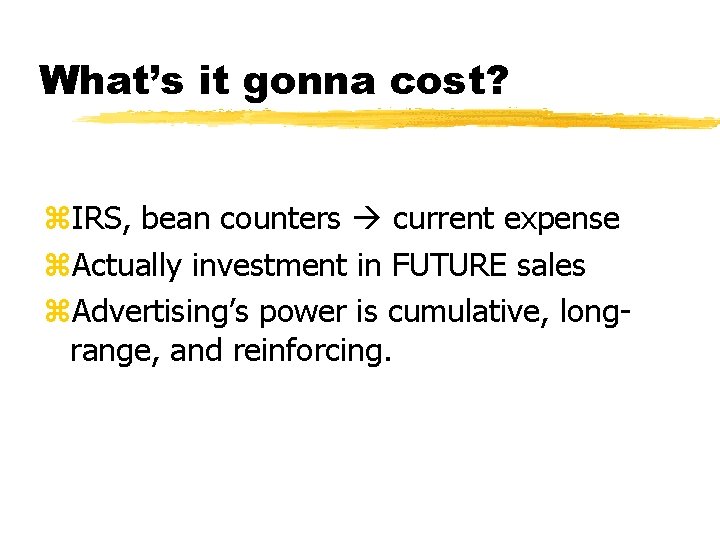
What’s it gonna cost? z. IRS, bean counters current expense z. Actually investment in FUTURE sales z. Advertising’s power is cumulative, longrange, and reinforcing.
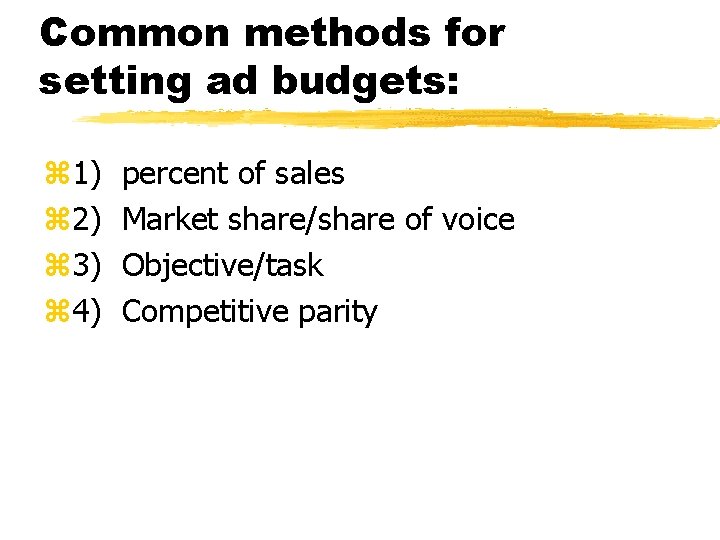
Common methods for setting ad budgets: z 1) z 2) z 3) z 4) percent of sales Market share/share of voice Objective/task Competitive parity