
SEGMENT TREES RELATED TOPICS Tian Cilliers Training Camp













- Slides: 40
SEGMENT TREES & RELATED TOPICS Tian Cilliers, Training Camp 2, 9 -10 February 2019
INTRODUCTION Why do we even use segment trees?
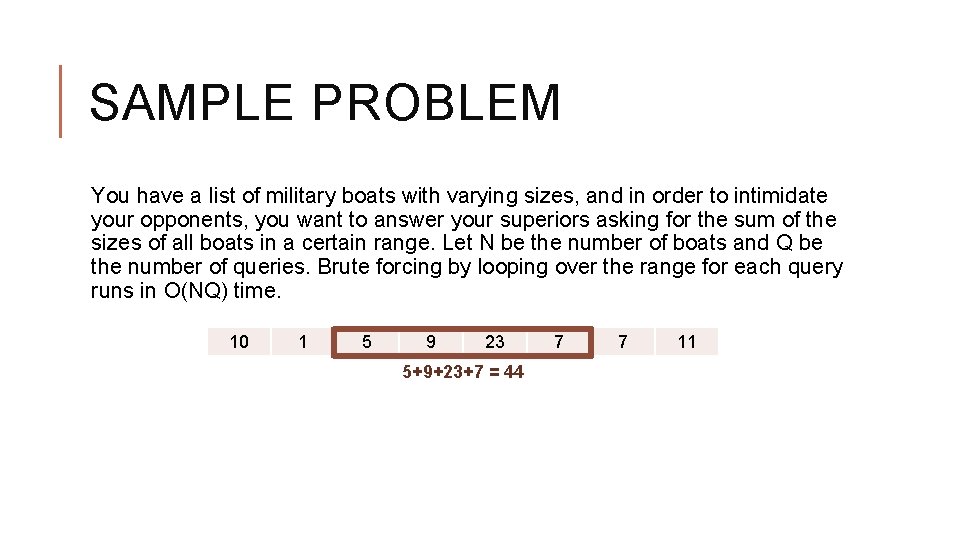
SAMPLE PROBLEM You have a list of military boats with varying sizes, and in order to intimidate your opponents, you want to answer your superiors asking for the sum of the sizes of all boats in a certain range. Let N be the number of boats and Q be the number of queries. Brute forcing by looping over the range for each query runs in O(NQ) time. 10 1 5 9 23 5+9+23+7 = 44 7 7 11
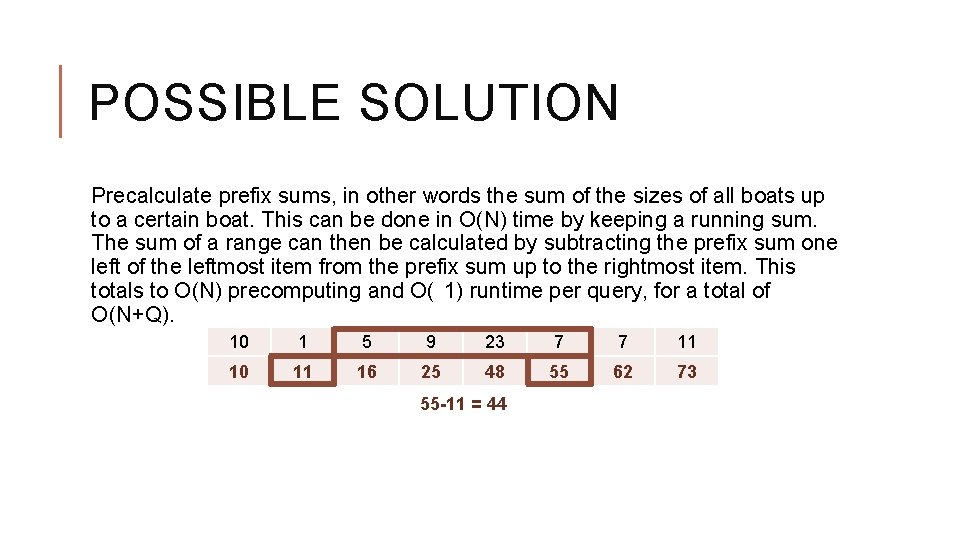
POSSIBLE SOLUTION Precalculate prefix sums, in other words the sum of the sizes of all boats up to a certain boat. This can be done in O(N) time by keeping a running sum. The sum of a range can then be calculated by subtracting the prefix sum one left of the leftmost item from the prefix sum up to the rightmost item. This totals to O(N) precomputing and O( 1) runtime per query, for a total of O(N+Q). 10 1 5 9 23 7 7 11 10 11 16 25 48 55 62 73 55 -11 = 44
PROBLEMS WITH SOLUTION As we can see, the proposed solution runs quite quickly, but has a few limitations. Firstly, if we needed the maximum of a range (RMQ) instead of the sum, prefix sums would not work. More importantly, however, prefix sums are unable to handle updates to the items. If any item in the list is updated, all the prefix sums including the item needs to be updated. If the problem is modified by stating that some amount U of updates to specific items are performed in between queries, the time complexity would be increased to O(UN+Q). Is this able to be improved on? Can we devise a fast way to do RMQ as well?
SEGMENT TREES In all their O(log. N) query and update beauty
WHAT IS A SEGMENT TREE? A segment tree is simply a binary tree, that is, a tree where each node has two child nodes. In a segment tree, the leaves represent data values, and each non-leaf node represents some associative operation on its children (for example the maximum or sum of its children). 73 48 25 14 11 10 1 5 18 30 9 23 7 7 11
EXAMPLE IMPLEMENTATION 1 To implement the data structure, a simple array with two times the length of the amount of data values required could be used. Rooting the tree with the index 1 also allows easy movement between parent and child nodes by dividing by two and getting the floor of that to find the parent index. 2 4 8 3 25 5 11 10 73 1 6 14 5 9 48 7 30 23 7 18 7 11 1 2 3 4 5 6 7 8 9 10 11 12 13 14 15 73 25 48 11 14 30 18 10 1 5 9 23 7 7 11
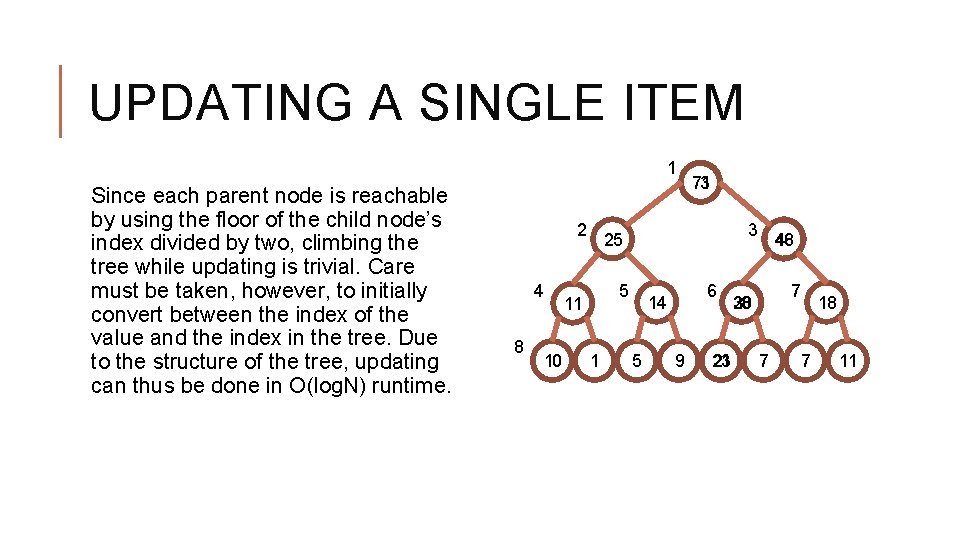
UPDATING A SINGLE ITEM 1 Since each parent node is reachable by using the floor of the child node’s index divided by two, climbing the tree while updating is trivial. Care must be taken, however, to initially convert between the index of the value and the index in the tree. Due to the structure of the tree, updating can thus be done in O(log. N) runtime. 2 4 8 3 25 5 11 10 71 73 1 6 14 5 9 23 21 48 46 7 30 28 7 7 18 11
EXAMPLE UPDATING CODE
QUERYING A RANGE 1 The key when querying is to include the highest nodes that completely covers part of the queried range. This can be done by keeping a left and right pointer, if necessary processing the node and shifting the pointer inward to be on the outer node of a parent, moving both up a level, and repeating. Again, this takes O(log. N) time. 2 4 8 3 25 5 11 10 73 1 6 14 5 9 48 7 30 23 14+48 = 62 7 7 18 11
EXAMPLE QUERYING CODE
TIME AND SPACE COMPLEXITY As we saw, both updating a single value and querying a range takes O(log. N) runtime. In addition, it can be seen that the space required is 2 N, or O(N). This means that the problem mentioned earlier could be run in O((Q+U)log. N) time instead of O(UN+Q) when using prefix sums.
CONDENSED CODE
FENWICK TREES Take segment trees and add a sprinkle of binary magic
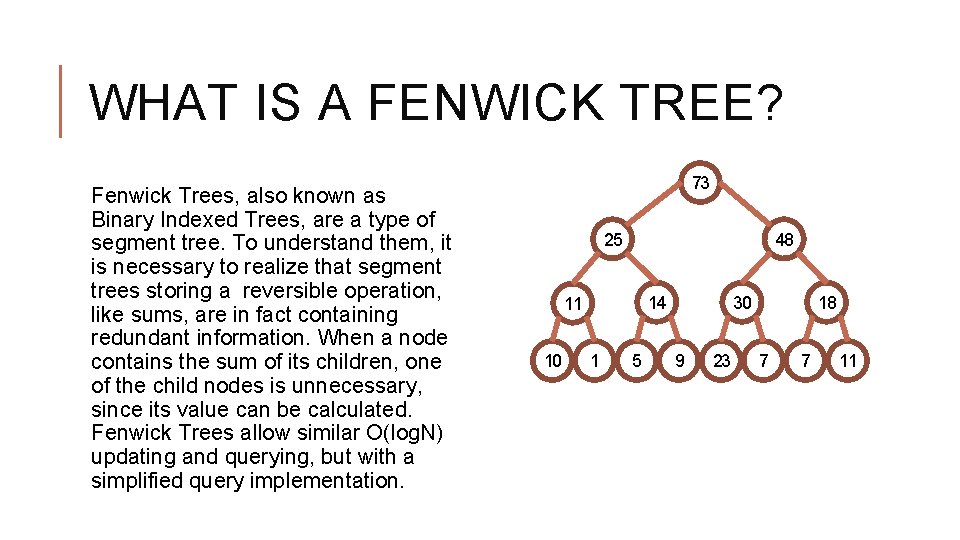
WHAT IS A FENWICK TREE? Fenwick Trees, also known as Binary Indexed Trees, are a type of segment tree. To understand them, it is necessary to realize that segment trees storing a reversible operation, like sums, are in fact containing redundant information. When a node contains the sum of its children, one of the child nodes is unnecessary, since its value can be calculated. Fenwick Trees allow similar O(log. N) updating and querying, but with a simplified query implementation. 73 48 25 14 11 10 1 5 18 30 9 23 7 7 11
EXAMPLE IMPLEMENTATION These remaining nodes can them be organized into a specific structure and be stored in an array with length N. Considering the binary representation of the indices of each node leads to an important observation that will be useful when doing updates and queries. 73 25 11 48 14 18 30 10 1 5 9 23 7 7 11 1 2 3 4 5 6 7 8 0001 0010 0011 0100 0101 0110 0111 1000
UPDATING A SINGLE ITEM 73 70 First, we just do an update like with a regular segment tree, keeping in mind that some nodes do not need to be visited since their values can be calculated using the rest. Notice that the binary representation of the indices of nodes we updated was as follows: 0011 > 0100 > 1000 It can further be seen that, to update any index, the least significant bit has to be added until the root is reached. 25 22 11 48 14 11 18 30 10 1 5 2 9 23 7 7 11 1 2 3 4 5 6 7 8 0001 0010 0011 0100 0101 0110 0111 1000
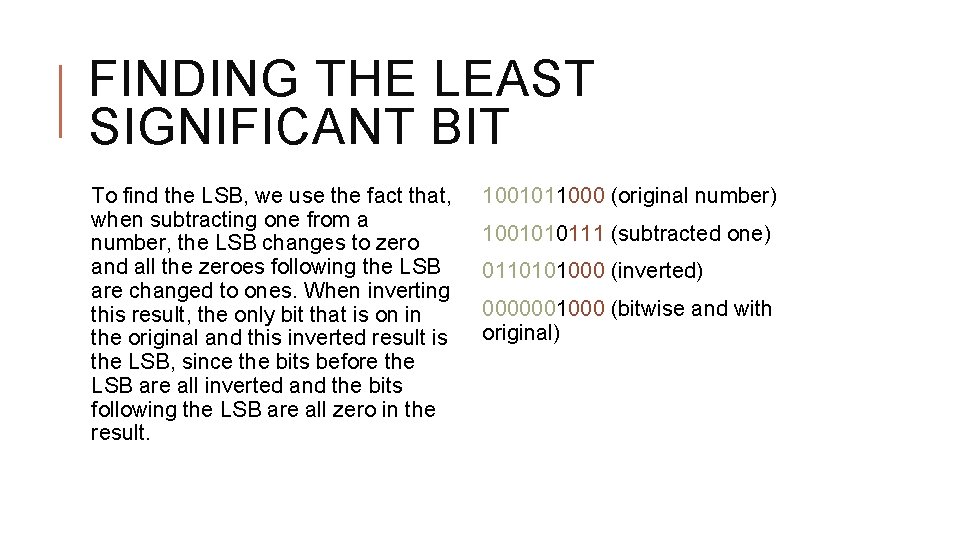
FINDING THE LEAST SIGNIFICANT BIT To find the LSB, we use the fact that, when subtracting one from a number, the LSB changes to zero and all the zeroes following the LSB are changed to ones. When inverting this result, the only bit that is on in the original and this inverted result is the LSB, since the bits before the LSB are all inverted and the bits following the LSB are all zero in the result. 1001011000 (original number) 1001010111 (subtracted one) 0110101000 (inverted) 0000001000 (bitwise and with original)
EXAMPLE UPDATING CODE
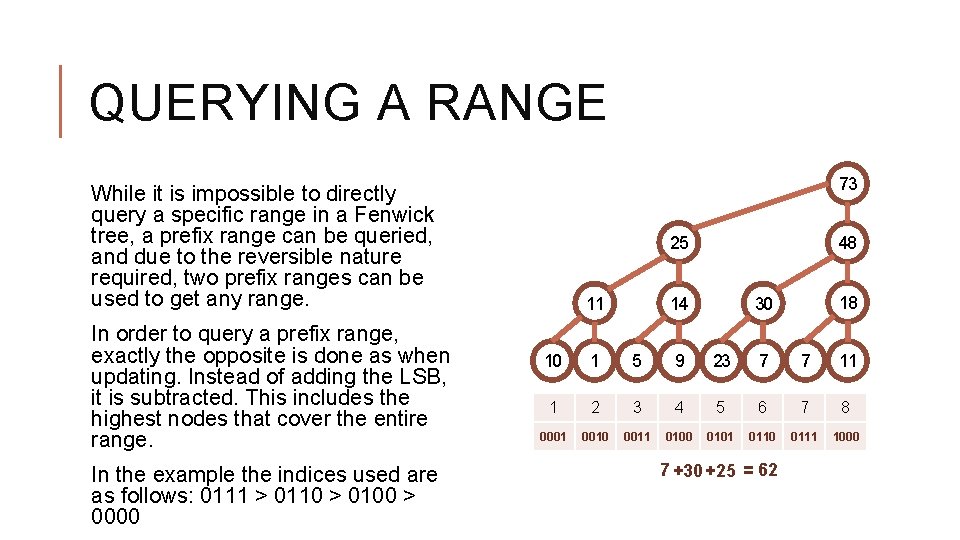
QUERYING A RANGE 73 While it is impossible to directly query a specific range in a Fenwick tree, a prefix range can be queried, and due to the reversible nature required, two prefix ranges can be used to get any range. In order to query a prefix range, exactly the opposite is done as when updating. Instead of adding the LSB, it is subtracted. This includes the highest nodes that cover the entire range. In the example the indices used are as follows: 0111 > 0110 > 0100 > 0000 25 11 48 14 18 30 10 1 5 9 23 7 7 11 1 2 3 4 5 6 7 8 0001 0010 0011 0100 0101 0110 0111 1000 7 +30 +25 = 62
EXAMPLE QUERYING CODE
WHY BRUCE IS A GOD The comprehensive analysis of Bruce Merry’s godlike nature
LAZY UPDATES Not suitable for lazy coders, by the way
ON RANGE UPDATES Sometimes it is necessary to not only update a single item at a time, but rather an contiguous range of items. Using a normal segment or Fenwick tree, this would run in O(Nlog. N). While still relatively fast, this can be improved on. Lazy updating or lazy propagation is a way to improve the speed of range updates by updating top-down and overriding nodes where the entire range of the node is to be updated, and only updating children when querying or otherwise needed. This can get both range updating and querying done in O(log. N) amortised time, but with a small constant penalty to both.
LAZY UPDATING 1 The idea when updating a range lazily is to start at the root, and if a node is completely contained in the range, override its value and mark it. If not, recursively do the same on both children. If it is entirely out of the range, do nothing. 65 73 2 4 x 8 25 4 8 5 11 10 3 1 6 14 5 8 9 8 23 48 33 7 15 30 7 7 18 11
EXAMPLE LAZY UPDATE CODE
EXAMPLE LAZY UPDATE CODE
QUERYING LAZY UPDATES 1 When querying from the root down, it is important to know that a node’s value can be used directly if it is contained in the range, but if not, any previous updates applied to it needs to be carried over to its children before it can be used. 65 2 4 x 8 4 8 5 11 10 3 1 6 14 5 9 8 33 7 30 7 7 18 11
EXAMPLE LAZY QUERYING CODE
HIGHER DIMENSIONS Honestly I just included this part because of my beautiful method
THE NEED FOR HIGHER DIMENSIONS Higher dimension segment trees exist, and it is in fact possible to generalize a lot of the code to make a K-dimensional segment tree. This can be used to get the sum, maximum or minimum of a rectangle, box, or any K-dimensional region in O((log. N)K). While there a few methods that can be used to do this, I have not put the effort in to understand the usual way of having a ‘segment tree of segment trees’, as seen in this diagram, but will rather teach my own method.
EXAMPLE IMPLEMENTATION (2 D) In order to represent the data properly, we apply a quadtree, or a tree where each node has 4 children in two rows and two columns. This quadtree is queried in much the same way as a segment tree is queried from the bottom up, leading to an intuitive and easy to figure out method. This quadtree, however, requires some extra information about specific ranges in a row or column of the quadtree, which we use segment trees for. 1 D 2 D
OPTIMAL STRUCTURE (2 D) This quadtree, with accompanying segment trees for each row and column of each level of the quadtree, can conveniently be laid out in a 2 Nx 2 N array, with the layout as shown right. This has the additional advantage of allowing providing easy queries in all trees, as both X and Y need to be halved to move up one level in the quadtree, and only one of them to move one level in the corresponding segment tree.
EXAMPLE UPDATING CODE (2 D)
EXAMPLE QUERYING CODE (2 D)
EXAMPLE QUERYING CODE (2 D)
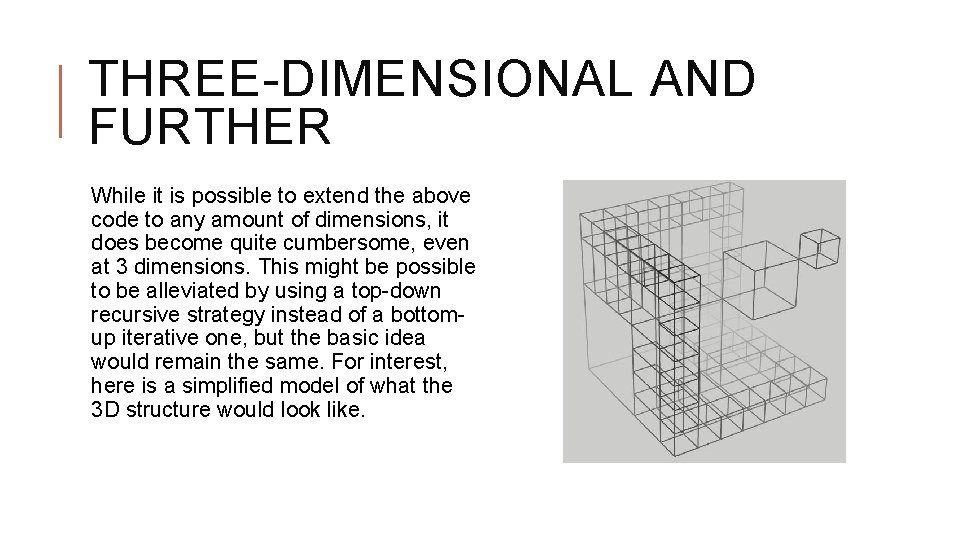
THREE-DIMENSIONAL AND FURTHER While it is possible to extend the above code to any amount of dimensions, it does become quite cumbersome, even at 3 dimensions. This might be possible to be alleviated by using a top-down recursive strategy instead of a bottomup iterative one, but the basic idea would remain the same. For interest, here is a simplified model of what the 3 D structure would look like.
EXAMPLE PROBLEMS Because we all love to see how easy something is in retrospect
QUESTIONS I was really confused myself when first introduced to segtrees