
Seesaw for the Higgs boson Xavier Calmet Universit
Seesaw for the Higgs boson Xavier Calmet Université Libre de Bruxelles
Outline • Review the motivations for physics beyond the standard model. • What do we know for sure? • Some minimal modifications of the Standard Model can address these issues • Modification of short distance physics • Modification in the Higgs sector • A gateway to new physics • Conclusions
Motivations for new physics
Guiding principles for physics beyond the SM • Guiding principles for model building have changed. • Till ‘ 03 or so hierarchy and naturalness were the main problems to address: why is the weak scale so small compared to the Planck scale and why is the Higgs boson’s mass stable under radiative corrections? • Indeed if quantum field theories are only an “effective tool” (Wilsonian approach) one has to explain small numbers!
Guiding principles for physics beyond the SM after 2003 • Post landscape era: fine-tuning is allowed ( or required: anthropic or statistical arguments). • More important we have experimental evidence that the hierarchy and naturalness problems are not necessarily valid guidance principles: • Hints from the cosmological constant: not zero and small: unnatural (but observed!!). Effective theories argument would imply new physics at 0. 001 e. V! No sign of it! • Next surprise: light Higgs and no SUSY (or little Higgs)?
• Personal point of view: within the framework of a renormalizable quantum field theory, fine-tuning or hierarchy problems make no sense: a parameter is measured at some scale and one can compute its running. • So what is the meaning of small or big? It’s an experimental question. • There may be an esthetic reason against the Higgs: only fundamental scalar? • But main issue is the negative squared mass: it’s never free to break a symmetry. • We can hope that the LHC will reveal the mechanism that triggers the Higgs mechanism.
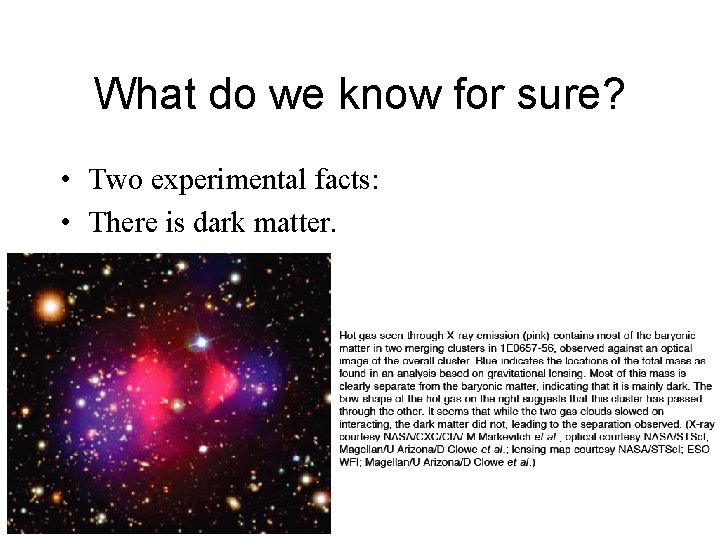
What do we know for sure? • Two experimental facts: • There is dark matter.
What do we know for sure? • • Two experimental facts: There is dark matter. Most probably dark energy exits as well. Mathematical consistency of the standard model implies that effectively there is a scalar degree of freedom in the standard model (or S matrix is nonperturbative) • Unification of gravity and quantum mechanics implies a minimal length in nature (see last year talk).
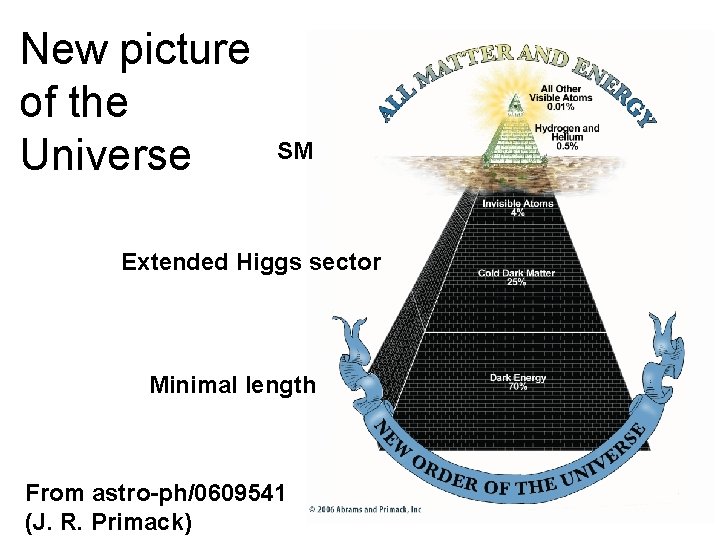
New picture of the Universe SM Extended Higgs sector Minimal length From astro-ph/0609541 (J. R. Primack)
How to implement these facts in the Standard Model? • Minimal length: modify spacetime at short distance: one option is a noncommutative spacetime. • What are the physical consequences? New insight for the cosmological constant. • What about the electroweak symmetry breaking: extend the Higgs sector. • Quite natural to expect that dark matter couples to the Higgs boson, if not it will be very difficult to ever produce it in a collider.
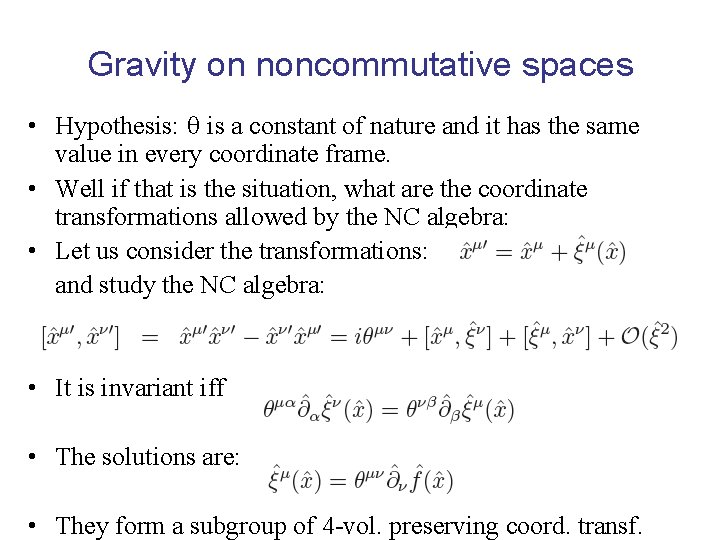
Gravity on noncommutative spaces • Hypothesis: is a constant of nature and it has the same value in every coordinate frame. • Well if that is the situation, what are the coordinate transformations allowed by the NC algebra: • Let us consider the transformations: and study the NC algebra: • It is invariant iff • The solutions are: • They form a subgroup of 4 -vol. preserving coord. transf.
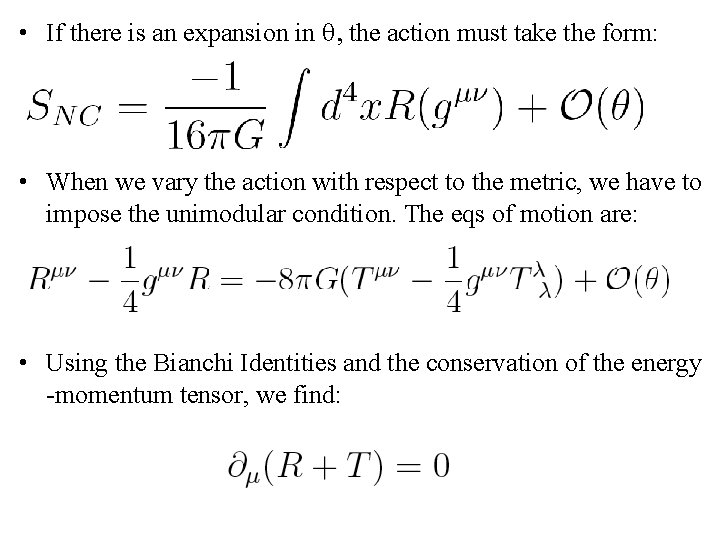
• If there is an expansion in the action must take the form: • When we vary the action with respect to the metric, we have to impose the unimodular condition. The eqs of motion are: • Using the Bianchi Identities and the conservation of the energy -momentum tensor, we find:
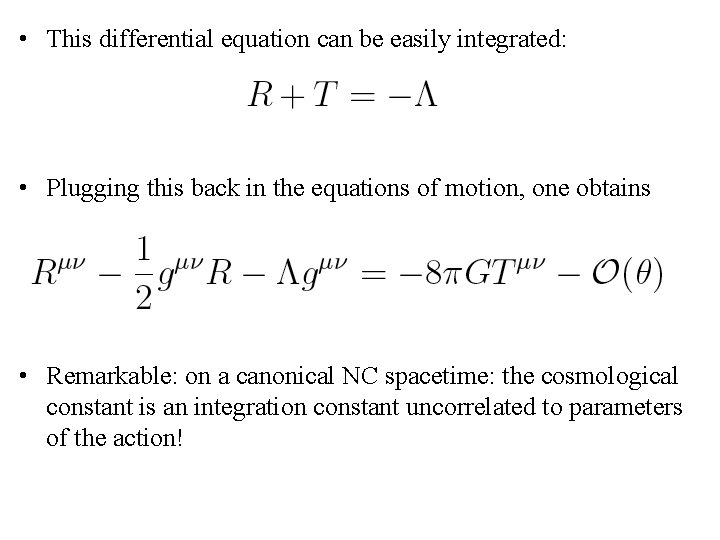
• This differential equation can be easily integrated: • Plugging this back in the equations of motion, one obtains • Remarkable: on a canonical NC spacetime: the cosmological constant is an integration constant uncorrelated to parameters of the action!

Get ready for a bit of speculation!
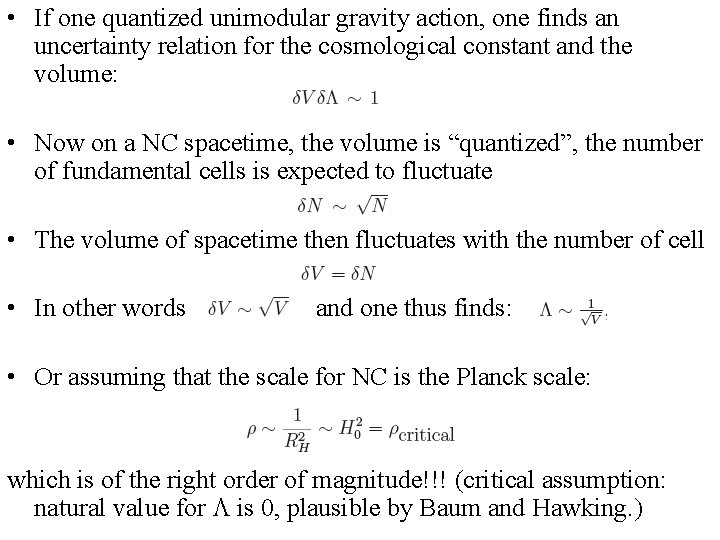
• If one quantized unimodular gravity action, one finds an uncertainty relation for the cosmological constant and the volume: • Now on a NC spacetime, the volume is “quantized”, the number of fundamental cells is expected to fluctuate • The volume of spacetime then fluctuates with the number of cell • In other words and one thus finds: • Or assuming that the scale for NC is the Planck scale: which is of the right order of magnitude!!! (critical assumption: natural value for is 0, plausible by Baum and Hawking. )
Back to the SM of particle physics • Let me assume that somehow gravity is taken care of at the quantum level by e. g. spacetime noncommutativity or nonperturbative effects: • There is a good chance that Nature is indeed described by renormalizable quantum field theories. • The remaining issue of the SM is to understand why the Higgs mechanism takes place.

Seesaw Higgs Mechanism
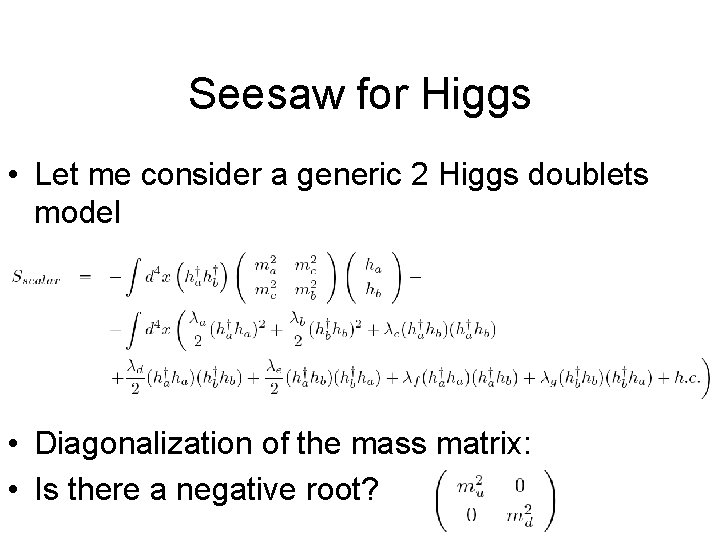
Seesaw for Higgs • Let me consider a generic 2 Higgs doublets model • Diagonalization of the mass matrix: • Is there a negative root?
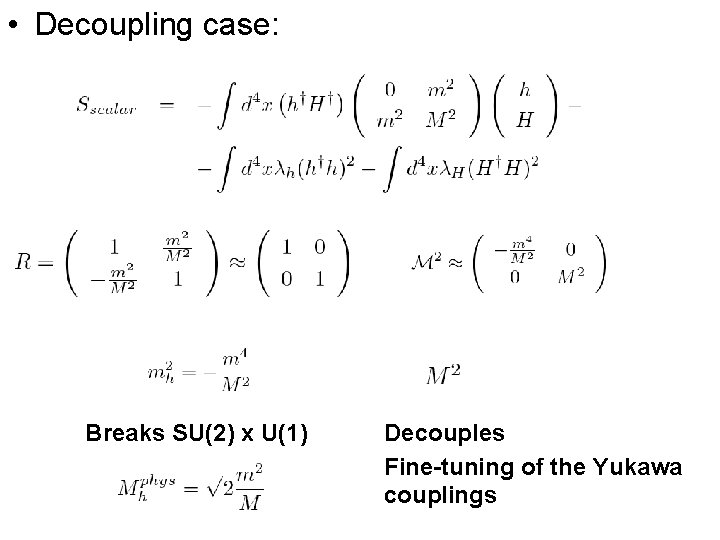
• Decoupling case: Breaks SU(2) x U(1) Decouples Fine-tuning of the Yukawa couplings
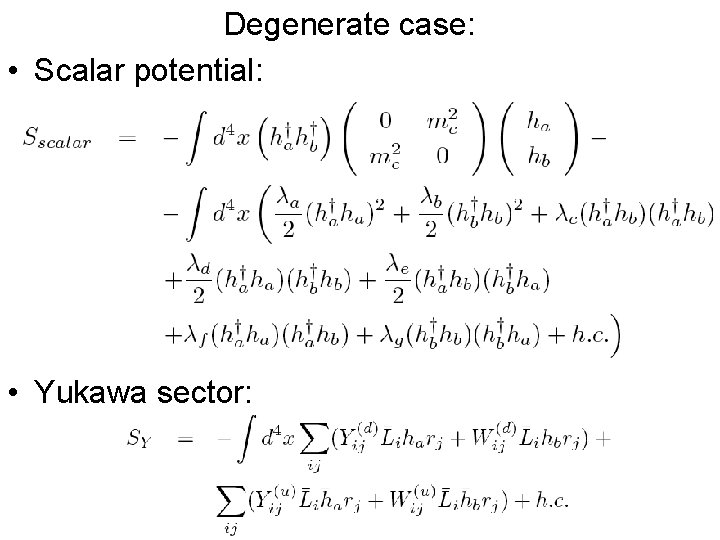
Degenerate case: • Scalar potential: • Yukawa sector:
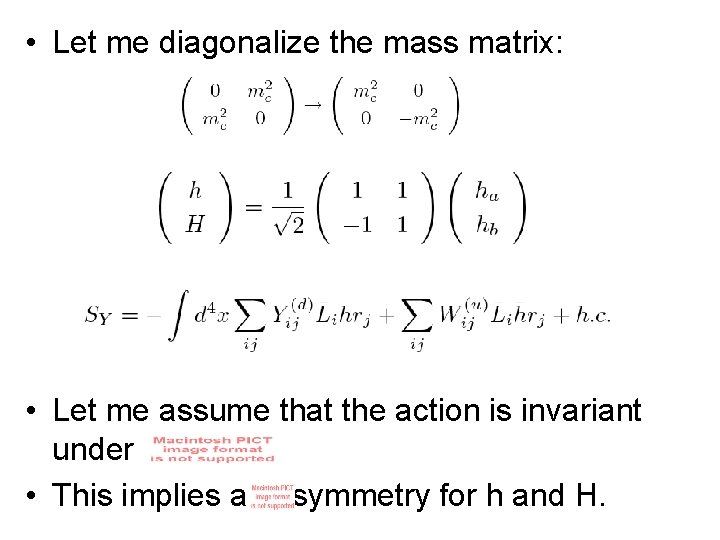
• Let me diagonalize the mass matrix: • Let me assume that the action is invariant under • This implies a symmetry for h and H.
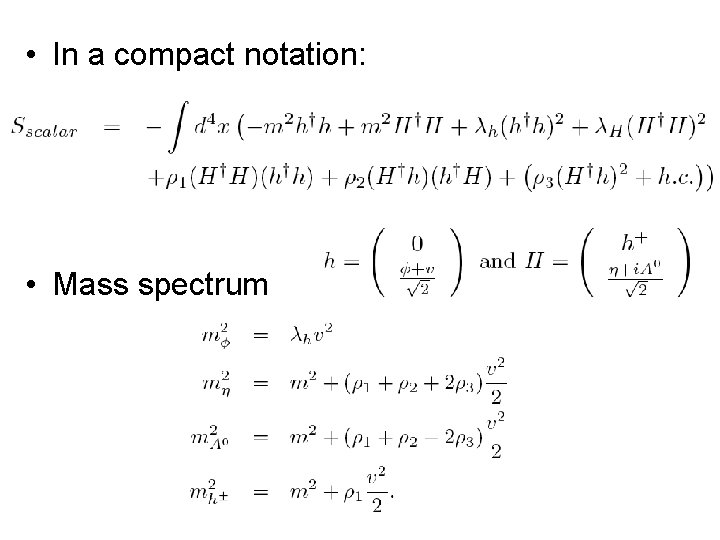
• In a compact notation: • Mass spectrum
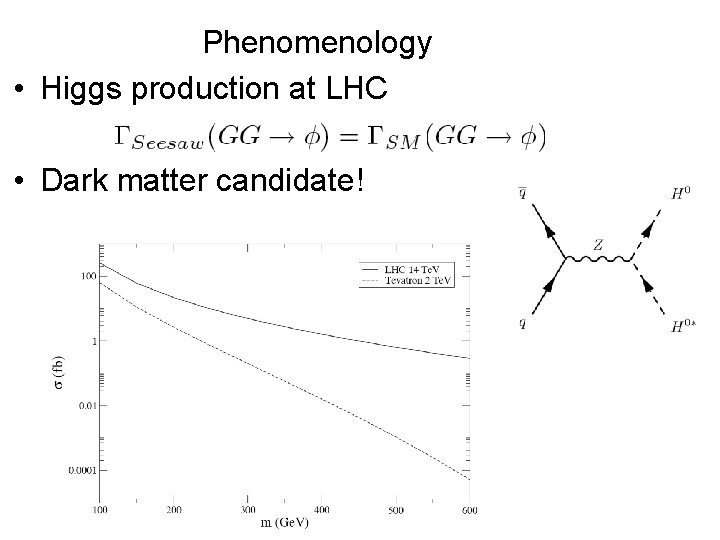
Phenomenology • Higgs production at LHC • Dark matter candidate!

A gateway to a hidden sector
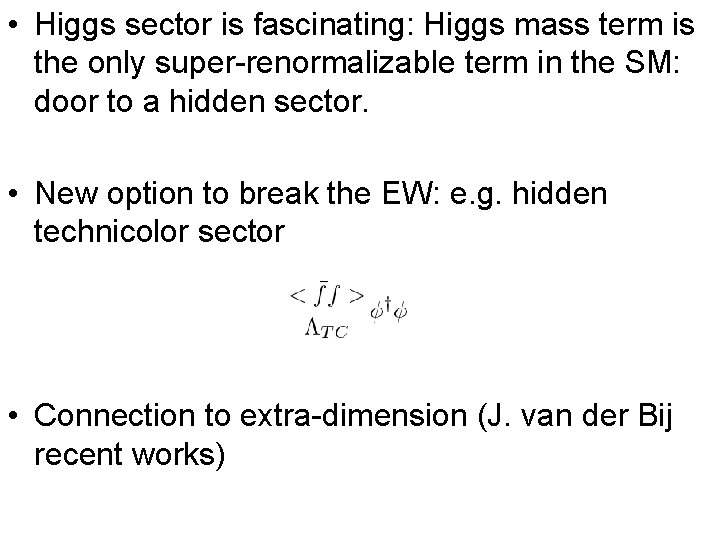
• Higgs sector is fascinating: Higgs mass term is the only super-renormalizable term in the SM: door to a hidden sector. • New option to break the EW: e. g. hidden technicolor sector • Connection to extra-dimension (J. van der Bij recent works)
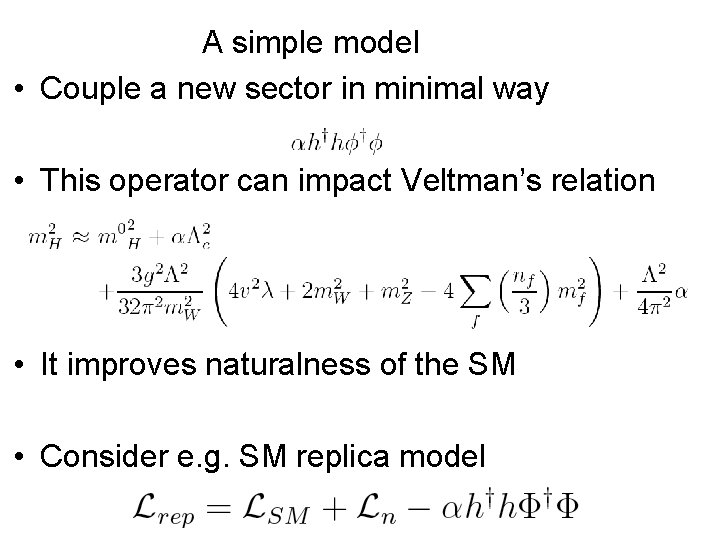
A simple model • Couple a new sector in minimal way • This operator can impact Veltman’s relation • It improves naturalness of the SM • Consider e. g. SM replica model
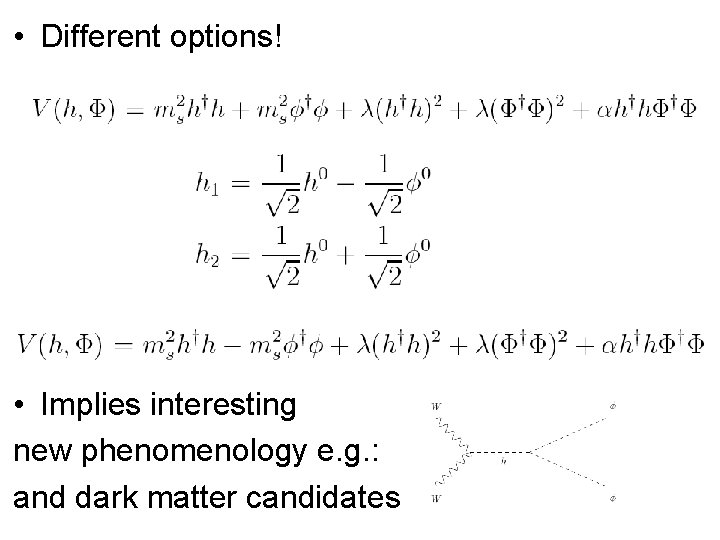
• Different options! • Implies interesting new phenomenology e. g. : and dark matter candidates
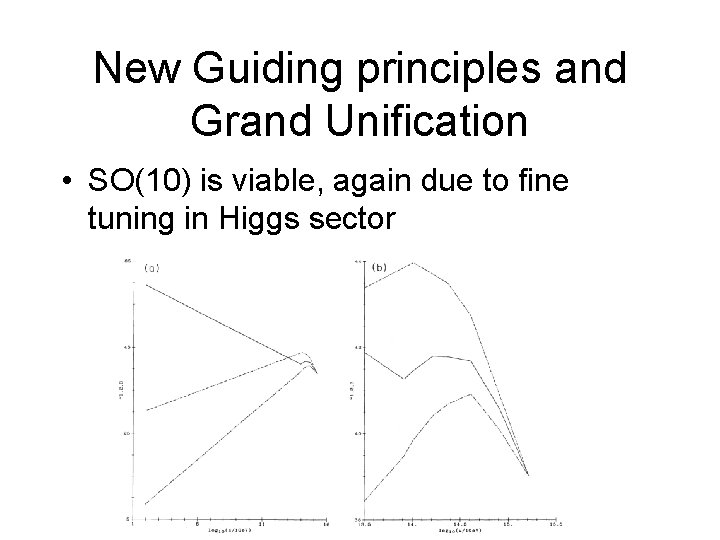
New Guiding principles and Grand Unification • SO(10) is viable, again due to fine tuning in Higgs sector
Conclusions • There are two missing blocks in High Energy Physics. • Dark energy might just be a cosmological constant which is connected to a minimal length. On a noncommutative spacetime its value is arbitrary. • Further hand waving arguments could explain its value. • Electroweak symmetry sector is the only SM one which has not be tested yet. • Possible connection to hidden sectors/dark matter: LHC will produce DM in most of the scenarios. • Were the guiding principles right? • We will have answers soon!
- Slides: 29