
Seeds Part 1 Seeds are central to life


- Slides: 72
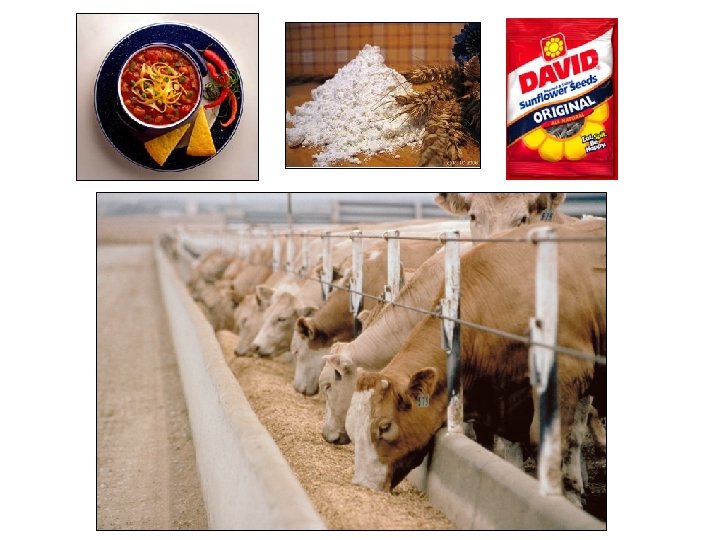
Seeds – Part 1 Seeds are central to life on Earth: 1. Establish a new plant (propagation) 2. Food for humans and animals 3. Genetic repository 4. Some things are not possible without seeds …
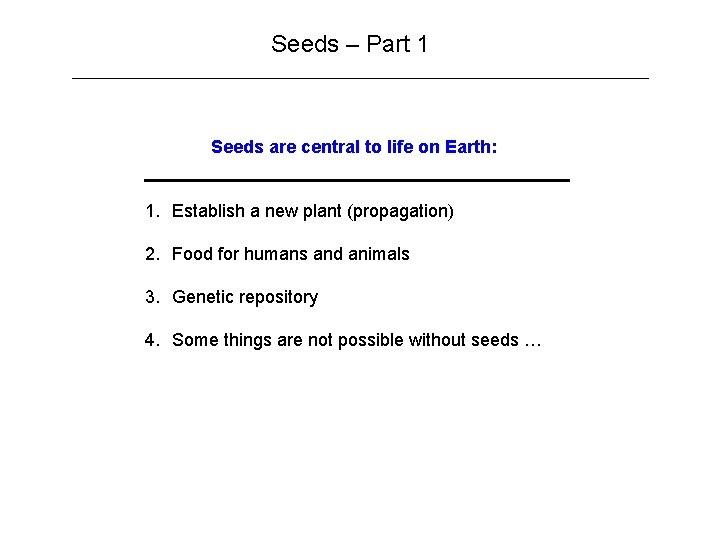
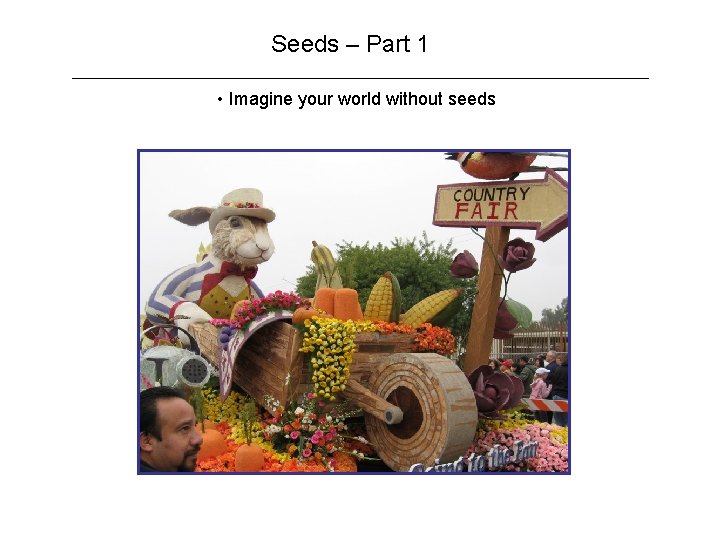
Seeds – Part 1 • Seeds play a large part in the Rose Parade
Seeds – Part 1 • Imagine your world without seeds
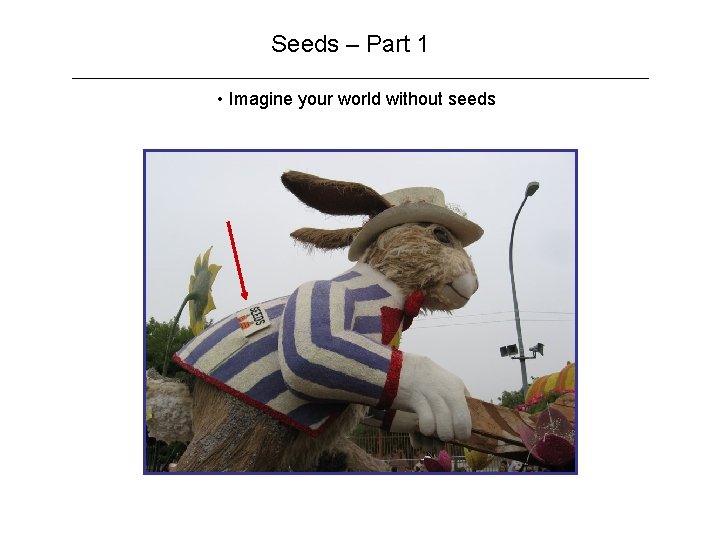
Seeds – Part 1 • Imagine your world without seeds
Seeds – Part 1 • Imagine your world without seeds
Seeds – Part 1 • Imagine your world without seeds
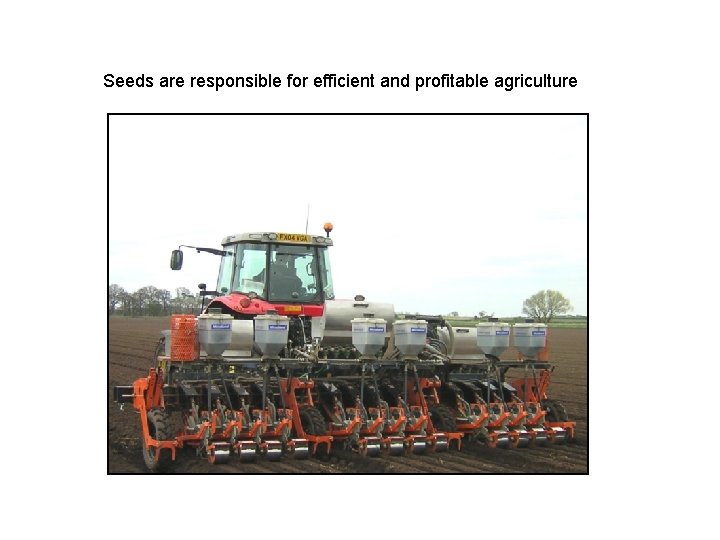
Seeds are responsible for efficient and profitable agriculture
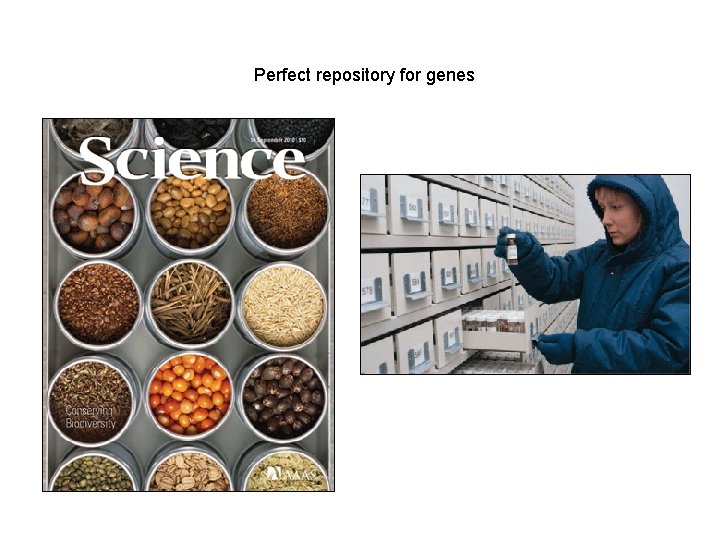
Perfect repository for genes
Seeds – Part 1 • Seeds are responsible for the success of angiosperms (seed-like structures ~ 360 million years bp, late Devonian period)
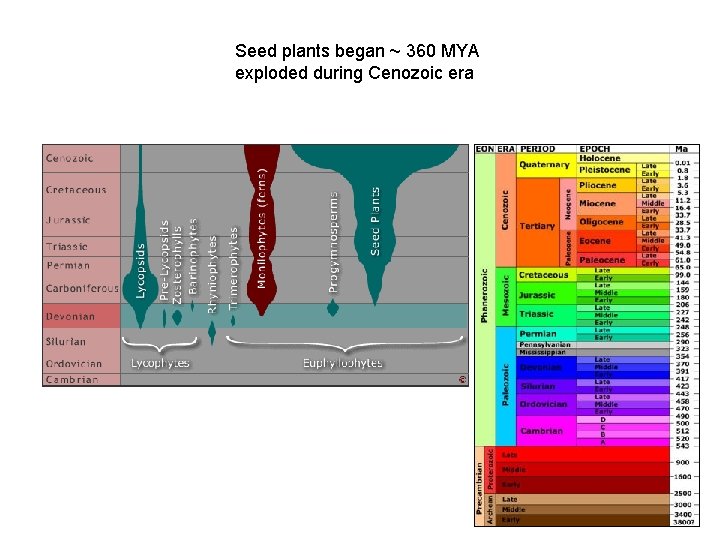
Seed plants began ~ 360 MYA exploded during Cenozoic era
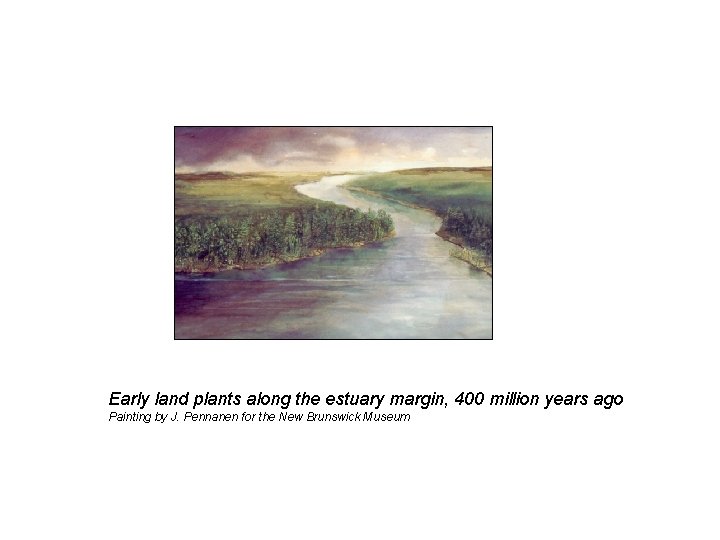
Early land plants along the estuary margin, 400 million years ago Painting by J. Pennanen for the New Brunswick Museum
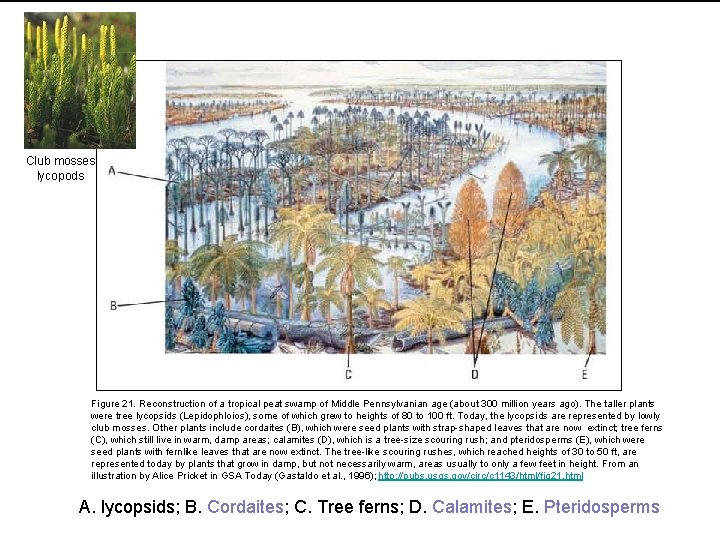
Club mosses lycopods Figure 21. Reconstruction of a tropical peat swamp of Middle Pennsylvanian age (about 300 million years ago). The taller plants were tree lycopsids (Lepidophloios), some of which grew to heights of 80 to 100 ft. Today, the lycopsids are represented by lowly club mosses. Other plants include cordaites (B), which were seed plants with strap-shaped leaves that are now extinct; tree ferns (C), which still live in warm, damp areas; calamites (D), which is a tree-size scouring rush; and pteridosperms (E), which were seed plants with fernlike leaves that are now extinct. The tree-like scouring rushes, which reached heights of 30 to 50 ft, are represented today by plants that grow in damp, but not necessarily warm, areas usually to only a few feet in height. From an illustration by Alice Pricket in GSA Today (Gastaldo et al. , 1996); http: //pubs. usgs. gov/circ/c 1143/html/fig 21. html A. lycopsids; B. Cordaites; C. Tree ferns; D. Calamites; E. Pteridosperms
Seeds – Part 1 • Virtually all seeds are dormant at maturity Ø The maintenance and release from dormancy is an unsolved biological mystery.
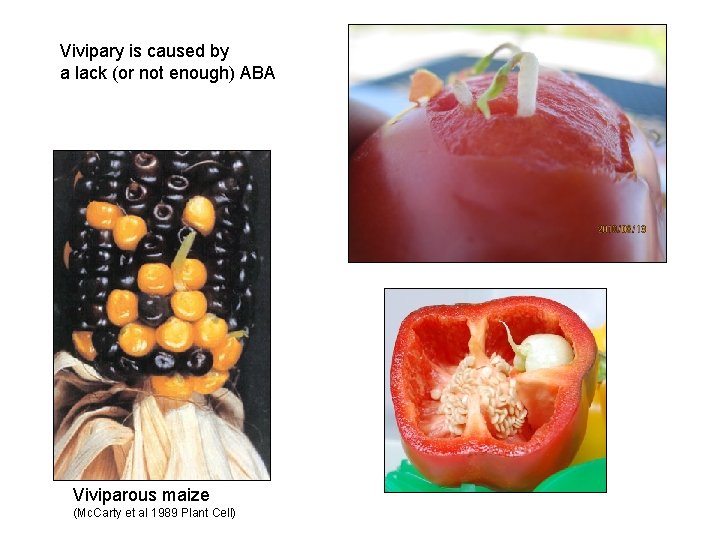
Vivipary is caused by a lack (or not enough) ABA Viviparous maize (Mc. Carty et al 1989 Plant Cell)
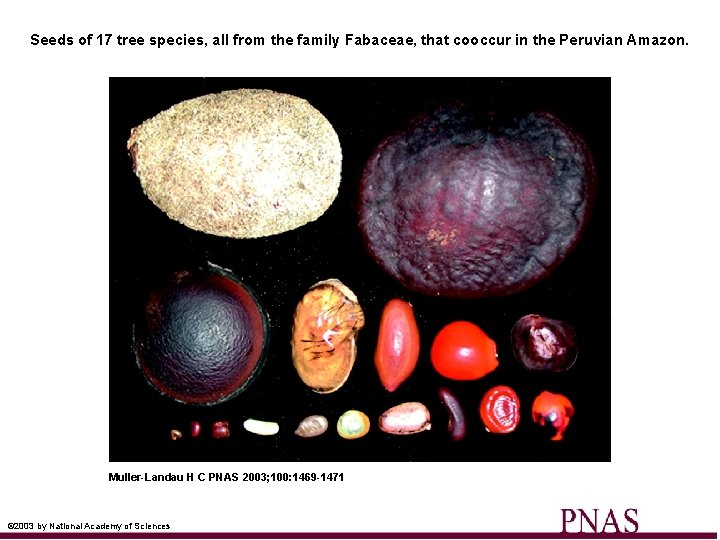
Seeds of 17 tree species, all from the family Fabaceae, that cooccur in the Peruvian Amazon. Muller-Landau H C PNAS 2003; 100: 1469 -1471 © 2003 by National Academy of Sciences
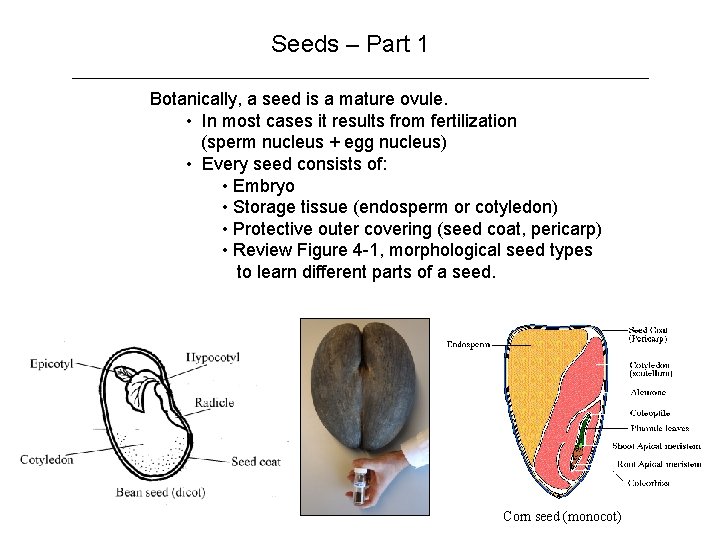
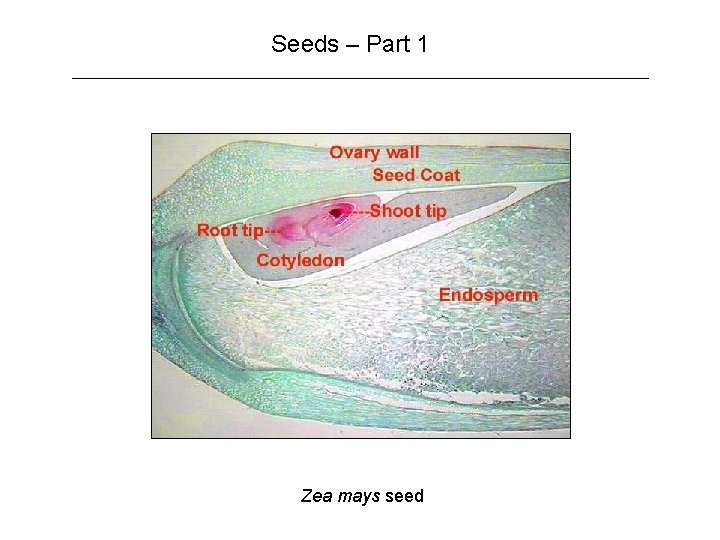
Seeds – Part 1 Botanically, a seed is a mature ovule. • In most cases it results from fertilization (sperm nucleus + egg nucleus) • Every seed consists of: • Embryo • Storage tissue (endosperm or cotyledon) • Protective outer covering (seed coat, pericarp) • Review Figure 4 -1, morphological seed types to learn different parts of a seed. Corn seed (monocot)
Seeds – Part 1 1. Seeds represent the successful result of sexual reproduction 2. Therefore, seeds represent genetic variability 3. Unless you buy an F 1 hybrid 4. Meiosis is the process by which genetic recombination occurs (meiosis is different from mitosis – see next slides) 5. Pollination occurs before fertilization
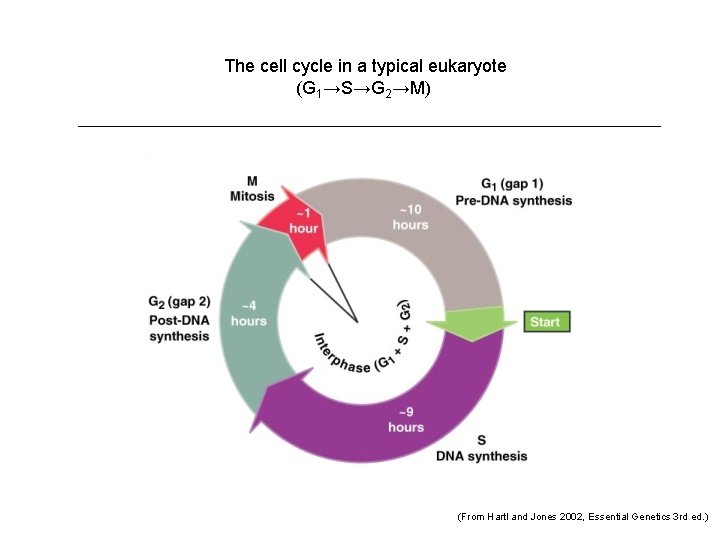
The cell cycle in a typical eukaryote (G 1→S→G 2→M) (From Hartl and Jones 2002, Essential Genetics 3 rd ed. )
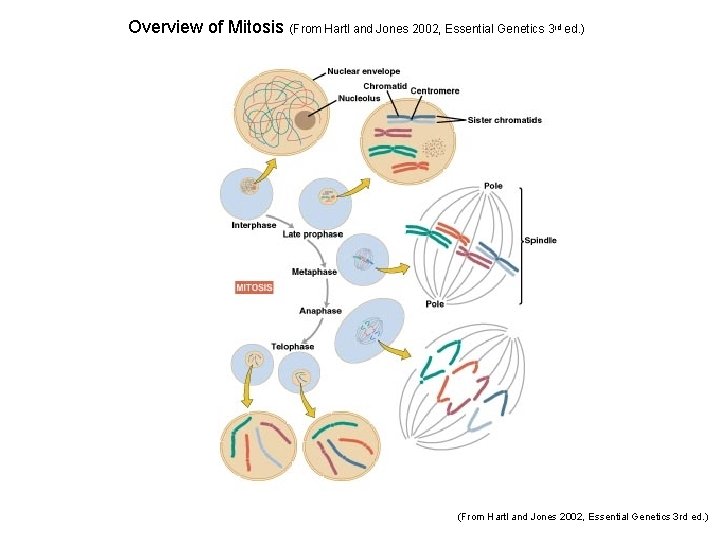
Overview of Mitosis (From Hartl and Jones 2002, Essential Genetics 3 rd ed. )
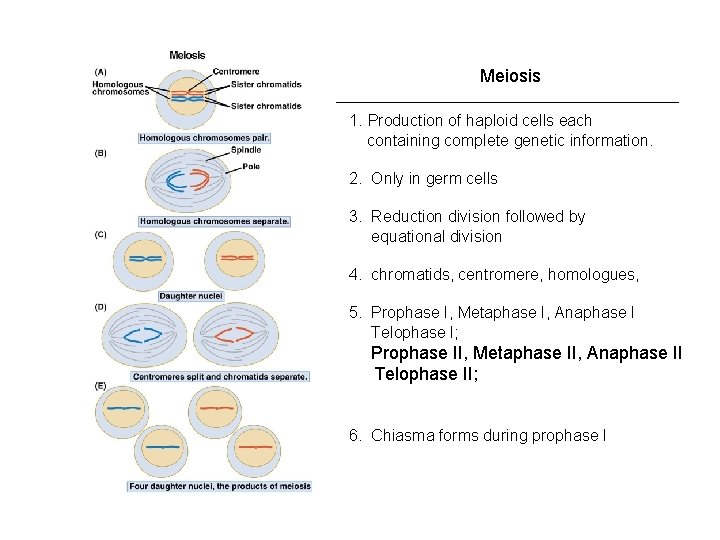
Meiosis 1. Production of haploid cells each containing complete genetic information. 2. Only in germ cells 3. Reduction division followed by equational division 4. chromatids, centromere, homologues, 5. Prophase I, Metaphase I, Anaphase I Telophase I; Prophase II, Metaphase II, Anaphase II Telophase II; 6. Chiasma forms during prophase I
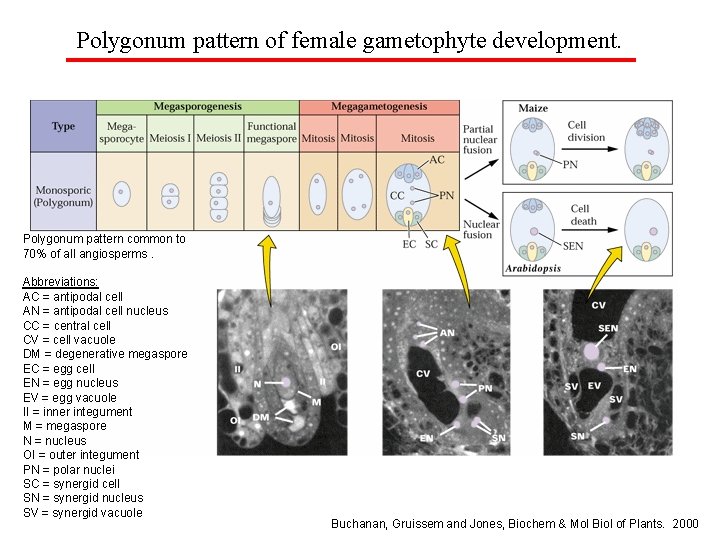
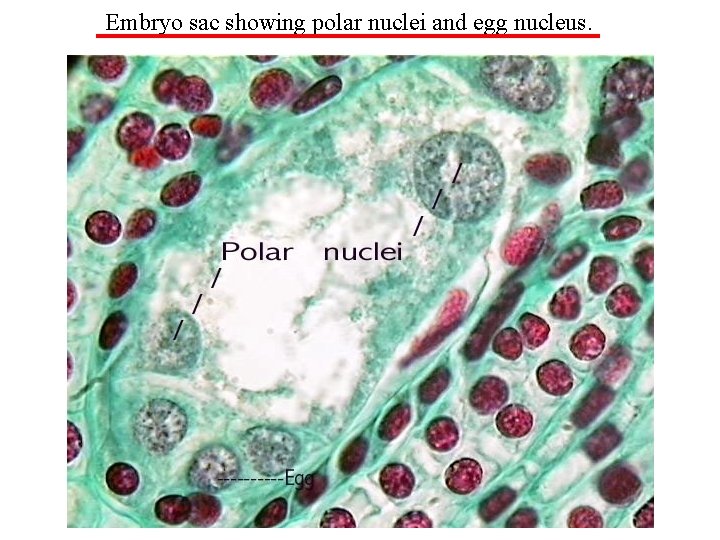
Seeds – Part 1 • Sexual reproduction (Figure 4 -5) • Pollination • Pollen tube • One tube nucleus • Two generative nuclei • Fertilization • Embryo + one generative nucleus (zygote) • 2 n • Double fertilization • Two polar nuclei + one generative nucleus • 3 n endosperm • Review “Polygonum” type embryo sac (Figure 4. 5) • Eight nuclei • 3 antipodal • 2 polar • 1 egg • 2 synergids
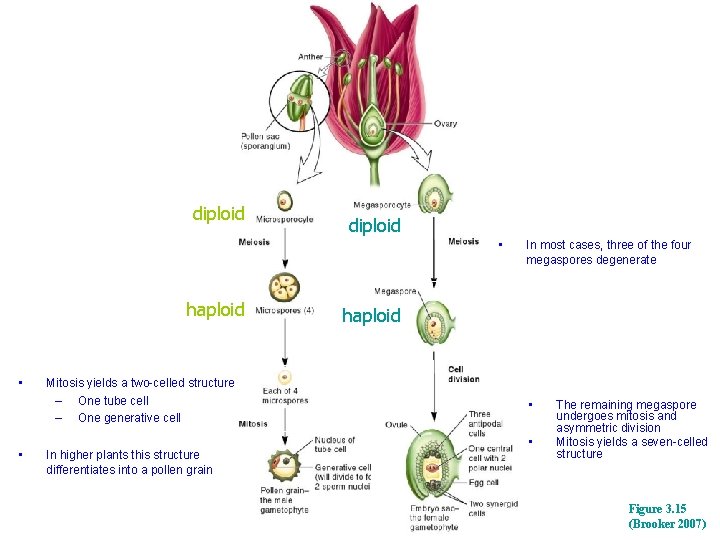
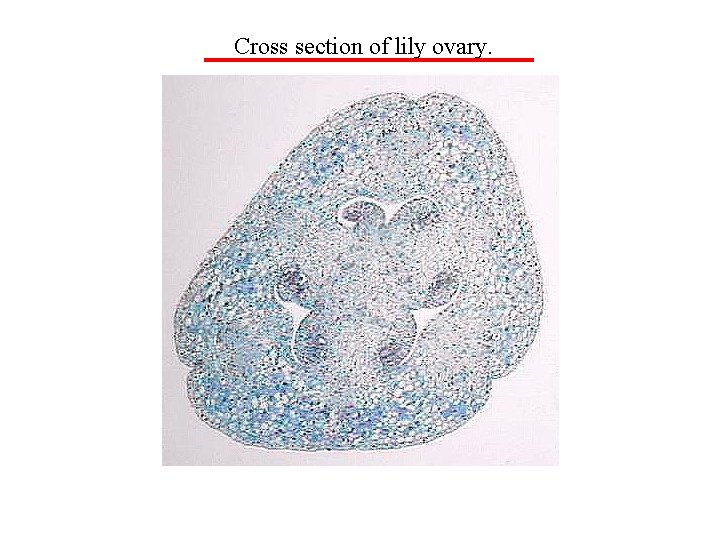
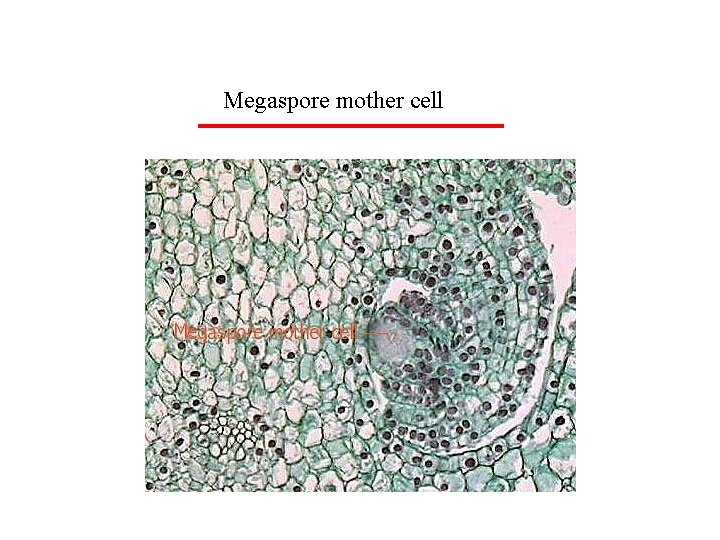
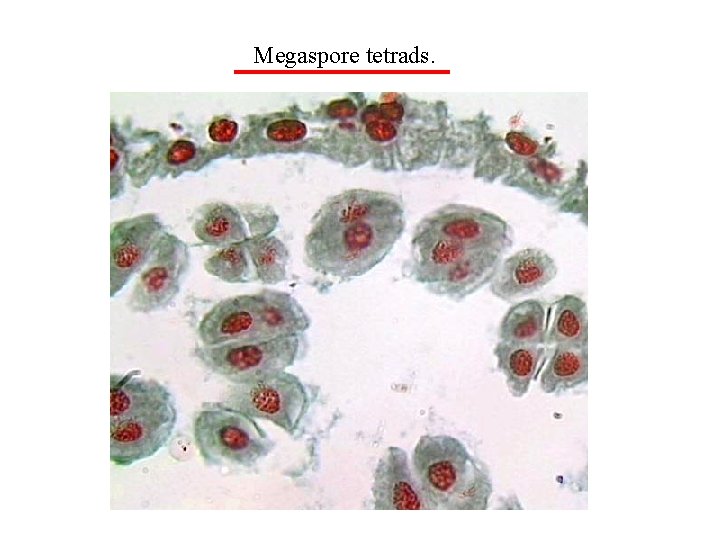
diploid • haploid • • Mitosis yields a two-celled structure – One tube cell – One generative cell In higher plants this structure differentiates into a pollen grain In most cases, three of the four megaspores degenerate haploid • • The remaining megaspore undergoes mitosis and asymmetric division Mitosis yields a seven-celled structure Figure 3. 15 (Brooker 2007)
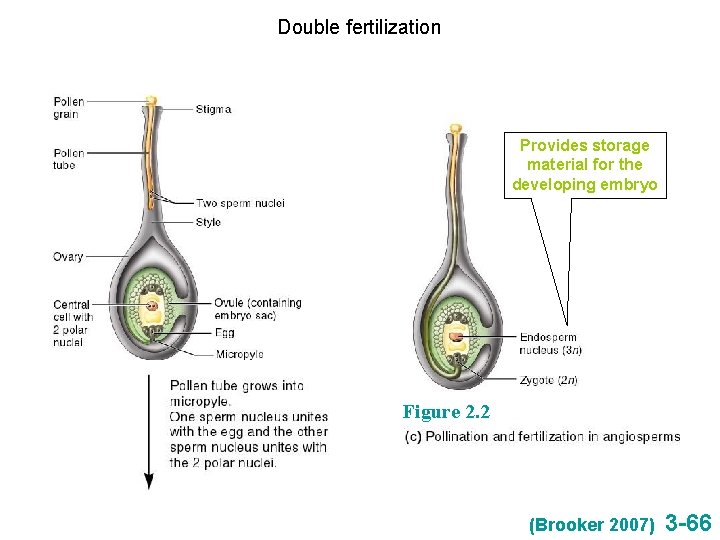
Double fertilization Provides storage material for the developing embryo Figure 2. 2 (Brooker 2007) 3 -66
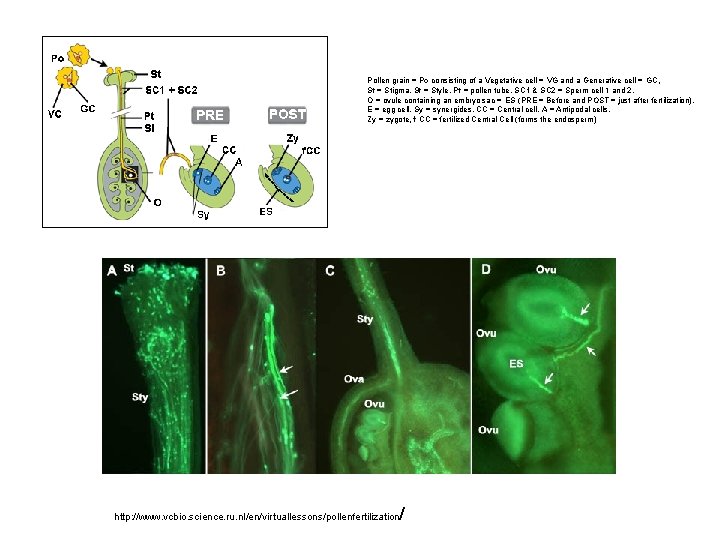
Pollen grain = Po consisting of a Vegetative cell = VG and a Generative cell = GC, St = Stigma, St = Style, Pt = pollen tube, SC 1 & SC 2 = Sperm cell 1 and 2, O = ovule containing an embryo sac = ES (PRE = Before and POST = just after fertilization), E = egg cell, Sy = synergides, CC = Central cell, A = Antipodal cells, Zy = zygote, f CC = fertilized Central Cell (forms the endosperm) / http: //www. vcbio. science. ru. nl/en/virtuallessons/pollenfertilization
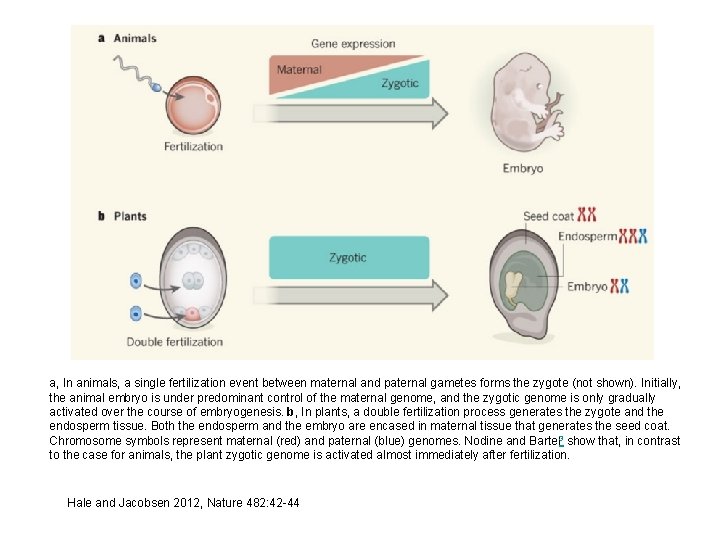
a, In animals, a single fertilization event between maternal and paternal gametes forms the zygote (not shown). Initially, the animal embryo is under predominant control of the maternal genome, and the zygotic genome is only gradually activated over the course of embryogenesis. b, In plants, a double fertilization process generates the zygote and the endosperm tissue. Both the endosperm and the embryo are encased in maternal tissue that generates the seed coat. Chromosome symbols represent maternal (red) and paternal (blue) genomes. Nodine and Bartel 3 show that, in contrast to the case for animals, the plant zygotic genome is activated almost immediately after fertilization. Hale and Jacobsen 2012, Nature 482: 42 -44
Polygonum pattern of female gametophyte development. Polygonum pattern common to 70% of all angiosperms. Abbreviations: AC = antipodal cell AN = antipodal cell nucleus CC = central cell CV = cell vacuole DM = degenerative megaspore EC = egg cell EN = egg nucleus EV = egg vacuole II = inner integument M = megaspore N = nucleus OI = outer integument PN = polar nuclei SC = synergid cell SN = synergid nucleus SV = synergid vacuole Buchanan, Gruissem and Jones, Biochem & Mol Biol of Plants. 2000
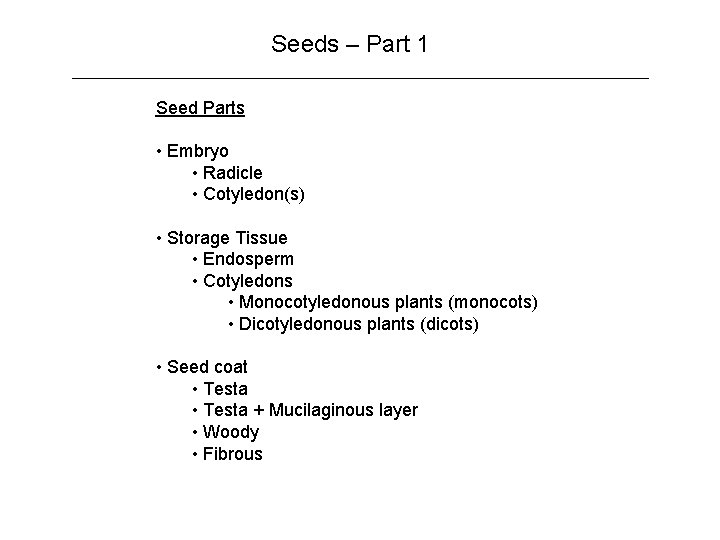
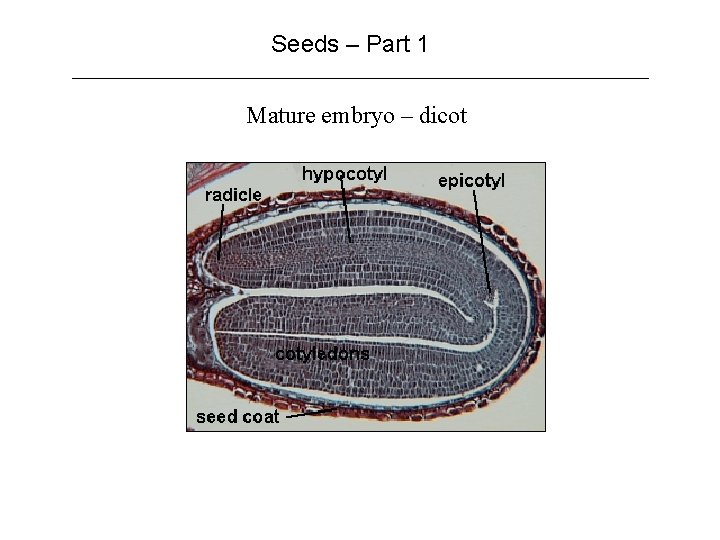
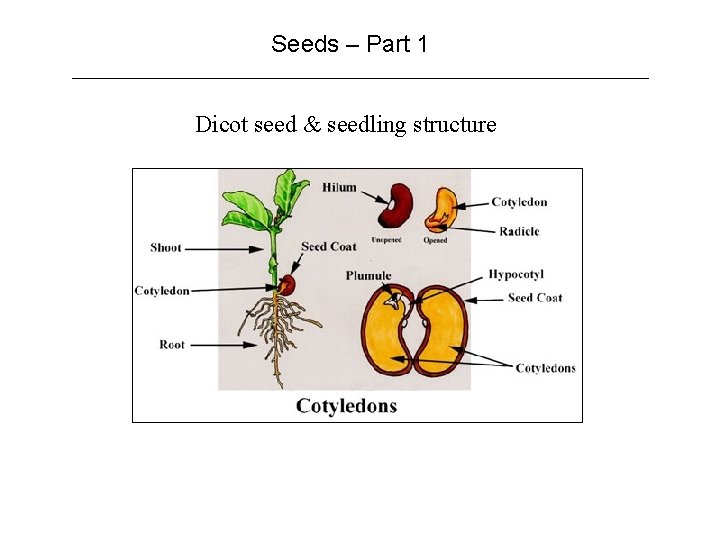
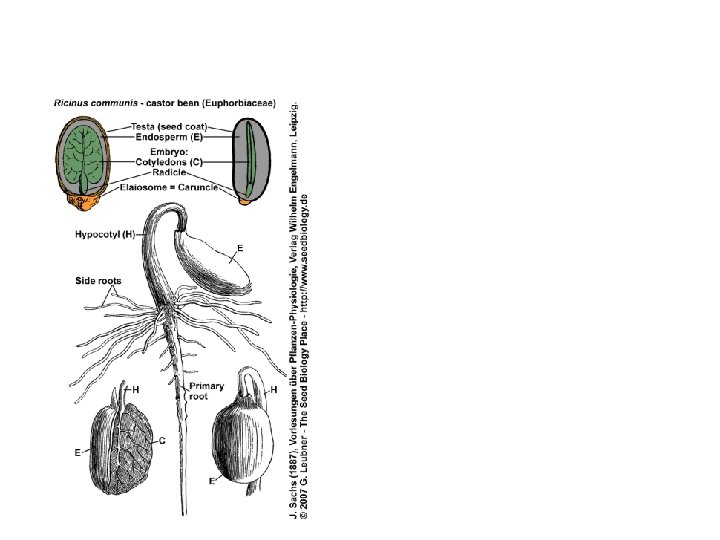
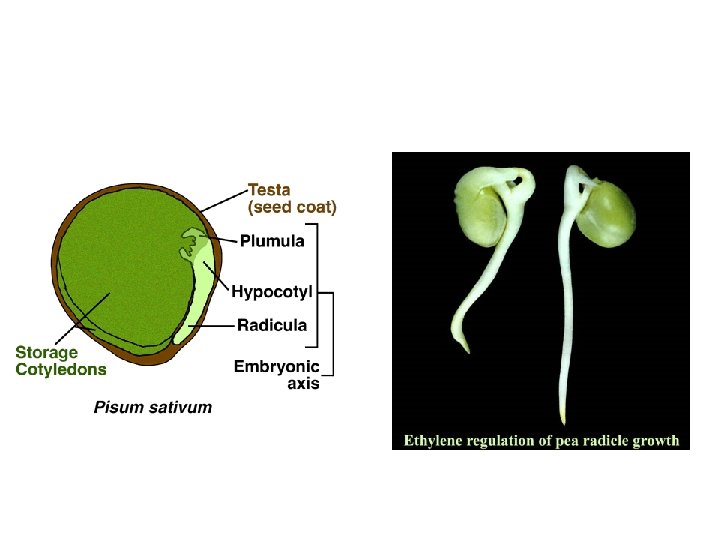
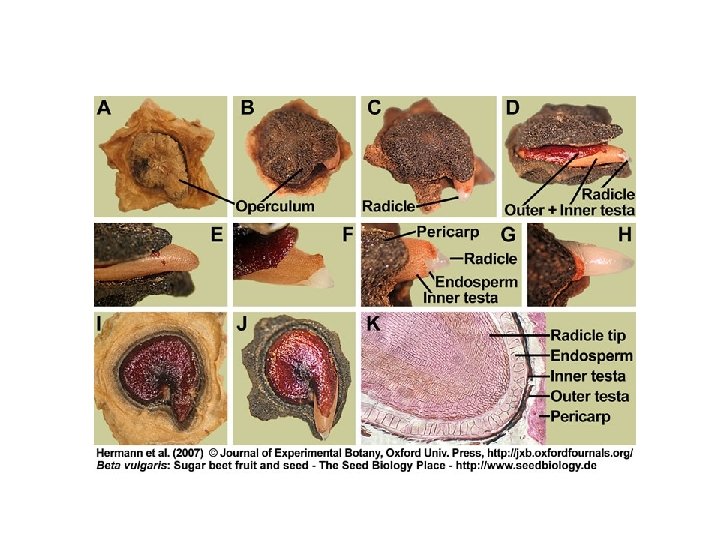
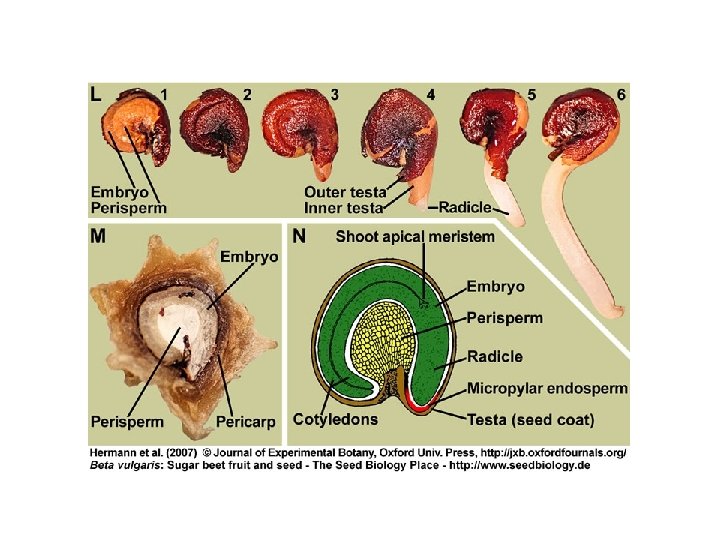
Seeds – Part 1 Seed Parts • Embryo • Radicle • Cotyledon(s) • Storage Tissue • Endosperm • Cotyledons • Monocotyledonous plants (monocots) • Dicotyledonous plants (dicots) • Seed coat • Testa + Mucilaginous layer • Woody • Fibrous
Seeds – Part 1 Mature embryo – dicot
Seeds – Part 1 Dicot seed & seedling structure
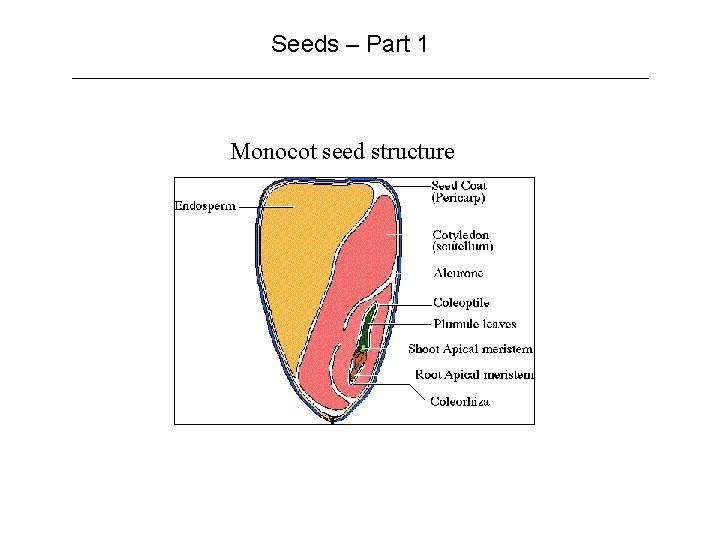
Seeds – Part 1 Monocot seed structure
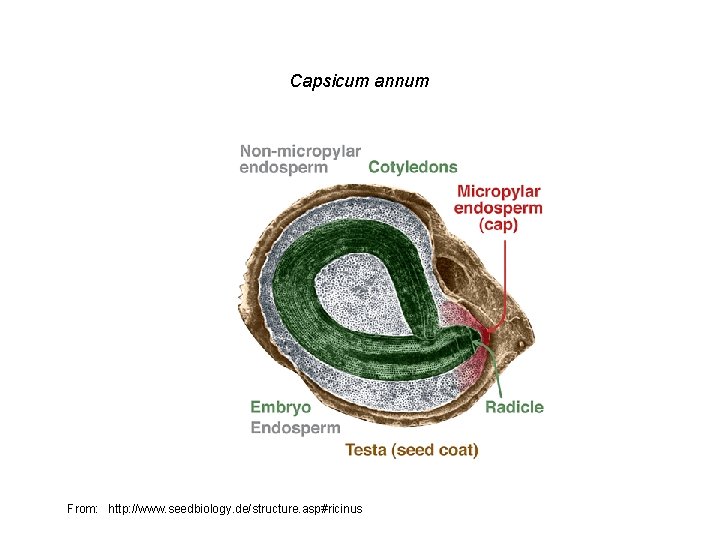
Capsicum annum From: http: //www. seedbiology. de/structure. asp#ricinus
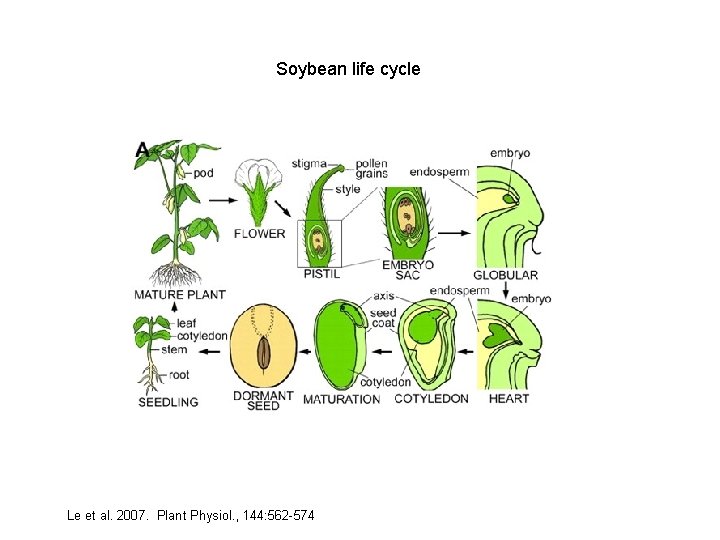
Soybean life cycle Le et al. 2007. Plant Physiol. , 144: 562 -574
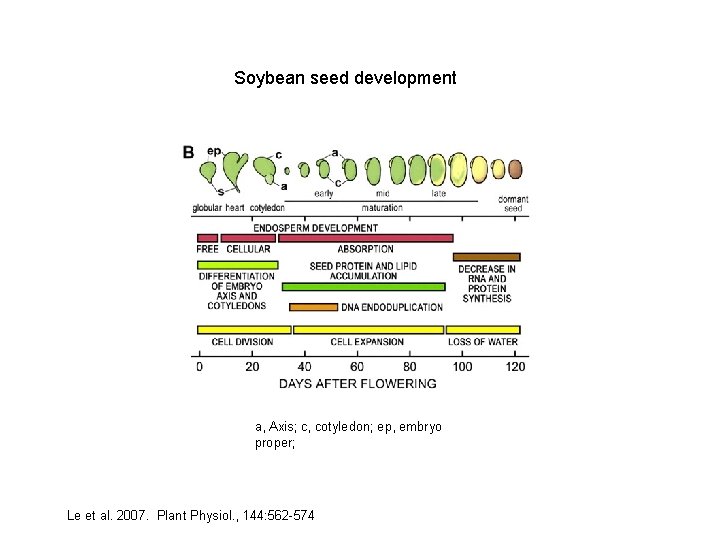
Soybean seed development a, Axis; c, cotyledon; ep, embryo proper; Le et al. 2007. Plant Physiol. , 144: 562 -574
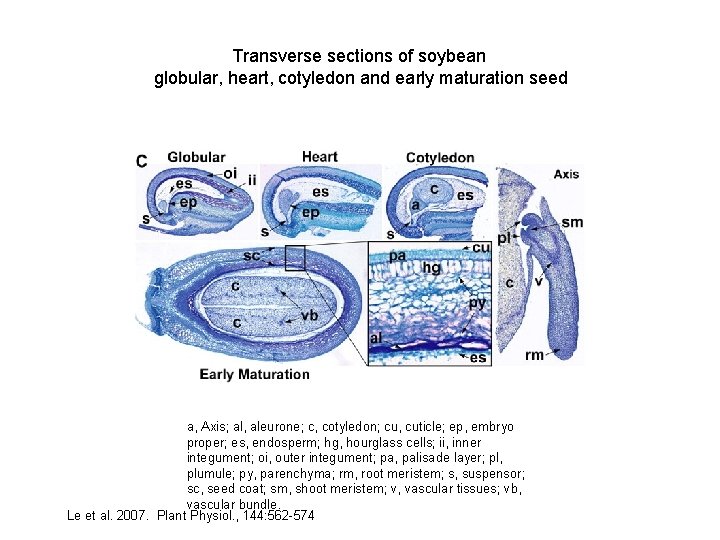
Transverse sections of soybean globular, heart, cotyledon and early maturation seed a, Axis; al, aleurone; c, cotyledon; cu, cuticle; ep, embryo proper; es, endosperm; hg, hourglass cells; ii, inner integument; oi, outer integument; pa, palisade layer; pl, plumule; py, parenchyma; rm, root meristem; s, suspensor; sc, seed coat; sm, shoot meristem; v, vascular tissues; vb, vascular bundle. Le et al. 2007. Plant Physiol. , 144: 562 -574
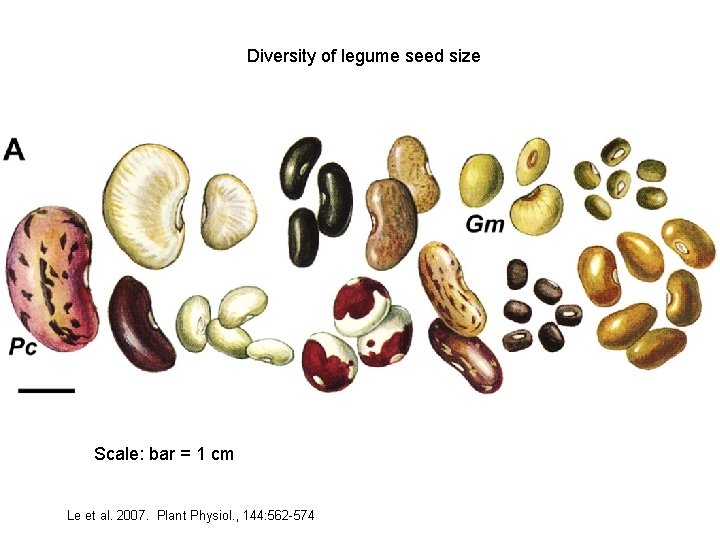
Diversity of legume seed size Scale: bar = 1 cm Le et al. 2007. Plant Physiol. , 144: 562 -574
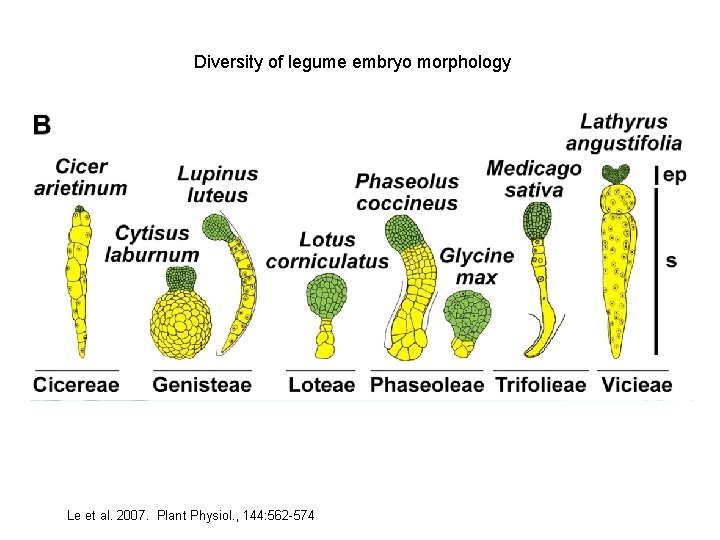
Diversity of legume embryo morphology Le et al. 2007. Plant Physiol. , 144: 562 -574
Seeds – Part 1 Zea mays seed
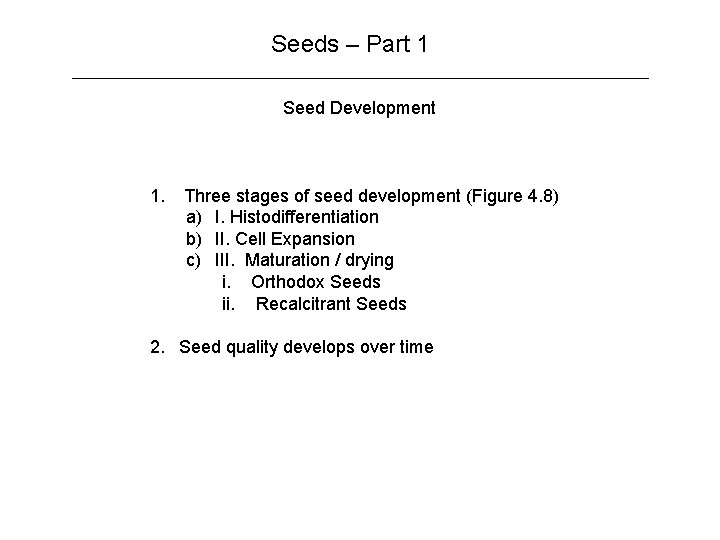
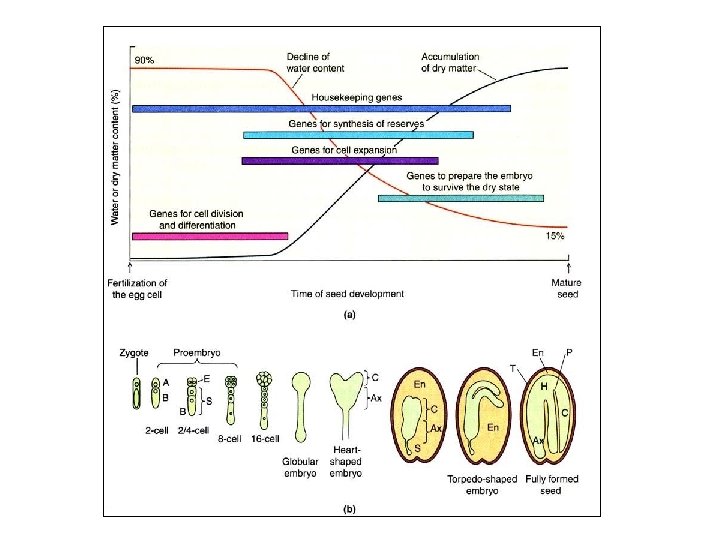
Seeds – Part 1 Seed Development 1. Three stages of seed development (Figure 4. 8) a) I. Histodifferentiation b) II. Cell Expansion c) III. Maturation / drying i. Orthodox Seeds ii. Recalcitrant Seeds 2. Seed quality develops over time
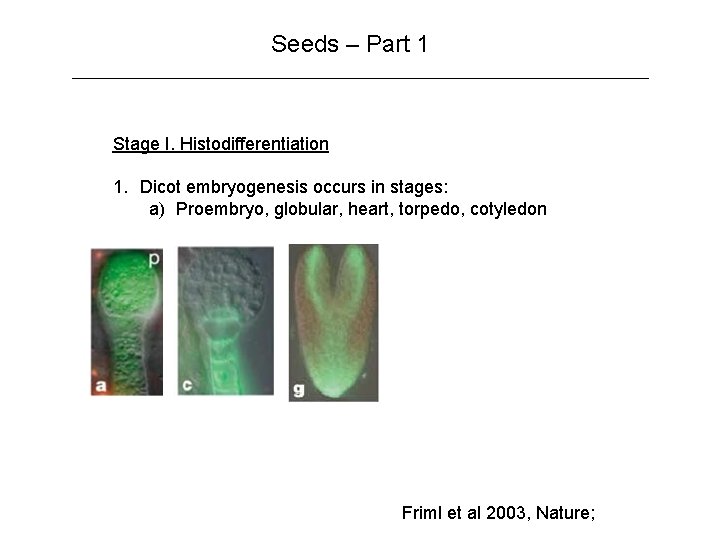
Seeds – Part 1 Stage I. Histodifferentiation 1. Dicot embryogenesis occurs in stages: a) Proembryo, globular, heart, torpedo, cotyledon Friml et al 2003, Nature;
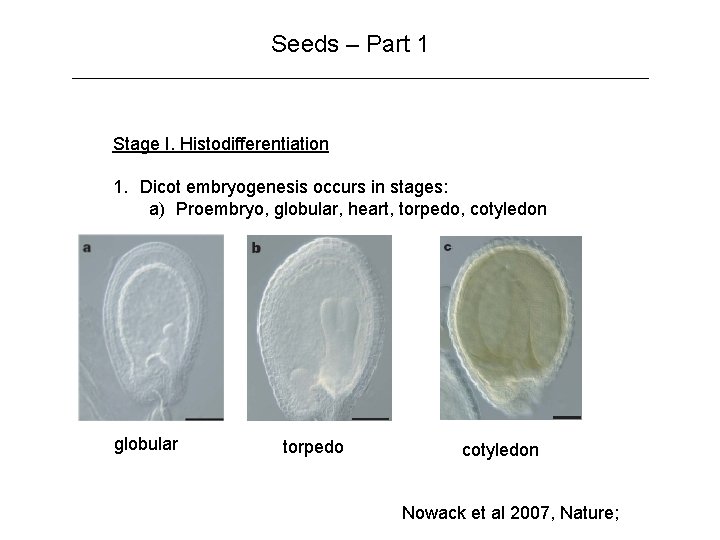
Seeds – Part 1 Stage I. Histodifferentiation 1. Dicot embryogenesis occurs in stages: a) Proembryo, globular, heart, torpedo, cotyledon globular torpedo cotyledon Nowack et al 2007, Nature;
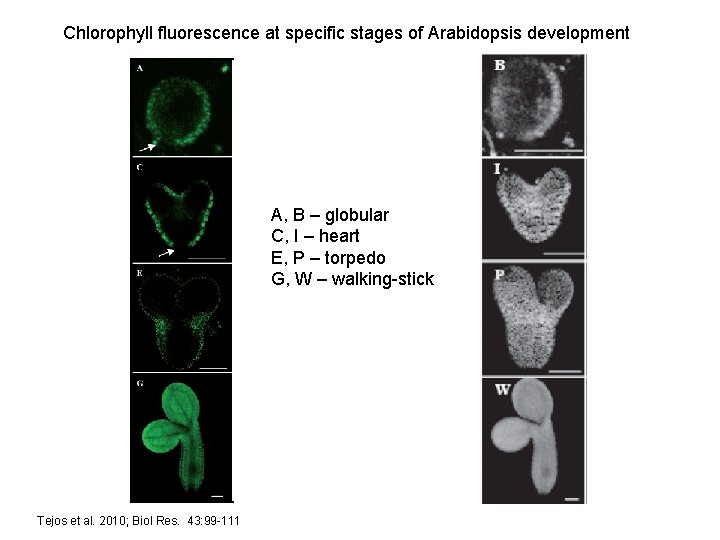
Chlorophyll fluorescence at specific stages of Arabidopsis development A, B – globular C, I – heart E, P – torpedo G, W – walking-stick Tejos et al. 2010; Biol Res. 43: 99 -111
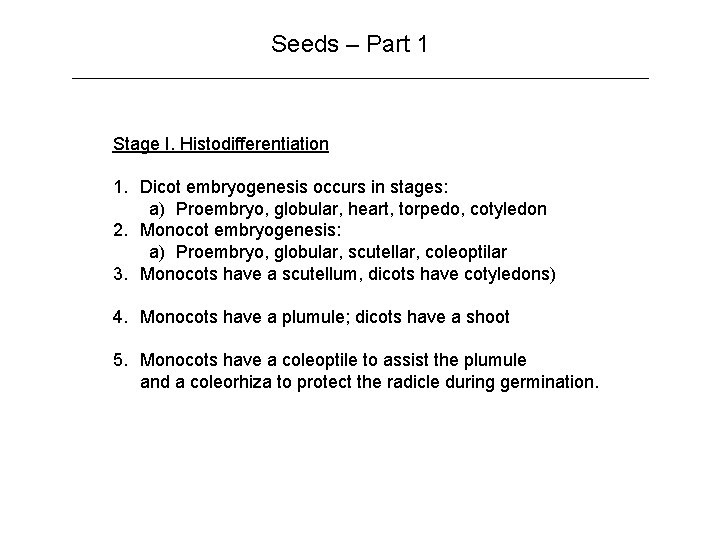
Seeds – Part 1 Stage I. Histodifferentiation 1. Dicot embryogenesis occurs in stages: a) Proembryo, globular, heart, torpedo, cotyledon 2. Monocot embryogenesis: a) Proembryo, globular, scutellar, coleoptilar 3. Monocots have a scutellum, dicots have cotyledons) 4. Monocots have a plumule; dicots have a shoot 5. Monocots have a coleoptile to assist the plumule and a coleorhiza to protect the radicle during germination.
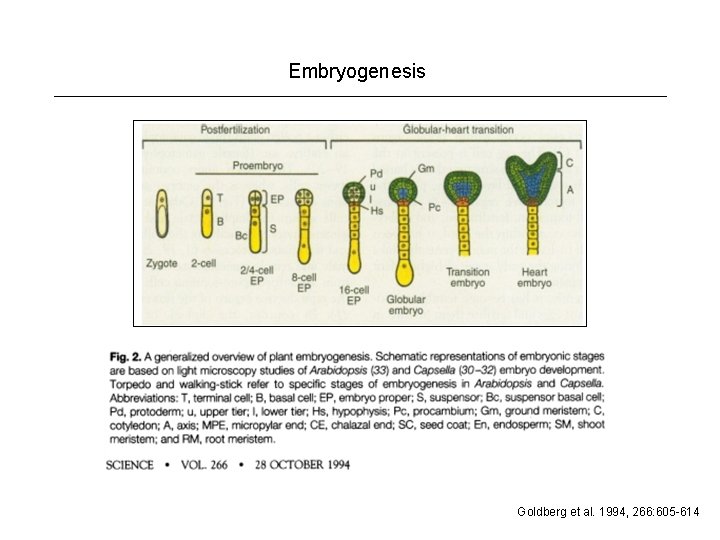
Embryogenesis Goldberg et al. 1994, 266: 605 -614
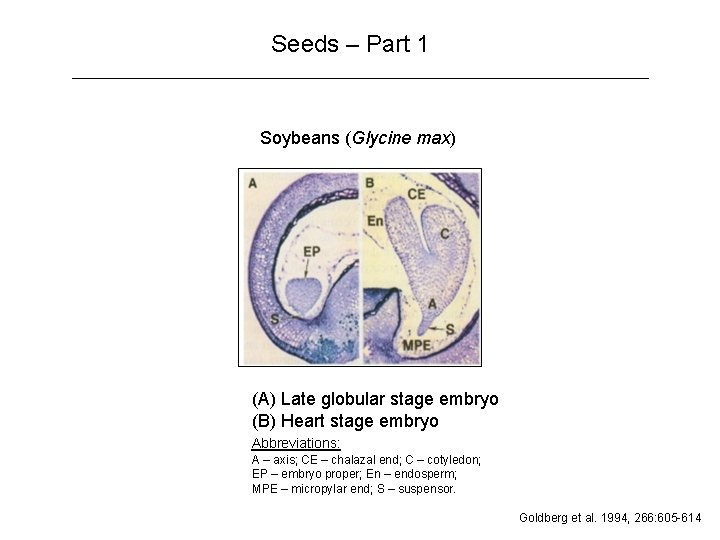
Seeds – Part 1 Soybeans (Glycine max) (A) Late globular stage embryo (B) Heart stage embryo Abbreviations: A – axis; CE – chalazal end; C – cotyledon; EP – embryo proper; En – endosperm; MPE – micropylar end; S – suspensor. Goldberg et al. 1994, 266: 605 -614
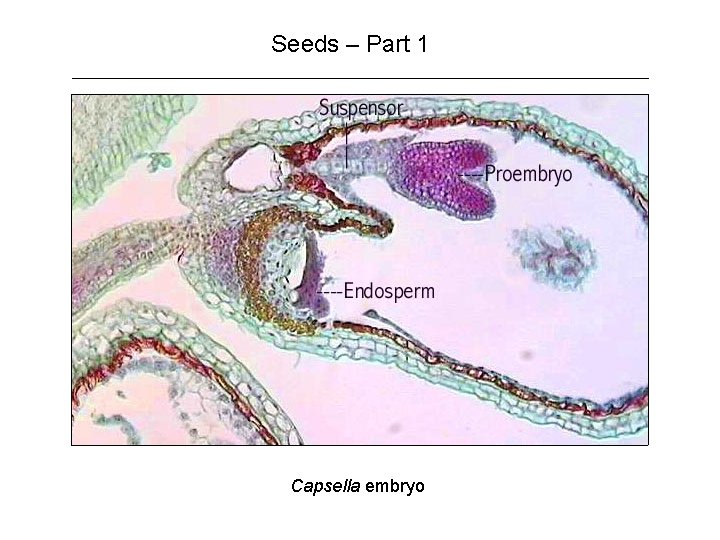
Seeds – Part 1 Capsella embryo
Seeds – Part 1 Stage II. Cell Expansion 1. Stage II is marked by rapid expansion of cells 2. Cotyledons or endosperm accumulate CH 2 O, fats, oils, proteins. a) All seeds contain each component, but in characteristic amounts. 3. Dicots connection b/t mother plant and developing seed is through the funinculus. a) Assimilates reach the embryo via diffusion b) Excludes most viruses 4. Reserve accumulation is under genetic control: a) Plants have ~25, 000 – 50, 000 genes b) At least 50% are expressed during seed development
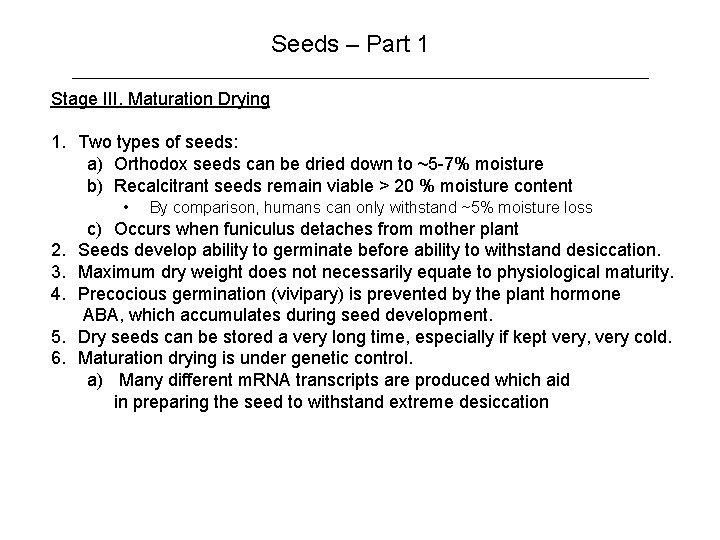
Seeds – Part 1 Stage III. Maturation Drying 1. Two types of seeds: a) Orthodox seeds can be dried down to ~5 -7% moisture b) Recalcitrant seeds remain viable > 20 % moisture content • 2. 3. 4. 5. 6. By comparison, humans can only withstand ~5% moisture loss c) Occurs when funiculus detaches from mother plant Seeds develop ability to germinate before ability to withstand desiccation. Maximum dry weight does not necessarily equate to physiological maturity. Precocious germination (vivipary) is prevented by the plant hormone ABA, which accumulates during seed development. Dry seeds can be stored a very long time, especially if kept very, very cold. Maturation drying is under genetic control. a) Many different m. RNA transcripts are produced which aid in preparing the seed to withstand extreme desiccation
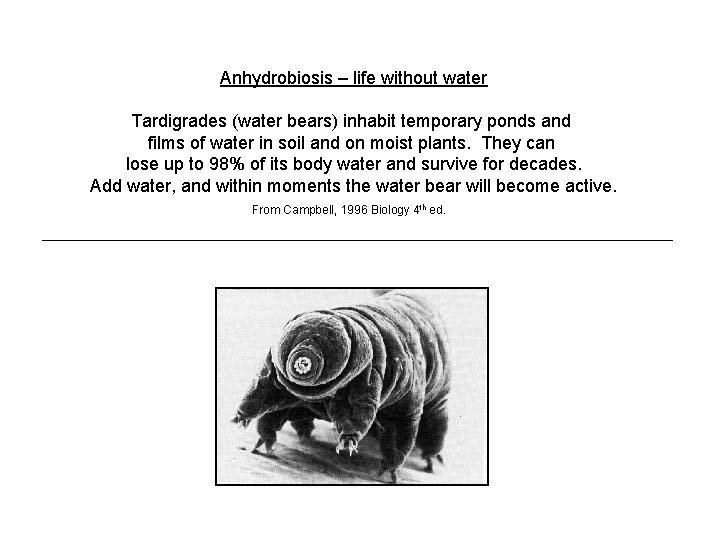
Anhydrobiosis – life without water Tardigrades (water bears) inhabit temporary ponds and films of water in soil and on moist plants. They can lose up to 98% of its body water and survive for decades. Add water, and within moments the water bear will become active. From Campbell, 1996 Biology 4 th ed.
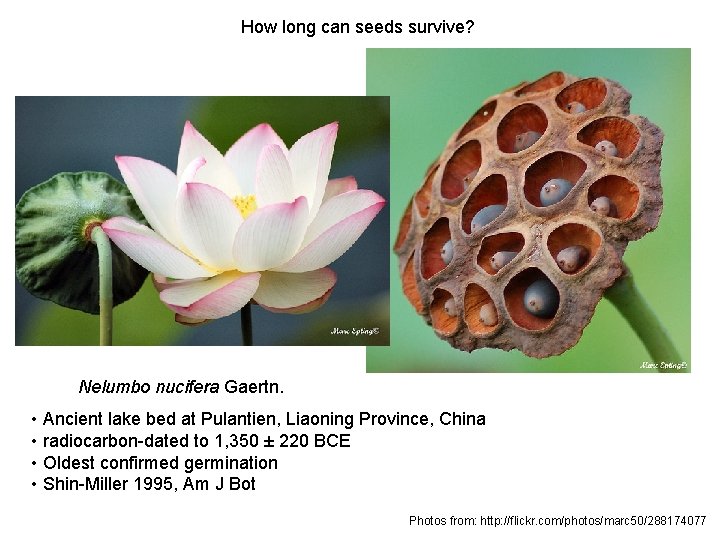
How long can seeds survive? Nelumbo nucifera Gaertn. • Ancient lake bed at Pulantien, Liaoning Province, China • radiocarbon-dated to 1, 350 ± 220 BCE • Oldest confirmed germination • Shin-Miller 1995, Am J Bot Photos from: http: //flickr. com/photos/marc 50/288174077
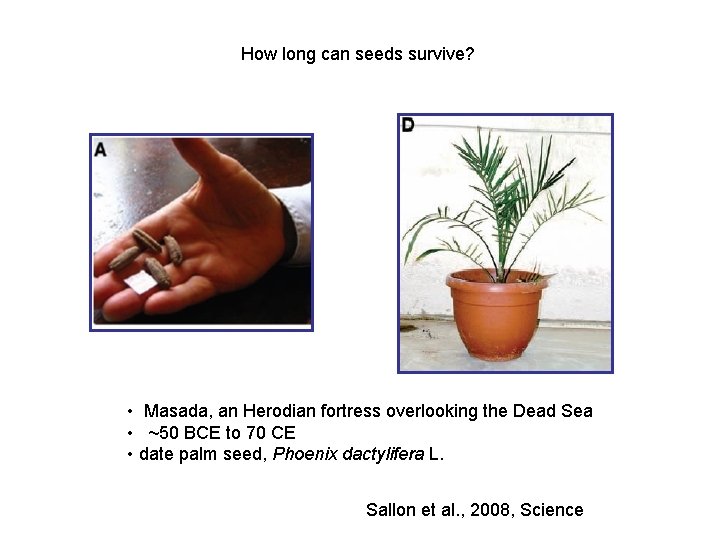
How long can seeds survive? • Masada, an Herodian fortress overlooking the Dead Sea • ~50 BCE to 70 CE • date palm seed, Phoenix dactylifera L. Sallon et al. , 2008, Science
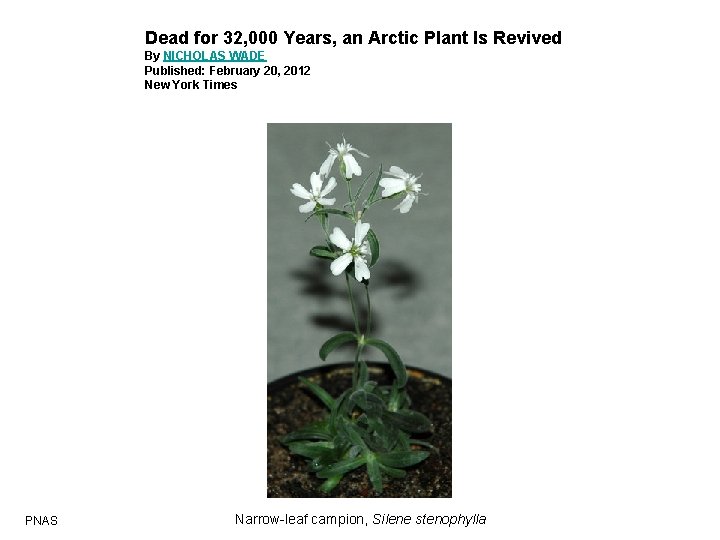
Dead for 32, 000 Years, an Arctic Plant Is Revived By NICHOLAS WADE Published: February 20, 2012 New York Times PNAS Narrow-leaf campion, Silene stenophylla
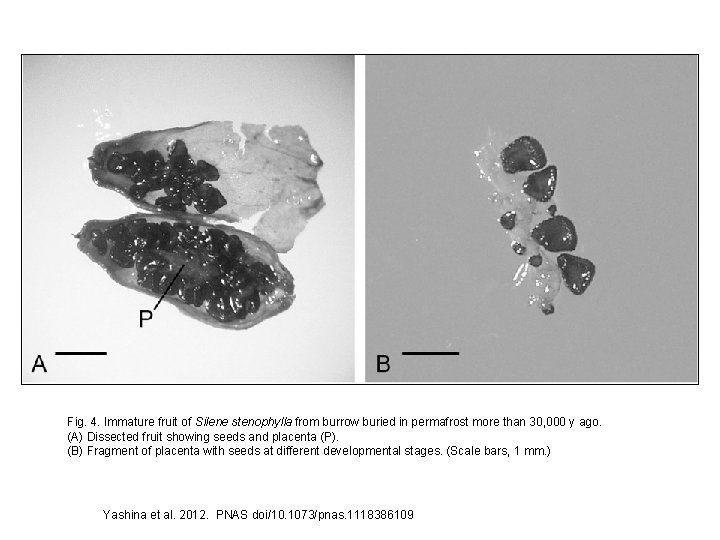
Fig. 4. Immature fruit of Silene stenophylla from burrow buried in permafrost more than 30, 000 y ago. (A) Dissected fruit showing seeds and placenta (P). (B) Fragment of placenta with seeds at different developmental stages. (Scale bars, 1 mm. ) Yashina et al. 2012. PNAS doi/10. 1073/pnas. 1118386109
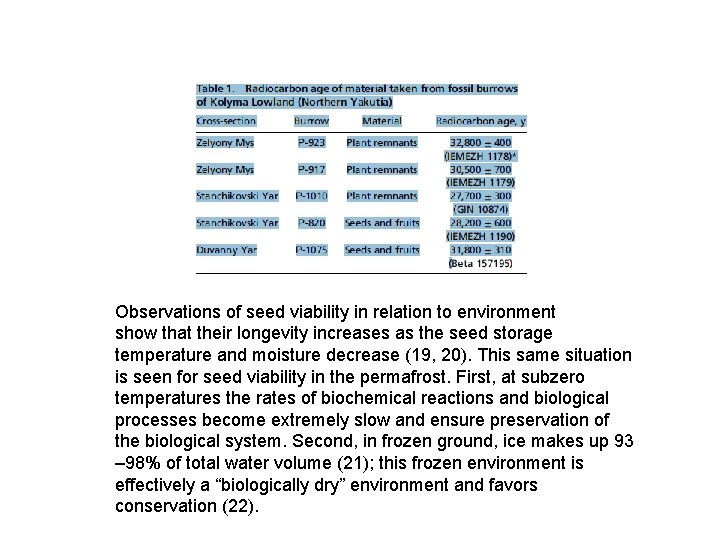
Observations of seed viability in relation to environment show that their longevity increases as the seed storage temperature and moisture decrease (19, 20). This same situation is seen for seed viability in the permafrost. First, at subzero temperatures the rates of biochemical reactions and biological processes become extremely slow and ensure preservation of the biological system. Second, in frozen ground, ice makes up 93 – 98% of total water volume (21); this frozen environment is effectively a “biologically dry” environment and favors conservation (22).
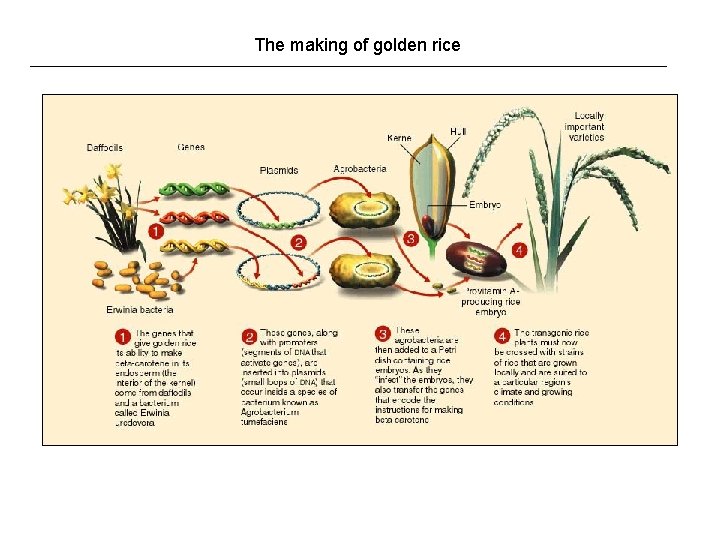
Seeds – Part 1 Biotechnology of Seed Reserves 1. Modifying F. A. content (omega-3 -fatty acids; novel cooking/industrial oils 2. Modifying amino acid content in maize (Brian Larkins’ work) 3. Adding to pathways (Golden rice)
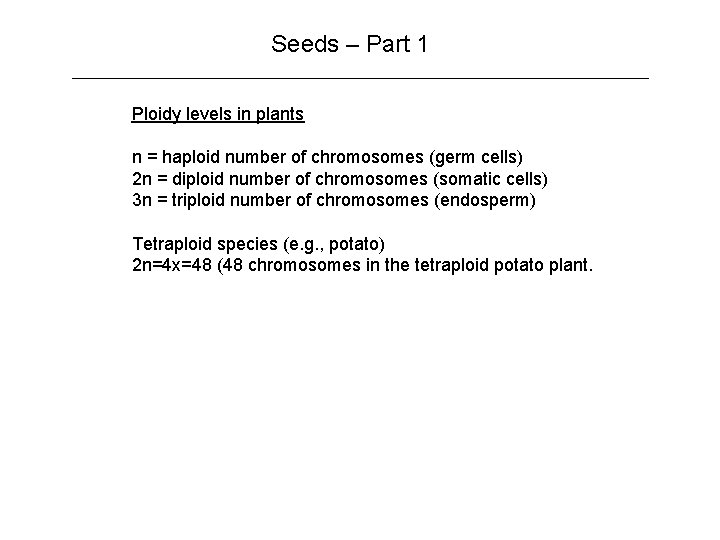
Seeds – Part 1 Ploidy levels in plants n = haploid number of chromosomes (germ cells) 2 n = diploid number of chromosomes (somatic cells) 3 n = triploid number of chromosomes (endosperm) Tetraploid species (e. g. , potato) 2 n=4 x=48 (48 chromosomes in the tetraploid potato plant.
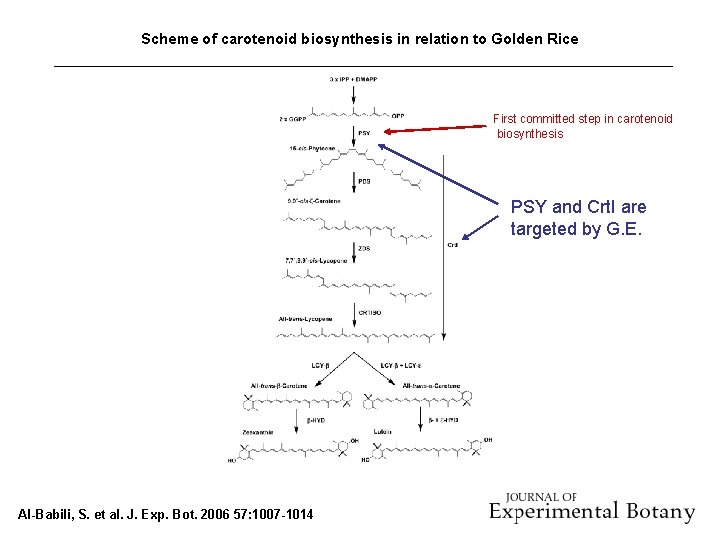
Scheme of carotenoid biosynthesis in relation to Golden Rice First committed step in carotenoid biosynthesis PSY and Crt. I are targeted by G. E. Al-Babili, S. et al. J. Exp. Bot. 2006 57: 1007 -1014
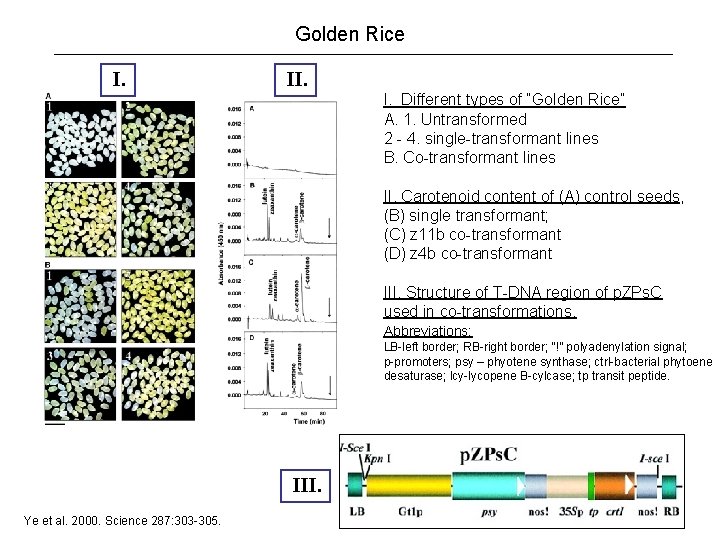
Golden Rice I. I. Different types of “Golden Rice” A. 1. Untransformed 2 - 4. single-transformant lines B. Co-transformant lines II. Carotenoid content of (A) control seeds, (B) single transformant; (C) z 11 b co-transformant (D) z 4 b co-transformant III. Structure of T-DNA region of p. ZPs. C used in co-transformations. Abbreviations: LB-left border; RB-right border; “!” polyadenylation signal; p-promoters; psy – phyotene synthase; ctrl-bacterial phytoene desaturase; lcy-lycopene B-cylcase; tp transit peptide. III. Ye et al. 2000. Science 287: 303 -305.
The making of golden rice
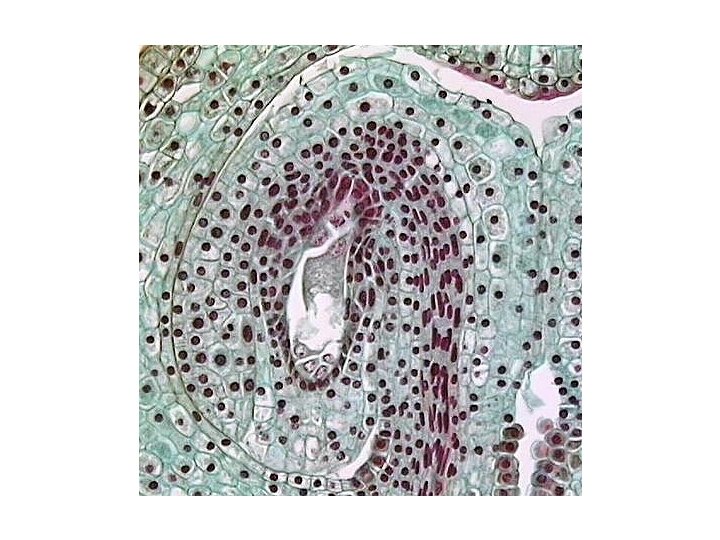
Cross section of lily ovary.
Megaspore mother cell
Megaspore tetrads.
Embryo sac showing polar nuclei and egg nucleus.