
Seeding in the presence of microbunching Gregg Penn
Seeding in the presence of microbunching Gregg Penn, LBNL CBP July 29, 2015
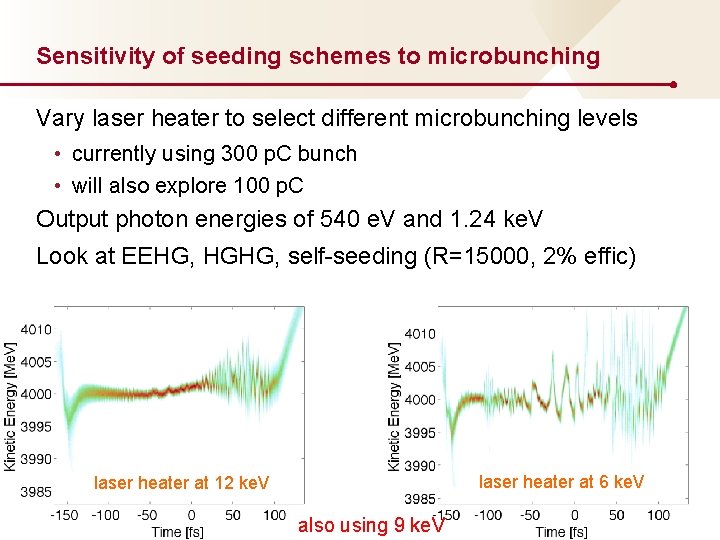
Sensitivity of seeding schemes to microbunching Vary laser heater to select different microbunching levels • currently using 300 p. C bunch • will also explore 100 p. C Output photon energies of 540 e. V and 1. 24 ke. V Look at EEHG, HGHG, self-seeding (R=15000, 2% effic) laser heater at 6 ke. V laser heater at 12 ke. V also using 9 ke. V
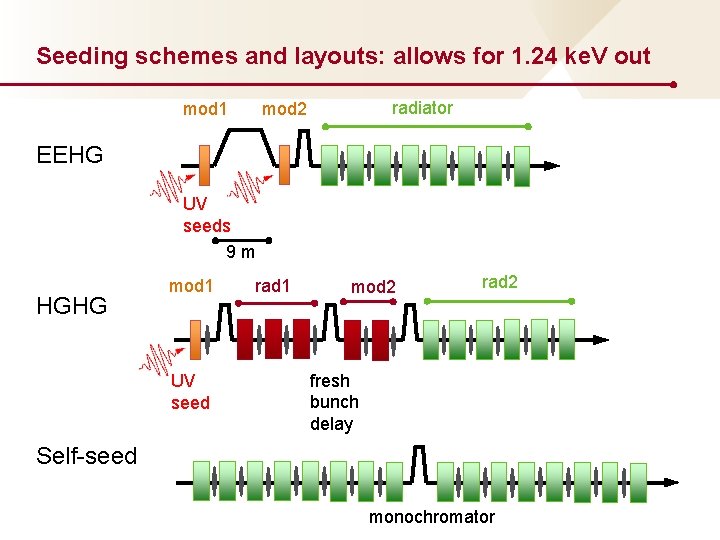
Seeding schemes and layouts: allows for 1. 24 ke. V out mod 1 radiator mod 2 EEHG UV seeds 9 m HGHG mod 1 UV seed rad 1 mod 2 rad 2 fresh bunch delay Self-seed monochromator
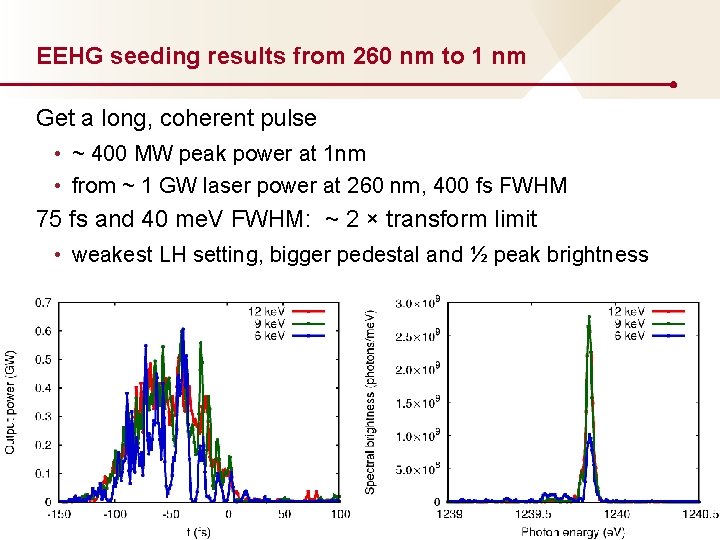
EEHG seeding results from 260 nm to 1 nm Get a long, coherent pulse • ~ 400 MW peak power at 1 nm • from ~ 1 GW laser power at 260 nm, 400 fs FWHM 75 fs and 40 me. V FWHM: ~ 2 × transform limit • weakest LH setting, bigger pedestal and ½ peak brightness
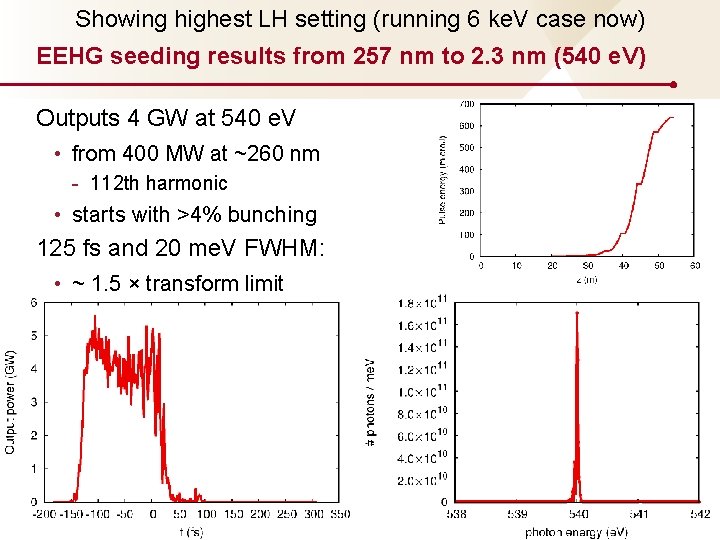
Showing highest LH setting (running 6 ke. V case now) EEHG seeding results from 257 nm to 2. 3 nm (540 e. V) Outputs 4 GW at 540 e. V • from 400 MW at ~260 nm - 112 th harmonic • starts with >4% bunching 125 fs and 20 me. V FWHM: • ~ 1. 5 × transform limit
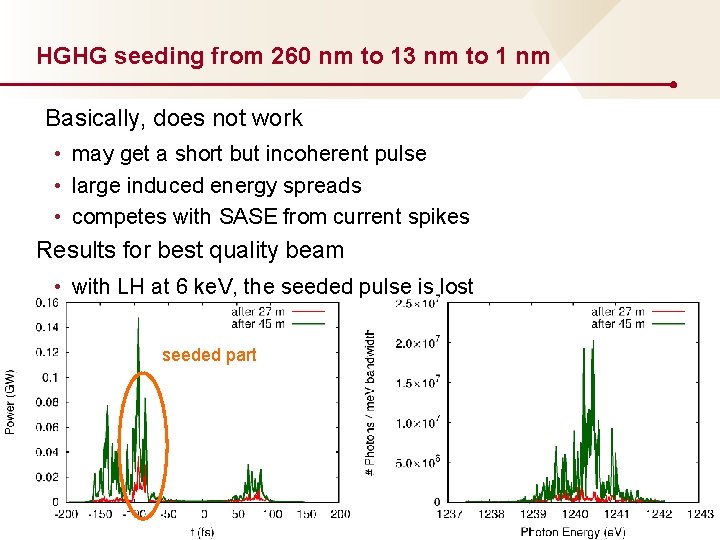
HGHG seeding from 260 nm to 13 nm to 1 nm Basically, does not work • may get a short but incoherent pulse • large induced energy spreads • competes with SASE from current spikes Results for best quality beam • with LH at 6 ke. V, the seeded pulse is lost seeded part
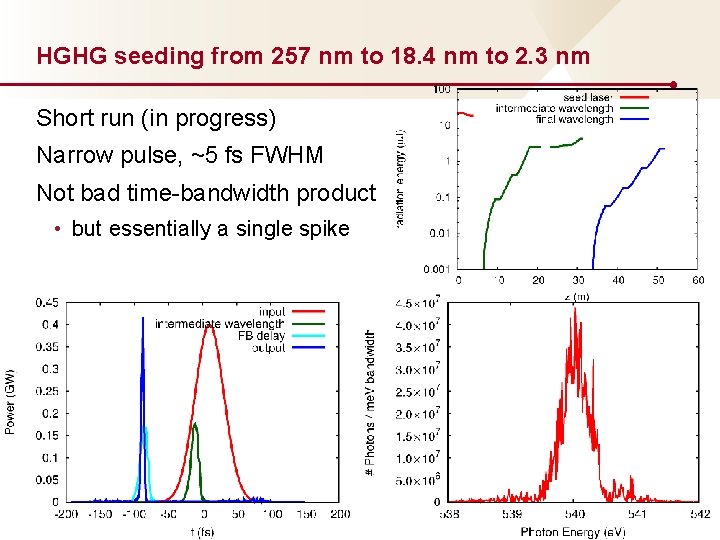
HGHG seeding from 257 nm to 18. 4 nm to 2. 3 nm Short run (in progress) Narrow pulse, ~5 fs FWHM Not bad time-bandwidth product • but essentially a single spike
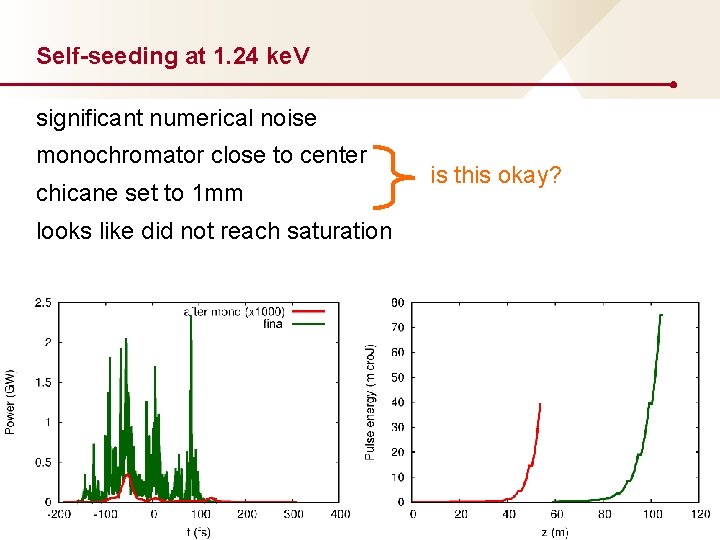
Self-seeding at 1. 24 ke. V significant numerical noise monochromator close to center chicane set to 1 mm looks like did not reach saturation is this okay?
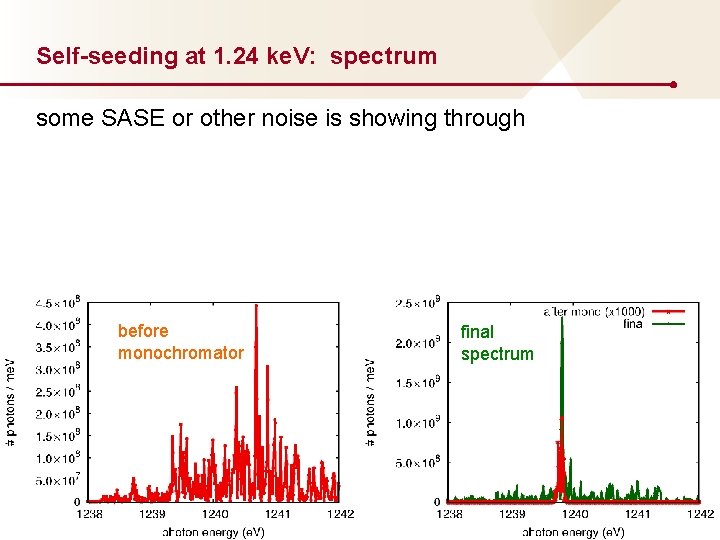
Self-seeding at 1. 24 ke. V: spectrum some SASE or other noise is showing through before monochromator final spectrum
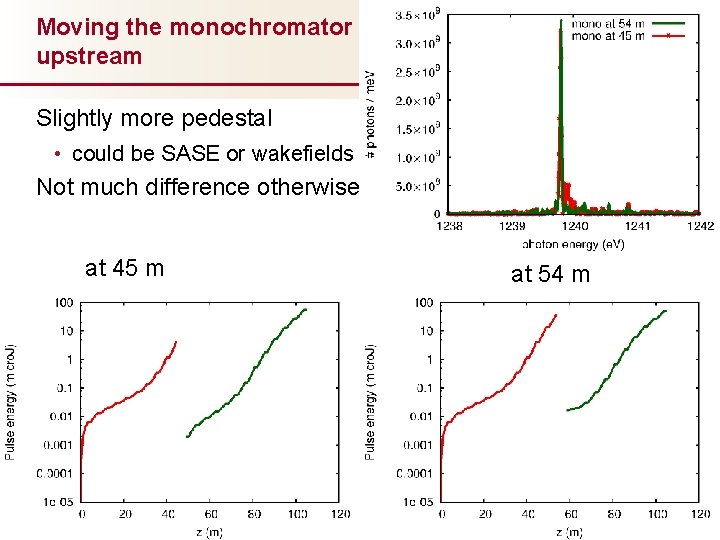
Moving the monochromator upstream Slightly more pedestal • could be SASE or wakefields Not much difference otherwise at 45 m at 54 m
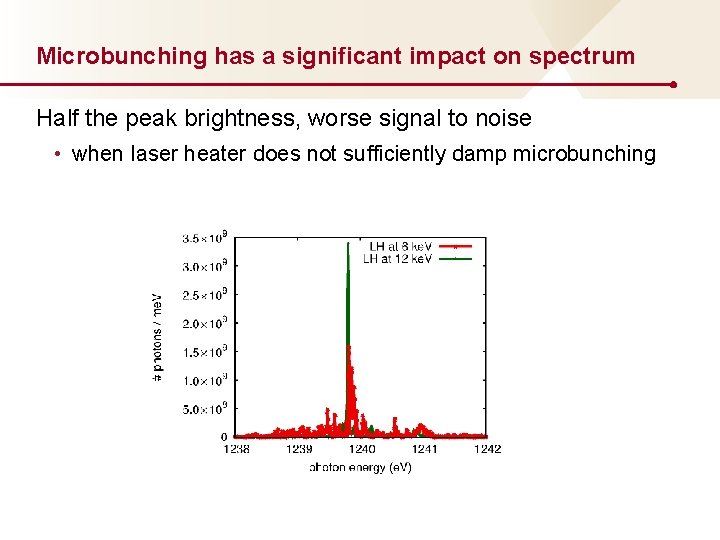
Microbunching has a significant impact on spectrum Half the peak brightness, worse signal to noise • when laser heater does not sufficiently damp microbunching
Comments on self-seeding For these runs, did not re-randomize particle phases • modeled propagation through chicane • pessimistic simulation, very susceptible to numerical noise Optics model not optimized – no transverse focusing • radiation diffracts across chicane • in practice, will be re-imaged to roughly same spot size Overall impact • pessimistic signal-to-noise ratio • monochromator positioned further upstream than needed
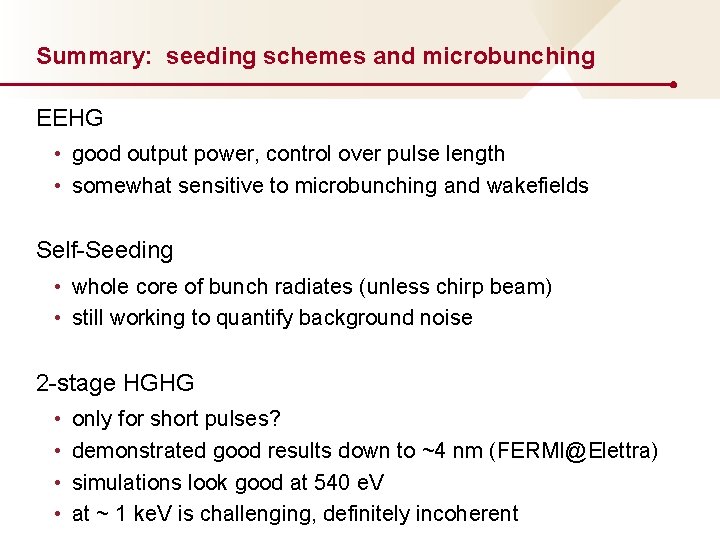
Summary: seeding schemes and microbunching EEHG • good output power, control over pulse length • somewhat sensitive to microbunching and wakefields Self-Seeding • whole core of bunch radiates (unless chirp beam) • still working to quantify background noise 2 -stage HGHG • • only for short pulses? demonstrated good results down to ~4 nm (FERMI@Elettra) simulations look good at 540 e. V at ~ 1 ke. V is challenging, definitely incoherent

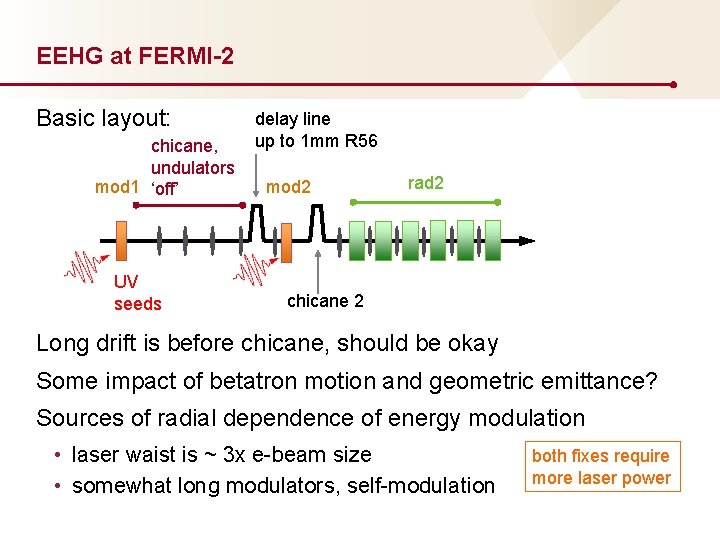
EEHG at FERMI-2 Basic layout: chicane, undulators mod 1 ‘off’ UV seeds delay line up to 1 mm R 56 mod 2 rad 2 chicane 2 Long drift is before chicane, should be okay Some impact of betatron motion and geometric emittance? Sources of radial dependence of energy modulation • laser waist is ~ 3 x e-beam size • somewhat long modulators, self-modulation both fixes require more laser power
First try at laser parameters 260 nm seeding, targeting 65 nm bunching 1 st energy modulation ~ 1 Me. V, 32 MW peak power 2 nd energy modulation ~ 2. 4 Me. V, 265 MW peak power required to keep R 56 of 1 st chicane <= 1 mm laser waist ~ 290 micron Rms energy spread after EEHG stage is 1. 9 Me. V • too high, debunching happens very fast
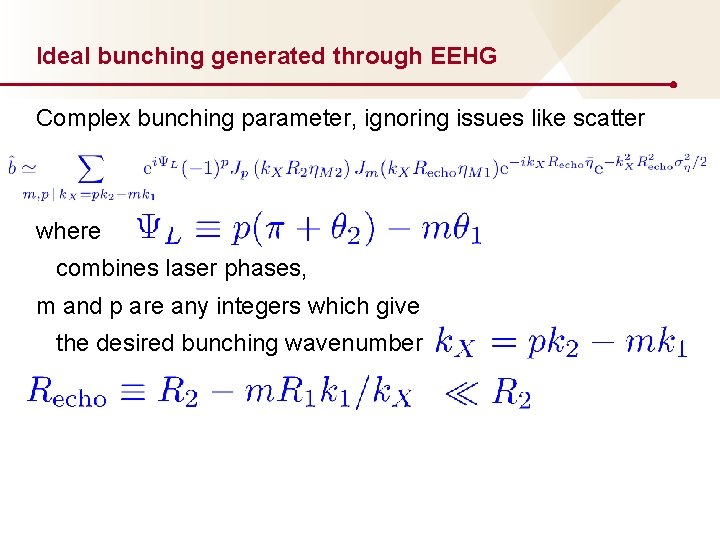
Ideal bunching generated through EEHG Complex bunching parameter, ignoring issues like scatter where combines laser phases, m and p are any integers which give the desired bunching wavenumber
Achieving bunching at 4 nm with R 1<=1 mm Usually expect only one combination of m, p to be significant m=0 is like HGHG, typical EEHG choice is m=1 High ratio of energy modulation to energy spread can give multiple contributions • they can either interfere or add to each other • more erratic spectrum of modulated current For m=2, modulating by 0. 9 Me. V, 2. 4 Me. V seems optimal • normally, bunching always better with increased h. M 1 • here, other effects seem to suppress the extra terms - self-modulation, laser profile, beam emittance
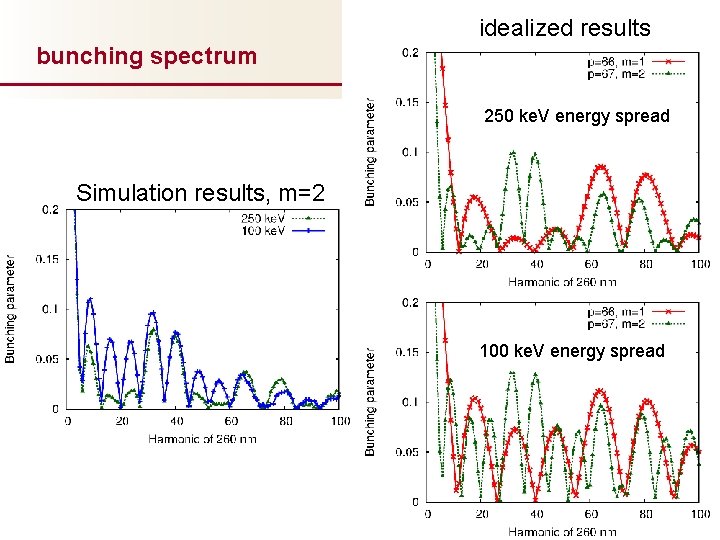
idealized results bunching spectrum 250 ke. V energy spread Simulation results, m=2 100 ke. V energy spread
Want energy spread < 1. 5 Me. V to get significant power A few options: 1) find a way to increase R 1 - first chicane and undulators too weak - kick the beam to generate dispersion? 2) use m=3 3) smaller beta=10 m (could go as low as 8 m? ) 4) higher peak current Try keeping R 1=1 mm, use m=3 (p=68) and beta=10 m modulate by 0. 9 Me. V and 1. 6 Me. V final energy spread ~ 1. 3 Me. V hope to get 4% bunching
First serious try at a seeding study m=3, final rms energy spread 1. 3 Me. V • only get 2% bunching • debunches immediately • get ~ 1. 5 MW same as when tried m=2 For EEHG, microbunching in phase space is highest at extremes of energy distribution • very little bunching at central energy • is it even worse for m>1? • rms energy spread is too optimistic a criterion To get gain, need to reduce modulation bigger R 56 or longer wavelength (or both) aim for only 500 ke. V energy spread?
- Slides: 21