
Seed Plants Gymnosperms Angiosperms copyright cmassengale 1 Evolution
- Slides: 76
Seed Plants Gymnosperms & Angiosperms copyright cmassengale 1
Evolution Of Land Plants REMEMBER: • Terrestrial plants evolved from a green algal ancestor • The earliest land plants were nonvascular, spore producers (bryophytes) • Ferns were the 1 st vascular, spore producing plants • Gymnosperms & angiosperms were the 1 st vascular, seed plants copyright cmassengale 2
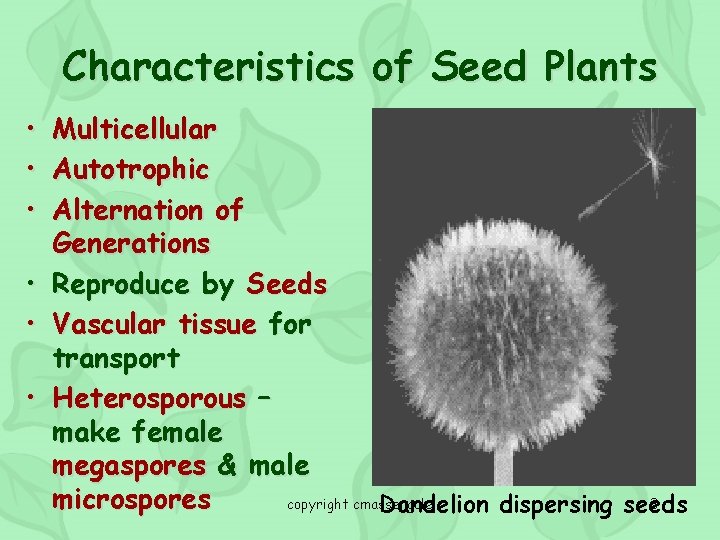
Characteristics of Seed Plants • • • Multicellular Autotrophic Alternation of Generations Reproduce by Seeds Vascular tissue for transport Heterosporous – make female megaspores & male microspores copyright cmassengale 3 Dandelion dispersing seeds
Reasons for Success on Land • Waxy cuticle • Stomata with guard cells to open & close • Gametes protected in tissue called Gametangia • Pollen tube to transfer sperm to the egg instead of water • Seeds protect developing embryo & contain food copyright cmassengale 4
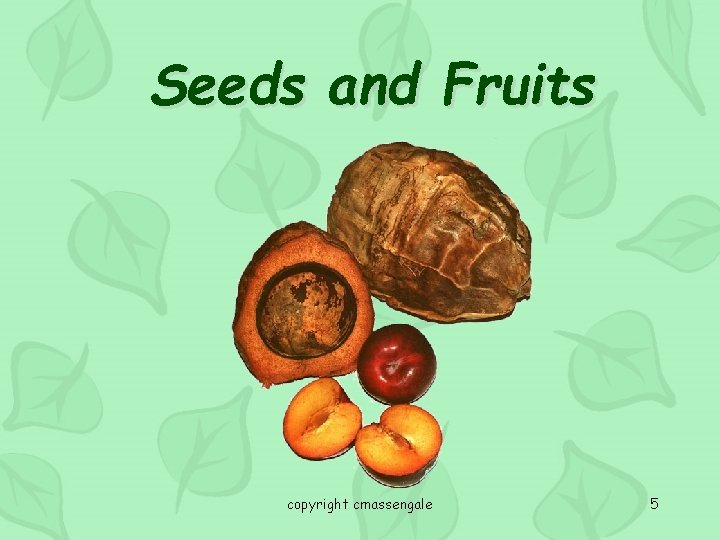
Seeds and Fruits copyright cmassengale 5
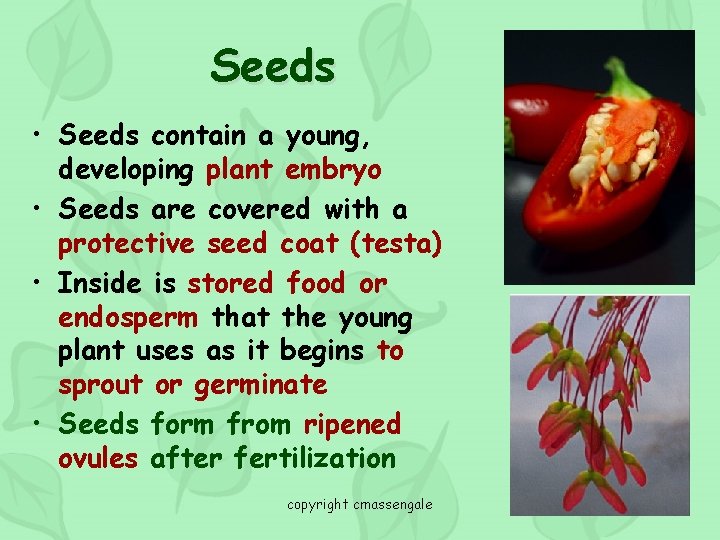
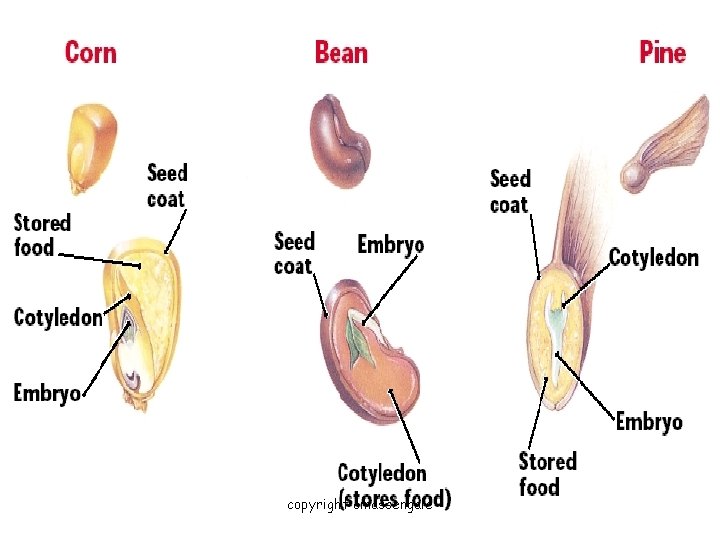
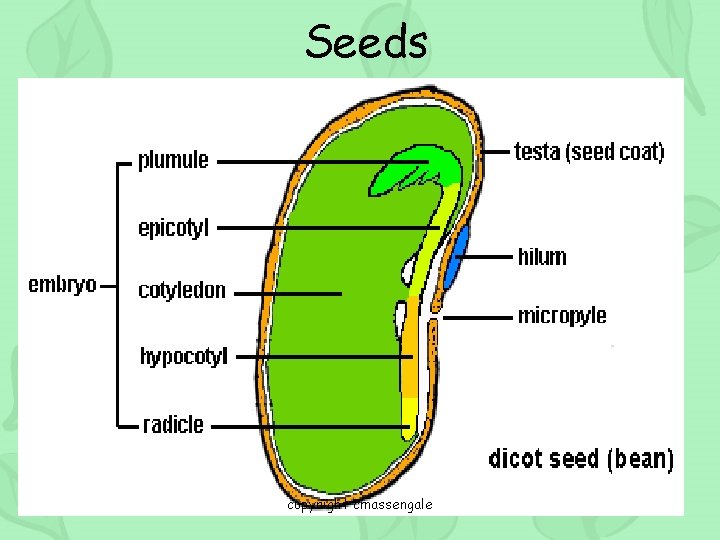
Seeds • Seeds contain a young, developing plant embryo • Seeds are covered with a protective seed coat (testa) • Inside is stored food or endosperm that the young plant uses as it begins to sprout or germinate • Seeds form from ripened ovules after fertilization copyright cmassengale 6
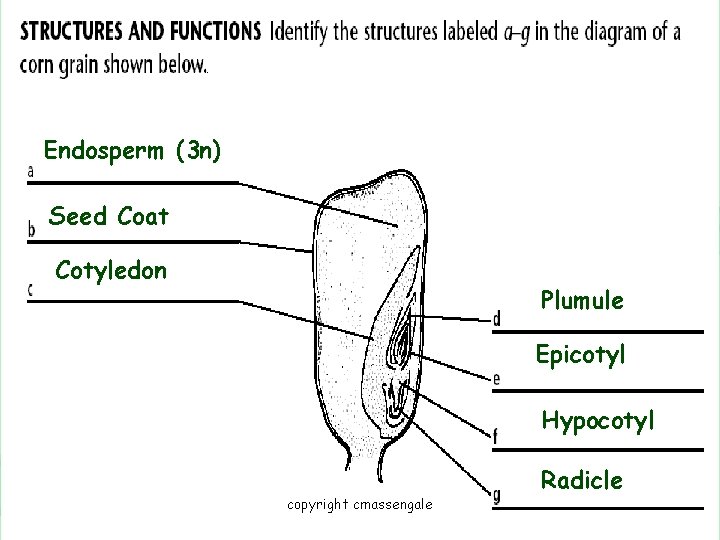
Parts of a Seed Embryo • Primary root or Radicle • One or two embryonic leaves called Cotyledons • Plumule becomes the shoot • Stem like portion below cotyledons called Hypocotyl • Stem like portion above cotyledons called Epicotyl copyright cmassengale 7
Endosperm (3 n) Seed Coat Cotyledon Plumule Epicotyl Hypocotyl copyright cmassengale Radicle 8
copyright cmassengale 9
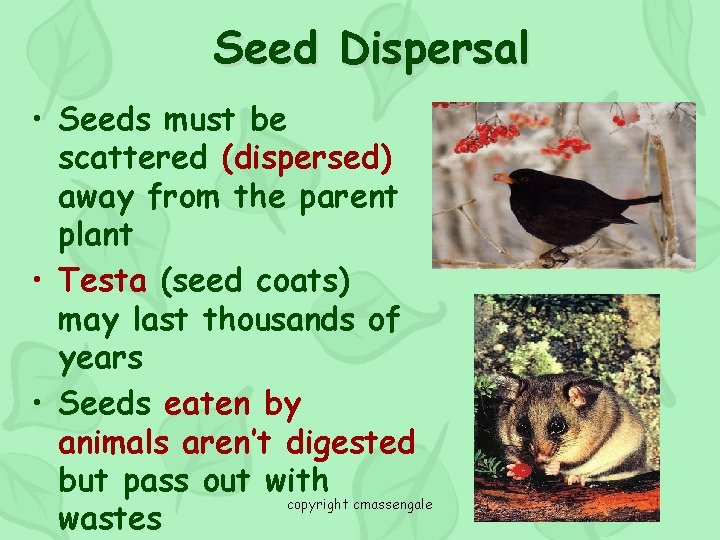
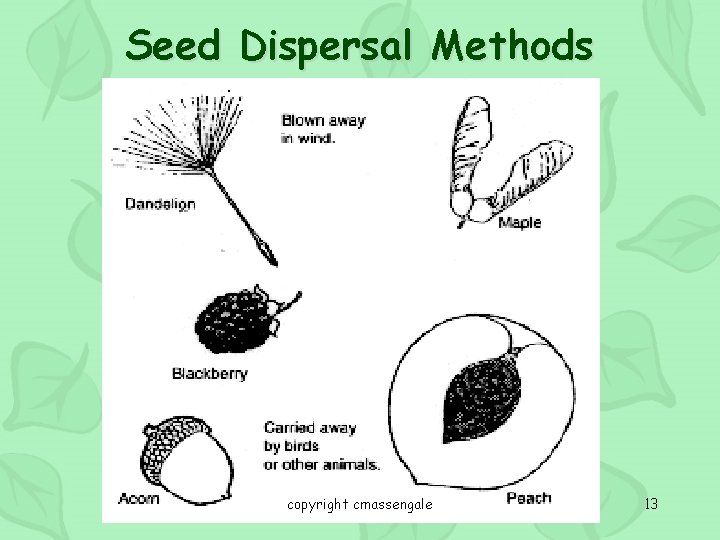
Seed Dispersal • Seeds must be scattered (dispersed) away from the parent plant • Testa (seed coats) may last thousands of years • Seeds eaten by animals aren’t digested but pass out with copyright cmassengale wastes 10
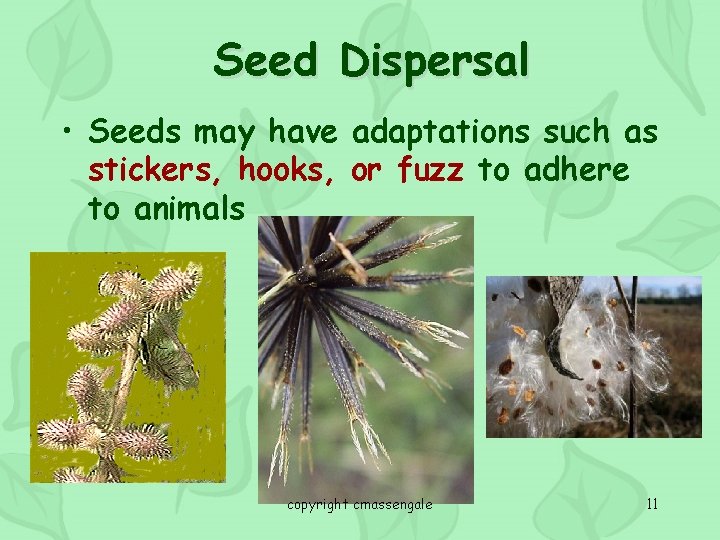
Seed Dispersal • Seeds may have adaptations such as stickers, hooks, or fuzz to adhere to animals copyright cmassengale 11
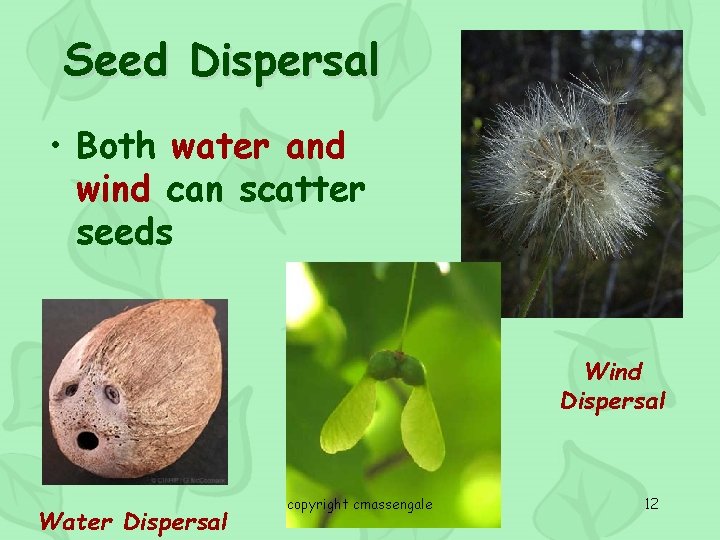
Seed Dispersal • Both water and wind can scatter seeds Wind Dispersal Water Dispersal copyright cmassengale 12
Seed Dispersal Methods copyright cmassengale 13
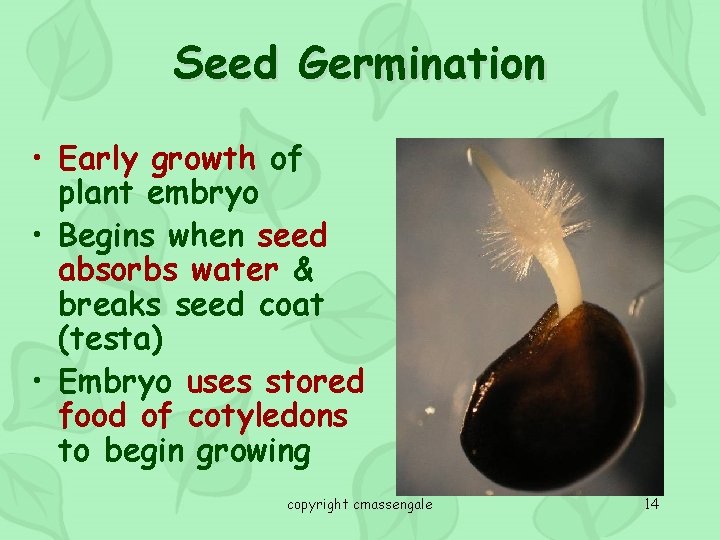
Seed Germination • Early growth of plant embryo • Begins when seed absorbs water & breaks seed coat (testa) • Embryo uses stored food of cotyledons to begin growing copyright cmassengale 14
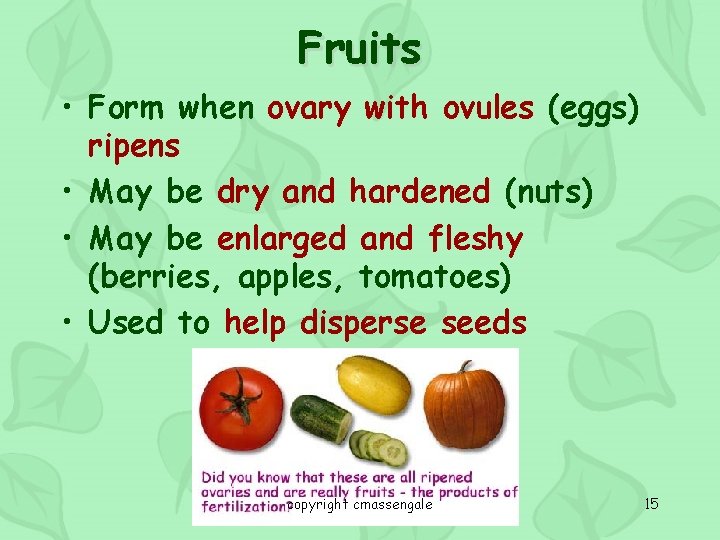
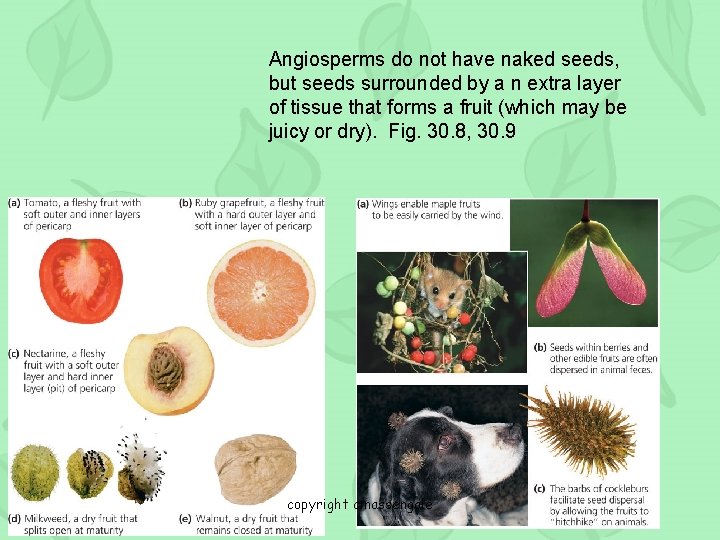
Fruits • Form when ovary with ovules (eggs) ripens • May be dry and hardened (nuts) • May be enlarged and fleshy (berries, apples, tomatoes) • Used to help disperse seeds copyright cmassengale 15
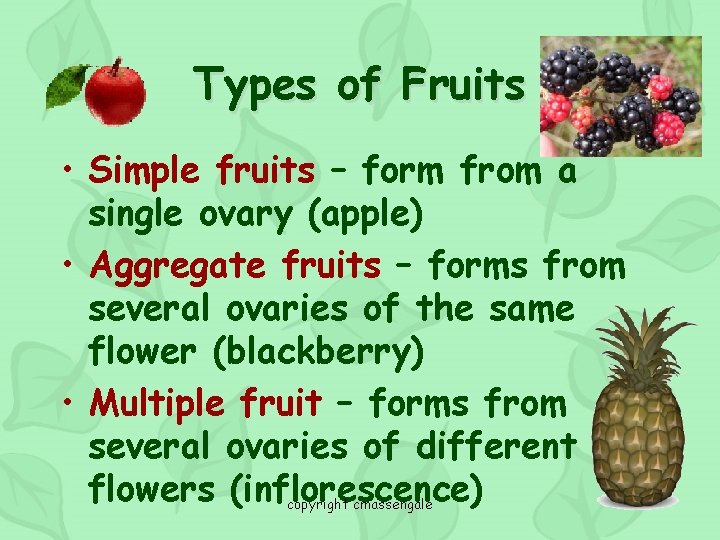
Types of Fruits • Simple fruits – form from a single ovary (apple) • Aggregate fruits – forms from several ovaries of the same flower (blackberry) • Multiple fruit – forms from several ovaries of different flowers (inflorescence) copyright cmassengale 16
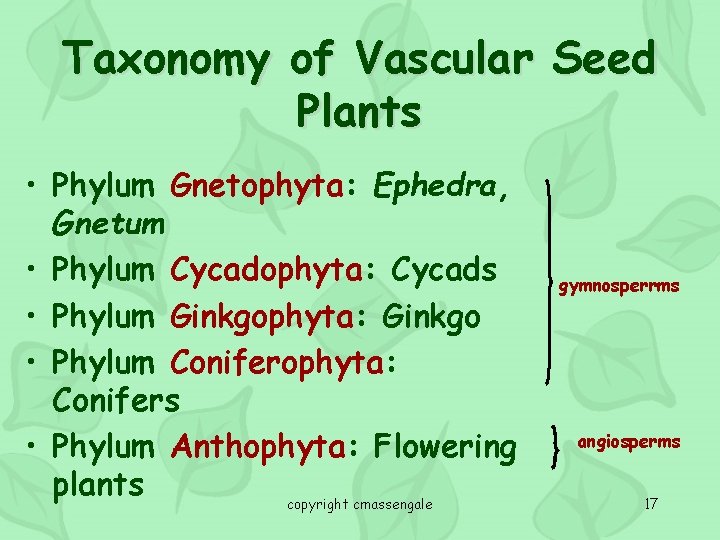
Taxonomy of Vascular Seed Plants • Phylum Gnetophyta: Ephedra, Gnetum • Phylum Cycadophyta: Cycads • Phylum Ginkgophyta: Ginkgo • Phylum Coniferophyta: Conifers • Phylum Anthophyta: Flowering plants copyright cmassengale gymnosperrms angiosperms 17
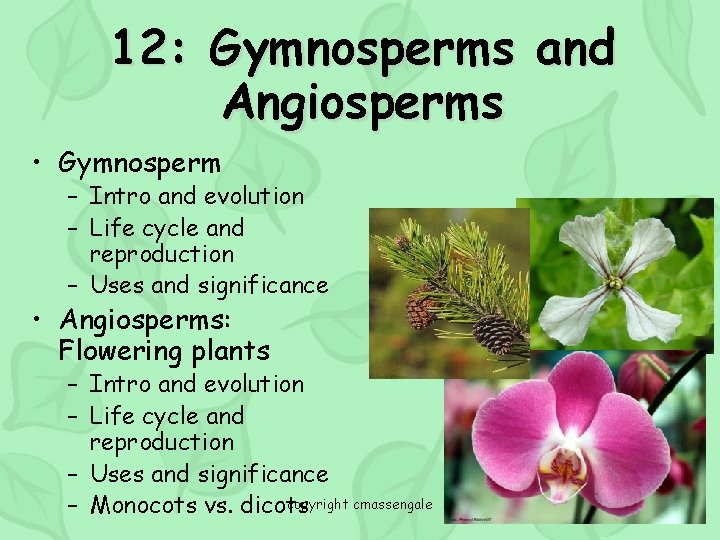
12: Gymnosperms and Angiosperms • Gymnosperm – Intro and evolution – Life cycle and reproduction – Uses and significance • Angiosperms: Flowering plants – Intro and evolution – Life cycle and reproduction – Uses and significance copyright cmassengale – Monocots vs. dicots 18
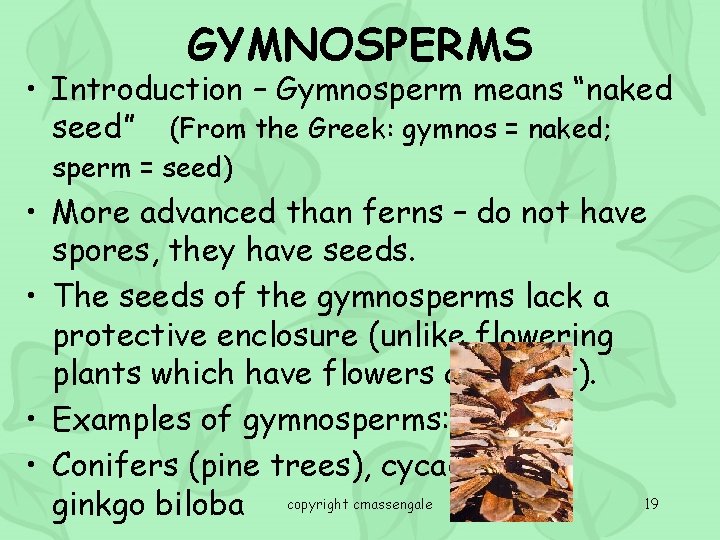
GYMNOSPERMS • Introduction – Gymnosperm means “naked seed” (From the Greek: gymnos = naked; sperm = seed) • More advanced than ferns – do not have spores, they have seeds. • The seeds of the gymnosperms lack a protective enclosure (unlike flowering plants which have flowers and fruit). • Examples of gymnosperms: • Conifers (pine trees), cycads, 19 ginkgo biloba copyright cmassengale
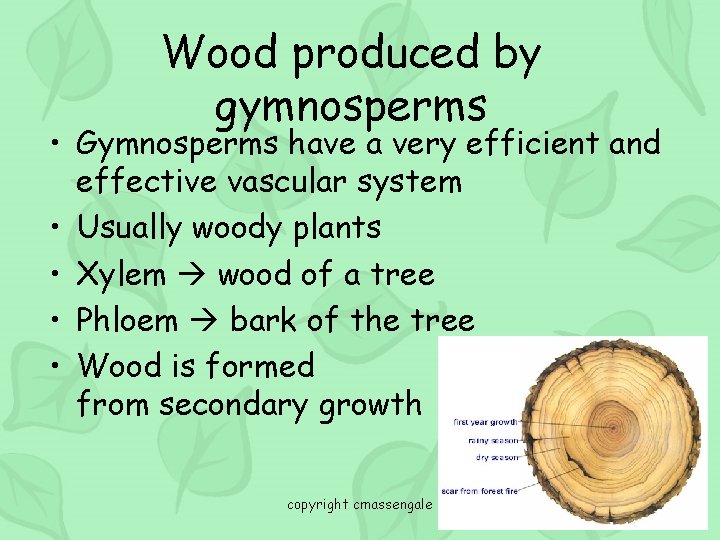
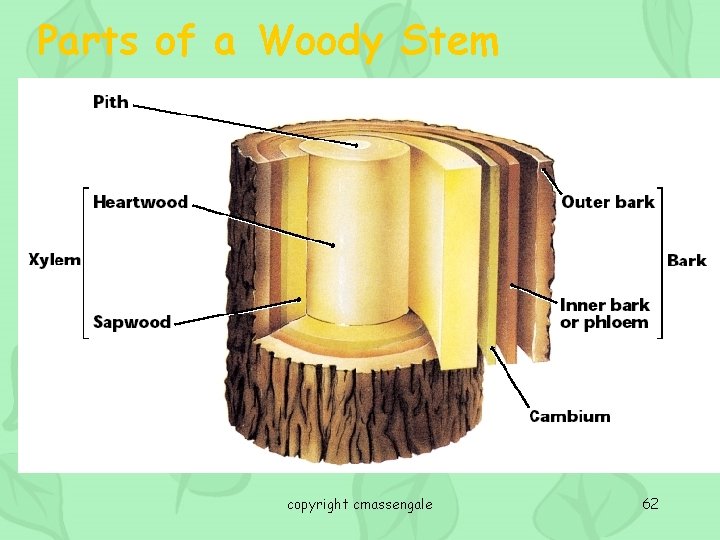
Wood produced by gymnosperms • Gymnosperms have a very efficient and effective vascular system • Usually woody plants • Xylem wood of a tree • Phloem bark of the tree • Wood is formed from secondary growth copyright cmassengale 20
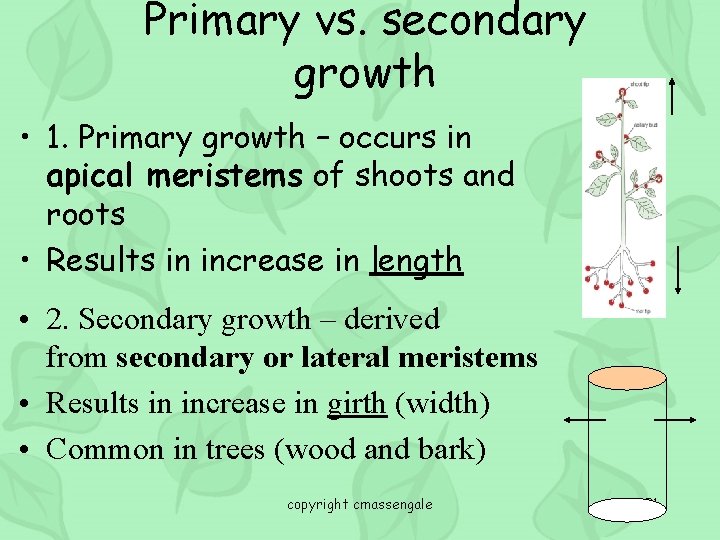
Primary vs. secondary growth • 1. Primary growth – occurs in apical meristems of shoots and roots • Results in increase in length • 2. Secondary growth – derived from secondary or lateral meristems • Results in increase in girth (width) • Common in trees (wood and bark) copyright cmassengale 21
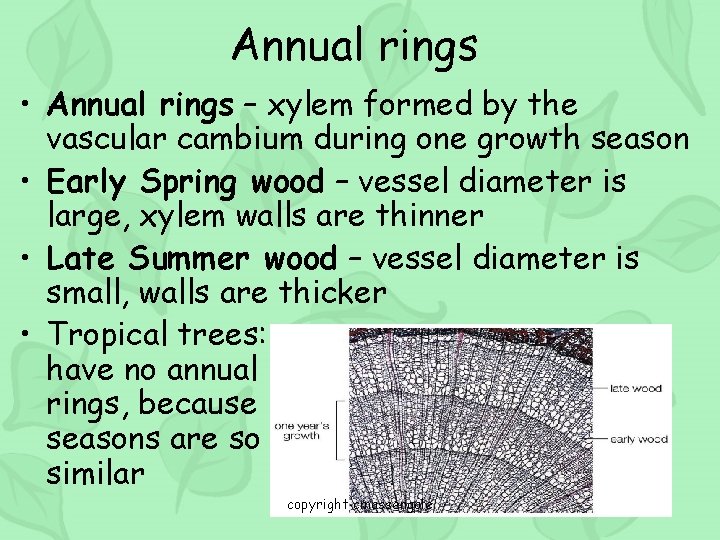
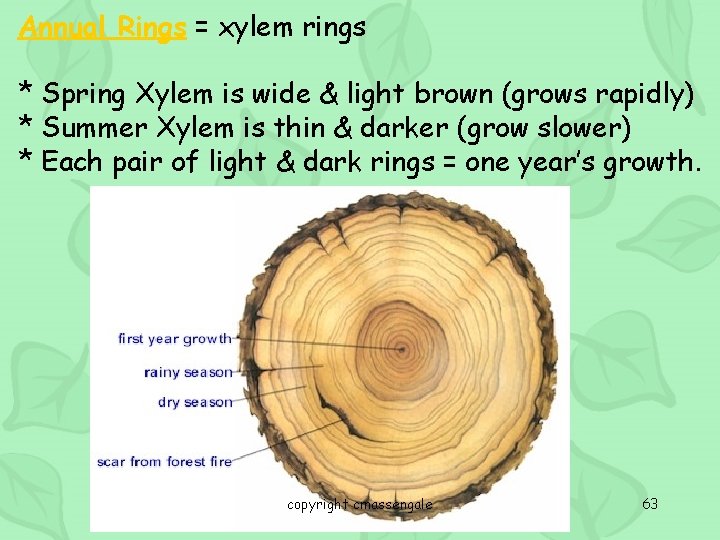
Annual rings • Annual rings – xylem formed by the vascular cambium during one growth season • Early Spring wood – vessel diameter is large, xylem walls are thinner • Late Summer wood – vessel diameter is small, walls are thicker • Tropical trees: have no annual rings, because seasons are so similar copyright cmassengale 22
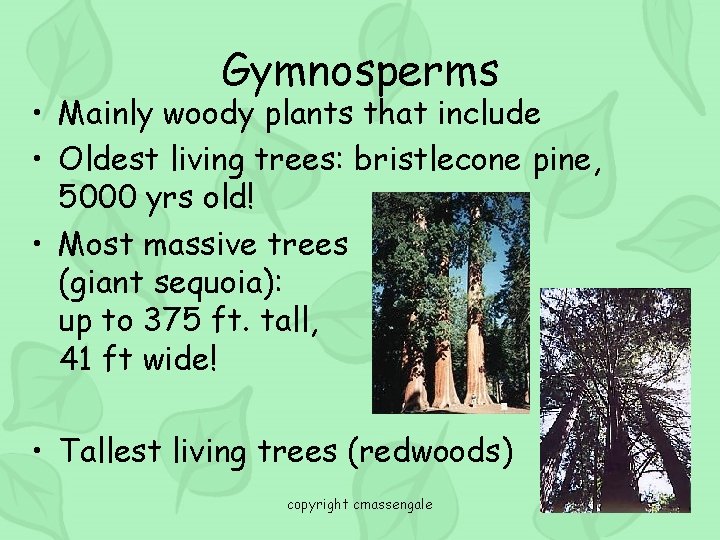
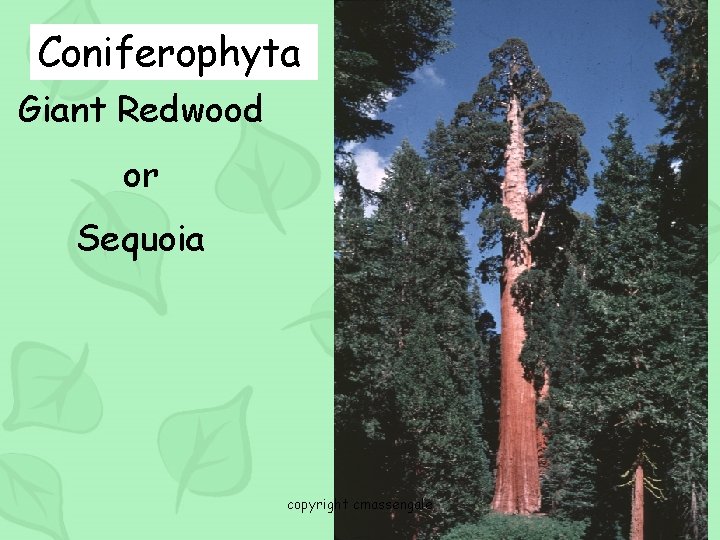
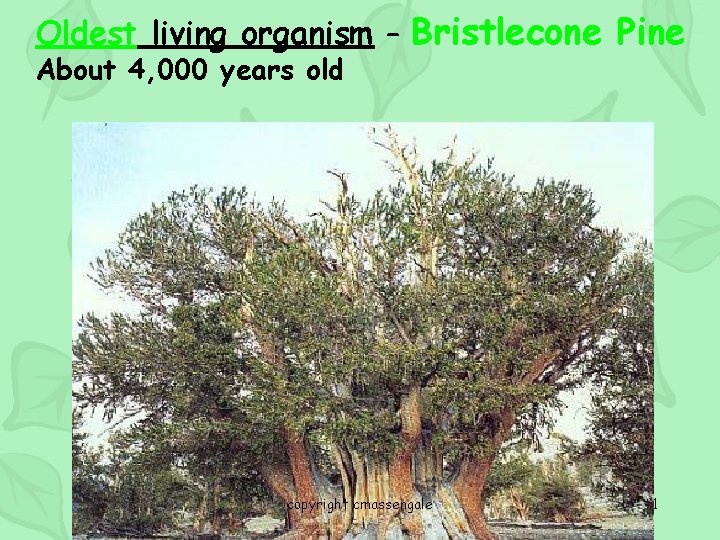
Gymnosperms • Mainly woody plants that include • Oldest living trees: bristlecone pine, 5000 yrs old! • Most massive trees (giant sequoia): up to 375 ft. tall, 41 ft wide! • Tallest living trees (redwoods) copyright cmassengale 23
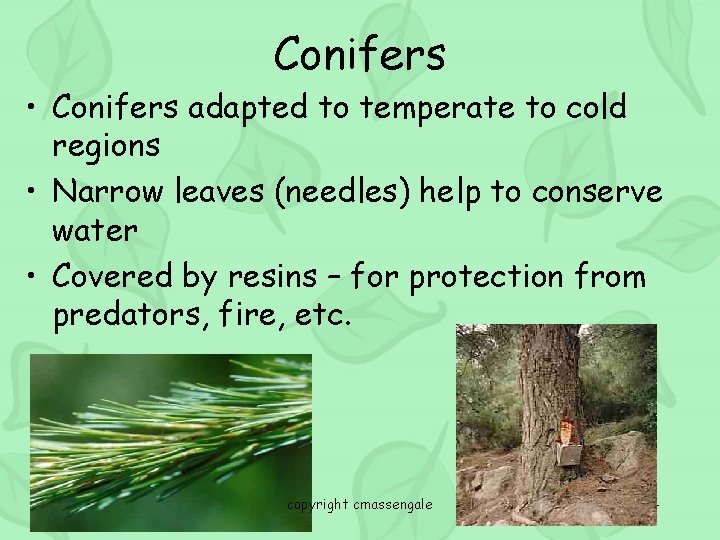
Conifers • Conifers adapted to temperate to cold regions • Narrow leaves (needles) help to conserve water • Covered by resins – for protection from predators, fire, etc. copyright cmassengale 24
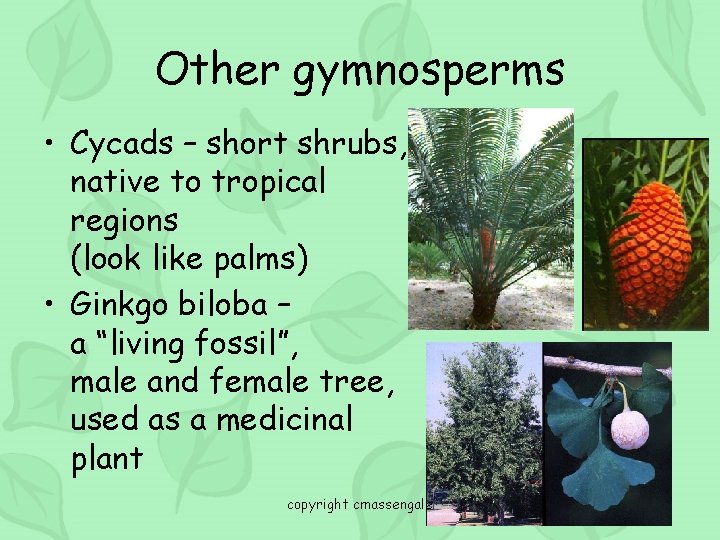
Other gymnosperms • Cycads – short shrubs, native to tropical regions (look like palms) • Ginkgo biloba – a “living fossil”, male and female tree, used as a medicinal plant copyright cmassengale 25
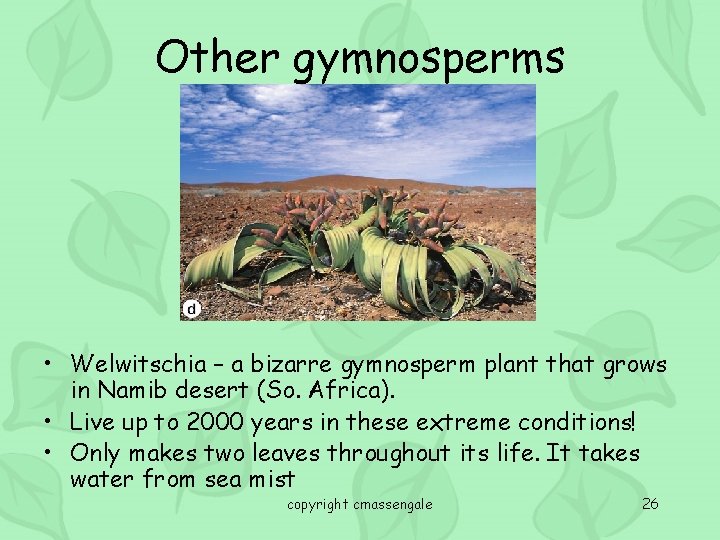
Other gymnosperms • Welwitschia – a bizarre gymnosperm plant that grows in Namib desert (So. Africa). • Live up to 2000 years in these extreme conditions! • Only makes two leaves throughout its life. It takes water from sea mist copyright cmassengale 26
Significance of gymnosperms • • • Ecological importance: Provide food and habitat for wildlife Forests prevent soil erosion Reduce greenhouse-effect gasses Economic and commercial importance: Lumber for wood, paper, etc. Resins – wood, furniture, etc. Ornamental plants (trees, landscaping) Food – pine nuts (pesto, etc. ) copyright cmassengale 27
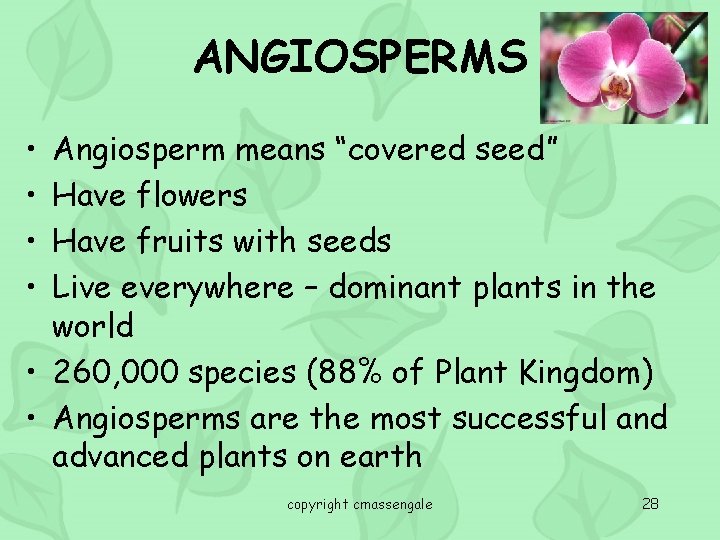
ANGIOSPERMS • • Angiosperm means “covered seed” Have flowers Have fruits with seeds Live everywhere – dominant plants in the world • 260, 000 species (88% of Plant Kingdom) • Angiosperms are the most successful and advanced plants on earth copyright cmassengale 28
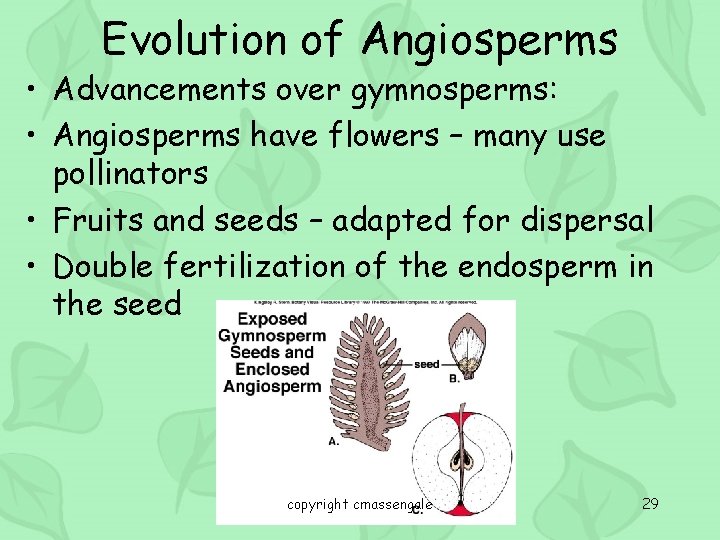
Evolution of Angiosperms • Advancements over gymnosperms: • Angiosperms have flowers – many use pollinators • Fruits and seeds – adapted for dispersal • Double fertilization of the endosperm in the seed copyright cmassengale 29
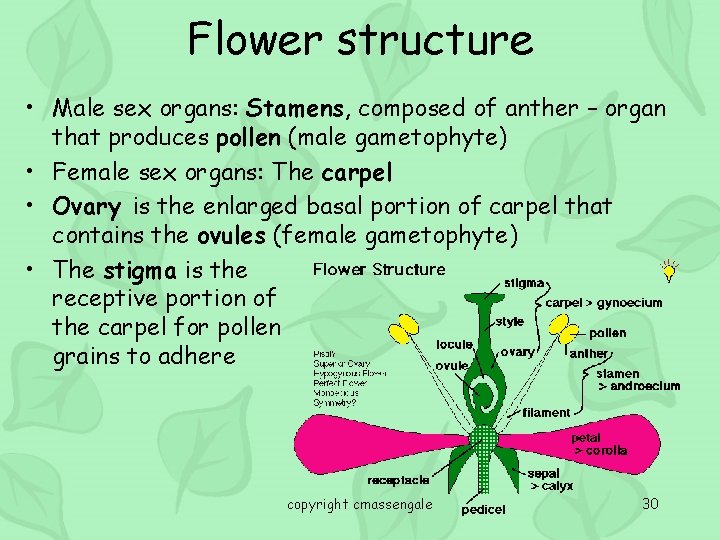
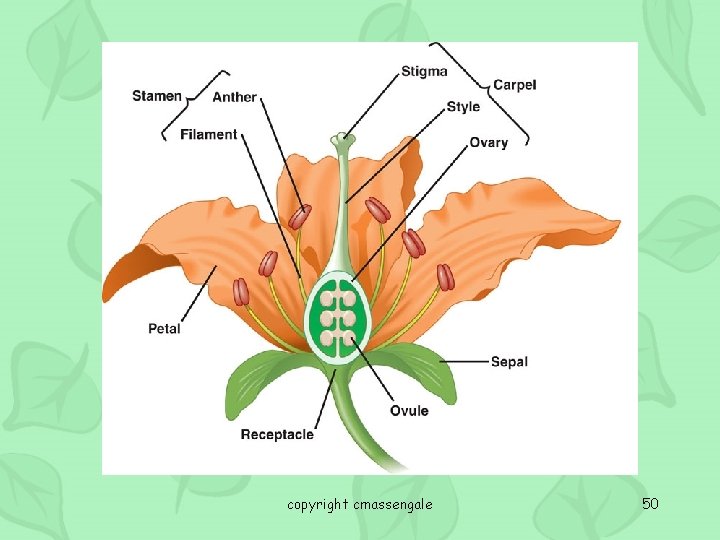
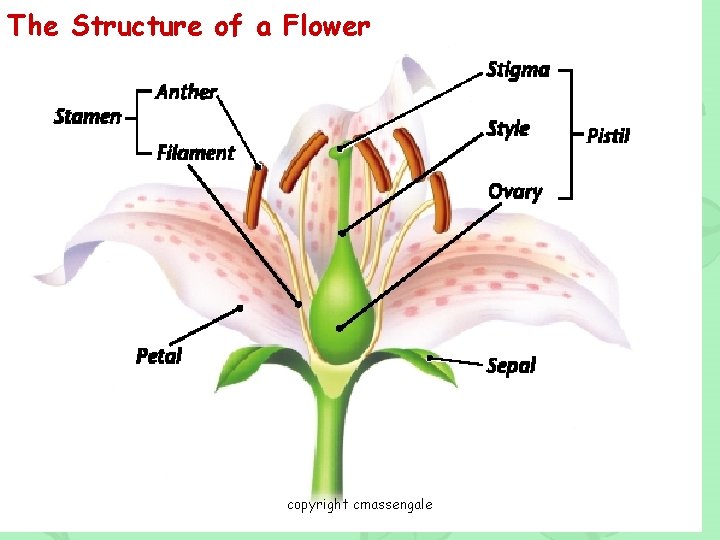
Flower structure • Male sex organs: Stamens, composed of anther – organ that produces pollen (male gametophyte) • Female sex organs: The carpel • Ovary is the enlarged basal portion of carpel that contains the ovules (female gametophyte) • The stigma is the receptive portion of the carpel for pollen grains to adhere copyright cmassengale 30
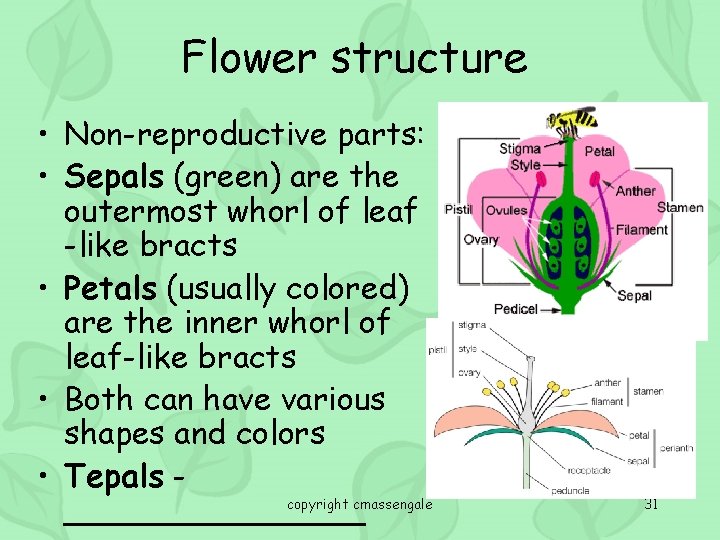
Flower structure • Non-reproductive parts: • Sepals (green) are the outermost whorl of leaf -like bracts • Petals (usually colored) are the inner whorl of leaf-like bracts • Both can have various shapes and colors • Tepals copyright cmassengale ________ 31
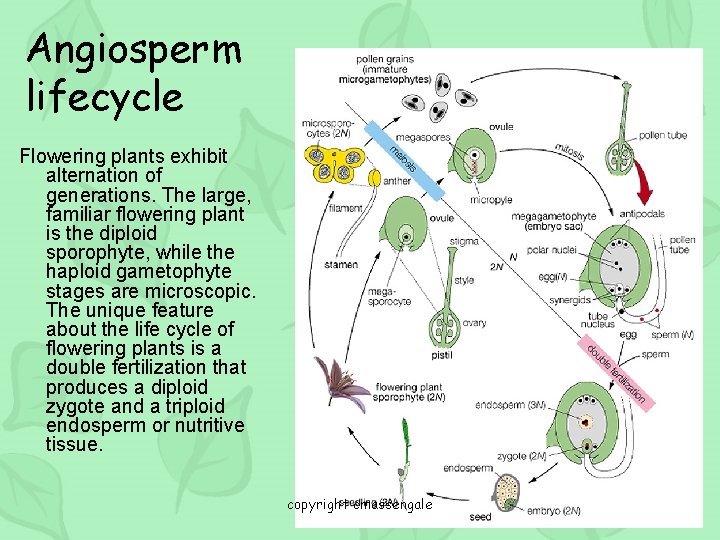
Angiosperm lifecycle Flowering plants exhibit alternation of generations. The large, familiar flowering plant is the diploid sporophyte, while the haploid gametophyte stages are microscopic. The unique feature about the life cycle of flowering plants is a double fertilization that produces a diploid zygote and a triploid endosperm or nutritive tissue. copyright cmassengale 32
Double fertilization • Pollen grain germinates on stigma forming a pollen tube, which grows down style to the ovary • Pollen has 2 haploid sperm nuclei, which travel to the ovary • One sperm nucleus fertilizes the haploid egg forming the 2 n zygote • Another sperm nucleus unites with the 2 polar nuclei, forming the triploid (3 n) endosperm copyright cmassengale 33
Seeds copyright cmassengale 34
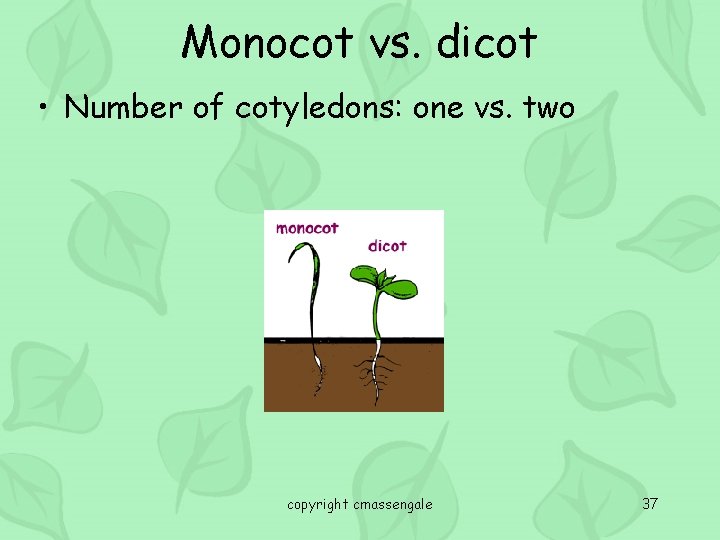
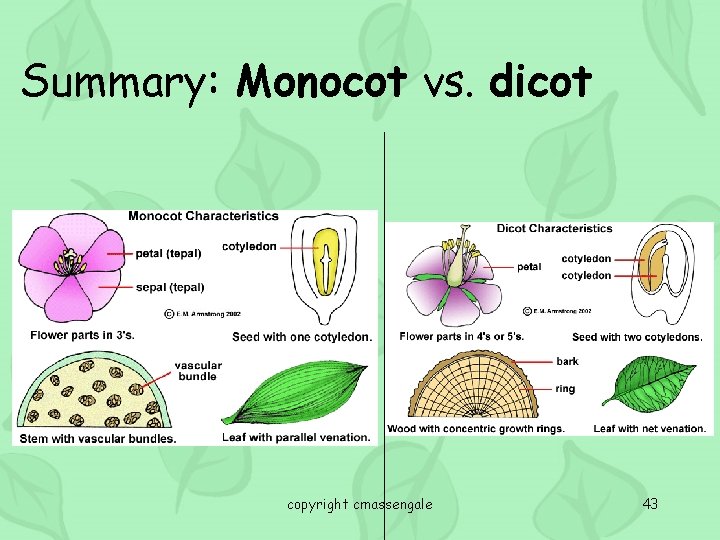
Monocot vs. dicot • Angiosperms are divided into monocots and dicots • As the zygote grows into the embryo, the first leaves of the young sporophyte develop and are called as cotyledons (seed leaves) • Monocots have one cotyledon (corn, lily, etc). • Dicots have two cotyledons (bean, oak, copyright cmassengale 35 etc).
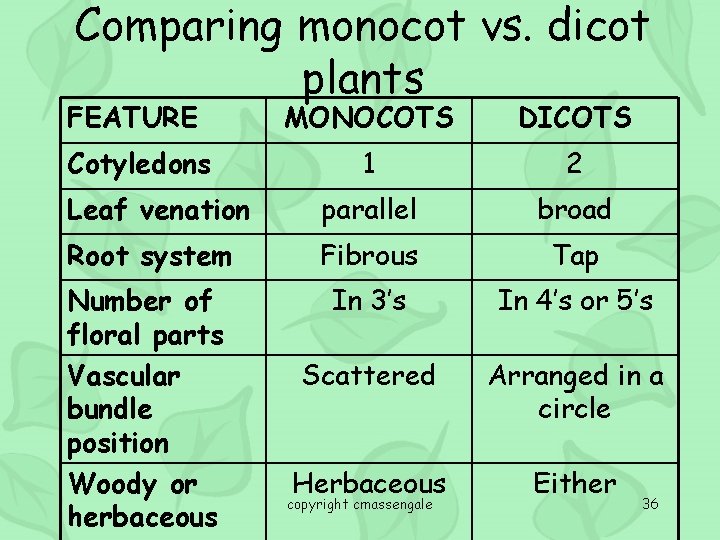
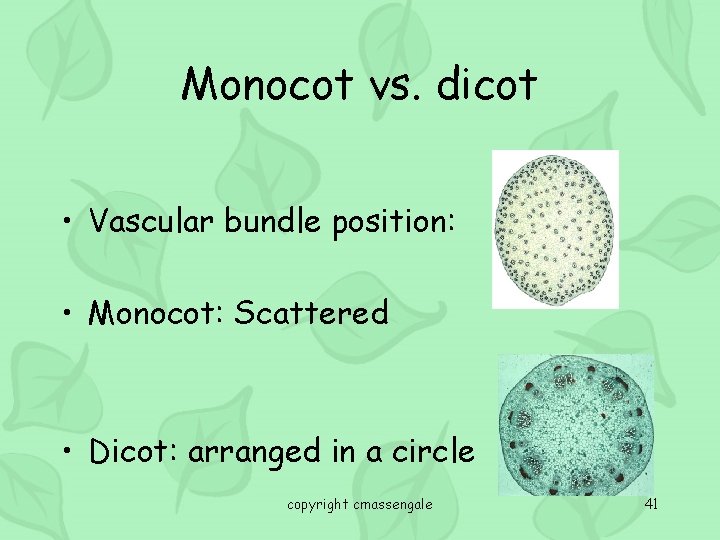
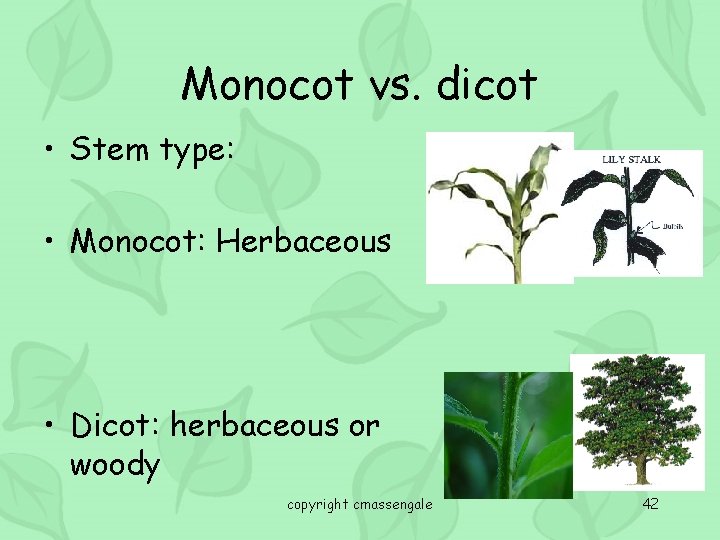
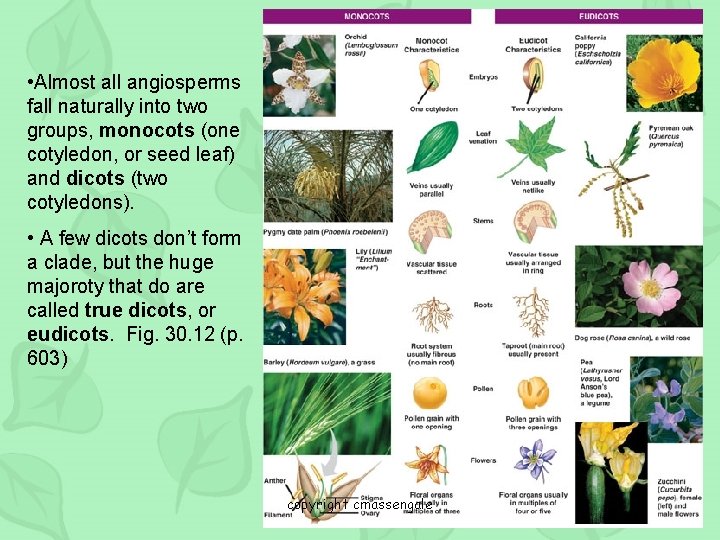
Comparing monocot vs. dicot plants FEATURE MONOCOTS DICOTS Cotyledons 1 2 Leaf venation parallel broad Root system Fibrous Tap Number of floral parts Vascular bundle position Woody or herbaceous In 3’s In 4’s or 5’s Scattered Arranged in a circle Herbaceous Either copyright cmassengale 36
Monocot vs. dicot • Number of cotyledons: one vs. two copyright cmassengale 37
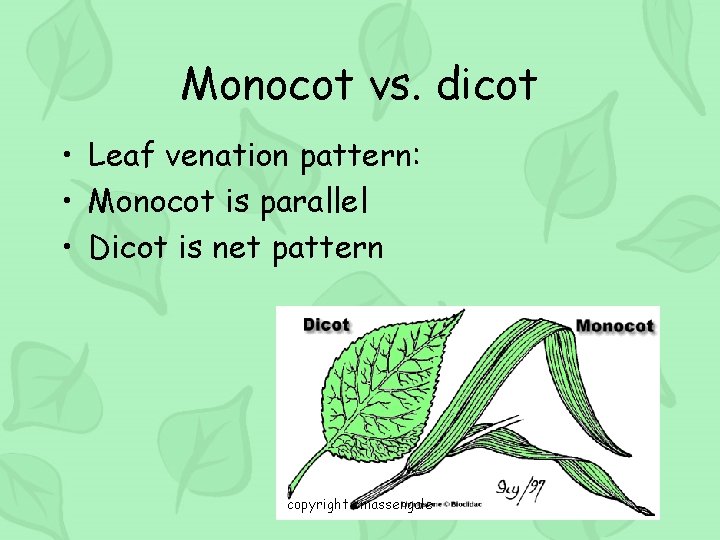
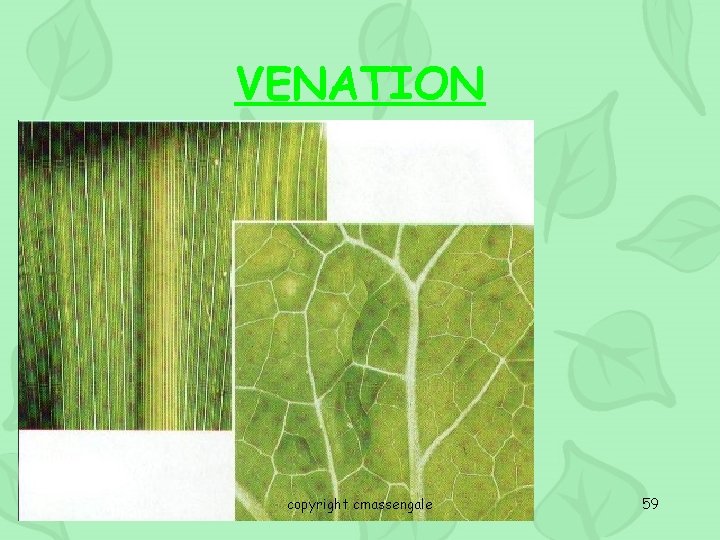
Monocot vs. dicot • Leaf venation pattern: • Monocot is parallel • Dicot is net pattern copyright cmassengale 38
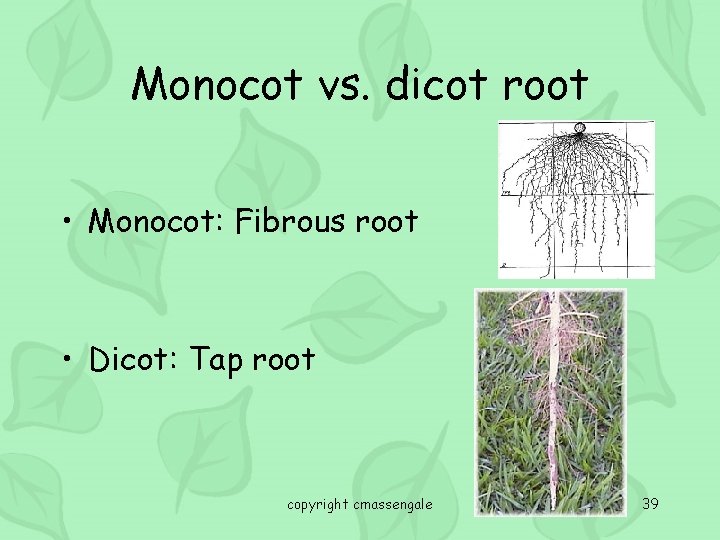
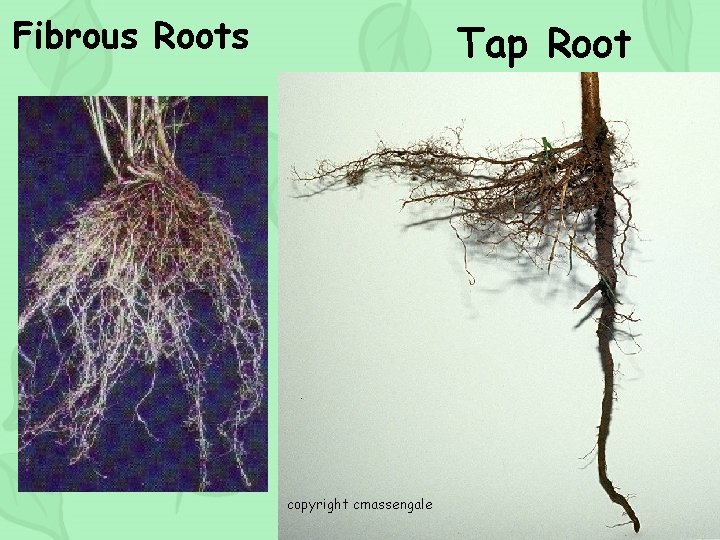
Monocot vs. dicot root • Monocot: Fibrous root • Dicot: Tap root copyright cmassengale 39
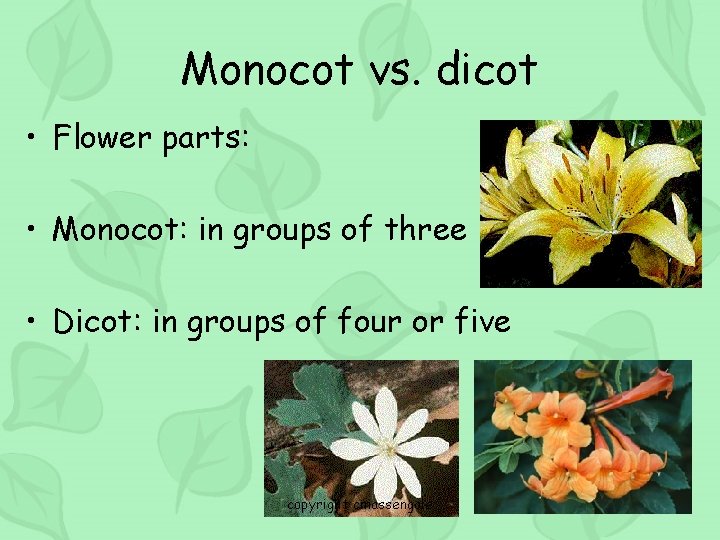
Monocot vs. dicot • Flower parts: • Monocot: in groups of three • Dicot: in groups of four or five copyright cmassengale 40
Monocot vs. dicot • Vascular bundle position: • Monocot: Scattered • Dicot: arranged in a circle copyright cmassengale 41
Monocot vs. dicot • Stem type: • Monocot: Herbaceous • Dicot: herbaceous or woody copyright cmassengale 42
Summary: Monocot vs. dicot copyright cmassengale 43
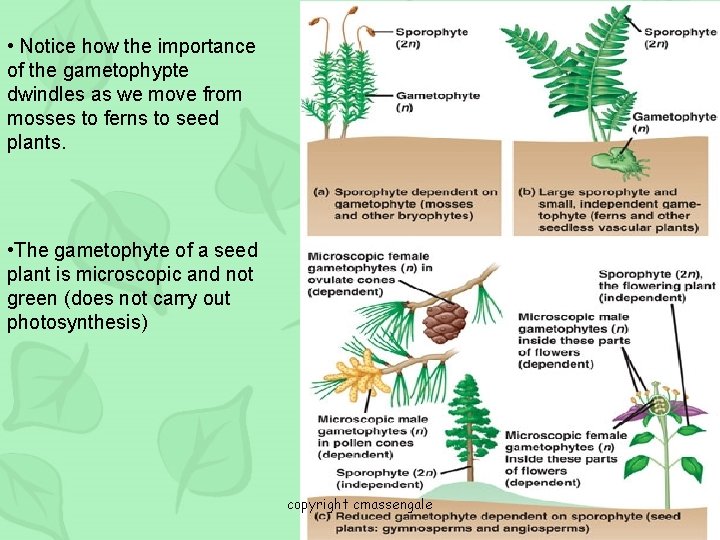
• Notice how the importance of the gametophypte dwindles as we move from mosses to ferns to seed plants. • The gametophyte of a seed plant is microscopic and not green (does not carry out photosynthesis) copyright cmassengale 44
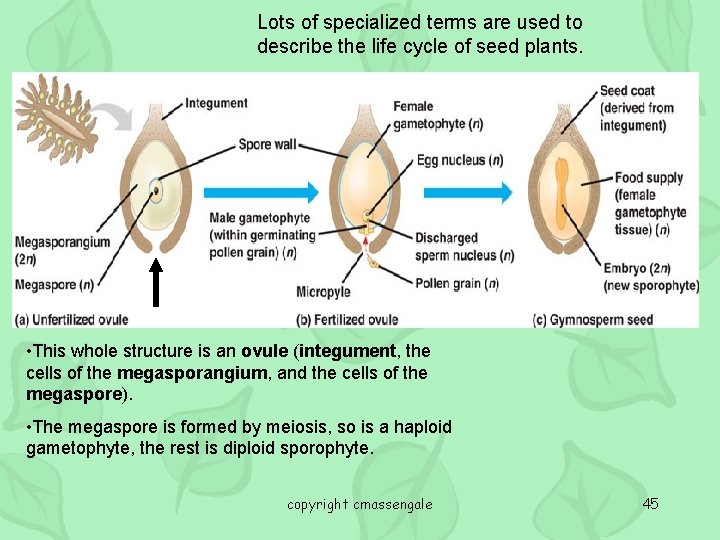
Lots of specialized terms are used to describe the life cycle of seed plants. • This whole structure is an ovule (integument, the cells of the megasporangium, and the cells of the megaspore). • The megaspore is formed by meiosis, so is a haploid gametophyte, the rest is diploid sporophyte. copyright cmassengale 45
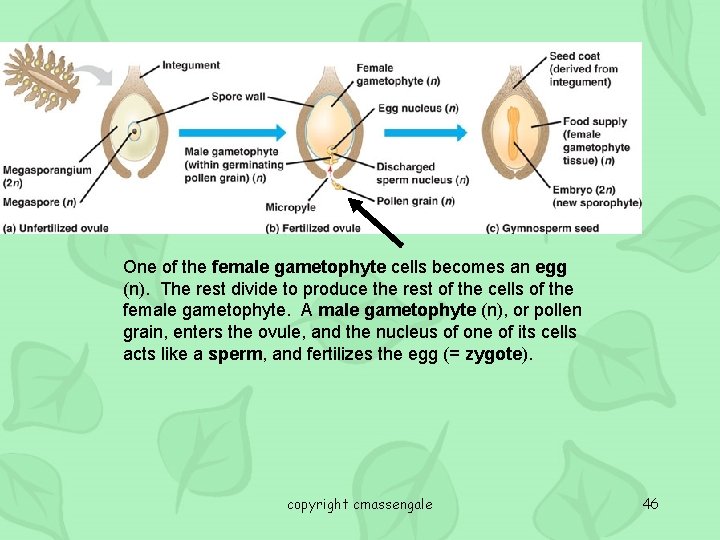
One of the female gametophyte cells becomes an egg (n). The rest divide to produce the rest of the cells of the female gametophyte. A male gametophyte (n), or pollen grain, enters the ovule, and the nucleus of one of its cells acts like a sperm, and fertilizes the egg (= zygote). copyright cmassengale 46
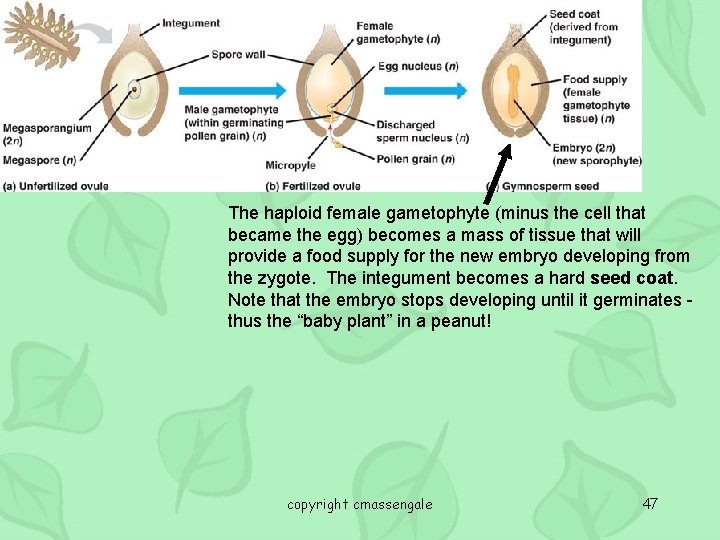
The haploid female gametophyte (minus the cell that became the egg) becomes a mass of tissue that will provide a food supply for the new embryo developing from the zygote. The integument becomes a hard seed coat. Note that the embryo stops developing until it germinates thus the “baby plant” in a peanut! copyright cmassengale 47
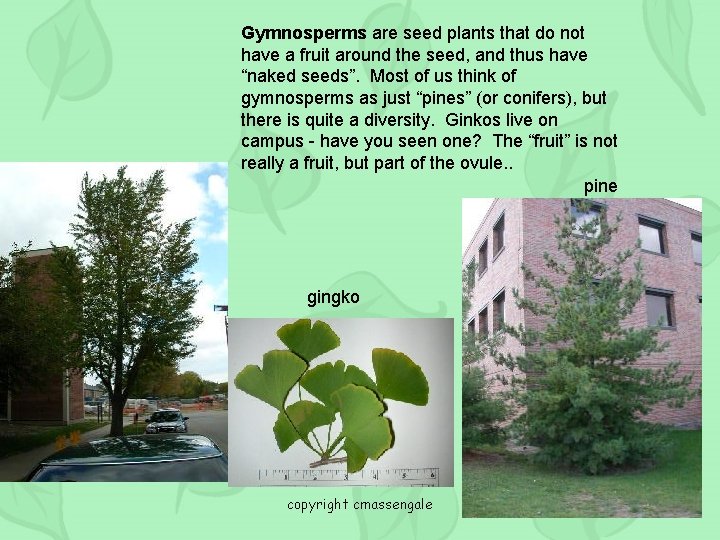
Gymnosperms are seed plants that do not have a fruit around the seed, and thus have “naked seeds”. Most of us think of gymnosperms as just “pines” (or conifers), but there is quite a diversity. Ginkos live on campus - have you seen one? The “fruit” is not really a fruit, but part of the ovule. . pine gingko copyright cmassengale 48
Angiosperms do not have naked seeds, but seeds surrounded by a n extra layer of tissue that forms a fruit (which may be juicy or dry). Fig. 30. 8, 30. 9 copyright cmassengale 49
copyright cmassengale 50
• Almost all angiosperms fall naturally into two groups, monocots (one cotyledon, or seed leaf) and dicots (two cotyledons). • A few dicots don’t form a clade, but the huge majoroty that do are called true dicots, or eudicots. Fig. 30. 12 (p. 603) copyright cmassengale 51
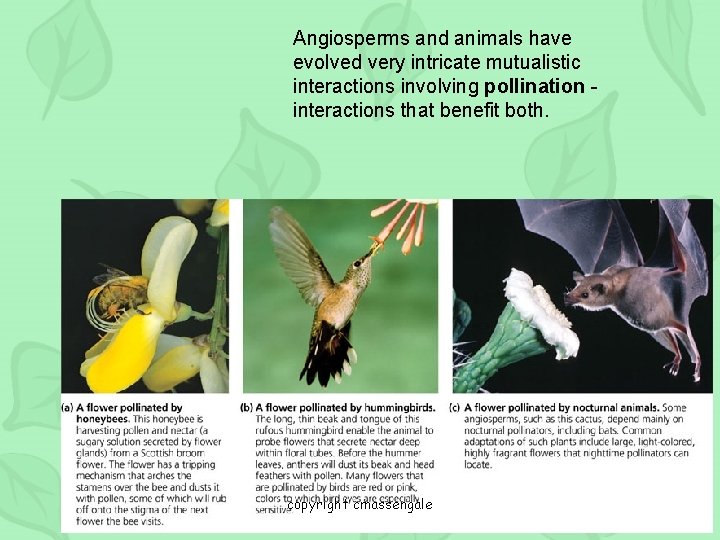
Angiosperms and animals have evolved very intricate mutualistic interactions involving pollination interactions that benefit both. copyright cmassengale 52
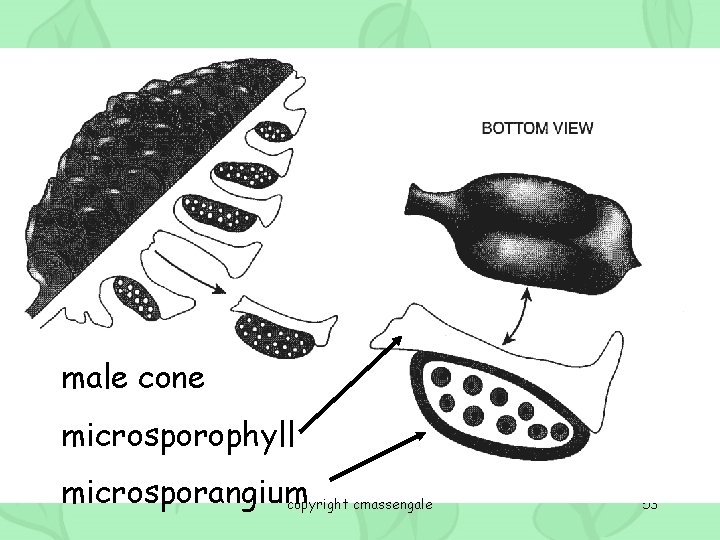
male cone microsporophyll microsporangium copyright cmassengale 53
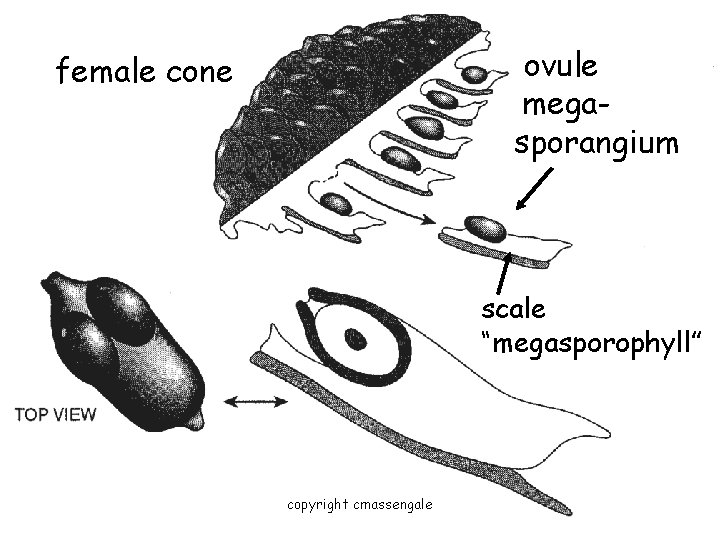
ovule. megasporangium female cone scale “megasporophyll” copyright cmassengale 54
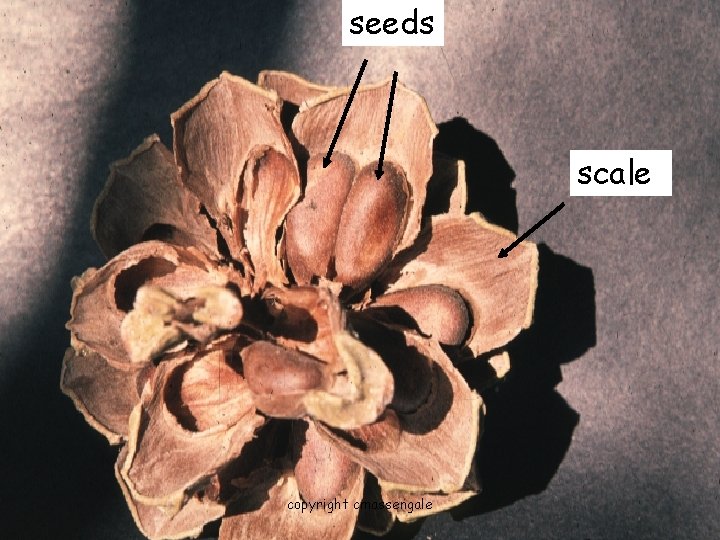
seeds scale copyright cmassengale 55
Coniferophyta Giant Redwood or Sequoia copyright cmassengale 56
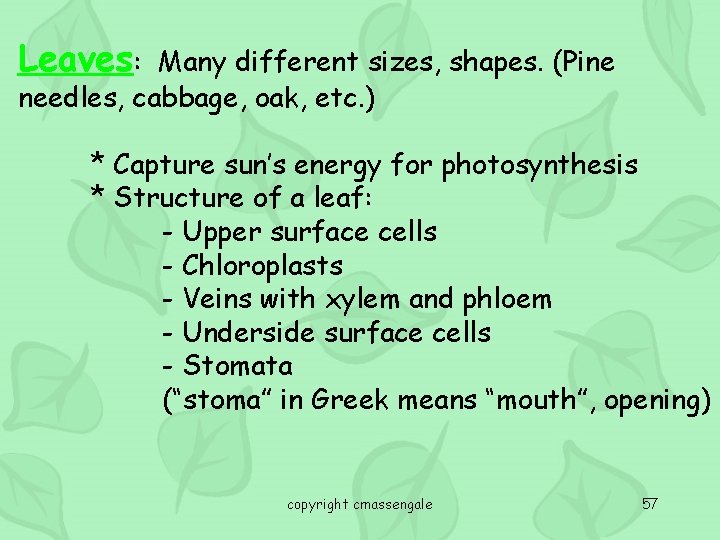
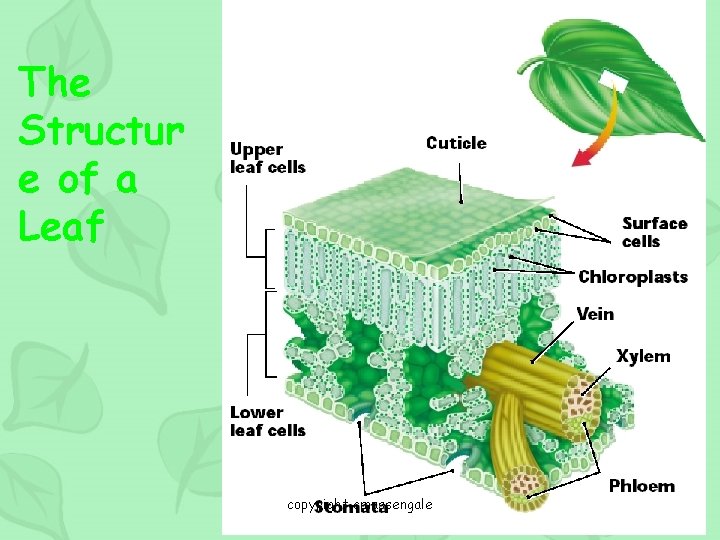
Leaves: Many different sizes, shapes. (Pine needles, cabbage, oak, etc. ) * Capture sun’s energy for photosynthesis * Structure of a leaf: - Upper surface cells - Chloroplasts - Veins with xylem and phloem - Underside surface cells - Stomata (“stoma” in Greek means “mouth”, opening) copyright cmassengale 57
The Structur e of a Leaf copyright cmassengale 58
VENATION copyright cmassengale 59
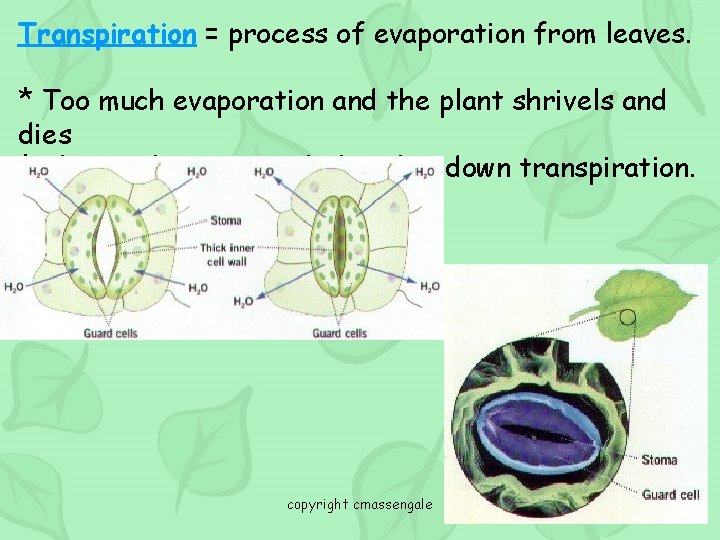
Transpiration = process of evaporation from leaves. * Too much evaporation and the plant shrivels and dies * Closing the stomata helps slow down transpiration. copyright cmassengale 60
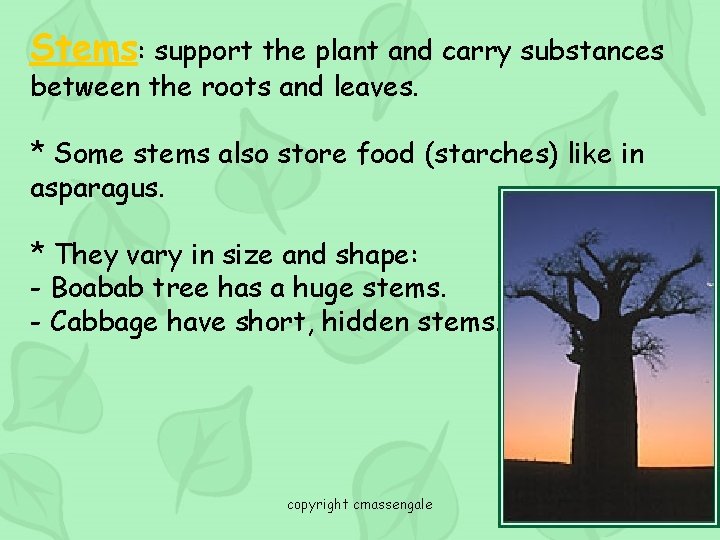
Stems: support the plant and carry substances between the roots and leaves. * Some stems also store food (starches) like in asparagus. * They vary in size and shape: - Boabab tree has a huge stems. - Cabbage have short, hidden stems. copyright cmassengale 61
Parts of a Woody Stem copyright cmassengale 62
Annual Rings = xylem rings * Spring Xylem is wide & light brown (grows rapidly) * Summer Xylem is thin & darker (grow slower) * Each pair of light & dark rings = one year’s growth. copyright cmassengale 63
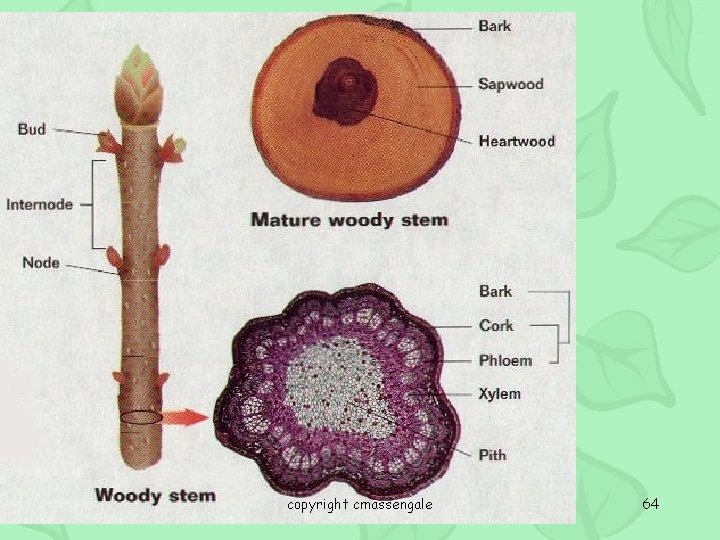
copyright cmassengale 64
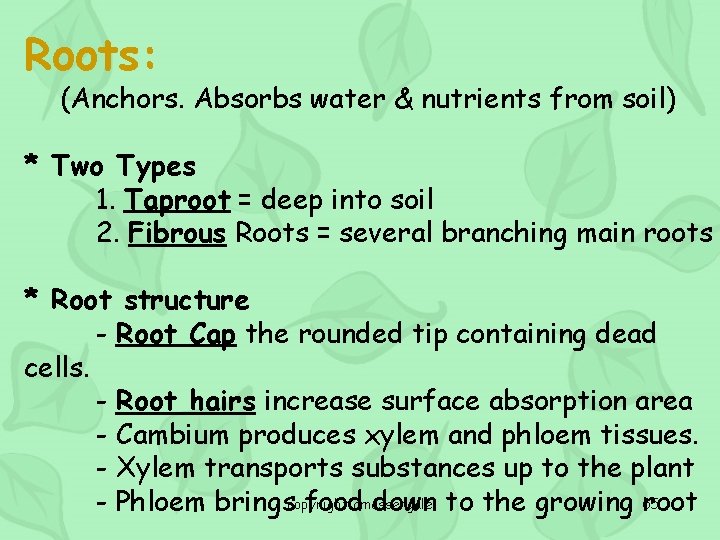
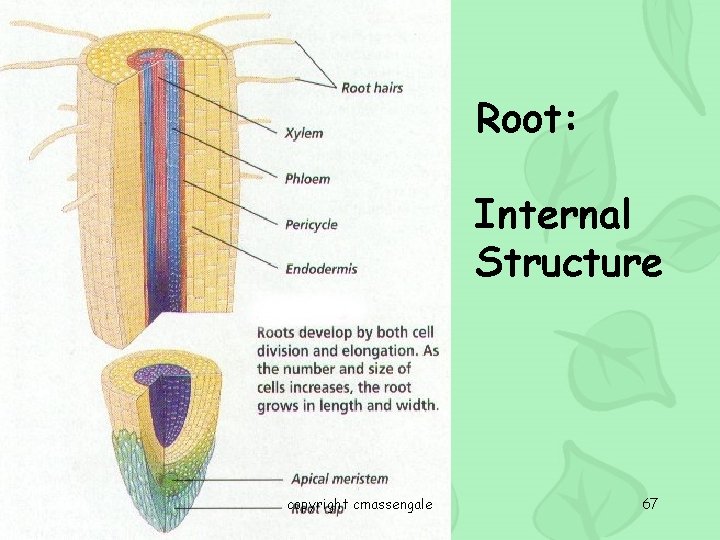
Roots: (Anchors. Absorbs water & nutrients from soil) * Two Types 1. Taproot = deep into soil 2. Fibrous Roots = several branching main roots * Root structure - Root Cap the rounded tip containing dead cells. - Root hairs increase surface absorption area - Cambium produces xylem and phloem tissues. - Xylem transports substances up to the plant - Phloem bringscopyright foodcmassengale down to the growing 65 root
Fibrous Roots Tap Root copyright cmassengale 66
Root: Internal Structure copyright cmassengale 67
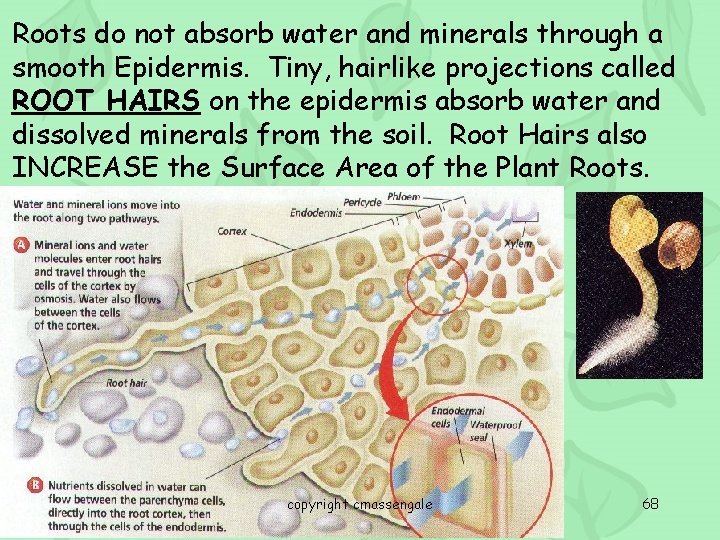
Roots do not absorb water and minerals through a smooth Epidermis. Tiny, hairlike projections called ROOT HAIRS on the epidermis absorb water and dissolved minerals from the soil. Root Hairs also INCREASE the Surface Area of the Plant Roots. copyright cmassengale 68
Gymnosperms Gymnosperm = seed plant that produces naked seeds. * Many have needlelike or scalelike leaves and deep root systems. * Note the book says fossils indicate there were many more gymnosperms in the past than today. This is because the global flood 4, 000 years ago wiped out many plants. (The dates given by many books of millions of years are false guesses. See the booklet by Dr. copyright cmassengale 69 Humphreys. )
Types of Gymnosperms: - Cycads (look like palm trees with large cones) - Ginkgo (only the Ginkgo biloba survives today) - Gnetophytes (found only in deserts - Conifers (largest & most common, pines, cedars, etc. ) [Conifers are evergreens: keep needles all year] copyright cmassengale 70
Oldest living organism – Bristlecone Pine About 4, 000 years old copyright cmassengale 71
Reproduction of Gymnosperms: * Cones – covered in scales, both male and female cones are produced. - Pollen is produced by male cones, and pollen are tiny cells that later become sperm cells. - Ovule is a structure containing an egg cell. Pollination = transfer of pollen from male structure to female part. (Pollen falls from a male cone to a female cone and fertilizes an ovule, which develops into a seed, with the zygote as the embryo part of the seed. It can take two years for seeds to mature, then the cones open & wind copyright cmassengale 72 carries the seeds off. )
Angiosperms – Two characteristics: 1. flowers 2. fruit (To remember, think: “Angie” likes flowers, but “Gym” does not. ) * They produce seeds inside a fruit. * Flower = angiosperm reproductive structure * Fruit starts copyright as ancmassengale Ovary = where the seeds develop 73
Flower Structure: Not all flowers have same parts. Some have only male parts. * Sepals = leaf-like structures covering a bud. * Petals = colorful structures of an open flower. * Stamens = male parts (stalks topped by knobs) * Pistils = the female parts in the center of the flower. - Stigma = sticky tip of the pistil - Style = tube connecting stigma to ovary. copyright cmassengale 74
The Structure of a Flower copyright cmassengale 75
Life Spans of Angiosperms: * Annuals = complete a life cycle in one year. (pansies, wheat, tomatoes, cucumbers, etc) * Biennials = complete life cycle in two years. (Second year they produce flowers and seeds. ) (Parsley, celery, etc) * Perennials = live for more than two years (Oak tree, honeysuckles, etc) (Roots and stems survive the winter) copyright cmassengale 76