
Sedimentology of Channel Infill Along the Barnegat Corridor

Sedimentology of Channel Infill Along the Barnegat Corridor, Offshore New Jersey Stanley Stackhouse Committee members: John Goff William Fisher Ron Steel

Overview • Previous Works • Location • Seismic Line and Core Location • Methods • Data • Results • Future Works

Notable Previous Work • Duncan, C. S. , Goff, J. A. , AND Austin, J. A. , JR. , 2000, Tracking the last sea-level cycle: seafloor morphology and shallow stratigraphy of the latest Quaternary New Jersey middle continental shelf: Marine Geology, v. 170, p. 395– 421. • “AHC-800 Coring on the New Jersey Shelf for ONR’s Geoclutter Initiative, ” 2002 Aboard R/V Knorr • Nordfjord, S. , Goff, J. A. , Austin, J. A. , Jr. , Gulick, S. P. S. , Alexander, C. , Sommerfield, C. K. and Schock, S. , 2004, "Seismic facies analysis of shallowly buried channel systems on the New Jersey outer shelf: • Goff, J. A. , Austin, J. A. , JR. , Gulick, S. P. S. , Nordfjord, S. , Christensen, B. , Sommerfield, C. K. , Olson, H. C. , AND Alexander, C. , 2005, Recent and modern marine erosion on the New Jersey Outer Shelf: Marine Geology, v. 216, p. 275– 296

Location Overview 80 meters water depth 30 meters water depth

LINE 162: Outer-Shelf Channel Estuarine Mouth Sands Estuarine Basin Mud Fluvial Lag Interpretation of outer shelf channel stratigraphy by Nordfjord et al. , 2006
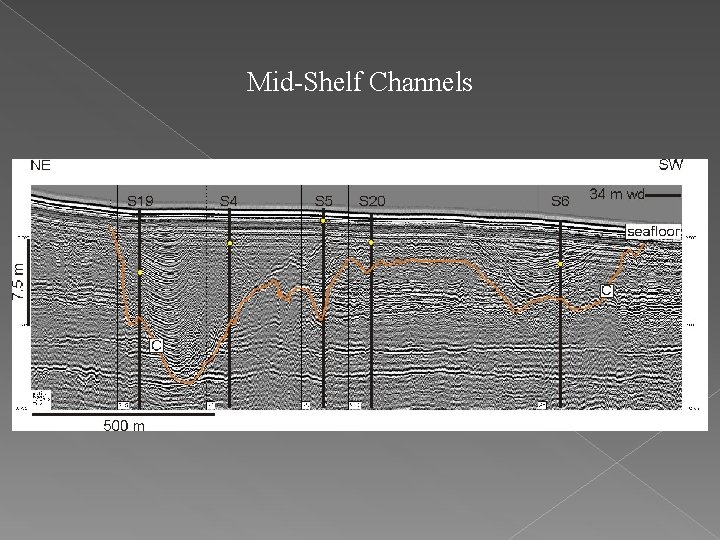
Mid-Shelf Channels

Methods • 2007 Vibracoring Expedition Offshore New Jersey • Spot Sampled Cores at Lamont Doherty Earth Observatory Core Repository • Grain Size Analysis via Pipette Method • Calculate Percentage of Sand, Silt, Clay • Sedigraph Fine Fraction

Spot Sampling First 30+ cms of Core S 6 Uniform equally interval sampling

Grain Size Analysis: Pipette Method Wash ~20 -30 grams of sediment thru a #230 sieve into a 1000 ml funnel. Remaining material in sieve is coarse fraction. Pipette out 25 ml of slurry 10 cm within the column. (silt/clay content) After 2 hrs 3 mins repeat pipette step to obtain clay content. Samples are placed into pre-weighted weighing dishes and placed in the oven to dry
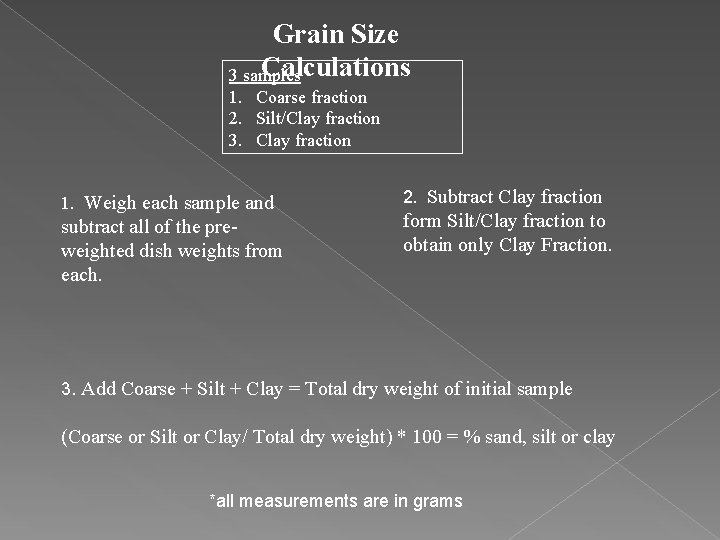
Grain Size Calculations 3 samples 1. Coarse fraction 2. Silt/Clay fraction 3. Clay fraction 1. Weigh each sample and subtract all of the preweighted dish weights from each. 2. Subtract Clay fraction form Silt/Clay fraction to obtain only Clay Fraction. 3. Add Coarse + Silt + Clay = Total dry weight of initial sample (Coarse or Silt or Clay/ Total dry weight) * 100 = % sand, silt or clay *all measurements are in grams
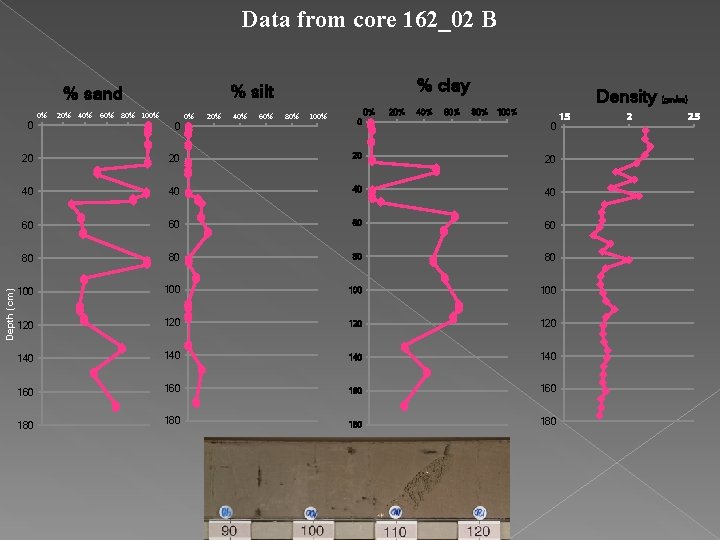
Data from core 162_02 B Depth (cm) 0 0% % clay % silt % sand 20% 40% 60% 80% 100% 0 0% 20% 40% 60% 80% 100% 0% 20% 40% 60% Density (gm/cc) 80% 100% 0 0 20 20 40 40 60 60 80 80 100 100 120 120 140 140 160 160 180 180 1. 5 2 2. 5
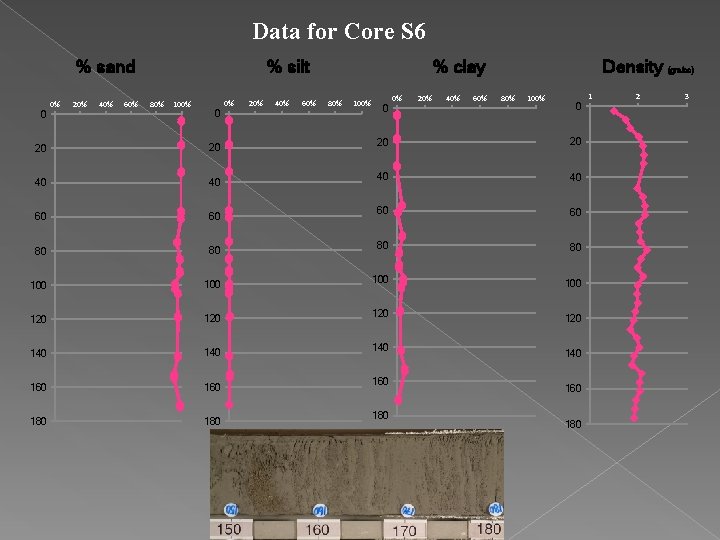
Data for Core S 6 % sand 0 0% 20% 40% 60% % silt 80% 100% 0 20 20 40 40 60 60 80 80 100 120 140 160 180 0% 20% 40% 60% % clay 80% 100% 0 0% 20% 40% 60% Density (gm/cc) 80% 100% 0 20 20 40 40 60 60 80 80 100 120 140 160 180 1 2 3

Results and Interpretation Based on grain size analysis, as well density log data, it is apparent that S 6 core is sandier than core 162_02 B. We suggest the sediment from S 6 was deposited in a higher energy environment than that of the sediment in the core 162_02 B. Core S 6 shows cyclic layering. Some of the cycles are marked by erosive bases. S 6
Future Works • Continued Sampling of S-Series Cores • Sedigraph all Fine Fraction with > 20% clay • Foraminiferal Assemblages • Bulk Carbon Dating • Possible heavy mineral separation • Possible analog x-ray of cores to expose sedimentary structures • Down Core Comparison of S-Series Cores with 162_02 Cores as well as AHC 800 series Cores from 2002 cruise.

Thanks for you support UTIG! Questions? . . .
- Slides: 15