
Sedimentary Rocks Earth Science Sedimentary Rocks Sediments pieces
- Slides: 25
Sedimentary Rocks Earth Science
Sedimentary Rocks • Sediments – pieces of solid material that have been deposited on Earth’s surface by wind, water, ice, gravity, or chemical precipitation. • When sediments become cemented together, they form sedimentary rocks • The formation of sedimentary rocks begins when weathering and erosion produce sediments
Sedimentary Rocks • Weathering – Chemical weathering occurs when the minerals in a rock are dissolved or otherwise chemically changed. – Physical weathering occurs when fragments simply break off the solid rock along fractures or grain boundaries. During physical weathering, minerals remain chemically unchanged
Sedimentary Rocks • Weathering – Weathering produces rock and mineral fragments known as clastic sediments. – Clastic sediments range in size from huge boulders to microscopic particles. – Clastic sediments usually have worn surfaces and rounded corners caused by physical abrasion during erosion and transport.
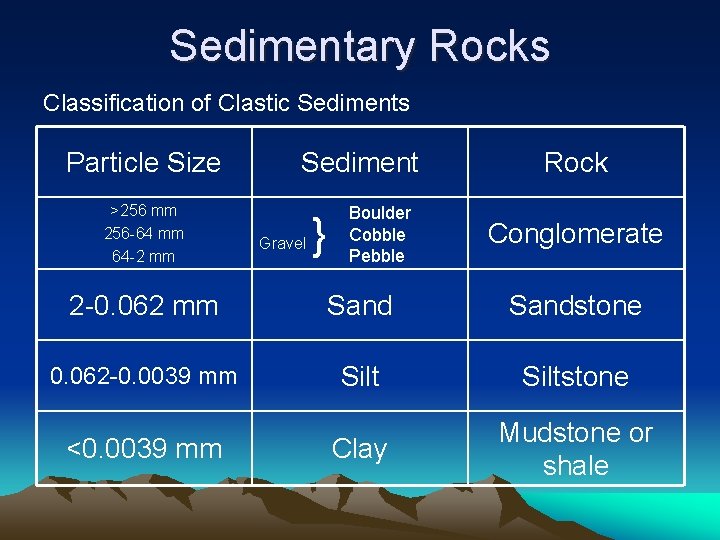
Sedimentary Rocks Classification of Clastic Sediments Particle Size >256 mm 256 -64 mm 64 -2 mm Sediment Gravel } Boulder Cobble Pebble Rock Conglomerate 2 -0. 062 mm Sandstone 0. 062 -0. 0039 mm Siltstone Clay Mudstone or shale <0. 0039 mm
Sedimentary Rocks • Erosion and Transport – Erosion - the removal and movement of surface materials from one location to another. – Four main agents of erosion: wind, moving water, gravity, and glaciers. – Eroded materials are almost always carried downhill
Sedimentary Rocks • Erosion and Transport – Deposition – when sediments are laid down on the ground or sink to the bottoms of bodies of water – Sediments in wind and water tend to form layers when deposited – largest particles at the bottom – Glaciers and landslides, however, move all materials with equal ease
Sedimentary Rocks • Burial – Most sediments are ultimately deposited on Earth in depressions called sedimentary basins – Some sedimentary basins can contain layers of sediment over 8 km thick – As more sediment is deposited in that area, the bottom layers are subject to increasing pressure and temperature
Sedimentary Rocks • Lithification – The increasing temperature and pressure cause lithification. – Lithification is the physical and chemical processes that form sediments into sedimentary rocks.
Sedimentary Rocks • Lithification – Begins with compaction. The weight of overlying sediments forces the sediment grains closer together. – For example: water is squeezed out of layers of compacted mud. – Some sediments, such as sand, resist lithification due to it being well-compacted during deposition
Sedimentary Rocks • Cementation – Sediments that are buried 3 -4 km deep experience temperatures that are high enough to start the chemical changes that cause cementation. – Cementation occurs when mineral growth cements sediments together into solid rock.
Sedimentary Rocks • Cementation – Two common types of cementation: • First type occurs when a new mineral grows between sediment grains as dissolved minerals precipitate out of groundwater. (Calcite growing between quartz grains) • Second type occurs when existing mineral grains grow larger as more of the same mineral precipitates from groundwater and crystallizes around them. (quartz crystallizing around quartz grains)
Sedimentary Rocks • Features – Bedding – the horizontal layering of sedimentary rocks • Bedding can range from a millimeter-thick layer of shale to a sandstone deposit several meters thick • The type of bedding depends on the method of transport.
Sedimentary Rocks • Features – Graded Bedding • Bedding in which the particle sizes become progressively heavier and coarser towards the bottom layers • Often observed in marine sedimentary rocks that were deposited by underwater landslides
Sedimentary Rocks • Features – Cross-bedding • Formed as inclined layers of sediment move forward across a horizontal surface. • Small-scale cross-bedding can be observed at sandy beaches and along sandbars in streams and rivers. • Most large-scale cross-bedding is formed by migrating sand dunes
Sedimentary Rocks • Evidence of past life – Fossils are the preserved remains, impressions, or any other evidence of onceliving organisms. – When an organism dies, it may be buried before it decomposes – If its remains are further buried without being disturbed, it might be preserved as a fossil.
Types of Sedimentary Rocks • Classification of sedimentary rocks depends on how they were formed. • Three main types: clastic, organic, and chemical
Types of Sedimentary Rocks • Clastic sedimentary rocks – The most common type of sedimentary rock – Formed from the abundant deposits of loose sediments found on Earth’s surface – Clastic sedimentary rocks are further classified according to the sizes of their particles.
Types of Sedimentary Rocks • Coarse-grained clastics – Sedimentary rocks consisting of gravel-sized rock and mineral fragments • Conglomerates – coarse-grained sedimentary rocks that have rounded particles – Gravel is transported by high-energy flows of water. – During transport, gravel becomes abraded and rounded as the particles scrape against one another
Types of Sedimentary Rocks • Breccias – Coarse-grained sedimentary rocks that have angular particles – The sediments from which they formed did not have time to become rounded. – This suggests that the particles were transported only a short distance and deposited close to their source.
Types of Sedimentary Rocks • Medium-grained clastics – Sedimentary rocks that contain sand-sized rock and mineral fragments – When medium-sized sediments are buried and lithified, sandstone is formed. – Sandstone has relatively high porosity – the percentage of open spaces between grains in a rock – Sandstone often holds underground oil, natural gas, or groundwater deposits due to its high porosity.
Types of Sedimentary Rocks • Fine-grained clastics – Sedimentary rocks consisting of silt and mud – Siltstone, mudstone, and shale – Siltstone is mostly composed of silt-sized grains – Shale is mostly composed of silt and claysized particles – Shale has very low porosity – it usually hinders the movement of underwater liquids.
Types of Sedimentary Rocks • Chemical sedimentary rocks – During chemical weathering, minerals can be dissolved and carried into lakes and oceans. – As water evaporates, the minerals are left behind.
Types of Sedimentary Rocks – Also, when the concentration of dissolved minerals in a body of water reaches saturation, crystal grains precipitate out of solution and settle to the bottom – The layers of chemical sedimentary rocks that form as a result of this process are called evaporites – The three most common evaporites are calcite, halite, and gypsum
Types of Sedimentary Rocks • Organic sedimentary rocks – Formed from the remains of once-living things – The most abundant organic sedimentary rock is limestone. • Formed from the shells of ancient shell fish – Coal is also an organic sedimentary rock • Formed from the remains of ancient plants